Korean Humidifiers: Buy the One That Comes Apart
Every English guide to buying a humidifier sorts the field the same way: ultrasonic, evaporative, or warm mist. Pick your type, pick your tank size, done.
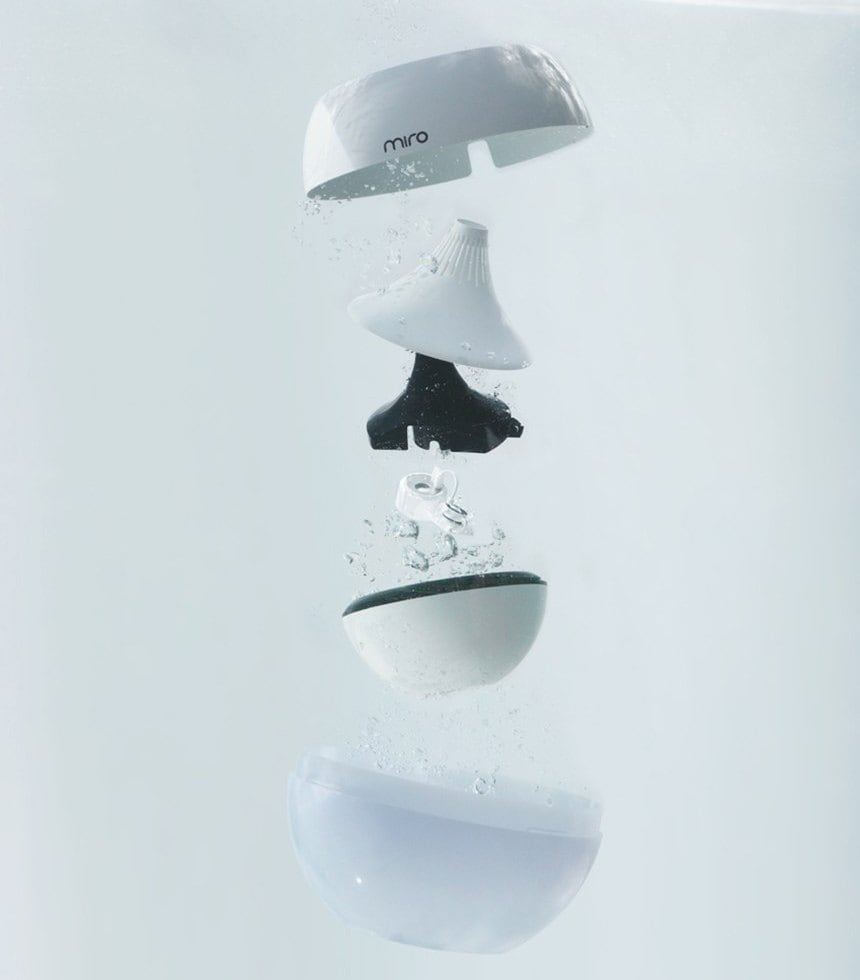
Korean buyers do not start there. Walk through the humidifier aisle of a Korean electronics store and the word printed largest on the boxes is not a capacity or a technology. It is 완벽세척 — perfect cleaning — and next to it, a photograph of the machine pulled apart into six separate pieces.
That is the Korean market's answer to a question the English guides mostly skip: not how the machine makes mist, but whether you can reach every surface the water touches. Once you know that is the question, the buying decision changes, the cleaning routine changes, and — if you are shopping from outside Korea — you find out that what Amazon lists is not what Korea is actually buying.
Quick Guide
| Question | Short answer |
|---|---|
| What do Korean buyers check first? | 완벽세척 — whether every wet part separates for washing |
| Why it matters | An ultrasonic humidifier has no sterilising step; what is in the tank leaves with the mist |
| The measured rule | Daily water change cuts bacteria 87.3%; washing every 2 days, 98.8% |
| Target humidity | 40–60%, the range Korean makers print on the box |
| Three types | 초음파식 ultrasonic · 가열식 heated · 복합식 hybrid, now the Korean flagship |
| White dust | Tap-water minerals, ultrasonic only. Not a fault — a consequence of cold misting |
| Price in Korea | ₩44,900 for a 4L basic; ₩249,000–279,000 for a 10–11L hybrid with UV |
| Buying abroad | As of late September 2026 the in-stock Miro listings on Amazon US are the NR MAX and the stainless-bowl MH7000; the NR07/NR08 listings show as unavailable, and the hybrid miro-twin line is not listed |
Miro NR MAX — the fully washable Korean humidifierAffiliate link. As an Amazon Associate, EpicKor earns from qualifying purchases at no extra cost to you.
The problem the design is solving
An ultrasonic humidifier works by vibrating a small metal disc thousands of times a second until the water above it breaks into a cold spray. It is silent, it is cheap to run, and it has one structural property that matters more than any of its features: nothing between the tank and your lungs filters or heats the water.
Whatever is living in that tank comes out with the mist.
This is not a hypothetical. The 한국소비자원 (Korea Consumer Agency) ran a safety survey of harmful micro-organisms inside humidifiers and found the highest microbial counts in the ultrasonic type — the very type most households own, because it is the quiet, affordable one.
That single fact explains the shape of the Korean humidifier market. If the machine cannot sterilise the water, the only remaining defence is that the owner can actually clean it. And on most humidifiers, you cannot. The tank has a narrow neck. The mist channel is a sealed tunnel. The vibrating element sits in a well you can wipe with a cotton bud at best.
Korean makers took that as the design brief.
What 완벽세척 means in parts
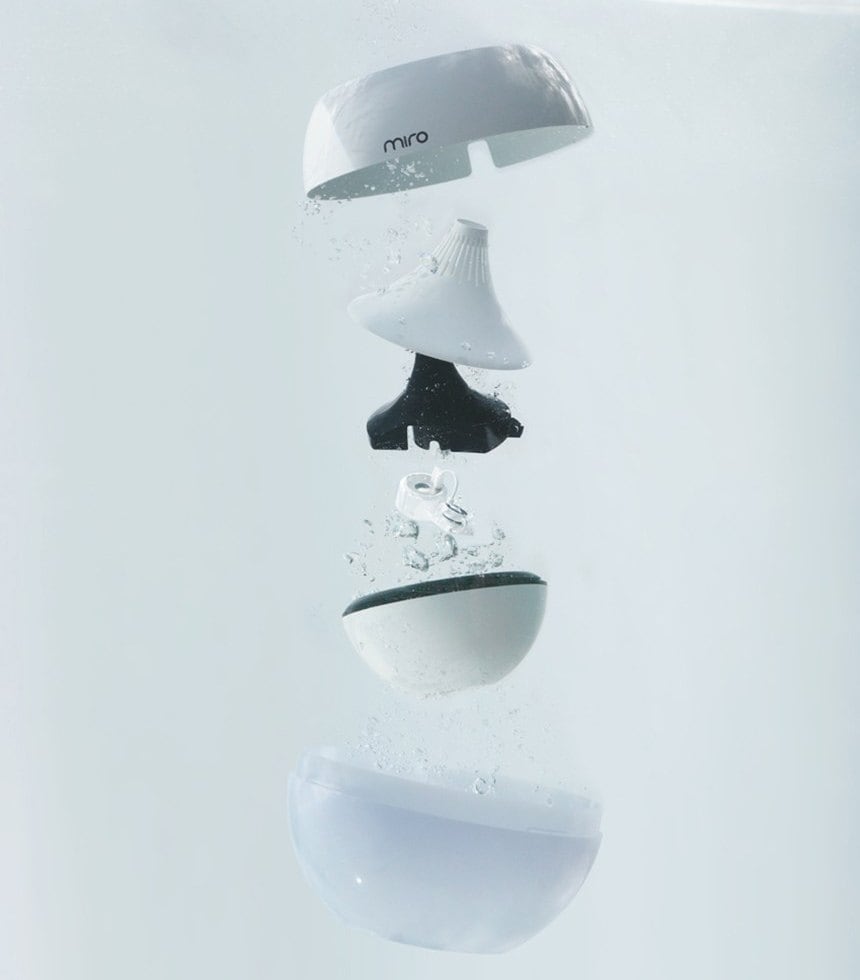
Look again at the photograph at the top of this article. That is not an exploded diagram — it is a real product, shot underwater, in six pieces:
- the outer cap
- the mist nozzle
- the inner fan housing
- the 가습엔진 (humidifying engine) — the transducer module itself
- the tank bowl
- the base bowl
MIRO (미로), the Korean maker whose product this is, claims theirs was the first in Korea to make the humidifying engine itself washable — that is the company's own claim, and it is the part worth understanding. On a conventional humidifier the engine is the one component you are told never to submerge. Here it is photographed underwater, on purpose, as the headline selling point.
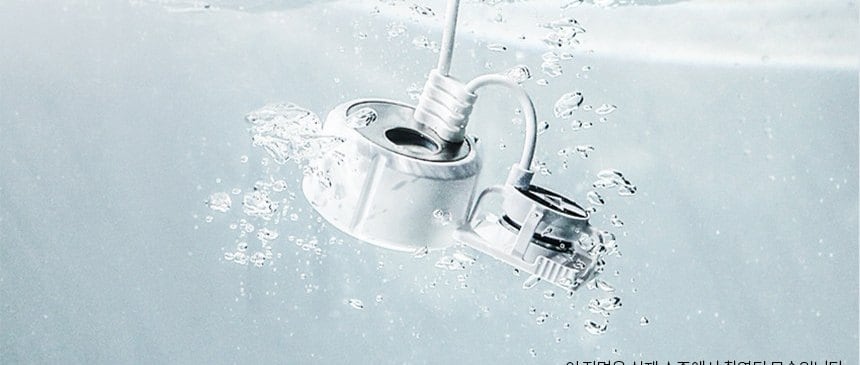
The rest of the specification follows from the same idea. The company lists the separated parts as dishwasher-safe (식기세척 사용가능), uses a magnetic connector so the engine detaches without a plug to line up, and says its newer generation halved the part count — because the point of a modular design is lost if reassembly is a puzzle.
The unglamorous numbers are unglamorous in a good way: 18.1–22dB noise, 24–36W power draw, 4,000–5,000cc tanks across the mid-range. This is a quiet appliance that runs all night in a bedroom, which is exactly the use case that makes tank hygiene matter.
The rule Korea actually measured
Here is the part no English humidifier guide will give you, because it comes from a Korean government consumer-testing body rather than a product review.
The same 한국소비자원 survey quantified what maintenance is worth:
- Change the water every day → bacteria down 87.3%
- Change the water daily and wash the unit every second day → down 98.8%
Two things follow from those numbers, and they point in different directions from the usual advice.
First, the water change does most of the work. Nearly seven-eighths of the benefit comes from an act that takes fifteen seconds. If you do nothing else, do that.
Second, the last stretch is where the machine's design decides the outcome. Getting from 87.3% to 98.8% requires physically washing the unit every other day. On a humidifier that comes apart into six pieces and goes in the dishwasher, that is a small chore. On one you cannot open, it is not a chore — it is impossible, and you simply live at 87.3%.
That gap is what Korean buyers are paying for. Not a technology — a maintenance ceiling.
The agency's own cleaning method is equally specific: dissolve baking soda, vinegar or salt in water, scrub the tank and the mist outlet with a brush, and then dry it completely. The drying step is the one people skip and the one that matters, because a sealed wet tank is the incubator.
The three methods, and what each does to the water
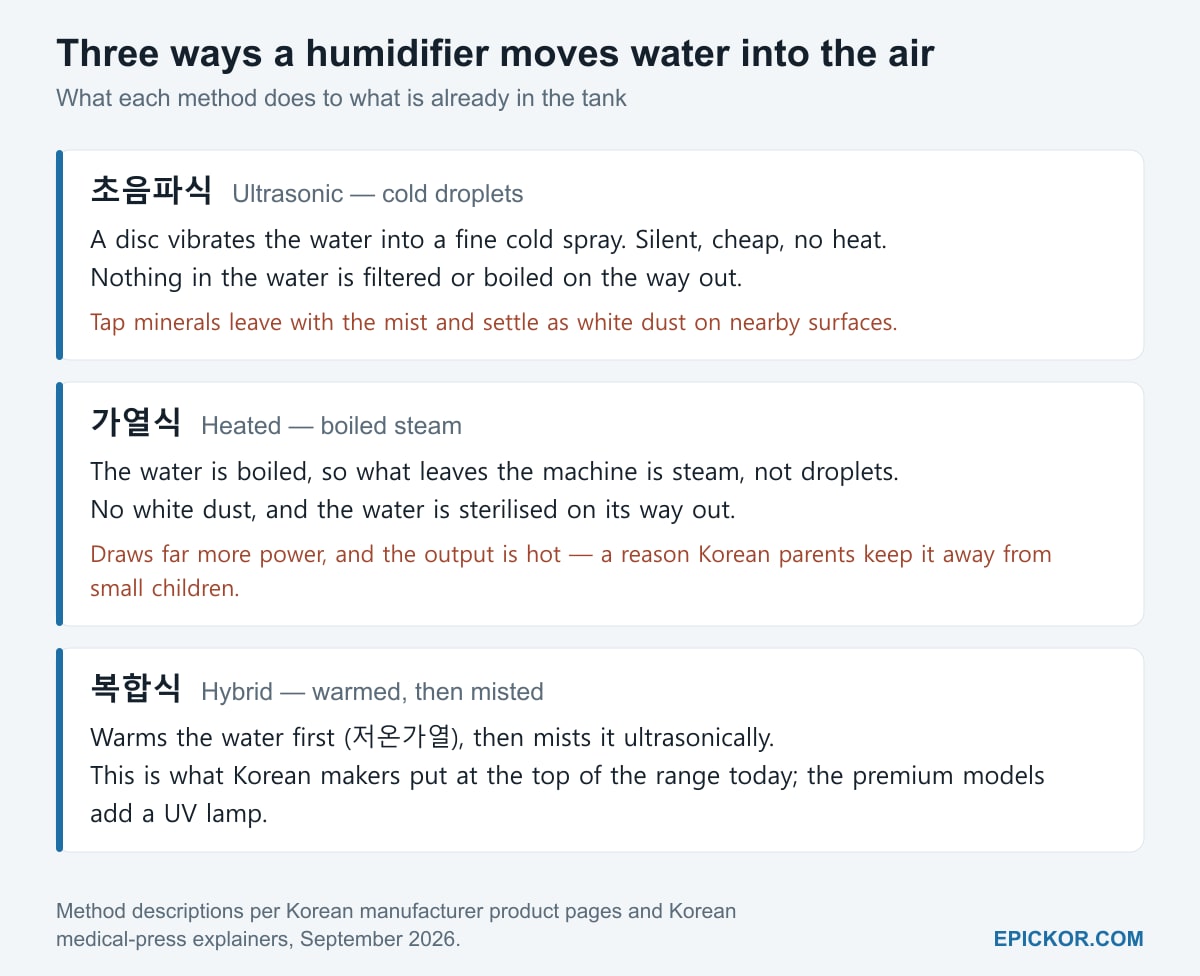
초음파식 (ultrasonic) sprays liquid droplets. Cheap, silent, cold. No sterilising step.
가열식 (heated) boils the water first, so what leaves the machine is vapour. No white dust, and the water is effectively sterilised on the way out. The trade-offs are real: much higher power draw, and hot output, which is why Korean parents of small children weigh this one carefully.
복합식 (hybrid) warms the water at low temperature (저온가열) and then mists it ultrasonically. This is where the Korean market has landed at the top of the range, and premium models add a UV lamp in the tank.
About that white dust
If you have used an ultrasonic humidifier and found a fine white film on the furniture nearby, that is not the machine failing. Ultrasonic misting sprays actual water droplets, minerals included; when the droplet evaporates in the air, the dissolved minerals from your tap water are left behind and settle.
The obvious fix — use purified water — carries a catch that Korean guidance is blunt about: filtered water also has the chlorine removed, and chlorine was suppressing bacterial growth in your tank. Purified water gives you a cleaner shelf and a dirtier tank. If you go that route, the every-second-day washing stops being optional.
This is the same winter air problem seen from the other side, and Korean homes usually run a second machine against it — an air purifier — for months at a time.
What Miro actually sells in Korea right now
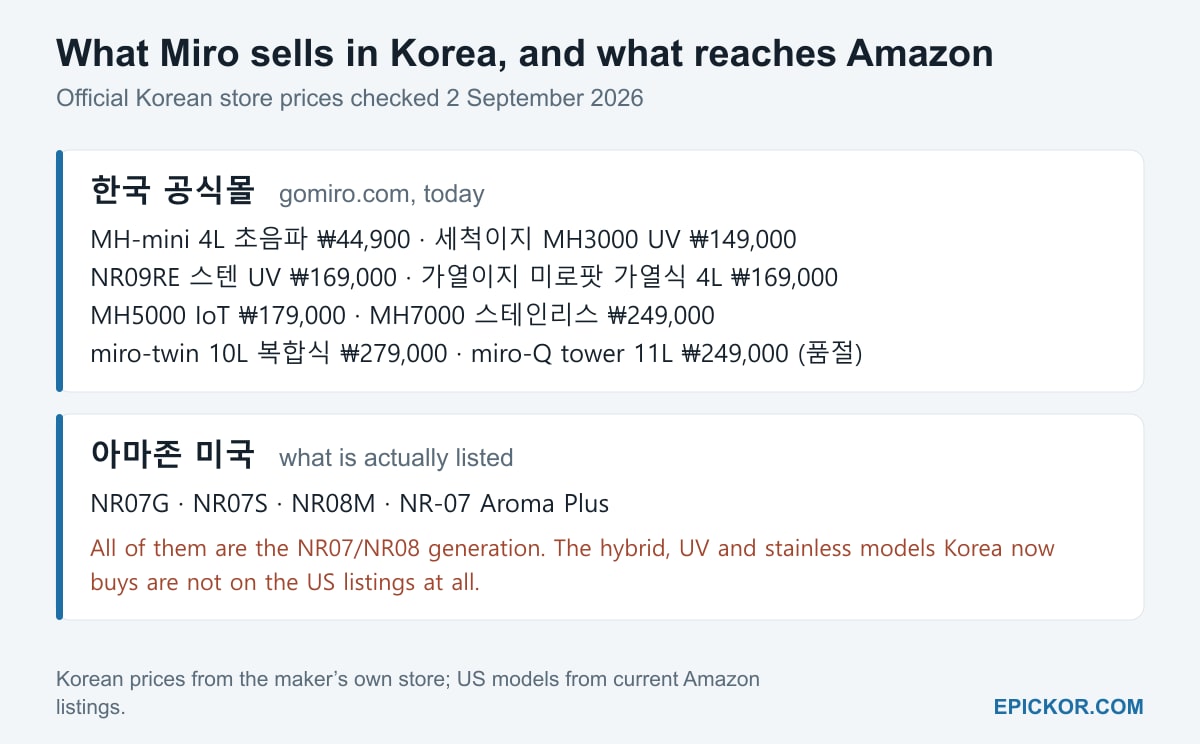
Prices from the company's official Korean store, as of 2 September 2026:
- MH-mini 4L ultrasonic — ₩44,900
- 세척이지 MH3000 UV — ₩149,000
- NR09RE stainless, UV — ₩169,000
- 가열이지 미로팟 heated, 4L — ₩169,000
- MH5000 IoT — ₩179,000
- MH7000 stainless, premium — ₩249,000
- miro-twin 10L hybrid, IoT — ₩279,000
- miro-Q tower 11L hybrid — ₩249,000 (sold out at time of writing)
Read that list as a map of the market. The entry point is ₩44,900 — genuinely cheap, and it is still a washable design. The middle is ₩149,000–179,000, where UV sterilisation and app control appear. The top is ₩249,000–279,000, and what the extra money buys is capacity plus the hybrid warming stage.
The 40–60% humidity target the makers print on these boxes is the practical setting to aim for; the models with humidity sensors are automating a number you could hit manually with a ₩10,000 hygrometer.
What reaches Amazon is a generation behind
This is the part worth knowing before you order.
For years the Miro models listed on Amazon in the US were NR07G, NR07S, NR08M and NR-07 "Aroma Plus" — the NR07/NR08 generation, the design that made the company's reputation, with the full modular teardown. Checked in late September 2026, the NR07S and NR08M listings show as currently unavailable, and the in-stock Miro listings are the NR MAX (a 1-gallon bowl with a humidity sensor) and the MH7000 (a stainless, dishwasher-safe bowl with a UV module) — both still built around the same take-apart design.
But the hybrid miro-twin line and the 저온가열 warming stage — the things Korea is buying in 2026 — are not on the US listings at all.
That is not a scandal; it is how export catalogues work. It does mean two specific things for a buyer abroad:
- You are choosing from part of the Korean range, not all of it. Comparing NR MAX against MH7000 is a real choice. Comparing either against Korea's hybrid flagship is not a choice you have.
- The feature you came for is the teardown, and the models on sale have it. If washability is why you wanted a Korean humidifier, the models available to you deliver exactly that.
If you are ordering from outside Korea, the choice narrows to two questions. As an Amazon Associate, EpicKor earns from qualifying purchases at no extra cost to you. First, does every wet part separate — the Miro NR MAX and the stainless-bowl MH7000 are the washable Miro models in stock for US addresses. Second, how hard is your tap water — because that decides whether the white dust above will bother you. Compare on the teardown before you compare on tank size.
See the Miro MH7000 on AmazonWinix: the Korean brand you may already own
There is a decent chance a Korean appliance is already in your house without your knowing it was Korean.
위닉스 (Winix) was founded in 1973 and is headquartered in Siheung, Gyeonggi Province. In the US it is known almost entirely for air purifiers — the ones stacked at Costco — but its actual product line covers air purifiers, dehumidifiers, humidifiers, dryers, washing machines and water purifiers, and it distributes through Amazon, Costco and Home Depot.
Its two humidifiers take opposite approaches to the problem above:
- L500 — ultrasonic, 7.5L tank, about 400ml per hour, rated for rooms up to roughly 50m². Big tank, cold mist, and everything in the ultrasonic column applies.
- AW600 — evaporative, not ultrasonic. A fan draws air through a wet wick, so the water evaporates rather than being sprayed. No white dust at all, because the minerals stay in the wick instead of going into the air. It also runs three-stage air purification with PlasmaWave.
Evaporative is the quiet third answer to the mineral problem, and it is worth knowing it exists before you decide the choice is only ultrasonic versus boiling.
If you are weighing the same brand for the other half of the winter air problem, our comparison of Coway and Winix as air purifiers covers how the two Korean makers differ on filters, running cost and room size.
Winix also sits inside a bigger Korean story about how appliances got into homes in the first place — our guide to the 1998 rental bet that built Coway's empire explains the monthly-fee model that put a machine in nearly every Korean apartment, and why so many Korean appliance categories are shaped by it.
How Koreans actually clean one
The routine that circulates in Korean households, which matches the consumer agency's method:
- Empty and refill daily. Never top up on top of yesterday's water. This is the 87.3% step.
- Every second day, take it apart and wash it. Baking soda, vinegar or salt dissolved in water; a brush on the tank and the mist outlet.
- Dry it completely before reassembling. Air-dry the parts separately. A sealed damp tank undoes everything above.
- Descale when you see film. Vinegar dissolves the mineral scale that builds on the transducer, and that scale also cuts mist output.
- Keep it off the floor and away from walls and wooden furniture — the settling mist is why.
Step 2 is the one that is only realistic on a machine designed for it, which is this article's argument restated as a chore list.
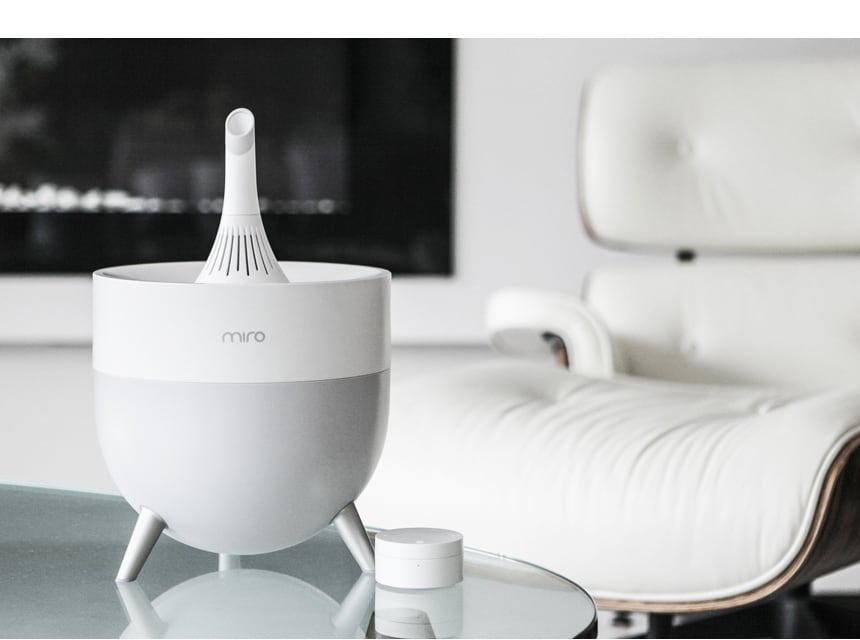
Whatever machine you own, the cleaning kit is the cheap part. As an Amazon Associate, EpicKor earns from qualifying purchases at no extra cost to you. A set of narrow cleaning brushes reaches the mist channel and the tank neck that a cloth cannot, and plain white vinegar handles the mineral scale on the transducer. If the machine you own does not come apart, those two are the difference between wiping the tank and actually cleaning it — and a cheap hygrometer tells you whether you are anywhere near the 40–60% the Korean boxes ask for.
Who should not buy an ultrasonic humidifier
Honest counter-advice, because the Korean design solves one problem and not all of them:
- If your tap water is hard, the white dust is not a maintenance issue you can wash away — it is physics. Go evaporative or heated.
- If nobody in the house will do the every-second-day wash, a heated model that boils the water is doing the sterilising for you, and that is the safer trade even at a higher running cost.
- If small children are around, the hot output of a heated model is a real hazard to plan for, and a hybrid or evaporative unit sidesteps it.
- If you were going to spend ₩250,000 on a flagship and then never open it, buy the ₩44,900 model and actually clean it. The consumer agency's numbers say the cleaning wins, not the price tag.
Korean homes run their heating for months, which is also why Korea has an unusually deep catalogue of winter comfort appliances — from heated mattress pads, water and electric to stone beds that start around ₩3.5 million. The humidifier is the counterweight to all of them.
FAQ About Korean Humidifiers
Q: Are Korean humidifiers actually available outside Korea?
Yes. MIRO (미로) sells on Amazon in the US; in late September 2026 the in-stock listings were the NR MAX and the MH7000, while the older NR07/NR08 listings showed as unavailable. Winix, a Korean company, sells humidifiers through Amazon, Costco and Home Depot. What you cannot get abroad is Korea's hybrid warming generation.
Q: What does 완벽세척 mean on a Korean humidifier box?
Literally "perfect cleaning". It is the claim that every part the water touches separates for washing — including the humidifying engine, which most humidifiers seal in. It is the first thing Korean buyers compare, ahead of tank size or mist output.
Q: How often should I really clean a humidifier?
Korea's consumer agency measured it: changing the water every day cuts bacteria by 87.3%, and adding a wash every second day takes it to 98.8%. The daily water change does most of the work; the every-other-day wash is what separates a machine you can open from one you cannot.
Q: Why does my humidifier leave white dust on the furniture?
You have an ultrasonic model and mineral-bearing tap water. The mist is real droplets, so when they evaporate the minerals stay behind. Purified water reduces it but removes chlorine too, which speeds bacterial growth in the tank. An evaporative or heated humidifier avoids the problem entirely.
Q: Ultrasonic, heated, or hybrid — which should I buy?
If you will clean it every other day, ultrasonic is quiet and cheap. If you will not, buy heated and let boiling do the sterilising for you. Hybrid (복합식) is where Korea's premium market has settled because it warms the water before misting — but it is also the part of the range that does not currently reach Amazon.
Bottom Line
The Korean humidifier market answers a different question from the English buying guides, and it is the better question. Not how does this make mist, but can I reach everything the water touches.
The reason is measurable rather than aesthetic. An ultrasonic humidifier has no sterilising step, Korea's consumer agency found the highest microbial counts in exactly that type, and the difference between a machine you can wash and one you cannot is the difference between 87.3% and 98.8%.
If you are shopping in Korea, ₩44,900 already buys a washable design and ₩249,000–279,000 buys hybrid warming with UV. If you are shopping abroad, you are choosing from the few Miro models Amazon US has in stock — which is fine, because the teardown is the feature, and they have it.
Buy the one that comes apart. Then actually take it apart.
Sources
- 한국소비자원 (Korea Consumer Agency) — 가습기내 유해 미생물 안전실태조사: highest microbial counts found in ultrasonic humidifiers; 87.3% bacterial reduction from daily water changes and 98.8% with washing every second day; cleaning method using baking soda, vinegar or salt.
- MIRO (미로) official product pages and official store (gomiro.com) — modular teardown, the washable humidifying-engine claim, dishwasher-safe parts, magnetic connector, 18.1–22dB noise, 24–36W draw, 4,000–5,000cc tanks, the 40–60% target humidity, and all Korean prices, checked 2 September 2026.
- Winix America and Winix corporate materials — founded 1973, Siheung headquarters, product range and US retail distribution; L500 and AW600 specifications.
- Amazon US listings — the four Miro models currently sold in the United States.
You Might Also Like
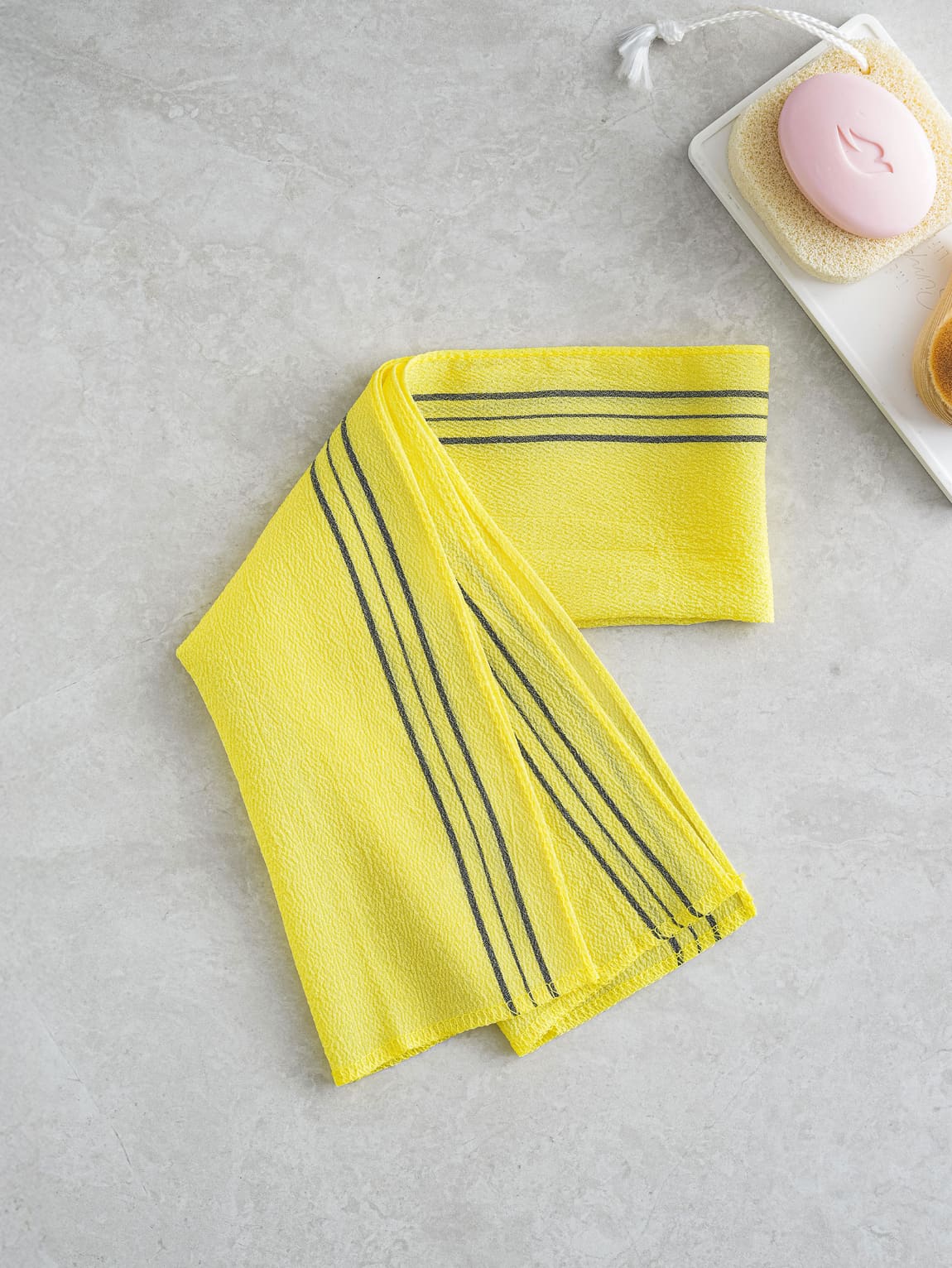
Korean Exfoliating Towels: What the Colours Mean, and How Often to Use One
English listings sell Korean exfoliating towels by a colour code — pink soft, blue coarse, green standard. Korean sources have no such code; green was simply the first one made. The real variable is the soak, and Korean dermatologists cap use at once a week.
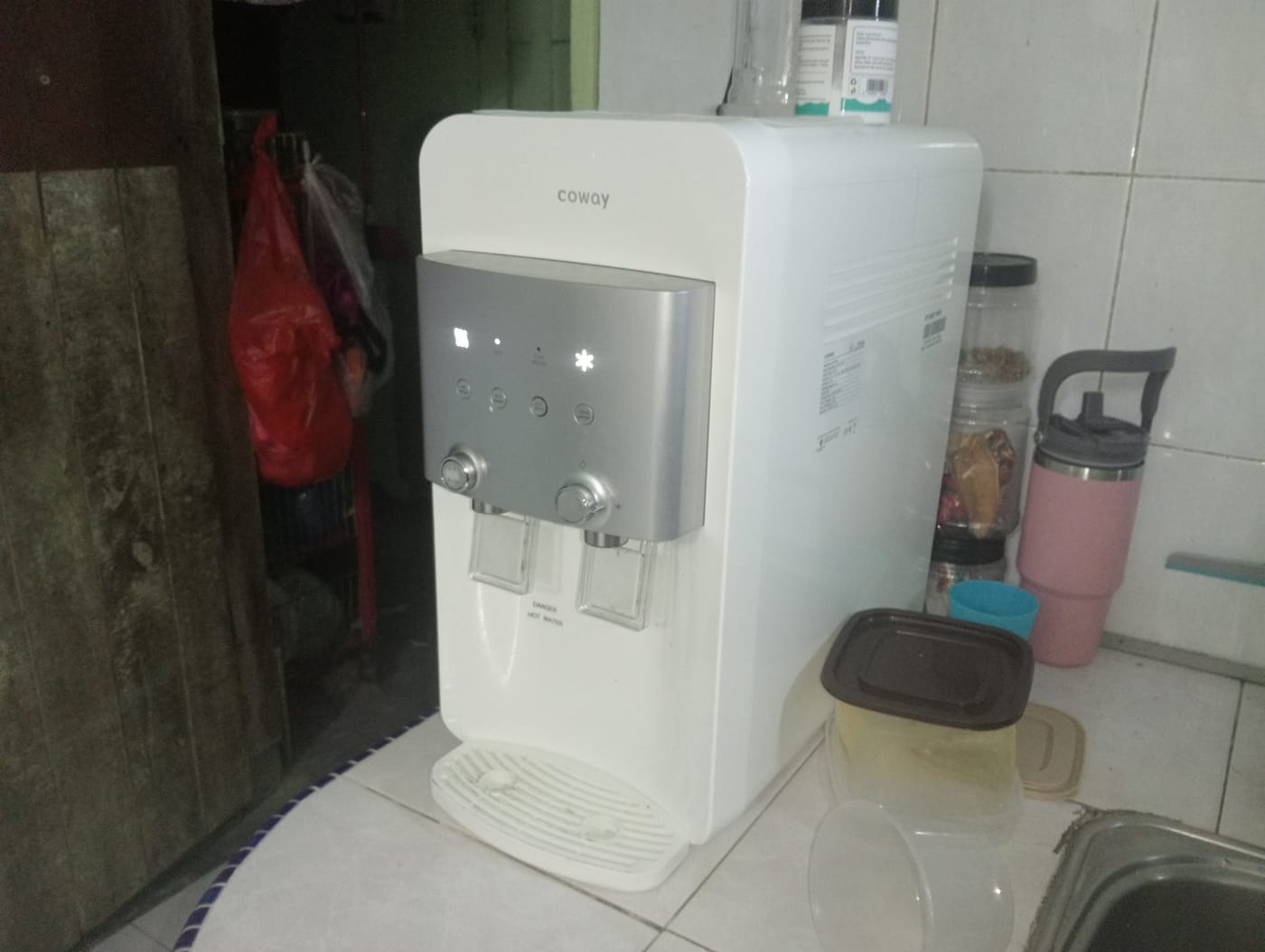
Korean Water Purifiers: The 1998 Rental Bet That Built Coway's Empire
In the worst month of Korea's IMF crisis, a water purifier company started lending machines instead of selling them. That decision built a ₩4 trillion empire, invented Korea's rental economy, and explains half the appliances on this site.
Korean Massage Chairs: How Bodyfriend Made a Recliner the Top Filial Gift
In Korea, the massage chair is a family milestone purchase — the holiday gift for parents, rented by the month like a water purifier. How Bodyfriend beat Japan at its own invention, what the chairs cost in the US, and the child-safety warning no listing shows.