Public Toilets in Korea: 78,183 of Them, and the Law That Decides Which You Can Walk Into
Korea had 78,183 public toilets at the last national count in 2024 — up 9,333 in a single year. That number is not the useful part.
The useful part is that Korean law sorts them into five legal categories, and one of those categories is a private building that the local government has designated as open to the public. In a 개방화장실 (gaebang hwajangsil), you can walk in and use the restroom without being a customer. Not as a favour. As a designation.
Most English guides describe finding a toilet in Korea as a search problem — look for a station, hope for the best. It is closer to a legal problem, and once you know the categories, the map changes.
This guide covers the categories, the exact subway rule that lets you leave the fare gates and come back free, why the stall often has no bin, and what to do when the toilet turns out to be a hole in the floor.
The Quick Answer
| Where | Legal category | Reliability | Cost |
|---|---|---|---|
| Subway station | 공중화장실 | Very high in Seoul, Busan, Daegu | Free |
| Park, riverside, trailhead | 공중화장실 | High, but seasonal closures happen | Free |
| District office, library, community centre | 개방화장실 | High during office hours | Free |
| Designated private building | 개방화장실 | Good — look for the sticker | Free, no purchase needed |
| Department store, mall, station building | Private facility | Very high during opening hours | Free in practice |
| Small cafe, small convenience store | Private facility | Variable — key, code, or purchase | Backup only |
| Highway rest area | 공중화장실 | Very high, 24 hours | Free |
Look for the Korean word 화장실 or the standard pictograms. Seoul's Smart Seoul Map carries a public-toilet layer, which is worth saving before a long riverside walk.
Kleenex On-The-Go pocket packs — on AmazonAffiliate link. As an Amazon Associate, EpicKor earns from qualifying purchases at no extra cost to you.
The Five Categories, and Why 개방화장실 Is the One to Know
The Public Toilets Act (공중화장실 등에 관한 법률) defines five types:
- 공중화장실 — built by government, a local authority, a corporation or an individual for general public use. Stations, parks, rest areas.
- 개방화장실 — a restroom inside another building that has been opened to the public, either because it is a public building or because the mayor, county head or district head designated it.
- 이동화장실 — mobile units for festivals and large events.
- 간이화장실 — small units where a standard facility cannot be built.
- 유료화장실 — paid. This category exists in law, so "all Korean toilets are free" is not quite true, though paid ones are rare in cities.
The one that changes your day is the second. Where a private building's restroom has been designated as 개방화장실 by the district office, the rule is explicit: it is provided even to people who are not using the building. You are not sneaking in and you do not need to buy a coffee first.
These carry a sticker or plate near the entrance, usually with the district's name on it. Once you have seen one you will start noticing them on office lobbies, bank branches, and neighbourhood buildings — and they are often cleaner and quieter than the station toilet across the road.
The honest limit: the designation is per-building and per-district, so coverage is patchy and there is no single national map of them. Treat it as a bonus you can spot, not a system you can plan around.
Kleenex On-The-Go pocket packs, 16 — for the dispenser that just ran out. Korea's restroom network is dense, but markets, trailheads and intercity stops still hand you an empty roll now and then; a strip of these earns its space in every day bag. As an Amazon Associate, EpicKor earns from qualifying purchases at no extra cost to you.
See the pocket packs on AmazonThe Subway Rule That Actually Solves This
Here is the question every visitor eventually has, standing at a fare gate: is the toilet inside or outside?
In Seoul, it is usually inside. Of the 313 stations run by Seoul Metro (excluding Korail-operated sections), 220 — about 70% — have a toilet inside the fare gates. A separate 82% have one outside the platform level. So the default assumption should be "yes, I can get to it after tapping in," not the reverse.
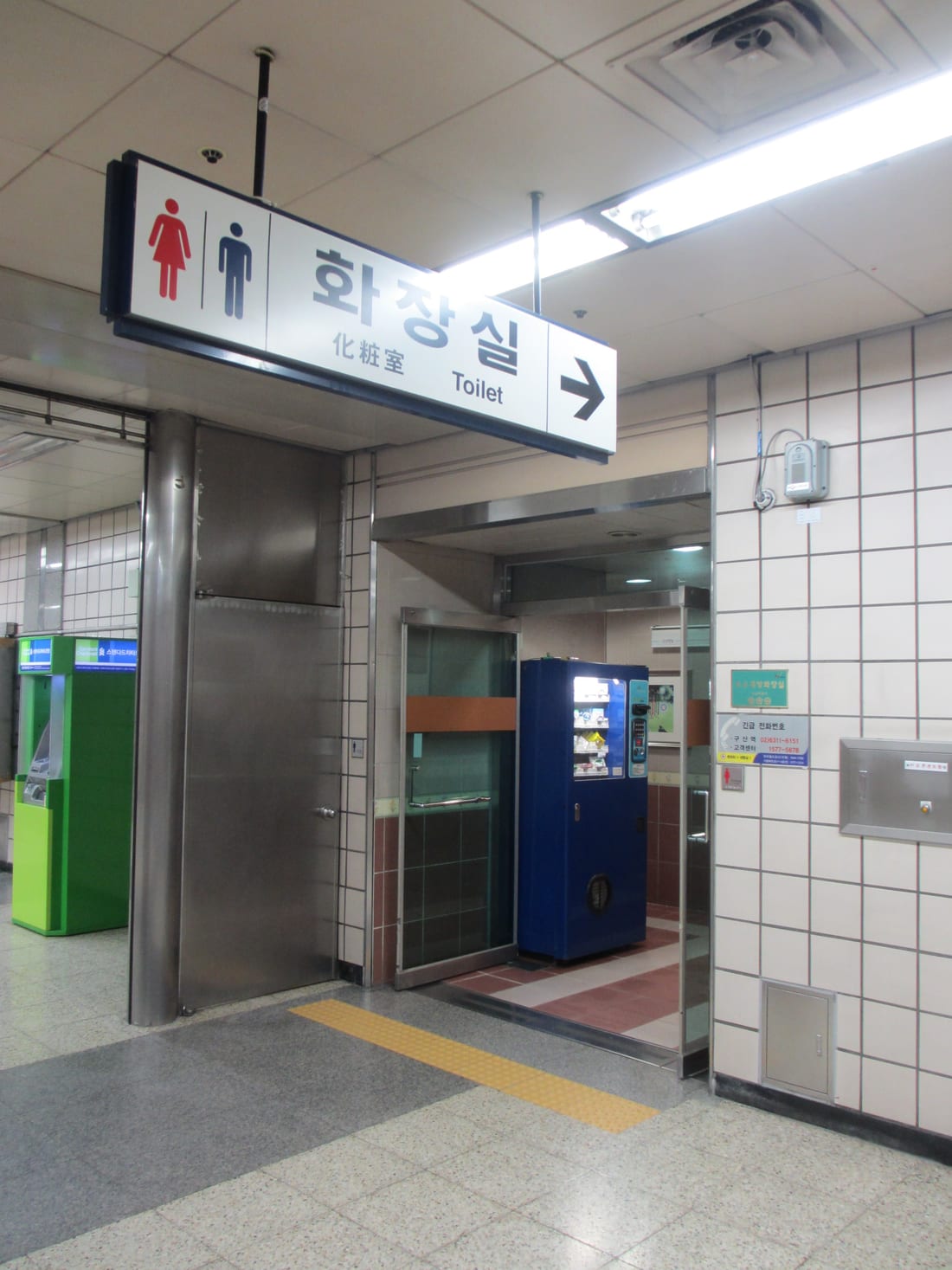
To check a specific station before you travel, use 또타지하철 (Ttota Jihacheol), Seoul Metro's own app. The facilities button at the bottom of the screen has a 게이트 내 화장실 (toilet inside the gate) listing, along with nursing rooms and document kiosks.
And if the toilet is outside the gates, you do not pay twice. Since 1 July 2023, Seoul Metro has run a re-entry rule:
- Tap out, use the toilet, and tap back in within 10 minutes and the fare is waived.
- It must be the same station and the same line.
- Once per subway journey.
- Prepaid or postpaid transit cards only — single-journey tickets and period passes are excluded.
- Exceed 10 minutes and you are charged the base fare again, ₩1,550 as of 2026 (raised from ₩1,400 on 28 June 2025; cash fare ₩1,650).
Coverage is the Seoul Metro network: Lines 2, 5, 8 and 9 in full, Line 1 between Seoul Station and Cheongnyangni (underground sections), Line 3 Jichuk–Ogeum, Line 4 Jinjeop–Namtaeryeong, Line 6 Eungam–Bonghwasan, and Line 7 Jangam–Onsu.
This is the rule that makes the old advice — ask staff before tapping through — mostly unnecessary. Tap out, go, come back.
For the rest of the transit experience, see EpicKor's Seoul subway etiquette guide. If your day includes older districts, the Seoul hanok experience guide sets more realistic accessibility expectations.
Why There Is No Bin: The 2018 Law
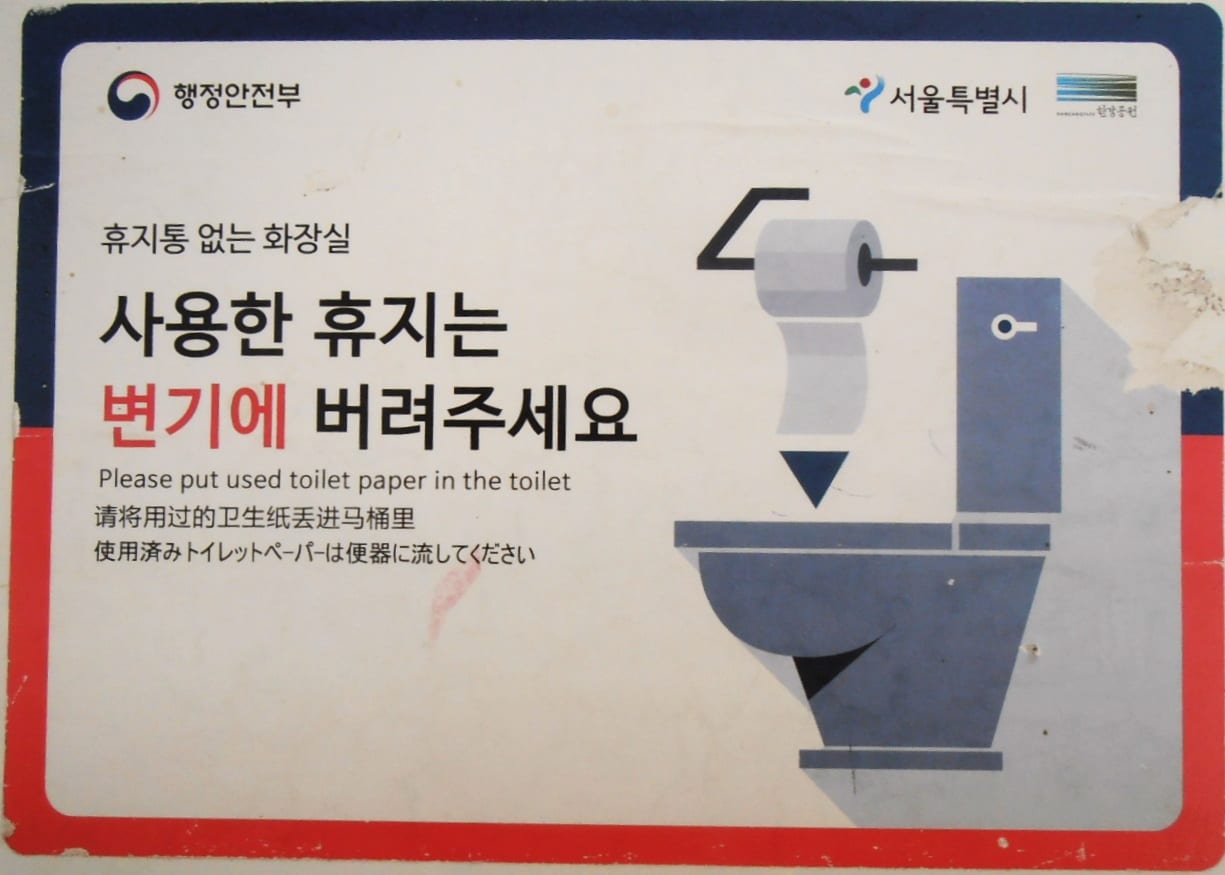
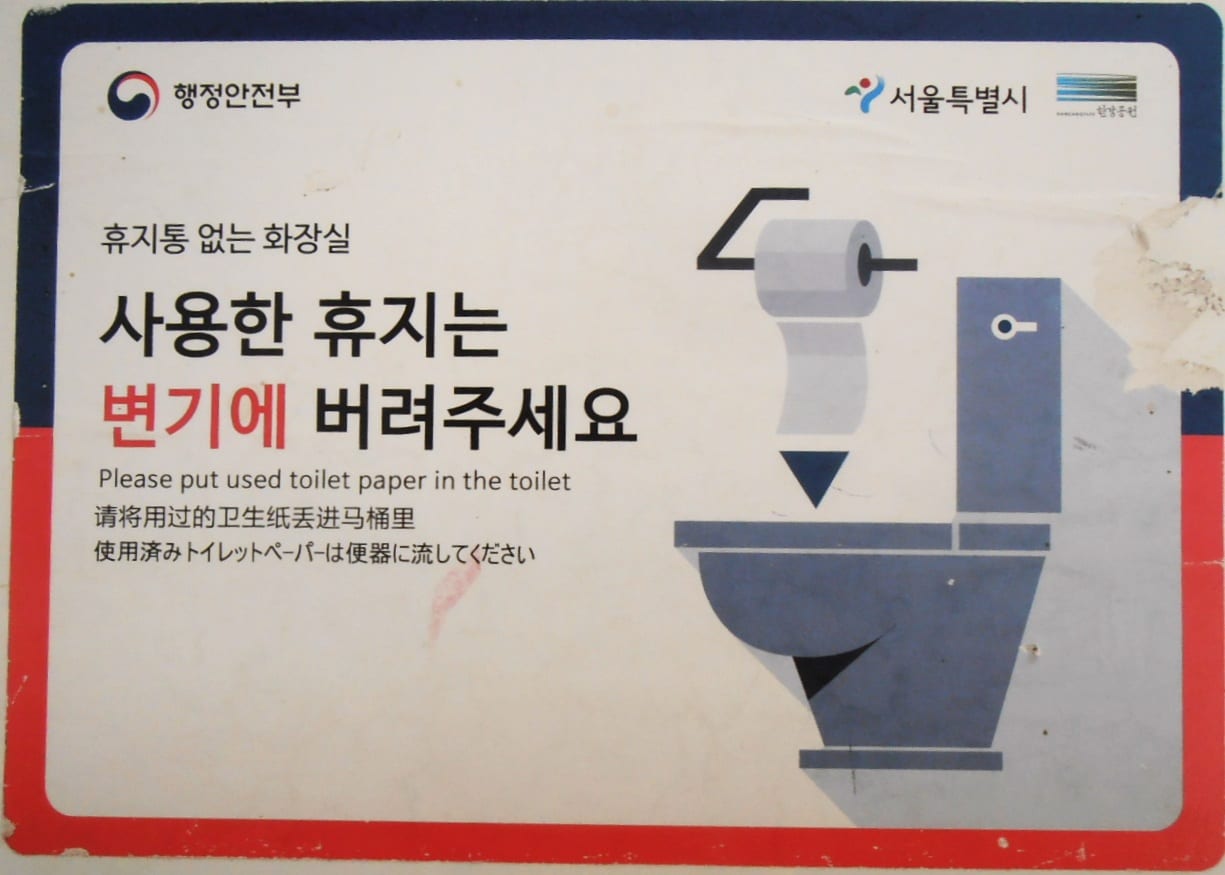
If you have travelled elsewhere in Asia you may have been trained to put paper in a bin. In Korea, do not.
The Ministry of the Interior and Safety amended the enforcement decree of the Public Toilets Act in May 2017, and from 1 January 2018 public toilets were required to be 휴지통 없는 화장실 — bin-free stalls. Used paper goes in the toilet. The change was pushed through ahead of the PyeongChang Winter Olympics to deal with odour and insects.
Two details follow from that, and they explain what you actually see:
- Women's stalls keep one small bin, but it is a 위생용품 수거함 — a sanitary-products bin. Its presence is not an instruction about paper.
- A public toilet that still has a paper bin is out of compliance. The district can issue a correction order, and failure to comply carries a fine of up to ₩1,000,000.
The honest part: enforcement is uneven and always has been. Some facilities — particularly older open-access restrooms in areas with heavy street use — kept their bins. If a stall has a bin and a sign telling you to use it, follow the sign in front of you. Absent a sign, flush the paper.
Never flush wet wipes, paper towels, sanitary products or nappies, including anything sold as "flushable."
Squat Toilets Still Exist
Most English guides skip this, and it is the thing that actually surprises people.
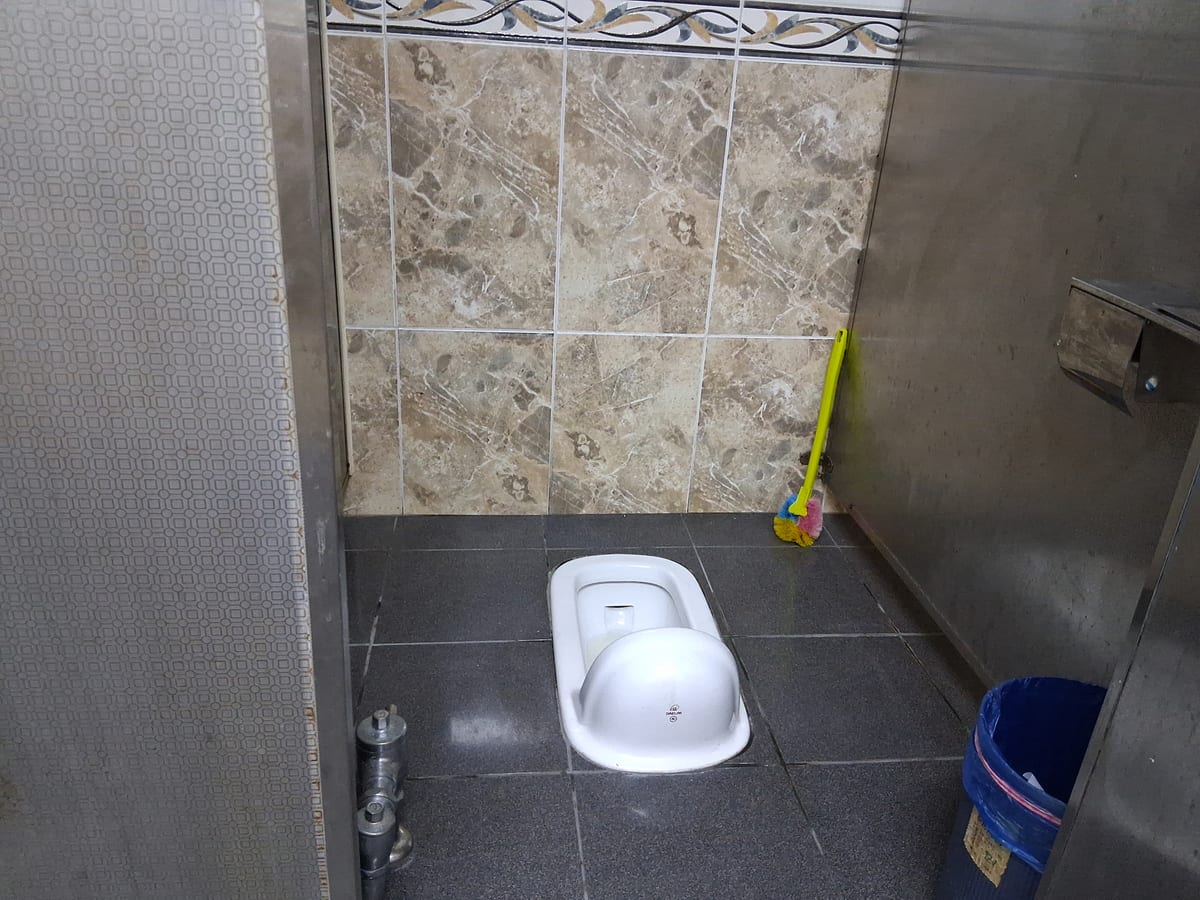
The 화변기 (hwabyeongi), a floor-level squat pan, is being replaced steadily but is far from gone. You will still meet one in older commercial buildings, traditional markets, mountain and park facilities, and — most consistently — in schools, where buildings from the late 1980s and 1990s have often not reached their renovation cycle yet.
Practical handling: face the hood end, not the open end. There may be no paper and no hook. Stalls in a mixed facility usually mark the type on the door, so if there is a choice, you can pick. This is another reason to carry tissues.
Bidet Panels Without the Panic
Electronic seats are common in hotels, newer buildings and malls, but they are not universal and you should not expect one in an ordinary station stall.
Find the stop button before you press anything. It is usually a square icon or the Korean word 정지 (jeongji). The wash functions typically will not fire unless a seat sensor detects someone sitting, so pressing buttons while standing beside the bowl mostly does nothing — but not always.
Two things that catch people out:
- The sound or privacy button plays running-water noise. It does not flush.
- The flush is often not on the panel at all. It may be a wall button, a side lever, a sensor, or a floor pedal.
If the panel itself is the puzzle, EpicKor has a full guide to what every button on a Korean bidet actually does — the eight Korean words, why more than half of Korean homes have one, and which brands you can buy abroad. Look around before assuming the biggest electronic button is it.
Accessibility, Family Rooms and Emergencies
Seoul has been applying universal-design guidance to public restrooms: large pictograms, changing equipment, child facilities, emergency bells, and multilingual guidance.
An accessible symbol does not guarantee a step-free route. Check the lift route from street or platform, the door width, the turning space inside, and whether cleaning equipment is stored in the room. Multi-purpose rooms may be signed for wheelchair users, parents, ostomy users or others — use them accordingly and do not occupy one as a changing room.
Emergency bells are for safety and medical incidents. In a real emergency call 112 for police or 119 for fire and ambulance. The 1330 Korea Travel Hotline handles tourist information and interpretation.
| Situation | Do this | Not this |
|---|---|---|
| Toilet is outside the fare gates | Tap out, return within 10 minutes, same station and line | Paying a second base fare |
| No visible flush | Check wall, side lever, sensor, floor pedal | Pressing every bidet button |
| Small bin in the stall | Read the sign; default is flush the paper | Assuming paper goes in the bin |
| Stall is a squat pan | Face the hood; check for paper first | Backing in |
| Need a toilet in a business district | Look for a 개방화장실 plate on an office lobby | Buying a coffee you do not want |
| Facility looks closed or unlit | Move to a staffed public building | Entering a dark restricted area |
Safety and Privacy
Korea has invested heavily in anti-illegal-camera inspection, emergency systems and facility standards, and the Ministry publishes an inspection manual for local governments. Use ordinary judgement anyway: prefer a busy, maintained facility, and do not enter a closed building because a map listed a toilet in it.
If you notice suspicious damage, an object that looks out of place, or harassment, leave and report it to station staff, building security or police. Do not touch or dismantle anything yourself.
Day Trips, Highways and Trails
Highway rest areas (휴게소) are Korea's most reliable intercity stop — food, toilets and parking in one place, open around the clock. Bus terminals have facilities but older terminals are slower; allow time. KTX stations are dependable anchors for day trips such as the Jeonju itinerary.
On mountains and riverside paths, distance matters more than quality. Use the trailhead toilet even if you do not need it, because the next one may be an hour away. Seasonal facilities close in winter and during maintenance. Carry tissues and sanitiser, and take waste out with you.
TESSAN Korea plug adapter (220V, Type F) — the other thing the day bag needs if you are coming from the US. Korean public toilets often have no paper and no hand dryer, so the day bag matters more here than in most countries: tissues, a sanitiser bottle, and the adapter that keeps the phone alive. As an Amazon Associate, EpicKor earns from qualifying purchases at no extra cost to you.
See the Korea adapter on AmazonWhat Not to Assume
- Not every convenience store has a customer restroom. Many small branches have none at all.
- Not every stall has paper. Some facilities keep a shared dispenser outside the stalls, near the entrance. Take some on the way in.
- Free is the norm, not the law. 유료화장실 is a real legal category. You will rarely meet one in a city, but "all Korean toilets are free by law" is wrong.
- "Korea has one nationwide rule for every toilet" is too simple. The bin-free policy is national; compliance is not uniform. Read the stall.
- Heated seats are not the system. The reason Korea is easy is the density of stations, parks, rest areas and designated open restrooms — not the electronics.
Sources Checked
- Ministry of the Interior and Safety, understanding the public toilet system for the five legal categories, the 개방화장실 designation, and the rule that designated private restrooms serve non-users of the building.
- Public Toilets Act (공중화장실 등에 관한 법률), National Law Information Center for the statutory definitions including 유료화장실.
- Korea.kr policy briefing on 휴지통 없는 화장실 for the May 2017 decree amendment, the 1 January 2018 start, the sanitary-products bin, and the correction order with a fine of up to ₩1,000,000.
- Seoul Metropolitan Government, subway re-entry rule for the 1 July 2023 start, the 10-minute window, same-station/same-line and once-per-journey conditions, card types, and covered line sections.
- Money Today, metropolitan subway fare increase for the ₩1,400 to ₩1,550 change on 28 June 2025 and the ₩1,650 cash fare.
- Seoul city media hub on the 또타지하철 app for the inside-the-gate toilet feature, and the 313-station / 220-station figures for Seoul Metro.
- Seoul Metropolitan Government, universal design in public restrooms.
Frequently Asked Questions
Q: How many public toilets are there in Korea?
A: 78,183 as of the 2024 national survey, up 9,333 from 68,850 at the end of 2023. They are legally divided into five categories, including 개방화장실 — restrooms inside other buildings that have been designated for public use.
Q: Can I use a restroom in a Korean building without buying anything?
A: If it is a designated 개방화장실, yes. The designation explicitly covers people who are not using the building. Look for a plate or sticker near the entrance, usually carrying the district office's name.
Q: Are subway toilets inside or outside the fare gates in Seoul?
A: Inside, in about 70% of cases — 220 of Seoul Metro's 313 stations. Check a specific station in the 또타지하철 app under the inside-the-gate toilet listing.
Q: What if the toilet is outside the gate and I already tapped in?
A: Tap out and tap back in within 10 minutes at the same station on the same line and the fare is waived. Once per journey, prepaid or postpaid cards only. Over 10 minutes you pay the base fare again — ₩1,550 in 2026.
Q: Can I flush toilet paper in Korea?
A: Yes. Bin-free stalls have been national policy since 1 January 2018, and a public toilet that keeps a paper bin can be ordered to fix it, with a fine of up to ₩1,000,000. The small bin in a women's stall is for sanitary products. Never flush wipes or towels.
Q: Are there still squat toilets in Korea?
A: Yes. The 화변기 persists in older commercial buildings, markets, mountain facilities and many schools. Stall doors usually mark the type, so you can choose when both exist.
Q: Do all Korean toilets have electronic bidets?
A: No. They are common in hotels, malls and newer buildings, but ordinary station and park stalls usually have a plain toilet. The stop button is marked 정지.
Q: What is the Korean word for restroom?
A: 화장실, romanised hwajangsil. Pictograms are standard nationwide, so recognising the word helps but is not essential.
The Rule Worth Remembering
Korea's advantage is not heated seats. It is that toilets are a regulated public category with a legal definition, a national count, an enforcement standard, and a subway network that will let you step out and come back for free.
Assume the station toilet is inside the gates. Flush the paper unless a sign says otherwise. And when you are in a business district with no station nearby, look for the 개방화장실 plate on the office lobby — someone already decided you are allowed in.
You Might Also Like
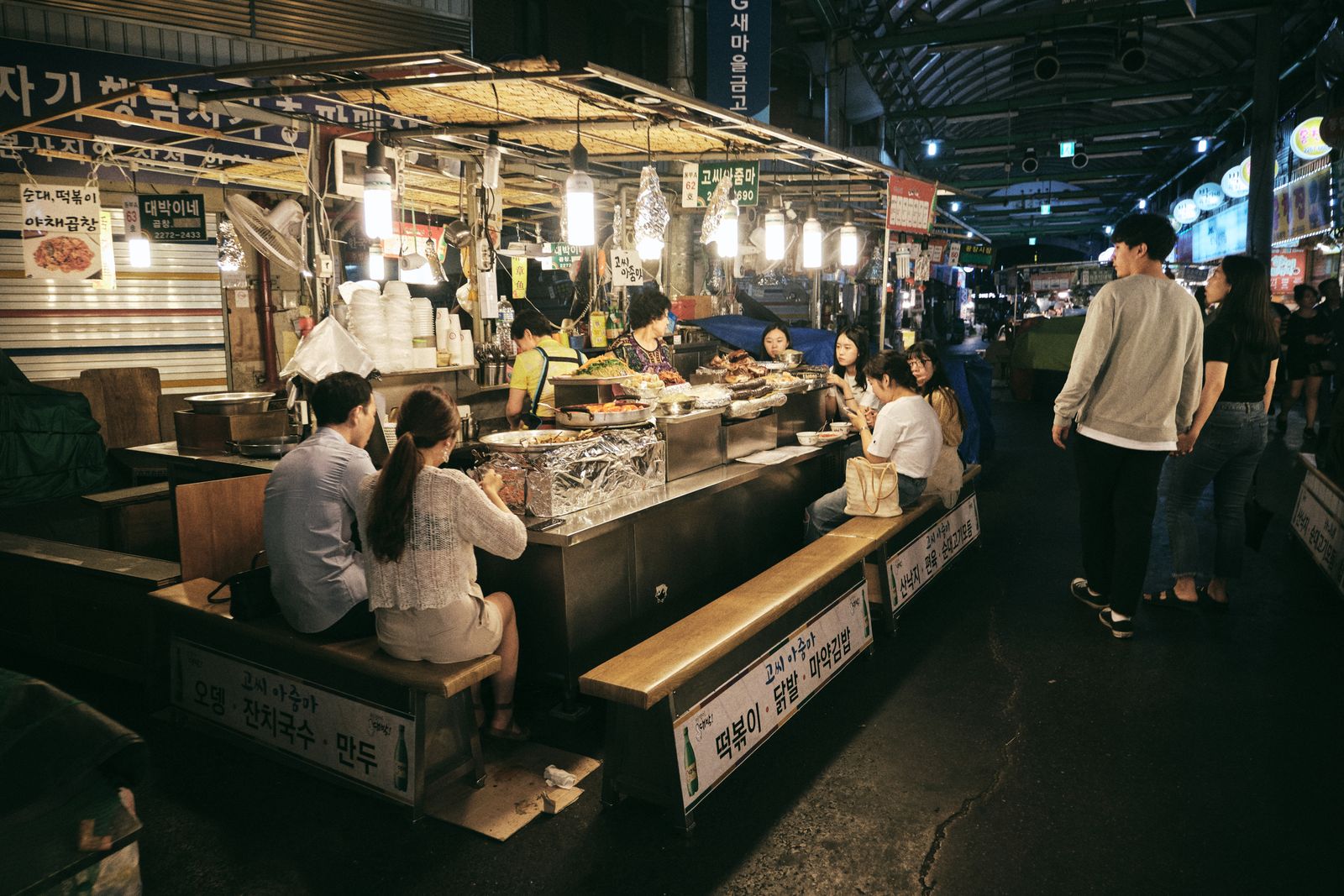
What Koreans Eat Beyond Tourist Classics: 7 Everyday Favorites
Seven everyday Korean food favorites beyond the usual tourist checklist, with ordering tips for gimbap, jjajangmyeon, bossam, jeon, and market snacks.

Korea Rainy Season Guide: Umbrellas, Jangma, and Travel Tips
A practical Korea rainy season guide covering umbrellas, jangma timing, Seoul etiquette, packing, weather checks, and travel mistakes.

Korean Food Scissors Guide: Practical Tools and Hangover Drinks
A practical guide to Korean food scissors, table tools, hangover drinks, and the small convenience habits visitors notice in Korea.