Bacchus D vs F: Why Korea's Energy Drink Comes in Two Versions
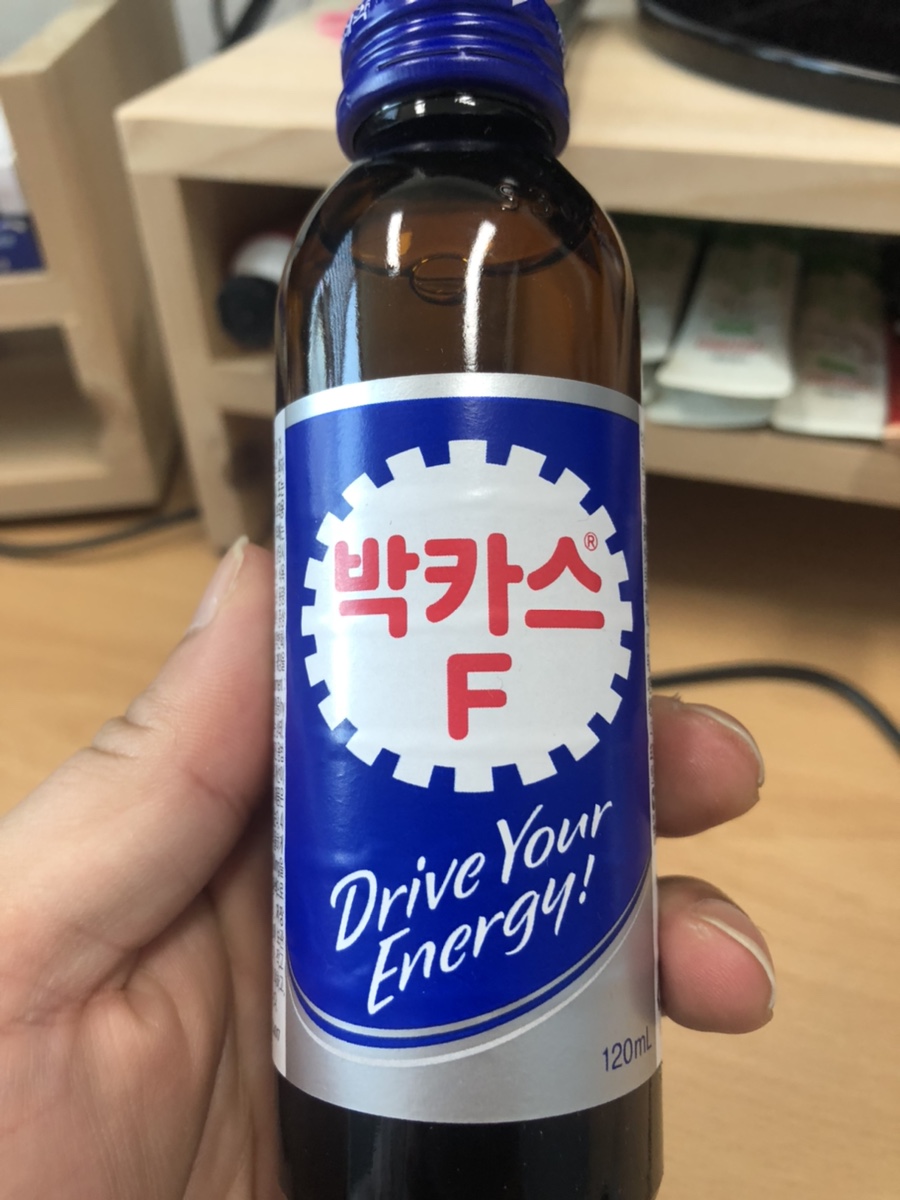
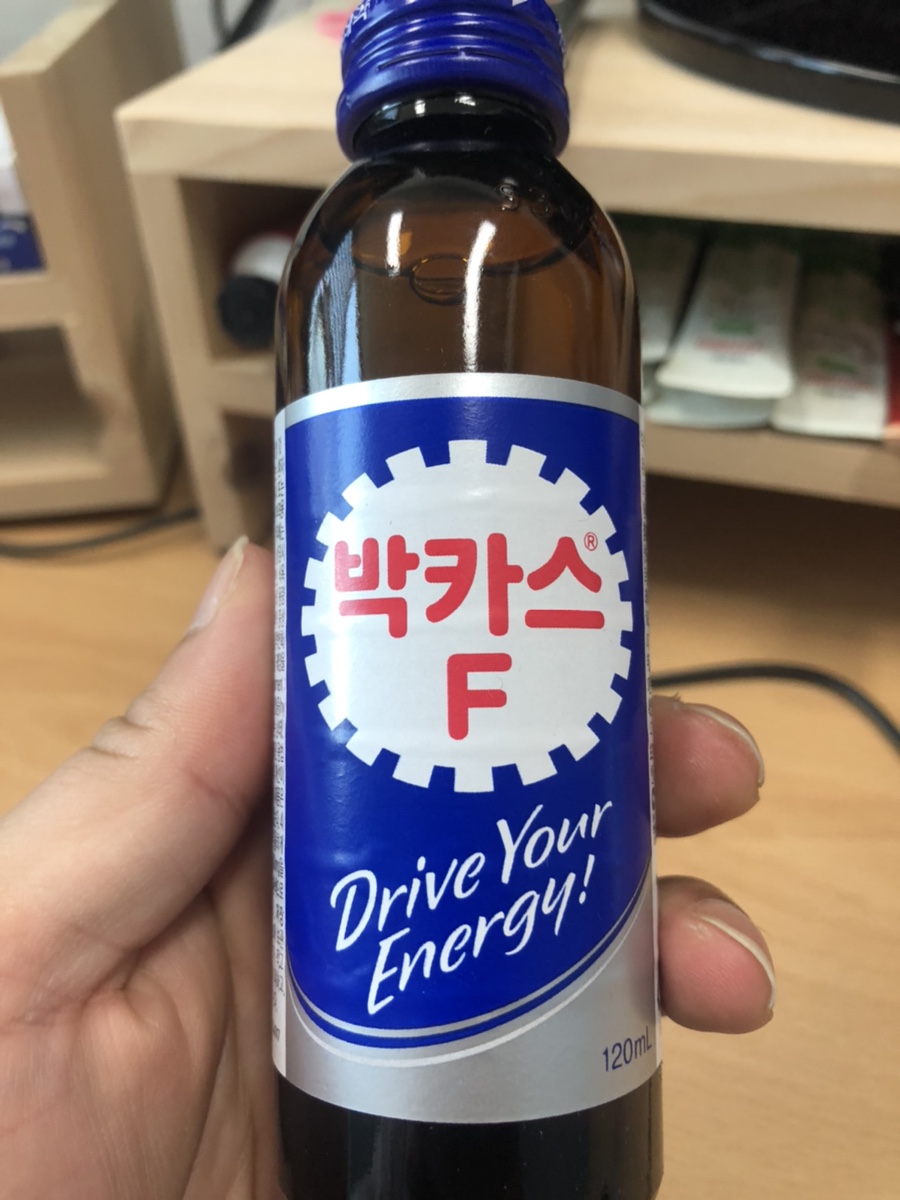
Bacchus F, the convenience store version. The label prints 120mL. Photo by 남종현 (Nam Jong-hyun), CC BY 2.0 KR.
Walk into any Korean convenience store and you will find a small brown bottle with a blue gear-shaped logo sitting near the register. That is Bacchus (박카스), and it has been Korea's best-selling drink of its kind for decades. Buy one, drink it, decide you like it, then walk into a Korean pharmacy and ask for another.
You will be handed a different product.
Same brand, same bottle shape, same logo, different drink. The pharmacy version is called Bacchus D (박카스D), the convenience store version is Bacchus F (박카스F), and the difference between them is not marketing. It is written into Korean pharmaceutical law, and it produces a result most visitors get backwards: the smaller bottle is the stronger one.
This guide explains what actually separates them, why the split exists, which one you should buy, and what changes if you order Bacchus from outside Korea.
The Short Answer
| Bacchus D (박카스D) | Bacchus F (박카스F) | |
|---|---|---|
| Where you buy it | Pharmacies only | Convenience stores, marts, supermarkets |
| Bottle size | 100ml | 120ml |
| Taurine content | 2,000mg | 1,000mg |
| Caffeine | 30mg | 30mg — identical |
| L-carnitine | None | 100mg — F only |
| Label dosage | One bottle a day. Not under 15 | One bottle a day. Not under 15 |
| Regulatory class | Quasi-drug, pharmacy-restricted | Quasi-drug, general retail |
| Practical read | Smaller bottle, double the taurine | Bigger bottle, half the taurine, but the only one with carnitine |
Bacchus-D, 20-pack, on AmazonAffiliate link. As an Amazon Associate, EpicKor earns from qualifying purchases at no extra cost to you.
The counterintuitive part is worth stating plainly. Bacchus D gives you 20% less liquid and twice the taurine. If you assumed the larger bottle was the upgrade, you had it exactly reversed, and so does almost every English-language page that treats Bacchus as one product.
Why Korea Splits One Drink Into Two
The split is not a product-line decision. It is a legal consequence.
Under Korea's Pharmaceutical Affairs Act, a drink containing more than 1,000mg of taurine is classified as a 의약외품 (quasi-drug) that may only be sold through pharmacies. Below that line, the same category of product can be sold in ordinary retail.
Bacchus D sits above the threshold at 2,000mg, so it stays behind the pharmacy counter. Bacchus F sits at exactly 1,000mg, which keeps it legal for convenience stores. Dong-A Pharmaceutical (동아제약) did not create two flavours for two audiences — it created one formula that could clear the retail line and one that did not need to.
This matters for understanding the timeline too. Bacchus was previously classified as a general pharmaceutical, which meant pharmacies were its only channel, full stop. In 2011 it was reclassified as a quasi-drug, and that single regulatory change is what put Bacchus into convenience stores at all. The D/F split is the company's answer to being allowed into two very different channels at once.
So when Koreans ask each other 박카스 D F 차이 — the single most-suggested Bacchus search on Korean search engines — they are not asking a trivia question. They are asking which channel and which strength they want.
Is Bacchus Bad for You? What the Korean Label Actually Says
This is the most-asked English question about Bacchus after the D-versus-F one, and it has a straightforward answer that almost no English page gives, because the answer is printed in Korean on the bottle.
Dong-A Pharmaceutical's own dosage line, identical on both products: 만 15세 이상 성인은 1일 1회 1병을 복용한다. 15세 미만은 복용하지 않는다. — Adults 15 and over: one bottle, once a day. Not for under-15s.
That is not a marketing suggestion. Bacchus is a 의약외품 (quasi-drug), so the dosage line is regulatory text, the same category of statement as the one on a box of lozenges.
The caffeine is not the reason for it. Both D and F contain 30mg of caffeine — the same amount, despite the different bottle sizes and taurine loads. For scale:
| Caffeine | |
|---|---|
| Bacchus D or F, one bottle | 30mg |
| 250ml Red Bull | about 80mg |
| Convenience store americano | commonly 120mg and up |
| MFDS daily limit, adult | 400mg |
| MFDS daily limit, pregnant | 300mg |
One bottle is roughly 7.5% of the adult daily caffeine allowance set by Korea's Ministry of Food and Drug Safety. If caffeine is what worries you, Bacchus is one of the milder things in the fridge, and the coffee next to it is the stronger drink by a wide margin.
The honest caveats are elsewhere. It is a sweetened tonic, so the sugar is real. The one-a-day line covers the whole formula rather than any single ingredient. And if you take medication, are pregnant, or react badly to taurine, the useful fact is structural: Bacchus D is sold only in pharmacies, so the person qualified to answer is standing behind the counter where you are already buying it.
Bacchus-D (박카스), 20-pack — the version that actually ships, if you want to taste it before you fly. Read the export section below first: the bottle sold abroad is not always the pharmacy bottle described above. Both are far cheaper bought after you land. As an Amazon Associate, EpicKor earns from qualifying purchases at no extra cost to you.
See Bacchus-D on AmazonWhat This Means When You Are Standing in the Store
Here is the practical version.
Buy Bacchus F if you are a normal traveller. It is everywhere, it is cheap, it requires no conversation, and it is the version Koreans actually drink most often during an ordinary day. It is the correct default.
Go to a pharmacy for Bacchus D only if you specifically want the stronger formula. You do not need a prescription and you do not need to explain yourself. Korean pharmacies (약국) have green cross signage and are extremely common in city centres. Just say "박카스 디 주세요" (Bacchus D juseyo) or point.
Do not assume a pharmacy will sell you F, or a convenience store will sell you D. That is the whole point of the split. If a shop has one, it generally does not have the other.
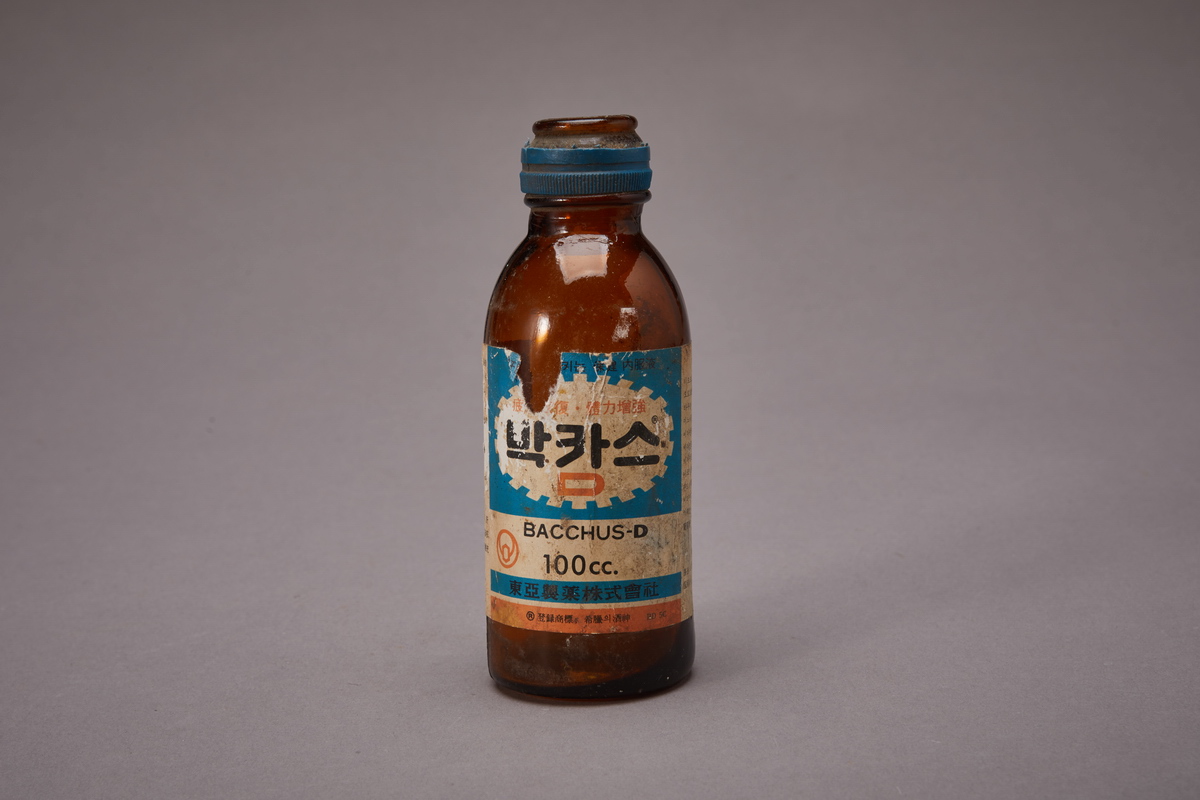
A 1970s Bacchus-D bottle. The label prints BACCHUS-D and 100cc. — the pharmacy line has carried the same small format for decades. Photo: 한국문화정보원 (Korea Culture Information Service Agency), KOGL Type 1.
What It Costs, and Where the Real Savings Are
As of July 2026, expect roughly the following in Korea.
| Purchase | Korean | Rough price (July 2026) |
|---|---|---|
| Bacchus F, single bottle at a convenience store | 박카스F | around ₩1,000–1,500 |
| Bacchus D, single bottle at a pharmacy | 박카스D | typically a little higher per bottle |
| Bacchus D, box of 10 or 20 at a pharmacy | 박카스D 한 박스 | markedly cheaper per bottle |
Prices vary by store, and pharmacies price boxes independently, so treat these as a range rather than a fixed number.
The honest counter-recommendation: do not buy singles if you want more than two. The single most common Korean search after the D/F question is 박카스 한 박스 가격 — the price of a full box — because buying by the box at a pharmacy is dramatically better value than picking up bottles one at a time at a convenience store. If Bacchus becomes part of your trip, buy a box once instead of a bottle six times.
And a second piece of honesty: if you just want caffeine, this is not the efficient way to get it. A convenience store coffee costs about the same and delivers more. Bacchus is not a high-caffeine product; people drink it for the taurine-and-B-vitamin formula and, frankly, for the ritual. Judge it on that, not as a Red Bull substitute.
The Export Bottle Is Not Always the Same Bottle
This is where most overseas buyers get caught, and it is the part no product listing explains.
The D/F split exists because of Korean pharmacy law. That law does not apply anywhere else. So when Bacchus is exported, there is no regulatory reason to maintain the same two-tier structure, and markets outside Korea may receive a different formulation, a different size, a can instead of a glass bottle, or a locally adapted product entirely.
Practical consequences:
- Do not assume an overseas listing matches the Korean domestic bottle. Check the stated volume and the ingredient panel on the actual product you receive.
- Taurine content is the number to look at, not the brand name or the bottle colour. That single figure is what separates D from F in Korea, and it is the figure most likely to differ abroad.
- A can of Bacchus is a different product experience from the 100–120ml glass bottle Koreans drink. If you want the Korean version, you want the small glass bottle.
None of this makes the export version bad. It just means "I tried Bacchus" outside Korea and "I tried Bacchus" in Seoul may not be the same sentence.
How Koreans Actually Drink It
Understanding the ritual explains the product better than the ingredient panel does.
Bacchus is a one-shot, stand-up drink. The bottle is small on purpose. You do not sip it over twenty minutes at a table; you drink it in two or three swallows, often standing at the counter, often mid-task. That is why the glass bottle survived while almost everything else in Korean retail moved to plastic and cans.
It shows up in specific moments:
- Before or during physical work, which is the association the brand has carried for decades
- During a long study or overtime session, alongside the convenience-store coffee habit
- As a small gesture — handing someone a Bacchus is a common, low-key way of saying "thanks for the effort," in an office, on a worksite, or at a family event
- Handed to older relatives, where it functions almost as a courtesy item
That last use is why you will sometimes see Bacchus sold in gift boxes at pharmacies. It is not an energy drink positioned at young people. It is closer to a national household staple that happens to be sold in a medicine bottle.
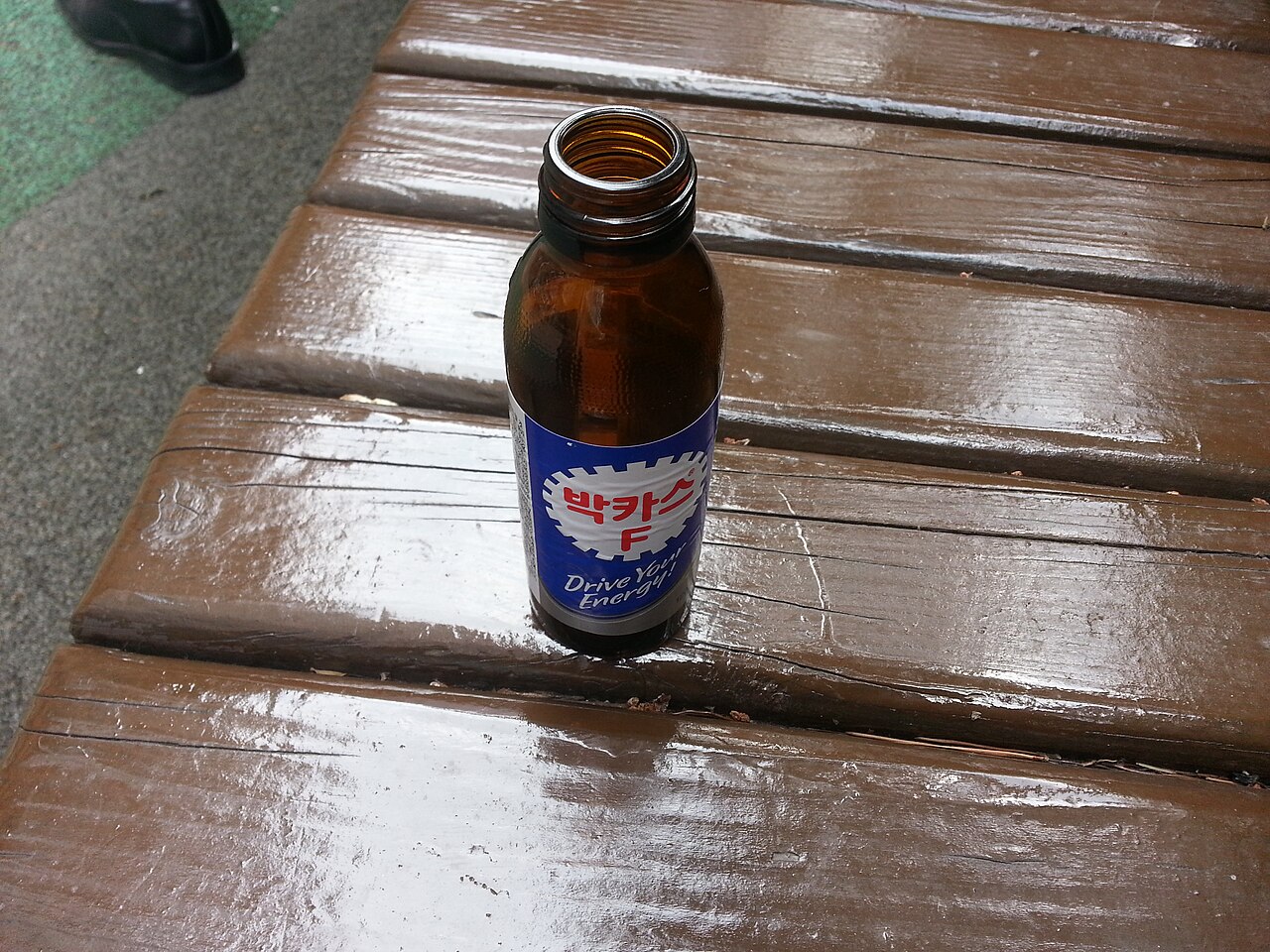
Bacchus turns up wherever the work is — job sites, park benches, between errands. Photo by Kth696586, CC BY-SA 4.0.
Where Bacchus Sits Among Korean Drinks
If you are building a picture of what Koreans drink during an ordinary day, Bacchus occupies a specific slot that no Western category maps onto cleanly.
It is not a soft drink, not a coffee, and not an energy drink in the Red Bull sense. It is a small functional tonic, a category Korea and Japan both maintain and most Western markets do not. Its closest domestic relatives are the other small brown-bottle tonics sold beside it at pharmacies.
The soft-drink slot beside it belongs to a brand with its own naming confusion: 칠성사이다, which is called cider and contains no apples. EpicKor's Chilsung Cider guide explains why, and how it held off Sprite for eleven years.
For the rest of the everyday drink landscape — the barley and corn teas that show up free at restaurants, the bottled grain drinks, and what to order when you want something non-alcoholic — see EpicKor's Korean tea and grain drinks guide. For the alcoholic side of Korean drinking, the Korea drinks guide covers makgeolli, somaek, and beer.
You might like: Korean Convenience Store Breakfast: What Locals Buy
Finding a Pharmacy in Korea
If you decide you want Bacchus D, the pharmacy step is easier than it sounds.
Look for 약국. Korean pharmacies are marked with that word and usually a green cross. In any city centre, subway station area, or residential neighbourhood, one is rarely more than a few minutes away. Many are open into the evening, and some near hospitals or major stations run longer hours.
You do not need a prescription. Quasi-drugs like Bacchus D are over-the-counter items. Walk in, ask, pay, leave.
Pharmacists frequently speak some English, particularly in central Seoul and tourist areas, but pointing at a phone screen works fine everywhere. For the broader picture — how Korean pharmacies work, what to do about minor illness, and how the healthcare system treats visitors — read EpicKor's Korean healthcare guide for tourists.
Vita 500 (비타500), 10 x 100ml — the rival, and the easier buy abroad. Bacchus-F never leaves the pharmacy, so the argument Korea has been having since 2001 is easiest to taste as Bacchus-D against Vita 500, both exported. As an Amazon Associate, EpicKor earns from qualifying purchases at no extra cost to you.
See Vita 500 on AmazonA Note on What This Drink Does and Does Not Claim
Worth stating clearly, because English-language pages about Bacchus often drift into health claims that Korean labelling does not make.
The figures in this guide — 2,000mg and 1,000mg of taurine, 100ml and 120ml — are regulatory and labelling facts. They describe how the product is classified and sold in Korea. They are not statements about what the drink does to your body.
Bacchus is widely associated in Korea with fatigue and with hangovers, and it is genuinely part of both routines. That is a cultural fact about consumption habits, not a medical claim, and this guide is not the place to make one. If you have a health condition, are sensitive to caffeine or taurine, or are taking medication, read the actual label on the bottle you buy and ask the pharmacist — which is, conveniently, exactly where Bacchus D is sold anyway.
FAQ About Bacchus D and F
Q: Is Bacchus bad for you?
A: The label answers it directly: Dong-A Pharmaceutical instructs one bottle a day for ages 15 and up, and no use under 15. Both D and F contain 30mg of caffeine — about 7.5% of the 400mg daily adult limit set by Korea's Ministry of Food and Drug Safety, and well under a 250ml Red Bull's 80mg. It is a sweetened tonic, so the sugar is the more honest concern than the caffeine. If you take medication or are pregnant, note that Bacchus D is sold only in pharmacies, so a pharmacist is already at the point of sale.
Q: Is Bacchus D stronger than Bacchus F?
A: In taurine content, yes. Bacchus D contains 2,000mg to Bacchus F's 1,000mg, despite being the smaller 100ml bottle against F's 120ml. That doubled taurine figure is precisely why D is restricted to pharmacies under Korean law.
Q: Can I buy Bacchus D at a convenience store?
A: No. Korean pharmaceutical regulation restricts drinks above 1,000mg of taurine to pharmacy sale, and Bacchus D sits above that line. Convenience stores, marts, and supermarkets carry Bacchus F instead.
Q: Do I need a prescription for Bacchus D?
A: No. It is classified as a quasi-drug (의약외품), which means over-the-counter sale at any Korean pharmacy. You can simply walk in and buy it.
Q: Why did Bacchus start appearing in convenience stores?
A: Bacchus was reclassified from a general pharmaceutical to a quasi-drug in 2011, which opened general retail channels for the first time. Dong-A Pharmaceutical then split the line so that a compliant version could sit on convenience store shelves while the stronger formula stayed with pharmacies.
Q: Is Bacchus an energy drink like Red Bull?
A: Not really. It is a small functional tonic in a 100–120ml glass bottle, drunk in a few swallows rather than sipped, and it is not built around high caffeine. If caffeine is what you want, convenience store coffee is the more direct option at a similar price.
Q: Will the Bacchus I order online outside Korea be the same?
A: Not necessarily. The D/F distinction exists because of Korean pharmacy law, which does not apply in export markets, so formulation, volume, and even packaging format can differ. Check the stated volume and taurine figure on the product you actually receive.
The One Thing to Remember
If you take a single fact from this guide, take this one: in Korea, the smaller Bacchus bottle is the stronger one, and you can only get it from a pharmacy.
Everything else follows from that. The 100ml pharmacy bottle holds 2,000mg of taurine, the 120ml convenience store bottle holds 1,000mg, and a line in Korean pharmaceutical law drawn at exactly 1,000mg is what keeps them in separate buildings.
Most visitors will drink Bacchus F, enjoy it, and never learn there was another version sitting three doors down behind a green cross. Now you know there is.
Sources and Further Reading
- Korean-language reporting on the Bacchus D and F distinction, covering the 100ml/2,000mg and 120ml/1,000mg split and the pharmacy-only restriction on products exceeding 1,000mg of taurine
- Coverage of the 2011 reclassification of Bacchus from general pharmaceutical to quasi-drug (의약외품), which opened convenience store distribution
- Dong-A Pharmaceutical (동아제약) official product pages for 박카스디액 and 박카스에프액 — ingredient tables and dosage lines, checked August 2026
- Image sources and licensing are documented in this post's
image-sources.md
Prices checked July 2026; ingredients and dosage re-checked against the manufacturer August 2026. Retail and pharmacy pricing varies by store; confirm at point of sale.
Bacchus is part of EpicKor's Korean convenience store guide — the four chains compared, current prices, and what each product actually is.
Also in the section: Vita 500 and Convenience store breakfast.
You Might Also Like
Maxim vs G7: Why Korea's Coffee Mix Tastes Nothing Like Vietnam's
Korea grows no coffee and drinks 405 cups a person a year. Vietnam is the world's second-biggest producer. That difference is why a Maxim stick is sweet and creamy and a G7 stick is bitter — and why one company holds 88% of Korea's coffee mix market.
Delaffe: Korea's Convenience-Store Coffee Brand That Cut Its Price to ₩900
델라페 is not a drink, it is CU's own label — 150 million units a year, sold as a pouch you pour into a separate cup of ice. In March 2026 five of them dropped to ₩900, which makes the convenience store cheaper than Korea's cheapest café chain.
Coolpis: The Korean Drink That Exists to Put Out Tteokbokki
쿨피스 is on every spicy Korean table for a reason, and it is not the one people assume. It does not neutralise capsaicin — milk does. Launched 1980, 80 million units a year, and in 2026 its first new flavour since 2011.