Coolpis: The Korean Drink That Exists to Put Out Tteokbokki
Last updated: 18 August 2026
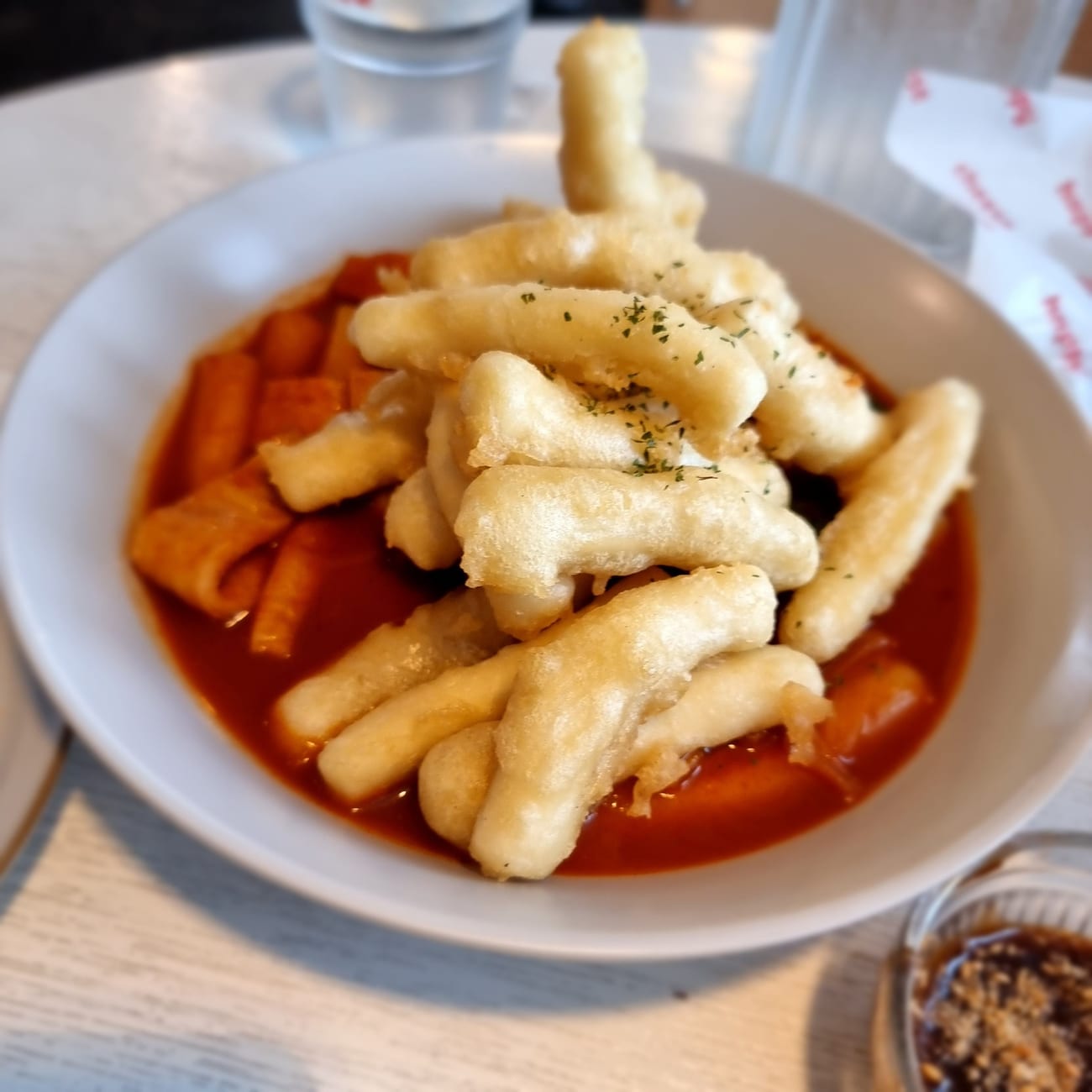
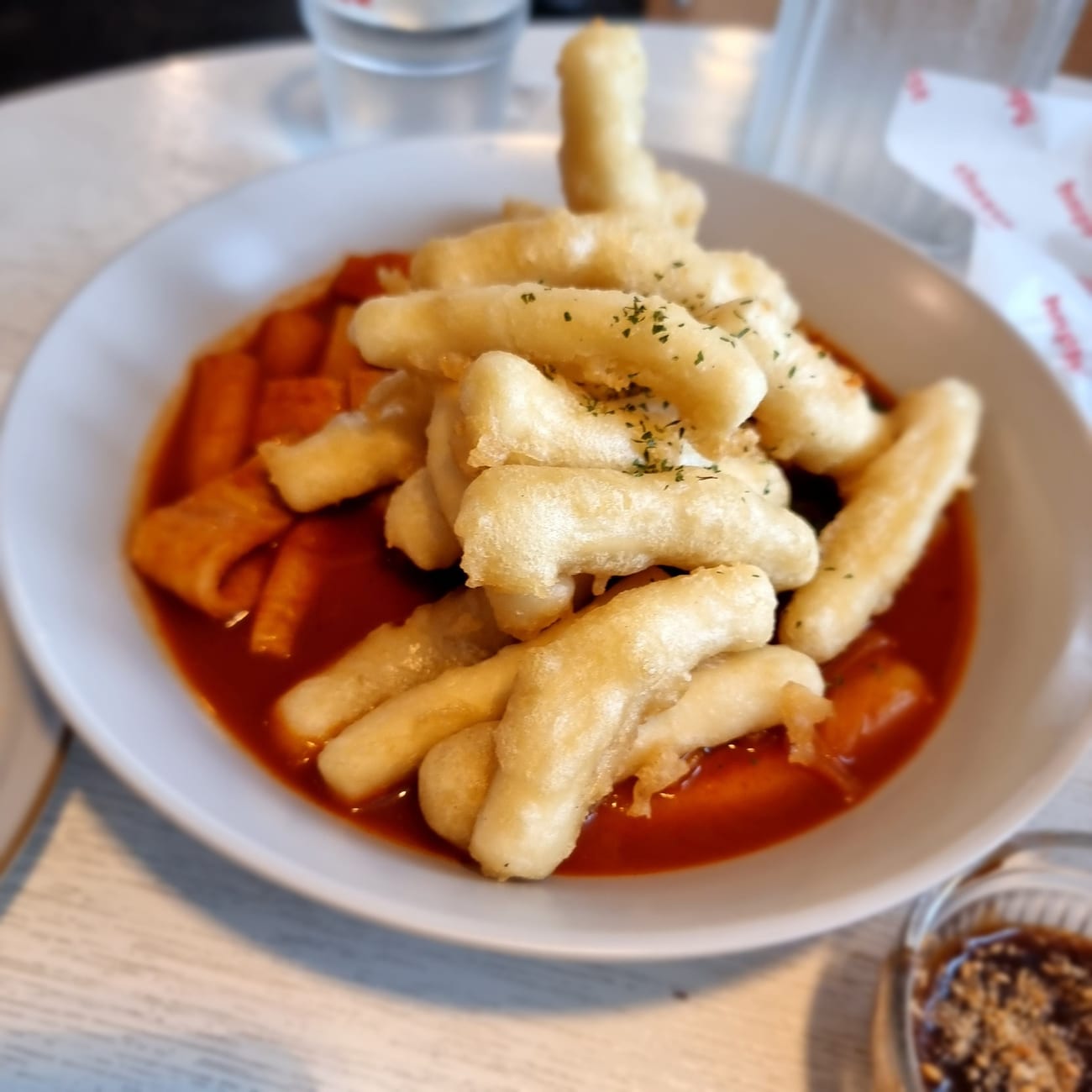
Order 떡볶이 at a Korean spicy-food shop and something arrives that you did not ask for and cannot identify. It is pale, slightly cloudy, sweet, and served cold in a cup or a squat bottle. Nobody explains it. Everyone at the next table is drinking one.
That is 쿨피스 (Coolpis), and it has been the standard-issue fire extinguisher on Korean tables since 1980. It is not lemonade, it is not yogurt, and — this is the part almost every English list gets wrong — it is not actually neutralising the chilli. Understanding why is the difference between drinking it correctly and wondering what the point was.
| Detail | |
|---|---|
| Korean name | 쿨피스 (Coolpis) |
| Maker | 동원F&B, since 2006. Launched by 해태유업 in 1980 |
| What it legally is | A fruit-flavoured drink containing 유산균 배양액, lactic-acid culture |
| Flavours | Peach (original), plum, pineapple — banana added 2026 |
| Sweetened with | Stevia and sucralose in the current formulation |
| Sold as | 200 ml cups, often frozen at convenience stores; 450 ml bottles; restaurant jugs |
| Price, Aug 2026 | ₩550 for the 450 ml peach bottle direct from 동원 (₩490 for members) |
| Volume | About 80 million units a year |
| Where you meet it | Free or near-free at 떡볶이, 엽떡, 찜닭 and fried-chicken shops |
| Honest catch | It masks heat with sweetness. It does not chemically bind capsaicin. |
If you only remember one line: it works, but not the way you think, and milk would work better if most Koreans could drink it.
Korea's First Lactic-Acid Drink, and Not Quite a Lactic-Acid Drink
쿨피스 launched in 1980 under 해태유업 and is routinely described in Korean coverage as the country's first 유산균 음료 — lactic-acid bacteria drink. 동원F&B bought the brand in 2006 and still makes it, which makes 2026 its 46th year on the shelf.
The classification is looser than the nickname suggests. 쿨피스 is a 과일향 음료 — a fruit-flavoured beverage — that contains 유산균 배양액, a lactic-acid culture, rather than being a fermented milk drink in the way Yakult is. That distinction matters for what it can and cannot do to your mouth, and we will come back to it.
The formulation has moved with the times. It was originally sugar and aspartame; the current product is sweetened with stevia and sucralose.
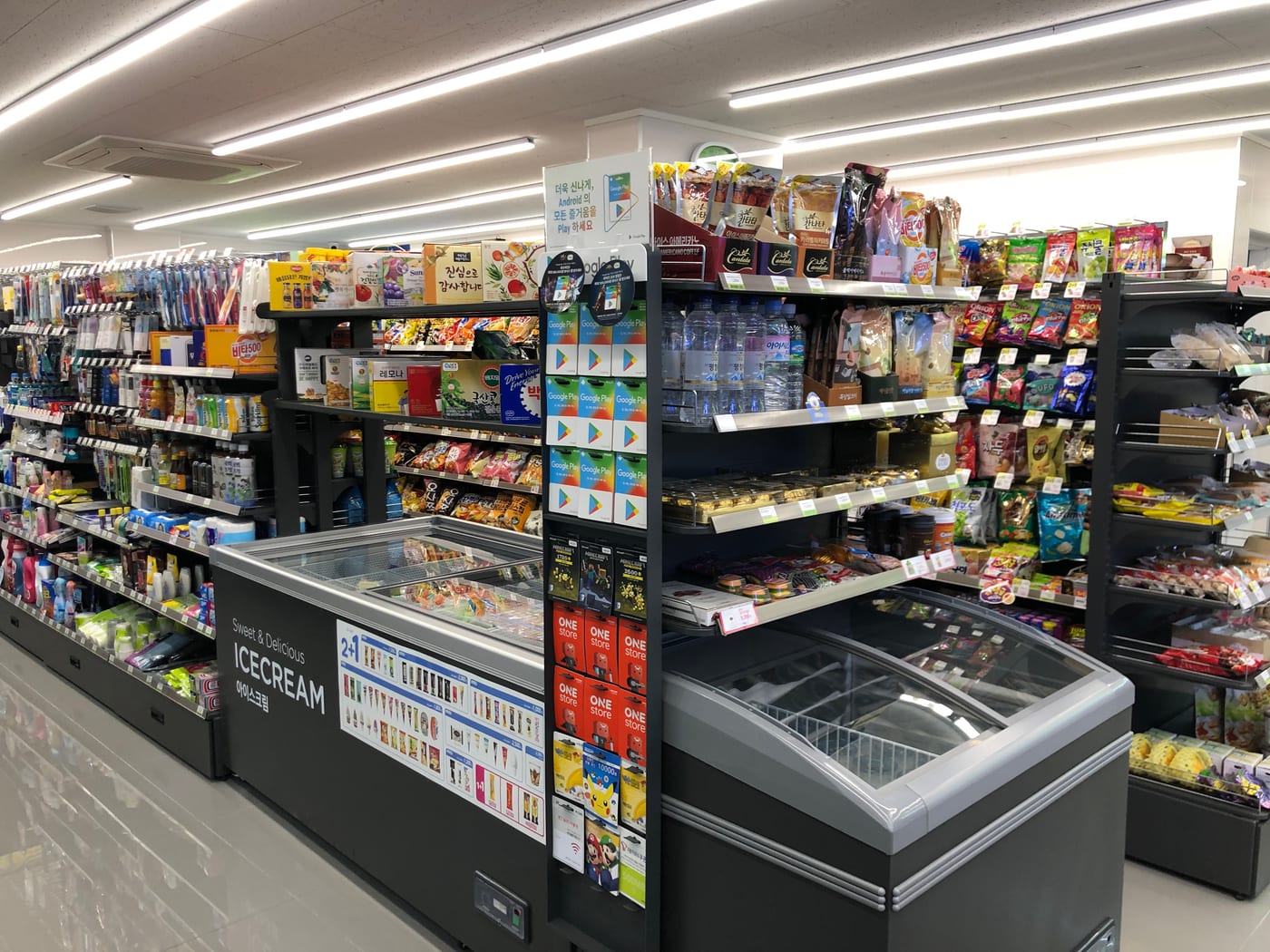
You might like: Korean Drinks Guide: what to buy in a Korean convenience store, with the price, sugar and caffeine of every bottle
Why It Is on Every Spicy Table
The commercial logic is simpler than the culinary one.
Korean spicy-food restaurants — 떡볶이 shops, 엽기떡볶이 branches, 찜닭 places, fried-chicken joints — need something to hand a customer whose mouth is on fire, and they need it to be cheap, shelf-stable and safe to leave in a jug. 쿨피스 is all three. It is concentrated, so a small amount of syrup makes a lot of drink, and it keeps far better in a warm dining room than milk does.
Korean coverage now frames the brand explicitly as "K-매운맛의 영원한 단짝" — the eternal partner of Korean spicy food — and it has ridden the last decade of escalating heat, the 엽떡 era in particular, the way a shovel manufacturer rides a gold rush.
You might like: Delaffe: Korea's Convenience-Store Coffee Brand That Cut Its Price to ₩900
The Honest Part: It Is Not Neutralising the Chilli
Here is the thing nobody tells visitors, and it is worth knowing because it changes what you order.
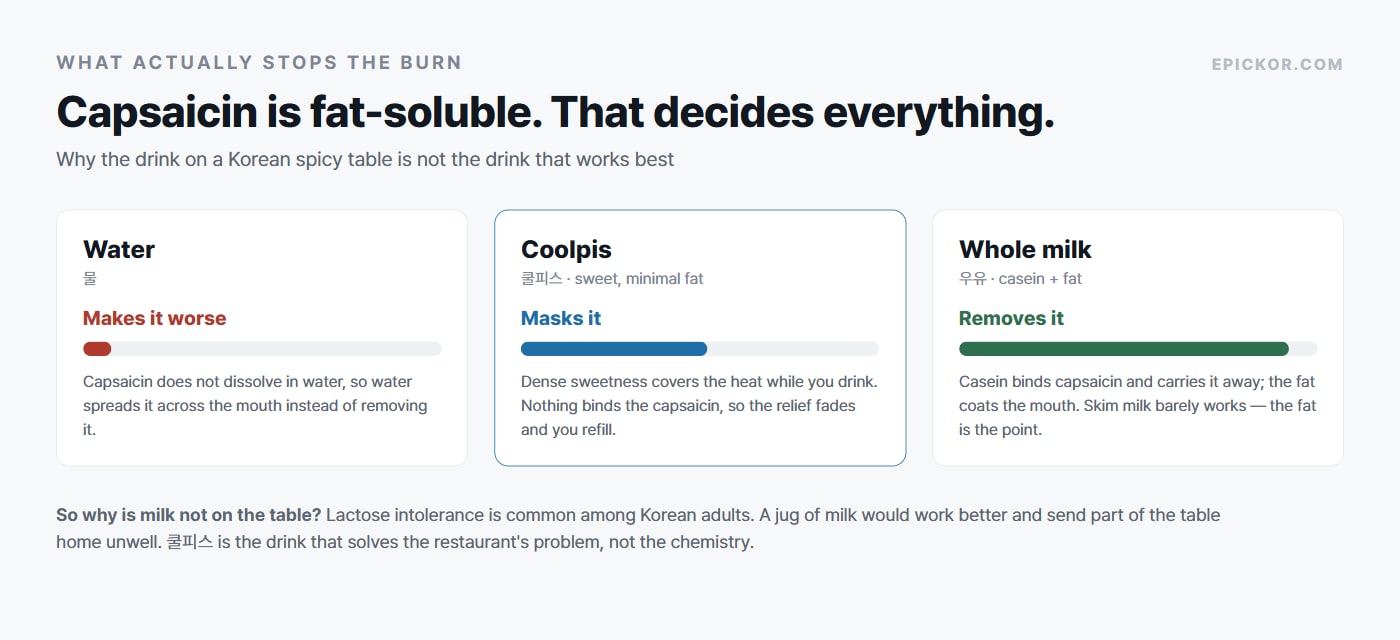
Capsaicin is fat-soluble. It does not dissolve in water, which is why drinking water after something spicy spreads the burn around rather than stopping it. What actually removes capsaicin from your tongue is casein, the protein in dairy: it binds the capsaicin molecule and carries it away, and the fat in whole milk coats the mouth on top of that. This is also why skim milk barely works — take the fat out and you lose most of the effect.
쿨피스 contains a lactic-acid culture, but it is not a fatty dairy drink. What it has in quantity is sweetness, and concentrated sweetness is genuinely effective at masking heat — Korean writing about the drink says exactly this, that its dense sweetness is good at "catching" the spicy taste. Masking and removing are different mechanisms with different results: masking works while you are drinking and fades quickly, which is why you keep refilling the cup.
So why does the restaurant not just put out milk, which would work better?
Because most Korean adults cannot drink it. Lactose intolerance is very common in Korea, and handing a table of six a jug of milk with their 엽떡 would send some of them home unwell. 쿨피스 is the drink that solves the restaurant's problem — cheap, stable, safe for everyone, and sweet enough to feel like relief — rather than the drink that solves the chemistry.
That is not a criticism. It is the actual reason it is on the table, and it is more interesting than "Korean sweet yogurt drink."
Building a Korean spicy shelf at home? If you are cooking 떡볶이 or buldak at home, plan the drink before the meal rather than after — the thing that actually works is a full-fat dairy drink, and the thing Koreans reach for is sweet. As an Amazon Associate, EpicKor earns from qualifying purchases at no extra cost to you.
You might like: Tteokbokki: Korea's Spicy Rice Cakes, Types and Spice Levels
The Flavours, and the One That Took Fifteen Years
Three flavours carry the brand, and the ranking is not close.
복숭아 — peach. The original and, by consensus, the one people mean when they say 쿨피스. If a restaurant stocks one flavour, this is it.
자두 — plum. Sharper, more sour, a real second place rather than a novelty.
파인애플 — pineapple. The tropical option, and the one most likely to turn up in a convenience-store frozen cup.
Then in 2026, banana — and the interesting part is the gap. It is the brand's first new flavour since 2011, a fifteen-year pause, and 동원F&B launched it explicitly on the back of the global K-spicy wave rather than as an ordinary line extension.
Why 2026 Was the Year It Got a New Flavour
A fifteen-year gap between flavours is not caution. It is a brand that had settled into being furniture — the thing on the table, unremarked, like the water jug — and then found itself standing next to a global story.
The story is Korean spice going worldwide. Buldak carried it first, and behind it came an entire export category built on how hot Korean food can be. 쿨피스 sits in a peculiar position inside that: it is not the spicy product, it is the thing you need because of the spicy product, and Korean industry coverage in 2026 started describing the brand in exactly those terms — the partner to K-매운맛 rather than a drink in its own right.
That is a genuinely good place to be. Every bowl of 엽떡 sold abroad is a person discovering, usually too late, that water does not help. The brand does not have to win a beverage category; it has to be the answer to a question the food is already asking.
Hence banana in 2026, the first new flavour since 2011. It is a mild, creamy, low-acid flavour — which is a deliberate choice for this job, because sharp and sour reads as more stimulation to a mouth that is already overstimulated. Peach and plum both have acidity. Banana does not.
Whether it displaces peach is doubtful; 46 years of muscle memory is a lot to move. But it tells you how the company reads its own product: not as a juice competing with juices, but as equipment.
Where You Actually Meet It
Three formats, three completely different experiences.
The restaurant jug or cup. Free or nearly free, poured from a dispenser, usually peach, usually watered to the shop's own taste. This is the default encounter and you do not order it — it appears.
The convenience-store frozen cup. A 200 ml cup sold from the freezer, which you let soften and then drink as slush. Genuinely good in August, and it is the version most visitors miss because it is not in the drinks fridge.
The 450 ml bottle. The one to buy if you are cooking something spicy at home. 동원's own online store lists the peach 450 ml at ₩550 as of August 2026, dropping to ₩490 for members — which tells you what the drink actually costs to make, and why restaurants can give it away.
Convenience stores charge more than that, as they do for everything, and 쿨피스 is a frequent 2+1 item there. If you are buying more than one bottle, the promotion cycle is worth waiting for; if you are buying a case, the manufacturer's own store is cheaper than any convenience store will be.
Honest Notes Before You Buy It
It is sweet, and that is the entire product. If you dislike sweet drinks you will dislike this one, and no amount of cultural context will fix that. Order water and accept the burn.
It is not a health drink. The lactic-acid culture in the name does real work in the marketing and very little in your gut compared with an actual fermented milk drink. Buy it because it is pleasant with spicy food, not because it is doing something for you.
Whole milk genuinely works better if you can drink milk. If you are not lactose intolerant and you are eating at the extreme end of Korean spice — 엽떡 단계별 매운맛, buldak — a cold full-fat milk is the more effective choice and the shops near those restaurants sell it.
It attracts insects. A minor but real point Korean writing makes about leaving an open cup around: it is a sugar solution, and outdoors in summer it does what sugar solutions do.
The pairing that actually works. If you want the Korean experience at home, the honest kit is a Korean sweet drink for the table and a spicy base worth putting out the fire from — the two are bought together for a reason.
You might like: Korean Convenience Store Ice Cups: The Best-Selling Item Is a Cup of Ice
What to Order Instead, by Situation
| Your situation | Order | Why |
|---|---|---|
| Ordinary 떡볶이 heat | 쿨피스 | Sweet, cold, free at the table, does the job |
| Extreme heat, you drink dairy | Cold whole milk | Casein binds capsaicin; fat coats the mouth |
| Extreme heat, you do not | 쿨피스, and eat rice | Starch physically absorbs; water does not |
| You dislike sweet drinks | Barley tea, cold | Neutral, free almost everywhere in Korea |
| You want the slush version | Frozen 200 ml cup | Convenience-store freezer, not the drinks fridge |
FAQ
Q: Is Coolpis yogurt? A: No. It is a fruit-flavoured drink containing a lactic-acid culture — 유산균 배양액 — rather than a fermented milk drink. It is closer in category to a cordial than to Yakult, which is a genuine liquid fermented milk.
Q: Does it actually stop spicy food burning? A: It masks the heat with concentrated sweetness rather than removing capsaicin. Whole milk removes it, because casein binds the molecule and fat carries it off. Coolpis is what restaurants serve because it is cheap, keeps in a warm room, and does not trouble lactose-intolerant customers.
Q: Is it free at restaurants? A: Usually included or nearly so at spicy-food shops, poured from a jug or dispenser. Convenience-store bottles are a normal paid product.
Q: Which flavour should I try first? A: Peach. It is the original, it is what restaurants stock, and it is what Koreans mean by the word. Plum if you want it sharper, pineapple if you are buying the frozen cup.
Q: Is it sugar-free? A: The current formulation is sweetened with stevia and sucralose rather than the sugar and aspartame it used decades ago. It still tastes emphatically sweet — that is the mechanism, not a flaw.
Sources Checked
- Korean food-industry press, 2026, for 쿨피스's 1980 launch under 해태유업, the 동원F&B era from 2006, the roughly 80 million units a year figure, and the 2026 banana launch as the first new flavour since 2011.
- Korean-language reference sources for the product classification (과일향 음료 with 유산균 배양액), the flavour lineup and discontinued flavours, the stevia and sucralose reformulation, the 200 ml frozen cup format, and the restaurant rationale.
- Korean science and dairy-industry writing for the capsaicin mechanism: fat solubility, casein binding, the reduced effect of skim milk, and the prevalence of lactose intolerance among Korean adults.
Prices vary by store format and promotion; convenience-store shelf tags are the authority. Verified August 2026.
You Might Also Like
Delaffe: Korea's Convenience-Store Coffee Brand That Cut Its Price to ₩900
델라페 is not a drink, it is CU's own label — 150 million units a year, sold as a pouch you pour into a separate cup of ice. In March 2026 five of them dropped to ₩900, which makes the convenience store cheaper than Korea's cheapest café chain.
Korean Convenience Store Ice Cups: The Best-Selling Item Is a Cup of Ice
A cup of ice outsells everything else in a Korean convenience store. What it costs in August 2026 after June's price rise, why the drink is sold separately, what Koreans pour into it, and why the ₩800 cup tested cleaner than café ice.
Milkis vs Calpis, and Whether Korea's Milk Soda Has Alcohol
Milkis is not Calpis — different country, different bacteria, seventy years apart — and it has no alcohol, though the question returns for a reason printed on the can. Which flavour to buy first, the ₩750 promotion price, and how Koreans drink it.