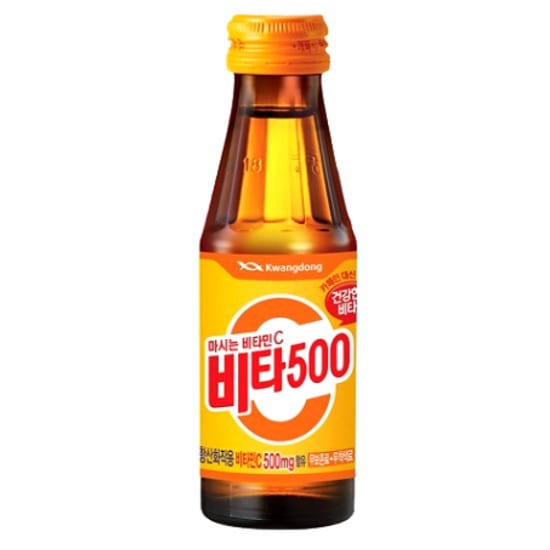
Vita 500: Korea's Vitamin Drink, and Why It Beat Bacchus to the Shelf
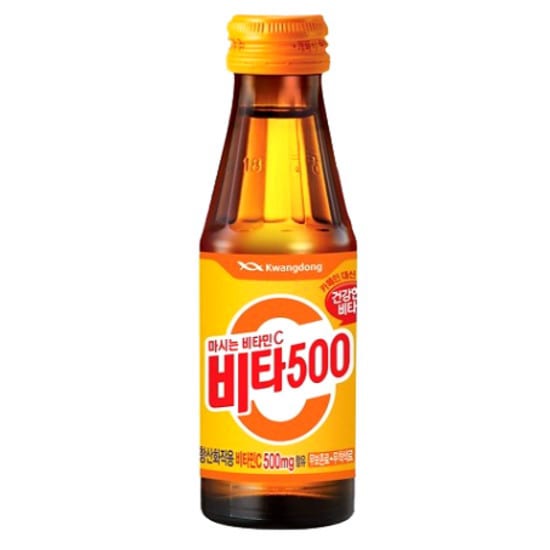
Vita 500. The label reads "drinking vitamin C" and 500mg of vitamin C, 100ml in a bottle you finish in three swallows.
There is a second small bottle next to the Bacchus in every Korean convenience store, and it is orange.
Vita 500 (비타500) is made by Kwangdong Pharmaceutical (광동제약), launched in March 2001, and has sold more than 7.5 billion bottles as of February 2025. It sits beside Bacchus, costs about the same, comes in the same small brown glass bottle, and is made by a pharmaceutical company — and yet the two products are separated by a legal decision that shaped both of their histories.
Bacchus is legally a quasi-drug. Vita 500 is legally just a drink.
That distinction sounds like paperwork. It was worth a decade.
The Ten-Year Head Start
Here is the part no English page explains, and it is the most interesting thing about this bottle.
Korean law sorts these products into categories. Bacchus was classified as a pharmaceutical, then a 의약외품 (quasi-drug) — a status that restricted where it could be sold. Until 2011, when Dong-A Pharmaceutical had it reclassified, Bacchus could not be stocked in ordinary convenience stores and supermarkets at all.
Kwangdong went the other way. Vita 500 was registered as a 혼합음료 — a mixed beverage. Not a drug, not a quasi-drug, just a drink. And a drink can be sold anywhere.
So from its launch in 2001, Vita 500 could sit in every convenience store, supermarket, and corner shop in Korea, while the far more famous Bacchus was still confined to pharmacies. By the time Bacchus was allowed onto the same shelf in 2011, Vita 500 had been building the habit for ten years.
There is a second layer to it. Kwangdong marketed Vita 500 explicitly on containing no caffeine, in direct contrast to Bacchus — a pharmaceutical company using a health-positioning argument against another pharmaceutical company's flagship. Two pharma firms, two small brown bottles, and a decade-long fight conducted partly through regulatory classification.
If you have read EpicKor's guide to Bacchus D vs F, this is the other half of that story.
What Is Actually In It
| Vita 500 | |
|---|---|
| Maker | Kwangdong Pharmaceutical (광동제약) |
| Launched | March 2001 |
| Bottle | 100ml glass |
| Vitamin C | 500mg — the number in the name |
| Also contains | zinc and taurine |
| Caffeine | none |
| Legal class | 혼합음료 (mixed beverage) — not a drug category |
| Cumulative sales | 7.5 billion+ bottles as of February 2025 |
Vita 500, 10 bottles, on AmazonAffiliate link. As an Amazon Associate, EpicKor earns from qualifying purchases at no extra cost to you.
The name is not decoration. 500 is the milligrams of vitamin C, printed on the front of the bottle, and the product's original pitch was that vitamin C could be something you drink rather than something you swallow as a tablet. In Korea in 2001 that was a genuinely new idea, and it opened a category.
The caffeine-free part matters practically, not just as marketing. If you want a small functional drink in the evening, or you are giving one to a child, or you have already had three convenience store coffees, Vita 500 is the bottle that does not add caffeine. Bacchus does.
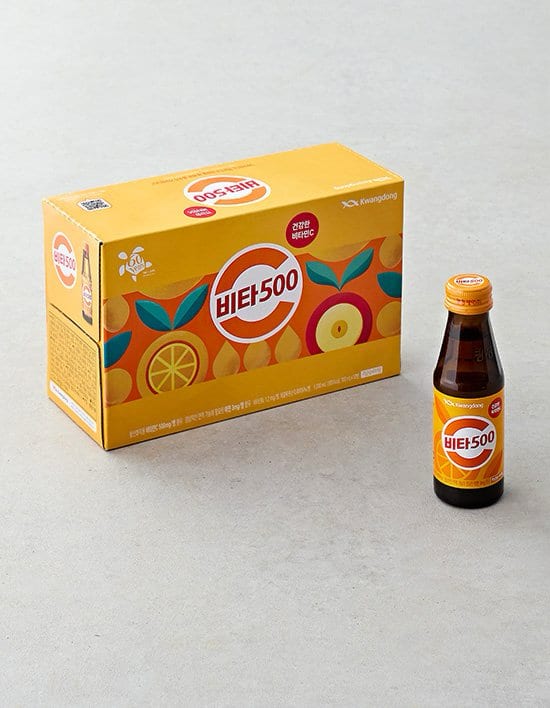
The ten-bottle box is the standard format. The single bottle at a convenience store is the expensive way to buy it.
The Three Versions, and Which to Buy
This is where most visitors get confused, because there are now three products sharing the name and the packaging does not translate itself.
| Version | Korean | What it is |
|---|---|---|
| Original | 비타500 | The classic. Non-carbonated, sweet, 500mg vitamin C |
| Zero | 비타500 ZERO | Non-carbonated (무탄산음료 on the label), zero sugar, 0 kcal |
| Zero Sparkling | 비타500 ZERO 스파클링 | Carbonated, zero sugar, vitamin C 500mg plus vitamin B2 |
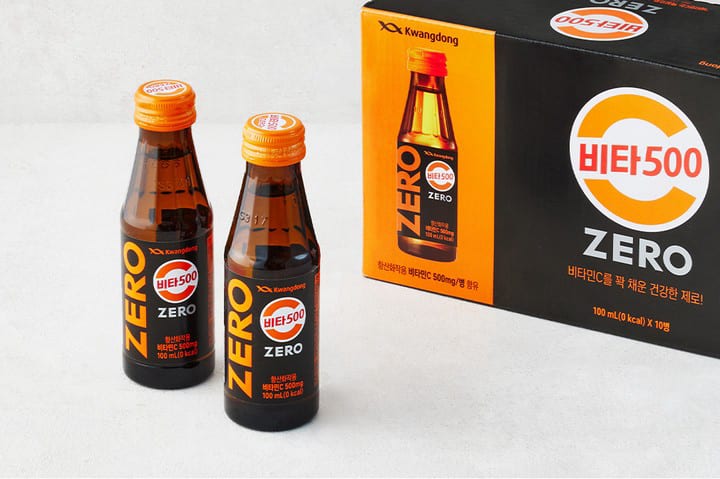
Vita 500 Zero. Note 무탄산음료 on the label — this is the still version, not the sparkling one.
The trap is the word Zero. Both Zero and Zero Sparkling say ZERO in large letters, and shoppers reasonably assume Zero means the fizzy one. It does not. Zero refers to the sugar, not the bubbles. The plain Zero bottle prints 무탄산음료 — non-carbonated beverage — right on the label.
Zero Sparkling launched in May 2024 and is the genuinely different drink of the three: carbonated, zero sugar and calories, and it adds vitamin B2 to the vitamin C.
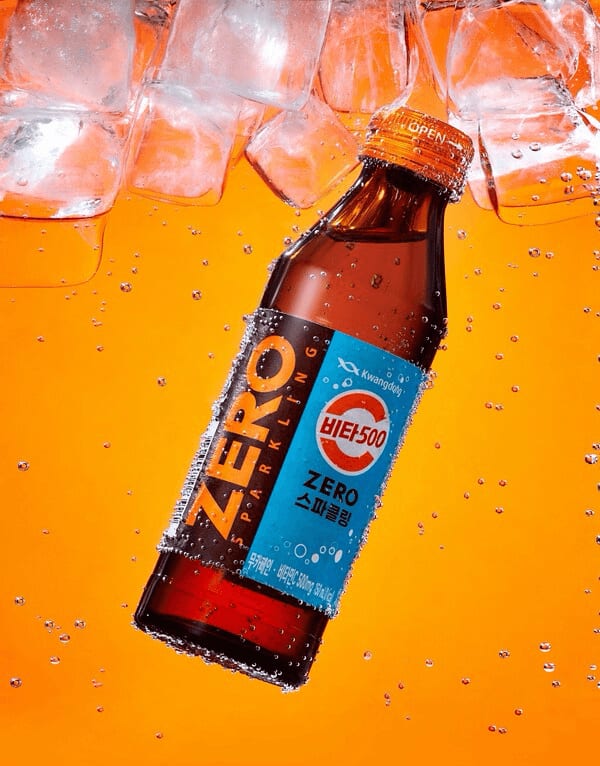
Zero Sparkling, in blue rather than orange. This is the carbonated one.
Which to buy:
- First time? Buy the original. It is the version 7.5 billion bottles were sold of, and the sweetness is part of what the drink is.
- Want it as a daily thing? Zero. Same format, no sugar, still non-carbonated.
- Want something refreshing on a hot Seoul afternoon? Zero Sparkling. The carbonation genuinely changes it, and Korean summers make the case for you.
- Look at the colour of the label, not the word ZERO. Orange is the still family, blue is sparkling.
You might like: Korea Drinks Guide: Makgeolli, Somaek, Beer, and More
Vita 500 (비타500), 10 x 100ml — the original version, to taste it before you fly. Check the stated bottle size and version: the Zero and Sparkling variants are newer, export listings do not always say which, and the Korean domestic bottle is 100ml. As an Amazon Associate, EpicKor earns from qualifying purchases at no extra cost to you.
See Vita 500 on AmazonWhat It Costs, and the Mistake to Avoid
As of 2026, a single bottle at a Korean convenience store runs roughly ₩1,000–1,500 depending on the store and the version. Treat that as an approximate band and check the shelf label, since convenience store pricing varies and promotions are frequent.
The honest counter-recommendation: do not buy this one bottle at a time.
Look at the packaging in the photo above — the standard format is a ten-bottle box (100 mL × 10병), and that is how Korean households actually buy it. A box from a mart or a pharmacy costs substantially less per bottle than ten separate convenience store purchases. Buy one single to find out whether you like it, then buy the box.
And a second piece of honesty: this is not an energy drink and it will not wake you up. It contains no caffeine at all, by design. If what you want is alertness, a convenience store coffee costs about the same and actually does the job. Vita 500 is a vitamin C drink that happens to be pleasant, and judging it as a Red Bull substitute guarantees disappointment.
A Note on What This Drink Does and Does Not Claim
Worth stating plainly, because English pages about Korean functional drinks slide into health claims quickly.
The figures here — 500mg of vitamin C, 100ml, zero calories in the Zero versions — are label and regulatory facts. They describe what is printed on the bottle and how Korea classifies the product. They are not statements about what the drink will do for your body.
Vita 500 is not a quasi-drug and makes no medicinal claim in Korea; that is precisely why it can sit in a convenience store fridge. If you are managing a health condition, are sensitive to any ingredient, or are taking medication, read the label on the bottle you buy rather than a travel guide.
How Koreans Actually Drink It
The behaviour around Vita 500 is different from Bacchus, and the difference is mostly about who and when.
It skews younger and it skews all-day. Because there is no caffeine and it tastes like a sweet citrus drink, it gets consumed the way a soft drink does — with a meal, after exercise, mid-afternoon at a desk — rather than as a specific pick-me-up before hard work, which is the Bacchus pattern.
It is a common small gift. Boxes of Vita 500 turn up at offices, at study rooms during exam season, and handed out at events. A ten-bottle box is inexpensive enough to give casually and legible enough to read as a gesture about health.
It appears where alcohol is not appropriate. At events, workplaces, and family gatherings where handing someone a beer would be wrong, this is a common thing to hand them instead.
None of that is exotic. It is just a national soft drink that happens to be made by a pharmaceutical company and named after a milligram figure.
Bacchus-D (박카스), 20-pack — the rival this article is about, and the other half of the taste test. Vita 500 beat Bacchus to the shelf by leaving the pharmacy; the two of them are the cheapest way to taste the argument Korea has been having since 2001. As an Amazon Associate, EpicKor earns from qualifying purchases at no extra cost to you.
See Bacchus-D on AmazonFAQ About Vita 500
Q: What is Vita 500?
A: A vitamin C drink made by Kwangdong Pharmaceutical, launched in March 2001 and sold in 100ml glass bottles containing 500mg of vitamin C — which is where the name comes from. It also contains zinc and taurine, and no caffeine. It has sold more than 7.5 billion bottles as of February 2025.
Q: Is Vita 500 the same as Bacchus?
A: No. Both are small bottled drinks made by Korean pharmaceutical companies, but Bacchus is classified as a quasi-drug (의약외품) while Vita 500 is registered as a mixed beverage (혼합음료). Bacchus contains caffeine; Vita 500 does not. The classification difference is why Vita 500 was in convenience stores from 2001 while Bacchus was restricted until 2011.
Q: Does Vita 500 have caffeine?
A: No. It is caffeine-free, and Kwangdong marketed that fact directly against the caffeinated Bacchus. If you want alertness rather than vitamin C, convenience store coffee is the more effective choice at a similar price.
Q: What is the difference between Vita 500 Zero and Zero Sparkling?
A: Zero refers to the sugar, not the carbonation. Plain Vita 500 Zero is still — its label reads 무탄산음료, non-carbonated beverage. Vita 500 Zero Sparkling, launched in May 2024, is the carbonated version and adds vitamin B2. The still versions use orange livery and the sparkling uses blue.
Q: Where can I buy Vita 500 in Korea?
A: Anywhere. Convenience stores, supermarkets, marts, and pharmacies all carry it, because it is legally an ordinary beverage rather than a quasi-drug. That universal availability was the whole point of how it was registered.
Q: Is it cheaper to buy a box?
A: Considerably. The standard format is a ten-bottle box, and that is how Korean households buy it. Single bottles at convenience stores carry a per-unit premium, so sample one and then buy the box at a mart or pharmacy.
The One Thing to Remember
Vita 500 won by choosing not to be a drug.
Kwangdong registered it as an ordinary beverage in 2001, which put it in every convenience store in Korea a full decade before Bacchus was allowed on the same shelf. Seven and a half billion bottles later, the orange bottle is a fixture — not because it did anything Bacchus could not do, but because it was allowed to be in more places, sooner.
Buy the original first, look at the label colour rather than the word ZERO, and buy the box rather than the bottle.
Sources and Further Reading
- Korean-language coverage of Vita 500's March 2001 launch by Kwangdong Pharmaceutical and cumulative sales exceeding 7.5 billion bottles as of February 2025
- Korean industry comparisons of Vita 500 and Bacchus covering their different regulatory classifications — 혼합음료 versus 의약외품 — and the 2011 reclassification that opened convenience store distribution to Bacchus
- Korean product announcements for 비타500 ZERO 스파클링, released May 2024 with vitamin C and vitamin B2 and zero sugar and calories
- Product labelling as shown in this post's photographs, including the 무탄산음료 marking on the still Zero bottle
- Image sources and rights status are documented in this post's
image-sources.md
Prices checked 2026 and stated as an approximate band; convenience store pricing varies by store and promotion. Confirm at the shelf.
Vita 500 is part of EpicKor's Korean convenience store guide — the four chains compared, current prices, and what each product actually is.
Also in the section: Bacchus and Convenience store breakfast.
You Might Also Like
Maxim vs G7: Why Korea's Coffee Mix Tastes Nothing Like Vietnam's
Korea grows no coffee and drinks 405 cups a person a year. Vietnam is the world's second-biggest producer. That difference is why a Maxim stick is sweet and creamy and a G7 stick is bitter — and why one company holds 88% of Korea's coffee mix market.
Delaffe: Korea's Convenience-Store Coffee Brand That Cut Its Price to ₩900
델라페 is not a drink, it is CU's own label — 150 million units a year, sold as a pouch you pour into a separate cup of ice. In March 2026 five of them dropped to ₩900, which makes the convenience store cheaper than Korea's cheapest café chain.
Coolpis: The Korean Drink That Exists to Put Out Tteokbokki
쿨피스 is on every spicy Korean table for a reason, and it is not the one people assume. It does not neutralise capsaicin — milk does. Launched 1980, 80 million units a year, and in 2026 its first new flavour since 2011.