ICONIX and Pororo: How a Korean Studio Turned One Penguin Into a Licensing Company
ICONIX makes under 10 percent of its money from broadcasting Pororo and over 90 percent from licensing it. A public-information deep dive on the Korean character IP company behind Pororo, Tayo and Zanmang Loopy, and what its model shows overseas operators.
Quick Answer
ICONIX Co., Ltd. (아이코닉스) is a Seongnam-based Korean character IP company founded in 2001. It is best known for Pororo the Little Penguin (뽀롱뽀롱 뽀로로), which first aired on EBS in November 2003 and has since been exported to more than 140 countries.
The number that defines the company: its founder has stated that broadcasting rights account for under 10 percent of revenue, and licensing accounts for the remaining 90 percent or so. ICONIX is not an animation studio that also licenses. It is a licensing business that also animates.
For an overseas operator studying Korean IP, that inversion is the whole lesson.
The Company at a Glance
| Detail | |
|---|---|
| Official name | ICONIX Co., Ltd. (주식회사 아이코닉스) |
| Founded | 2001 |
| Headquarters | Seongnam, Gyeonggi Province |
| Representative | Choi Jong-il (최종일) |
| Revenue | ₩146.7 billion, as of the December 2025 filing period |
| Core IP | Pororo, Tayo the Little Bus (꼬마버스 타요), Zanmang Loopy (잔망루피), Haechi |
| Divisions | Content development · media marketing · licensing · merchandise and sales |
| Licensed products | Over 10,000 released domestically and internationally, per the company |
| Digital reach | 100 million+ YouTube subscribers across channels; 2 billion+ annual views, per the company |
| Owned venues | Pororo Park, Tayo Kids Café |
| Pororo brand value | ₩389.3 billion, estimated by the Seoul Business Agency on 30-year projected economic impact |
Books on doing business in KoreaAffiliate link. As an Amazon Associate, EpicKor earns from qualifying purchases at no extra cost to you.
The Model: Licensing First, Broadcasting Second
Most animation companies treat the show as the product and merchandise as an aftermarket. ICONIX runs it the other way round.
Its structure makes this explicit — the company describes four divisions covering content development, media marketing, licensing, and merchandise and sales operations. Three of those four exist downstream of the animation. The show is the top of a funnel, not the business.
Why that works for a preschool property specifically:
- The audience replaces itself. A three-year-old ages out in two years and a new three-year-old arrives. A property aimed at adults has to keep the same viewers; a preschool property only has to keep the same parents' trust.
- The buyer is not the viewer. Parents pay. That decouples merchandise pricing from the child's attention span.
- Categories are close to unlimited. ICONIX reports over 10,000 licensed products. The characters have appeared across food, drink, stationery, furniture, transport livery, banking products and physical venues.
The commercial consequence: revenue is not tied to a broadcast slot, a streaming deal, or a release schedule. That is a materially more stable base than a studio dependent on commissioning.
The Production History Is Unusual, and It Is Public
Pororo was not made by one company. It was a co-production — ICONIX with the 3D studio Ocon, public broadcaster EBS, and SK Broadband (then Hanaro Telecom).
The part that draws attention outside Korea: the first two seasons involved North Korean designers, as part of inter-Korean business collaboration in the period following the 2000 North–South Joint Declaration. Korean and English reporting has consistently named the North Korean partner in that arrangement as Samcheolli.
This is publicly documented rather than hidden, and it is worth understanding for what it says about the era rather than as trivia. In the early 2000s, inter-Korean production arrangements were an actively promoted policy channel, and animation labour was one of the few sectors where they were practical. A character now recognised in 140 countries began partly inside that policy window.
For an overseas operator, the useful read is about co-production structure, not politics. Pororo's ownership was shared from the start across a studio, a broadcaster and a telecom. That is a common Korean pattern — a broadcaster or carrier funds early production in exchange for rights participation — and it is a structure a foreign partner will encounter when negotiating for Korean content. Ask who holds which rights in which territories before assuming the studio can license alone.
What Licensing at This Scale Actually Looks Like
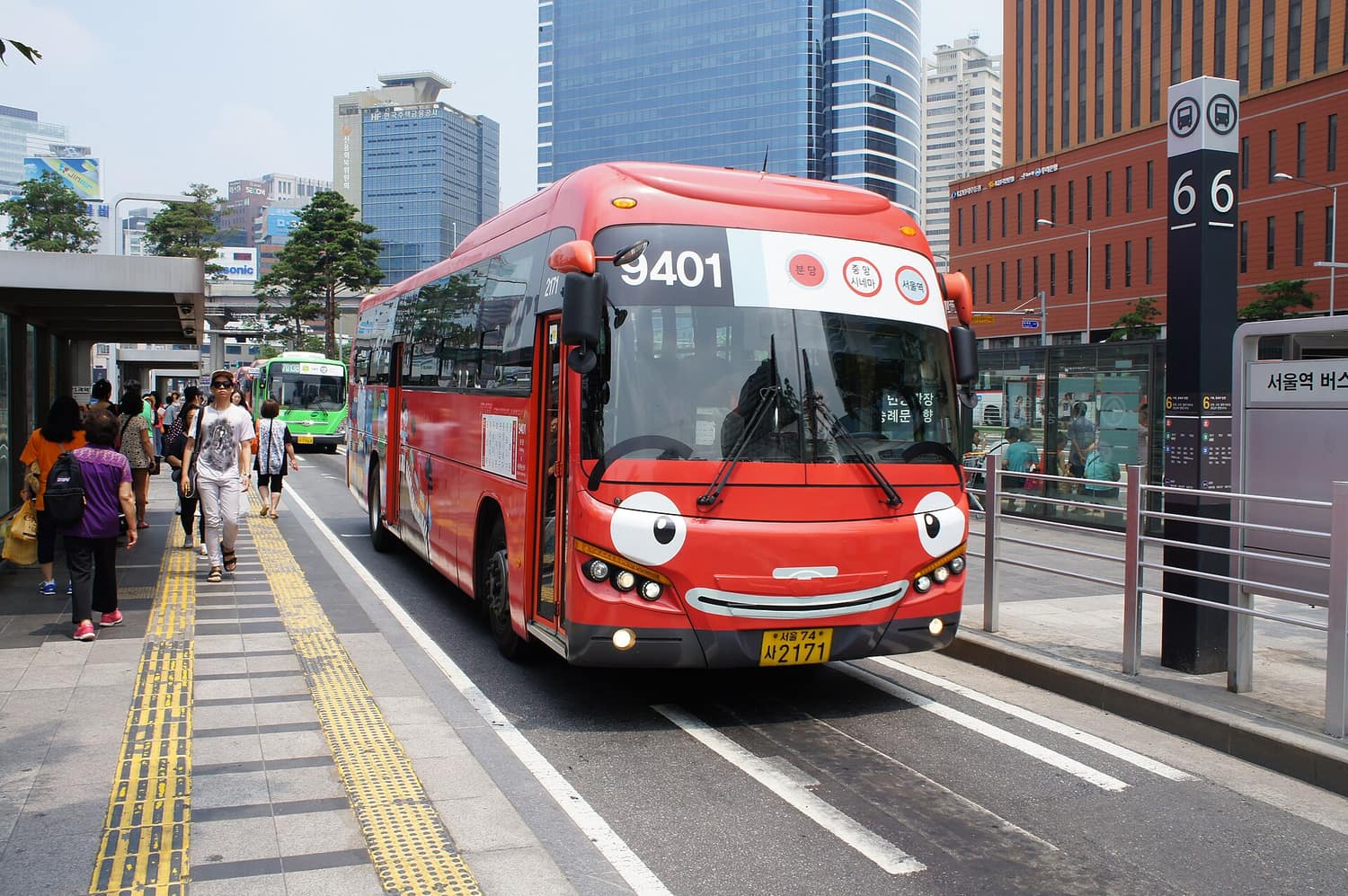
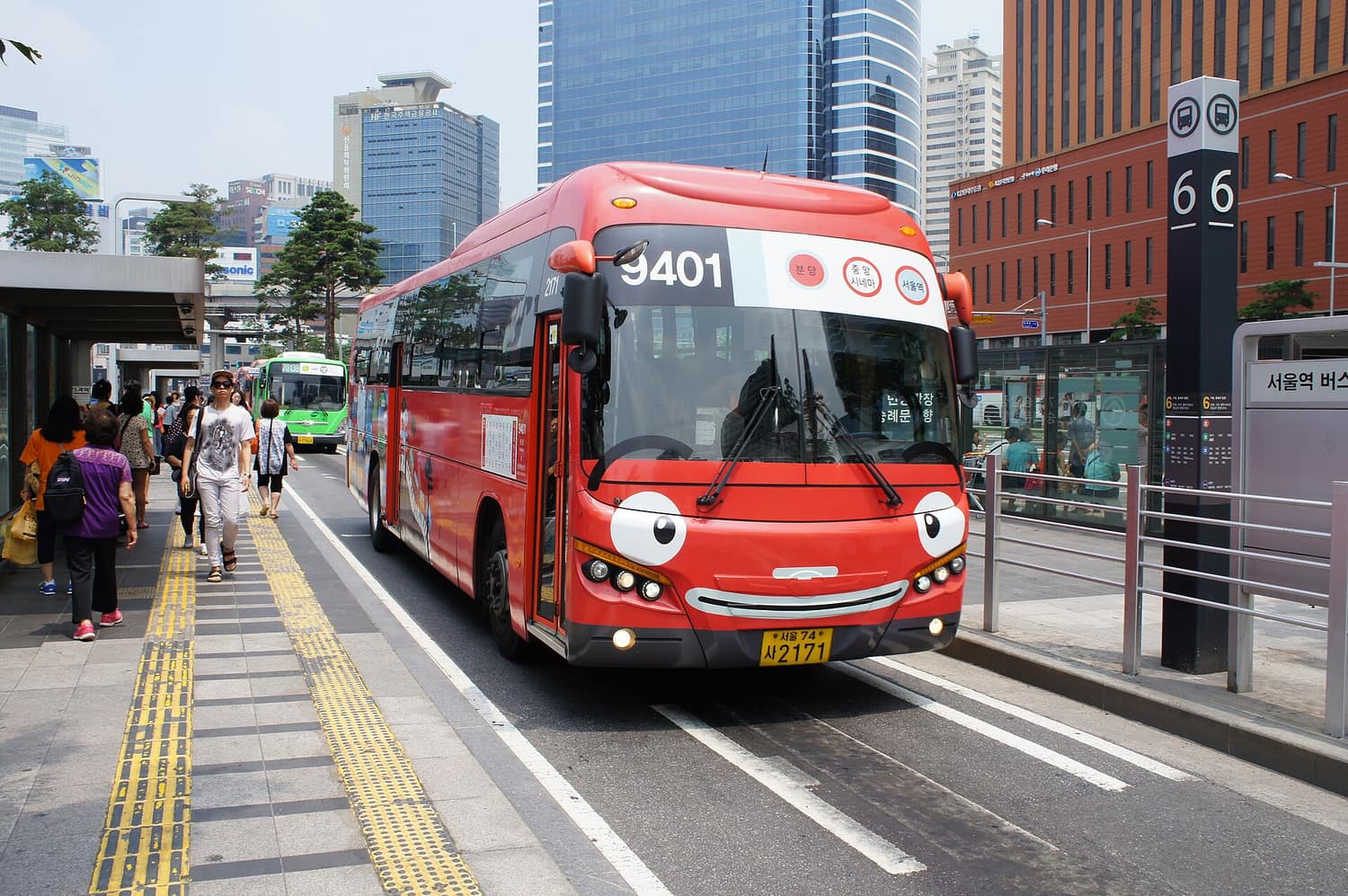
A working Seoul bus in Tayo livery at Seoul Station. Photo by 분당선M, CC BY-SA 3.0, via Wikimedia Commons.
The clearest way to grasp the scale is not a revenue figure. It is that the city of Seoul put the characters on its buses.
Seoul has run city buses wrapped in Tayo livery — eyes and a smile applied to the front of an ordinary working vehicle on a normal route. Children queue for them. It is a licensing placement on public transport infrastructure, which is a category most character brands never reach.
And it is not a one-off wrap that went up once and was forgotten.
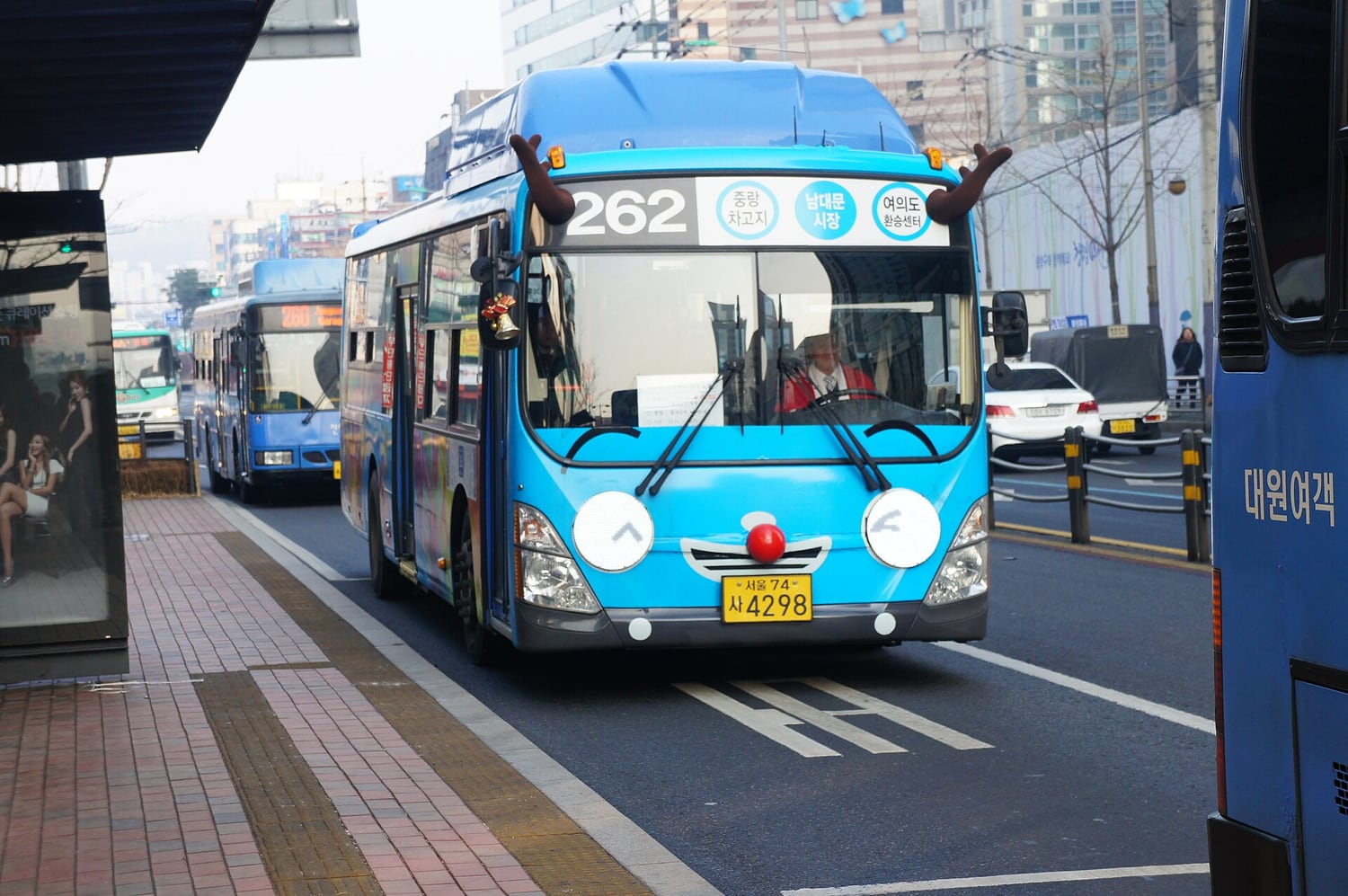
The same programme at Christmas: route 262 with antlers and a red nose added on top of the Tayo face. Photo by 분당선M, CC BY-SA 3.0, via Wikimedia Commons.
Look at what the bus operator has done here. The Tayo face is the licensed element; the antlers and the red nose are not. Somebody at the depot decided the character was worth dressing for the season and did the work themselves.
That is the state a licensor is actually trying to reach, and it is worth naming because it is easy to miss when measuring a licensing programme by royalty revenue. A licence that gets executed to the minimum contractual standard produces income. A licence the licensee volunteers effort into produces income and brand presence that the licensor did not pay for. The second one is what a character brand is competing for, and it cannot be bought in the contract — it comes from the property being genuinely wanted by the people who apply it.
For an operator evaluating a licence, the practical version of this test is simple: ask to see what existing licensees did beyond the brand guidelines. If the answer is nothing, the property is renting a logo. If the answer includes seasonal variants, unprompted extensions and staff enthusiasm, the property has real pull in that market.
Three other placements show the range:
Food and drink. ICONIX licensed Pororo to Paldo, which launched the Pororo children's drink in April 2007. That single licensed SKU has sold roughly 800 million bottles, held first place in Korea's children's beverage category, and — critically for the licensor — carried MUI halal certification since 2018, which is what let it distribute across Muslim-majority Southeast Asia. In April 2025 Paldo signed Indofood's distribution arm, Indomarco, for exclusive Indonesian supply. We cover the product itself in our guide to the Pororo drink and how to open it.
Owned venues. Pororo Park and Tayo Kids Café are operated experiences rather than pure licences. Venues do something licences cannot: they generate first-party customer contact and a physical brand presence that a competitor cannot replicate by outbidding on a licence renewal.
Digital. The company reports over 100 million subscribers across its YouTube channels and more than 2 billion annual views. For a preschool property, YouTube is not promotion for the broadcast — it increasingly is the broadcast, and it reaches territories no distribution deal covered.
If you are studying Korean IP commercially: As an Amazon Associate, EpicKor may earn from qualifying purchases. The licensing mechanics behind a model like this are covered far better in trade references than in company profiles — brand licensing handbooks are the practical starting point before a first Korean licensing conversation.
See licensing referencesThe Second Act: Tayo, and the Loopy Problem Solved
A single preschool property has a ceiling, and ICONIX has run two distinct plays against it.
Tayo the Little Bus is the straightforward one: a second original property, launched into the same channel with the same licensing machine behind it. It works, and the Seoul bus livery is the proof.
Zanmang Loopy (잔망루피) is the more interesting one, and it is the case worth studying.
Loopy was a minor supporting character in Pororo — a beaver, present since the early seasons, with no particular prominence. Rather than leave her inside the ensemble, ICONIX relaunched her as a standalone brand with a completely different personality and a different target audience: sardonic, adult-coded, built for the meme and messenger-sticker economy rather than for preschoolers.
Why that is a genuinely clever piece of IP management:
- It created a new revenue line with near-zero character development cost. The asset already existed and was already owned.
- It reached an audience the parent property structurally cannot — adults in their twenties and thirties, who will not buy Pororo merchandise but will buy Loopy.
- It carries no cannibalisation risk, because the two brands do not compete for the same buyer.
The general principle for any IP holder: an existing catalogue may contain a second brand you already own and have not separated out. The constraint is usually imagination and rights hygiene, not capital.
What to Watch: The Honest Risks
A company profile that lists only strengths is a brochure. Four real pressures apply here.
Korea's demography is the structural one. A preschool property's domestic addressable market is the number of preschoolers, and Korea's birth rate is among the lowest in the world. The domestic base for the core business narrows every year regardless of execution quality. Overseas expansion is not upside for this company — it is the replacement for a shrinking home market.
Platform dependence has moved, not disappeared. Escaping broadcast dependence by moving to YouTube substitutes one gatekeeper for another. Algorithm changes, kids-content policy changes, and advertising rules on children's content are all outside the company's control and have all changed materially in recent years.
Licensed quality is borrowed trust. With over 10,000 licensed products, the brand's reputation sits partly in the hands of licensees. One product safety failure by a licensee lands on the character, not on the manufacturer. This is the standard cost of a licensing-heavy model.
IP ages. Pororo is over twenty years old. The parents buying it today watched it themselves — which is an asset while nostalgia holds and a liability the moment a competing property owns the current cohort. Loopy is, among other things, a hedge against exactly that.
What Overseas Operators Can Take From This
| Observation | Practical implication |
|---|---|
| Licensing is 90 percent of revenue, broadcast under 10 | If you are evaluating a Korean content partner, ask for the licensing split before the viewership figures. The second number predicts the business; the first one describes it |
| Rights were shared across studio, broadcaster and telecom from day one | Confirm who holds which rights in which territory before negotiating. The studio may not be able to grant what you are asking for |
| Halal certification unlocked Southeast Asia for a licensed SKU | Certification is a distribution decision, not a compliance chore. For food and drink licences it can determine whether a market exists at all |
| A supporting character became a separate adult brand | Audit an existing catalogue for assets that could serve a different audience before commissioning new ones |
| Owned venues sit alongside licences | First-party physical presence is the part of a character business a competitor cannot outbid you for |
FAQ About ICONIX and Pororo
Q: Who owns Pororo?
A: Pororo was co-produced by ICONIX with Ocon, EBS and SK Broadband (then Hanaro Telecom). ICONIX is the company that runs the brand and its licensing programme.
Q: How does ICONIX make money?
A: Predominantly licensing. Its founder has stated that broadcasting rights are under 10 percent of revenue and licensing is roughly the remaining 90 percent. Reported revenue was ₩146.7 billion as of the December 2025 filing period.
Q: Is it true that North Korea worked on Pororo?
A: Yes, and it is publicly documented rather than disputed. North Korean designers contributed to the first two seasons as part of inter-Korean business collaboration following the 2000 North–South Joint Declaration.
Q: How widely is Pororo distributed?
A: It had been exported to more than 140 countries by 2018, and the company reports over 10,000 licensed products released domestically and internationally.
Q: What is Zanmang Loopy?
A: A minor Pororo character relaunched as a standalone adult-facing brand. It is a case of extracting a second property from an existing catalogue rather than developing a new one.
Q: Why does a children's drink matter to an IP company?
A: Because the Paldo Pororo drink shows what a single well-chosen licensee can do — roughly 800 million bottles since 2007, category leadership in Korea, and halal certification that opened Southeast Asian distribution the licensor could not have reached alone.
Related Reading
- Pororo Drink: Korea's Kids' Drink, Which Flavour to Pick and How to Open It — the licensed product this business rests on, from the consumer side
- Musinsa Company Deep Dive — a different Korean platform model
- Samyang Foods and Buldak: The Global Deep Dive — Korean food IP going overseas
- Toss / Viva Republica Deep Dive — Korea's fintech super-app company
This is a non-client company spotlight written from public information only: ICONIX's official company site, Korean corporate databases and filings, EBS broadcast records, Korea Herald reporting, Korean trade press, and Paldo's public announcements. EpicKor has no commercial relationship with ICONIX, Paldo or Ocon, and no company reviewed this article before publication. Figures attributed to a company are that company's own published figures and are labelled as such.
More Business Guides
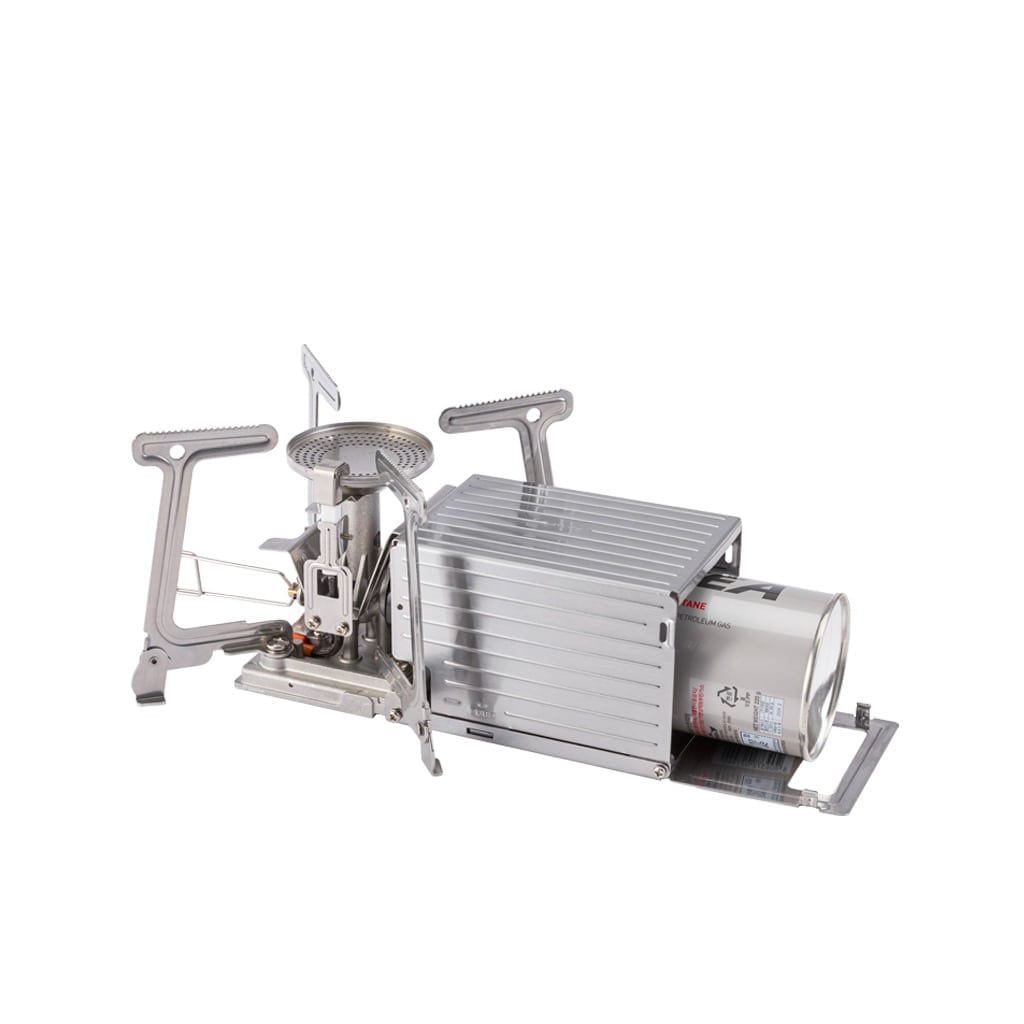
Kovea Deep Dive: The Korean Burner Maker That Took Apart a Swedish Stove — and Now Builds for MSR
Look at the box your Snow Peak LiteMax came in and it says Made in Korea. Kovea started in 1982 when its late founder took apart a Swedish SVEA burner, now supplies MSR and Decathlon, and still earned a 21% operating margin after Korea's camping market halved.
Mooto Deep Dive: Korea Still Dresses Taekwondo — Spain Makes the Part That Scores the Points
World Taekwondo recognises Mooto in six equipment categories. The two it is absent from are the electronic ones — and the scoring system at Tokyo 2020 and Paris 2024 came from Barcelona. A look at the Korean company that dresses the sport Korea exported.
Aurora World Deep Dive: The Korean Company Behind the Plush Toy on Your Shelf
Aurora's plush sits in zoo shops, bookstores and Target aisles worldwide, and its own American website never mentions Korea. A public-information deep dive on the Seoul company that owns its factories, built Palm Pals, and bought a 90-year-old Vermont brand.