Gooun Gamja: What Korea's Baked Potato Snack Is Actually Made Of
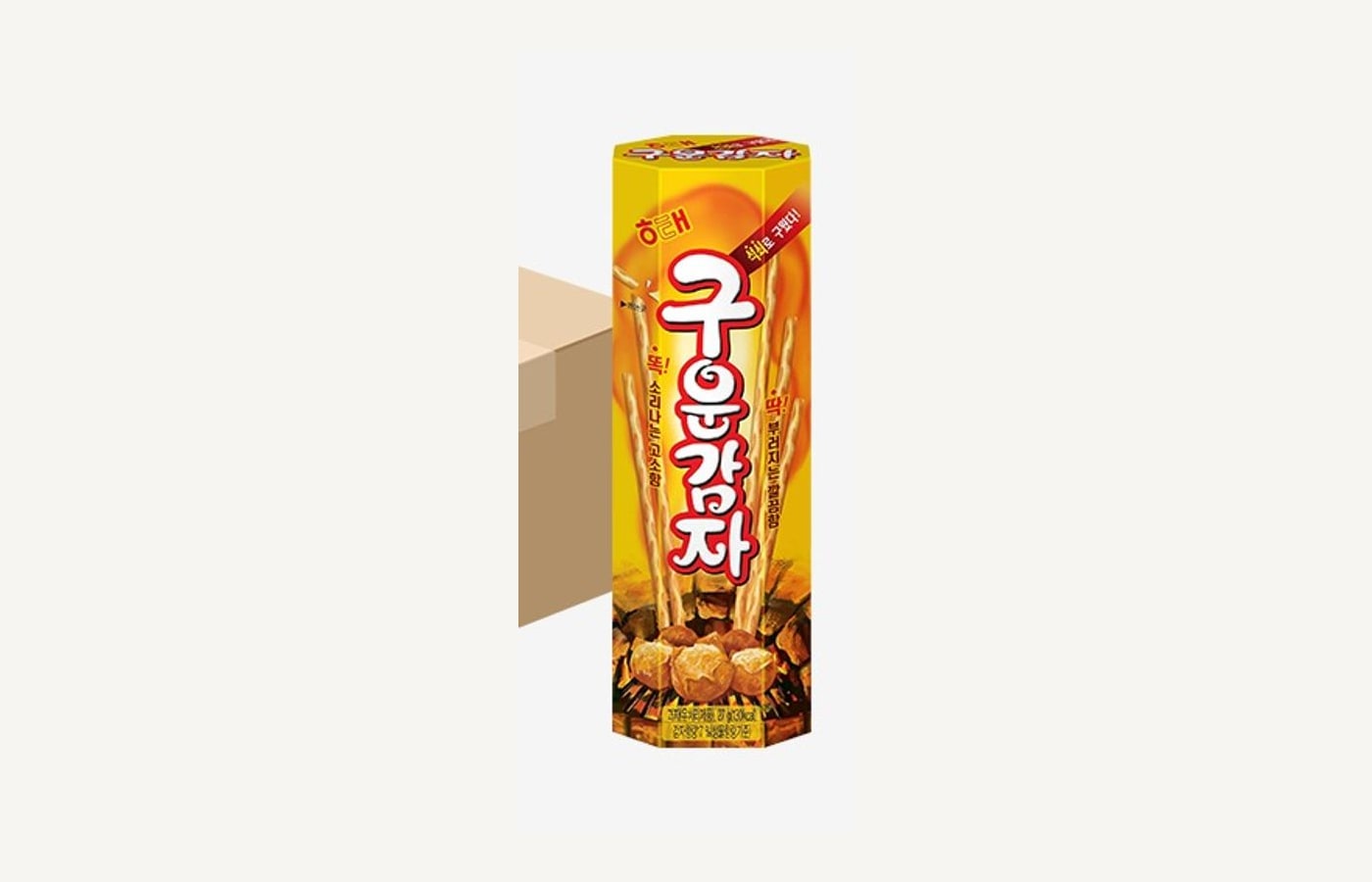
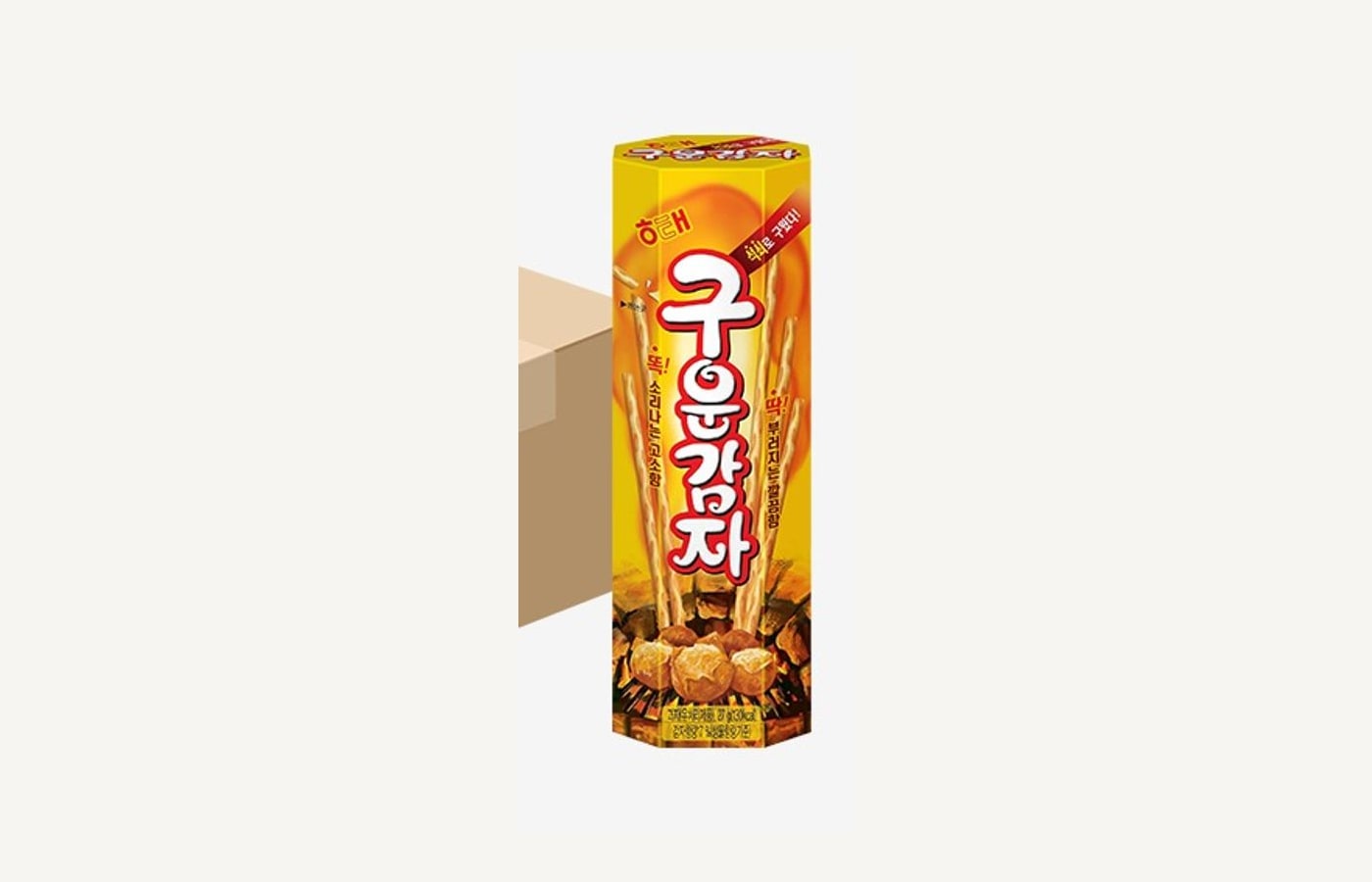
구운감자 — gooun gamja, "baked potato" — is a box of long, very thin, very crisp potato sticks that Haitai has sold in Korea since 1997. It costs about a thousand won, it snaps rather than crunches, and the whole proposition is in the first word: it was baked, not deep-fried.
Koreans search it accordingly. The autocomplete branches around this product are calories, ingredients, and diet — people are trying to work out whether "baked" means what they hope it means.
So this article does the thing nobody has done in English: reads the label.
| Korean name | 구운감자 — literally baked potato |
|---|---|
| Maker | Haitai (해태제과) |
| On sale since | 1997 |
| Form | Long thin sticks in a Pepero-style box; a round-cracker version (슬림) since 2017 |
| Potato content, declared | 32.6% potato starch + 5.2% dried potato powder |
| Fats, declared | Mixed cooking oil (palm olein, palm oil) and margarine |
| Energy | 130 kcal per 27 g bag — roughly 480 kcal per 100 g |
| Price | Around ₩1,000 at a convenience store |
| Slogan | 뚝! 소리 나는 고소함 / 딱! 부러지는 깔끔함 — the snap is the pitch |
Korea Built a Product Line Out of a Cooking Method
Orion Ye Gam baked potato chips on Amazon — on AmazonAffiliate link. As an Amazon Associate, EpicKor earns from qualifying purchases at no extra cost to you.
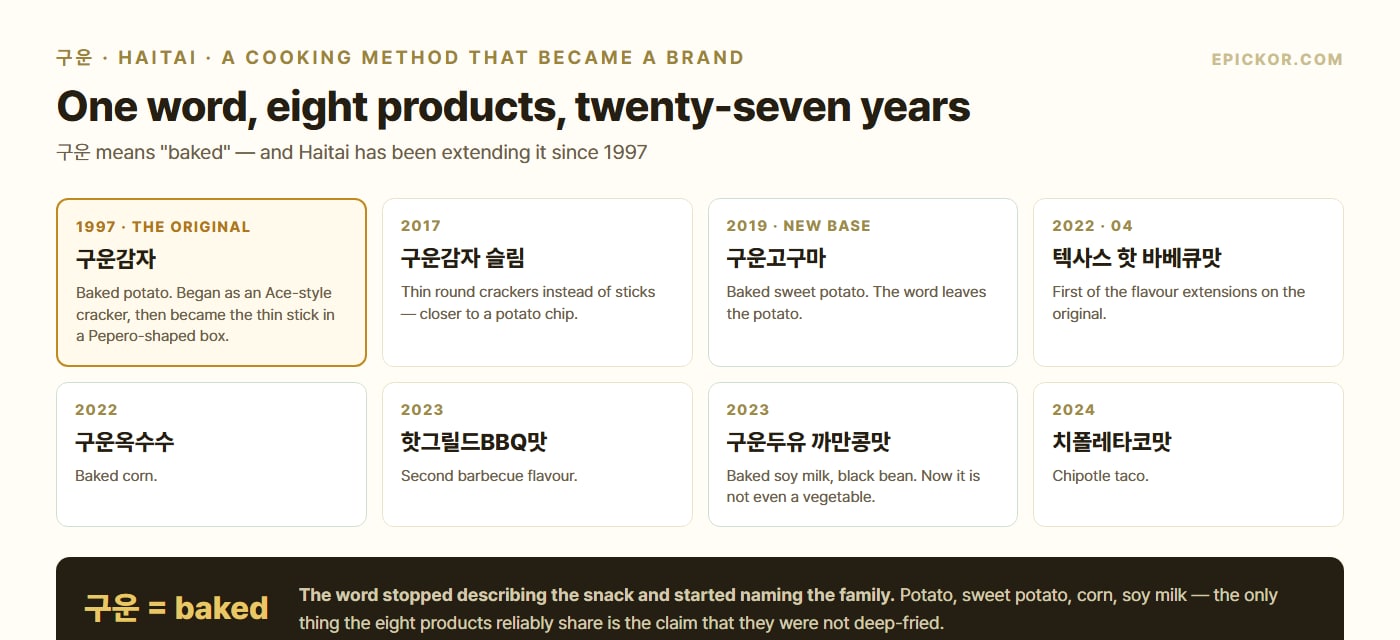
Most snack brands are named after a thing. This one is named after a verb, and Haitai has spent nearly three decades finding out how far that goes.
구운감자 arrived in 1997, first as a cracker resembling Haitai's own Ace, then as the thin stick in a tall box that everyone knows now. 구운감자 슬림 followed in 2017 — round, thin, closer to a potato chip than a stick.
Then the noun started moving. 구운고구마 (baked sweet potato) in 2019. 구운옥수수 (baked corn) in 2022. And in 2023, 구운두유 까만콩맛 — baked soy milk, black bean flavour — at which point the family is no longer held together by a vegetable at all.
Meanwhile the original picked up flavours: 텍사스 핫 바베큐맛 in April 2022, 핫그릴드BBQ맛 in 2023, 치폴레타코맛 in 2024.
The only thing all eight reliably share is the claim that they were not deep-fried. 구운 stopped describing the snack and started naming the family.
You might like: Jagalchi: The Korean Octopus Snack That Contains No Octopus
What "Baked" Actually Buys You
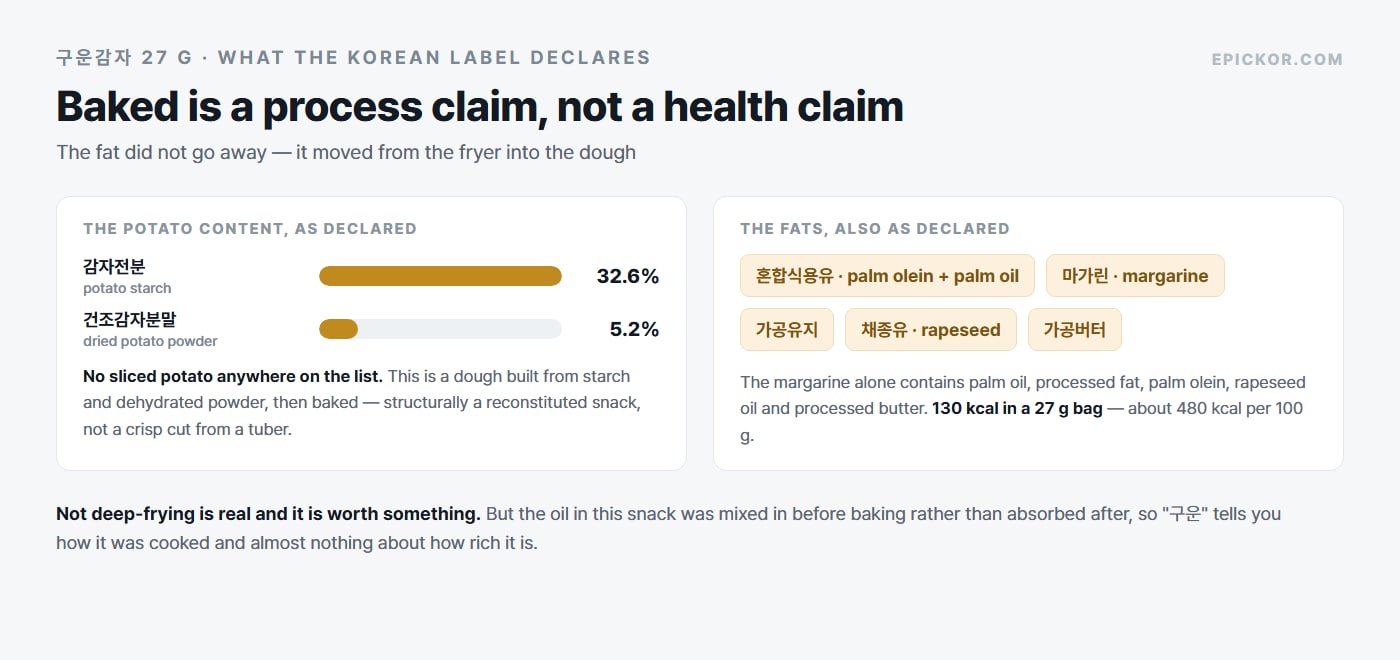
Haitai prints the two key numbers on the front of the box, next to the product name, which is unusual and to the company's credit. Here is the fuller declaration, in order.
감자전분 32.6% — potato starch. 건조감자분말 5.2% — dried potato powder. Then a potato-starch blend (German and Korean starch), a processed-starch preparation from Thailand (tapioca starch, sugar, refined salt), 혼합식용유 — mixed cooking oil, being palm olein and palm oil from Malaysia with rosemary oleoresin — more dried potato powder (American), a grain preparation of wheat flour, glutinous rice and starch, and 마가린.
That margarine is itself palm oil, processed fat, palm olein, rapeseed oil and processed butter.
Two things follow, and they matter in opposite directions.
First: there is no sliced potato in it. The potato arrives as starch and dehydrated powder, which are combined into a dough and baked. That makes this a reconstituted snack, structurally more like a Pringle than a kettle chip — and it is why the sticks are so uniform and snap so cleanly.
Second: not frying it did not remove the fat. In a deep-fried crisp, oil is absorbed during cooking. Here it was mixed into the dough beforehand, along with margarine. The bag runs 130 kcal for 27 g, about 480 kcal per 100 g — lower than a typical fried potato chip, but not by the margin the name suggests.
"구운" is a process claim, and it is true. It is not a health claim, and the label never says it is.
구운감자 itself is not sold on Amazon, and the closest thing that is happens to make the same argument: Orion's 예감 is also baked rather than fried, and its label carries the same kind of percentage the front of a box never advertises. If you want to see whether Korea's non-fried potato snacks are actually different from a crisp, that is the one to test. As an Amazon Associate, EpicKor earns from qualifying purchases at no extra cost to you.
Orion Ye Gam baked potato chips on Amazon
Orion Ye Gam baked potato chips on AmazonWhy the Snap Matters More Than the Flavour
Haitai's own slogan for this product is two onomatopoeic lines and a name: 뚝! 소리 나는 고소함 / 딱! 부러지는 깔끔함 / 구운감자. Roughly: nuttiness that goes 뚝, cleanness that snaps 딱.
That is unusual copy. Most snack advertising sells flavour. This one sells two sounds.
It is also accurate about what the product is for. The stick is very thin and very dry, so it breaks in a single clean fracture rather than crumbling — and because there is no seasoning powder and no oily surface film, it does not leave anything on your fingers. That is a specific and underrated property. It is why the box lives in office drawers, why it goes into children's snack boxes, and why Korean reviewers describe it as 담백 — plain in a way that is meant as praise rather than a complaint.
The trade-off is that it is genuinely quiet in flavour. If you are coming from a heavily seasoned chip, the first stick will read as underwhelming. That is the design, and it is why Haitai eventually added barbecue and chipotle versions for people who wanted the opposite.
The Pepero Day Loophole
Every 11 November, Korea observes 빼빼로 데이 — Pepero Day, named for Lotte's thin chocolate-coated biscuit sticks, on the date whose digits look like four sticks standing in a row. People give each other boxes of Pepero. It is the single largest confectionery day in the Korean calendar and it belongs entirely to one company's product.
구운감자 is also a long thin stick in a tall box.
So a small counter-tradition exists: buying 구운감자 instead of Pepero on Pepero Day. Sometimes it is a joke about not wanting to enrich Lotte, sometimes it is just for people who do not want chocolate, and sometimes it is a genuine preference — the snap of a baked potato stick is a different pleasure from a soft biscuit under chocolate.
If you are in Korea in early November and you want to take part in the ritual without buying the obvious thing, this is the local move.
You might like: Badacoconut: The Korean Biscuit That Survived by Spelling Its Own Name Wrong
What to Buy, and What It Costs
The small box is around ₩1,000 at a convenience store, in 24 g and 27 g sizes. That is cheap even by Korean snack standards and is part of why it is a fixture in school bags and office drawers.
슬림 is the one to get if you want a chip. The 2017 round-cracker version behaves like a potato crisp — flat, wide, snappable — while the original is a stick you eat like a breadstick. They taste similar and feel completely different.
Bulk exists and is popular with institutions. 240 g and 405 g multipacks, and 24-count and 36-count boxes, are sold specifically into daycares, schools, after-school programmes and office pantries. If a Korean office has one snack in the cupboard, there is a decent chance it is this.
The barbecue and chipotle versions are seasoning-powder variants on the same stick, not different products. Try the plain one first — the whole point of it is being 담백, plain and clean-tasting, which the flavoured versions deliberately give up.
Honest Notes
The name will mislead an English speaker more than a Korean one. 구운감자 in ordinary Korean means an actual baked potato, the vegetable. Nobody in Korea is confused about which one is in the box. Translated onto an export label as "Baked Potato Snack," it reads more like a claim than it does in Korean.
It contains wheat, milk and soy. The declared allergens are 밀, 우유 and 대두 — worth knowing, because "potato snack" does not imply any of the three, and the wheat is in there as a structural ingredient.
It is not a low-calorie food. About 480 kcal per 100 g. A 27 g bag at 130 kcal is a reasonable single portion; a 240 g bulk bag is not a single portion, and it is very easy to treat it as one.
English-language search will fight you. "Korean baked potato snack" drifts toward sweet potato products, which are a separate and much better-known Korean category. If you want this specific thing, search Haitai Baked Potato or 구운감자.
The sister products are genuinely different snacks. 구운고구마 and 구운옥수수 share the process and the branding, not the recipe. Liking one tells you very little about the others.
If it is the Pepero-shaped stick format you want, the original is easy to find abroad and worth comparing side by side — the difference between a soft biscuit under chocolate and a hard baked potato stick is the whole reason the substitution exists.
FAQ
Q: Is 구운감자 actually baked? A: Yes — it is not deep-fried, which is the product's founding claim. But oil and margarine are mixed into the dough before baking, so it is not low in fat. About 480 kcal per 100 g.
Q: How much real potato is in it? A: The label declares 32.6% potato starch and 5.2% dried potato powder, plus a further potato-starch blend. There is no sliced potato — it is a dough, baked.
Q: What does it taste like? A: 고소하고 담백 — nutty and plain, without a strong seasoning. The selling point is texture: it snaps hard and cleanly, which is what the slogan is about.
Q: What is 구운감자 슬림? A: A 2017 version in thin round crackers rather than sticks. Same idea, chip-like format.
Q: Why do Koreans buy it on Pepero Day? A: Because it is also a long thin stick in a tall box, so it works as a substitute for people who do not want chocolate or do not want to buy the Lotte product.
Sources Checked
- Korean-language reference sources for Haitai's production of 구운감자 since 1997, the original Ace-style cracker form and the later Pepero-style stick box, the 뚝! 소리 나는 고소함 / 딱! 부러지는 깔끔함 slogan, the roughly ₩1,000 convenience-store price, the Pepero Day substitution custom, and the product line: 구운감자 슬림 (2017), 구운고구마 (2019), 텍사스 핫 바베큐맛 구운감자 (April 2022), 구운옥수수 (2022), 핫그릴드BBQ맛 구운감자 (2023), 구운두유 까만콩맛 (2023) and 치폴레타코맛 구운감자 (2024).
- The product box itself, which prints 과자류(감자스틱) 27 g (130 kcal) with 감자전분 32.6% and 건조감자분말 5.2% on the front panel — the two figures this article is built on are front-of-pack, not buried.
- A Korean transcription of the 27 g product label for the fuller ingredient declaration: 감자전분 32.6%, 건조감자분말 5.2%, the potato-starch blend of German and Korean starch, the Thai processed-starch preparation, the mixed cooking oil of Malaysian palm olein and palm oil with rosemary oleoresin, American dried potato powder, the grain preparation of wheat flour, glutinous rice and starch, the margarine of palm oil, processed fat, palm olein, rapeseed oil and processed butter, and the declared allergens 밀, 우유 and 대두.
- Korean nutrition databases for 130 kcal per 27 g bag.
- Korean retail listings for the 24 g and 27 g single packs and the 240 g and 405 g bulk formats sold to daycares, schools and offices.
Ingredients and formulations change; the packet in your hand is the authority. Verified August 2026.
You Might Also Like
Hetbahn: What Korea's Instant Rice Is Made Of, and How to Heat It Without a Microwave
햇반 is 99.9% Korean rice and water plus 0.1% rice bran extract, sealed in a room cleaner than a hospital ward. The lid prints three cooking times and one of them needs no microwave at all. Prices, varieties, and the mistake almost everyone makes with the film.
Korean Food Prices in August 2026: What Already Rose, and What Changes on the 25th
Four Korean food makers raised prices within three weeks, and Paris Baguette's 127-item increase lands on 25 August. The exact brands, dates and won amounts, why wheat and corn are behind it, and what it actually changes for a visitor.
Kkokkalcorn: Korea's Cone Snack, and Why Each Convenience Store Has a Different Flavor
Lotte split one snack across three convenience store chains on purpose, and Koreans started touring stores to collect all four flavors. Which chain has which, what 꼬깔콘 costs in August 2026, and why the convenience store is the worst value per gram.