Cham Bungeoppang: The Korean Fish Snack That Is Four Different Fish Abroad
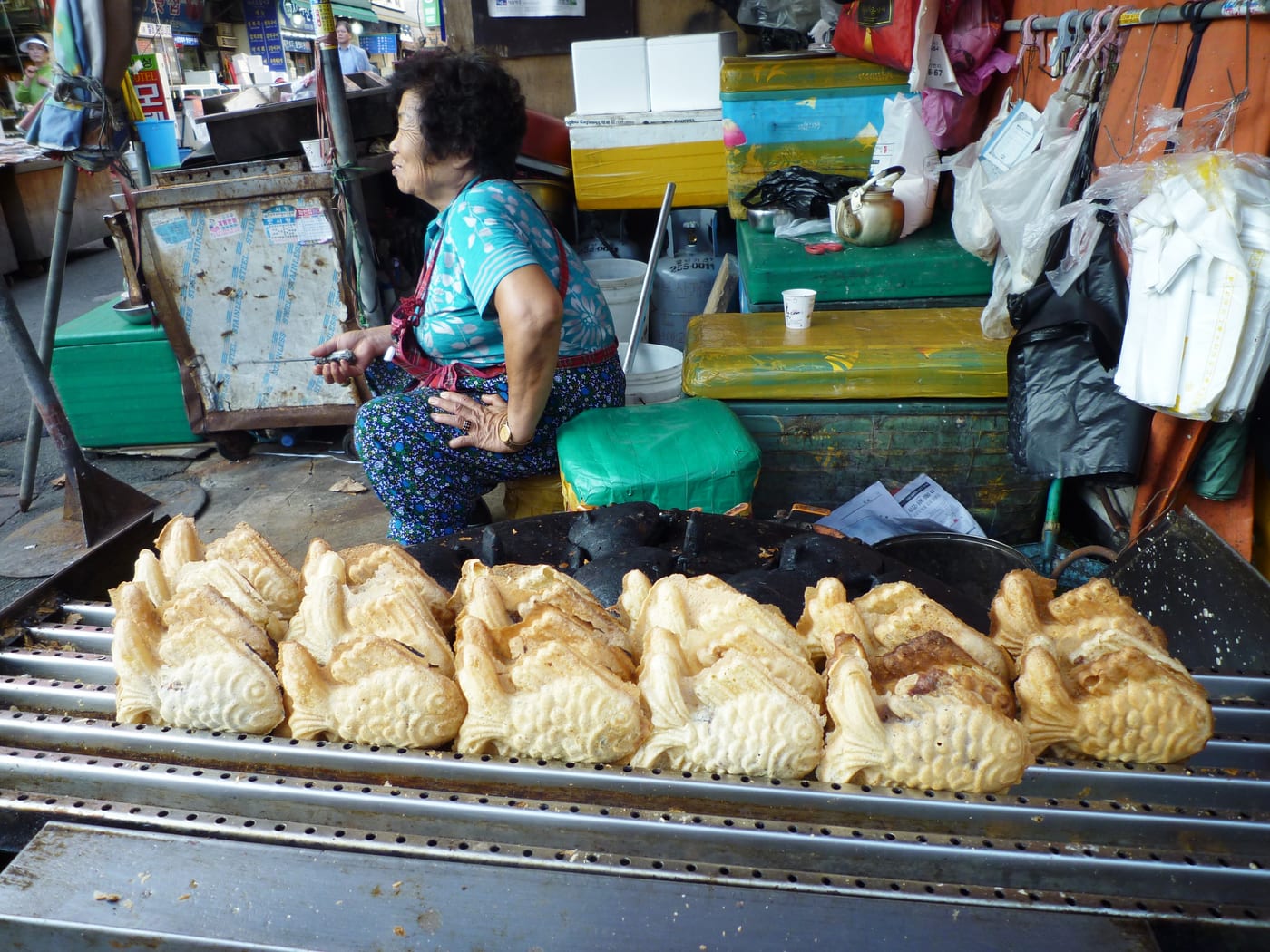
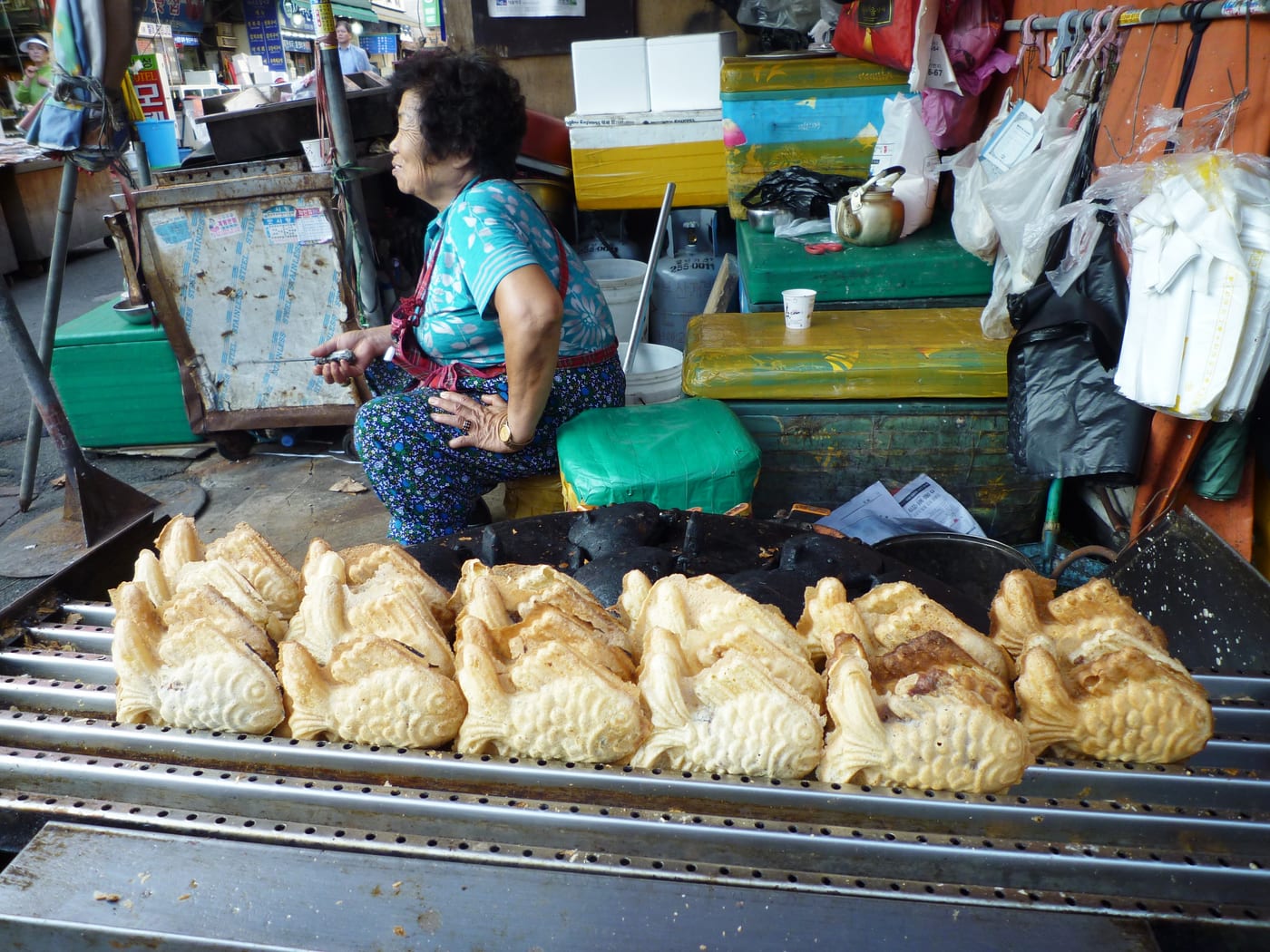
붕어빵 is Korea's great winter street pastry: a fish-shaped batter cake filled with sweet red bean, cooked in a hinged iron mould on a cart, handed over hot in a paper bag. It is seasonal, it is cash-only, and increasingly it is hard to find — which is why Koreans invented a word for living near one.
참붕어빵 is what happens when a confectionery company decides that should not be a limitation.
Orion boxed the thing in 2011, deliberately launched it in May, sold 640 million packs in Korea alone, and then sent it abroad under three completely different names — each one reaching for a different country's fish.
| Korean name | 참붕어빵 — full name 쫀득쫀득~ 참붕어빵 |
|---|---|
| Literally | "True carp bread" — 붕어 is a crucian carp |
| Maker | Orion (오리온) |
| Launched | May 2011 — before summer, for a winter food |
| What it is | A fish-shaped soft cake with glutinous rice cake and chocolate cream inside — not bread |
| Box | 348 g, 1,452 kcal, 찹쌀떡 6.37%, and the count is printed as 12마리 |
| Sold in Korea | Over 640 million packs cumulative |
| Sold abroad as | 小鱼糯糯 (China) · Bống Bang (Vietnam) · Bungo (Russia) |
붕세권: Why a Boxed Bungeoppang Is Not a Downgrade
Korean has a family of words built on 역세권, "station catchment" — the desirable property of living within walking distance of a subway station. From it, half-jokingly, came 붕세권: the catchment area of a bungeoppang cart.
The word exists because the carts have become scarce. They are seasonal, they are informal, the cost of red bean and flour has risen, and in any given winter Korean media runs a story about how few are left and how much a single fish now costs. There are crowd-sourced maps for finding them.
Against that, a boxed version that is available in July, at a fixed price, in every convenience store in the country, is not a sad substitute for the real thing. It is solving the actual problem, which is that the real thing is not there when you want it.
Orion's own framing has been exactly this from the start: a winter street snack turned into something you can eat 사시사철 — in all four seasons.
You might like: Samanco: Korea's Fish-Shaped Ice Cream Is Named "Cheap and Plentiful"
Released in May, on Purpose
The launch is the part that gets retold in Korean coverage, because it looks like a mistake and was not.
참붕어빵 went on sale in May 2011 — heading into summer, with a product whose entire reference point is a food Koreans eat in freezing weather. Korean write-ups call it a 역발상, a deliberate inversion.
It worked immediately. The product sold out as fast as it could be shelved, and the launch is remembered in Korea as a stock shortage rather than a launch.
The logic is the same as the 붕세권 point. In December you can buy the real thing. In May you cannot, and nobody else was selling one.
You might like: Tornado Potato: The Korean Invention Everybody Thinks Is Generic Fair Food
팥붕 or 슈붕: Korea's Oldest Snack Argument
Ask Koreans what belongs inside a bungeoppang and you will start an argument that has been running for decades.
팥붕 is red bean — the original, the traditionalist position. 슈붕 is 슈크림, custard cream — the modern one. People genuinely identify as 팥붕파 or 슈붕파, cart signs specify which they sell, and the debate resurfaces every winter with the reliability of a public holiday.
If custard is the side you land on, Korea already sells that year-round and underground: Deli Manjoo (델리만주) is the same warm-mould-and-custard idea in a corn shape, made to order inside subway stations instead of on a winter cart.
Orion's approach to this national question was to refuse to answer it.
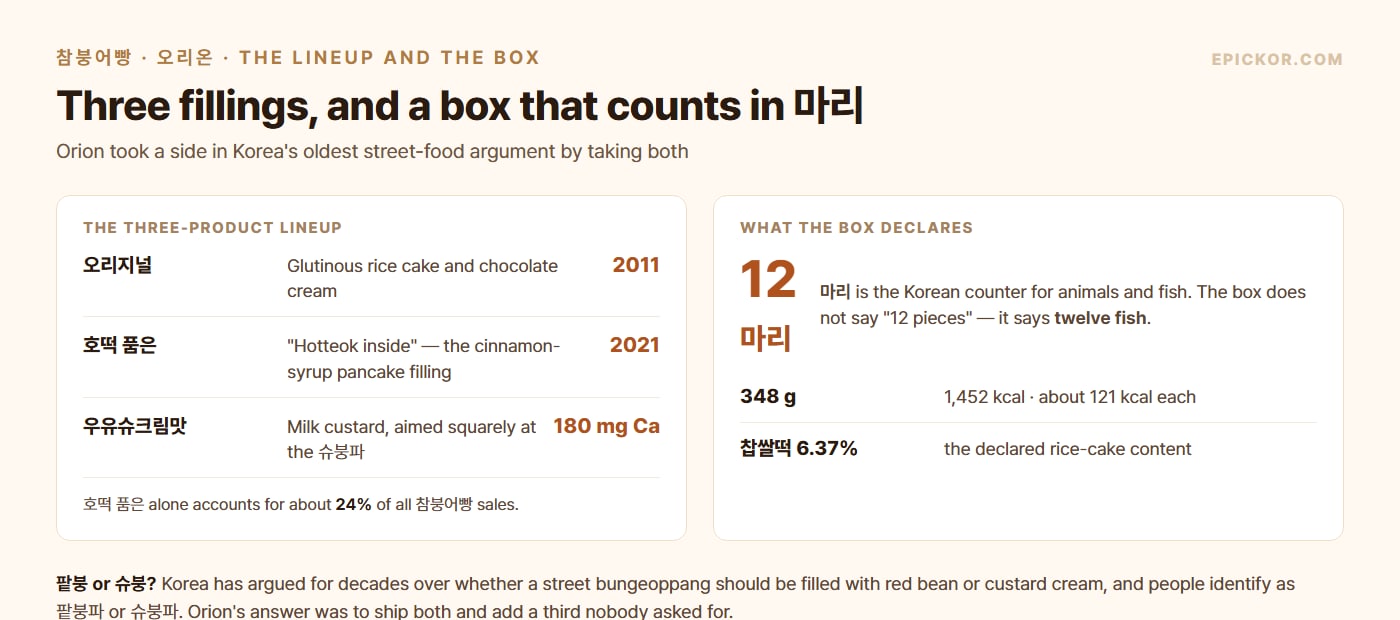
The original 참붕어빵 (2011) contains glutinous rice cake and chocolate cream — already a third position, since street bungeoppang contains neither.
호떡 품은 참붕어빵 (2021) — "hotteok inside" — borrows the filling of Korea's other great winter street food, the cinnamon-syrup pancake. It now accounts for roughly 24% of all 참붕어빵 sales, which is a remarkable share for a variant.
참붕어빵 우유슈크림맛 goes directly at the 슈붕파, with milk custard, and adds an argument neither cart can make: 180 mg of calcium per 29 g piece, about a glass of milk, pitched at parents buying snacks for growing children.
That is three products, none of which is 팥붕.
Four Countries, Four Fish
This is the part that makes 참붕어빵 worth writing about rather than just eating.
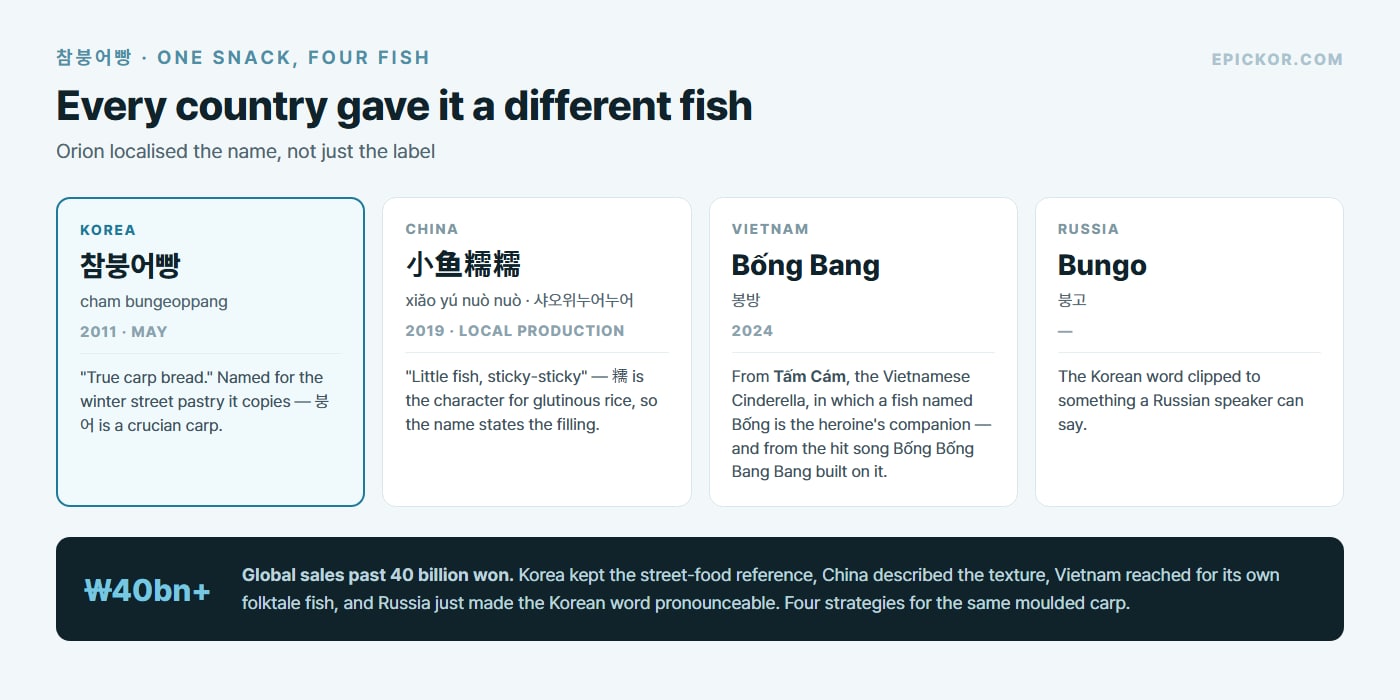
Orion did not translate the name into other markets, and it did not romanise it either. It replaced the fish.
China, 2019 — 小鱼糯糯 (xiǎo yú nuò nuò). Local production began that year. The name means roughly "little fish, sticky-sticky," and 糯 is the character used for glutinous rice — so the Chinese name describes the texture the Korean name leaves implied. Cumulative sales there passed ₩40 billion by early in the reporting year.
Vietnam, 2024 — Bống Bang (봉방). This is the elegant one. Tấm Cám is Vietnam's Cinderella story, and in it the heroine's companion and protector is a fish named Bống. The name also points at Bống Bống Bang Bang, an enormous Vietnamese pop hit built on that tale. So a Korean snack shaped like a Korean street pastry entered Vietnam named after a Vietnamese folktale fish and a song everyone already knew.
Russia — Bungo (붕고). No folklore here: the Korean word simply clipped into something a Russian speaker can say.
Four markets, four strategies. Korea kept the street-food reference, China described the filling, Vietnam borrowed its own mythology, and Russia just made the word pronounceable.
You might like: Jagalchi: The Korean Octopus Snack That Contains No Octopus
If you want the real thing rather than the boxed one, the pan is the whole technology — a hinged cast-iron fish mould, unchanged for decades, and the reason a cart can turn out a fish in ninety seconds. As an Amazon Associate, EpicKor earns from qualifying purchases at no extra cost to you.
The Box Counts Them in 마리
Korean uses different counter words for different kinds of thing: 개 for objects, 명 for people, 마리 for animals and fish.
The 참붕어빵 box does not say 12개. It says 12마리 — twelve fish.
It is a joke, and it is the single most Korean thing about the packaging. But it also tells you what the product is claiming to be: not twelve pieces of confectionery, but twelve of the thing you would have bought from a cart, if a cart had been there.
The rest of the box is more literal. 348 g, 1,452 kcal — about 121 kcal per fish — and 찹쌀떡 6.37%, the declared glutinous-rice-cake content. The English strapline is MOIST & CHEWY CAKE, and cake is the accurate word: this is a soft sponge, not the crisp-edged batter of a street bungeoppang.
It Has Quietly Become a Souvenir
Something happened to this product that Orion did not plan.
Word spread on social media outside Korea, and 참붕어빵 turned into what Korean coverage now calls a 한국여행 필수 기념품 — an essential Korea-travel souvenir. It is cheap, it is unmistakably fish-shaped, it survives a suitcase, and it is bought by the box for colleagues and family.
The data behind that is specific: in supermarkets in Seoul Station and Myeongdong — the districts where foreign visitors actually shop — Orion measured sales up more than 20% year on year, against a national rise of over 40% in the same January–February window.
And the company has responded in the most direct way possible. It is producing a 참붕어빵 코리아 에디션 for Seoul's main tourist districts, with the fish dressed in traditional costume — 선비 the scholar, 각시 the bride, 도령 the young gentleman.
If you are reading this before a trip to Korea, that edition was made for you specifically. Which is either charming or slightly unnerving, depending on your mood.
Honest Notes
It is not a bungeoppang and it does not pretend to be. The street version is a thin crisp batter shell around hot red bean, eaten within a minute of leaving the mould. This is a soft, sweet, shelf-stable cake with rice cake and chocolate cream in it. Liking one tells you nothing about the other.
Early versions were not good. Korean commentary is candid that the original was greasy and heavily nitrogen-padded, and that it took years to become genuinely pleasant. If you tried it a decade ago and dismissed it, it is a different product now.
121 kcal per fish adds up quickly. They are small and they are individually wrapped, which is exactly the combination that makes people eat four.
호떡 품은 is the one to try if you only try one variant. A quarter of all sales is a strong verdict, and the cinnamon-syrup filling is further from what you can buy elsewhere than the custard version is.
The Hanaro Mart exclusivity thing is real. Some variants have launched into a single retail chain first, so a flavour existing does not mean the shop in front of you has it.
참붕어빵 초코붕 is discontinued. It replaced the red bean with chocolate cream. If you find it referenced online, it is no longer made.
Orion's own boxes are hard to find outside Korea, but the format is not — a Korean maker sells 참붕어빵 on Amazon in eight individually wrapped pieces, same fish shape, same chewy rice-cake centre. It is not the Orion box this article is about, and the filling is cream rather than Orion's chocolate-and-rice-cake original, so treat it as a way to find out whether you like the texture before committing suitcase space on a trip.
Cham Bungeoppang, eight pieces, on Amazon
Cham Bungeoppang, eight pieces, on AmazonFAQ
Q: Is 참붕어빵 the same as street bungeoppang? A: No. Street 붕어빵 is a hot, thin-shelled batter cake filled with red bean, made to order on a cart in winter. 참붕어빵 is a shelf-stable soft cake with glutinous rice cake and chocolate cream, sold year round.
Q: Why was it launched in May? A: Deliberately. Korean coverage calls it a 역발상 — releasing a winter food heading into summer, when nobody else was selling one. It sold out as fast as it was shelved.
Q: What does 12마리 mean on the box? A: Twelve fish. 마리 is the Korean counter for animals, not objects — the packaging counts the snacks as if they were live carp.
Q: What is it called outside Korea? A: 小鱼糯糯 in China (local production from 2019), Bống Bang in Vietnam (from the Tấm Cám folktale, 2024), and Bungo in Russia. Global sales have passed ₩40 billion.
Q: 팥붕 or 슈붕? A: Neither, in the original — it has chocolate cream. Orion later added a milk-custard version for the 슈붕파, with 180 mg of calcium per piece.
Sources Checked
- Korean-language reference sources for the 2011 Orion launch, the full product name 쫀득쫀득~ 참붕어빵, the composition as a fish-shaped cake with 찹쌀떡 and chocolate cream, roughly 121 kcal per piece, the 6-piece and 8-piece formats, the discontinued 참붕어빵 초코붕, the 호떡 품은 and 슈크림 variants with the latter's Hanaro Mart exclusivity, the early criticism of greasiness and nitrogen padding, the 송창식 advertising jingle, and the 2024 Vietnam launch as 봉방 (Bống Bang) named from the Tấm Cám folktale and the song Bống Bống Bang Bang.
- Korean business press for the May 2011 launch timing as a deliberate 역발상 and the immediate sell-out, cumulative Korean sales passing 640 million packs, the year-on-year January–February rise of over 40%, the 20%-plus rise in supermarkets around Seoul Station and Myeongdong, 호떡 품은 참붕어빵 (2021) accounting for about 24% of total 참붕어빵 sales, and Chinese local production from 2019 as 샤오위누어누어 (小鱼糯糯) with cumulative sales passing ₩40 billion.
- Korean news coverage of the 참붕어빵 우유슈크림맛 launch for the 팥붕파 / 슈붕파 positioning, the 180 mg of calcium per 29 g piece, the three-product lineup, the localised brand names in China, Vietnam and Russia, the global sales figure past ₩40 billion, the "한국여행 필수 기념품" framing, and the planned 참붕어빵 코리아 에디션 with 선비, 각시 and 도령 costumes for Seoul tourist districts.
- The product box for 348 g / 1,452 kcal, 찹쌀떡 6.37%, the 12마리 count and the MOIST & CHEWY CAKE strapline.
Korean snack prices and lineups change by retailer and season. Verified August 2026.
You Might Also Like
Tornado Potato: The Korean Invention Everybody Thinks Is Generic Fair Food
The spiral potato on a stick has a named inventor, a debut date in Myeongdong, and patents in six jurisdictions. 회오리감자 was designed in Korea in 2006, and the word itself is a trademark — which is why Korean vendors write 스프링감자 instead.
Postick: The Korean Snack That Used to Come With a Ketchup Packet
Postick (포스틱) has been on Korean shelves since 1980, it is only 23% potato, and it shipped with a ketchup sachet until the sachet got too expensive. What it costs now, and the ramyun-powder trick Koreans use on it.
Korean McDonald's: Why the Burgers Are Named After Farm Counties, and What to Order Now
McDonald's Korea has bought 459.2 tonnes of named Korean produce since 2021 and prints the county on the burger — Changnyeong garlic, Jindo spring onion, Jinju pepper. 24 million sold, ₩61.7 billion of measured regional value. Here is what is on the menu now.