Orion Squid Peanut: Korea's Beer Snack Is Coated Twenty-Eight Times
Last updated: 18 August 2026
Two questions come up every time somebody outside Korea opens a bag of 오징어땅콩 (ojingeo-ttangkong, "squid peanut"), and both have better answers than the internet gives them.
Is there actually squid in it? Yes — and the form it takes explains the whole product.
Why does it crunch like that? Because a machine wrapped each peanut roughly twenty-eight times and then counted.
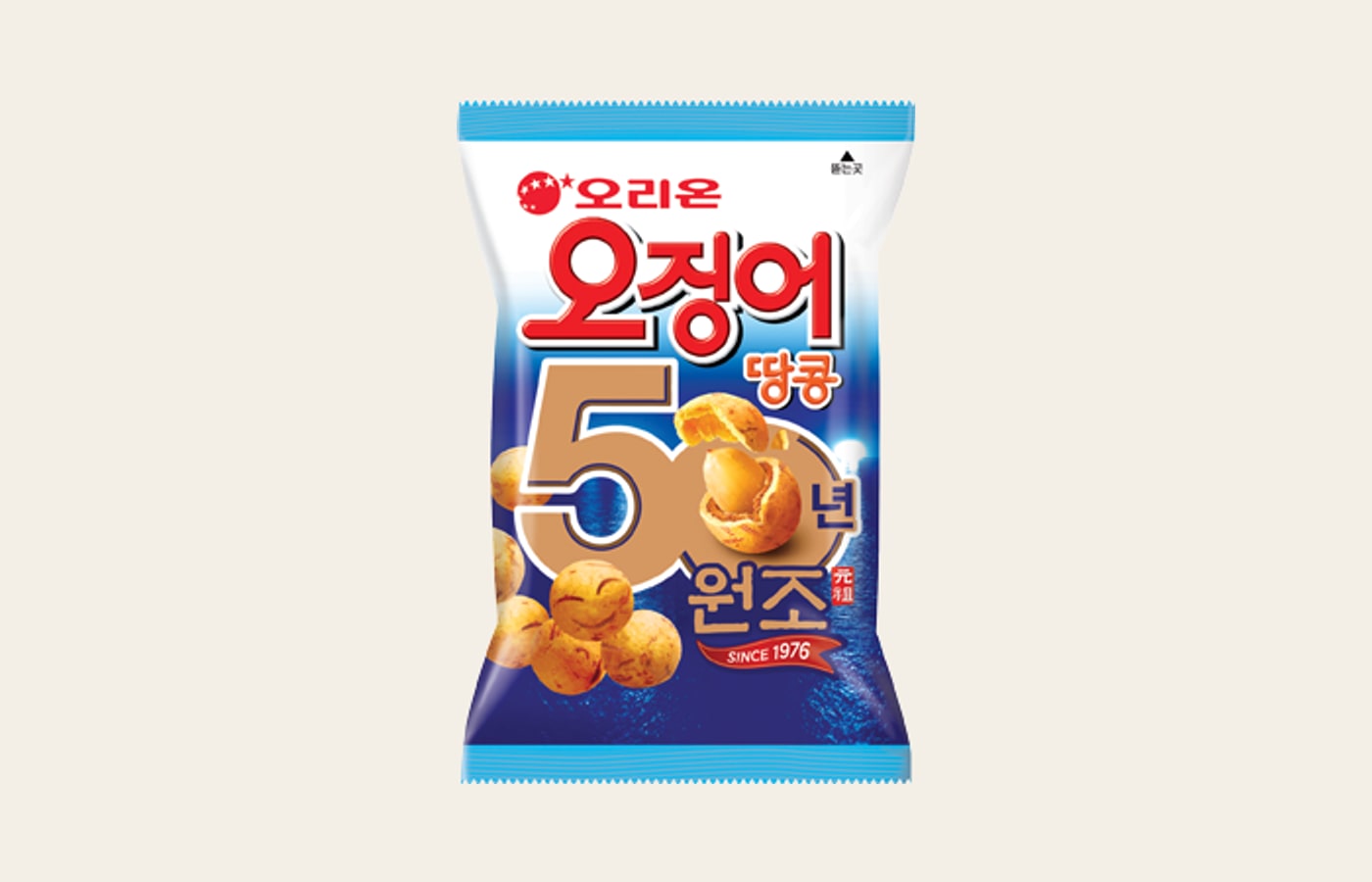
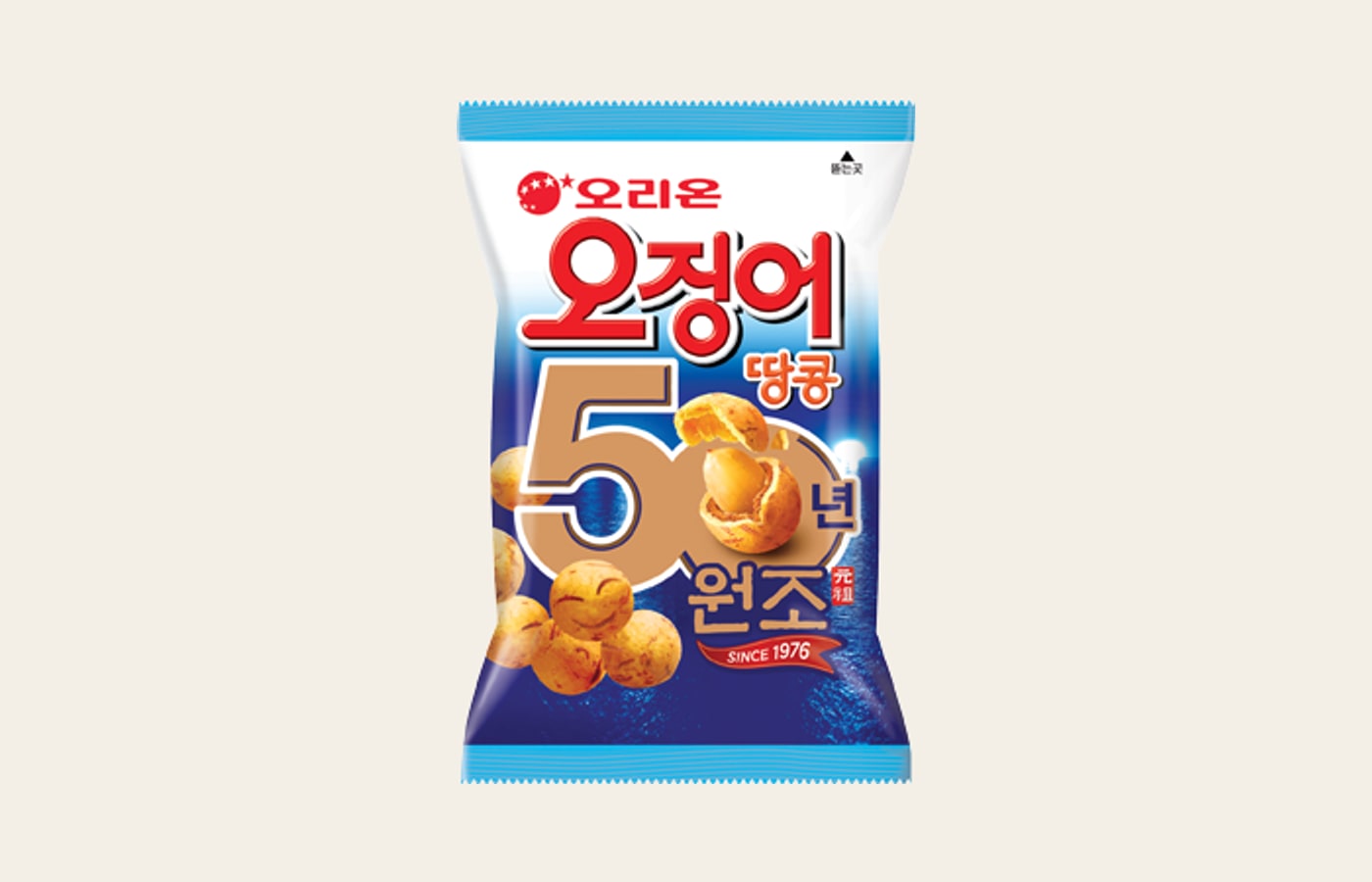
Orion launched it in 1976, which made 2026 its fiftieth year, and the company marked it by putting "50년 원조" — fifty years, the original — in large type on a redesigned bag. Here is what is inside, what the brown markings are, and why an old people's beer snack suddenly acquired an audience in their twenties.
| Detail | |
|---|---|
| Korean name | 오징어땅콩 (ojingeo-ttangkong) |
| Maker | 오리온 (Orion) |
| Launched | 1976 — 50th anniversary marked March 2026 with a package redesign |
| The core | A Spanish-type peanut: round rather than oval, chosen for uniform size |
| The build | About 28 coats of batter, then baked — 27 for a big peanut, 29 for a small one |
| The crunch | A 그물망 구조, a net-like lattice that forms as the layers bake |
| The squid | Real 오징어채 strips, 0.2 mm or thinner, on the outside, with shrimp extract |
| Seasoning | Salt only. No seasoning powder is sprayed on the surface. |
| Typical price | ₩3,000 for the 202 g supermarket bag · from ₩960 for a 98 g bag bought online in bulk |
| Eaten with | Beer. This is 안주 before it is a snack. |
If you only remember one line: the squid is a coating measured in tenths of a millimetre, which is exactly why it does not taste like squid.
The Number Is Twenty-Eight, and It Is Not Fixed
This is the fact worth knowing, and Korean manufacturing coverage lays it out plainly.
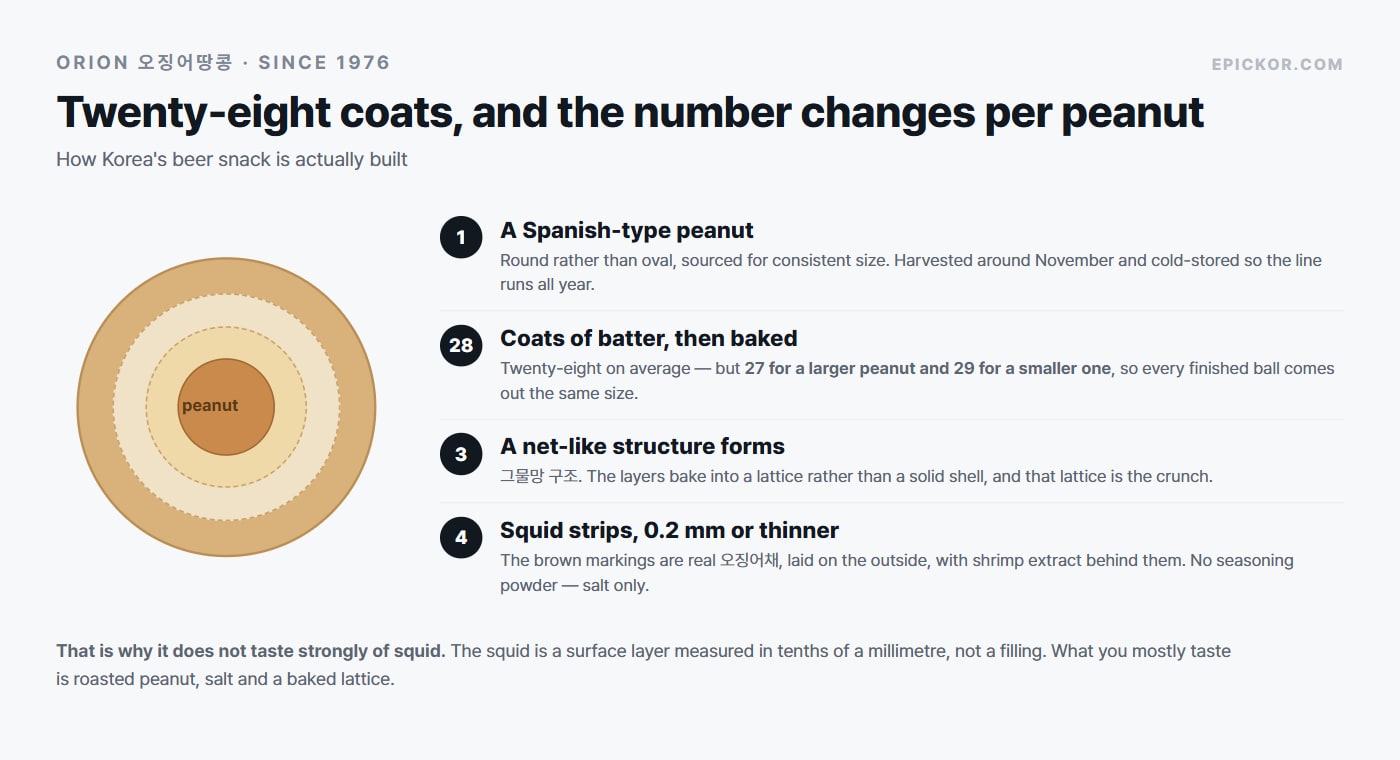
A peanut goes into the machine and comes out wrapped in an average of 28 thin coats of batter, which are then baked. That is not a rounded figure for effect — it is an average, because the count is adjusted to the peanut. A larger nut gets about 27 coats. A smaller one gets about 29. The point is that every finished ball leaves the line at the same diameter regardless of what it started as.
The baking is where the texture comes from. Twenty-eight thin layers do not fuse into a solid shell; they set into what Orion calls a 그물망 구조, a net-like lattice with air in it. That lattice is why the snack shatters rather than cracks, and it is why a thicker coating of the same batter would produce something completely different to eat.
Orion 오징어 땅콩, box of seven, on Amazon — on AmazonAffiliate link. As an Amazon Associate, EpicKor earns from qualifying purchases at no extra cost to you.
Yes, There Is Squid. No, You Will Not Taste Much of It.
The brown markings on the surface are the part everyone asks about, and they are not printed.
They are 오징어채 — dried shredded squid — laid on as strips 0.2 mm thick or less, with shrimp extract behind them to push the seafood note further. That is real squid on a real snack, and it is also almost nothing by weight.
Which resolves the argument. People who say "there is no squid in it" are wrong about the ingredient and right about the experience. A film two tenths of a millimetre thick cannot dominate a mouthful of roasted peanut and baked batter. What you taste is peanut, salt and lattice, with a marine note underneath that most people read as vaguely seafood rather than specifically squid — closer to takoyaki than to a squid steak.
The other half of that restraint is what is not on it. No seasoning powder is sprayed on the surface at all. The only seasoning is salt. In a snack aisle where almost everything arrives dusted in flavour, that is a deliberate and slightly old-fashioned choice, and it is why the bag does not leave your fingers orange.
The Peanut Is Chosen, Not Just Bought
Orion does not use the flat oval peanut most people picture. It uses a Spanish type — small and round — for a mechanical reason rather than a culinary one: a round core coats evenly as it tumbles, and an oval one does not.
The supply chain is built around consistency too. The crop is harvested around November and held in refrigerated storage so the line can run the same peanut all year rather than following a season. When the whole product is a size-controlled sphere, the thing you cannot afford is a nut that varies.
You might like: Matdongsan: Korea's Peanut Crunch Snack, and Why It Was Pulled for Selling Too Well
Also: Jayu Sigan — the Korean chocolate bar designed to leave no evidence
Fifty Years of Flavours That Did Not Stick
Orion has tried repeatedly to extend the line, and the record is unusually one-sided.
고로케땅콩 (croquette) arrived in 2018. 마라맛 followed in 2019, riding the Sichuan-peppercorn wave that was reshaping Korean snacks at the time. 구운김땅콩, roasted seaweed, came in 2022. 불오징어땅콩 — fire squid — in 2024. Before all of those there were wasabi (알싸한맛), a plain 매운맛, a soy-wasabi version relaunched after a factory fire in 2016, and a gochujang-mayo.
Almost none of them survived. The one extension currently holding shelf space is 핫스파이시, launched 2023 as a convenience-store line.
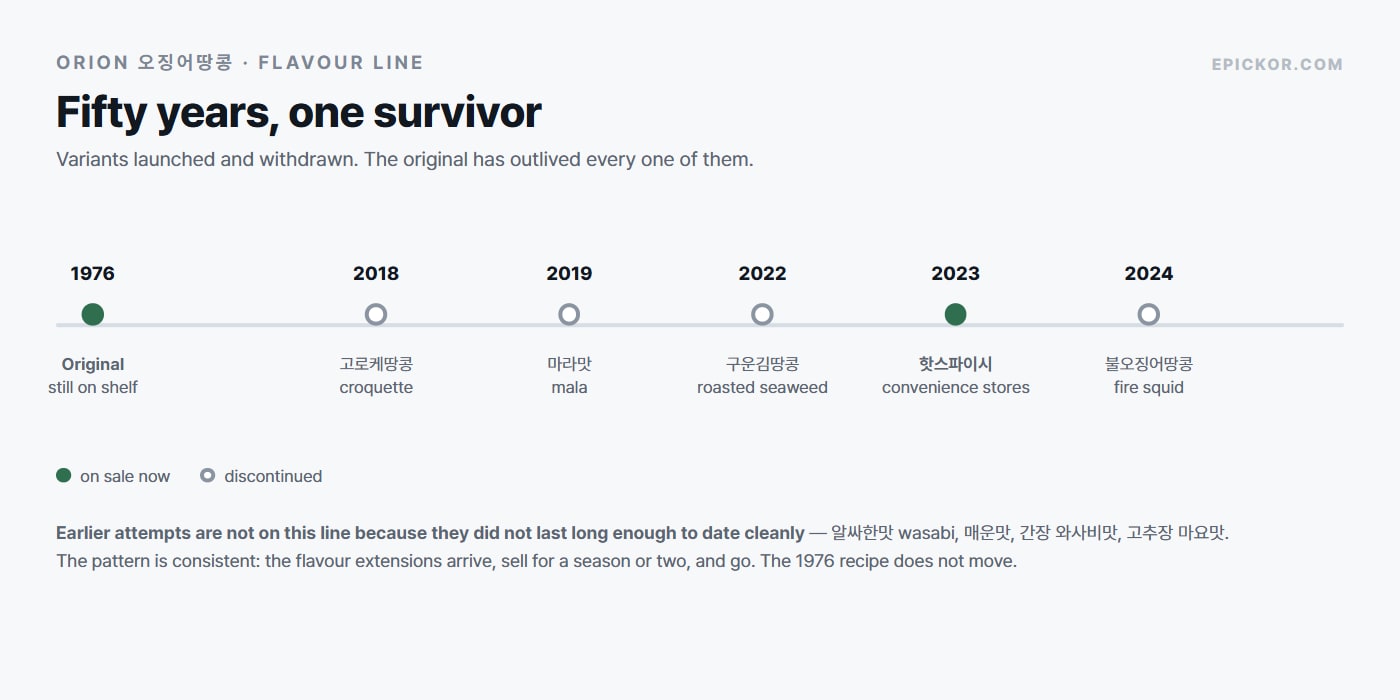
There is a reason the original resists replacement, and it is structural rather than sentimental. The product's whole appeal is a restrained one — salt, peanut, a thin marine note, and texture. Every flavour extension works by adding a powder to the surface, which is precisely the thing the original deliberately does not do. You cannot make a mala version without breaking the rule that makes it good.
Stocking a Korean snack shelf? 오징어땅콩 is the one to try if you have already done the sweet Korean snacks and want the savoury, beer-adjacent end of the aisle. As an Amazon Associate, EpicKor earns from qualifying purchases at no extra cost to you.
Orion 오징어 땅콩, box of seven, on Amazon
Orion 오징어 땅콩, box of seven, on AmazonYou might like: Is Korean Beer Really Bad? The North Korean Insult, Cass vs Terra vs Kelly, and the Craft Cans Worth Buying
It Is 안주 Before It Is a Snack
Categorise this correctly and everything about it makes sense.
In Korea 오징어땅콩 is 안주 — food that exists to be eaten alongside alcohol — and specifically beer. The salt, the seafood note, the dry crunch and the fact that it leaves your fingers clean are all beer-table properties. A Korean drinking table is built around this relationship, and this snack has held a place at it for fifty years.
Which is what makes the 2026 development odd and rather charming. The buyer base had drifted older — 50-plus was the core — and then younger Koreans found a use for it that has nothing to do with drinking: 오땅 표정놀이, "squid-peanut face play," arranging the surface squid markings so the balls look like they have expressions, and photographing them. Orion leaned into it in the 50th-anniversary redesign, drawing the squid pattern to read like a friendly face.
A fifty-year-old bar snack acquiring a second life as a toy is not a marketing plan anyone could have written.
Honest Notes
It is not a squid snack and you will be disappointed if you want one. If you are after real dried-squid intensity, buy 진미채 or dried squid itself. This is a peanut snack with a marine finish.
Peanut allergy: this is a whole peanut in every piece. Obvious, but worth stating plainly because the outside gives no visual clue.
Buy the 202 g bag, not the small one. At around ₩3,000 for 202 g against ₩960 or so for 98 g in a bulk multipack, the per-gram difference is real but the convenience-store single bag is the worst of the three. This is a snack that rewards buying a large bag at a supermarket.
It is dense. Whole peanuts under baked batter make this far heavier in fat and protein than a puffed corn snack of the same volume — closer to nuts than to crisps, which is a virtue at a beer table and a problem in front of a television.
Competitor versions exist and are not the same. Haitai and Lotte both make one. Korean comparisons are consistently unkind to them: weaker flavour in one case, more pieces but smaller and less crisp in the other. If you want the thing this article describes, check that the bag says 오리온.
Where It Came From, Briefly
The format is not originally Korean. Japan's Kasugai confectionery sold a coated-peanut snack called Ika Pina from 1967, nine years before Orion's launch, and the lineage is generally acknowledged in Korean writing about the product.
That is worth stating plainly rather than tiptoeing around, because it is how a great deal of Korea's 1970s snack industry worked — a Japanese format was adapted, localised and then developed independently for half a century. What Orion did with the next fifty years, including a coating count tuned per peanut and a squid layer measured in tenths of a millimetre, is its own.
Beer-table shopping. If you are assembling a Korean 안주 shelf rather than a sweet-snack one, the savoury side is the half most people abroad never get to — dried squid, seasoned seaweed and coated nuts.
FAQ
Q: Is there real squid in Orion squid peanut? A: Yes. The brown markings on the surface are dried shredded squid — 오징어채 — laid on as strips 0.2 mm thick or less, with shrimp extract supporting them. It is real, and it is tiny by weight, which is why the taste is subtle.
Q: Why is it so crunchy? A: Each peanut is coated an average of 28 times with thin batter and then baked. The layers set into a net-like lattice — 그물망 구조 — rather than a solid shell, and that lattice shatters instead of cracking.
Q: Is the coating count really different per peanut? A: Yes. Larger peanuts get about 27 coats and smaller ones about 29, so that every finished ball ends up the same size.
Q: What does it taste like? A: Roasted peanut and salt first, with a light seafood note behind it that most people compare to takoyaki rather than to squid. There is no seasoning powder on the surface at all.
Q: What should I drink with it? A: Beer. It is 안주 — drinking food — and that is the context the recipe was built for.
Sources Checked
- Korean food-industry reporting, 2026, for the 1976 launch, the 50th-anniversary package redesign announced 12 March 2026, the "50년 원조" positioning, and the shift in buyer base from 50-plus toward consumers in their twenties and thirties, including the 오땅 표정놀이 trend.
- Korean manufacturing coverage for the process detail: an average of 28 coats with 27 for larger and 29 for smaller peanuts, the 그물망 구조 that produces the texture, squid strips of 0.2 mm or less with shrimp extract, salt-only seasoning, and the Spanish-type peanut with November harvest and refrigerated storage.
- Korean-language reference sources for the flavour-variant history, the Kasugai Ika Pina antecedent from 1967, pack sizes and pricing, and competitor comparisons.
Prices verified August 2026: the 202 g supermarket bag sits around ₩3,000, and the 98 g bag was listed from ₩960 at the cheapest online sellers. Convenience stores charge more than either — the gap between a bulk online multipack and a single bag at a 24-hour store is the widest of any figure in this article.
You Might Also Like
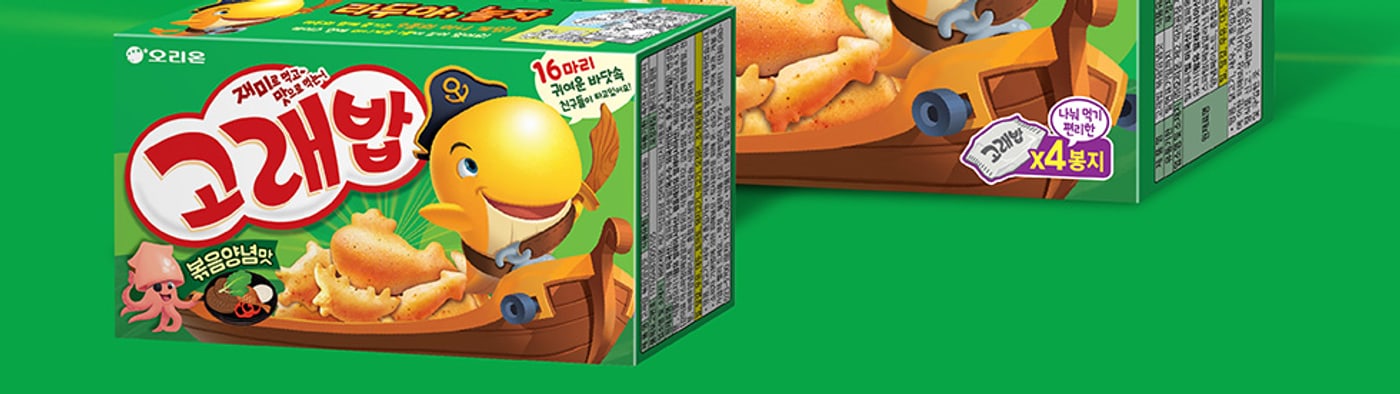
Goraebap: Korea's Whale Food Crackers Have 16 Shapes, and Every One Has a Name
English sources say nine sea creatures. Orion's own packaging says 16, and each has a pun name — the dolphin is called Endorphin. Launched March 1984, what the box games are, which flavour to buy, and August 2026 prices.
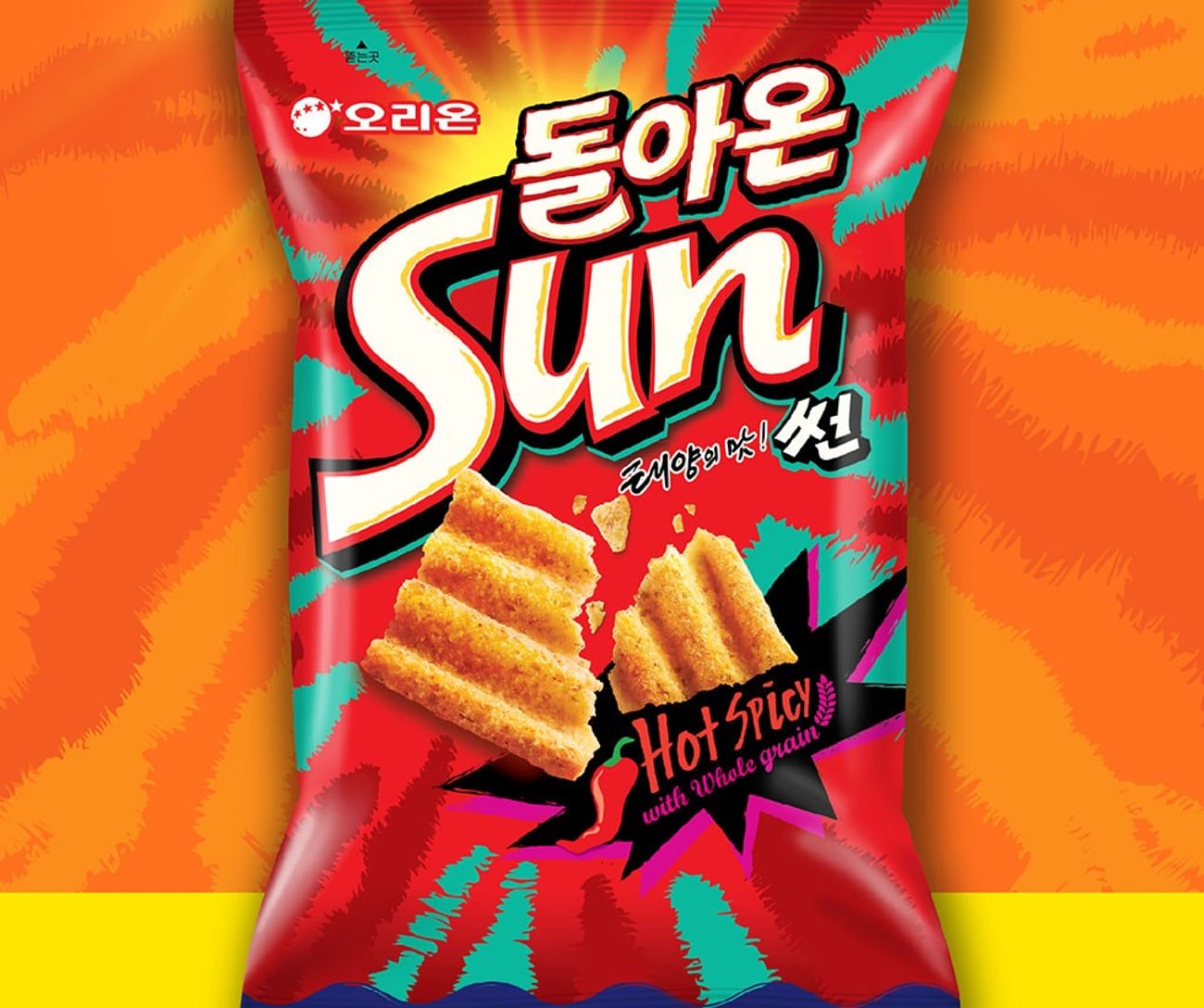
Korea's Sun Chips Is a Different Chip, and It Came Back From a Fire
A 2016 factory fire destroyed the only production line and Orion discontinued it; customers asked for two years and it returned in April 2018 as 돌아온 썬. Why the Korean bag is not the American one, which flavour to buy, and August 2026 prices.
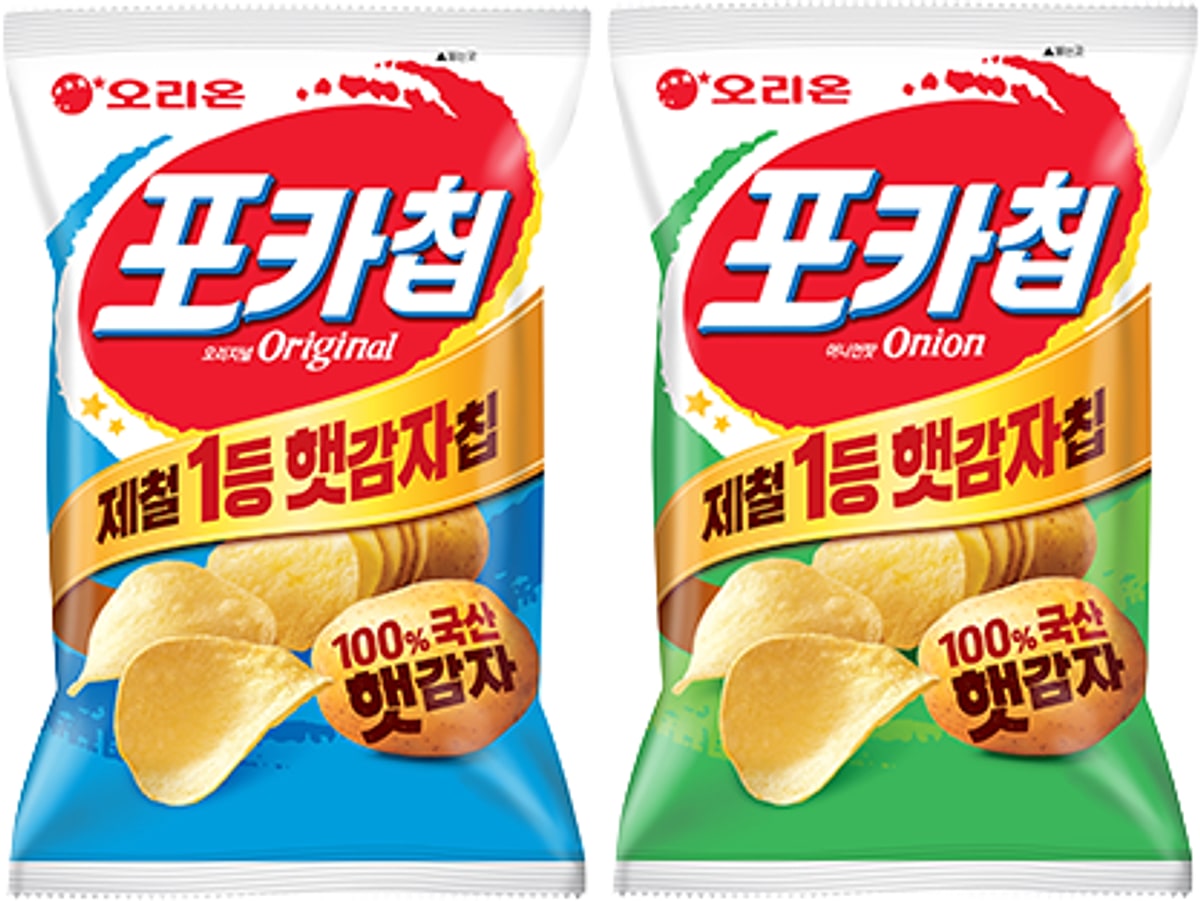
Pocachip: Korea's No.1 Potato Chip, and Why the Original Came Second
Onion launched in 1988 and Original only in 1992, so Pocachip's original is not the original. Which flavour to buy, how it differs from Swing Chip, why the same bag tastes different by month, and August 2026 prices.