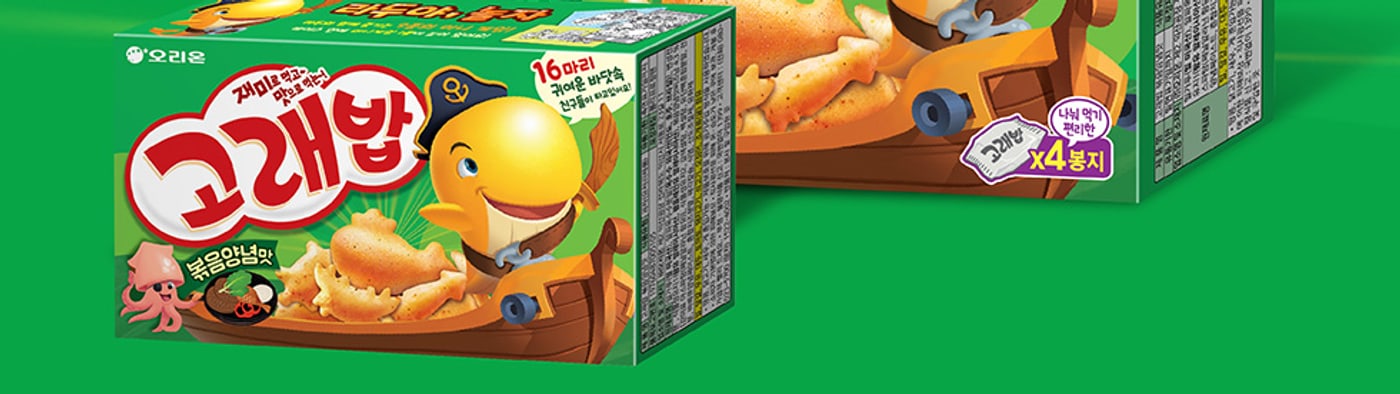
Goraebap: Korea's Whale Food Crackers Have 16 Shapes, and Every One Has a Name
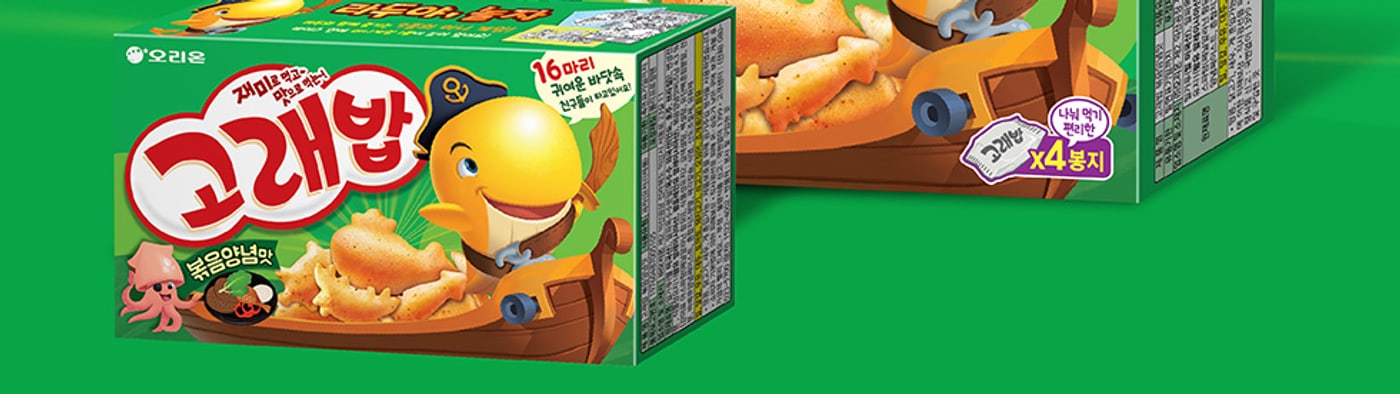
고래밥, "whale food." The badge in the corner reads 16마리 귀여운 바닷속 친구들이 들어있어요 — 16 cute sea friends inside. Official product image, Orion.
Every English page about this snack says it has nine sea-creature shapes.
Orion's own packaging says 16, prints all of them in a labelled chart, and gives each one a name. The dolphin is called 엔돌핀 — Endorphin. The clownfish is called 아네모네, Anemone, because clownfish live in anemones. The shark is called 후크, Hook.
None of that has ever been written down in English, and it is the entire reason Korean children spend longer sorting this snack than eating it.
The Short Answer
| Detail | |
|---|---|
| Korean name | 고래밥 (Goraebap) — literally "whale food" |
| Maker | 오리온 (Orion) |
| Launched | March 1984 |
| Shapes | 16, each a named character |
| Standard box | 46 g · 206 kcal · 8-month shelf life · four sealed bags inside |
| Standard flavour | 볶음양념맛 — roasted/stir-fried seasoning, savoury |
| Price, August 2026 | About ₩610–655 per 46 g bag in online multipacks |
| Structure | Hollow inside — collapses rather than snapping |
| Closest thing you know | Goldfish crackers, but savoury-seasoned rather than cheese-baked |
| Skip it if | You expected cheese, or you want a substantial snack |
All 16, With Their Names
Straight off Orion's packaging artwork. The first name is the species, the bracketed name is the character.
| Creature | Character name | The joke | |
|---|---|---|---|
| 1 | 고래 Whale | 라두 | The mascot, and the one on the box |
| 2 | 오징어 Squid | 징어징가 | Sing-song repetition of 오징어 |
| 3 | 불가사리 Starfish | 스타피 | "Starfy" |
| 4 | 돌고래 Dolphin | 엔돌핀 | Endorphin — 돌핀 is "dolphin" |
| 5 | 꽃게 Blue crab | 여보게 | An old-fashioned "hey, you there," ending in 게 (crab) |
| 6 | 복어 Pufferfish | 요리보고 | From 요리 보고 조리 보고, "look this way, look that way" |
| 7 | 거북이 Turtle | 메탈부기 | "Metal boogie" |
| 8 | 다랑어 Tuna | 따랑해 | Baby-talk for 사랑해, "I love you" |
| 9 | 상어 Shark | 후크 | Captain Hook |
| 10 | 문어 Octopus | 문어크 | 문어 plus a hard ending |
| 11 | 소라 Conch | 나팔소라 | "Trumpet conch" |
| 12 | 해파리 Jellyfish | 파리지행 | "Bound for Paris" — 파리 is both jellyfish-syllable and Paris |
| 13 | 새우 Shrimp | 누구새우 | From 누구세요, "who is it?" |
| 14 | 가재 Crayfish | 집게가재 | "Pincer crayfish" |
| 15 | 망치상어 Hammerhead | 솜망치 | "Cotton hammer" |
| 16 | 흰동가리 Clownfish | 아네모네 | Anemone — where clownfish actually live |
Two things fall out of that list. First, the naming is pun-driven Korean wordplay, which is why it never crossed into English — half of it does not survive translation. Second, Orion did not pick generic sea creatures. A hammerhead, a conch and a clownfish are specific choices, and the clownfish being named after its host anemone is a piece of actual marine biology hidden in a ₩650 snack.
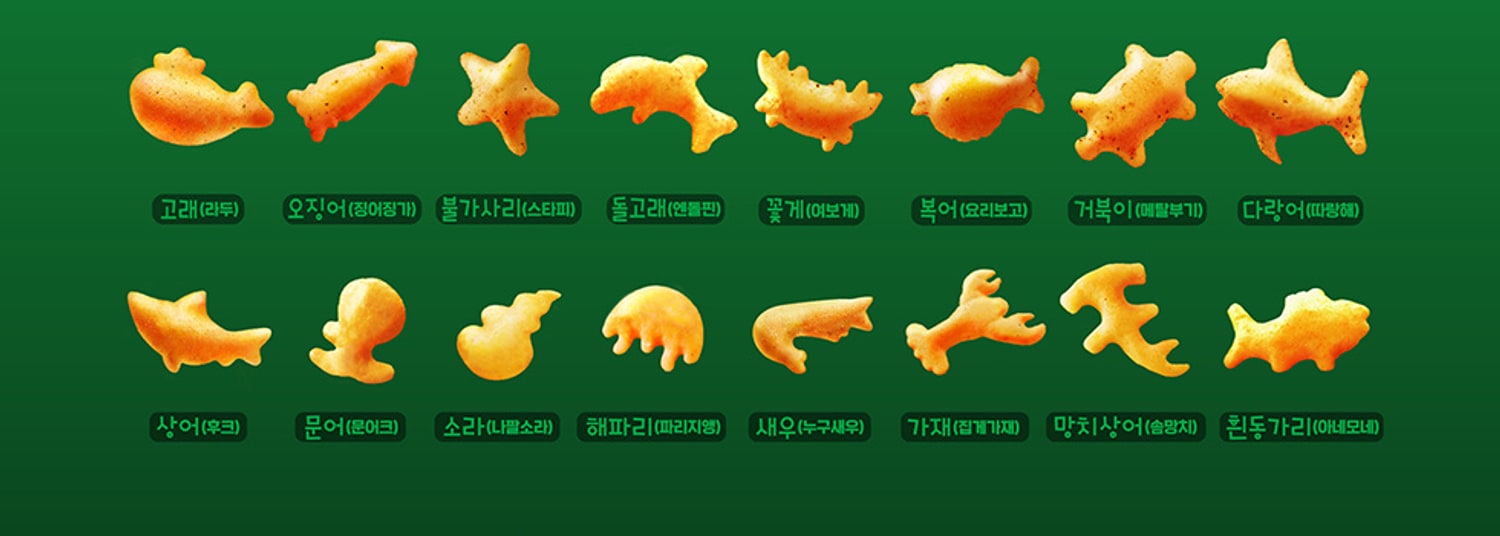
The chart Orion prints on its own product page. Sixteen, not nine. Official product image, Orion.
You might like: Korean Snacks Guide: What to Buy, Taste, and Pack
You might like: Orion Squid Peanut: Korea's Beer Snack Is Coated Twenty-Eight Times
Why "Whale Food"
The name is the joke that starts everything. 고래밥 means the food a whale eats — so the contents are not whales, they are the things whales swim through. The whale character 라두 on the box is steering the boat, not being eaten.
It launched in March 1984, which makes it two years older than Sun and six years younger than Banana Kick. In Korea it sits in a category people describe as 갑과자 — the cheap snack, the one that costs almost nothing and everybody has had. That is a compliment in Korean usage, not a criticism.
The Box Is the Toy
Original Goraebap came in a paper box, and for most of its life that box carried comics on the back. Around 2015 those were replaced with bingo cards, which is what is printed there now.
The mechanic is obvious once you know the shapes have names: you eat, you check off what you find, you try to complete a line. There is no prize and no rare shape — Orion has never run a chase-piece promotion on it. The game is entirely between a child and a box.
The other thing the box does is split the contents into four sealed bags rather than one. That is why the box looks big for 46 g, and it is a deliberate sharing format — a box goes into a bag for a school trip and comes out as four portions.
What It Actually Tastes Like
This is the point where the Goldfish comparison stops being useful.
Goldfish crackers are baked cheese. Goraebap is a hollow puffed cracker with a seasoning coating, and the standard flavour — 볶음양념맛 — is closer to a savoury stir-fry seasoning than to cheese: soy-salty, faintly sweet, a little toasty. It is closer in spirit to a prawn cracker with a barbecue dust on it.
The hollow interior matters as much as the coating. The pieces do not snap; they give way. That is the same structural trick as Banana Kick, and it is why Goraebap is another snack Korean parents hand to small children without thinking about it.
Building a Korean snack box at home? Goraebap is the cheapest thing on this list and the one most likely to be missing from an export variety pack — worth checking what is actually in the box before you buy, because the assortments differ a lot between sellers. As an Amazon Associate, EpicKor earns from qualifying purchases.
Which One to Buy
Orion currently lists four on its Korean catalogue.
| Product | Korean | Size | Calories | Shelf life |
|---|---|---|---|---|
| Goraebap (standard) | 고래밥 볶음양념맛 | 46 g | 206 kcal | 8 months |
| Wang Goraebap | 왕고래밥 | 56 g | 247 kcal | 6 months |
| Hot Goraebap | 핫고래밥 매콤양념맛 | 56 g | 247 kcal | 6 months |
| Sweet Cheese | 고래밥 달콤치즈맛 | 34 g | 152 kcal | 8 months |
Start with the standard 볶음양념맛. It is the reference flavour, the one the bingo boxes are built around, and the cheapest.
왕고래밥 means "king Goraebap" — bigger pieces, same idea. Worth it if you found the standard pieces too small to identify, which with sixteen shapes is a real problem for adult eyes.
핫고래밥 is the spicy version and is genuinely mild by Korean standards. If Buldak is your reference for Korean heat, this will not register.
달콤치즈맛 is the sweet cheese one, and the smallest box. It is the closest the range gets to a Goldfish flavour profile, which makes it either the easiest entry point or the least interesting one depending on why you came.
Over the years the line has also carried marine blue salt, chilli shrimp and pizza versions. Most limited editions have been discontinued, so a flavour you find abroad that is not in the table above is old stock.
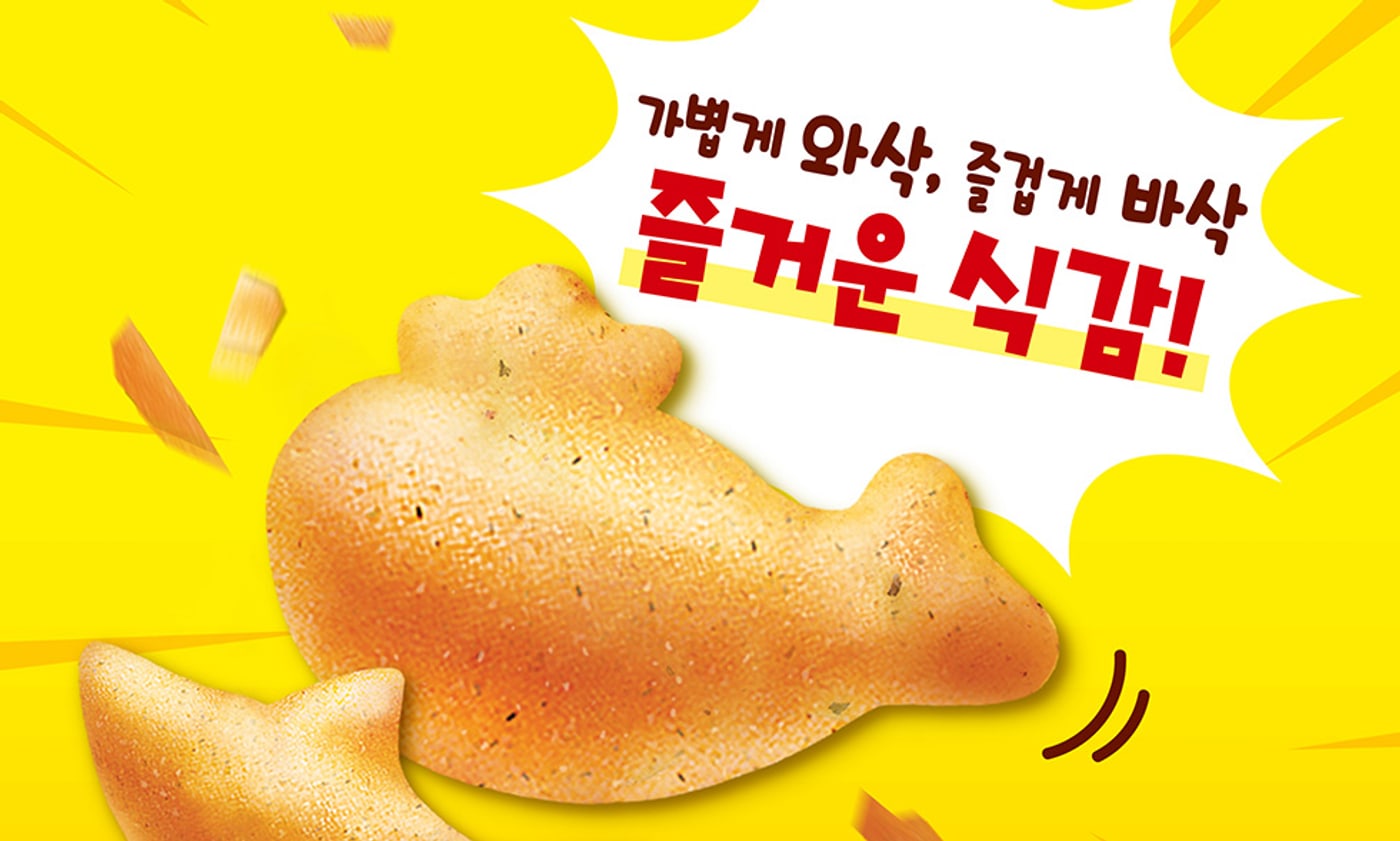
The interior is hollow, which is why the pieces give way instead of snapping. Official product image, Orion.
You might like: Banana Kick: Korea's Banana Snack Is 1.6% Banana
Finding It Abroad Is Harder Than It Should Be
The romanisation is a mess, and it is the single biggest practical obstacle to buying this outside Korea. The same box is sold as Goraebap, Goraebab, Goraebob and — on more than one listing — Marine Boy, which is an export sub-brand rather than a translation.
If you are searching, the reliable identifiers are visual rather than textual: the green box, the yellow fish in a pirate hat, and the word 오리온 in the corner. Any listing showing those is the right product whatever it has been spelled as.
Note also that export boxes are often the single-bag format rather than the Korean four-bag box, so a box that looks the same size may be packed differently inside. If the four-portion split is the reason you want it — for a lunchbox, a classroom, a long drive — check the listing photo for the inner bags rather than trusting the outer box.
Where It Actually Shows Up in Korea
Goraebap has a specific social position that a product listing cannot convey, and it explains the four-bag design.
It is a 소풍 snack — the thing that goes into a bag for a school outing, a hike, a long bus ride. The box is bought by an adult and dispensed by an adult, one sealed bag at a time, which is exactly the behaviour the packaging is built for. You will find it in kindergarten cupboards, in the glovebox on a family drive, and in the snack drawer of an office that has children visiting.
What you will not find is Goraebap being eaten with a beer, which is where Sun lives. The two snacks sit on the same shelf and belong to completely different parts of Korean life. If you are buying Korean snacks to understand the aisle rather than to eat one thing, that contrast is worth more than either bag on its own.
What It Costs
As of August 2026, online multipacks put the 46 g box at roughly ₩610–655 each — a four-pack around ₩2,620 and a six-pack around ₩3,650. That is well under fifty US cents a box, and it is the reason the 갑과자 label sticks.
Convenience stores charge more for a single box, as always, and Goraebap appears in 1+1 and 2+1 promotions frequently enough that it is worth a look at the shelf tag.
Buying for children rather than yourself? The four-sealed-bag box is the format that makes Goraebap work for lunchboxes and long journeys, and it is the detail export packaging most often drops — worth checking the inner packing on the listing photo before you order a case.
Who Should Skip It
Skip it if you want cheese crackers. The default flavour is savoury seasoning, not cheese, and the mismatch with Goldfish expectations is the most common disappointment.
Skip it if you want a substantial snack. A 46 g box split into four bags is a small amount of food, and the hollow pieces make it feel smaller still.
Skip Hot Goraebap if you actually want heat. It is a children's spicy, not a Korean spicy.
Do not skip it if you are buying snacks for anyone under about twelve, or if the idea of a snack with sixteen named characters and a bingo card on the back sounds like a good forty-five cents. Nothing else in the Korean aisle is doing that.
Frequently Asked Questions
Q: How many Goraebap shapes are there? A: Sixteen. Orion prints all of them in a labelled chart on its own packaging and product page. English sources commonly say nine, which appears to count only the older named character set — the current chart runs to sixteen, including a conch, a hammerhead shark and a clownfish.
Q: What does 고래밥 mean? A: "Whale food." The pieces are the sea creatures a whale would eat, not whales themselves — although one of the sixteen shapes is in fact a whale, the mascot 라두.
Q: Is Goraebap the same as Goldfish crackers? A: No. Goldfish is a baked cheese cracker. Goraebap is a hollow puffed cracker with a savoury seasoning coating — closer to a seasoned prawn cracker. The sweet cheese variant is the nearest thing in the range to a Goldfish flavour.
Q: What are the games on the Goraebap box? A: The boxes carried comics for most of the product's life and were changed to bingo cards around 2015. You mark off the shapes you find. There is no prize and no rare piece.
Q: How much does Goraebap cost in Korea? A: About ₩610–655 for a 46 g box in online multipacks as of August 2026 — under fifty US cents. Convenience stores charge more per box and discount it often.
Q: Which Goraebap flavour should I start with? A: The standard 볶음양념맛. It is the original seasoning, the cheapest, and the one the box games are built around. 왕고래밥 is the same thing in larger pieces if you want to actually see the shapes.
Sources
Launch date of March 1984, the name's meaning, the hollow structure, the shift from comics to bingo cards on the packaging around 2015, the flavour history including discontinued limited editions, and the 갑과자 market positioning from Korean-language reference sources. The count of sixteen shapes, the full species and character-name list, the "16마리" packaging claim and the four-inner-bag format are read directly from Orion's official product artwork. Weights, calories and shelf lives for all four current variants from Orion's official product pages. Retail pricing checked August 2026 across Korean online grocers.
Flavour ranges differ between the Korean and export markets, and prices change constantly. Check the box in front of you.
You Might Also Like
Orion Squid Peanut: Korea's Beer Snack Is Coated Twenty-Eight Times
오징어땅콩 turned 50 in 2026. There is real squid on it — strips thinner than 0.2 mm — and each peanut gets 27, 28 or 29 coats of batter depending on its size, so every ball comes out identical.
Korea's Sun Chips Is a Different Chip, and It Came Back From a Fire
A 2016 factory fire destroyed the only production line and Orion discontinued it; customers asked for two years and it returned in April 2018 as 돌아온 썬. Why the Korean bag is not the American one, which flavour to buy, and August 2026 prices.
Pocachip: Korea's No.1 Potato Chip, and Why the Original Came Second
Onion launched in 1988 and Original only in 1992, so Pocachip's original is not the original. Which flavour to buy, how it differs from Swing Chip, why the same bag tastes different by month, and August 2026 prices.