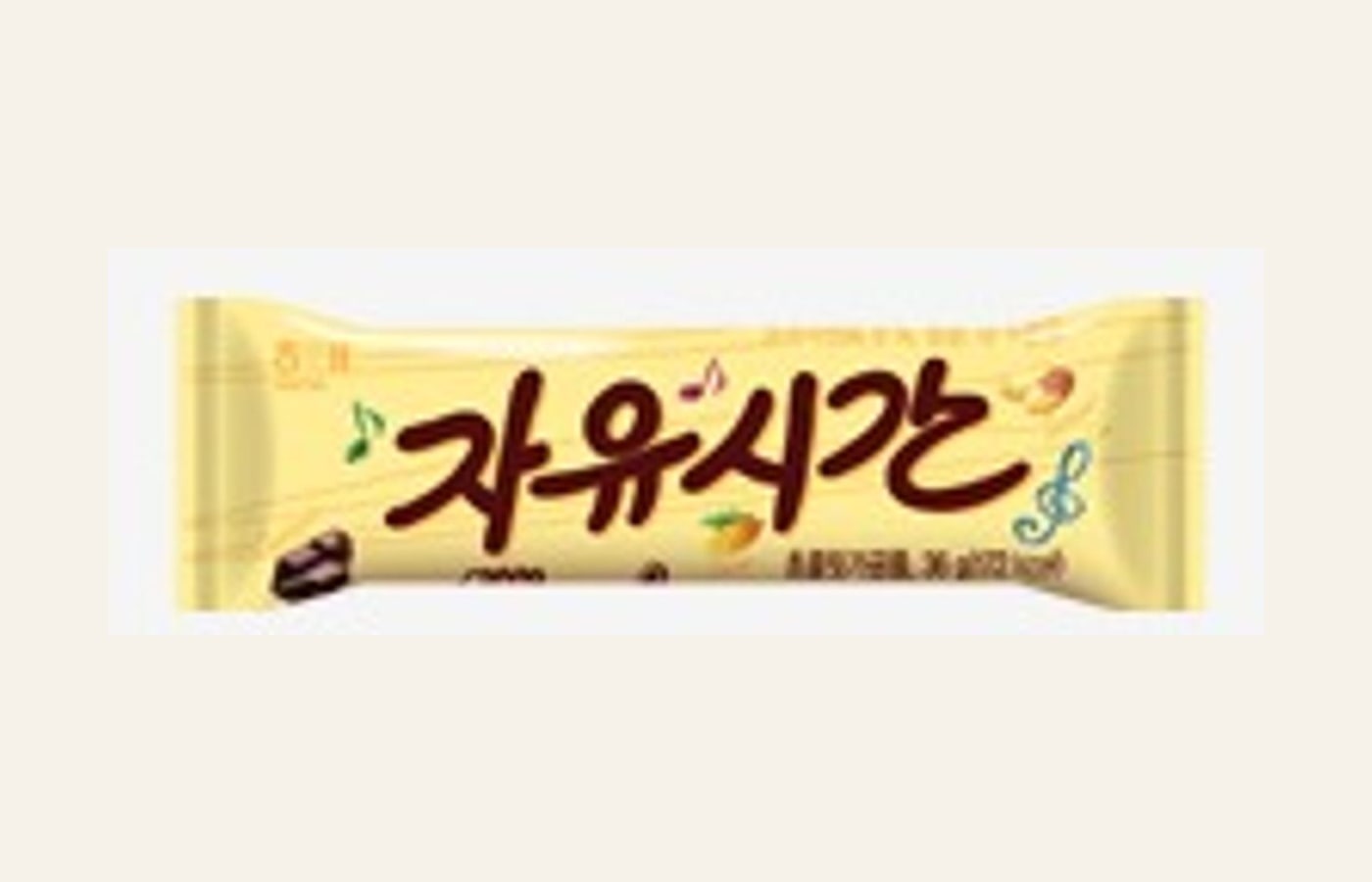
Jayu Sigan: The Korean Chocolate Bar Designed to Leave No Evidence
Last updated: 18 August 2026
Most chocolate bars are named after what they are. 자유시간 (Jayu Sigan) is named after what you are supposed to be doing while you eat one: it means "free time."
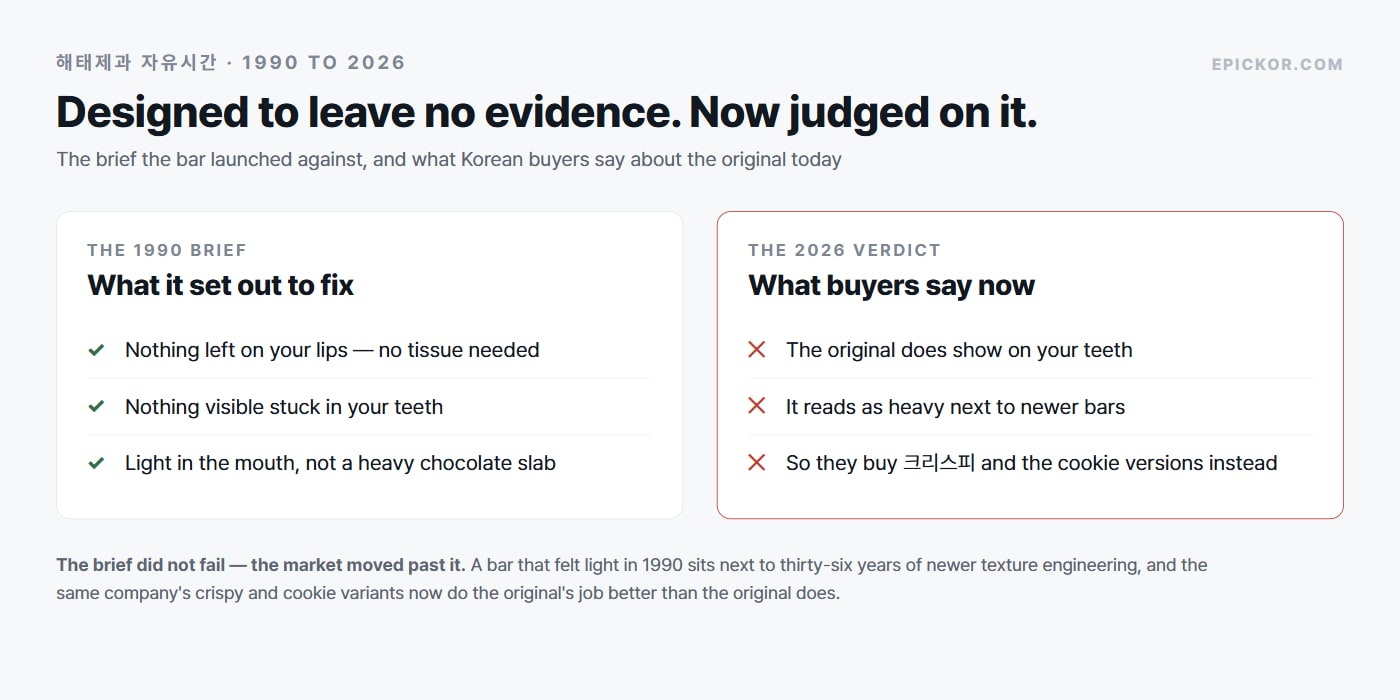
That is not a throwaway. 해태제과 launched it in September 1990 against a specific and slightly odd design brief — not "make a good chocolate bar" but make a chocolate bar you can eat in public without evidence. No smear on the lips that needs a tissue. Nothing wedged visibly in your teeth. No heavy chocolate-bar weight sitting on you afterwards. A bar for a break between things, hence the name.
Thirty-six years later the joke is that Korean consumers now criticise the original for failing at precisely those three things, and buy the newer variants instead. Here is the product, the arc, and where it has ended up in 2026 — which, improbably, is Dubai.
| Detail | |
|---|---|
| Korean name | 자유시간 (Jayu Sigan), "free time" |
| Maker | 해태제과 (Haitai Confectionery) |
| Launched | September 1990 |
| The 1990 pitch | A bar that leaves no trace on lips or teeth and does not feel heavy |
| The 1990 ad | Comedian 정재환, with the line "아! 자유시간!!" |
| Core line | 리얼초코 (original) · 아몬드 · 크리스피 |
| Typical price | About ₩2,000, very often on a 2+1 promotion |
| Calories | Mini 10 g 47 kcal · 크리스피 27 g 134 kcal · Big 64 g 313 kcal |
| The 2026 twist | A pistachio-and-kadayif version, part of Haitai's Dubai-chocolate line |
If you only remember one line: buy the crispy or the cookie version, not the original — Korean buyers worked this out years ago.
The Brief: A Chocolate Bar With No Aftermath
Korean writing about 자유시간 keeps returning to the same three conditions the product was built to satisfy, and they are all social rather than culinary.
Nothing on your lips. A normal chocolate bar leaves a smear that needs wiping, which means you cannot eat one discreetly at a desk or on a bus.
Nothing in your teeth. The visible-residue problem is worse than the lip problem because you cannot see it and somebody else can.
No weight. A chocolate bar sits in you afterwards. A ten-minute break does not want that.
Solve those three and you get a bar you can eat during a gap in the day without it becoming an event — which is what the name is claiming. 자유시간 is not describing the chocolate. It is describing the ten minutes.
The 1990 launch campaign ran with comedian 정재환 and the line "아! 자유시간!!" — Ah, free time! — which is still the phrase older Koreans produce if you say the product name at them.
Haitai chocolate bars on Amazon — on AmazonAffiliate link. As an Amazon Associate, EpicKor earns from qualifying purchases at no extra cost to you.
And Then the Market Moved
Here is the honest part, and it is the reason to read a Korean source rather than a product page.
The original 리얼초코 is now the least recommended version of its own product. Korean consumer discussion is fairly blunt about it: the original does show on your teeth, it does feel heavy, and the crispy and cookie variants — which came later — handle both problems better. Buyers migrated accordingly.
That is not a scandal, it is a thirty-six-year-old formulation competing against everything invented since. What is interesting is that Haitai solved the same brief again, twice, without retiring the first attempt. The original stays on the shelf because a lot of people are buying a memory rather than a texture.
So the practical advice inverts the usual one. With most heritage Korean snacks the original is the one to buy. Here, buy the 크리스피 or a cookie variant first, and try the 리얼초코 afterwards if you want to know what 1990 tasted like.
The Formats Matter More Than the Flavours
| Format | Weight | Calories | What it is for |
|---|---|---|---|
| 미니 자유시간 | 10 g | 47 kcal | The size the name describes |
| 자유시간 피스타치오 | 30 g | 130 kcal | The 2020s flavour wave |
| 자유시간 크리스피 | 27 g | 134 kcal | The version Korean buyers recommend |
| 자유시간 Big | 64 g | 313 kcal | Not a break — most of a light lunch |
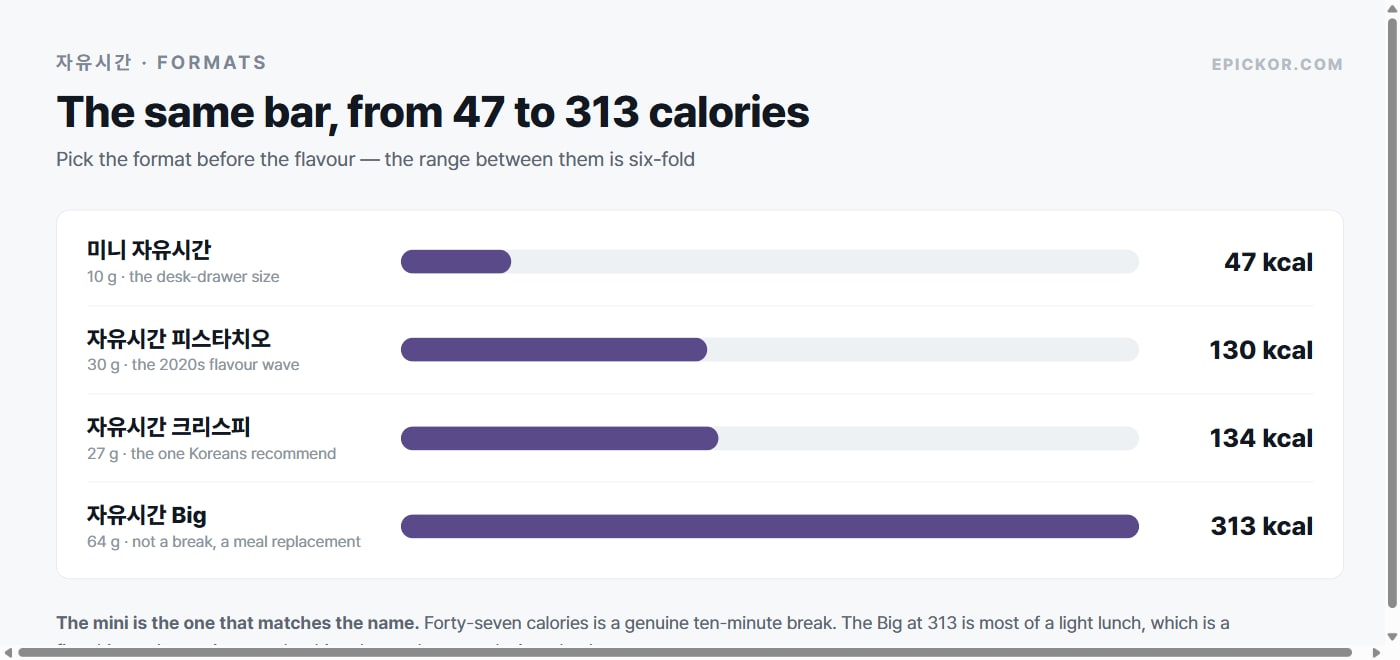
The mini is the interesting one, because it is the format that actually delivers the original promise. Ten grams and 47 calories is a genuine short break rather than a decision. It is also the format Haitai has used for almost every recent experiment — the new flavours tend to appear as minis in a multipack first.
Price sits around ₩2,000, and this is a product that spends a remarkable amount of its life on a 2+1 promotion at convenience stores. Elongated formats run nearer ₩1,500. If you see it at full price and you are not in a hurry, wait a week.
You might like: Korean Convenience Store 1+1: How It Works and Who Can Bank the Free One
Also: Orion Squid Peanut — coated twenty-eight times
자유시간 is not sold on Amazon — it is one of the Korean bars that never made the export list. Haitai's exported chocolate bars are the nearest thing, and they carry the same design instinct this article is about: lighter, crisper, far more interested in texture than in cocoa percentage. As an Amazon Associate, EpicKor earns from qualifying purchases at no extra cost to you.
Haitai chocolate bars on Amazon
Haitai chocolate bars on AmazonThe Variant Rush, and What It Is Actually For
Something changed in the last two years. A bar that spent three decades on essentially three versions — 리얼초코, 아몬드, 크리스피 — suddenly acquired a queue of them.
The 2024–2026 run includes 크리스피 딸기 (strawberry crispy), 크리스피 피스타치오, 쿠키앤피스타치오크림, 쿠키앤헤이즐넛크림, a tiramisu, a marble nougat strawberry, and a milk variant. Most arrive as minis in a multipack rather than as single bars.
That format choice is the tell. A single bar has to earn a place at the till on its own; a mini in a bag of eight only has to be interesting enough not to be the one left over. It is a much cheaper way to test a flavour, and it explains why the pace jumped without the shelf visibly changing.
It also explains why so few of them stay. The Korean confectionery market runs flavour cycles fast — mala, then honey butter, then Dubai pistachio — and a heritage brand with an established bar shape is a convenient chassis to bolt each one onto. The chassis stays; the flavour rotates off.
Which brings the product to an odd place for its 36th year. 자유시간 is no longer really one bar. It is a name and a shape that Haitai reuses, and the version you meet depends entirely on which year you walked into the shop. Someone who ate it in 1995 and someone who buys it in 2026 have eaten different things.
For a visitor that is useful rather than confusing, as long as you know it. Do not look for the 자유시간. Look at what is in the multipack this month, and read the format weight before the flavour name.
How a 1990 Bar Ended Up in Dubai
The strangest chapter is the current one.
Dubai chocolate — the pistachio-cream-and-kadayif bar that spread globally through short-form video — arrived in Korea and did what trends do: it went straight into the existing snack aisle rather than staying a dessert. 해태제과 released a five-product pistachio line built on the Dubai formula, and 자유시간 was one of them, alongside 홈런볼, a buttercream product and others.
The 자유시간 version pairs the bar's chocolate with pistachio cream and crisp kadayif — the shredded pastry strands that give the original Dubai bar its texture. Haitai's own explanation is straightforward: pistachio demand rose because of Dubai chocolate, so they put pistachio in things.
It is worth noticing what that says about the product. A bar whose entire original identity was restraint — nothing on your teeth, nothing heavy — is now available in the most maximalist chocolate format of the decade. Both versions are on the same shelf, which is a fairly good picture of the Korean snack market in general.
Honest Notes
The original is not the one to buy. Stated again because it inverts the usual advice for heritage Korean snacks. Start with 크리스피 or a cookie variant.
It is small. A standard bar is a snack, not a dessert, and visitors used to a 45 g Western chocolate bar often find the Korean equivalent slight. That is deliberate, and the mini is smaller still.
There was a recall-grade incident, in 2009. Korean records note 2,605 boxes withdrawn over bacterial counts above the permitted threshold. It is seventeen years old and has no bearing on a bag bought today, but a product history that mentions only the good years is not a product history.
It is very sweet, in the Korean way. Which is to say less bitter and less cocoa-forward than a European bar. If you measure chocolate by cocoa percentage you will not rate this. If you measure it by whether it suits a coffee at 3pm, you might.
Chasing the Dubai chocolate thing? Korea's version of the trend went into the mass snack aisle rather than staying a boutique dessert, which is a very Korean outcome — pistachio and kadayif at convenience-store prices.
You might like: Korean Snack Prices From 1 October 2026: Pocky ₩2,200 and 14 Packs That Shrink
FAQ
Q: What does 자유시간 mean? A: "Free time." It names the break you are taking rather than the chocolate you are eating, which was the entire pitch in 1990 — a bar you could eat during a short gap without it leaving evidence.
Q: Who makes it? A: 해태제과, Haitai Confectionery, since September 1990. It is not a Crown or Lotte product, which is a common mix-up.
Q: Which version should I buy first? A: 크리스피 or one of the cookie variants. Korean buyers moved away from the original 리얼초코 because it does the two things the product was designed to avoid — showing on your teeth and feeling heavy.
Q: Is the pistachio one the Dubai chocolate thing? A: Yes. Haitai built a five-product pistachio line on the Dubai chocolate formula, and 자유시간 is one of them, combining pistachio cream with crisp kadayif strands.
Q: How much does it cost? A: Around ₩2,000 at convenience stores, and it is very frequently on 2+1. Longer formats sit nearer ₩1,500. Prices vary by store type. Haitai's own announced price for the standard 36 g bar went from ₩1,200 to ₩1,400 from 1 October 2026 (the full list); convenience-store shelf prices can run higher.
Sources Checked
- Korean-language reference sources for the September 1990 launch by 해태제과, the design conditions the product was built against, the 정재환 advertising campaign and the "아! 자유시간!!" line, the variant lineup including 리얼초코, 아몬드 and 크리스피, and the 2009 withdrawal of 2,605 boxes over bacterial counts.
- Korean nutrition listings for the format figures: mini 10 g at 47 kcal, 피스타치오 30 g at 130 kcal, 크리스피 27 g at 134 kcal, and Big 64 g at 313 kcal.
- Korean confectionery-industry reporting for the Dubai-chocolate pistachio line, the five products it covers, and Haitai's stated reason for launching it.
Convenience-store pricing moves with promotions; the 2+1 cycle on this product is frequent enough to be worth waiting for. Verified August 2026.
You Might Also Like
Nunettine: The Korean Snack Whose Real Name Is Italian
누네띠네 is a Korean supermarket staple named after an Italian pastry and a Korean pun at the same time. Most Koreans cannot tell you what it means. Here is the original, the joke, and what it costs.
Matdongsan: Korea's Peanut Crunch Snack, and Why It Was Pulled for Selling Too Well
Matdongsan looks like traditional Korean confection and isn't — it descends from Japanese karinto. The 1974 product that was withdrawn because demand beat the factory, the traditional-music fermentation claim, and August 2026 prices.
Korean Snacks Guide: What to Buy, Taste, and Pack
A practical Korean snacks guide comparing Turtle Chips, honey-butter flavors, seaweed snacks, convenience-store finds, souvenirs, and packing tips.