Matdongsan: Korea's Peanut Crunch Snack, and Why It Was Pulled for Selling Too Well
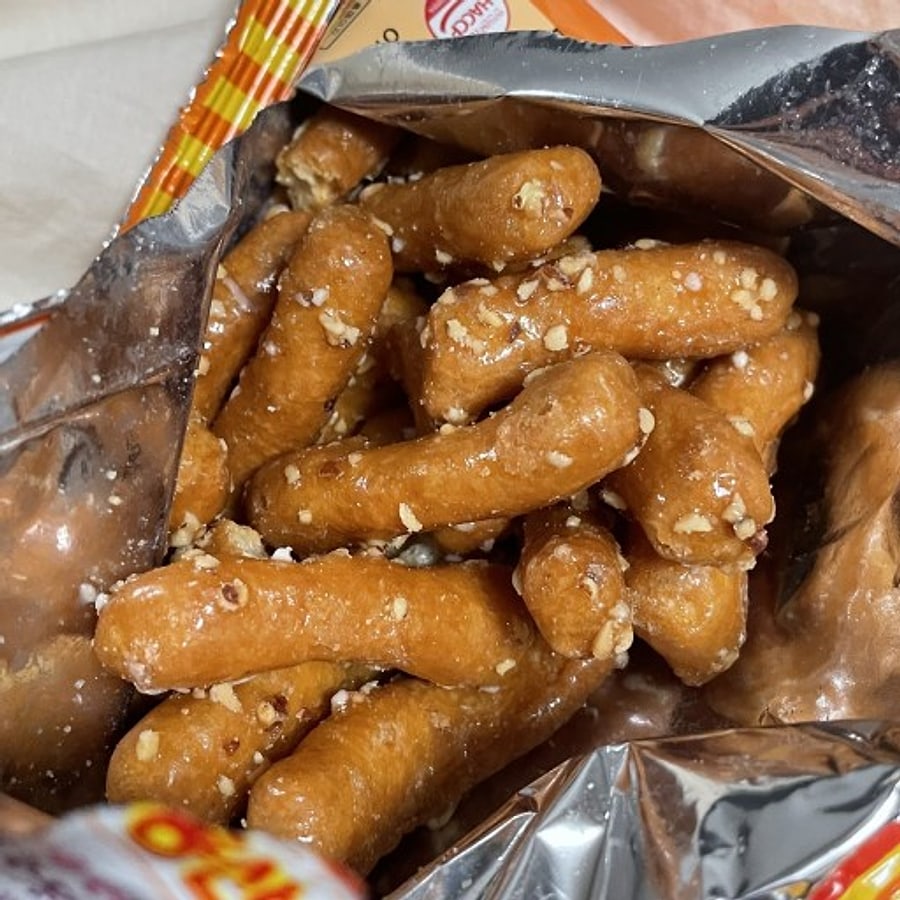
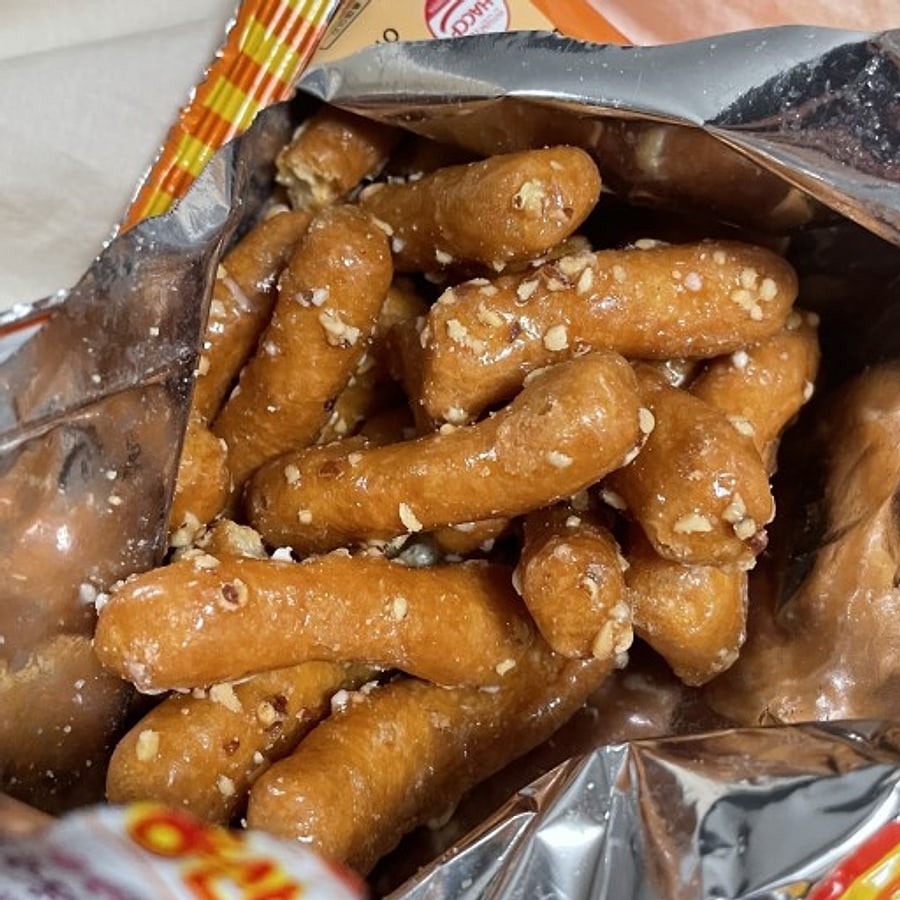
맛동산 in the bag, which is how most Koreans first see it. The pale flecks are crushed peanut. Photo by 박찹쌀, CC BY-SA 2.0 KR, via Wikimedia Commons.
Open a bag of 맛동산 and you get short fried sticks, glazed sticky-sweet, rolled in crushed peanuts. They look old-fashioned in a way that suggests something traditional — the sort of thing you would expect to find on a lacquered dish at a Korean holiday table.
They are not that. Matdongsan is an industrial snack from 1975, and its direct ancestor is Japanese.
That is the first of three things about this bag that are not what they appear. The second is that the product was taken off the market for selling too well. The third is that Haitai spent roughly a decade telling Koreans it played traditional court music to the dough.
The Short Answer
| Detail | |
|---|---|
| Korean name | 맛동산 (Matdongsan) |
| Maker | 해태제과 (Haitai Confectionery) |
| Launched | 1975, at ₩90 — after a 1974 predecessor called 맛보다 was pulled |
| What it is | Wheat-flour dough, fried, glazed in 물엿 (starch syrup), rolled in 땅콩가루 (peanut powder) |
| Descended from | かりんとう (karintō), a Japanese fried-dough sweet |
| Not descended from | 한과 / 유과, Korea's traditional confection — despite looking the part |
| Price, Aug 2026 | ₩1,500 for the 90 g mini · ₩4,380 list for 300 g, often ₩3,980 |
| Calories | 145–150 kcal per 30 g serving |
| Sodium | Low — about 20 mg per 30 g |
| Cumulative sales | 3 billion bags by the end of 2009 |
| The jingle | "땅콩으로 버무린 튀김과자" — written by composer 김도향, 1976 |
Find Matdongsan on AmazonAffiliate link. As an Amazon Associate, EpicKor earns from qualifying purchases at no extra cost to you.
If you only remember one line: it tastes like a peanut-coated doughnut stick, and it is much sweeter than it looks.
What Is Actually In It
The construction is simple, which is why it has survived fifty years without meaningful reformulation.
Wheat-flour dough is fermented, cut into short lengths, and deep-fried. The fried sticks are then tumbled in 물엿 — Korean starch syrup, thicker and less sweet-sharp than corn syrup — and finished with 땅콩가루, crushed peanut.
That is the whole product. There is no filling, no chocolate, no cream in the original.
The texture is the point and it is unusual: crisp on the outside, but noticeably light and airy inside rather than dense. Bite one and it shatters, then gives. The fermentation step is what produces that interior; a straight unfermented dough fries up harder and heavier.
Taste-wise, expect sweet first, nutty second, and salty barely at all. At 20 mg of sodium per 30 g serving this is one of the few Korean snacks where salt is genuinely not a factor. Sweetness is — 145 to 150 kcal per 30 g, almost entirely from the syrup glaze and the frying oil.
The Name Story: Pulled for Selling Too Well
This is the part that gets told wrong in English, and often in Korean too.
In February 1974, Haitai launched a snack called 맛보다 — roughly "taste it." It worked immediately. Korea was in the middle of rapid growth, the baby-boom generation was hitting snack-buying age, and demand for packaged confectionery was climbing faster than anyone's factory.
And that was the problem. Haitai could produce 100 boxes a day. Demand was far beyond it. Rather than ship a product they could not supply, they stopped selling it.
They spent the next year expanding production. In 1975 the snack came back under a new name — 맛동산 — and sold 5 million bags in its first year, worth about ₩5 billion at the time, which contemporary retrospectives put at well over ₩700 billion in today's money.
You will find sources, including some Korean ones, saying the original name was dropped because sales were poor. That version is the opposite of what happened, and it is worth correcting, because the real story explains the product's position better: Matdongsan did not have to fight its way to popularity. It arrived popular and had to wait for a factory to catch up.
It Looks Like Hangwa. It Isn't.
Here is the honest lineage, and it is the single most useful thing to know about this snack.
Matdongsan is a Korean adaptation of かりんとう (karintō), a Japanese confection of fried wheat dough glazed in brown sugar.
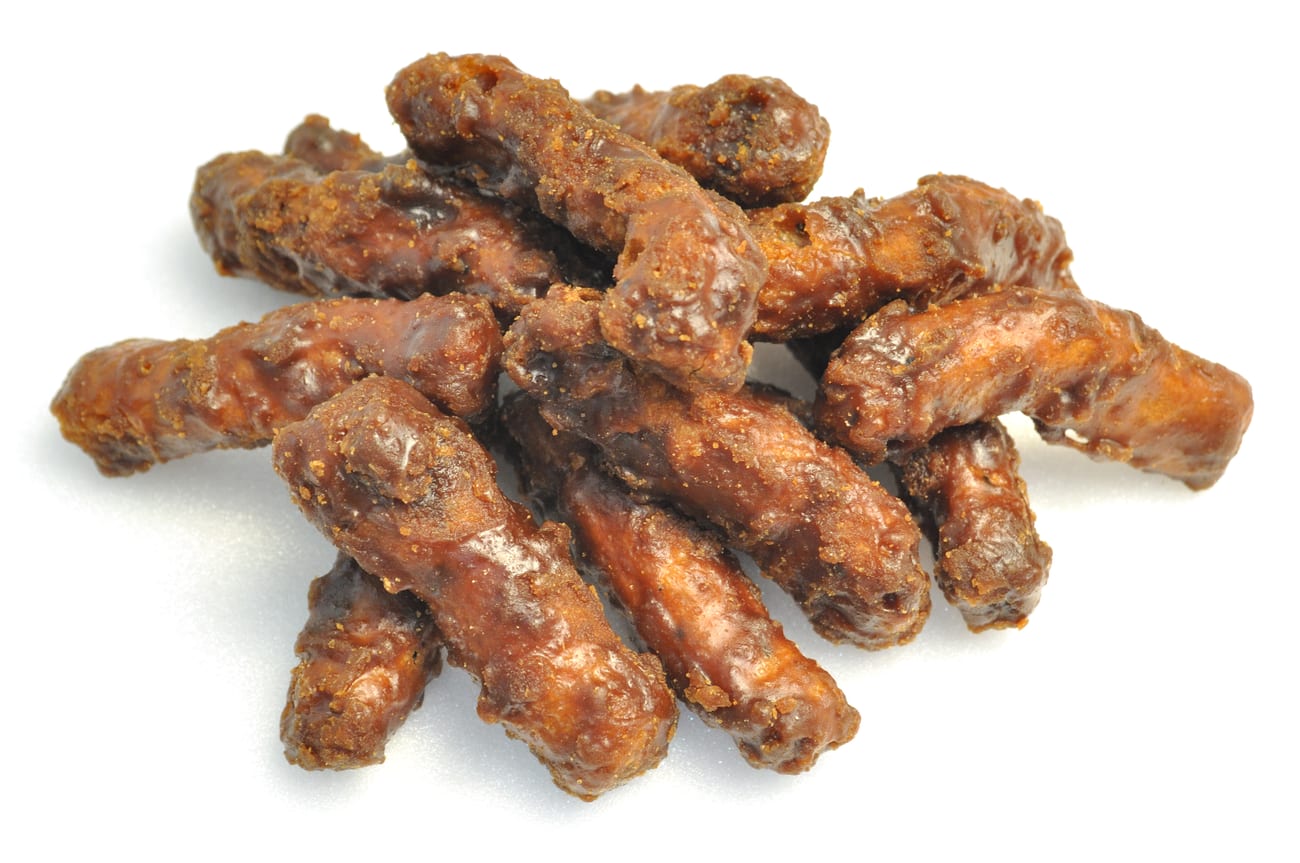
Karintō, Japan. Same short fried sticks, same glaze — but darker, and with nothing coating the outside. Photo by Ocdp, CC0, via Wikimedia Commons.
Put them side by side and the relationship is obvious. Same format, same technique, same shape. The differences are that karintō's glaze is brown sugar, giving it a much darker colour, and that karintō is left bare where Matdongsan is rolled in peanut.
That peanut coat is the Korean contribution, and it is not a small one — it is what the advertising jingle names, and it changes the snack from a sugar delivery system into something with savoury weight.
Now compare what Matdongsan is often assumed to be:
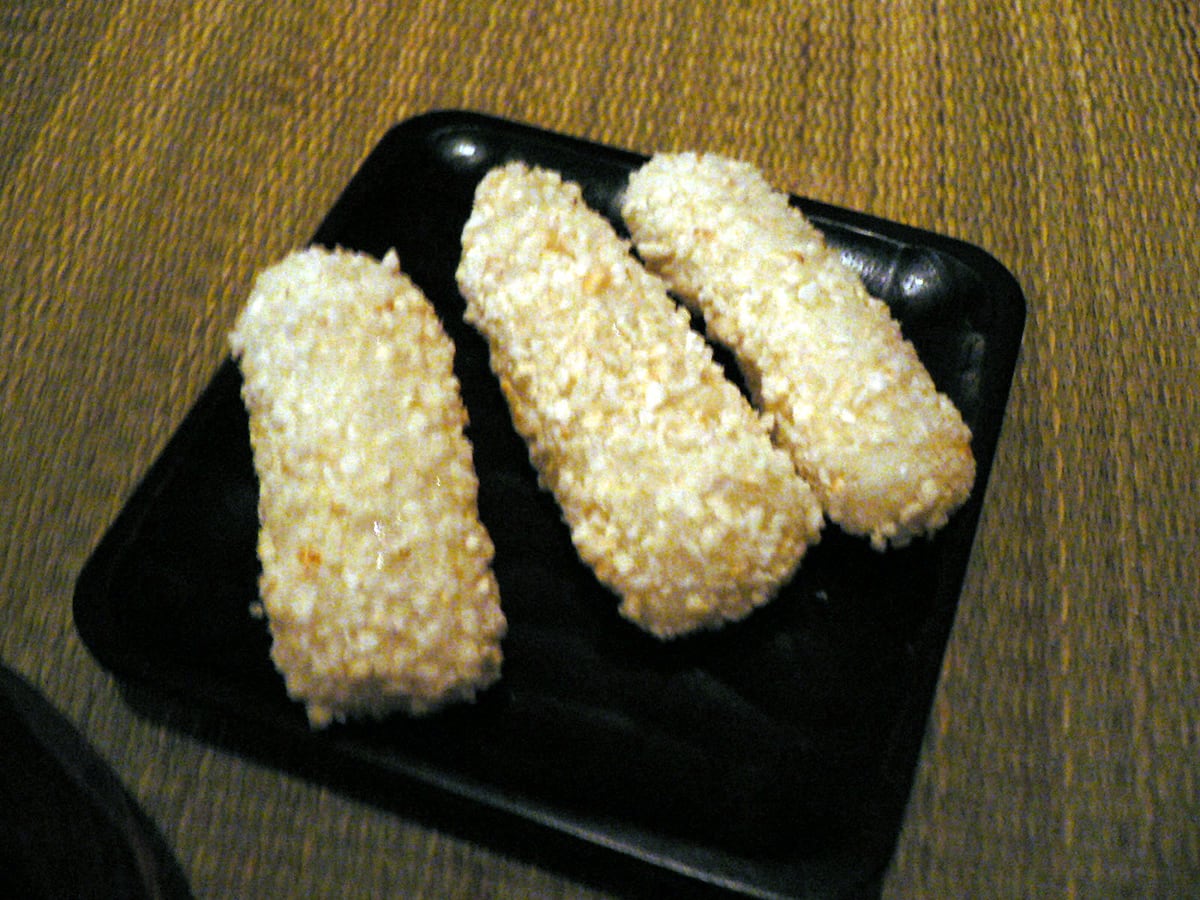
유과, a traditional Korean 한과. Rice-based, puffed, coated in grain — a completely different construction. Photo by abex, CC BY-SA 2.0, via Wikimedia Commons.
유과 is made from glutinous rice, puffed rather than simply fried, and coated in puffed grain or sesame. It is pale, extremely light, and structurally nothing like Matdongsan.
So the resemblance people feel is real but misleading: both are fried, both are syrup-coated, both are old. One is a rice confection with centuries behind it. The other is a wheat snack from 1975 with a Japanese template.
This is not a criticism of the product. Korea's food industry in the 1970s built a great deal by adapting Japanese formats and making them Korean — the same story runs through Dashida, which was commissioned as a Korean answer to Japan's Hondashi in exactly the same decade. Knowing that lineage makes the peanut coat more interesting, not less.
You might like: Yakgwa Guide: Why Korea's Honey Cookie Became Cool Again
The Traditional Music Fermentation Claim
For roughly a decade, Haitai marketed Matdongsan on an unusual claim: that during fermentation, the dough was played 국악 — Korean traditional music — and that this increased yeast activity, producing the snack's characteristic crisp-outside, soft-inside texture.
It appeared in advertising, in press coverage, and on packaging.
It is worth being straightforward about this. There is no accepted evidence that playing music to yeast changes fermentation in any commercially meaningful way, and the campaign drew criticism in Korea as pseudoscience — particularly, as Korean commentary noted at the time, because the marketing budget was going into a musical story rather than into holding the price down.
The texture is real. The explanation was a story. Both things can be true, and the honest reading is that fermentation itself — not its soundtrack — is what makes the inside light.
It has largely disappeared from current marketing, but if you meet a Korean of a certain age and mention Matdongsan, there is a decent chance the music comes up.
The Jingle Nobody Forgets
In 1976, Haitai became one of the first Korean confectioners to advertise a snack on television, and the jingle — written by composer 김도향 — did more for the product than any packaging change since.
땅콩으로 버무린 튀김과자 "A fried snack tossed with peanuts"
It is a product description set to music, which is exactly why it worked. Fifty years later it is still the line Koreans quote, and the "party" framing of that campaign is why Matdongsan reads as a sharing snack rather than a personal one. It shows up at gatherings, on office desks, and in the big 300 g bag far more than the mini.
Every Flavour, and When
Matdongsan ran on the original recipe alone for 43 years. Then Haitai opened the gates.
| Year | Variant | Korean |
|---|---|---|
| 1975 | Original | 맛동산 |
| 2018 | Brown sugar chocolate | 흑당쇼콜라맛 |
| 2020 | Black — almond and hazelnut | 블랙 맛동산 |
| 2021 | Salted almond caramel | 솔티드 아몬드카라멜 |
| 2022 | Honey | 꿀단지 |
| 2024 | Pretzel | 프레첼맛 |
| 2025 | Chestnut · Coffee | 밤맛 · 커피맛 |
Two practical notes. The original is the one to buy first — the variants are built on the same fried stick and mostly change the coating, so if you do not like the base you will not like any of them. And variants are not permanent. Several have already rotated off shelves. If you want a specific one, buy it when you see it rather than planning a trip around it.
Price and Where to Buy
As of August 2026:
| Size | Where | Price |
|---|---|---|
| 90 g mini | Daiso (다이소) | ₩1,500 |
| 300 g | Emart Mall and major supermarkets | ₩4,380 list, commonly ₩3,980 |
You will find it in every large supermarket, most convenience stores, and Daiso. It is not a specialty item and it does not require hunting.
Buy the 300 g bag if you are sharing or taking it home, and the 90 g mini if you just want to try it. The mini at Daiso is the cheapest reliable way to test whether you like it.
One genuine complaint Koreans have, and it is fair: the quantity per bag has shrunk over the years while the price has climbed. It is still inexpensive in absolute terms, but longtime buyers are not imagining the change.
Taking Korean snacks home? Matdongsan travels well — it is dry, shelf-stable, and the sealed bag survives a suitcase better than most Korean confectionery. If you are assembling a box to bring back or want to compare what is actually available where you live, it is worth checking before you fill your luggage with it.
Who Should Skip It
An honest list, because "national steady seller" is not the same as "everyone will like it."
Skip it if you dislike very sweet things. This is not a mildly sweet biscuit. The syrup glaze is the dominant flavour and it does not let up.
Skip it if you have a peanut allergy. The peanut is not a trace ingredient or a possible-contamination warning — it is the coating on every piece.
Skip it if you want something distinctively Korean to bring home. That sounds harsh for a fifty-year-old national brand, but be practical: someone who has eaten karintō, or any peanut brittle, will find this familiar rather than surprising. If the goal is a snack that could not come from anywhere else, Korea has stranger and better options.
Do buy it if you want to eat what Koreans actually eat, rather than what gets marketed to visitors. Three billion bags is not a tourist number.
FAQ
Q: What is Matdongsan? A: A Korean snack made by 해태제과 (Haitai) since 1975: short sticks of fermented wheat dough, deep-fried, glazed in starch syrup (물엿), and rolled in crushed peanut (땅콩가루). Crisp outside, light inside, and distinctly sweet.
Q: Is Matdongsan a traditional Korean sweet? A: No. It is an industrial product from 1975, adapted from the Japanese fried-dough confection かりんとう (karintō). Korea's actual traditional equivalent is 한과, of which 유과 is the closest-looking — but 유과 is rice-based and puffed, a completely different construction.
Q: What does Matdongsan taste like? A: Sweet first, nutty second. The closest reference point for most people is a glazed doughnut stick rolled in peanuts, or peanut brittle with a lighter, airier centre. Salt is negligible at about 20 mg per 30 g.
Q: How much does Matdongsan cost in Korea? A: As of August 2026, the 90 g mini is ₩1,500 at Daiso and the 300 g bag is ₩4,380 list price, frequently discounted to around ₩3,980 at supermarkets.
Q: Why was the name changed from 맛보다? A: Not because it failed — because it succeeded. 맛보다 launched in February 1974 and outran Haitai's production capacity of 100 boxes a day, so the company withdrew it, expanded the factory, and relaunched it in 1975 as 맛동산. It sold 5 million bags that first year.
Q: Did Haitai really play traditional music during fermentation? A: Haitai marketed that claim for about a decade, saying 국악 increased yeast activity. It drew criticism in Korea as pseudoscience, and there is no accepted evidence that music meaningfully affects industrial fermentation. The airy texture comes from the fermentation step itself.
Q: How many flavours of Matdongsan are there? A: The original ran alone for 43 years. Since 2018 Haitai has released brown sugar chocolate, Black (almond and hazelnut), salted almond caramel, honey, pretzel, and in 2025 chestnut and coffee. Variants rotate and are not all available at once.
Sources
Launch history, the 맛보다 withdrawal, first-year sales, and the 1976 jingle from Korean business-press retrospectives on the brand. Product composition, the karintō lineage, the 국악 fermentation marketing and its criticism, cumulative sales, and the variant timeline from Korean-language reference sources. Prices from Daiso and Emart Mall listings current in August 2026; nutrition figures from the product labels as recorded in Korean nutrition databases.
Prices, pack sizes, and available variants change frequently. Check the bag in front of you.
You Might Also Like
Postick: The Korean Snack That Used to Come With a Ketchup Packet
Postick (포스틱) has been on Korean shelves since 1980, it is only 23% potato, and it shipped with a ketchup sachet until the sachet got too expensive. What it costs now, and the ramyun-powder trick Koreans use on it.
Hetbahn: What Korea's Instant Rice Is Made Of, and How to Heat It Without a Microwave
햇반 is 99.9% Korean rice and water plus 0.1% rice bran extract, sealed in a room cleaner than a hospital ward. The lid prints three cooking times and one of them needs no microwave at all. Prices, varieties, and the mistake almost everyone makes with the film.
Korean Food Prices in August 2026: What Already Rose, and What Changes on the 25th
Four Korean food makers raised prices within three weeks, and Paris Baguette's 127-item increase lands on 25 August. The exact brands, dates and won amounts, why wheat and corn are behind it, and what it actually changes for a visitor.