Korean Convenience Store Ice Cups: The Best-Selling Item Is a Cup of Ice
Last updated: 18 August 2026
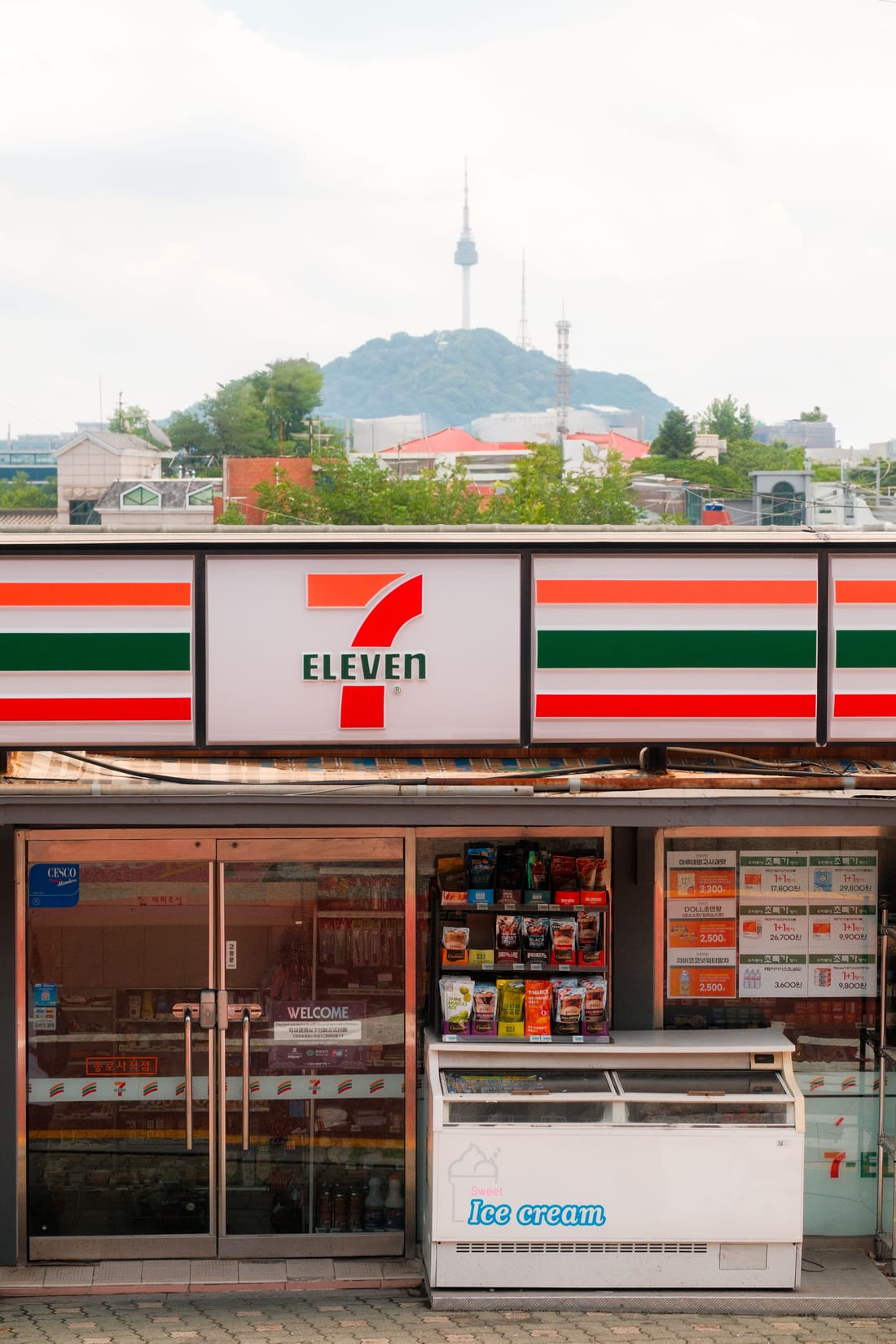
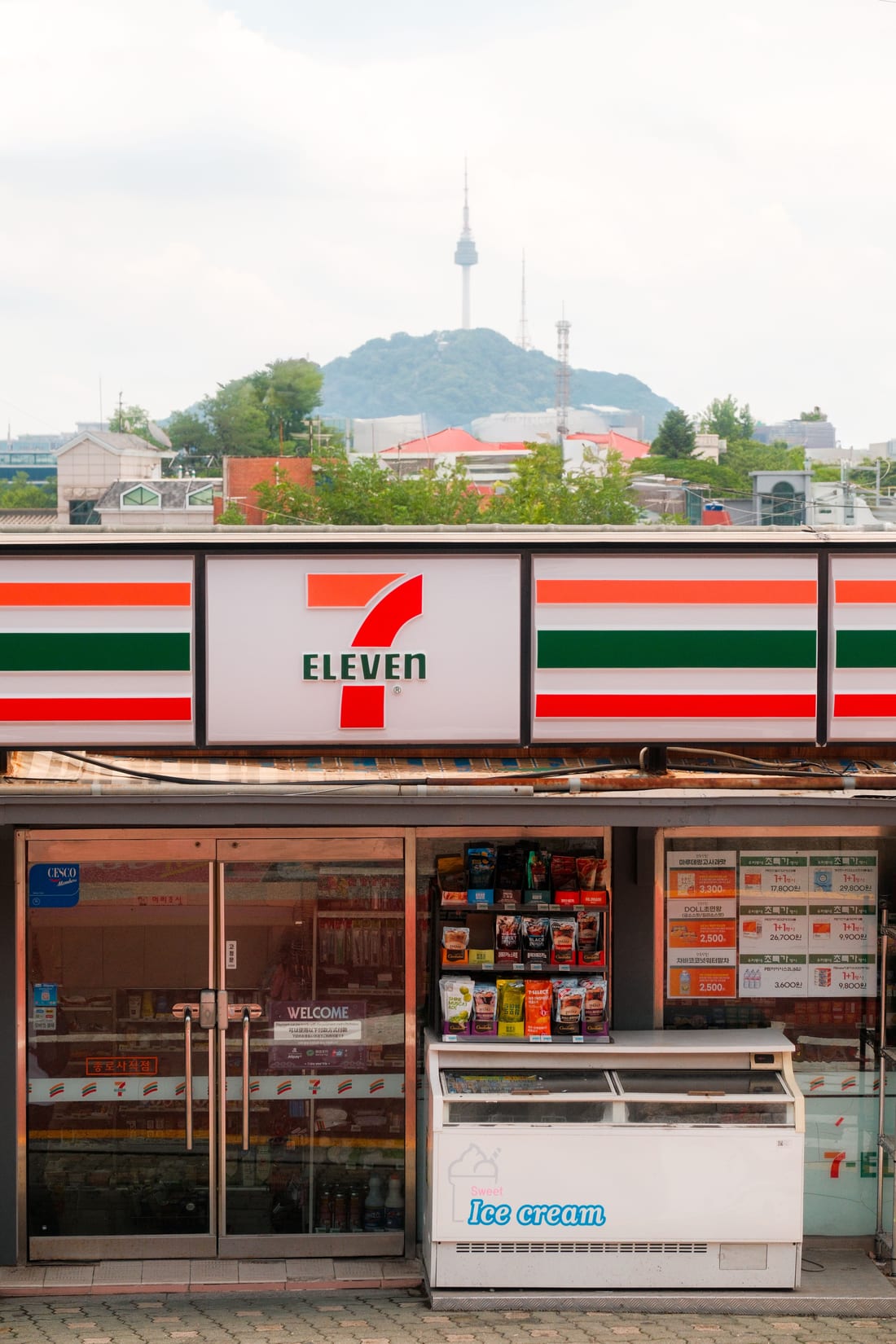
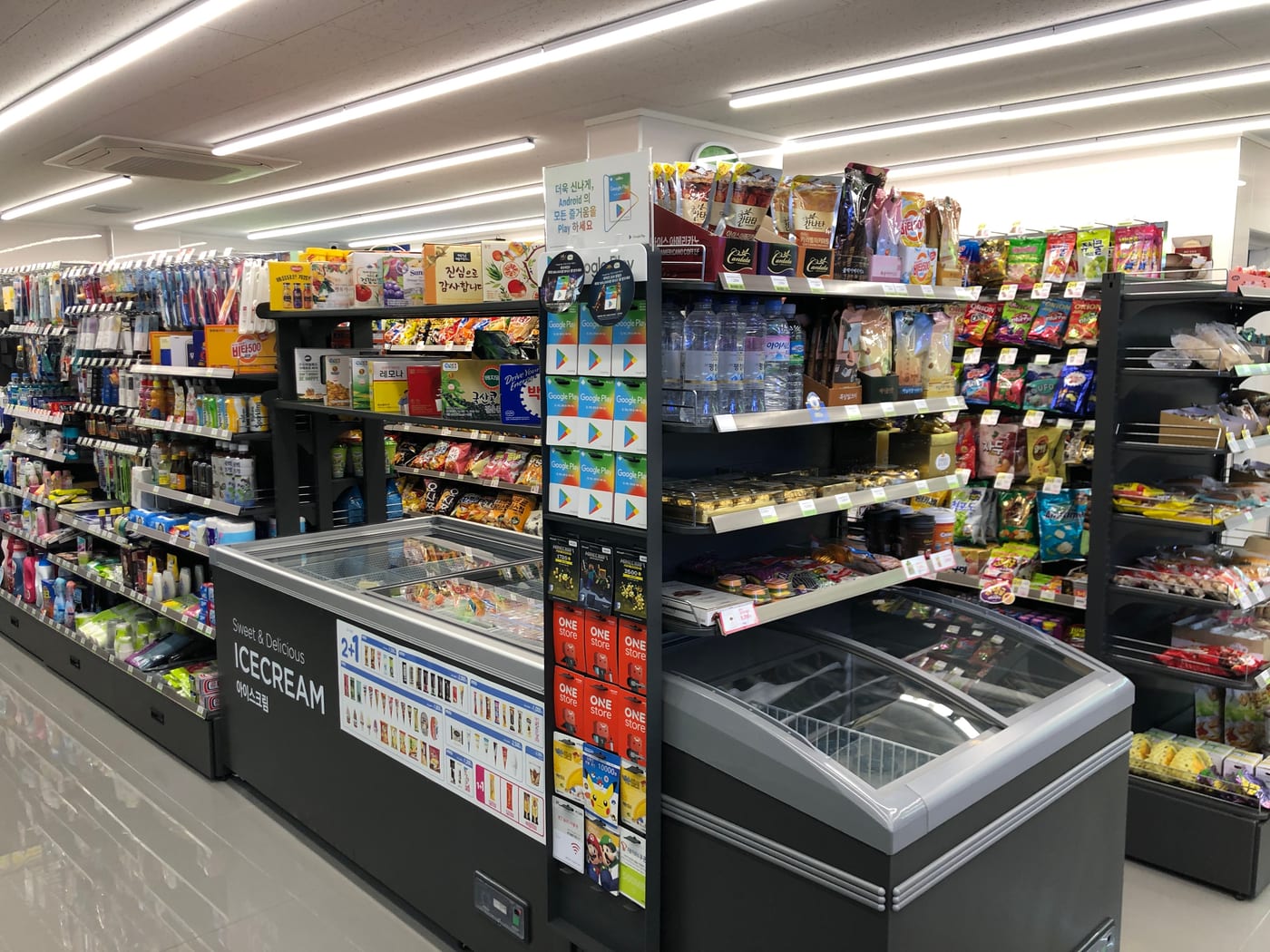
Walk into a Korean convenience store in July — a CU, a GS25, a 7-Eleven — and you will see people doing something that makes no sense the first time you watch it. They take a sealed plastic cup out of a chest freezer, carry it to the counter, and pay for it. There is no drink in it. The ice cup is the product.
Then they open a second fridge, take out a pouch or a small bottle, pay for that too, and pour one into the other on the pavement outside.
This is not a workaround for a broken drinks machine. The 얼음컵 (eoreum-keop, "ice cup") is a product with its own barcode, its own sizes, its own price list, and — this is the part that surprises people — the best sales rank in the store. Korean convenience-store chains have been selling more units of it than of any other single item for over a decade.
Here is what it costs right now, what to pour into it, and the one finding from Korea's food safety regulator that should change how you think about the ₩800 cup versus a ₩7,500 café iced coffee.
| Detail | |
|---|---|
| Korean name | 얼음컵 (eoreum-keop) or 아이스컵 (aiseu-keop) |
| What you buy | A sealed plastic cup of edible ice. No drink included. |
| Price, August 2026 | ₩800 medium · ₩1,000 large · ₩1,300–1,400 the biggest size |
| Where | The chest freezer, usually near the door or the ice cream |
| What goes in it | Pouch coffee, banana milk, sports drinks, beer, whisky |
| Sales rank | No.1 by units at CU, year-round, for over a decade |
| Last price change | June 2026 — GS25 on the 12th, 7-Eleven on the 15th, +₩100 |
| Skip it if | You want the drink cold, not diluted. Buy the chilled bottle instead. |
If you only remember one line: the ice is the product, the drink is the accessory, and the pair costs about half a Starbucks — but no less than a low-cost Korean coffee chain.
The Single Best-Selling Item in a Korean Convenience Store Is a Cup of Ice
This is the fact that reframes everything else, and it is not a marketing claim.
Korean-language retail reporting has tracked the ice cup at the top of CU's annual unit-sales ranking since the early 2010s — three to four consecutive years at No.1 as of 2016, and still No.1 by sales regardless of season as of 2024. Not ramyeon. Not triangle gimbap. Not cigarettes or bananas or bottled water. A cup of ice.
Two things make that possible.
The first is that it is almost never bought alone. The ice cup is half of a transaction — you buy the cup, then you buy something to put in it — so it rides along with a second purchase nearly every time. That is a very efficient thing for a retailer to own.
The second is that Korea's summer has been getting harder. In 2026, Gyeongnam recorded five straight days above 40°C from 29 July, peaking at 42.5°C in Yangsan on 2 August. Ice cup sales at all four major chains rose roughly 20% year-on-year over that stretch.
Maxim Mocha Gold coffee mix on Amazon — on AmazonAffiliate link. As an Amazon Associate, EpicKor earns from qualifying purchases at no extra cost to you.
You might like: Korean Drinks Guide: what to buy in a Korean convenience store, with the price, sugar and caffeine of every bottle
What an Ice Cup Costs, as of August 2026
Prices went up across the sector in June 2026. The chains blamed raw-material and manufacturing costs; the practical effect is that the round number changed from ₩700 to ₩800.
| Chain | Product | Ice weight | Price (Aug 2026) | Was |
|---|---|---|---|---|
| GS25 | 컵얼음 — purple lid | 180 g | ₩800 | ₩700 |
| GS25 | 빅컵얼음 — sky-blue lid | 230 g | ₩1,000 | ₩900 |
| GS25 | 벤티컵얼음 — white lid | 400 g | ₩1,400 | ₩1,300 |
| GS25 | 빅볼컵얼음 — one 70 mm sphere | 160 g | ₩1,500 | ₩1,300 |
| 세븐일레븐 | Regular | — | ₩800 | ₩700 |
| 세븐일레븐 | Large | — | ₩1,000 | ₩900 |
| 세븐일레븐 | Grande | — | ₩1,300 | ₩1,200 |
| 세븐일레븐 | 스파클링아이스컵 | — | ₩1,500 | new, 6 May 2026 |
CU and Emart24 had not confirmed new ice cup prices when GS25 and 7-Eleven announced theirs, and both said they were reviewing supplier cost requests. Treat CU and Emart24 as "around the same, check the shelf tag" rather than assuming a number — the tag is printed on the freezer lid and takes two seconds to read.
Bagged ice moved too, if you are buying for a cooler rather than a cup: 1 kg went to ₩2,300 at both chains, and 3 kg sits at ₩4,700–4,800 depending on the chain.
The lid colour is the size. GS25's freezer sticker codes them so you do not have to read anything: purple is 180 g, sky-blue is 230 g, white is 400 g. Once you know that you can buy the right one from three metres away, which is the whole point of a colour code.
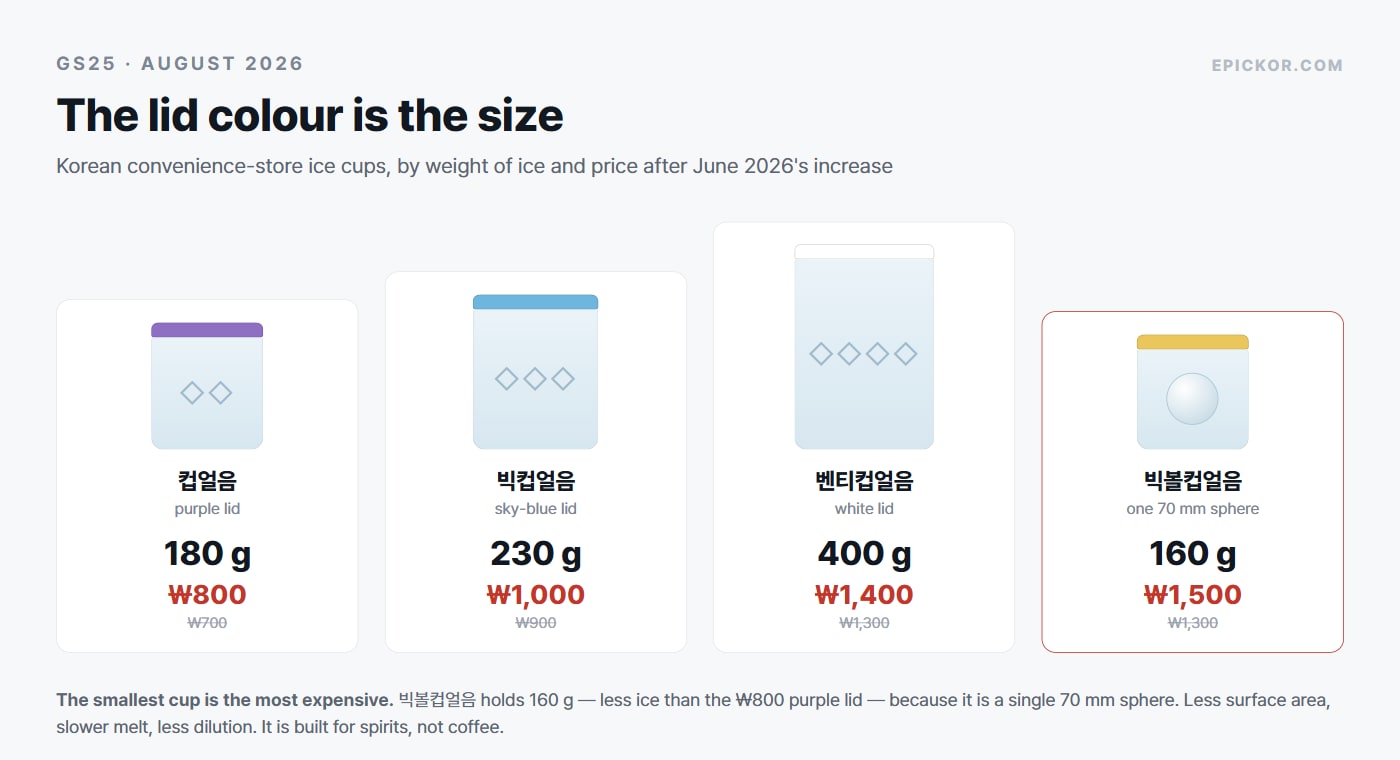
And the one that catches everybody: 빅볼컵얼음 is the smallest cup on the list and the most expensive. It holds 160 g — less ice than the ₩800 purple lid — because it is a single 70 mm sphere rather than cubes. GS25 launched it in 2020 as the industry's first spherical ice cup, and the physics is the point: one big sphere has far less surface area than a cup of small cubes, so it melts slowly and dilutes less. It is built for spirits, not for coffee.
You might like: Delaffe: Korea's Convenience-Store Coffee Brand That Cut Its Price to ₩900
Why the Drink Is Sold Separately
The short answer is price. The honest answer is that price only half explains it.
An ice cup plus a pouch of coffee runs ₩1,800–2,300 total. A tall iced americano at Starbucks Korea is ₩4,700 as of 2026, so against that the cup wins outright. But Korea's low-cost coffee chains are the real competition, and they are not expensive: 메가커피 is ₩2,000 and 컴포즈커피 ₩1,800 for an iced americano. On price alone the convenience-store route is level with them, not cheaper.
Korean retail coverage in 2026 still frames ice cups and pouch drinks as 가성비 — value-for-money — substitutes for franchise café drinks. That is true against the ₩4,700 end of the market, and it is what is driving the volume. It is not true against the ₩1,800 end, and anyone telling you the ice cup is always the cheap option has not checked.
That is why the pouch exists at all. A pouch has no bottle to chill, no cap, no rigid packaging, and it can sit in an ambient shelf rather than occupying prime fridge space. Chains sell it under their own labels — 델라페 (Delaffe) at CU, 세븐셀렉트 at 7-Eleven, 성수310 at Emart24, and GS25's flat-₩1,000 line — precisely because the margin structure works when you are not paying to refrigerate the liquid.
The ice does the cooling. The pouch just supplies flavour.
There is a second reason, and it is the one that makes the format stick: you control the ratio. A bottled iced coffee arrives at whatever strength the factory chose. A pouch over a large cup of ice is weak and long; the same pouch over a medium is strong and short. Koreans who drink four of these a week have a fixed opinion about which.
Want the same cup at home? The pouch is the hard part to replicate outside Korea, but the stick is not — Korean coffee mix is built to dissolve in cold liquid, which is exactly what an ice cup asks of it. As an Amazon Associate, EpicKor earns from qualifying purchases at no extra cost to you.
Maxim Mocha Gold coffee mix on Amazon
Maxim Mocha Gold coffee mix on AmazonYou might like: Why Koreans Drink Iced Americano Year-Round
You might like: Why Korea Has 100,000 Cafés: The ₩2,000 Americano, the ₩222 Bean, and Why Half of Them Will Close
What Koreans Actually Pour Into It
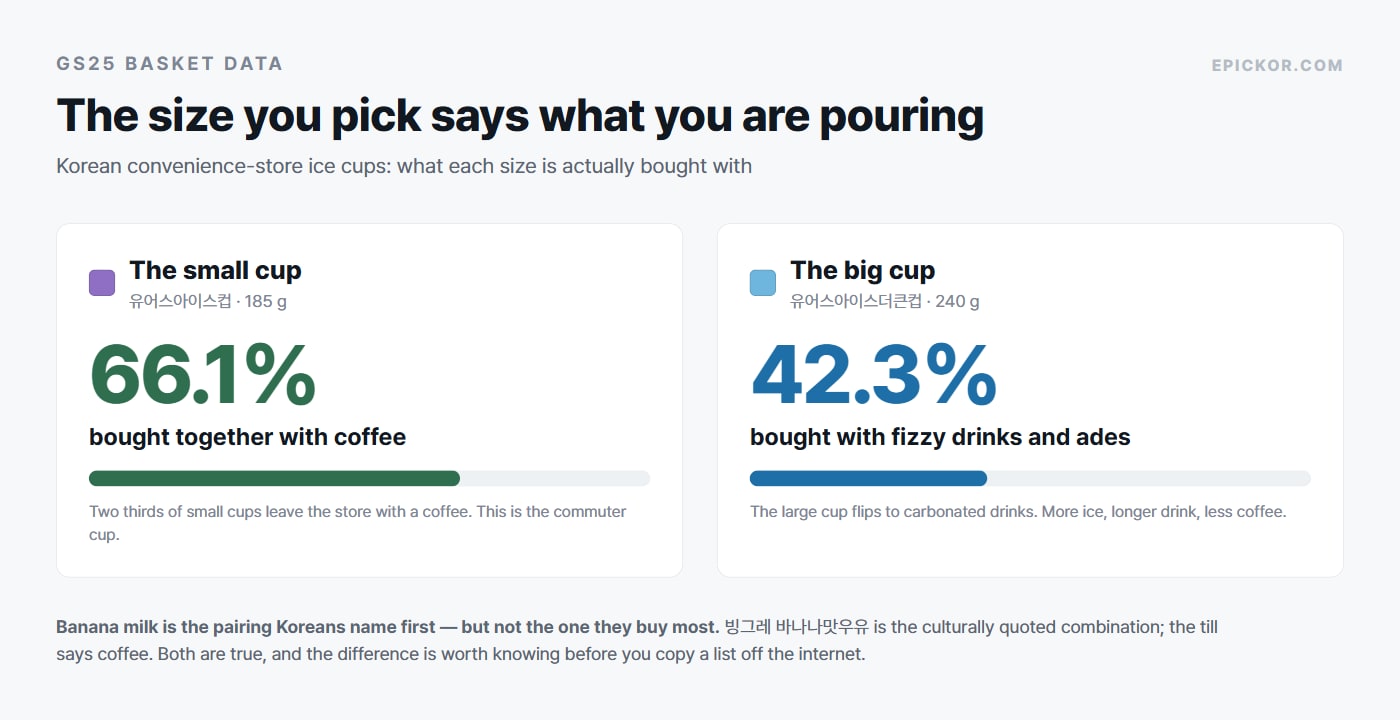
Ask a Korean what goes in an ice cup and you will get a short list, not a shrug. GS25 has published what its own basket data says, and it splits cleanly by cup size: the small cup is bought with coffee 66.1% of the time, while the big cup pairs with carbonated drinks and ades 42.3% of the time. The size you pick is effectively a declaration of what you are about to pour.
빙그레 바나나맛우유 (Binggrae banana milk). The pot-shaped bottle is the single most-quoted pairing — enough that Korean writing about ice cups calls the combination 국룰, "the national rule." It is sweeter than you expect over ice, and the melt works in its favour rather than against it.
Pouch coffee. Hazelnut is the default flavour in the ice-cup context, which surprises people who assume americano. The chains' own-label pouches are the cheap route; a branded pouch costs a few hundred won more.
Sports drinks and sparkling water. Less discussed, very common in actual use — a ₩1,000 ion drink over a large cup is what people carry out of the store at 2pm in August.
Beer, and now spirits. Naver's own autocomplete for 얼음컵 surfaces 맥주 (beer) as one of the top branches. This is a normal adult use of the product, not a loophole.
The mechanics are worth one line, because the first attempt usually goes badly. The lid is a foil seal, not a snap cap. Peel it off completely rather than punching a straw through it — you need the opening to pour into, and a punched hole will spit when the liquid hits the ice.
The Sparkling Ice Cup: Press the Bottom and It Fizzes
On 6 May 2026, 7-Eleven Korea launched a 스파클링아이스컵 at ₩1,500, and it is the most interesting thing to happen to this product in years.
The cup has carbonation powder built into a compartment in its base. You pour in whatever you want, press the bottom, and the powder reacts and drives bubbles up through the drink. 7-Eleven developed the structure with a partner and holds a patent on it.
The stated use case is telling. The chain's own framing is not "sparkling juice" but highballs — pour in whisky, press, and you have a carbonated drink without buying a bottle of soda water. White wine gives you something approximating a sparkling wine. Fruit juice and sports drinks work too, and 7-Eleven has been explicit that the visual of the bubbles rising is aimed at short-form video.
Whether it tastes better than just buying sparkling water is a matter of opinion, and Korean reviews are split. What is not in dispute is that a convenience-store chain patented a cup.
The Hygiene Question, and the Answer That Surprises People
The obvious worry about buying ice from a convenience store is that it is ice from a convenience store. The data says the worry is pointed at the wrong target.
Korea's Ministry of Food and Drug Safety (식품의약품안전처) ran a summer sweep of edible ice in 2026, collecting 409 samples from coffee franchises, fast-food outlets and convenience stores. The standard for edible ice (식용얼음) is a total bacterial count of 1,000 or fewer per mL.
Four samples failed. All four were ice-machine ice at cafés — including franchise stores — at counts of 2,300 to 3,300 per mL, up to 3.3 times the limit. The MFDS ordered those four to stop using their ice machines immediately, clean and disinfect them internally, and replace the filters.
The packaged cup ice passed. So did the newer ice cups with fruit or additives in them, which are regulated as a processed fruit-and-vegetable product rather than as plain ice.
That result is not a coincidence, and it is the practical takeaway of this whole article. A convenience-store ice cup is a manufactured, sealed, date-coded food product made in a plant and shipped frozen. Café ice comes out of a machine in the back of a shop, and that machine has a filter and an interior that somebody has to remember to clean. One of those two supply chains has an inspection regime pointed at it.
So the ₩800 cup is not the compromise. In a summer where a ₩7,500 iced coffee can be built on ice that is three times over the bacterial limit, it is arguably the safer purchase.
Building a Korean drinks shelf at home? The ice cup does not travel, but the things Koreans pour into it do — banana milk, pouch and stick coffee, and the sweet-tangy drinks that work over ice rather than straight from the fridge.
When Not to Buy One
Three honest cases where the ice cup is the wrong call.
You want the drink cold, not diluted. This is the real trade-off and nobody mentions it. Ice cools by melting, and what melts goes into your drink. A chilled bottle from the fridge is colder for longer and stays at full strength. If you are drinking something you actually care about the taste of, buy it cold rather than buying it warm plus ice.
You are drinking it indoors within five minutes. The ice cup earns its keep on a walk, on a bus, at a desk over an hour. Consumed immediately, you paid ₩800 for nothing.
You want the cheapest possible cold coffee. Then walk to 컴포즈커피 or 메가커피. At ₩1,800–2,000 for a made-to-order iced americano they match or beat the cup-plus-pouch total, and somebody else does the pouring. The ice cup wins on volume, on duration, on being open at 3am and on ratio control — not on the number at the till.
And one thing that is not a reason to skip it: the occasional complaint in Korean forums about ice that tastes or smells faintly of the freezer. It happens, it is a storage problem at that particular store rather than a product problem, and the fix is to buy from a store with turnover — which in practice means almost any store in a city in August.
You might like: Korean Convenience Store Breakfast: What Locals Buy
Also: Coolpis — the drink Korean spicy-food shops put on the table
What This Costs You Versus the Alternatives
| Option | Typical cost | What you get |
|---|---|---|
| Ice cup + pouch coffee | ₩1,800–2,300 | Long, cold, ratio you chose |
| Ice cup + banana milk | ₩2,000–2,500 | The pairing Koreans name first |
| Canned coffee, chilled | ₩1,200–1,800 | Colder, no dilution, fixed strength |
| 컴포즈커피 iced americano | ₩1,800 | Made to order, no cheaper than the cup |
| 메가커피 iced americano | ₩2,000 | Made to order, seating at some branches |
| Starbucks iced americano, tall | ₩4,700 | Where the value argument actually lands |
| Bagged ice, 1 kg | ₩2,300 | For a cooler, not a cup |
FAQ
Q: Do I have to buy a drink to buy an ice cup? A: No. It is its own product with its own barcode and you can buy it alone — people do, for coolers, for a hangover, or to carry home. It is simply designed to be bought with something.
Q: Is the ice safe to eat? A: Yes, and by the regulator's own 2026 sampling it is the safer end of the market. Packaged cup ice passed; the failures in that sweep were all café ice machines. Edible ice in Korea must test at 1,000 or fewer bacteria per mL.
Q: What size should I get? A: Medium (₩800) for one pouch or one small bottle. Large (₩1,000) if you want it long and weak, or if you are walking for a while in real heat. The XL and Grande sizes are for sharing or for spirits.
Q: Can I put alcohol in it? A: Yes, and it is a normal use — beer is one of the top Korean search branches for the product, and 7-Eleven markets its sparkling cup for whisky highballs specifically.
Q: Do other countries have this? A: Barely. The sealed convenience-store ice cup is essentially a Korea-and-Japan format, which is why it turns up on so many visitor lists of things to try in Korea. There is no equivalent aisle in most Western convenience stores.
Sources Checked
- Korean retail press, June–July 2026, for the GS25 (12 June) and 7-Eleven (15 June) ice cup and bagged ice price increases, the stated cost reasons, and the per-size ice weights: 컵얼음 180 g, 빅컵얼음 230 g, 벤티컵얼음 400 g, 빅볼컵얼음 160 g.
- GS25 product announcements for 빅볼아이스컵 (2020, a 70 mm sphere, industry first) and for the basket-pairing split — 66.1% coffee with the small cup, 42.3% carbonated drinks and ades with the large one.
- Korean retail press, July–August 2026, for chain-by-chain ice cup and pouch drink sales growth and the four-chain year-on-year figure.
- Korea Meteorological reporting via Korean press for the 2026 Gyeongnam heat figures, including 42.5°C at Yangsan on 2 August.
- 식품의약품안전처 (MFDS) 2026 edible-ice sampling: 409 samples, four failures at 2,300–3,300 bacteria per mL against a 1,000/mL standard, all from café ice machines.
- 세븐일레븐 product announcement, 6 May 2026, for the 스파클링아이스컵 launch, price and patented carbonation structure.
- Korean-language reference sources for CU's ice cup unit-sales ranking and the 바나나맛우유 pairing convention.
- Korean coffee-chain menu pricing, 2026: 스타벅스 iced americano (tall) ₩4,700, 메가커피 ₩2,000, 컴포즈커피 ₩1,800.
Prices verified against Korean retail reporting for August 2026. Convenience-store prices vary by store type and location — the shelf tag on the freezer is the authority.
You Might Also Like
Delaffe: Korea's Convenience-Store Coffee Brand That Cut Its Price to ₩900
델라페 is not a drink, it is CU's own label — 150 million units a year, sold as a pouch you pour into a separate cup of ice. In March 2026 five of them dropped to ₩900, which makes the convenience store cheaper than Korea's cheapest café chain.
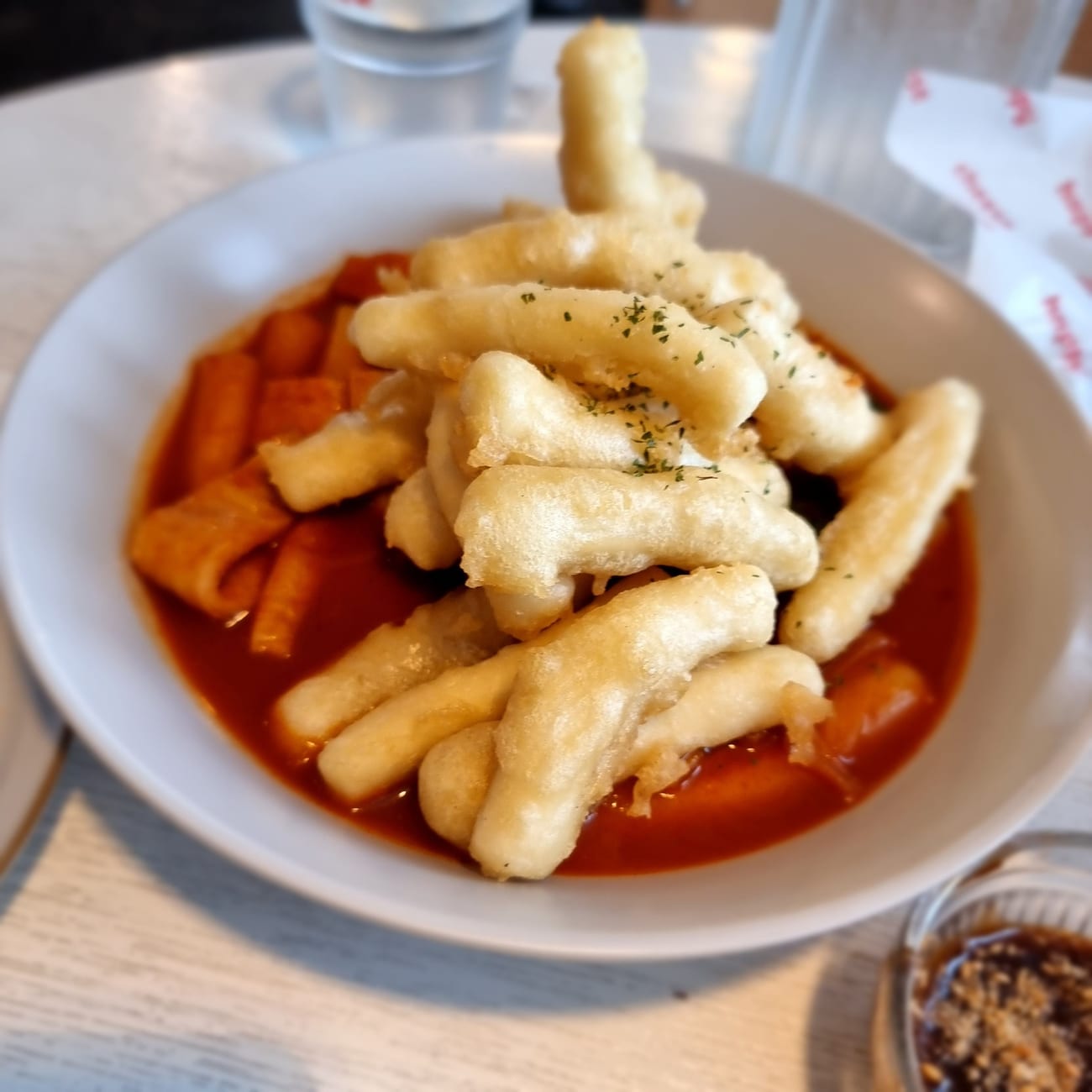
Coolpis: The Korean Drink That Exists to Put Out Tteokbokki
쿨피스 is on every spicy Korean table for a reason, and it is not the one people assume. It does not neutralise capsaicin — milk does. Launched 1980, 80 million units a year, and in 2026 its first new flavour since 2011.
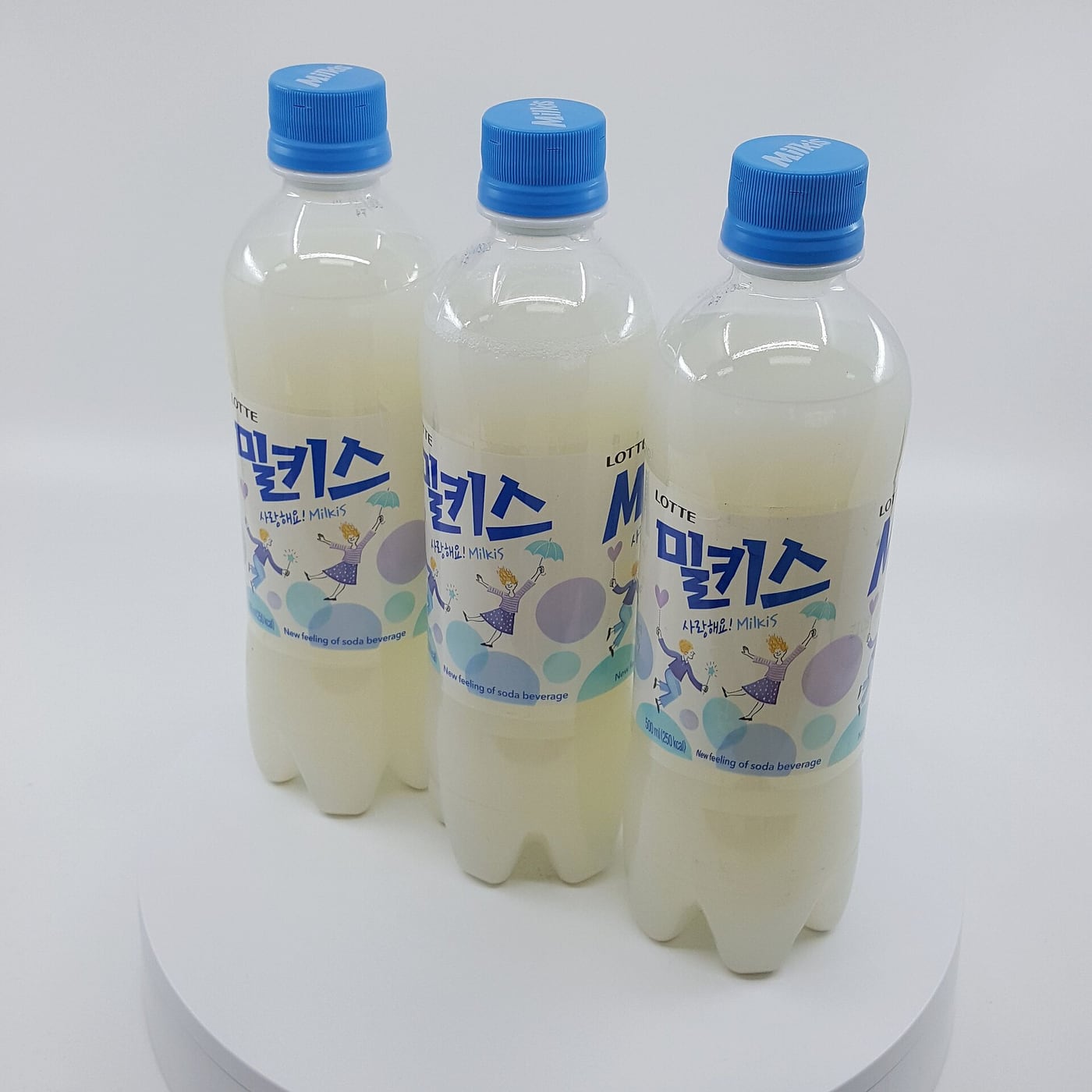
Milkis vs Calpis, and Whether Korea's Milk Soda Has Alcohol
Milkis is not Calpis — different country, different bacteria, seventy years apart — and it has no alcohol, though the question returns for a reason printed on the can. Which flavour to buy first, the ₩750 promotion price, and how Koreans drink it.