Why Korea Has 100,000 Cafés: The ₩2,000 Americano, the ₩222 Bean, and Why Half of Them Will Close
Last updated: September 2026
Stand on any corner in a Korean city and count. There will be a Starbucks, a Mega Coffee with a yellow sign, a Compose Coffee, an Ediya, and at least two cafés with names in cursive English that opened this year. Walk one block and count again. The numbers behind that view are these: Korea has more than 100,000 coffee shops, about twice as many as it has convenience stores, or one café for every 536 people; in Seoul the density is about ten times New York's. Japan, the country that taught Asia to drink coffee, has one for every 2,630. The United States has one for every 4,402. Koreans drink 405 cups of coffee a year each, second in the world only to France and two and a half times the global average.
Foreigners notice the density first and assume it means Koreans love coffee. They do. But that is not why there are 100,000 cafés. There are 100,000 cafés because opening one is the cheapest, fastest, most respectable way for a Korean with ₩200 million and no job to become self-employed, because a chain will sell you the whole business in a box, and because a ₩2,000 americano can be sold at a profit when the beans in it cost less than ₩250. The same economics explain the other number, the one Koreans talk about: in Seoul in 2025, for the first time in a decade, more cafés closed than opened.
This is a companion to our post on why Koreans drink iced americano year-round, which is about the drink. This one is about the shop: what a cup costs at each tier and why, who actually owns the chains (one of them is Filipino), what the beans cost against the price, the unwritten rules for sitting in one all afternoon, and what to order where.
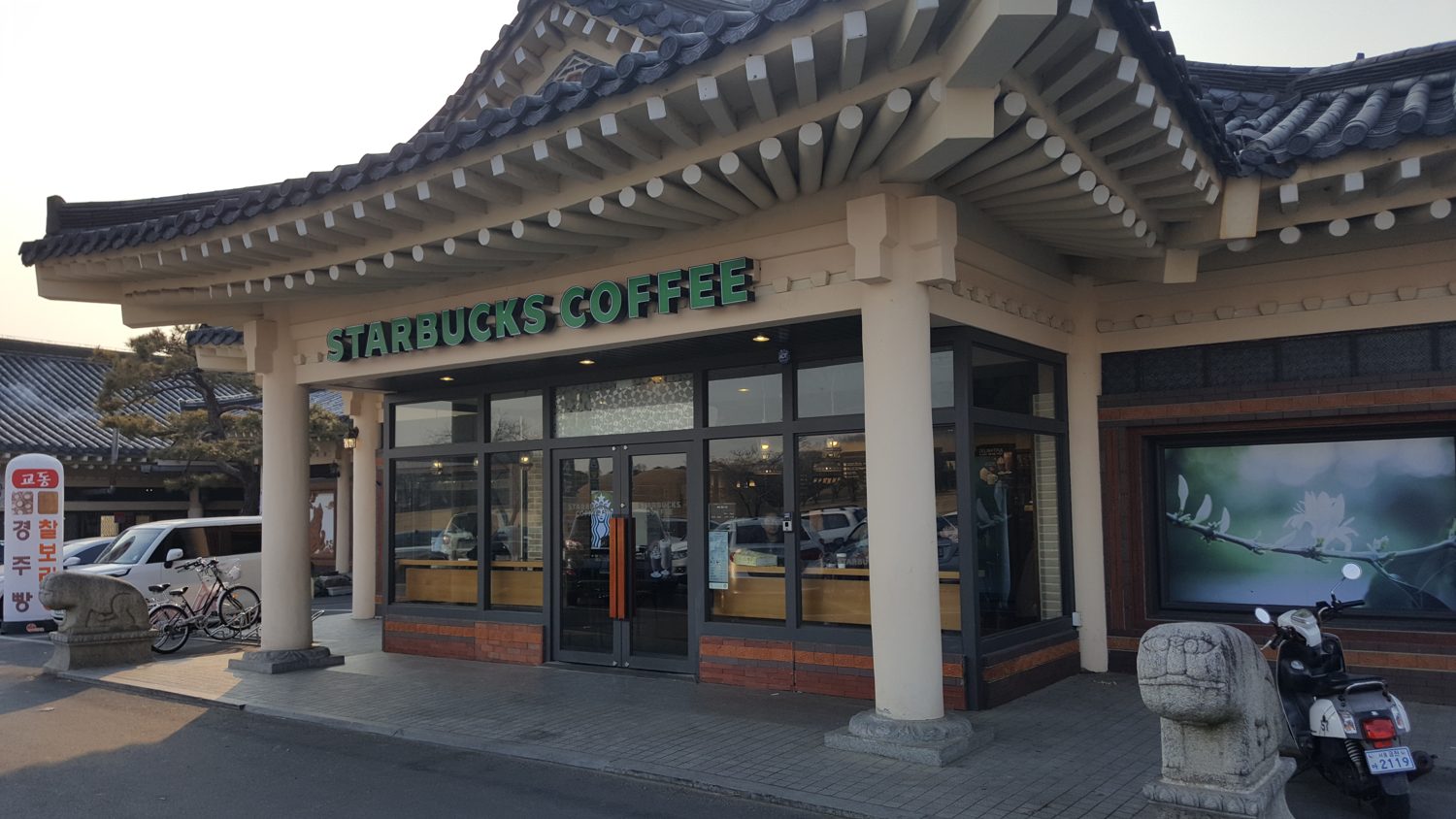
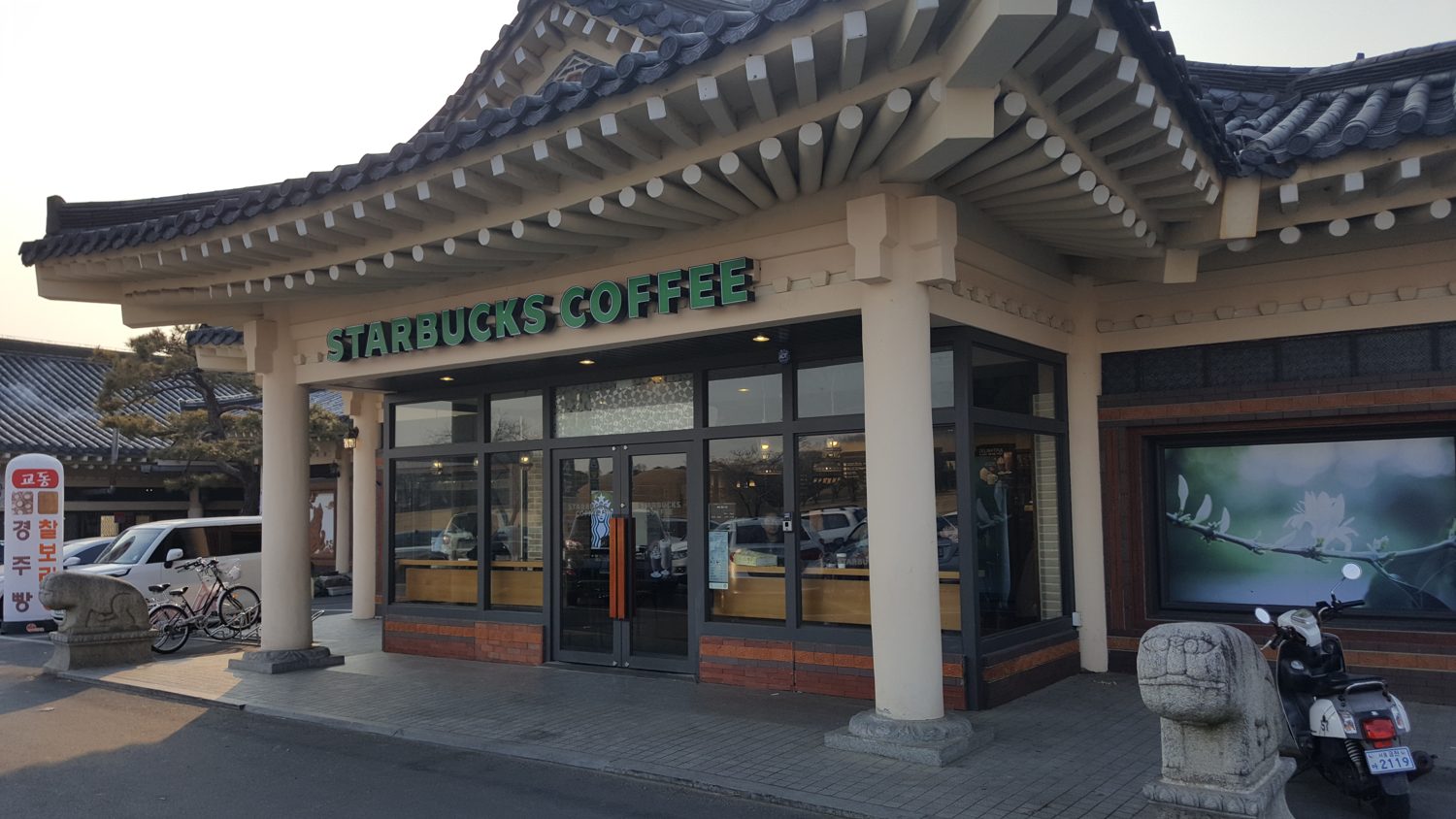
Starbucks Gyeongju Daereungwon, built as a hanok beside the royal tombs. Korea's 2,185 Starbucks stores are run not by Seattle but by Shinsegae, Korea's department-store group. Photo: CC BY-SA 3.0, via Wikimedia Commons.
The Korean office answer to the ₩4,700 cup: KANU mini americano sticks are the instant black coffee on every Korean desk, and the reason the café is a place to sit rather than a place to get caffeine. As an Amazon Associate, EpicKor earns from qualifying purchases.
Watch the 7-minute episode: Why Korea Has 93,600 Cafés — and Most Are Losing Money — the same question as this post, on screen. The episode uses the July 2026 register of coffee and drink shops (93,600); the 100,000 below is the trade-press count from tax data. Two counts, same conclusion.
Quick Guide: what an iced americano costs in Korea, 2026
| Tier | Chains | Iced americano | Stores | What you are paying for |
|---|---|---|---|---|
| Ultra-low | Mammoth, Hasamdong, Compose | ₩1,200 to ₩1,800 | Compose 3,000+ | A takeaway window, a big cup, two shots, no seat |
| Low | Mega MGC Coffee, Paik's (빽다방), The Venti | ₩2,000 (Mega hot ₩1,700) | Mega 4,466; Paik's 1,800+ | Same, with a few stools and a celebrity on the window |
| Middle | Ediya, Coffee Bay | ₩3,200 | Ediya about 2,500 | A proper seat, the neighbourhood café franchise |
| Premium chain | Starbucks, Twosome Place, Pascucci, Paul Bassett, Hollys | ₩4,500 to ₩4,700 | Starbucks 2,185 | Space, power sockets, three hours, no questions |
| Top chain | Coffee Bean | ₩5,000 | Habit | |
| Independent | Any café with a plant and a font | ₩4,500 to ₩7,000 | Roughly 70,000 of the 100,000 | The interior, which is the product |
Prices are 2025-2026 list prices from the chains and the E-Today price survey; the cheapest tier moved up ₩200 to ₩300 in 2025 for the first time in a decade. The gap between the top and the bottom of that table, ₩1,200 to ₩7,000 for what is chemically the same drink, is the subject of this post.
KANU Mini Dark Roast Americano — 30 sticks, the Korean desk coffee Maxim's KANU is the instant that made Koreans stop calling instant coffee "mix." A 0.9 g stick in hot or iced water makes a black coffee close enough to a café americano that most Korean offices run on it, and go to the café for the chair. As an Amazon Associate, EpicKor earns from qualifying purchases.
See KANU mini on Amazon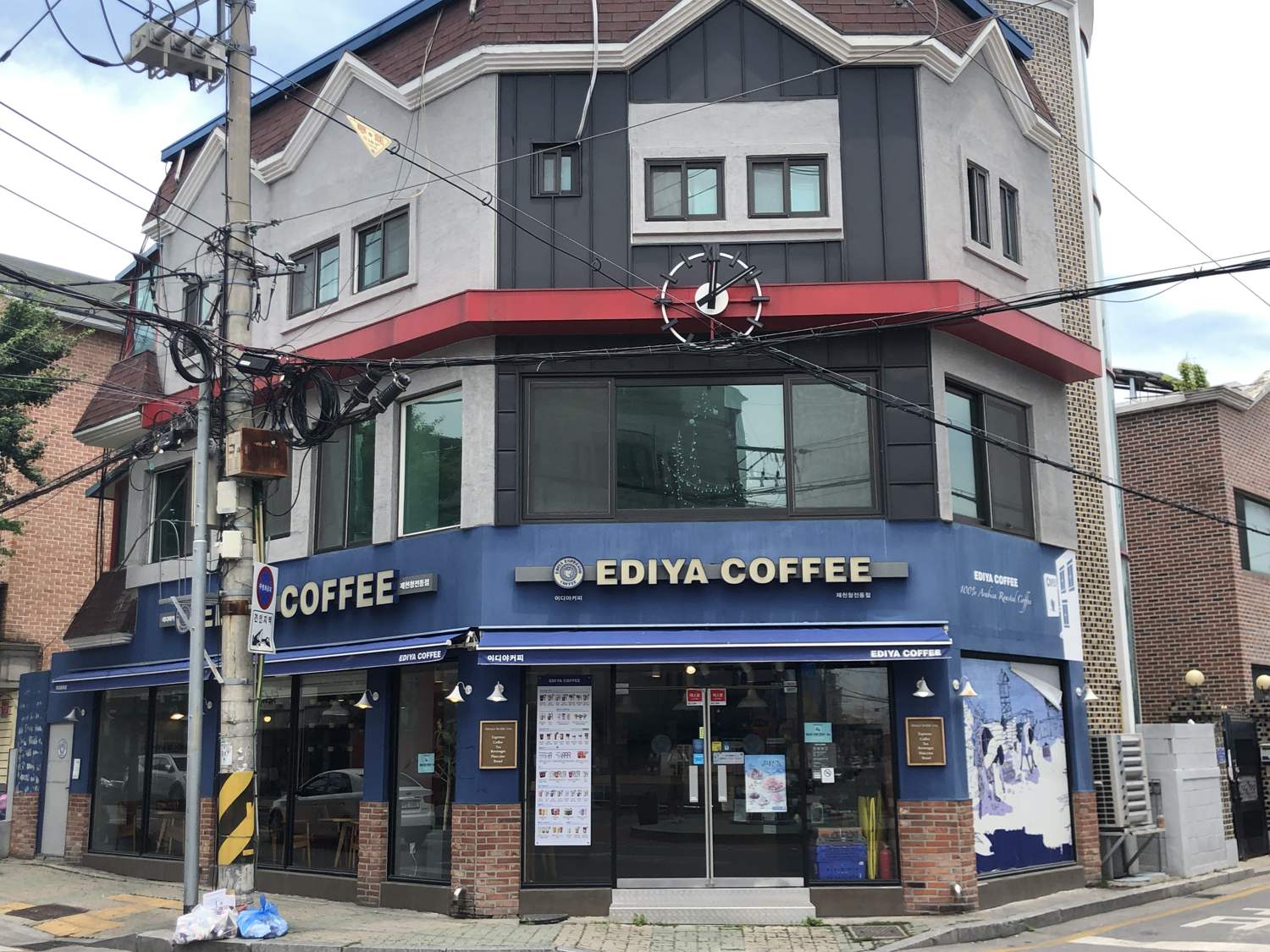
Ediya in Jecheon, a provincial city: the middle tier, ₩3,200 for an americano and a seat, and the franchise that reached small towns before the budget chains did. Photo: CC0, via Wikimedia Commons.
The ₩4,700 cup: Starbucks, which is not American here
Start at the top, because it is where the price anchor sits. Starbucks opened its first Korean store at Ewha Womans University in 1999, selling a tall americano for ₩3,000 (a short was ₩2,500). It went to ₩3,600 in 2012, ₩3,900 in 2013, ₩4,100 in 2014, ₩4,500 in 2022, and on 24 January 2025 to ₩4,700, which is where it is now: a 57 percent rise over 26 years, more or less in line with inflation, which is not what the annual outrage in the Korean press would suggest.
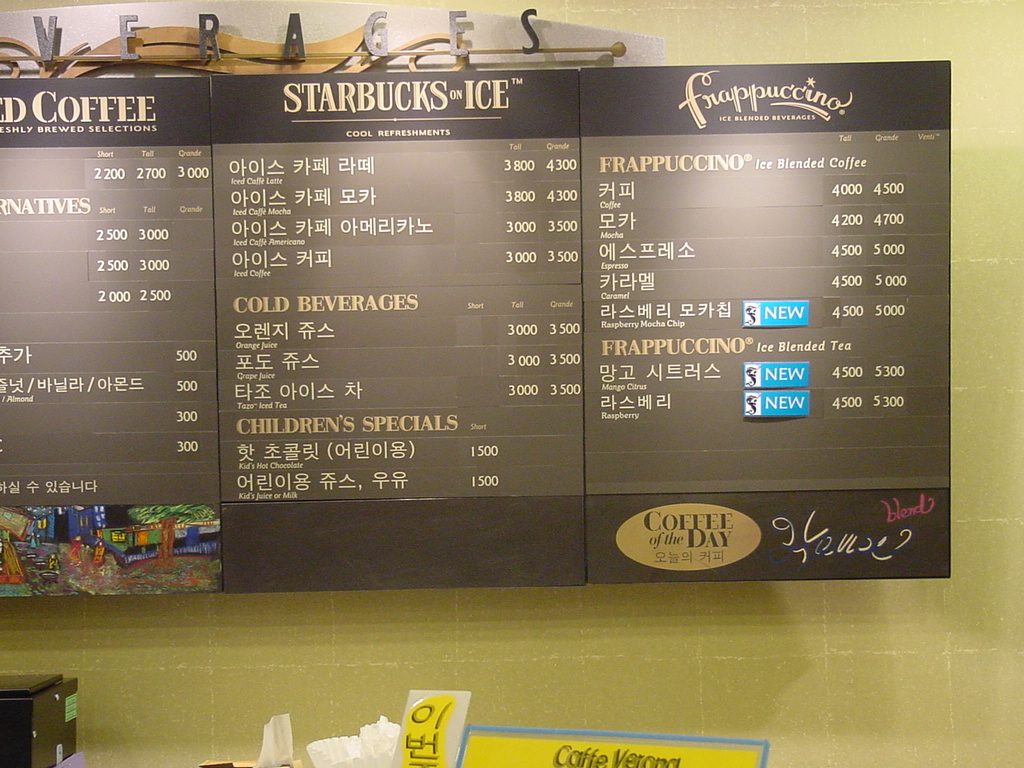
A Seoul Starbucks board in 2001: iced americano ₩3,000. Twenty-five years later it is ₩4,700. Photo: Alex C, CC BY 2.0, via Wikimedia Commons.
What most visitors do not know is that Starbucks Korea is a Korean company. Since 2021 it has been owned by SCK Company, a subsidiary of Shinsegae's E-Mart, with Singapore's sovereign fund as minority partner; Starbucks Seattle sold out. That is why it behaves unlike Starbucks anywhere else: 327 stores in 2010, about 2,000 in 2025, 2,185 by June 2026, a store built as a hanok beside the Gyeongju tombs, a summer merchandise "frequency" promotion that produces queues at 6 am, and a Korea-only menu that reads like a dessert shop. It is also, in Korean, spelled out phonetically on the sign, 스타벅스커피, in the one country where the company agreed to drop the Roman alphabet, because the store in the photograph below is in Insadong and the district asked.
The scale is easy to miss from inside Korea. In 2025 Korea passed Japan to become the country with the third-most Starbucks stores on earth, 2,009 at the count against Japan's 1,901, behind only the United States (17,049) and China (7,685); per head of population it is first in the world, one Starbucks for every 25,000 Koreans. A third of them are in Seoul, ninety in Gangnam district alone, and seventeen on the 3.8 kilometres of Teheran-ro. If you feel there is a Starbucks on every corner in Seoul, that is because, by the company's own numbers, there very nearly is.
The other American name from the first wave is going the other way. The Coffee Bean & Tea Leaf, which arrived in 2001 and for a decade was the Gangnam status café at ₩5,000 a cup, has shrunk every year since 2019, from 291 stores to 221 in 2024; it posted its first operating loss in 2025 and in December 2025 withdrew its franchise registration altogether, retreating to company-run stores. Squeezed between Starbucks above and the ₩2,000 chains below, the middle of the premium tier is where Korean coffee brands go to disappear.
The ₩222 bean
Now the other end. In September 2025 the Korea Consumer Organizations Council did the arithmetic on a tall Starbucks americano: two shots of espresso contain about ₩222 worth of coffee beans, or 4.7 percent of the ₩4,700 price. For the budget chains the beans are 12 to 13 percent of the price. The council's point was that the 2025 price rises, blamed on green-coffee prices and the exchange rate, could not be explained by beans; the rest of the cup is rent, labour, the cup, the ice and the seat. Which is exactly the point of the Korean café market. You are never paying for coffee. You are paying for a chair, and the price of the chair depends on how long you can sit in it.
That is why the cheapest tier exists. Mega MGC Coffee opened its first store in Hongdae in 2015 with a ₩1,500 americano in a 20-ounce cup, and built the business on a simple bet: sell the coffee at cost, keep the shop to ten pyeong with three stools, and put the whole margin in volume. It reached 3,000 stores in June 2024 and 4,466 by June 2026, the most of any café brand in Korea, and in April 2025 raised its hot americano to ₩1,700, the first price rise in its history; the iced one stayed at ₩2,000. Compose Coffee, its nearest rival, passed 3,000 stores in September 2025. Paik's, the chain fronted by the celebrity chef Paik Jong-won, has more than 1,800. The four biggest budget brands together run close to 10,000 shops, a third of all franchised cafés in the country.
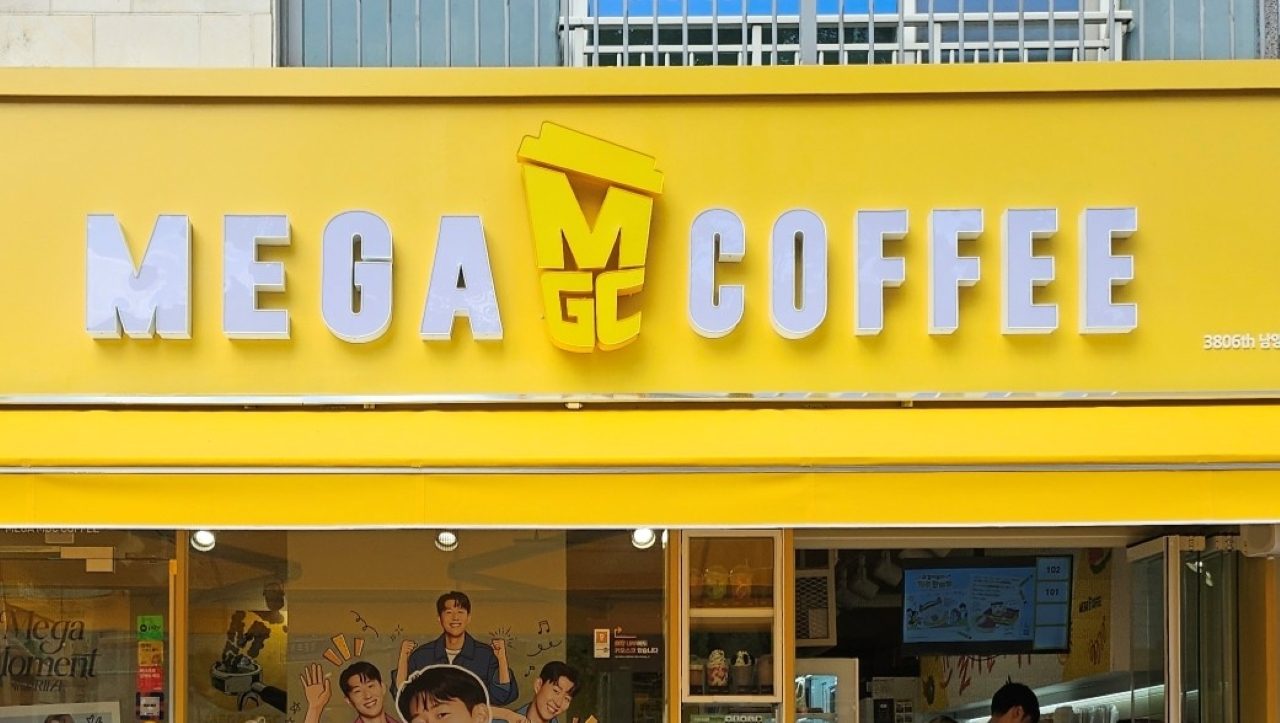
Mega MGC Coffee: ten pyeong, a yellow sign, ₩2,000 iced americano, 4,466 stores. Image: Mega MGC Coffee, shown for identification.
Who owns the cheap coffee
Here is the part Koreans find faintly embarrassing. The budget chains that look like plucky local upstarts are mostly owned by financiers, and one of them is owned by a Filipino fried-chicken company.
Mega Coffee's operator, Anhouse, was bought in 2021 for ₩140 billion by a consortium of private-equity firms, Premier Partners and Woo Yoon Partners. In 2023 Anhouse's revenue was ₩368.4 billion, up 111 percent in a year, on an operating profit of ₩69.4 billion, an 18.8 percent margin, which is a very good margin for selling a drink at ₩2,000. It gets there by charging franchisees almost nothing in royalties, about ₩150,000 a month, and making its money on the supplies it sells them, on the ₩74 million official setup fee (₩200 to ₩300 million once you add the shop lease and fit-out), and on scale. In 2022 it signed the footballer Son Heung-min for a ₩6 billion campaign and asked the franchisees to chip in ₩120,000 a month each, which caused a small revolt; the private-equity owner has since exited at twice its money, and Anhouse has been bidding for a supermarket chain.
Compose Coffee was sold in July 2024 to Jollibee Foods of the Philippines, the fried-chicken group, for $238 million, a deal that valued the chain at about $340 million; Jollibee owns 70 percent and is now opening Compose stores in Southeast Asia as a "K-coffee" brand. So the two cheapest coffees in Korea are owned, respectively, by a Seoul buyout fund and a Manila chicken company, and Starbucks is owned by a department store. The independents in cursive English are the only cafés in Korea that are actually somebody's café.
Why there are 100,000 of them
The demand side is real. Korea imported $1.38 billion of coffee in 2024, up 11 percent in a year, and the 405-cups-a-year figure has risen every year since it was 363 in 2018. Coffee replaced the post-lunch cigarette, the after-dinner tea, and, for a generation that drinks less, the after-work soju.
But the supply side is what produces the density, and it is about self-employment. Korea has one of the highest self-employment rates in the developed world, and a café is the self-employment of choice for the newly retired, the laid-off and the young, for three reasons. It needs no licence beyond a food-business registration; a franchise will supply the machine, the menu, the sign and the training in a package; and it is respectable in a way that a fried-chicken shop, the other classic Korean small business, is not. So people open them. The trade press in 2026 counted more than 100,000 operating coffee shops, drawing on National Tax Service data, against about 55,000 convenience stores, and 921 registered café franchise brands with 29,101 franchised stores between them, an average of 31 stores per brand.
Seongsu-dong, Seoul: the independent café as a product. The coffee is the same as everywhere else; the box is the business. Photo: CC BY-SA 4.0, via Wikimedia Commons.
Seoul versus New York: ten times the cafés
The national figure understates what a visitor actually sees, because the cafés are not spread evenly; they are stacked in Seoul. The city had more than 25,000 cafés in 2022 and has passed 30,000 since, on 605 square kilometres. New York, with a similar population on 780 square kilometres, has somewhere around 3,000. Per square kilometre that is roughly ten Seoul cafés for every one in New York, and per resident it is one café for every 1,000 Seoulites against one for every 1,600 New Yorkers, which is the comparison the New York Times used in 2025 when it ran a piece under the headline "South Korea Has a Coffee Shop Problem." Gangnam alone has more cafés than San Francisco.
That density is the reason the profit margins in the section after this one are what they are. When there are ten cafés where a city like New York would have one, the coffee is not competing against tea or a kettle at home; it is competing against the nine other cafés, and every customer one of them gains is one that another loses.
Then there is the interior. Korean independent cafés compete on the room, not the cup, because the cup is a commodity and the room is what people photograph. Seongsu-dong, Yeonnam-dong, Ikseon-dong and Hannam-dong each turned over their café stock two or three times in the last decade as the fashionable interior changed from industrial to plant-filled to minimalist to Japanese-retro. A café there is a design object with a two-year lifespan, and the ₩6,000 latte is the entry ticket.
Why half of them will close
And so the number that Koreans talk about. In the first quarter of 2025 the closure rate for cafés and drink shops in Seoul was 4.0 percent against an opening rate of 3.1 percent, the first time closures had outnumbered openings since 2015. Across food and drink, the annual closure rate runs at 12 to 15 percent and more than 40 percent of new shops close within three years. The trade magazine that did the profitability sums in September 2026 found café net margins had halved from 15-20 percent to 5-10, that many owners were working 10 to 12 hours a day for subsistence income, and that shops with a paid employee were often losing money. The national backdrop is worse: the tax office recorded 624,000 self-employed business closures in the first half of 2026, a record, with 1.32 closures for every new business.
The mechanism is arithmetic. A ₩2,000 americano leaves a franchisee, by the trade's rough reckoning, a few hundred won after the cup, the beans, the ice and the card fee; to pay Seoul rent and one part-timer on that, the shop needs to sell three or four hundred cups a day, every day. The chain makes money on 4,466 shops whether each one does or not. The independent, with a ₩6,000 latte and forty seats, needs the neighbourhood to stay fashionable for longer than the lease, and it rarely does. Korean cafés do not fail because Koreans stopped drinking coffee. They fail because 100,000 of them are dividing 405 cups a head, and the ones with the yellow signs take the cups while the ones with the plants take the rent.
The people Koreans listen to about small business say this out loud, which is unusual for people who sell advice about small business. Baek Jong-won, the celebrity chef whose face is on the Paik's sign and who spent years on television rescuing failing restaurants, saw 62 of the 83 outlets of his own Yeondon Volkatsu franchise close, and the 2024 dispute with the survivors told Koreans more about the odds than any of his shows had. Eun Hyeon-jang, the YouTuber known as "the God of Business," who sold his own restaurant franchise for ₩20 billion and then said the money gave him depression, and Yu Jung-su, the developer whose company Glow Seoul built the café streets of Ikseon-dong and Gyeongridan-gil, went on camera together under the title "If you want to make money, close the shop." Their shared message, across a great many hours of video, is the one a Korean café owner will give you after the second drink: in a market this crowded, success is not about being good, it is about being the one shop on the street that survives by taking the others' customers, and only a small minority ever does. The 100,000 are not a sign of a healthy industry. They are the queue for the exit.
A garden café in Seongsu-dong, 2022. The neighbourhood's cafés turn over roughly every two years as the fashionable interior changes. Photo: CC BY-SA 4.0, via Wikimedia Commons.
You might like: Iced Americano in Korea: Why Koreans Drink It Year-Round
The upside, which is you
All of this is a bad deal for the owners and a wonderful one for everyone else. There is no city on earth where it is easier, cheaper or faster to get a good iced americano than Seoul: within two hundred metres of almost any point in the city there is a ₩2,000 cup from a window, a ₩1,000 cup from a convenience-store machine, and a ₩4,700 cup with a chair, a socket and a clean bathroom. The coffee at the bottom of the market is not bad; it is two proper shots in a large cup, made on a decent machine by someone who makes four hundred of them a day. The ruinous economics of the Korean café are, from the customer's side of the counter, simply the best coffee infrastructure in the world, and it is subsidised by the people who keep opening cafés. Enjoy it. Tip nobody, because there is no tipping, and do not feel guilty about the ₩2,000; the chain is doing fine.
카공: the unwritten rules for sitting in one
Because the seat is the product, the fight in Korean cafés is over who gets to sit in it and for how long. The word is kagong-jok (카공족), "café-study tribe": students and remote workers who buy one ₩4,700 americano and occupy a table with a laptop for six hours. Starbucks tolerates them; its Korean strategy from the beginning was big stores, sockets at every seat and no time limit, and it is the default library for a great many Seoul university students. The independents and the budget chains cannot afford it, and since 2023 a counter-movement has spread that a visitor should know about:
- Time limits. A sign saying 이용 시간 2시간 (two-hour limit) or 3시간, sometimes enforced with a polite visit from staff.
- No-study zones. Cafés in Ulsan and elsewhere introduced 노스터디존 in 2025: no laptops, no textbooks, no work. A few went further in 2023 with "no twenties zones," which caused a national argument about age discrimination and were mostly withdrawn.
- Blocked sockets and no Wi-Fi. The quiet version: the plugs are taped over.
- One drink per person, and reorder to stay. In a small café, the rule is that your cup is your lease. Order again after two hours or leave.
- No desktops, printers, partitions or multi-plugs. These bans exist because people brought them.
The etiquette for a visitor: in a Starbucks, a Twosome or a Hollys, sit as long as you like. In a ten-pyeong Mega Coffee, you are not expected to sit at all. In an independent café with a view, one drink buys about ninety minutes, and if you want the afternoon, buy a second one before anyone has to ask.
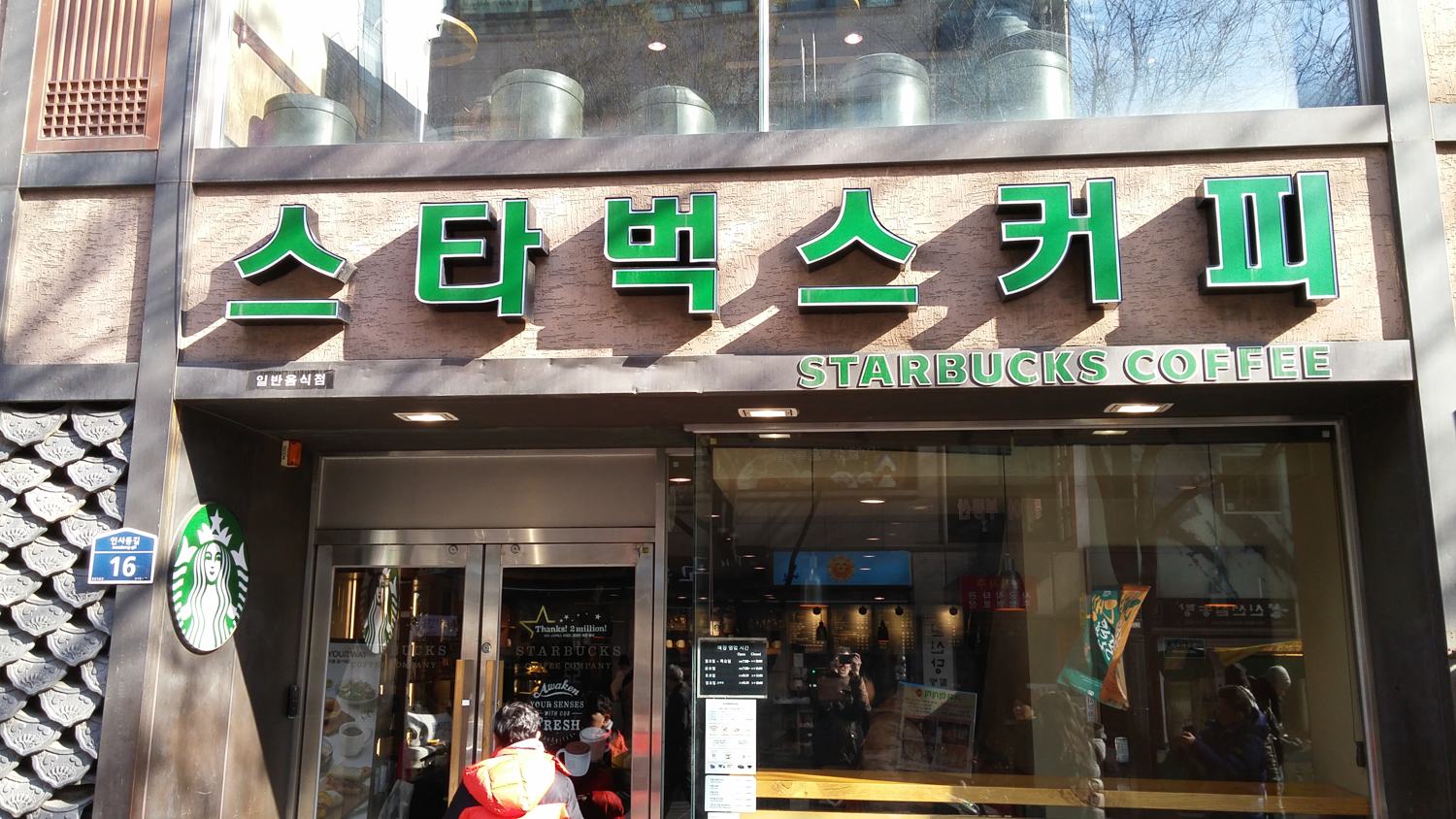
The Insadong Starbucks, the only one in the world that had to write its name in hangul. The district asked; the company agreed. Photo: CC BY-SA 4.0, via Wikimedia Commons.
What to order where
| You want | Go to | Order | Pay |
|---|---|---|---|
| Caffeine, fast, on the way somewhere | Mega, Compose, Paik's | Iced americano (아이스 아메리카노), or the 20 oz "Mega-ricano" | ₩1,800 to ₩2,000 |
| A seat for three hours with a laptop | Starbucks, Twosome Place | Anything; the drink is rent | ₩4,700 |
| The Korean café experience itself | An independent in Seongsu, Yeonnam or Ikseon | Whatever is in the photographs on the wall; usually an einspänner (아인슈페너, cream-topped black coffee) | ₩6,000 to ₩8,000 |
| Korean-only Starbucks | Any Starbucks | Sweet potato latte, misugaru (grain) latte, the seasonal frappuccino with a Korean fruit | ₩5,900 to ₩7,000 |
| Coffee at 6 am | Convenience store | The counter machine, or a cup of ice and a KANU stick | ₩900 to ₩1,500 |
| To see where it started | Starbucks Ewha Womans University, or the hanok store in Gyeongju | A tall americano, for the record | ₩4,700 |
Two notes. The convenience-store coffee tier is its own subject, and Korea's chains now sell a ₩900 americano and a cup of ice as their best-selling item, which we covered in the Delaffe post and the ice-cup post. And "americano" in Korea means two shots in a large cup by default; if you want it stronger, say 샷 추가 (shot chuga), ₩500.
KANU Mild Roast Americano — 60 sticks, the full-size version The same instant black coffee in the standard 1.6 g stick (the dark-roast 70-stick box is currently unavailable on Amazon US), which is what a Korean convenience store will sell you beside the cup of ice. If you have decided the café is for the chair and the coffee can come from a sachet, this is the sachet. As an Amazon Associate, EpicKor earns from qualifying purchases.
See KANU 60-stick on AmazonYou might like: What Time Do Restaurants Close in Korea? Closing Times, Break Time, Last Order and Monday Closures
FAQ
Q: Why are there so many cafés in Korea? Demand and supply. Koreans drink 405 cups a year each, second in the world. But the density, one café per 536 people against Japan's one per 2,630, comes from self-employment: a café is the cheapest respectable business a Korean can open, and 921 franchise brands will sell one in a box.
Q: How much is a coffee in Korea? An iced americano is ₩1,200 to ₩2,000 at the budget chains, ₩3,200 at Ediya, ₩4,700 at Starbucks and its peers, and ₩5,000 to ₩8,000 at an independent café. The beans in a Starbucks tall americano cost about ₩222.
Q: Why is Mega Coffee so cheap? Ten-pyeong shops, three stools, a takeaway window, two shots in a huge cup, and a franchise model that charges ₩150,000 a month in royalties and makes its money on supplies and scale across 4,466 stores. The parent company runs an 18.8 percent operating margin.
Q: Is Starbucks in Korea different? Yes. It is owned by Shinsegae, Korea's department-store group, not by Starbucks in Seattle, and it runs 2,185 stores with a Korea-only menu, hanok-style stores and seasonal merchandise that queues at dawn. A tall americano is ₩4,700, up from ₩3,000 in 1999.
Q: Can I work in a Korean café all day? In a Starbucks or Twosome, yes; it is what they are for. In a small independent or a budget chain, no: expect two-hour limits, taped-over sockets, "no-study zone" signs, and a rule that one drink buys about ninety minutes. Reorder to stay.
Bottom Line
Korea's 100,000 cafés are not a coffee story; they are a real-estate and employment story with coffee in it. The bean is ₩222, the chair is everything else, and the price of the chair runs from ₩1,200 at a takeaway window owned by a chicken company to ₩8,000 in a Seongsu box that will be a different café in two years. Drink the ₩2,000 americano when you are walking, pay the ₩4,700 when you need the seat, and spend the ₩7,000 once, on a good afternoon, in a café that is somebody's actual café, because the odds are it will not be there next time.
You might like: Delaffe: Korea's Convenience-Store Coffee Brand That Cut Its Price to ₩900 and Maxim Coffee Mix: Korea Invented the Coffee Stick.
Sources
- The Buyer (더바이어), "100,000 coffee shops: the profitability reality," 4 September 2026; National Tax Service and Small Business Administration counts as cited there.
- Brunch/Hankyung Magazine on cafés per capita in Korea, Japan and the US (2024 figures: 96,473 / 47,530 / 78,851 shops); Busan Ilbo and Yonhap on coffee imports and 405 cups per head (January 2025).
- E-Today, "2025 iced americano price comparison"; Kyunghyang Shinmun on the Starbucks ₩4,700 increase (20 January 2025); Newstop on SCK Company's store growth; Coffee Salon's Starbucks Korea price chronology.
- Data Som on the Korea Consumer Organizations Council bean-cost analysis (16 September 2025).
- Asia Economic Daily on Anhouse (Mega Coffee) results (13 June 2024); Deal Site and The Scoop on Mega Coffee's private-equity ownership; Kyunghyang Shinmun and Hankyung on the Son Heung-min advertising cost dispute (December 2022); Herald and New Daily on Mega Coffee's April 2025 price rise; franchise-cost guides for the royalty and setup figures.
- KED Global, Bloomberg and Jollibee Foods on the Compose Coffee acquisition (July 2024); Compose Coffee 3,000-store milestone (September 2025).
- Nate/Yonhap on Seoul café closure and opening rates (13 June 2025); Mobi Inside 2025 franchise report; Biz Focus on National Tax Service closure data for H1 2026.
- Daum/Ulsan Ilbo on no-study zones (October 2025); Farmers' Newspaper on "no twenties zones" (August 2023).
- Nate/Yonhap on the New York Times piece "South Korea Has a Coffee Shop Problem" and Seoul versus New York café density (5 December 2025); VM Space and Kakao Pay on Seoul café counts; Money Today on Starbucks store counts by country (20 March 2025); Seoul Shinmun and Maeil Shinmun on Starbucks concentration in Seoul (March 2024).
- Financial News, Newsis and Think Food on The Coffee Bean & Tea Leaf's store decline and franchise withdrawal (2024 to 2026); KBS Chujeok 60 Minutes on the Yeondon Volkatsu closures (July 2024); the Eun Hyeon-jang and Yu Jung-su YouTube conversation "If you want to make money, close the shop."
You Might Also Like
Korean Lottery for Foreigners: Lotto Price, Toto Prizes, Tax, and the Casino Rule That Flips for Tourists
Yes, a foreigner can buy and win Korea's Lotto: at least 25 have taken first prize. ₩1,000 a game, a 22 to 33 percent tax, first prize paid only at NH Bank in Seoul, how Sports Toto prizes are split, and why casinos admit you but not Koreans.
Korea's Neighbourhood Bathhouses Are Disappearing, and the Bath Is Not: Where the Hot Water Went
Seoul had 1,764 public bathhouses in 1995 and has 510 now. Koreans have not stopped soaking; they moved to private-bath hotels, ₩60,000 scrub studios and the apartment-basement sauna. Why the old tang died, what Japan did differently, where to bathe in 2026.
Korean Bathhouse Prices: What a Mogyoktang Costs in Every Region
A Korean neighbourhood bathhouse (mogyoktang) now costs ₩11,000 in Seoul, the highest in Korea, and ₩8,100 in Gwangju. Government prices for September 2026 by region, what the ticket covers, scrub prices, the age-4 rule and how to use one.