Korean Convenience Store 1+1: How It Works and Who Can Bank the Free One
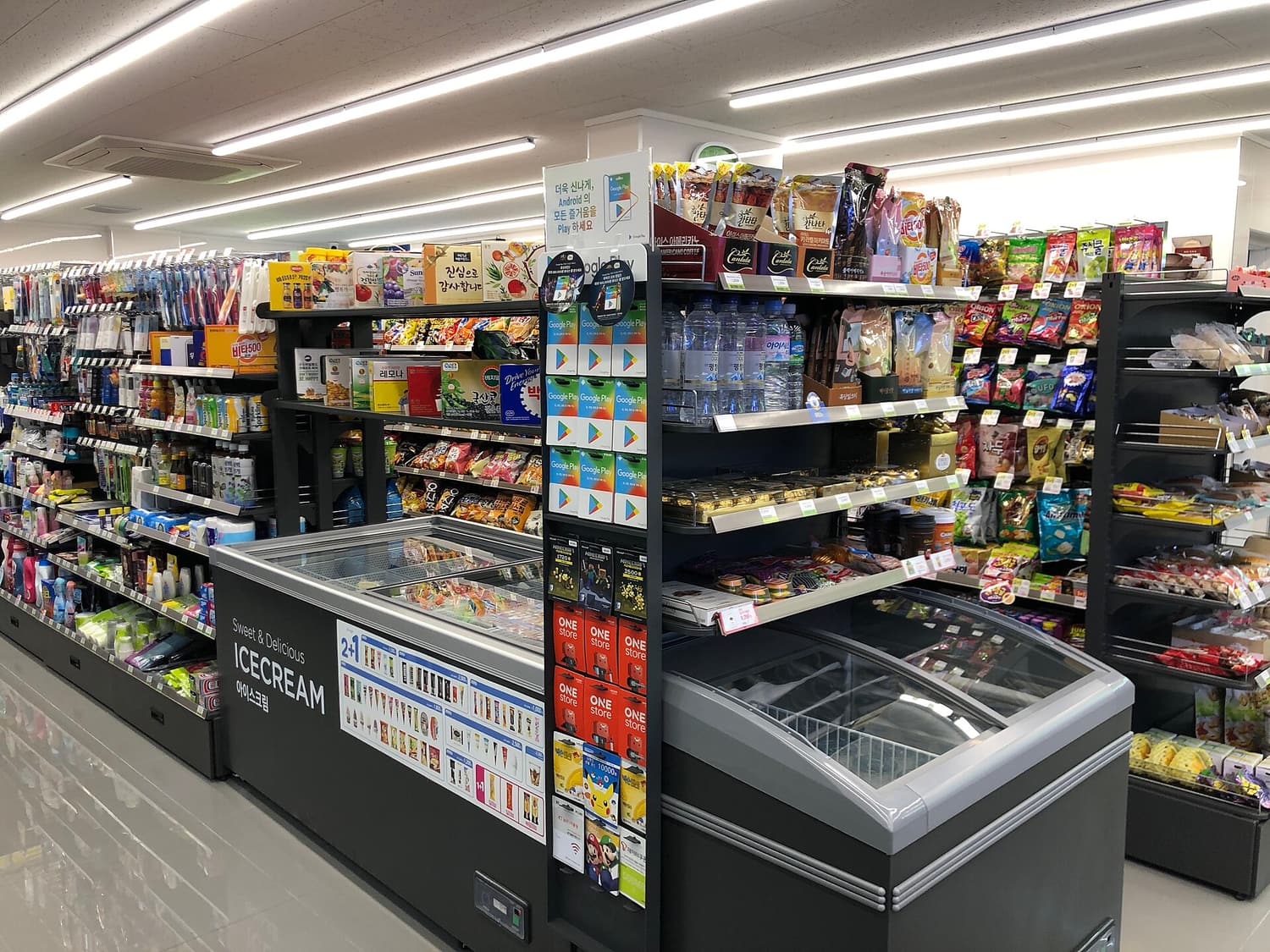
Walk into any Korean convenience store and a large share of the fridge is wearing a sticker that says 1+1 or 2+1. Buy one, take two. Buy two, take three. No card, no coupon, no app, no minimum — you pick the extra off the shelf yourself and carry it to the till.
That part is genuinely as simple as it looks, and it works for everybody.
The complication is what to do with the second one when you do not want to carry it around Seoul all afternoon. There is a solution: the chains let you leave it behind, bank it in their app, and collect it later at a different branch. It is the single most-recommended tip in English guides to Korean convenience stores.
Almost no short-term visitor can use it. Not because it is hidden or hard, but because signing up for the app requires a form of Korean identity verification that a tourist does not have. Here is how the deals actually work, how the banking system actually works, and what to do instead.
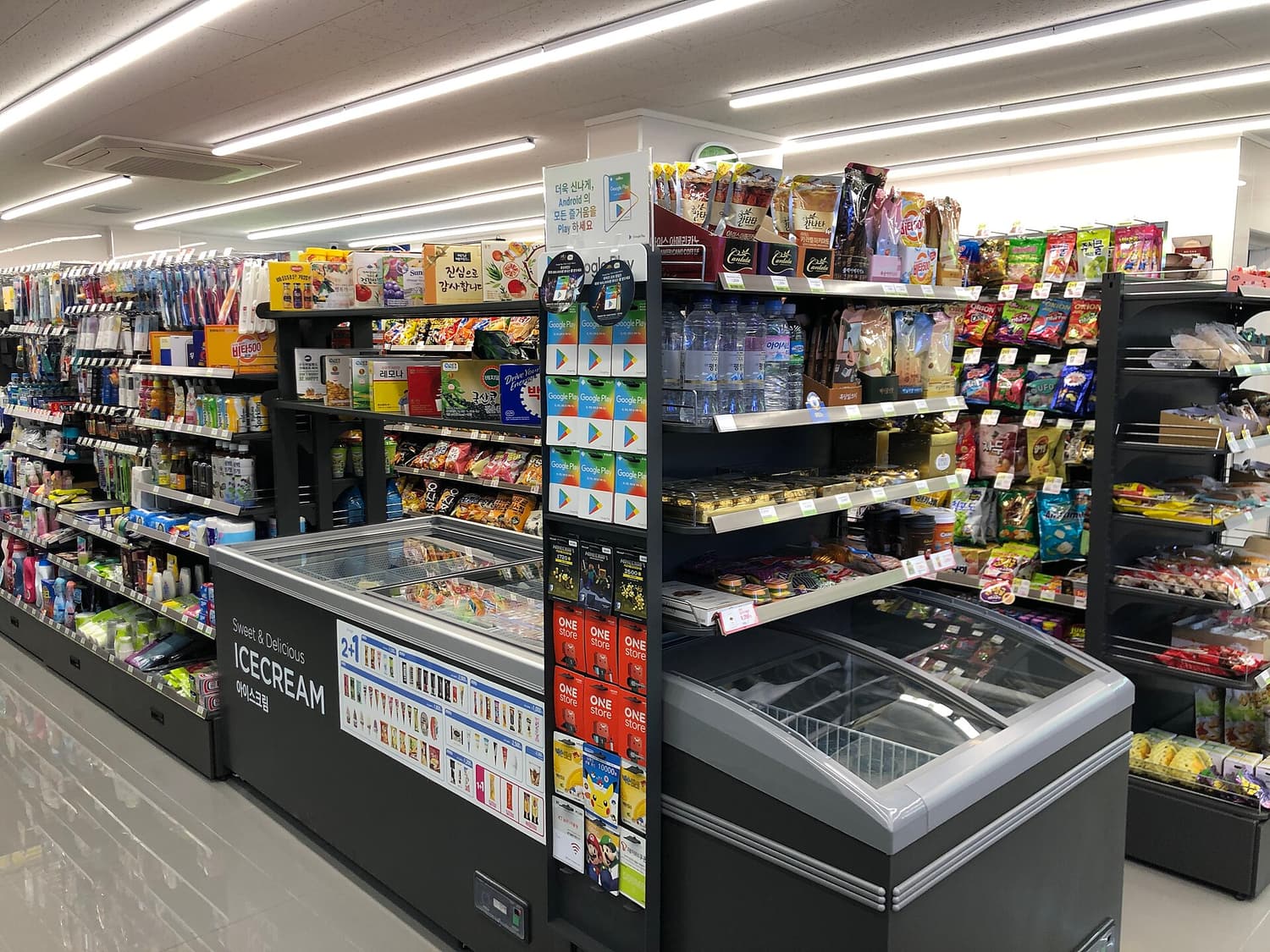
2+1 strip on the ice-cream chest, at a CU branch. The grid on it is the list of products the promotion covers. Photo: Wikimedia Commons (CC0).The Short Answer
| Question | Answer |
|---|---|
| Do I need an app for 1+1? | No. It applies at the till automatically |
| Do I need a membership card? | No |
| Who hands me the free item? | Nobody. You take it off the shelf yourself |
| Can I bank the free one for later? | Only with the chain's app account |
| Can a tourist get that account? | Realistically no — all three chains require 본인인증 |
| Can a foreign resident? | Yes, with an ARC and a Korean phone line in their own name |
| Does the shop hold my banked item? | No. It is a claim, not a locker |
1+1 and 2+1: the part that works for everyone
The tags are stuck to the shelf edge, not the product, and they mean exactly what they say.
- 1+1 (원 플러스 원) — pay for one, take two
- 2+1 (투 플러스 원) — pay for two, take three
- 덤 (deum) — the freebie itself, the word you will hear at the counter
There is no card to show, no code to enter and nothing to ask for. The register applies it when the barcodes are scanned. This matters for visitors specifically: it is one of the few discount structures in Korea that does not route through a membership number, an app, or a Korean phone number.
Two practical rules decide whether it applies:
The free one usually has to be the identical product. Some promotions allow any item within a brand's line, and the tag says so in Korean, but the default is same-for-same. If you are unsure, the safe move is to pick two of exactly the same thing.
Nobody will remind you. This is where visitors quietly lose money. If you take one item off a 1+1 shelf and pay, you have paid full price for half the deal. Korean shoppers scan the shelf edge before they reach for anything; foreigners tend to read the product. The tag is the thing to read.
Promotions rotate roughly monthly, and they cluster hard on drinks, coffee, yoghurt, sparkling water, cup ramyeon and confectionery — categories where a second unit is easy to shift. Fresh food such as gimbap, sandwiches and lunchboxes rarely goes 1+1, because it has a different discount mechanism: a 마감 할인 markdown as its sell-by time approaches, which our convenience store breakfast guide covers in detail.
What the shelf tag actually says
You do not need to read Korean to shop, but four short strings do most of the work:
| Korean | Romanised | What it means |
|---|---|---|
| 1+1 | won plus won | Pay one, take two |
| 2+1 | tu plus won | Pay two, take three |
| 덤증정 | deum-jeungjeong | Free-gift promotion |
| 마감할인 | magam-harin | End-of-life markdown, usually evening |
마감할인 is the one people confuse with a promotion. It is not a bundle — it is a single item being discounted because it expires soon, and it is applied by a sticker on the package rather than the shelf.
The app trick every guide recommends
Here is the tip you will find in most English convenience-store guides, usually near the top: you do not have to carry the free item. You can leave it, store it in the chain's app, and pick it up whenever you want.
The feature is real. GS25 calls it 나만의 냉장고 ("my own fridge"), now folded into its main 우리동네GS app. CU runs its equivalent inside 포켓CU.
What the guides do not explain is what actually happens when you collect it — and the mechanics change how useful it is.
The shop is not holding your item. Nothing is set aside, labelled, or put in a back room. What you are holding is a claim on that product, redeemable at any branch of the same chain.
So collection works like this: some days later you walk into a different store of the same brand, find that product on the shelf and pick it up yourself, carry it to the counter, and show the barcode in the app. The cashier scans it the same way they would scan a purchase, and you walk out. From the outside it looks identical to buying it, because at the register it more or less is — the scan settles against the credit you already paid for.
Which produces a limitation nobody writes down in English: the branch has to actually stock the thing. If that shop does not carry the flavour you banked, there is nothing to pick up. Korean users discuss this exact problem on community boards — searching 나만의 냉장고 재고 없을 때 ("when my-fridge has no stock") turns up threads about it. It is not a flaw so much as a consequence of it being a voucher rather than a locker, but it means the feature is most useful for common, everywhere-stocked items and least useful for the limited-edition thing you were excited about.
Why most visitors cannot use it
To bank anything you need an account, and that is where the trip ends for most travellers.
All three major chains gate account creation on 본인인증 — Korean identity verification. We checked the current signup screens in August 2026, and they are not the same:
| Chain | App | Sign-up methods offered |
|---|---|---|
| emart24 | Shinsegae Point | Shinhan certificate · phone verification · card verification — nothing else |
| GS25 | 우리동네GS | Kakao · Naver · Apple · phone verification · email ID |
| CU | 포켓CU | Naver · Kakao · Apple · biometric · ID |
emart24 is the honest one: its signup is a four-step flow and step one is 본인인증, with three methods that each assume a Korean bank certificate, a Korean carrier line, or a Korean-issued card. There is no social or email path at all.
GS25 and CU look more open, and this is where it gets misleading. Both offer Apple sign-in, which works anywhere in the world, so the reasonable assumption is that a foreigner can get in that way.
They cannot. Tapping Apple sign-in on either app takes you through Apple's authentication and then straight into a 본인인증 request. The verification gate belongs to the convenience store app, not to the login provider — the social buttons only carry you as far as the wall.
So what actually decides it
Not the chain. Your residency status.
Korean identity verification binds to a mobile line registered in your own name, or to a Korean bank certificate or Korean-issued card. That produces a clean split:
- Foreign residents with an ARC (외국인등록증) and a Korean phone line in their own name can verify, and therefore can use the app and the banking feature normally.
- Short-term visitors on roaming or a tourist prepaid SIM cannot. Tourist SIMs are generally sold without name registration against an ARC, which is precisely what the verification checks.
That distinction is missing from every English guide we found, which is why the advice reads as if it applies to tourists. It applies to residents.
What to do instead
None of this makes 1+1 useless to a visitor. It makes one specific convenience unavailable. The deals themselves are fully open, and there are sensible ways to handle the second item.
Just take both. It is free, and the real constraint is almost never money — it is your hands and whether the item needs refrigeration. Two 500ml drinks are heavy; two packets of crisps are not.
Match the deal to your day. A 1+1 on something shelf-stable travels perfectly well in a day bag. A 1+1 on yoghurt when you have six hours of walking ahead is how you end up throwing one away.
Skip it when you genuinely do not want two. Taking only one from a 1+1 shelf is allowed — you simply pay the single price and gain nothing. If the item is not something you would buy twice, the promotion is not a discount, it is an upsell.
Use the evening markdown instead. For fresh food, 마감할인 needs no account, no app and no verification, and the discounts are often larger than a bundle. It is the visitor-accessible version of the same instinct.
Do not try to borrow an account. The banked item sits in an identity-verified account, so a friend's app means the credit and the collection are theirs, not yours. It works, but it is their purchase.
What things cost, August 2026
Prices are what we last verified across Seoul branches. Convenience stores are typically a little more expensive than a supermarket for the same item, and prices move with promotions.
| Item | Typical price |
|---|---|
| Triangle gimbap (삼각김밥) | ₩1,200–1,900 |
| Sandwich | ₩2,500–4,500 |
| Bagged ramyun, single | about ₩1,000 |
| Banana milk, 240ml | ₩1,800 |
| Vita 500 (비타500) | ₩1,000–1,500 |
| Bacchus F (박카스 F) | ₩1,000–1,500 |
| Store-brand coffee | from about ₩1,000 |
| Yonsei Cream Bread (연세우유 생크림빵) | ₩2,600–3,000 |
Note what this does to the arithmetic. On a ₩1,500 drink, a 1+1 is worth ₩1,500 — which is real, but it is not worth reorganising your afternoon around. That is the honest frame for how hard to chase this.
The parts we would tell a friend
If you are visiting for a week: ignore the app entirely. Read the shelf tags, take both items when they are easy to carry, and use evening markdowns for fresh food. You lose nothing meaningful.
If you are moving to Korea: set the app up once you have your ARC and a phone line. The banking feature is genuinely convenient for drinks you buy constantly, and the same apps carry coupons and points you would otherwise leave on the counter.
If you read a guide that told you to bank your free item: it was not lying, it was written without checking who could follow the instruction.
FAQ About Korean Convenience Store 1+1 Deals
Q: Do I need to be a member to get 1+1 in a Korean convenience store? No. 1+1 and 2+1 apply automatically at the register with no app, card, or membership. The only thing you have to do is take the extra item off the shelf yourself and bring it to the counter.
Q: Can I mix flavours in a 1+1? Usually not. The default is the identical product. Some promotions do allow any item within a line and the shelf tag says so in Korean, so when in doubt take two of exactly the same thing.
Q: Can a tourist use the GS25 or CU app to save the free item? Realistically no. Both apps require Korean identity verification (본인인증) to create an account, and signing in with Apple, Kakao or Naver does not bypass it — the verification request comes after the social login. A foreign resident with an ARC and a Korean phone line in their own name can.
Q: If I bank an item, is the shop keeping it for me? No. It is a claim, not storage. You pick that product off the shelf at any branch of the same chain and show the app barcode at the till. If that particular branch does not stock it, you cannot collect it there.
Q: Which Korean convenience store has the best 1+1 deals? There is no consistent winner — promotions rotate monthly and the chains largely match each other on national brands. The more useful difference is exclusives, which we compare in the Korean convenience store hub.
The move that actually matters
The banking feature is a nice piece of retail engineering and it is not the thing that will improve your convenience store shopping in Korea. Reading the shelf edge is.
Almost everything else about a Korean convenience store is open to you: the breakfast basket locals actually buy, the lunchbox aisle, the ice cream chest, the triangle gimbap wrapper that has to be opened in order, and the microwaves and seating that turn the shop into a small restaurant. None of that asks who you are.
The app is the one door that does — and now you know why, instead of standing in the aisle wondering what you did wrong.
You Might Also Like
Korean Kitchen Scissors: Why Koreans Cut Meat and Noodles at the Table, and Why It Is Not an Office Scissor
Scissors on a restaurant table look wrong to most of the world and normal to every Korean. The tool is not a desk scissor: thick blades, one serrated edge, big rings, often detachable, built for galbi and cold noodles. Where it came from, and which one to buy.
Nunettine: The Korean Snack Whose Real Name Is Italian
누네띠네 is a Korean supermarket staple named after an Italian pastry and a Korean pun at the same time. Most Koreans cannot tell you what it means. Here is the original, the joke, and what it costs.
Korean Hangover Drinks: Which One to Grab, and What Korea Made Them Prove
Korea sells about ₩350 billion of hangover products a year, and since January 2025 anything claiming to relieve a hangover needs human trial evidence to say so. Of 28 products reviewed, three lost the right. What is on the shelf, and how to choose.