Korea's Exam Day: Why Planes Stop for Suneung and How to Plan Around It
On one Thursday every November, South Korea does something no other country does at this scale: it grounds its own aviation.
For roughly 35 minutes in the early afternoon, aircraft nationwide stop taking off and landing. Planes already airborne are told to hold above 3km. Helicopters and drones are prohibited. Artillery drills and tank movements stop. The reason is a 25-minute English listening test being played through loudspeakers in classrooms across the country.
That test is part of 수능 (Suneung), the College Scholastic Ability Test. The next one is Thursday, November 19, 2026, and if you are travelling in Korea that week it will affect your day whether or not you know it is happening.
The Short Answer
| Next exam | Thursday, November 19, 2026 (results December 11) |
| Who sits it | About 554,000 registered for the most recent exam — the highest in seven years |
| Length | Doors close 08:10; last section ends 17:45 |
| Aircraft grounded | ~35 minutes around the English listening section, roughly 13:05–13:40 |
| Stock market | Opens 10:00, closes 16:30 — the whole session shifts an hour |
| Offices | Government and most large firms start at 10:00 |
| Subway | Extra trains 06:00–08:10 on the Seoul metro network |
| Near test sites | No horns, no loudspeakers, construction halted; 200m road access restricted |
| If you are flying | Avoid booking a flight that lands or departs early afternoon on exam day |
| The month after | Cinemas at ₩7,000, theme parks up to 50% off — and packed with teenagers |
What Actually Stops
The measures are not symbolic. They are coordinated between the Ministry of Land, Infrastructure and Transport, the National Police Agency, provincial education offices and local governments, and they are announced fresh each year about a week before the date.
Aviation. During the English listening section, all takeoffs and landings are suspended nationwide. In a recent year this shifted the schedules of roughly 140 flights — about 65 international and 75 domestic. Aircraft already in the air must remain above 3km. Helicopters, light aircraft and drones are grounded outright.
The military. Artillery fire and tank movement stop. A country that lives beside an armistice line pauses its live training so that teenagers can hear a recording clearly.
The financial market. KOSPI, KOSDAQ and KONEX all shift by an hour — trading runs 10:00 to 16:30 instead of 09:00 to 15:30. This is not a courtesy to the students; it is to keep rush hour off the roads while half a million of them travel to test centres.
Everyone's commute. The government asks public offices and large companies to start at 10:00. The Seoul metropolitan subway adds trains between 06:00 and 08:10.
The streets around every test centre. Within about 2km, illegal-parking enforcement is intensified. Within 200m, vehicles other than public transport are kept out and parking is banned. Nearby construction and inspection work is suspended. Buses and taxis are asked to avoid horns and sudden braking. Loudspeaker broadcasts — including campaign trucks and street preaching — are prohibited.
And the police become a taxi service. Patrol cars and administrative vehicles are stationed to run late students to their test centres. Every year the news carries footage of a squad car with its lights on, delivering a seventeen-year-old to a school gate at 08:07.
The Day, Hour by Hour
| Time | Section |
|---|---|
| 08:10 | Doors close. Arrive after this and you do not sit the exam |
| 08:40–10:00 | Korean (국어) |
| 10:30–12:10 | Mathematics (수학) |
| 12:10–13:00 | Lunch — eaten at your desk, from a packed lunch |
| 13:10–14:20 | English (영어) — the listening portion is the first ~25 minutes |
| 14:50–16:37 | Korean History + Electives (한국사·탐구) |
| 17:05–17:45 | Second Foreign Language / Classical Chinese (제2외국어·한문) |
Two details that surprise people. First, Korean History is compulsory — skip that section and your entire exam is voided, regardless of how the other papers went. Second, the second-foreign-language paper is optional, so many candidates finish at 16:37 rather than 17:45, which is why the crowds outside test centres build in two waves.
What It Looks Like From the Street
If you are anywhere near a high school on the morning of November 19, you will notice before you understand.
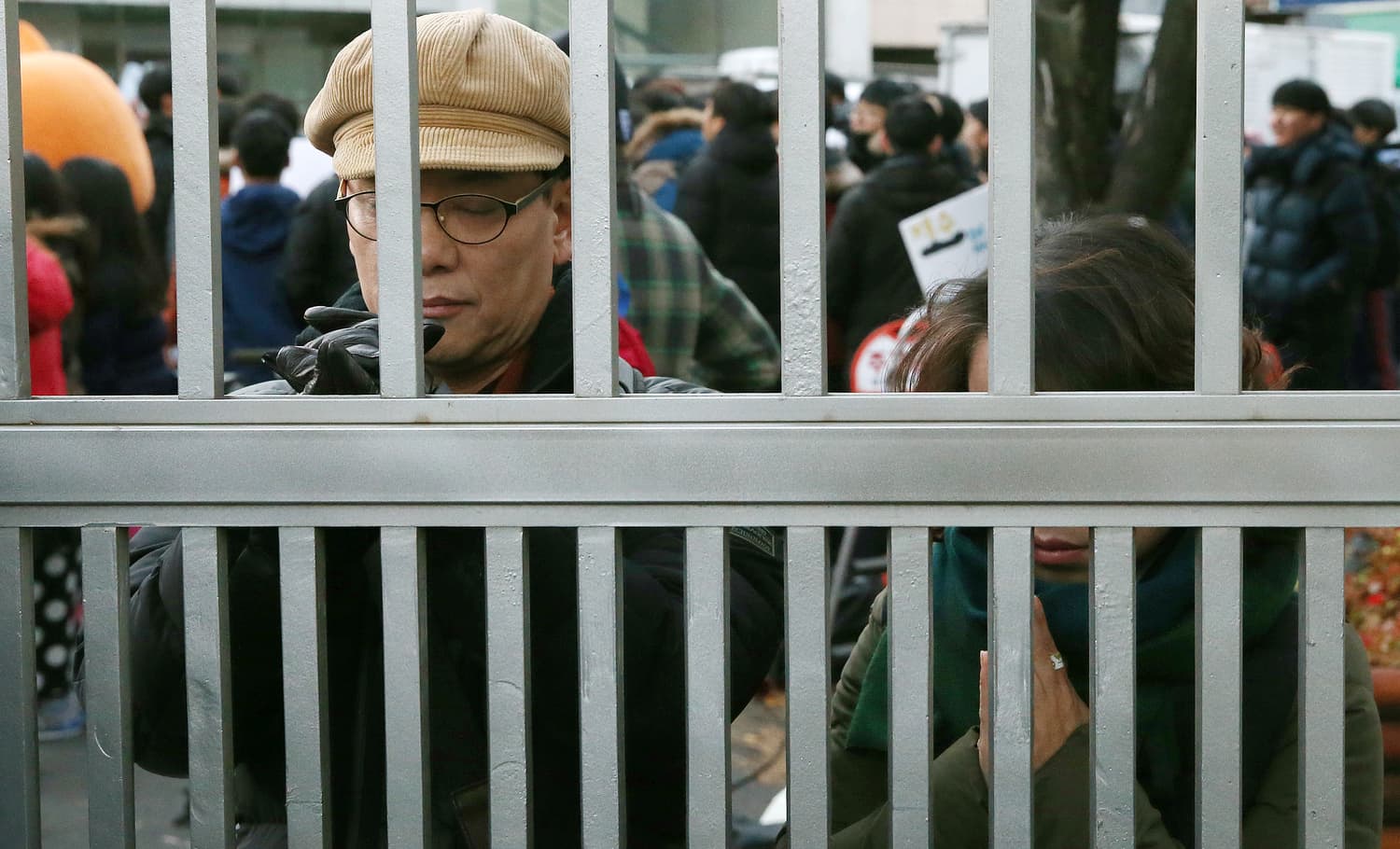
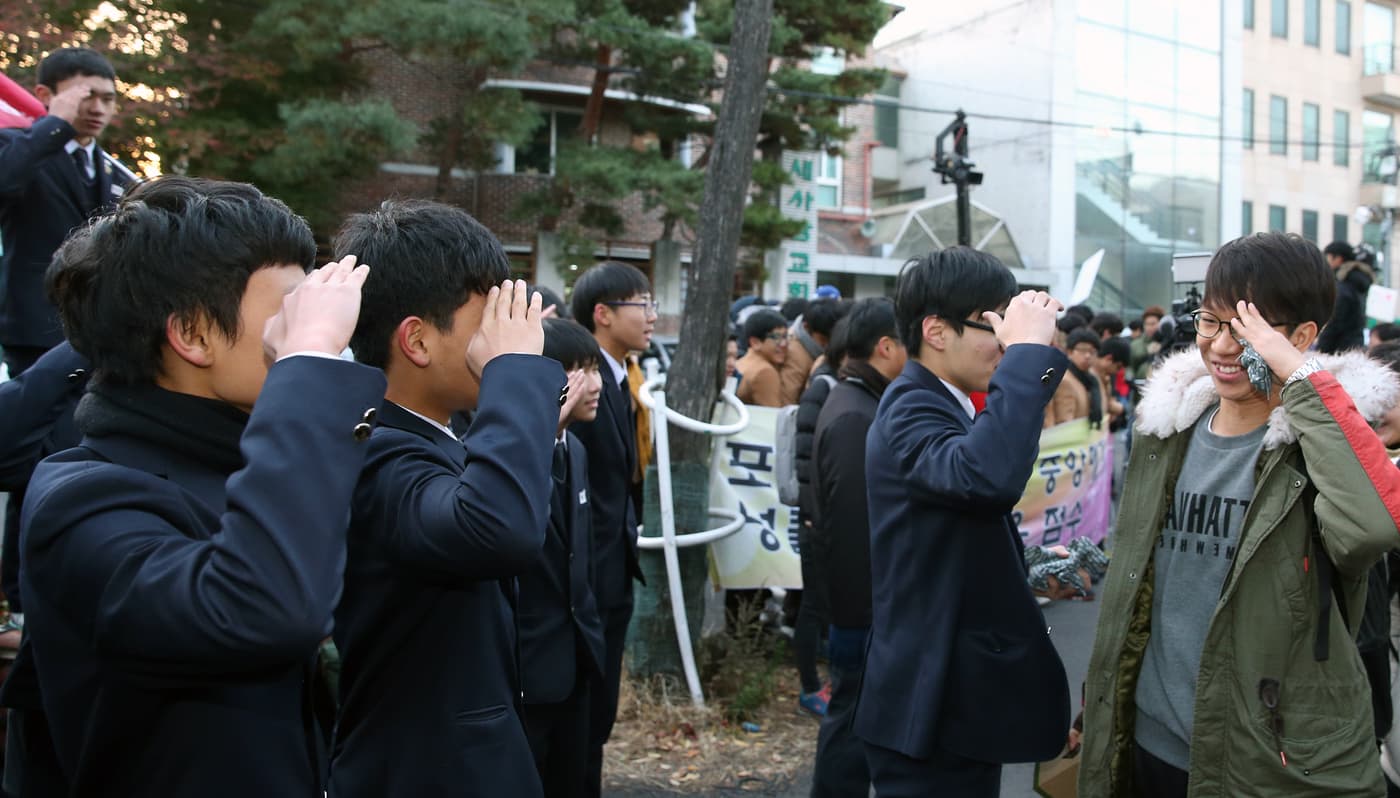
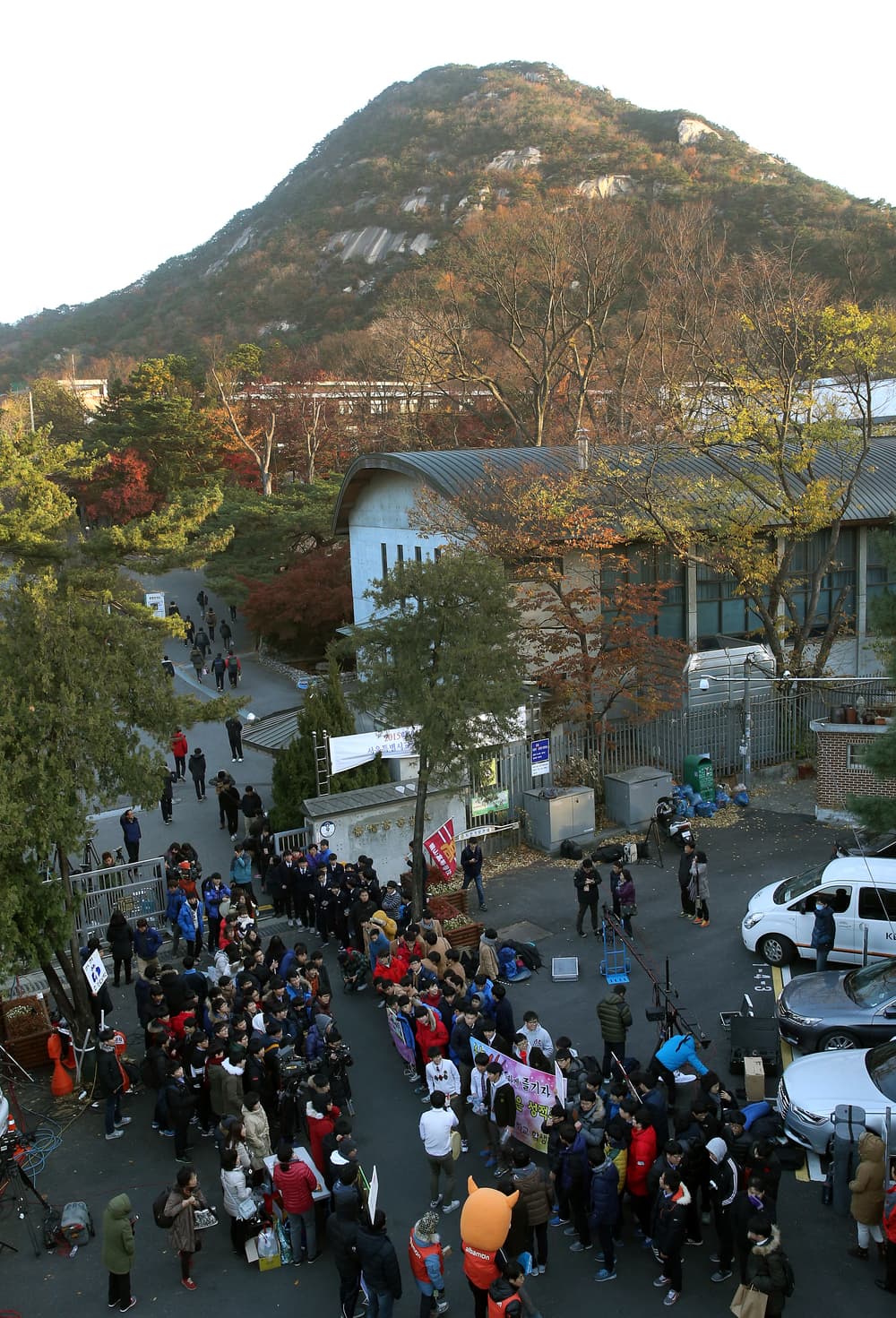
From about 06:30 the streets around test centres fill with underclassmen — second-year students who came to see the third-years in. They arrive with drums, banners, hand-painted signs and school mascots. They bow, salute, shout, and hand out hot drinks. The banners are aggressively cheerful, and often funny: "From this second, I won't waste even one more on this problem", or simply "재수는 없다" — no repeat year.
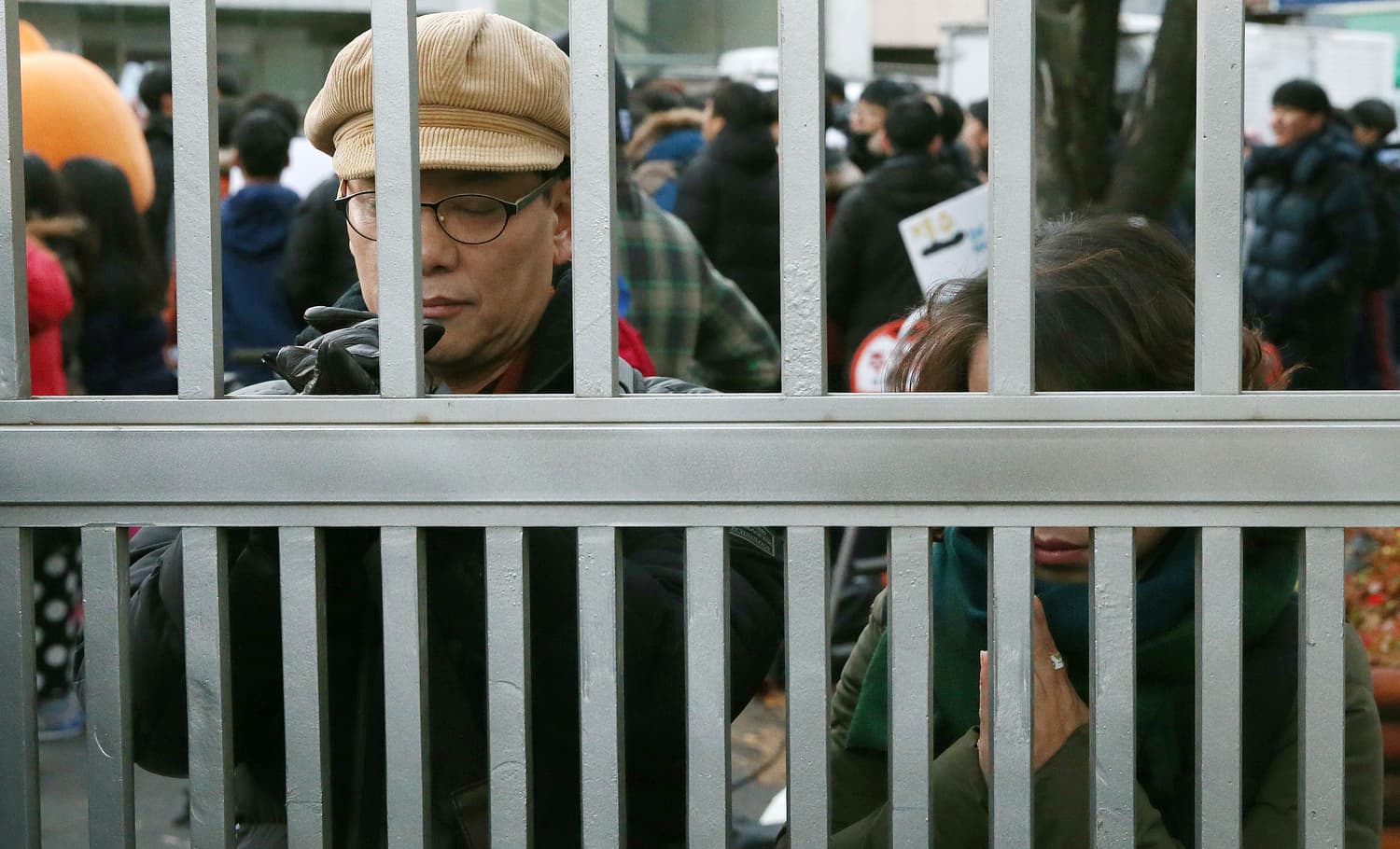
At around 08:10 the gate closes, the noise stops, and the composition of the crowd changes completely. The students go quiet. The parents stay. Some go to a nearby temple or church — Buddhist temples and churches near major test centres run all-day services on exam day, with parents doing full prostrations for hours. Many just remain at the railings.
Why One Exam Carries This Much Weight
The short version: it is largely one shot per year, and where you land shapes a great deal of what follows.
Korean universities are ranked with unusual public consensus, and the top of that ranking — Seoul National, Korea and Yonsei, together called SKY — feeds into hiring, professional networks and, still, marriage prospects in ways that are openly discussed rather than merely implied. There is no rolling admissions calendar to soften a bad day. Miss it, and the realistic option is 재수 (jaesu): a year at a cram school, sitting the same exam again.
That path is common enough to be an industry. At the most recent exam, 554,174 people registered — up 31,504 (6.0%) year on year and the highest total in seven years. Of those, 371,897 (67.1%) were current students and 159,922 (28.9%) were graduates, most of them repeat candidates. That graduate share had held above 30% for years and dropped below it only because an unusually large birth-year cohort — the "golden pig" children born in 2007 — hit their final year of high school at once.
Roughly three in ten people in that exam hall were not seventeen. They were doing it again.
You might like: What Are SKY Universities in Korea? SNU, Korea, Yonsei — the three names that make this day feel like a verdict.
Want the version with people in it? Korean fiction and reportage in translation covers education pressure better than any explainer can — it is one of the country's central literary subjects, not a side note. Browse Korean literature in translation on Amazon →
EpicKor is an Amazon Associate and may earn from qualifying purchases at no extra cost to you.
The Superstitions Are Very Specific
The exam has its own gift economy, and it runs on adhesion.
엿 (yeot), a hard Korean taffy, and 찹쌀떡 (chapssaltteok), glutinous rice cakes, are the standard gifts — because both stick, and the verb for passing an exam, 붙다, is the same verb used for something sticking to a surface. You "stick" to the university. Convenience stores and bakeries stock these in volume through the first half of November, and department stores build gift displays around them.
The mirror-image rule: do not serve 미역국 (seaweed soup) on exam morning. Seaweed is slippery, and 미끄러지다 — to slip — is the standard verb for failing an exam. This is the one piece of Korean food advice that Korean families follow more strictly than any dietary rule, and it is genuinely awkward if a birthday falls on exam day, since seaweed soup is the traditional birthday breakfast.
Other common charms: a fork, because 찍다 means both "to stab" and "to guess an answer"; toilet paper, because 잘 풀리다 means both "unrolls well" and "works out well"; and small padlocks or sticky notes attached to school fences by underclassmen. None of it is ironic. People buy these seriously, then laugh about buying them.
Curious about the sticky-sweet part? Traditional 엿 barely exists outside Korea, but 약과 (yakgwa) — the honeyed, chewy Korean sweet that had its own viral moment a couple of years ago — travels well and is the closest thing you can actually get delivered. See Korean yakgwa on Amazon →
If You Are in Korea That Week
Practical, in rough order of how likely it is to affect you.
Do not book a flight for early afternoon on November 19. Anything scheduled to depart or land between roughly 13:00 and 13:45 is exposed to a rescheduling window. If your itinerary is fixed, check with the airline the week before; the exact control window is published only a few days ahead.
Do not plan an early-morning drive or airport transfer near a school. Roads within 200m of any test centre are restricted, and there are more than a thousand test centres nationwide. A taxi that would normally take 20 minutes can take 50.
Do expect a very quiet, very late-starting morning. With offices opening at 10:00, the 08:00 rush hour is muted and cafés in business districts are half empty. It is, oddly, one of the better mornings of the year to visit a popular Seoul café or landmark.
Do not stay next to a high school if you value a lie-in. Drums start before 07:00.
Do expect the evening to be loud. From about 18:00 the released students flood into Hongdae, Gangnam, Konkuk University station and every other student district. Restaurants and karaoke rooms are full. It is a genuinely good-natured night out to witness, but book anything you care about in advance.
You might like: Korea Work Culture: Hours, Hoesik, and Work-Life Balance — the same intensity, twenty years later.
The Month After Is a Different Country
The week after the exam, Korea flips into an extended discount season aimed squarely at newly-freed eighteen and nineteen-year-olds. If you are travelling in late November or December, this shapes what places feel like.
These are the figures from the November 2025 cycle, which is the best available guide to the scale to expect in 2026 — the offers are announced each year in the days after the exam. CGV, Lotte Cinema and Megabox ran flat ₩7,000 tickets for standard 2D screenings for about a month. Lotte World Adventure sold combined passes at ₩26,000 in Seoul and ₩20,000 in Busan; Lotte World Aquarium and Seoul Sky ran 50% off at ₩17,500 and ₩15,500. Legoland Korea and Gyeongju World ran comparable half-price offers. Airlines, phone carriers and electronics brands run their own promotions, some stretching to the end of January.
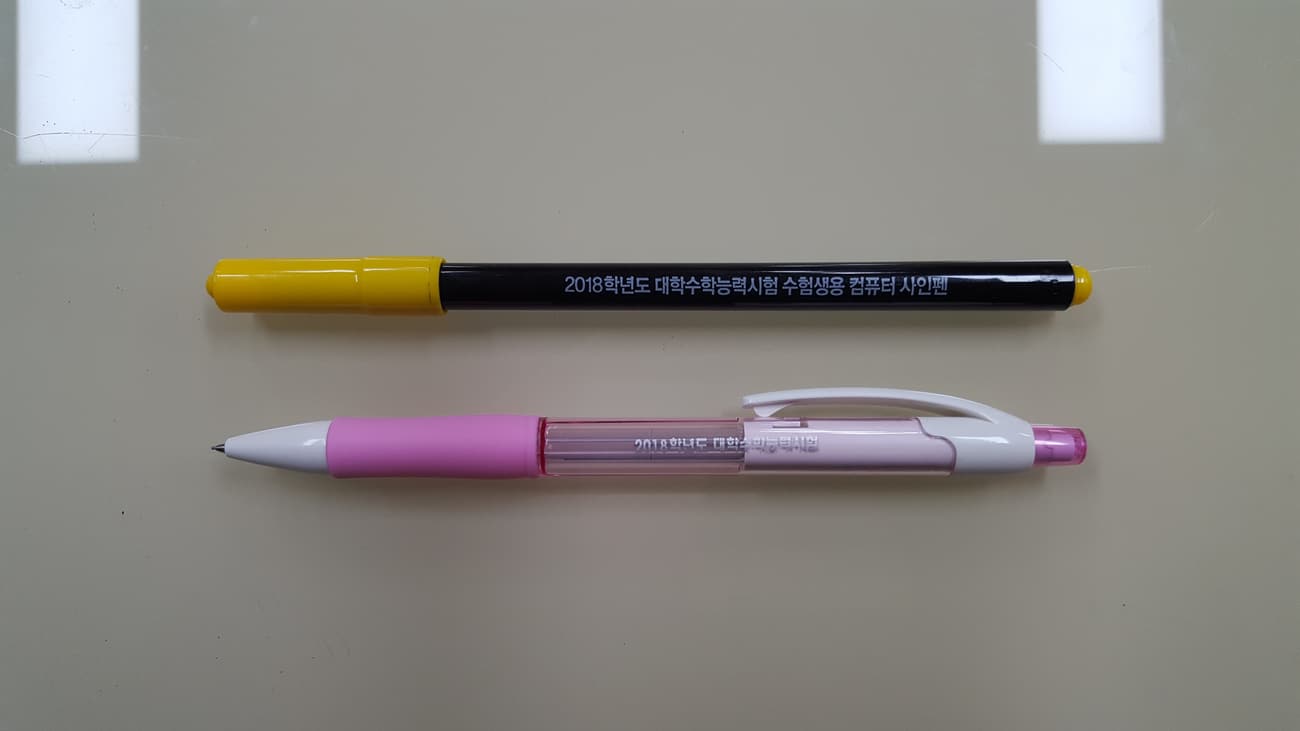
These require the original exam admission ticket — the 수험표. Photocopies and phone photos are almost never accepted, which is why you will see teenagers guarding a slip of paper like a passport for six weeks.
For a visitor, the practical read is simple: from mid-November to late December, theme parks, cinemas, aquariums, photo booths and hair salons are cheaper for that group and busier for everyone. Lotte World on a December weekend is not a relaxed day out. Weekday mornings still are.
Frequently Asked Questions
Q: When is the next Suneung exam? Thursday, November 19, 2026, for the 2027 academic year. Results are released on December 11, 2026. The date is announced by the Korea Institute for Curriculum and Evaluation more than a year in advance and lands on a Thursday in mid-November each year.
Q: Do flights really stop during the exam? Yes, for about 35 minutes around the English listening section — roughly 13:05 to 13:40, though the exact window is confirmed each year shortly before the date. Takeoffs and landings are suspended nationwide, aircraft in the air hold above 3km, and helicopters and drones are grounded. In a recent year about 140 flights were rescheduled.
Q: Will my trip be disrupted if I am visiting Seoul that day? Mostly at the edges. Public transport runs normally and adds capacity. The real risks are an early-afternoon flight, a road transfer near a test centre, and noise near a school before 08:00. Shops, restaurants and attractions are open all day.
Q: Why does the stock market open late on exam day? To keep the morning rush hour clear. Shifting the trading session to 10:00–16:30, and asking offices to start at 10:00, removes a large share of commuter traffic while more than half a million candidates travel to test centres.
Q: What do Koreans give students before the exam? 엿 (hard taffy) and 찹쌀떡 (glutinous rice cakes), because both stick and the verb for passing an exam is the verb for sticking. Forks and toilet paper are common joke-but-not-really gifts. Seaweed soup is avoided entirely, because "slipping" is the verb for failing.
Q: Can foreigners or international students take the Suneung? Yes. Foreign nationals who meet the eligibility rules can register, and the exam is used for admission to Korean universities. Many universities also run separate international-admissions tracks that do not require it, which is the more common route.
Q: Is it true that shops give discounts after the exam? Yes, and the scale is larger than most visitors expect — cinemas at a flat ₩7,000, theme parks and observation decks at up to half price, running from mid-November into late December and in some cases January. The original paper admission ticket is required; copies are not accepted.
You Might Also Like
Korean Etiquette Guide: Habits Locals Notice Most
A practical Korean etiquette guide explaining shoes indoors, quiet public behavior, two-hand manners, indirect refusals, dining rules, and nunchi.
The One Korean Food Foreigners Never Learn to Love: Hamheung Naengmyeon, and Why Koreans Can't See the Problem
Foreigners who eat cheonggukjang and even hongeo still will not pay for this twice. A Korean creator who fed foreigners for years says naengmyeon was the overwhelming number one refusal, and Koreans, who rank it first every summer, cannot see why.
Why Do Koreans Stare at Foreigners? The 5% Country, and Where the Looking Actually Happens
In central Seoul nobody looks at you. In a provincial market, a small town or a subway car of grandmothers, they do. Korea only became a 5%-foreign country in 2025. Where the staring happens, what it means and does not mean, and what to do with it.