
What Are SKY Universities in Korea? SNU, Korea, Yonsei
If you searched SKY universities in Korea, the answer is simple: SKY refers to South Korea's three most prestigious universities: Seoul National University (SNU), Korea University, and Yonsei University. There is no single school called "SKY University." The acronym comes from SNU, Korea, and Yonsei, and it is one of the most important education status labels in Korean society.
But SKY is not only a ranking. It is a cultural shortcut for elite education, exam success, alumni networks, and social prestige. In Korea, the label can affect how people talk about intelligence, family sacrifice, career opportunity, marriage prospects, and social class. That may sound dramatic if you come from a country where university prestige matters but does not define your whole identity. In Korea, SKY can feel like a passport into the country's elite networks.
So when Koreans talk about SKY universities, they are not just talking about campuses. They are talking about pressure, pride, rivalry, and the dream of entering the country's most respected academic circle. If you are comparing SKY university, SKY universities Korea, or top universities in Korea searches, start with this distinction: SKY is the famous three-school label, not a complete list of every strong Korean university.
Quick answer: SKY universities means Seoul National University (SNU), Korea University, and Yonsei University. It is not just an official ranking label. It is a cultural shortcut Koreans use for elite education, exam success, alumni networks, and social prestige.

Lonely Planet Korean Phrasebook & Dictionary — on AmazonAffiliate link. As an Amazon Associate, EpicKor earns from qualifying purchases at no extra cost to you.
What Are the SKY Universities in Korea?
The SKY universities are:
- S: Seoul National University, often called SNU
- K: Korea University
- Y: Yonsei University
Together, they are widely seen as Korea's top three universities. They are not the only excellent schools in the country, and Korea has many strong institutions in science, engineering, medicine, business, and the arts. But SKY has a special cultural position because the name itself has become shorthand for elite education.
For many Korean families, SKY is not just "a good option." It is the dream. Students who enter one of these schools are often seen as people who survived the country's brutal academic competition. Parents may treat admission as proof that years of private academies, late-night studying, and exam pressure were worth it.
That is why the phrase SKY university Korea appears in so many searches. Foreigners often expect a simple list, but the Korean meaning is bigger. SKY is a social symbol.
If you see searches like "sky university," "sky universities Korea," "sky university Korea," or "sky universities in Korea," they are usually asking about the same acronym. The singular wording can be confusing, but SKY is not one school. It is a three-university group.
If you understand SKY, you understand a major part of Korea's education culture: the belief that a small number of schools can open doors that remain difficult for everyone else.
Seoul National, Korea, and Yonsei: The Quick Difference
Each SKY school has its own public image. These images are simplified, of course, but they shape how Koreans talk about the schools.


Seoul National University (SNU) is usually seen as the top of the top. It is the school most closely associated with academic achievement, government leadership, law, medicine, research, and national prestige. If someone says "the best university in Korea," many Koreans will think of SNU first.
Korea University is known for tradition, loyalty, and a strong school spirit. Its image is often more energetic and collective. Korea University alumni pride themselves on connection, toughness, and belonging. The school's rivalry with Yonsei is one of the most famous in Korean student culture.
Yonsei University is often associated with a more global, stylish, and international image. It has deep historical roots and is frequently imagined as polished, urban, and outward-facing. Many people connect Yonsei with a more liberal campus culture and strong international visibility.
Here is the simple version:
| University | Common image in Korea | What people associate with it |
|---|---|---|
| Seoul National University | The academic peak | National elite, exams, government, research |
| Korea University | Loyalty and school spirit | Alumni network, rivalry, tradition, energy |
| Yonsei University | Global and polished | International image, style, campus culture |
None of these images tells the whole truth. Every school has many departments, personalities, and subcultures. But these public images matter because Koreans often talk about universities through reputation as much as through official rankings.
Study-culture note: As an Amazon Associate, EpicKor may earn from qualifying purchases. If SKY made you curious about Korea's education pressure, start with Korean Alphabet with Writing Workbook before diving deeper into Korean campus life.
See it on AmazonIs SKY an Official Ranking or a Cultural Label?
SKY is best understood as a cultural label, not a complete university ranking system.
That matters because international readers often ask whether SKY automatically means "the best universities in every field." The honest answer is more nuanced. Seoul National University, Korea University, and Yonsei University have enormous prestige, but South Korea also has other highly respected schools, especially in science, engineering, medicine, business, education, women's education, and regional public education.
So why does SKY still dominate the conversation? Because the acronym is easy, famous, and socially powerful. It compresses a complex education hierarchy into one short word. In a drama, news article, variety show, or family conversation, saying someone went to a SKY university quickly tells the audience that this person is supposed to be academically elite.
Think of SKY as the phrase Koreans use when they are talking about status and social recognition, not a perfect map of every department in the country.
| Search phrase | What it usually means |
|---|---|
| SKY university | A searcher asking what the SKY acronym means |
| SKY universities Korea | Seoul National University, Korea University, and Yonsei University |
| SKY university ranking | A prestige question, not always a department-by-department ranking |
| Top universities in Korea | Broader than SKY; can include strong non-SKY schools |
| SNU Korea University Yonsei | The three names behind the acronym |
Why SKY Matters So Much in Korean Society
To understand why SKY matters, you need to understand how competitive Korean education can feel. Students do not simply apply to college after a relaxed high school experience. Many spend years preparing for exams, building grades, attending hagwon, and competing inside a system where tiny differences can decide life-changing outcomes.
In that environment, getting into a SKY university becomes a signal. It says the student performed at an extremely high level in one of the world's most education-obsessed societies.

The result is a kind of social shortcut. A SKY degree can make people assume you are smart, disciplined, and connected. In job applications, professional networks, family conversations, and even dating assumptions, the school name can carry weight.
This does not mean every SKY graduate becomes rich or powerful. It also does not mean non-SKY graduates cannot succeed. Korea is more complicated than that. But the label still matters because people believe it matters. And when enough people believe a label has power, the label starts to shape real outcomes.
This is similar to how age works in Korea. A number is not only a number; it changes how people speak and relate to each other. If you want to see another example of Korean social ranking logic, read our Korean age system explained. SKY works differently, but both show how Korean society often organizes people through visible social markers.
For the career side of that pressure, EpicKor also has a guide to top jobs in Korea and how status shapes work. University prestige is not the whole story, but it often appears near the beginning of the story.
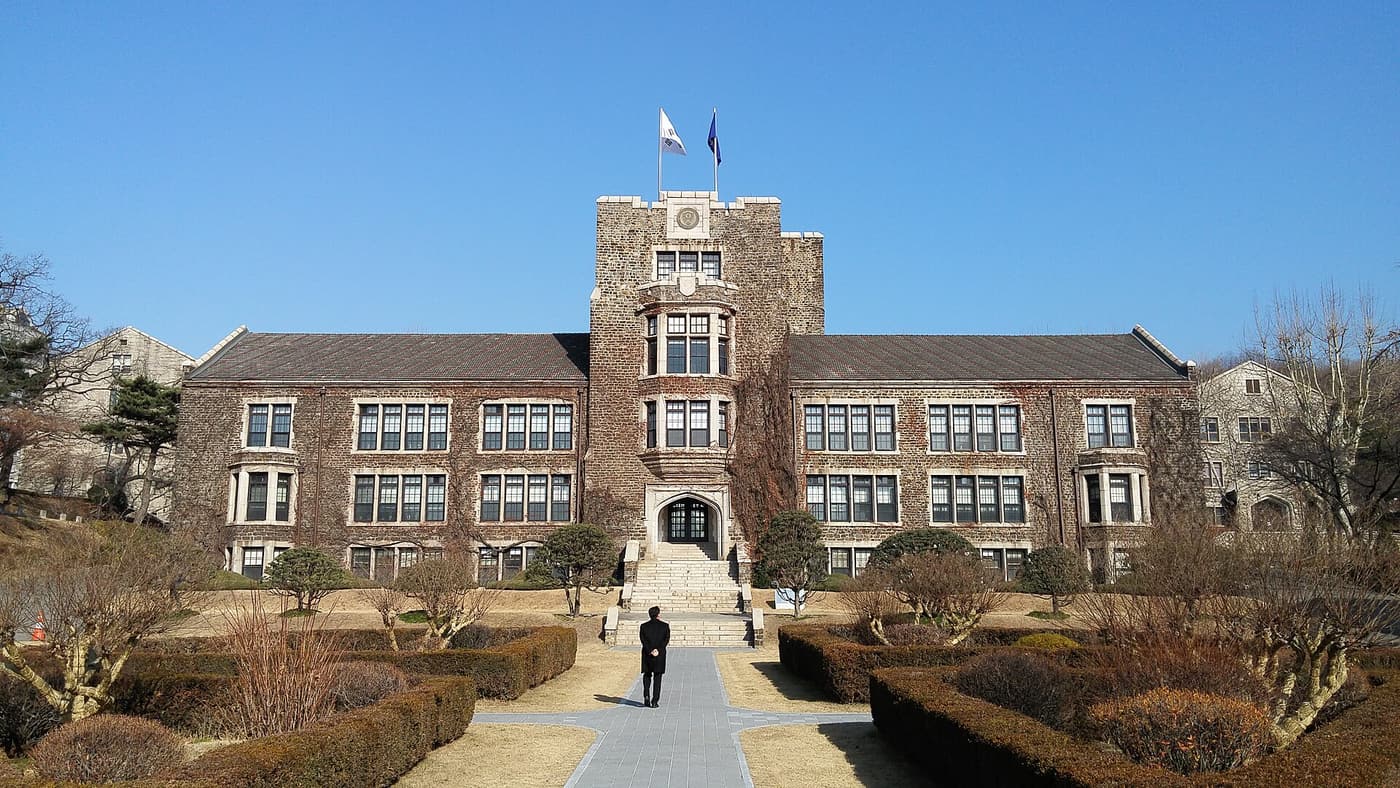
Yonsei University, Sinchon. The Y in SKY, and one half of Korea’s most theatrical university rivalry. Photo by Christian Bolz, CC BY-SA 4.0.
The Korea University vs Yonsei Rivalry
One reason SKY is easy to remember is the legendary rivalry between Korea University and Yonsei University. This rivalry is not a small campus joke. It is a major part of student identity.
Every year, the two schools compete in a famous sports festival often called the Korea-Yonsei games or Yonsei-Korea games, depending on which side is speaking. The naming itself is part of the rivalry. Korea University students prefer one order; Yonsei students prefer the other. That small detail tells you everything.


The games include sports, but the cheering culture is just as important. Students practice songs, chants, and synchronized movements. The point is not only to win. The point is to feel the school identity in your body, with thousands of people moving and shouting together.
For outsiders, this can look like a college sports event. For students and alumni, it becomes a memory of belonging. That matters because Korean universities are not only places to study. They can become lifelong networks.
This is why Korea University and Yonsei University have such distinct emotional brands. SNU may sit at the top academically, but the KU-Yonsei rivalry gives SKY its drama.
Is SKY the Only Path to Success?
No. SKY is powerful, but it is not the only path to success in Korea.
This is important because international readers sometimes misunderstand the topic. They hear "SKY universities" and imagine that every Korean who does not attend one has failed. That is not true. Korea has excellent universities outside SKY, including strong technical, medical, business, and regional institutions. Many successful Koreans did not graduate from SKY.
Still, the pressure is real. In some fields, especially law, politics, academia, journalism, medicine, consulting, finance, and large-company office tracks, school prestige can matter a lot. The SKY label can help open the first door. After that, performance, personality, timing, and network still matter.

For younger Koreans, there is also growing criticism of the old prestige system. Many people question whether one exam season should shape someone's entire future. Others argue that Korea needs more diverse definitions of talent, especially in creative industries, startups, global work, and technical fields.
So the honest answer is balanced: SKY is not destiny, but it is still a powerful advantage.
For language learners: Korean school names, titles, and campus culture make more sense once the basics click; the Lonely Planet Korean Phrasebook & Dictionary is a low-commitment starting point if this topic made you want a practical next step.
See it on AmazonWhy Foreigners Notice SKY Later Than Koreans Do
Foreigners often learn about SKY after they already know K-pop, K-dramas, Korean food, or travel destinations. That makes sense. Education hierarchy is not as visible as street food or subway signs.
But once you notice it, you start seeing it everywhere. Korean dramas mention elite universities to quickly explain a character's background. Variety shows joke about school prestige. Parents talk about education as family strategy. Job interviews and biographies often include university names. Even casual conversations may reveal a quiet respect for certain schools.

This is why understanding SKY helps you read Korean society more clearly. It explains why exams feel so emotional, why parents invest heavily in education, and why a university name can become part of someone's social identity.
The phrase is short. The cultural story behind it is huge.
It also explains why one acronym can appear in family conversations, school jokes, job anxiety, and national debates about fairness.
FAQ About SKY Universities in Korea
Q: What are the SKY universities in Korea?
Simply put, SKY universities are Seoul National University, Korea University, and Yonsei University. The acronym comes from SNU, Korea, and Yonsei, and it refers to Korea's most prestigious university group.
Q: What does SKY university mean in Korea?
Simply put, SKY university means one of Korea's top three elite universities. It also suggests academic prestige, strong social reputation, and access to influential alumni networks.
Q: Is Seoul National University better than Korea University and Yonsei?
Simply put, Seoul National University is usually seen as the most prestigious overall. But Korea University and Yonsei University have their own strengths, identities, and powerful alumni networks.
Q: Are SKY universities the only good universities in South Korea?
Simply put, no. South Korea has many excellent universities outside SKY. But SKY has a special cultural status because it is strongly linked to elite education, social prestige, and career opportunity.
Q: Why do Koreans care so much about SKY universities?
Simply put, Korea's education system is highly competitive, and university prestige can influence jobs, networks, family expectations, and social perception. SKY became a shorthand for winning that competition.
Q: Is SKY an official university ranking? Simply put, no. SKY is a famous cultural acronym for Seoul National University, Korea University, and Yonsei University. It reflects prestige, but it is not a full ranking of every Korean university or every academic department.
Q: Are non-SKY universities in Korea still good? Simply put, yes. Korea has many strong universities outside SKY, including schools known for science, engineering, medicine, business, education, arts, and regional leadership. SKY matters culturally, but it is not the only path.
Q: Why do people search "sky university" if there are three schools? Simply put, many searchers hear the acronym as one phrase and type it in singular form. In Korea, SKY always points to the group: Seoul National University, Korea University, and Yonsei University.
Conclusion: SKY Is a Shortcut for Understanding Korea
The SKY universities in Korea are not just Seoul National University, Korea University, and Yonsei University. They are a shortcut for understanding how education, status, family ambition, and social pressure meet in Korean life.
If you only memorize the names, you miss the point. SKY matters because it represents a promise: study hard enough, test well enough, and maybe you can enter the room where Korea's elite networks begin.
Whether that promise is fair is another question. But if you want to understand modern Korea, you need to know why three university names can carry so much weight.
Video Insight: The SKY Universities
You Might Also Like

Why Koreans Eat Pajeon and Makgeolli on Rainy Days
Why pajeon and makgeolli became Korea’s rainy-day pairing, plus pancake types, drink etiquette, ordering tips, and places to try them in Seoul.

Korean Couple Anniversaries: 100 Days, White Day, and Pepero Day
A practical guide to Korean couple anniversaries, including 100-day milestones, Valentine’s Day, White Day, Pepero Day, gifts, and dating etiquette.

Ahjussi Meaning: The Korean Word, and What an Ahjussi Actually Looks Like
Ahjussi means a middle-aged Korean man. The part a dictionary cannot tell you is what one looks like: the fishing vest and hiking jacket that Korean media calls the definition of 아재 패션 — and that Dior turned into menswear.