Haebangchon Seoul Guide: The Village Named After Liberation
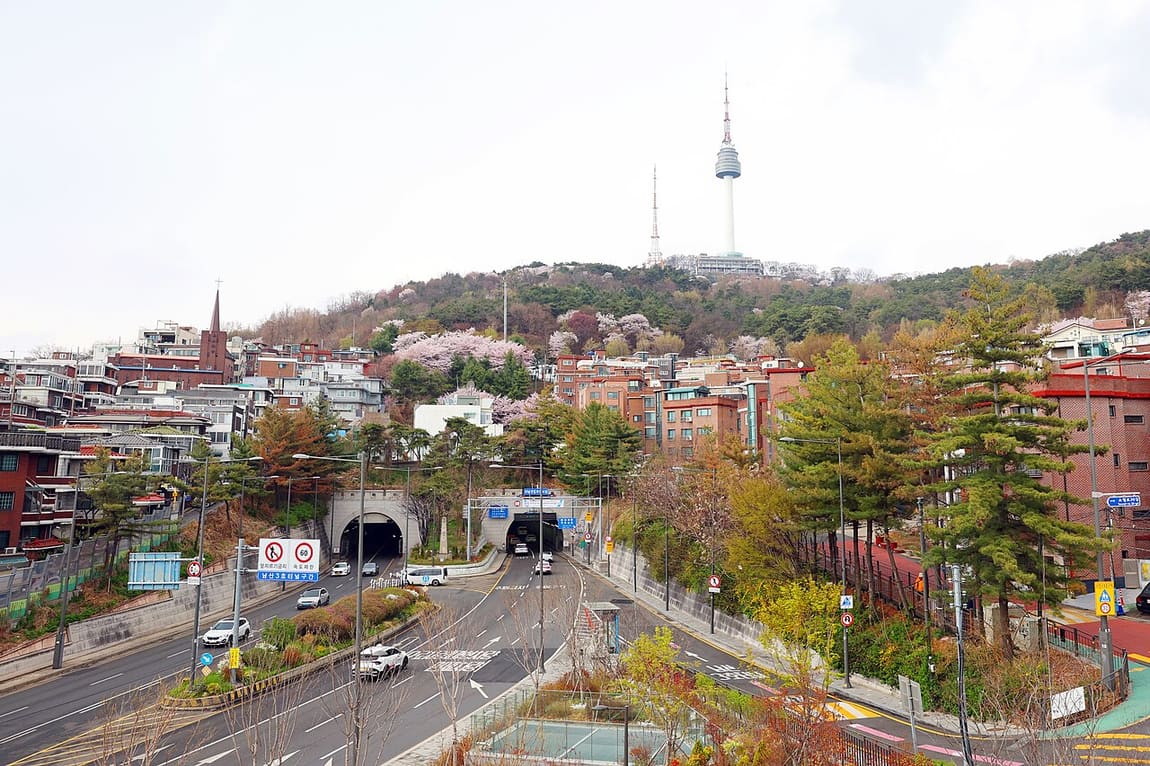
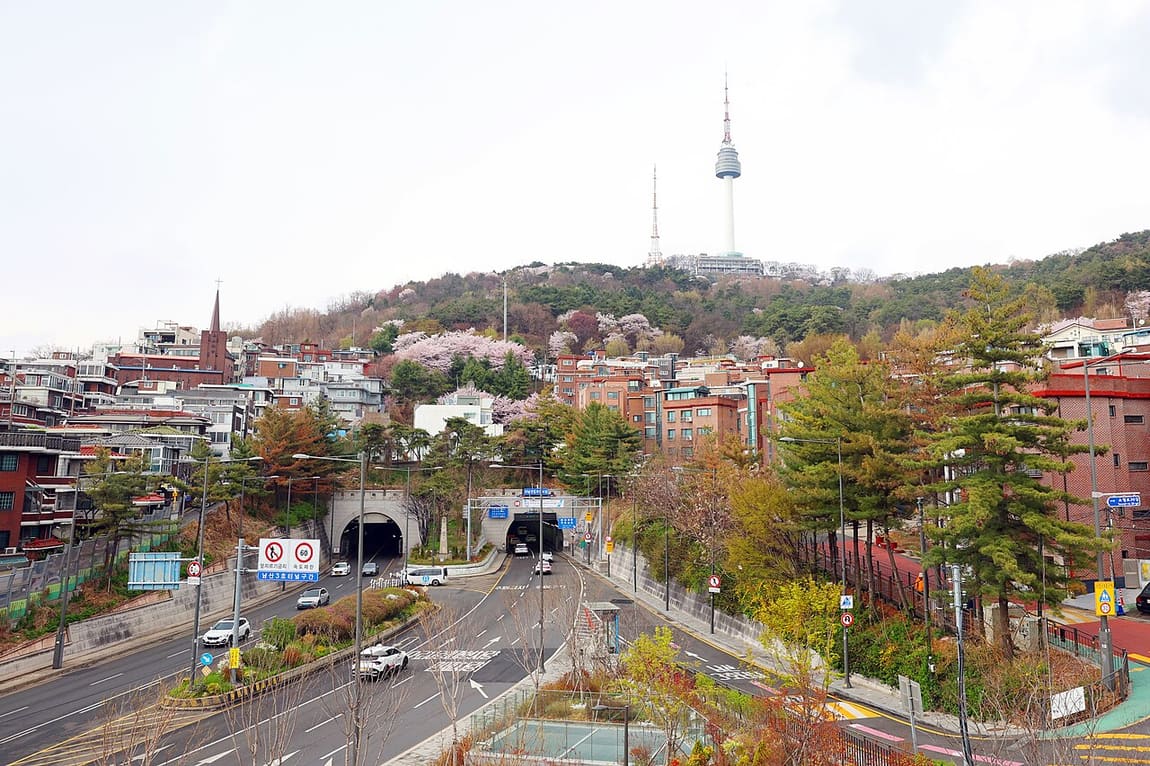
Haebangchon on the southern slope of Namsan, directly under the tower. The shape of the neighbourhood is its history. Photo by 이정우 / Ministry of Culture, Sports and Tourism, CC BY-SA 4.0.
Haebangchon (해방촌) means "Liberation Village."
The name is literal and it is a date. When Korea was liberated in 1945, people came back — from Japan, from Manchuria, from wherever the colonial period had scattered them — and people came down from the North. Then the Korean War added refugees. Many of them had nowhere to go, so they built on the steep southern slope of Namsan, in the middle of Seoul, because nobody else wanted land that hard to build on.
That shanty settlement is the neighbourhood you can still see in the photograph above: dense, low, and climbing a hill under a broadcast tower.
Today most English coverage files Haebangchon under "the international neighbourhood near Itaewon, good for craft beer." That is true and it is the least interesting thing about it.
Here is the part almost nobody tells you: the famous staircase at the centre of it is a piece of a Japanese colonial shrine.
The Short Answer
| Detail | |
|---|---|
| Korean | 해방촌 (Haebangchon), Yongsan-gu |
| Means | Liberation Village — from the 1945 liberation |
| Where | The southern slope of Namsan, just above Itaewon |
| Founded by | Returnees from abroad, people who came south from the North, and Korean War refugees |
| The market | 신흥시장 (Sinheung Market), opened 1953 — "the newly rising market" |
| The steps | 108 steps, the surviving approach of a colonial-era Shinto shrine. Inclined lift added 2018 |
| Best for | Walking a hillside, history, small bars and cafes, international food |
| Warning | It is genuinely steep. Wear proper shoes |
Supportive walking shoes — compare on AmazonAffiliate link. As an Amazon Associate, EpicKor earns from qualifying purchases at no extra cost to you.
The 108 Steps Are Not What They Look Like
This is the fact that reorganises the whole visit.
During the colonial period, a Japanese Shinto shrine stood on Namsan. The approach to it climbed the slope on a stone stairway.
In August 1945, at liberation, the shrine's main hall and its torii gate were destroyed. But the heavy retaining wall and the 108 stone steps stayed — too embedded in the hillside to be worth removing.
So the refugees who settled here after 1945 built their village around the surviving approach path of the shrine that had just been torn down, and the neighbourhood they named after liberation grew up on both sides of it.
In 2018 an inclined lift — effectively a small funicular — was installed alongside the steps, because the climb is genuinely hard for residents.
Stand at the bottom and look up. You are looking at colonial infrastructure, a liberation-era settlement, and a 2018 accessibility project stacked on one staircase. There is no plaque that explains this well, which is exactly why it is worth knowing before you go.
Sinheung Market, 1953
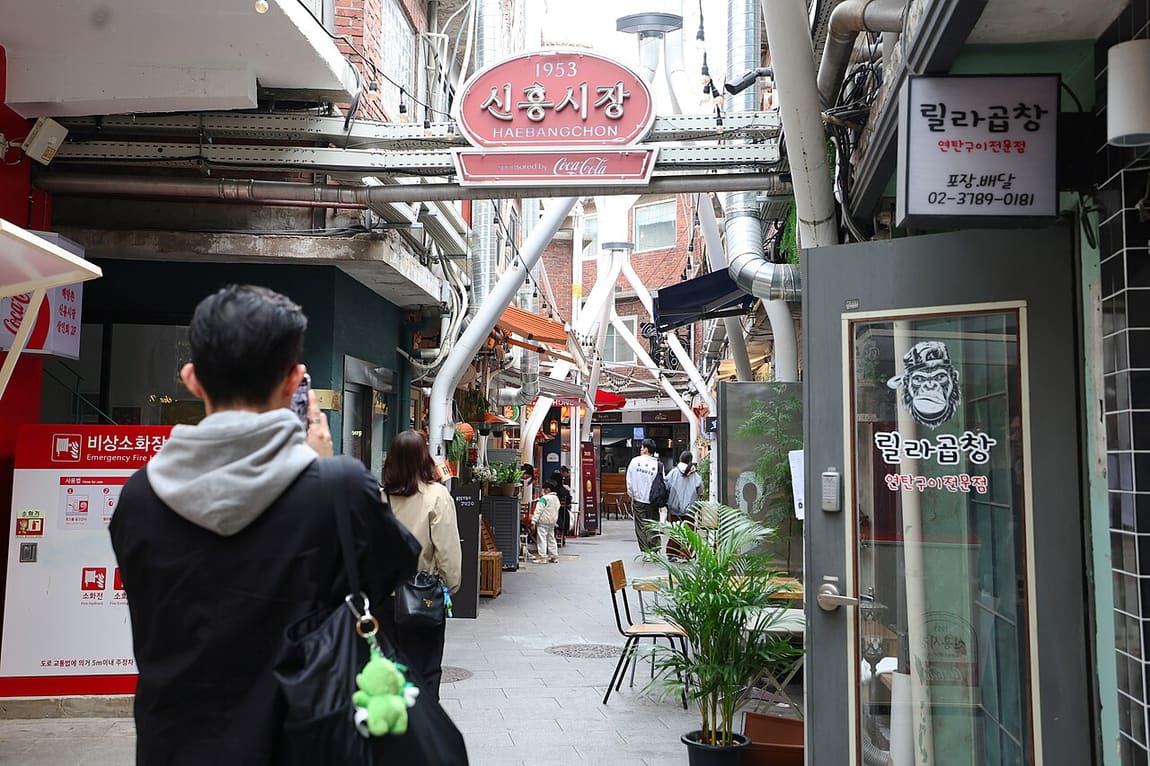
The arch says 1953. The market opened right after the armistice. Photo by 이정우 / Ministry of Culture, Sports and Tourism, CC BY-SA 4.0.
The date on the arch is the point.
신흥시장 (Sinheung Market) opened in 1953, immediately after the armistice, in the middle of the slope. The name means roughly "the newly rising market" — which tells you what kind of optimism was available in 1953 in a village of displaced people.
For decades it was an ordinary neighbourhood market selling daily necessities to residents. As the population aged and shopping habits changed, it emptied out. Then small bars, cafes and restaurants moved into the old stalls, and the covered lane became one of the most photographed spots in the district.
The structure is still a 1953 market. The narrow covered aisle, the stall-sized units, the metal ducting overhead — none of that was designed for cafes. That is why it feels the way it does.
Why It Became International
The plain explanation, since it is the thing visitors notice first.
Haebangchon sits immediately above Itaewon, historically the centre of Seoul's foreign community because of the nearby US military presence. Haebangchon was the cheaper, steeper, more residential neighbour — so foreign residents who wanted to live near Itaewon without Itaewon prices moved up the hill.
The result is a district with an unusual food mix for Seoul: Mexican, Middle Eastern, Southeast Asian and Western food alongside Korean, much of it run by people who live there rather than by chains.
Practical read: Haebangchon is where you go if you have been in Korea long enough to want something that is not Korean food, or if you want to see how an international community actually lives rather than where it goes out.
What to Actually Do
Walk up, then walk down. The neighbourhood is a slope. Going up first and drifting down is far easier than the reverse, and you will see more.
Use the 108 steps deliberately, now that you know what they are. Take the stairs at least one direction even if the lift is running.
Eat something not Korean. It is the district's genuine specialty and there is no reason to be precious about it.
Go through Sinheung Market slowly. It is small. The interest is in the structure, not the length.
Look at the views between buildings. Because the neighbourhood is on a slope facing away from Namsan, gaps between houses open onto the city. This is the best free view in the district and there is no designated viewpoint for it.
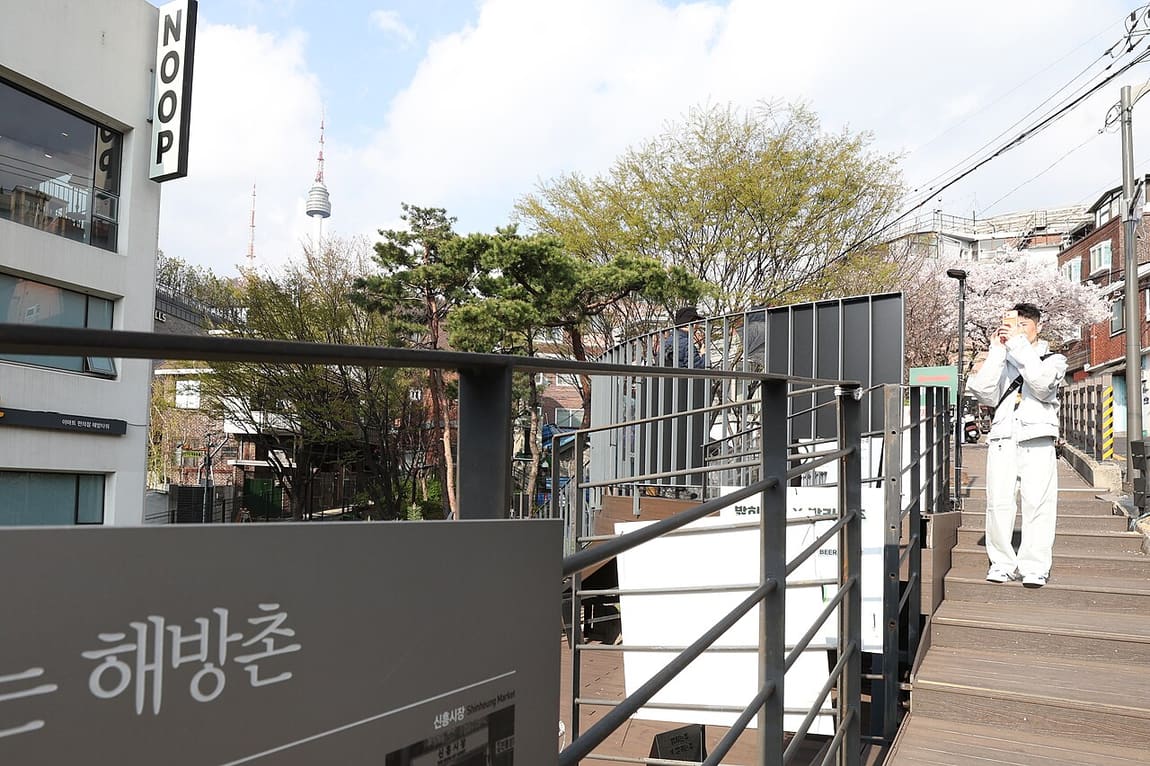
The tower is always above you here, which makes the neighbourhood hard to get lost in. Photo by 이정우 / Ministry of Culture, Sports and Tourism, CC BY-SA 4.0.
You might like: Yeonnam-dong Seoul Guide: The Park Built on a Buried Railway
The Slope Is the Whole Experience
Worth saying plainly because it changes what you should wear and how long you should allow.
Haebangchon is steep. Not "a bit of a hill" — properly steep, with stairs used as ordinary streets and alleys that turn into staircases without warning. That steepness is why the land was available to refugees in 1945 and why the district still looks the way it does.
Practical consequences:
- Proper shoes. This is not a neighbourhood for anything you would not walk a hill in
- Allow more time than the map distance suggests. Horizontal distance is misleading when the route is vertical
- The inclined lift by the steps is there for a reason. Using it is not cheating; residents use it daily
- Avoid it in ice. Winter turns steep alleys into a genuine hazard, and this is a neighbourhood of steep alleys
Walking a hillside neighbourhood: As an Amazon Associate, EpicKor may earn from qualifying purchases. Haebangchon is genuinely steep with alleys that become staircases — compare supportive walking shoes before a day built around it.
Compare on AmazonReading the Hillside as You Walk
Once you know the sequence, the buildings tell you the history without a guide.
The lowest and steepest lots came first. Land nobody wanted in 1945 is the land the first settlers took — the hardest gradients, the narrowest plots, the places a truck still cannot reach. Where the alleys are tightest and the steps most improvised, you are in the oldest fabric.
Then came permanence. The shanty village was rebuilt in brick and concrete over decades, but on the same plot lines, which is why the streets still follow a footpath logic rather than a planned grid. Modern buildings here are new structures on very old boundaries.
Then came the newest layer. Renovated units, glass shopfronts, cafes with English signage — almost always on the more accessible edges, near roads wide enough to deliver to. The further you climb from a driveable street, the older the neighbourhood you are in.
A practical way to use this: if you want the historical Haebangchon rather than the photographed one, walk uphill and away from anywhere a car could park.
What It Costs
| Korean | Rough cost | |
|---|---|---|
| The walk, the steps, the market lane | — | Free |
| Inclined lift beside the 108 steps | 경사형 엘리베이터 | Free to use |
| Cafe coffee | 카페 | around ₩5,000–7,000 |
| Craft beer | 수제맥주 | commonly ₩8,000–12,000 a glass |
| Non-Korean meal | — | roughly ₩12,000–20,000 |
| Subway to the area | 지하철 | about ₩1,500 |
Haebangchon is not a cheap night out. The international food and craft beer that define it price like international food and craft beer anywhere in Seoul, and above what an equivalent Korean meal costs down the hill.
The honest counter-recommendation: come for the walk, not the bar tab. The genuinely distinctive part of this neighbourhood — the slope, the steps, the 1953 market structure, the views between houses — costs nothing. The drinking is good and is not what makes the place unusual. If your budget is tight, walk it in the afternoon and eat in Itaewon.
How It Compares
| Neighbourhood | Korean | Character | Go for |
|---|---|---|---|
| Haebangchon | 해방촌 | Hillside, historical, international | History, non-Korean food, views |
| Itaewon | 이태원 | Flat, commercial, nightlife-heavy | Going out, variety |
| Yeonnam | 연남동 | Low-rise, park-centred | Daytime walking |
| Mullae | 문래동 | Working steel + art studios | Industrial texture |
Do Haebangchon in daylight and Itaewon after dark. They are a ten-minute walk apart and they are good at opposite things.
When to Skip It
- Skip it if stairs are a problem. There is no flat version of this neighbourhood
- Skip it in ice or heavy rain. Steep alleys plus bad footing is a genuinely poor combination
- Skip it if you want landmarks. Aside from the steps and the market there is no monument here. The neighbourhood is the attraction
- Do not come only for one bar. Small businesses here turn over, and the district is what you came for
- Do not treat it as an Itaewon annexe. It is a residential neighbourhood with a history, and people live in the houses you are photographing
The history under your feet: The colonial and liberation-era history this neighbourhood sits on is worth more than one post — compare books on modern Korean history.
Compare on AmazonFAQ About Haebangchon
Q: What does Haebangchon mean?
A: Liberation Village. It is named for Korea's 1945 liberation, and it was settled by people returning from abroad, people who came south from the North, and refugees from the Korean War, who built on the steep southern slope of Namsan.
Q: What are the 108 steps?
A: The surviving approach stairway of a Japanese Shinto shrine from the colonial period. The shrine's main hall and torii gate were destroyed at liberation in August 1945, but the retaining wall and the 108 stone steps remained. An inclined lift was added alongside them in 2018.
Q: What is Sinheung Market?
A: A neighbourhood market that opened in 1953, immediately after the armistice — the name means roughly "the newly rising market." It served residents for decades, emptied out, and has since filled with small cafes, bars and restaurants inside the original stall structure.
Q: Why are there so many foreigners in Haebangchon?
A: It sits directly above Itaewon, long the centre of Seoul's foreign community, and was cheaper and more residential. Foreign residents moved up the hill, and the food scene followed.
Q: How do I get there?
A: It is a walk uphill from the Itaewon area in Yongsan-gu. Expect a genuine climb, and wear shoes you can walk a hill in.
Q: Is it worth visiting if I only have a few days in Seoul?
A: Only if you want history and neighbourhood texture rather than sights. On a short trip with a landmark checklist, this is not the priority. On a second visit, or if you like walking cities, it is one of the more rewarding hours in Seoul.
The One Thing to Remember
A village named for liberation grew around the staircase of the shrine that liberation destroyed.
That is the fact to carry up the hill. Haebangchon is not a craft-beer district that happens to be old; it is a refugee settlement built on colonial infrastructure, still standing on the steepest land in central Seoul, with cafes in a 1953 market.
Walk up, take the steps, and look at what is under your feet.
Sources and Further Reading
- Korean coverage of Haebangchon's founding after the 1945 liberation by returnees from abroad, people who came south from the North, and Korean War refugees settling the southern slope of Namsan
- Korean reporting that the 108 steps are the surviving approach path of a colonial-era Japanese Shinto shrine on Namsan, whose main hall and torii were destroyed at liberation in August 1945, and that an inclined lift was installed alongside them in 2018
- Korean documentation of Sinheung Market opening in 1953 immediately after the armistice, its name meaning "the newly rising market," and its later transformation into a lane of small cafes and restaurants
- Seoul city coverage of the district's urban regeneration
- Image sources and licensing are documented in this post's
image-sources.md
Small businesses in this neighbourhood change frequently. Confirm anything specific before travelling for it.
Haebangchon is one of the neighbourhoods compared in EpicKor's Seoul neighbourhood guide — character, nearest station, whether it is worth staying in, and how long each actually takes.
Next in the series: Mullae and Seongsu & Hannam.
You Might Also Like
Bukchon Hanok Village, Seoul: The Village That Now Has Legal Visiting Hours
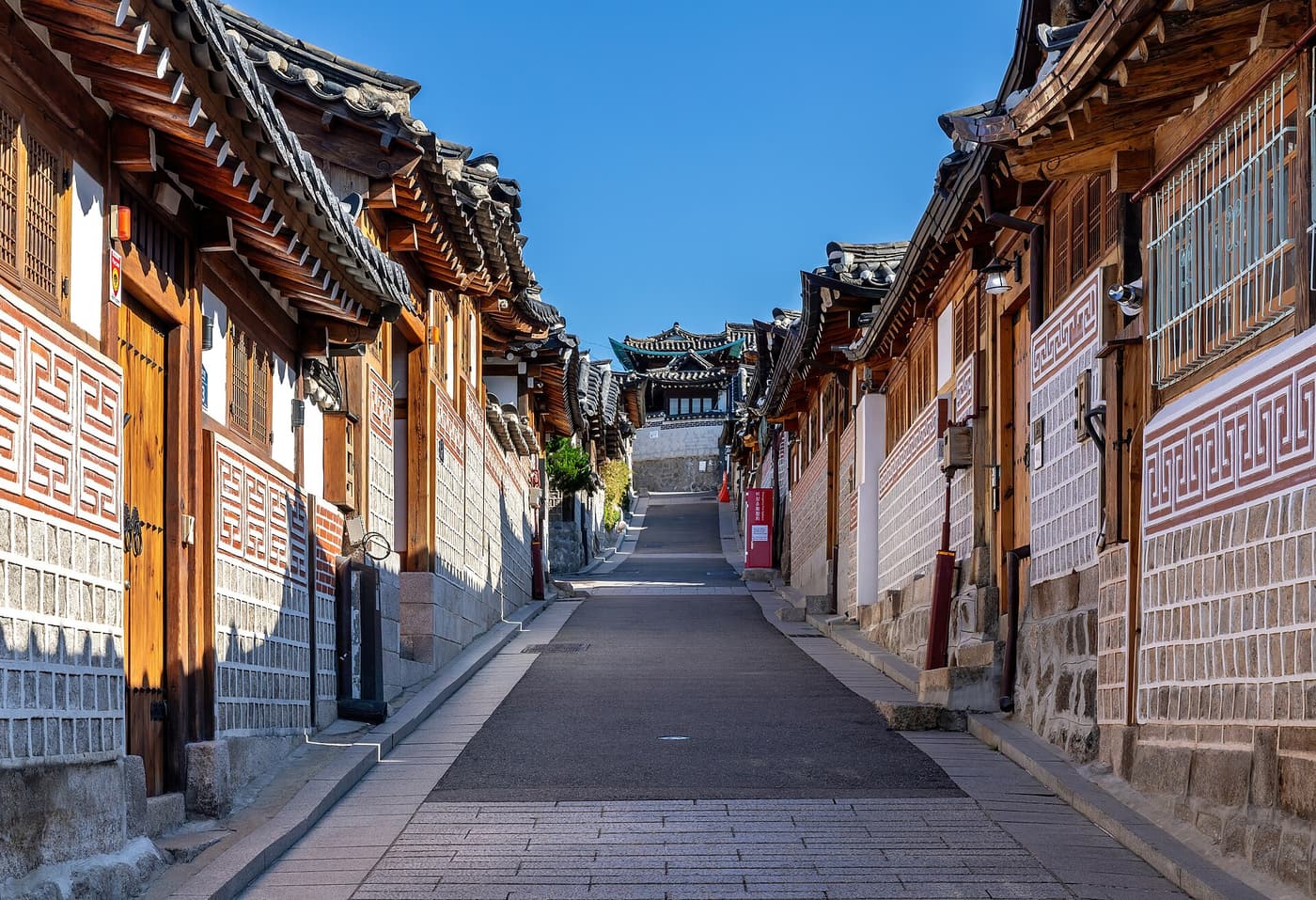
Bukchon is Korea's first Special Management Area for tourism. Since November 2024 the red-zone street has been closed to sightseeing after 5pm, with a ₩100,000 fine enforced from March 2025. It was also built by the same developer as Ikseon-dong.
Seochon, Seoul: The Valley Restored From a 300-Year-Old Painting
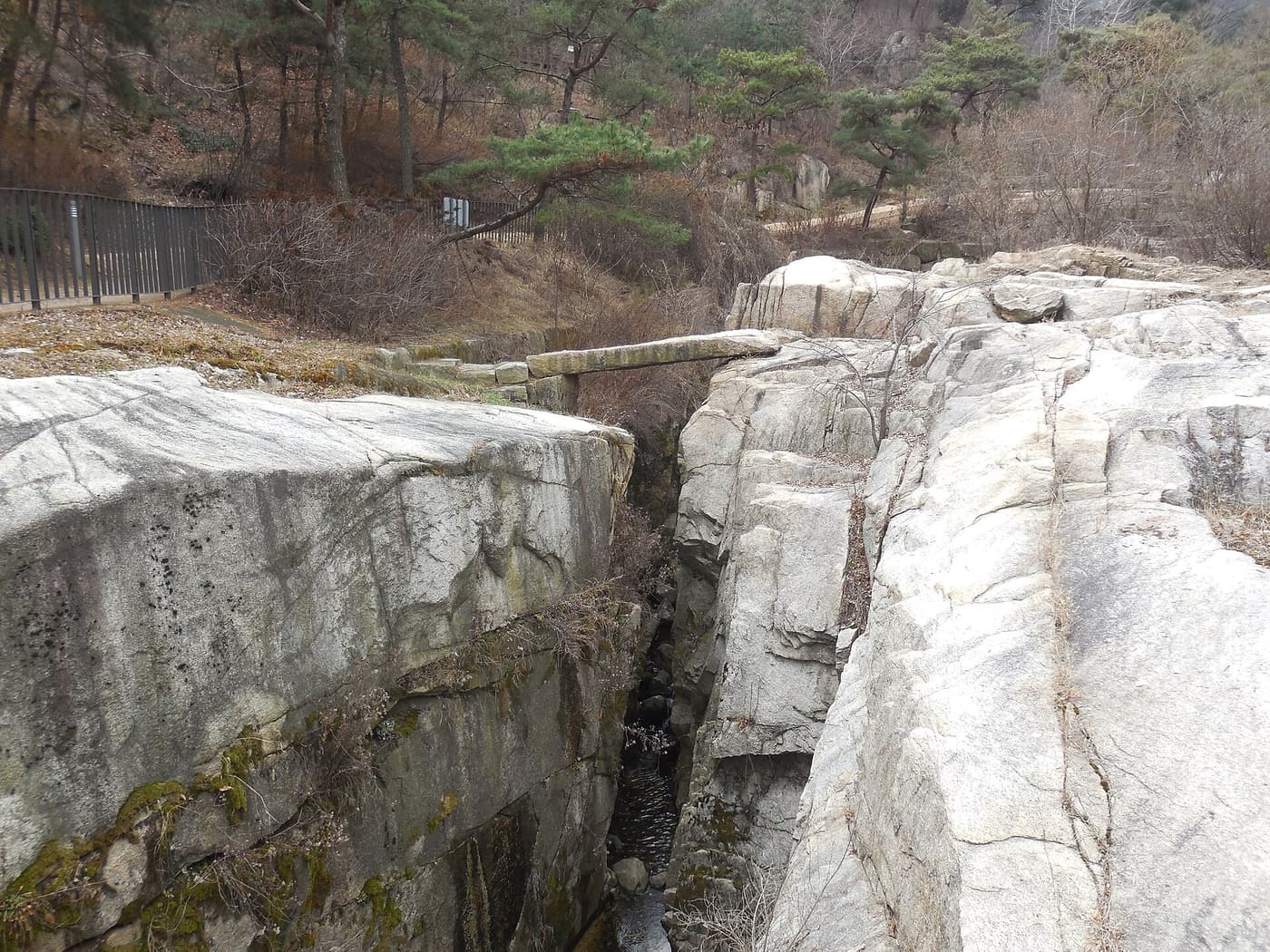
Seoul demolished a 1971 apartment block in Seochon and rebuilt the valley underneath using an 18th-century painting as the reference. The stone bridge in the painting was still there. Plus the brass-coin lunchbox at Tongin Market, from ₩5,000.
Ikseon-dong, Seoul: The Hanok Village a Developer Mass-Produced in the 1920s
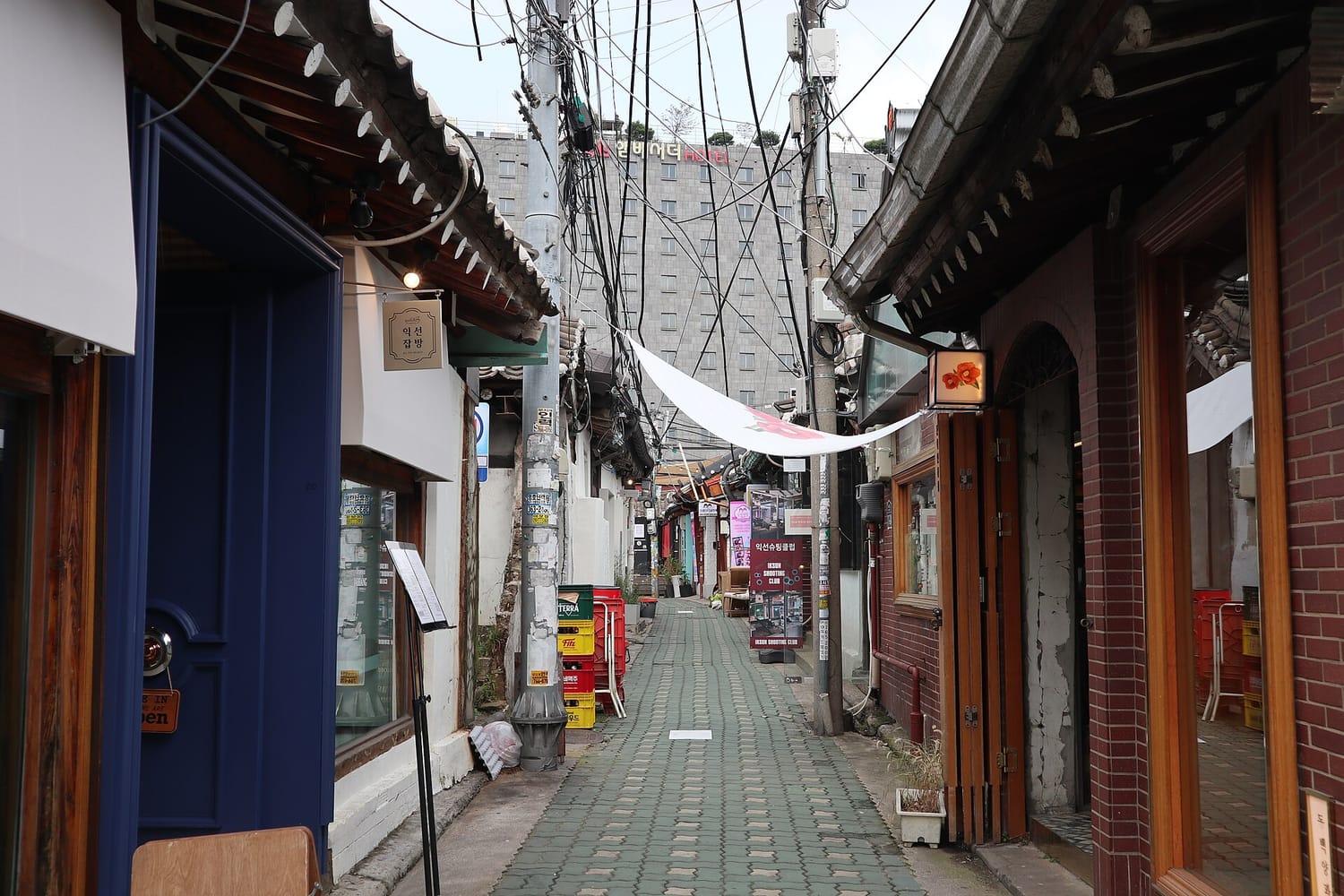
Ikseon-dong is Seoul's oldest surviving hanok village, and it was not preserved from the Joseon era. It was built as a speculative housing development in the late 1920s, and it survived because redevelopment plans kept failing for nearly twenty years.