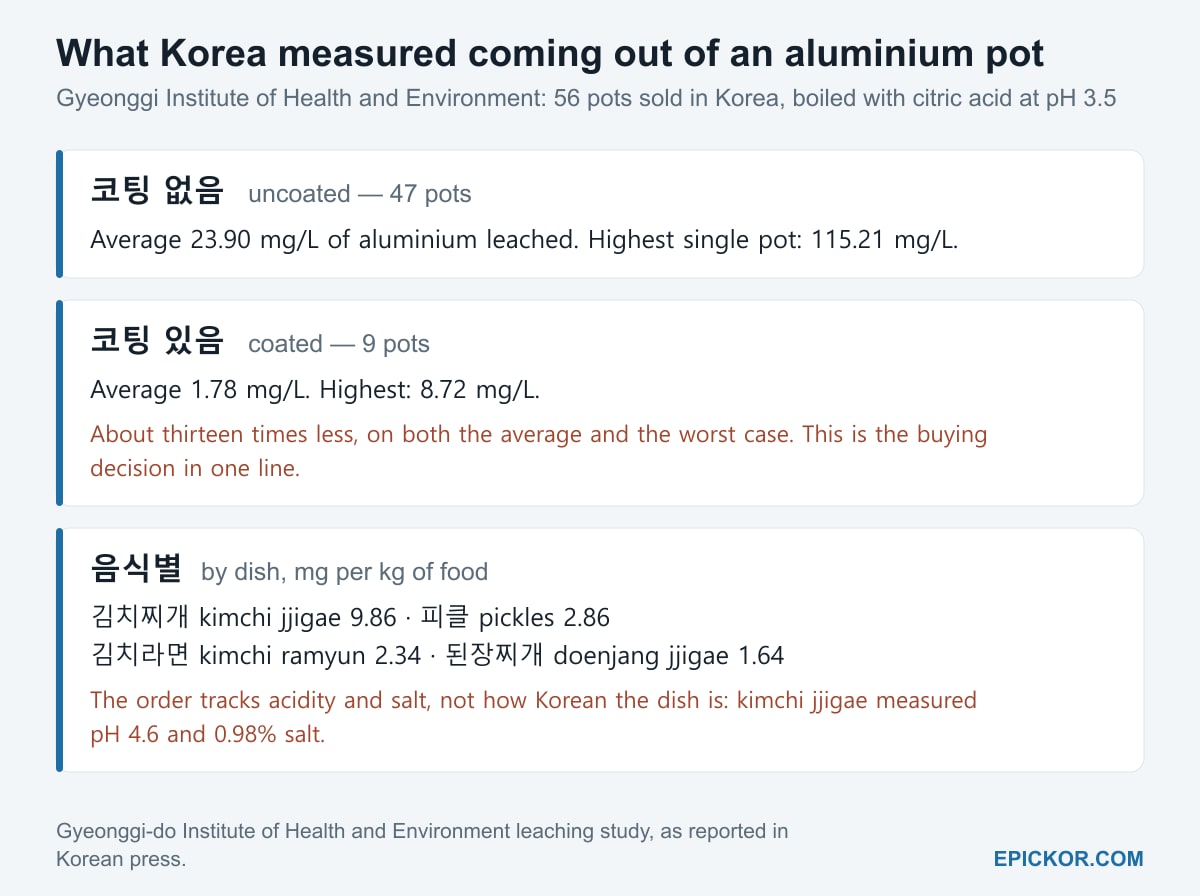
Korean Ramen Pots: Is the Aluminium One Safe?
Every Korean ramyun scene uses the same pot. Thin metal, two handles, a lid that becomes the plate. It boils absurdly fast, it costs almost nothing, and it is the reason instant noodles feel like a specific meal in Korea rather than a generic one.
It is also the thing people ask about most once they own one. Is it safe?
That question has a better answer in Korean than in English, because Korea has actually measured it — pot by pot, dish by dish, with numbers. This is a deep dive on one item from our Korean cookware starter guide; if you are furnishing a Korean kitchen from nothing, start there, and come here when you want to know what is coming out of the pot.
Quick Guide
| Question | Short answer |
|---|---|
| Korean name | 양은냄비 (yangeun naembi) — and the name is wrong, see below |
| What it is made of | Aluminium, thin, usually surface-treated |
| Uncoated pots leached | 23.90 mg/L average, 115.21 mg/L worst case |
| Coated pots leached | 1.78 mg/L average — about 13× less |
| Worst dish for it | 김치찌개 at 9.86 mg/kg — acid plus salt |
| Korea's own safe figure | About 17 mg a day for a 60kg adult; only ~1% is absorbed |
| Alzheimer's link | Korea's food-safety authority: no established causal link |
| What actually ruins it | A steel scrubber. One pass takes the film off |
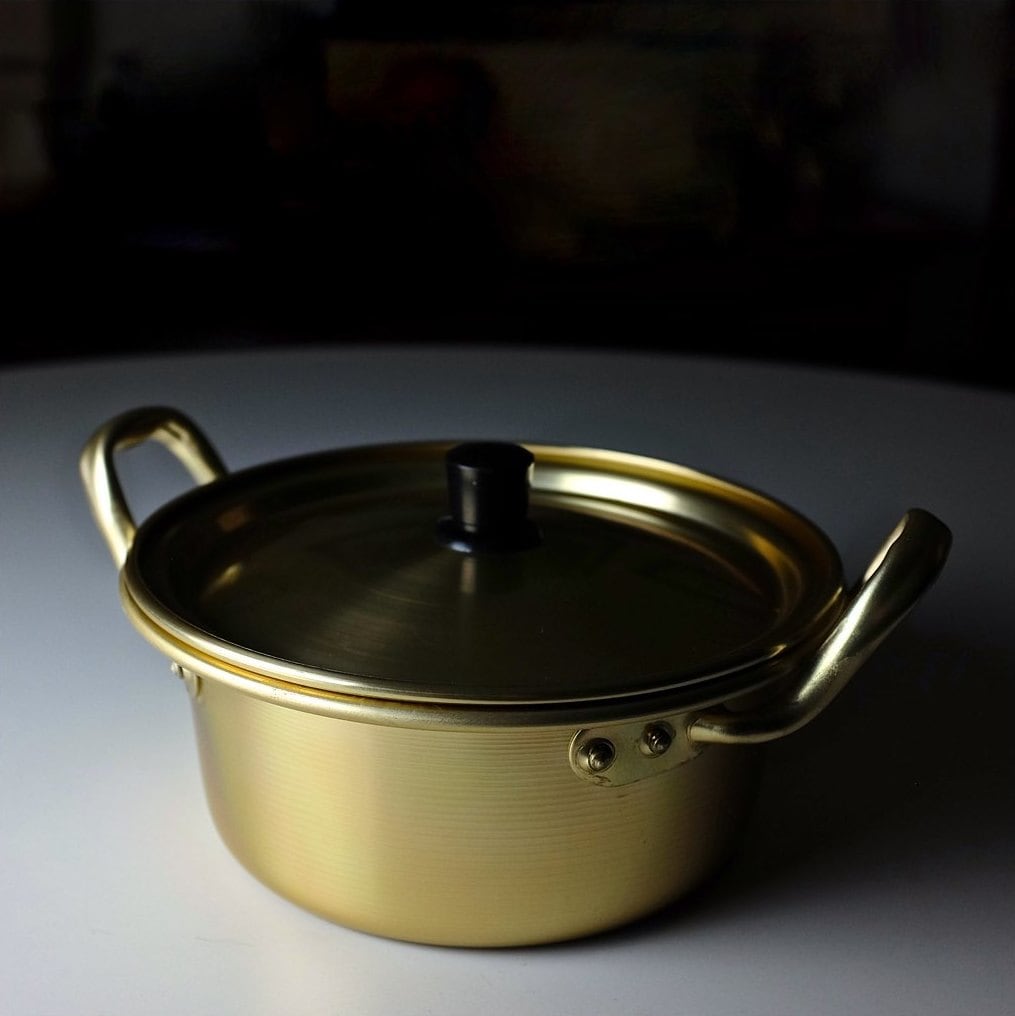
AHIER Korean ramen pot with lid (6.3 in) — the one-portion sizeAffiliate link. As an Amazon Associate, EpicKor earns from qualifying purchases at no extra cost to you.
The name is wrong, and that is the first clue
양은 (洋銀) means Western silver — nickel silver, an alloy of copper with 15–30% zinc and 10–20% nickel. It is silvery, it was used for tableware and instruments, and it is what these pots were originally made from.
Modern 양은냄비 contain no 양은 at all. They are aluminium. The material changed; the name did not.
The colour gives it away, and it is the fastest way to identify one in a shop. Nickel silver is silvery, as the name says. The pot Koreans actually picture is gold — that yellow tone is an anodised finish on aluminium, not a metal. If you are looking for the classic ramyun pot rather than a generic saucepan, look for the gold body with two matching side handles and a black lid knob.
This matters because almost every English explanation of the pot inherits the old name and then reasons from the wrong metal. Everything below — the boiling speed, the leaching, the care rules, the replacement interval — is a property of thin aluminium, not of a nickel alloy.
The surface is usually treated, and the treatment is what varies between a pot that is fine and a pot that is not.
You might like: Korea's Spam Gift Sets Explained: What the Numbers Mean and Which One to Buy
What Korea measured
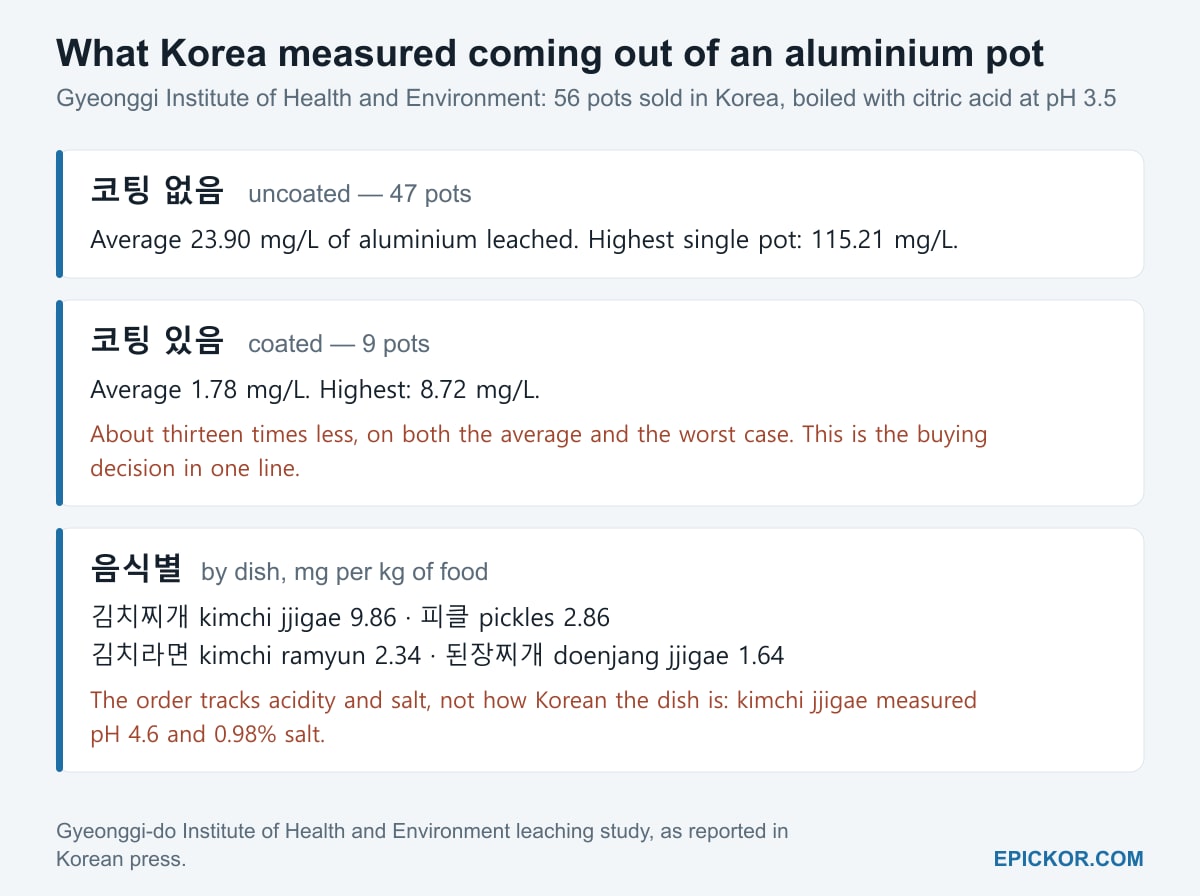
The 경기도보건환경연구원 (Gyeonggi-do Institute of Health and Environment) bought 56 aluminium pots on the Korean market and boiled a citric acid solution at pH 3.5 in each one — a deliberately harsh acid test, more aggressive than most cooking.
The 47 uncoated pots released an average of 23.90 mg/L of aluminium, and the worst single pot released 115.21 mg/L.
The nine coated pots released an average of 1.78 mg/L, worst case 8.72.
That is roughly a thirteenfold difference, and it holds on both the average and the extreme. If you take one thing from this article to a shop, take that.
They then cooked real dishes and measured aluminium per kilogram of food:
- 김치찌개 kimchi jjigae — 9.86 mg/kg (pH 4.6, 0.98% salt)
- 피클 pickles — 2.86 mg/kg (pH 3.8, 0.38% salt)
- 김치라면 kimchi ramyun — 2.34 mg/kg (pH 4.4, 0.55% salt)
- 된장찌개 doenjang jjigae — 1.64 mg/kg (pH 5.7, 1.02% salt)
The ranking follows acidity, with salt amplifying it. It is not about the dish being Korean; it is about pH. The institute's own conclusion was measured rather than alarmed: not at a level harmful to the body, but do not use aluminium pots long-term for high-acid, high-salt cooking.
Is that a lot? Korea publishes the other half of the sum
A leaching figure means nothing on its own. Here is the number to weigh it against.
Korea's 식품의약품안전처 (Ministry of Food and Drug Safety) states that a 60kg adult can take in about 17 mg of aluminium a day without health risk — a quantity it compares to a single grain of rice. It adds two facts that most scare-writing omits:
- Only about 1% of ingested aluminium is absorbed. The rest leaves in urine.
- Korean dietary aluminium intake sits at about 19.5% of the WHO safety standard.
Now do the arithmetic on the worst dish. Kimchi jjigae at 9.86 mg/kg means a 300g serving carries roughly 3 mg of aluminium from the pot. Against a 17 mg daily figure, that is about a sixth of it, from the single most aggressive dish in the study, cooked in an uncoated pot.
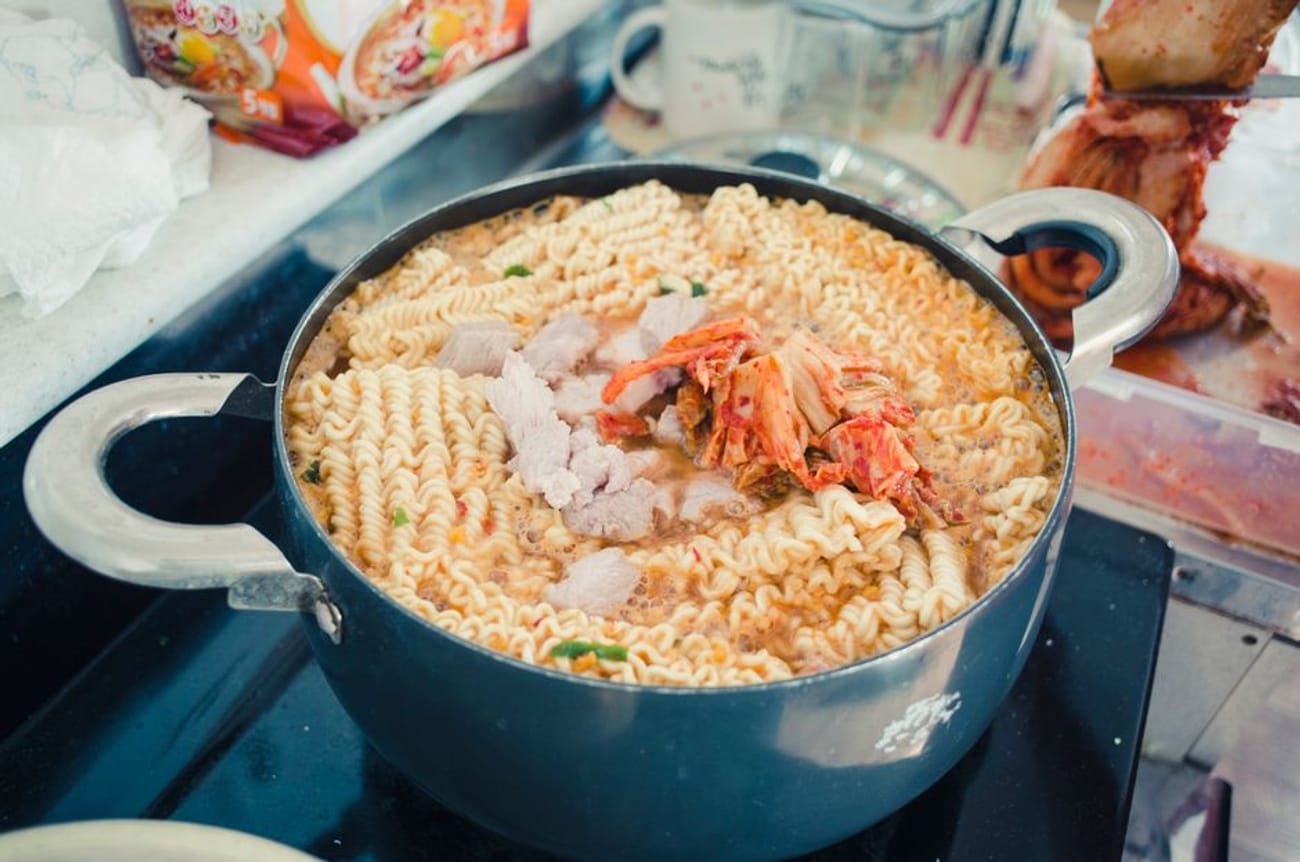
A bowl of kimchi ramyun works out lighter but not trivially so. A packet cooked in the standard 550ml of water lands around 600g of noodles and broth, which at 2.34 mg/kg is roughly 1.4 mg — under a tenth of the daily figure, and that is if you drink all the broth.
So the honest answer to is it safe is: yes, at the amounts measured, for the way people actually cook — and the way to keep it that way is specific rather than vague. Buy coated. Do not stew acid in it for hours. Do not wreck the surface.
The Alzheimer's question
This one deserves a direct sentence rather than a shrug, because it is the reason many people ask in the first place.
Korea's food-safety authority states plainly: "현재, 국제적으로 알루미늄과 알츠하이머병과의 인과 관계가 명확히 밝혀진 바는 없습니다" — internationally, no causal relationship between aluminium and Alzheimer's disease has been clearly established.
That is an accurate statement of where the evidence sits, and it is the position of the body that regulates this cookware in the country that uses it most. It is not a promise that nothing is ever knowable; it is that the link people worry about has not been shown.
The surface is the whole product
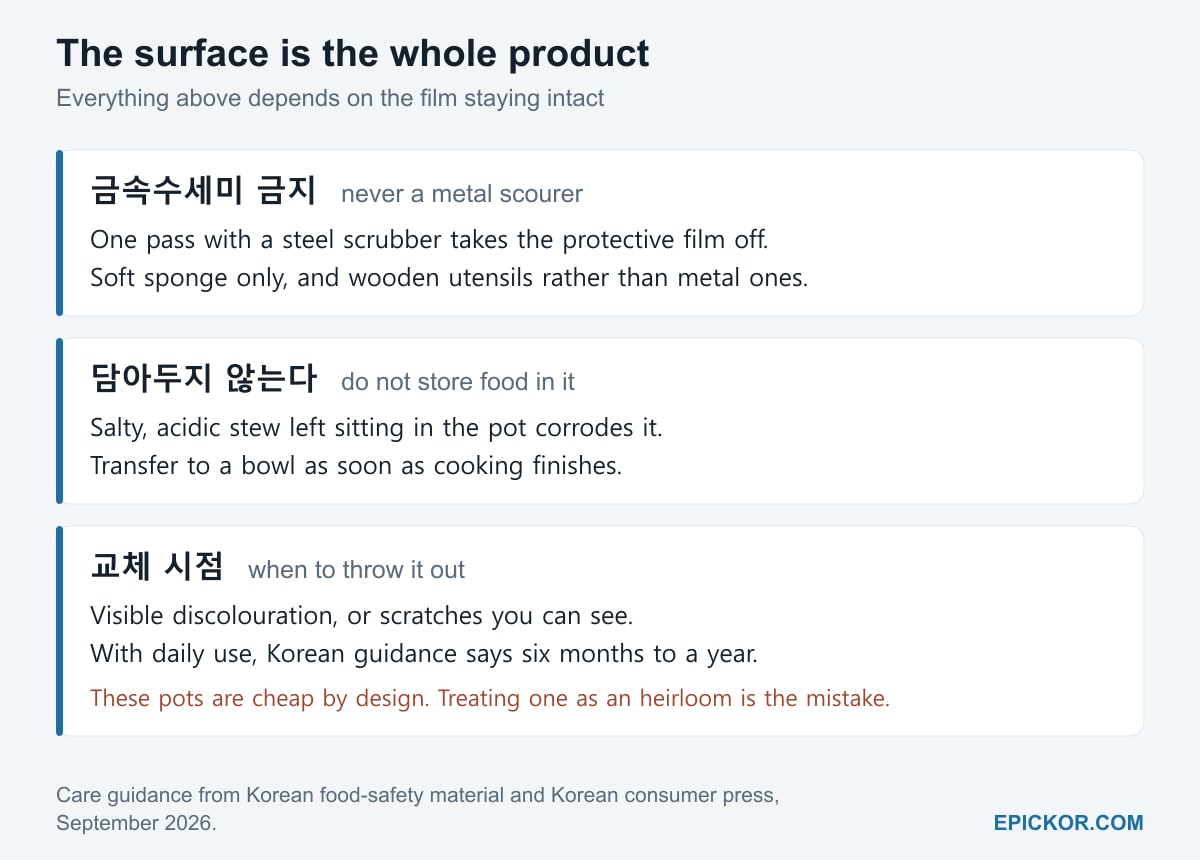
All of the reassuring arithmetic rests on one assumption: that the pot still has its protective surface. Korean guidance on this is unusually blunt.
A steel scrubber removes the film in a single pass, leaving bare aluminium in contact with your food. That converts a coated pot — the 1.78 mg/L category — into something closer to the uncoated one, and no amount of careful cooking undoes it.
So the rules are short:
- Soft sponge only. Never a metal scourer, never a scouring powder.
- Wooden or silicone utensils, not metal ones scraping the base.
- Do not leave stew sitting in it. Salt and acid corrode the pot between meals, not just during cooking. Transfer to a bowl when you are done — which, conveniently, is how it is served anyway.
- Replace it when it discolours or visibly scratches. Korean guidance puts the interval at roughly six months to a year with daily use.
Point 4 is the one Western kitchen instincts resist. These pots cost a few thousand won. They are consumables, not cookware you keep. Treating one as an heirloom is exactly how you end up cooking in a scratched pot for five years.
If you are buying one, the coating is the decision. As an Amazon Associate, EpicKor earns from qualifying purchases at no extra cost to you. Korea's own measurements put coated pots at roughly a thirteenth of the aluminium migration of bare ones, so a coated Korean ramen pot is the straightforward pick if you plan to cook kimchi jjigae or anything else acidic in it. A plain 16cm aluminium one is still fine for boiling noodles and water, which is most of what these get used for. Buy the 16cm for one person and the 20cm only if you actually cook for two.
See coated Korean ramen pot on AmazonWhy it cooks ramyun better anyway
None of the above is an argument against the pot. It exists because it does one thing extremely well.
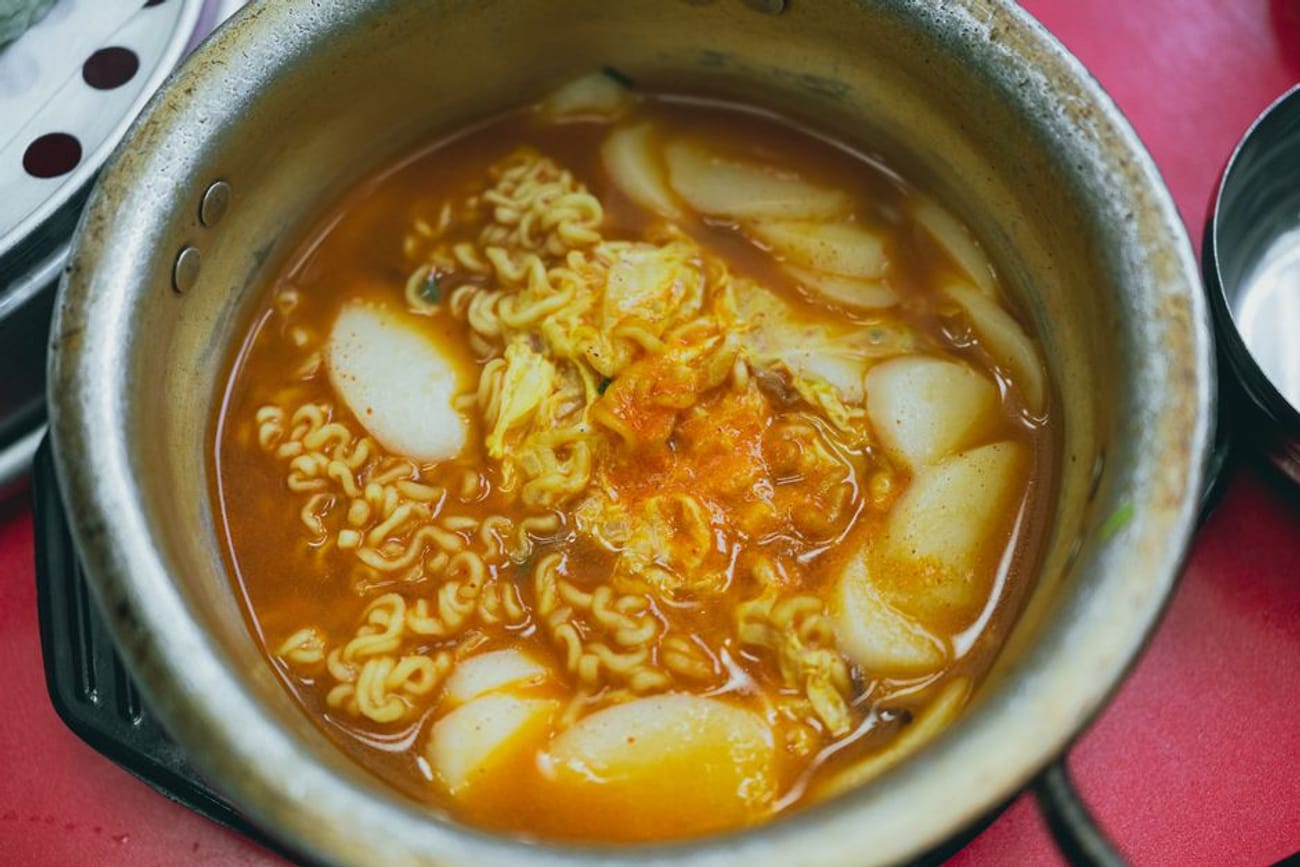
Thin aluminium boils fast and loses heat fast. That is the entire functional argument. Ramyun is a dish whose identity is speed — three minutes, no ceremony — and a thin pot reaches a rolling boil far quicker than a heavy one, then cools quickly enough that you can eat straight out of it. The lid becomes the plate for the noodles you lift out first.
This is also why the pot is visual shorthand in Korean film and television, a point our guide to what Korean dramas are actually showing you at the dinner table gets into: eating from the lid is the least-pretentious way to feed someone, so directors reach for it.
The physics that make it good are the same physics that make it thin, and thin is why the surface matters so much. Those are not two separate facts about the pot. They are one fact.
Coated, uncoated, or stainless
Three real options, and the choice is not close once you know the numbers.
- Coated aluminium — the default recommendation. Keeps the fast boil, cuts migration by roughly thirteen times, and costs a few thousand won more. The trade-off is that the coating is destructible, which returns you to the care rules above.
- Uncoated aluminium — fine for water and plain noodles, which is genuinely most of its use. Not the pot for simmering kimchi jjigae for an hour.
- Stainless steel — no aluminium question at all, and no fast boil either. Heavier, slower, and it will not behave like the pot you saw on screen. It is a legitimate choice if the whole issue bothers you, and it is what many Korean households now use for actual stews while keeping the aluminium pot for noodles.
That last split is worth copying. In practice a lot of Korean kitchens keep both and use each for what it is good at — the aluminium pot for the three-minute job, a heavier pot or a ttukbaegi for anything that simmers.
The cheap accessories change more than the pot does. As an Amazon Associate, EpicKor earns from qualifying purchases at no extra cost to you. Since a steel scrubber is the single fastest way to ruin one of these, a pack of non-scratch sponges and a set of wooden cooking utensils protect the surface the whole article depends on. If you would rather sidestep the aluminium question for stews entirely, a ttukbaegi is the Korean answer for anything that needs to simmer.
FAQ About Korean Ramen Pots
Q: Is a Korean aluminium ramen pot safe to use?
At the amounts Korea measured, yes. Uncoated pots released an average of 23.90 mg/L of aluminium under a harsh pH 3.5 acid test and coated ones 1.78 mg/L, while Korea's food-safety authority puts the daily figure a 60kg adult can take in at about 17 mg, of which roughly 1% is actually absorbed. Buy coated, avoid long acidic simmering, and keep the surface intact.
Q: Which food pulls the most aluminium out of the pot?
Kimchi jjigae, at 9.86 mg per kilogram of food, well ahead of pickles at 2.86, kimchi ramyun at 2.34 and doenjang jjigae at 1.64. The ranking follows acidity, amplified by salt.
Q: Does aluminium cookware cause Alzheimer's disease?
Korea's Ministry of Food and Drug Safety states that no causal relationship between aluminium and Alzheimer's has been clearly established internationally. That is the position of the regulator in the country where these pots are most used.
Q: Why is it called 양은냄비 if it is aluminium?
Because it used to be nickel silver — 양은 literally means "Western silver". The metal was replaced with aluminium and the name stayed. Most English explanations inherit the old name and then describe the wrong material.
Q: How long should a Korean ramen pot last?
Korean guidance suggests replacing it at roughly six months to a year of daily use, and immediately if it discolours or you can see scratches. They are cheap on purpose; the surface is the part you are actually buying.
Bottom Line
The pot is safe in the way most kitchen things are safe: within a range, under conditions, and not if you destroy it.
Korea did the work of establishing the range. Uncoated 23.90 mg/L, coated 1.78, kimchi jjigae the worst dish at 9.86 mg/kg, against a daily figure of about 17 mg of which 1% is absorbed. Those numbers say the answer is yes, and they also say exactly where the margin comes from.
Buy the coated one. Use a soft sponge. Do not leave stew in it overnight, and throw it out when it looks worn rather than when it fails. Then use it for what it is genuinely better at than any expensive pot you own: getting water to a rolling boil in about two minutes and putting dinner in front of you before you have decided what to watch.
Sources
- 경기도보건환경연구원 (Gyeonggi-do Institute of Health and Environment) — leaching study of 56 aluminium pots sold in Korea, citric acid at pH 3.5: 47 uncoated pots averaged 23.90 mg/L (max 115.21), 9 coated pots averaged 1.78 mg/L (max 8.72); by dish, 김치찌개 9.86, 피클 2.86, 김치라면 2.34, 된장찌개 1.64 mg/kg with the pH and salinity of each; institute's conclusion that levels are not harmful but acidic and salty foods should not be cooked in aluminium long-term.
- 식품의약품안전처 (Ministry of Food and Drug Safety), foodsafetykorea.go.kr — about 17 mg per day tolerable for a 60kg adult; roughly 1% of ingested aluminium absorbed and the rest excreted; Korean intake at 19.5% of the WHO standard; no internationally established causal link with Alzheimer's disease; guidance to protect the surface with soft sponges and non-sharp utensils.
- Korean-language reference entries on 양은 — nickel silver as copper with 15–30% zinc and 10–20% nickel, the origin of the name, and the fact that modern 양은냄비 are aluminium rather than nickel silver.
- Korean consumer press on 양은냄비 care — a single pass with a steel scrubber removing the protective film; avoiding storage of salty and acidic food in the pot; replacement at roughly six months to a year with daily use.
You Might Also Like
Korean Kitchen Scissors: Why Koreans Cut Meat and Noodles at the Table, and Why It Is Not an Office Scissor
Scissors on a restaurant table look wrong to most of the world and normal to every Korean. The tool is not a desk scissor: thick blades, one serrated edge, big rings, often detachable, built for galbi and cold noodles. Where it came from, and which one to buy.
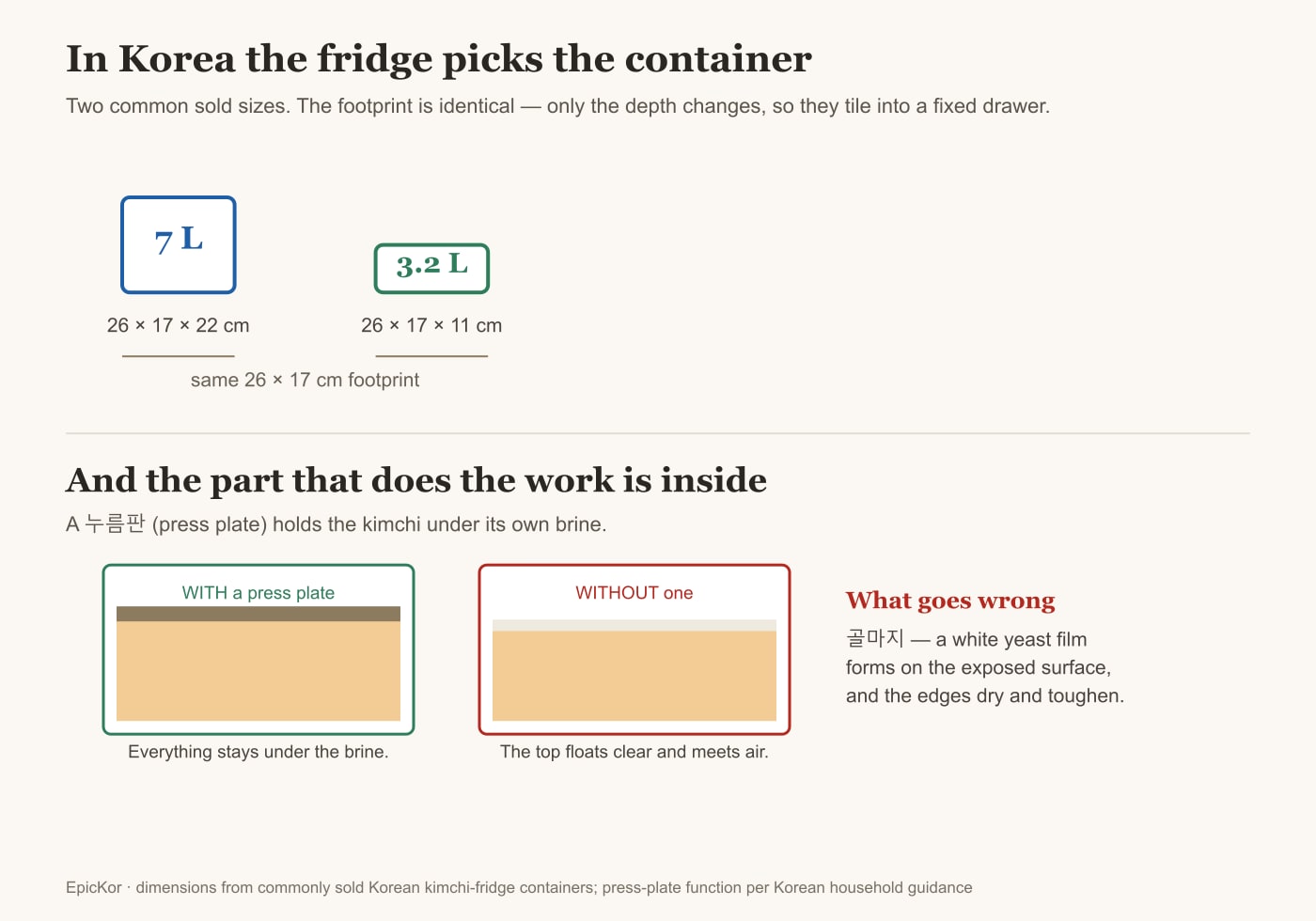
Korean Kimchi Containers: The Press Plate Matters More Than the Lid
English buying guides rank kimchi containers by lid. In Korea the fridge picks the size — 7L and 3.2L share a 26 × 17cm footprint so they tile — and the part that decides whether the kimchi survives is the 누름판, the plate that holds it under its own brine.
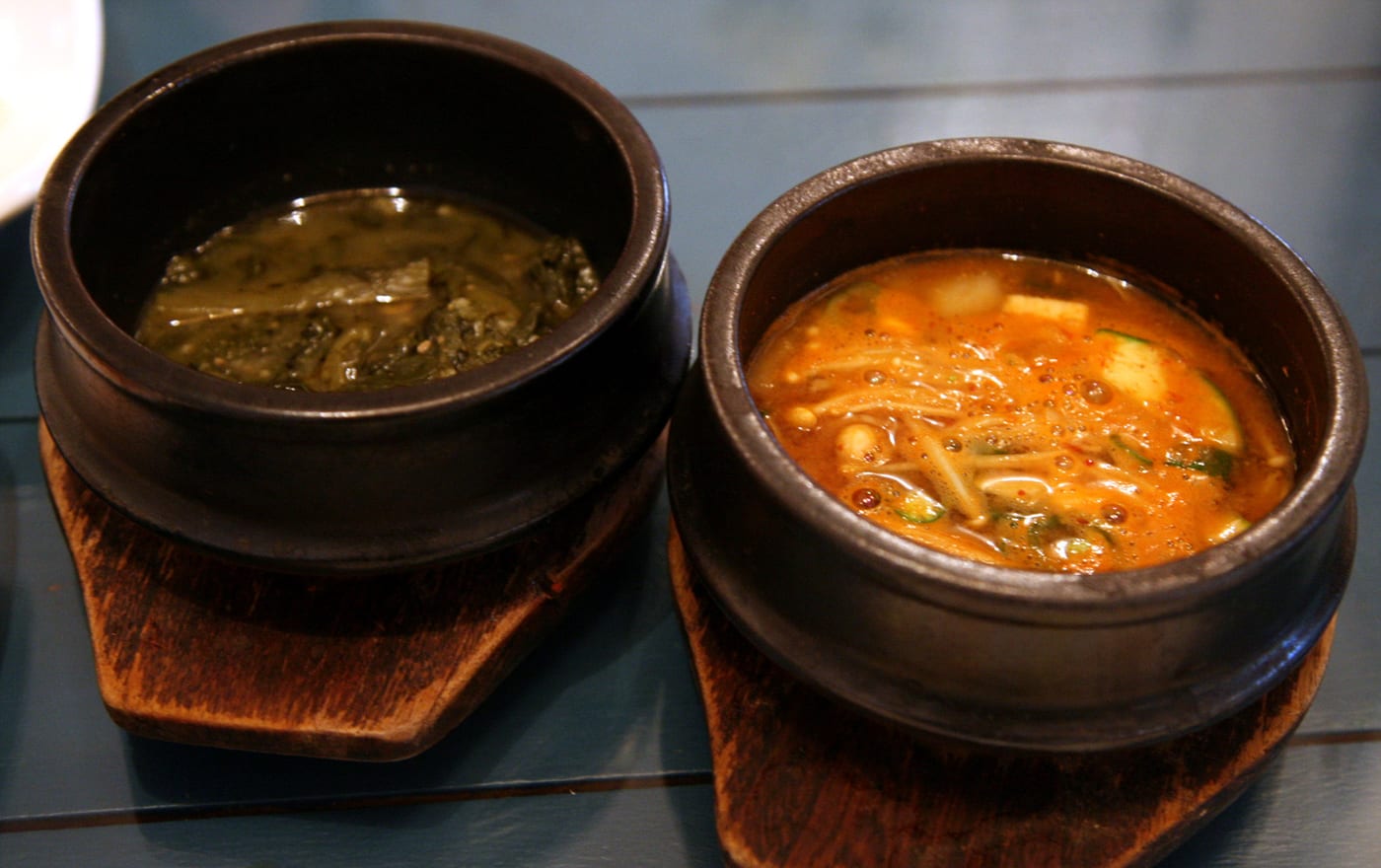
Korean Ttukbaegi vs Dolsot, and Why Koreans Never Use Dish Soap
A ttukbaegi is fired clay, and fired clay is porous — which decides everything about owning one. No dish detergent, never water it while hot, and it will not work on induction. Here is how it differs from a dolsot and which one you actually want.