
MUSINSA Deep Dive: Korea's Fashion Platform Going Offline and Global
MUSINSA closed 2025 with record revenue of ₩1.47 trillion, opened its first overseas stores in Shanghai, and is expected to file for a KOSPI listing. A public-info deep dive on Korea's fashion platform: numbers, stores, global push, and risks.
Quick Answer
MUSINSA is worth studying because it has become one of Korea's clearest examples of a digital fashion platform moving into offline retail, owned brands, brand incubation, global commerce, and tourist-facing physical stores. Its public story starts with a sneaker-photo online community in 2001 and now stretches across MUSINSA Store, MUSINSA Standard, 29CM, Empty, offline stores, global service, and partner-brand support.
For overseas readers, MUSINSA is not just a place to buy clothes. It is a map of how Korean fashion demand is organized: communities, platform discovery, domestic designer brands, private-label basics, curated retail, offline experience, cross-border selling, and the rising tourist value of Seoul shopping districts.

This is a public-information-only company spotlight. EpicKor is not implying a client relationship with MUSINSA, and this article is not investment advice. The goal is to explain what the company is, why it matters, what public data says as of August 2026, and what overseas brands, buyers, and Korea-market researchers should independently verify.
Why MUSINSA Matters Outside Korea
K-fashion is often described through idols, street style, celebrities, or Seoul shopping neighborhoods. MUSINSA is useful because it shows the operating layer behind that demand. The company is not only selling finished products. It helps shape how brands are discovered, how collections are promoted, how discounts scale, how offline stores convert tourists, and how Korean labels enter cross-border channels.
MUSINSA's official corporate page states a vision of becoming a leading global fashion company representing Korea. Its mission language focuses on creating success with partners, helping people discover fashion and style, and raising K-fashion to the next level. That partner language is important because MUSINSA's strategic value depends on whether brands believe the platform expands their opportunity rather than only extracting margin.
For an overseas fashion brand entering Korea, MUSINSA is a reference point for local consumer behavior and platform curation. For a Korean brand going overseas, MUSINSA is a possible demand aggregator and visibility channel. For a buyer or investor researching K-fashion, it is a signal company: when MUSINSA moves offline, goes global, or pushes a sale event, it often reflects a broader shift in Korean fashion commerce.
From Community To Commerce Platform
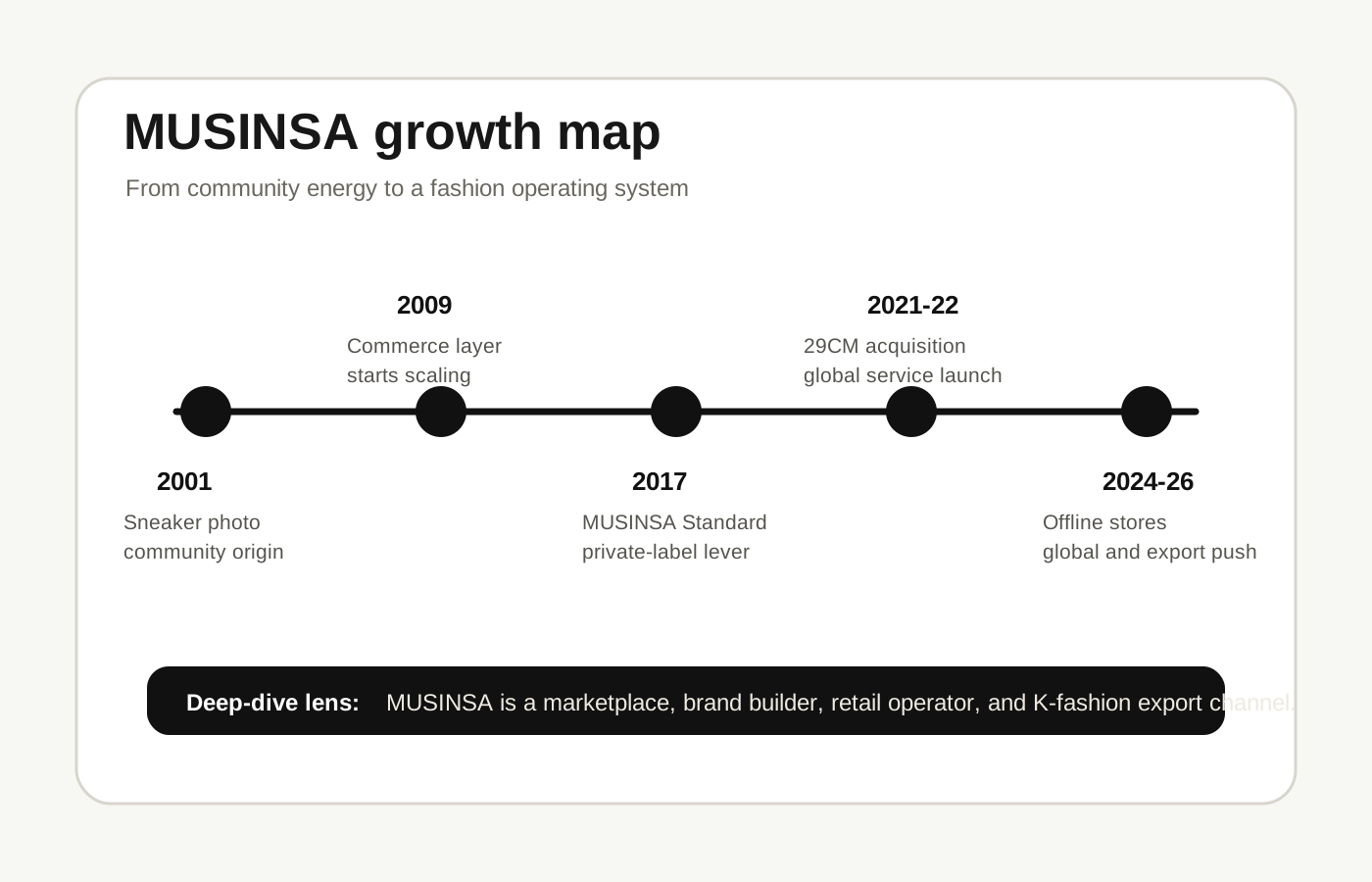
MUSINSA's history is unusually useful because it explains the company's culture. According to the official corporate history, the company began in 2001 as an online community called "a place with a huge number of shoe photos." MUSINSA.com opened in 2003, MUSINSA Magazine launched in 2005, MUSINSA Store opened in 2009, and MUSINSA Standard launched in 2017.
The timeline matters because MUSINSA did not begin as a conventional retailer. It began around fashion interest, user attention, and editorial/community behavior. Commerce came after attention. That sequence is very different from a department-store model, where real estate and brand buying often come first.
Later moves made the platform broader. MUSINSA acquired 29CM in 2021, opened global service in 2022, expanded multiple offline formats, and continued to add brand-support, private-label, and overseas-growth efforts. The result is not a simple marketplace. It is a fashion operating system with several customer and brand-facing surfaces.
What MUSINSA Does Now
MUSINSA's public ecosystem can be read in layers.
| Layer | Examples | Strategic Role | What Overseas Readers Should Watch |
|---|---|---|---|
| Marketplace | MUSINSA Store and online campaigns. | Aggregates Korean fashion demand and creates a discovery path for brands. | Category growth, brand concentration, take rates, discount dependence, and buyer quality. |
| Owned label | MUSINSA Standard. | Captures demand for basics and gives the company more control over product and margin. | Offline store economics, cannibalization risk, and whether partner brands see it as complementary. |
| Curated platforms | 29CM, Empty, beauty and lifestyle surfaces. | Lets MUSINSA segment different audiences and price points instead of treating fashion as one mass channel. | Audience clarity, brand fit, and whether curation remains distinct as the group grows. |
| Offline retail | Seongsu, Myeongdong, Hongdae, Hannam, department-store and standard-store locations. | Turns digital demand into physical discovery, tourist sales, and brand theater. | Visitor conversion, rent pressure, location quality, and how offline stores support online sales. |
| Global and export | MUSINSA Global, overseas stores, export support, tourist-facing stores. | Connects Korean brands with overseas customers and Korea-visit shopping demand. | Localization, logistics, returns, sizing, payment, language, and overseas brand awareness. |
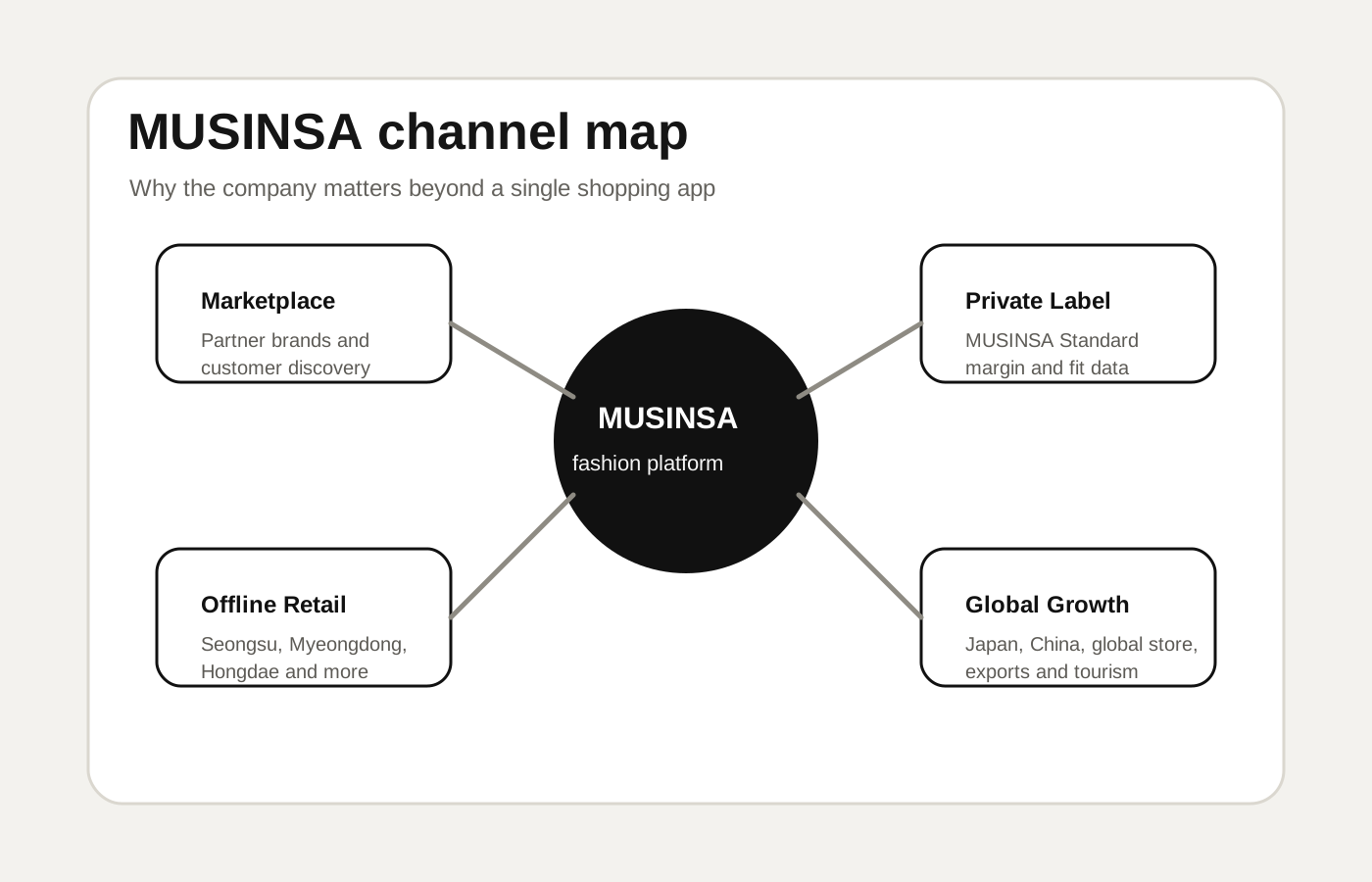
The key is that these layers reinforce each other when they work well. Online data can guide offline assortment. Offline stores can create social proof and tourist conversion. Owned labels can bring repeat basics demand. Curated platforms can protect taste-driven audiences. Global service can convert overseas interest into transactions.
The Public Numbers: A Record 2025, Then A Strong Q1
Start with the full year, because it frames everything else. In its 31 March 2026 results release, MUSINSA (무신사) reported record consolidated FY2025 revenue of KRW 1.4679 trillion (₩1조 4,679억), up 18.1% year over year, and operating profit of KRW 140.5 billion (₩1,405억), up 36.7%. On a standalone basis, revenue was ₩1조 3,529억 and operating profit ₩1,458억. Net income fell 41.2% to ₩77억 — an accounting effect of redeemable convertible preferred stock, worth knowing because it will resurface in IPO coverage.
The revenue mix is the more interesting disclosure. Commission sales — the marketplace take — were 38.76% of revenue; own-label products, essentially MUSINSA Standard (무신사 스탠다드), were 30.78%; directly purchased merchandise 27.3%. Read that as a platform where the private label is closing in on the marketplace itself. Exports reached ₩489억, roughly ten times the prior year, across 13 global regions.
Q2 2025 had already set the tone: revenue of ₩3,777억 (+30.7%) and operating profit of ₩413억 (+22.6%) in a quarter Korean fashion media described as an industry-wide slump.
The Q1 2026 Numbers
MUSINSA's official newsroom gives unusually concrete 2026 operating signals. In its May 27, 2026 release, MUSINSA said Q1 2026 consolidated revenue reached KRW 363.6 billion, up 24.1% year over year, and operating profit reached KRW 19.0 billion, up 8.2% year over year. It also reported standalone Q1 revenue of KRW 335.0 billion, up about 25%, and standalone operating profit of KRW 27.5 billion, up 45.5%.
The same release said MUSINSA Standard offline revenue rose about 86% year over year in Q1 2026, while visitors to its nationwide stores reached about 9.23 million, up about 98%. For global business, MUSINSA said Q1 2026 global-store gross merchandise value rose more than 48% year over year, and that foreign-customer revenue represented about 44% of sales across five road-shop locations in Myeongdong, Seomyeon, Seongsu, Hannam, and Hongdae. It also said exports reached about KRW 15.3 billion, about 11.9 times the year-earlier level, and represented 4.2% of quarterly sales versus 0.44% in Q1 2025.
That set of figures is important because it points to three growth engines: online platform scale, offline retail execution, and global/tourist-facing demand.
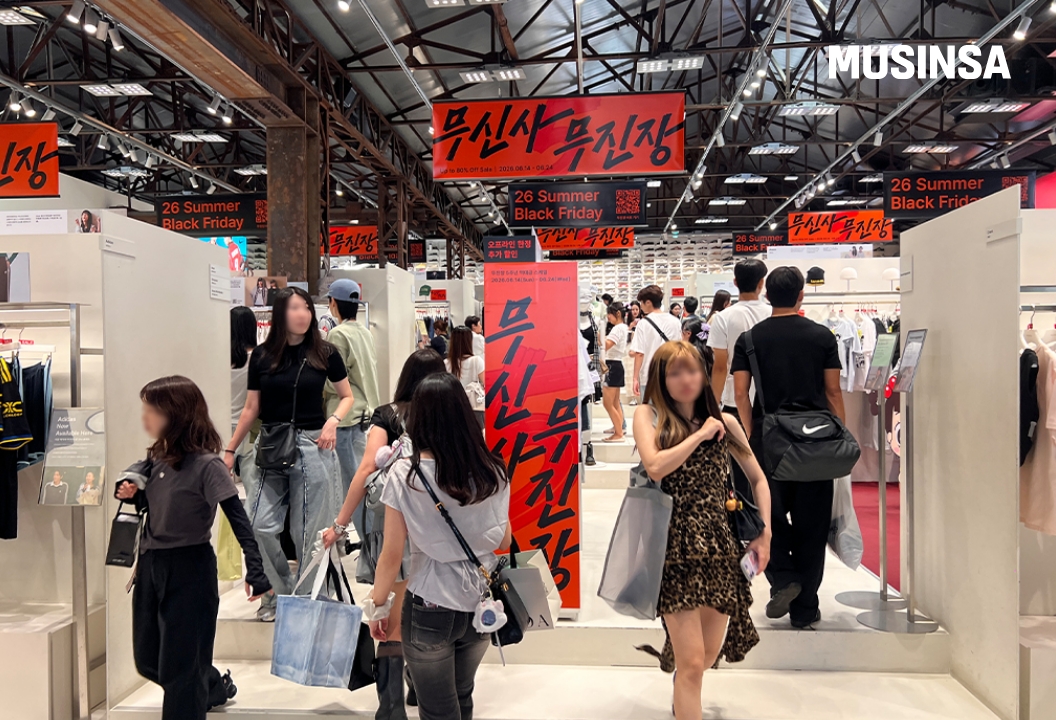
MUSINSA's June 26, 2026 newsroom release adds another signal. During its roughly 11-day 2026 summer Black Friday event, MUSINSA reported online-store cumulative sales above KRW 265.8 billion and total online/offline sales of KRW 283.0 billion. It also said cumulative online-store unit sales approached 7.75 million, offline stores and MUSINSA Standard stores attracted about 2.2 million visitors during the event, and 470 brands each exceeded KRW 100 million in sales, with domestic brands making up more than 85% of those high-selling brands.
| Public Signal | Reported Figure | Why It Matters |
|---|---|---|
| Q1 2026 consolidated revenue | KRW 363.6 billion, up 24.1% YoY. | Shows continued scale growth in a fashion market where seasonality and inventory risk matter. |
| Q1 2026 consolidated operating profit | KRW 19.0 billion, up 8.2% YoY. | Suggests profit discipline while the company expands offline and globally. |
| MUSINSA Standard offline visitors | About 9.23 million visitors in Q1 2026, up about 98% YoY. | Physical retail is becoming a measurable growth channel, not just marketing decoration. |
| Global and export momentum | Global-store GMV up more than 48%; exports about KRW 15.3 billion in Q1 2026. | Signals that Korean fashion demand is moving beyond domestic app traffic. |
| Summer Black Friday event | KRW 283.0 billion total online/offline sales over about 11 days. | Shows campaign power and the ability to move inventory at scale for partner brands. |
These figures are company-reported, so readers should treat them as strong public signals, not a full substitute for audited long-form financial analysis. They are still useful for understanding the company's direction: more offline, more global, more brand support, and more integrated online/offline events.
The IPO, Which This Story Now Points Toward
Everything above is now also a listing prospectus in the making, and any serious reader of this company should know the timeline.
As of August 2026, Korean financial media report that MUSINSA is expected to file its preliminary listing review (예비심사) with the Korea Exchange for a KOSPI listing as early as August 2026. The syndicate is set: Korea Investment & Securities as domestic lead, KB Securities as co-manager, and Citigroup Global Markets and J.P. Morgan on the international side. If the filing lands in late August and review takes the usual two months, a listing becomes possible around year-end — though Korean IPO practice often slips such timetables into the following January.
The tension to watch is valuation. MUSINSA's last funding round in 2023 valued it in the mid-₩3 trillion range. During underwriter selection, securities firms reportedly pitched values above ₩10 trillion. Meanwhile the unlisted-share market has been trading it around ₩5 trillion. That gap — between what banks pitched and what the grey market pays — is exactly why the company is pushing the three stories this article describes: own-label share of revenue, offline execution, and global growth. Each one is an argument that MUSINSA deserves a platform multiple rather than a fashion-retail multiple.
None of this is investment advice, and pre-IPO reporting changes quickly. But it reframes the company: the numbers below are no longer just operating updates. They are the evidence base for what would be the largest listing yet attempted by a Korean fashion company.
Why Offline Stores Matter
MUSINSA's offline move is not a retreat from digital. It is a sign that Korean fashion discovery has become hybrid.
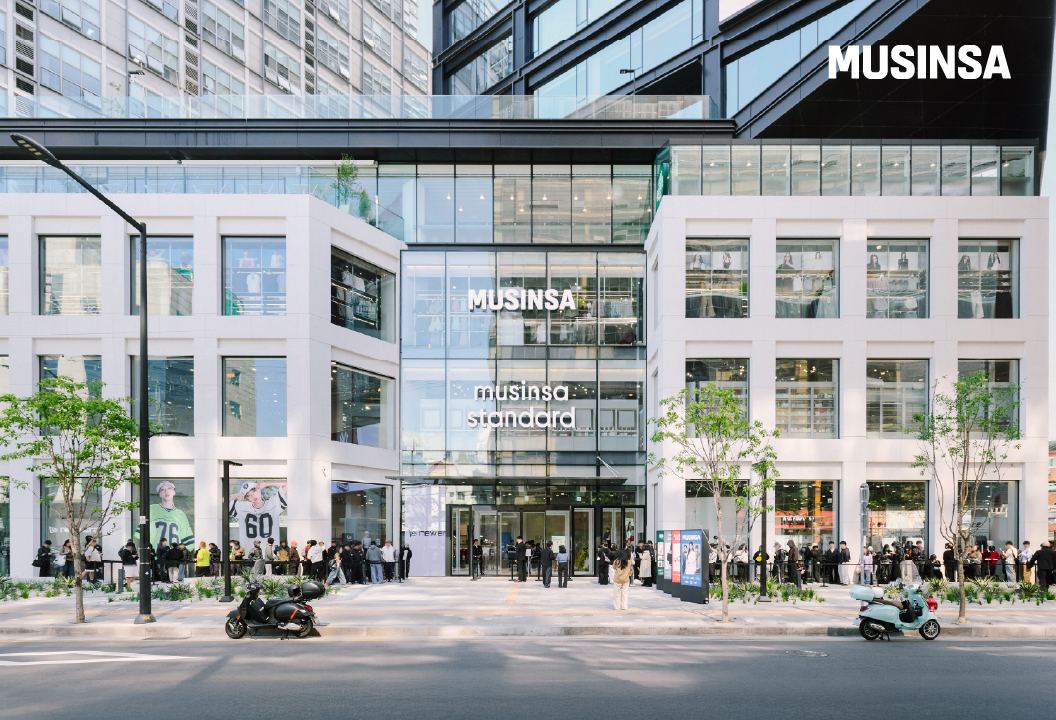
Seoul neighborhoods such as Seongsu, Myeongdong, Hongdae, Hannam, and department-store districts now act as media surfaces. A store can function as a showroom, tourist stop, social-content set, and conversion channel at the same time. (For how those same neighborhoods work from the visitor's side, EpicKor's Korea tourist shopping route walks the retail geography this strategy is betting on.) For fashion, that is powerful because texture, fit, sizing, and styling still matter.
MUSINSA Standard is especially important because it gives MUSINSA an owned-label anchor in offline retail. Basics are easier to understand physically than online: fabric hand, fit, color, and price become immediate. If a tourist or local shopper walks into a MUSINSA Standard store, the experience can reinforce the brand even if the later purchase happens online.
The risk is that offline execution is expensive. Locations, staffing, inventory, design, rent, and operations can pressure margins. The success question is not only visitor count. The deeper question is whether offline stores improve conversion, repeat purchase, brand awareness, and partner-brand value enough to justify the operating burden.
Context for the case study: As an Amazon Associate, EpicKor may earn from qualifying purchases. The best single backgrounder on how Korean consumer culture became exportable is The Birth of Korean Cool — MUSINSA is, in effect, the fashion-commerce chapter that book did not yet have.
What MUSINSA Means For Korean Brands
For Korean fashion brands, MUSINSA can be both a growth channel and a strategic dependency. That tension is normal in platform commerce.
The upside is discovery. A small or mid-sized Korean fashion brand can use MUSINSA to reach shoppers who are already looking for new labels, seasonal campaigns, and trend-led products. Large events can also provide inventory movement and marketing visibility. MUSINSA's reported Black Friday figures show that many domestic brands can achieve meaningful sales during major platform events.
The risk is channel dependence. If a brand depends too heavily on one platform, it may become vulnerable to fee changes, algorithmic visibility, campaign pressure, discount expectations, and audience overlap with competing brands. Strong brands should use MUSINSA as one part of a broader mix: own site, offline pop-ups, overseas channels, wholesale, social content, and community.
For overseas buyers, MUSINSA can be useful as a trend radar. It shows which Korean brands are visible, which categories are promoted, how pricing works, and how customers respond. But a visible MUSINSA presence is not the same as export readiness. Buyers still need to check wholesale terms, distribution rights, production capacity, sizing, labels, logistics, and after-sales expectations.
Global Growth And K-Fashion Export Logic
For the other half of Korean commerce — the logistics-first model that built next-morning delivery as a national expectation and now competes with MUSINSA for the same shoppers — see EpicKor's Coupang deep dive.
MUSINSA's global push matters because K-fashion has often been more fragmented than K-beauty or K-pop. Many Korean fashion labels have strong identity but limited overseas distribution. MUSINSA can potentially reduce that fragmentation by giving overseas consumers a recognizable discovery surface.
The company has also benefited from Korea-bound tourism. A foreign customer who discovers a brand in a Seoul store may later buy online after returning home. That makes offline stores and global commerce complementary rather than separate.
Since this article first ran, the global push has become concrete, with addresses and dates.
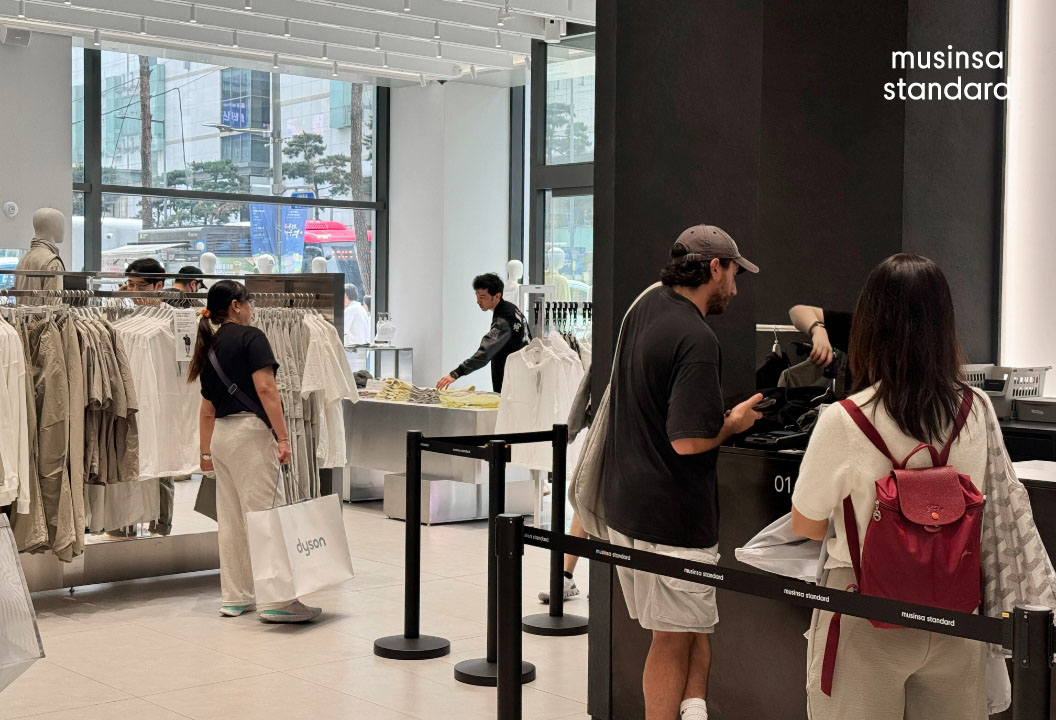
China — the first overseas stores exist now. In December 2025 MUSINSA opened two permanent stores in Shanghai: a MUSINSA Standard flagship at the Baisheng shopping centre on 화이하이루 (Huaihai Road), at 1,300㎡ the third-largest Standard store after 대구 동성로 and 한남; and 무신사 스토어 상하이 안푸루 (Anfu Road), a three-floor, roughly 700㎡ editorial shop in a century-old building on the street Korean coverage calls Shanghai's answer to 성수동 — with a K-pop-themed top floor. The stated plan: more than 100 stores in China within five years, additional openings on Nanjing East Road, Xujiahui and in Hangzhou, and ₩1 trillion in combined China online/offline sales by 2030. Treat the targets as ambition; treat the two open stores as fact.
Japan — pop-ups first, flagship later. The April 2026 Tokyo pop-up at Media Department Tokyo in Shibuya drew about 75,000 visitors in 17 days, up 27% on the previous year's event, and an encore branded 무신사역 (MUSINSA Station) runs in Harajuku in August 2026, with an Osaka pop-up planned for October. MUSINSA has meanwhile opened flagship stores in Tokyo and Osaka for 마뗑킴 (Matin Kim), one of its portfolio brands — a template where the platform carries individual Korean labels into Japanese retail rather than opening under its own name first. A Tokyo MUSINSA flagship has been reported as under preparation.
At home, the base keeps widening. MUSINSA Standard passed its 30th domestic store in October 2025 — the 30th being Lotte Department Store 평촌, its 11th opening of that year — which matters for the global story because the domestic store network is the operating manual being exported.
Still, global fashion is hard. Size standards, returns, duties, delivery speed, local language, payment methods, seasonality, and brand awareness all vary by market. A Korean product that looks obvious in Seoul may need different storytelling in Los Angeles, Tokyo, Singapore, Paris, or Sydney.
The global question for MUSINSA is whether it can make K-fashion easier to discover abroad without flattening the diversity that made it interesting in Korea.
Risks And Watchlist
MUSINSA has several attractive public signals, but the company also faces risks that overseas readers should track.
| Watch Area | Why It Matters | Signal To Track |
|---|---|---|
| Discount intensity | Large sales events can drive volume but may train shoppers and brands around discount cycles. | Full-price sell-through, event frequency, brand margin commentary, and inventory quality. |
| Offline economics | Stores can build brand value but also increase fixed costs. | Store productivity, visitor conversion, rental exposure, and whether offline boosts online behavior. |
| Partner-brand trust | MUSINSA's mission depends on helping partner brands grow, not only capturing platform value. | Brand support programs, funding, data tools, dispute handling, and whether domestic brands keep choosing the platform. |
| Global localization | International fashion buyers need more than Korean popularity. | Language quality, returns, shipping reliability, size guidance, duties, market-specific merchandising, and overseas customer service. |
| Owned-label balance | MUSINSA Standard can strengthen the group but may create perceived competition with partner labels. | Category overlap, merchandising placement, and partner-brand sentiment. |
The company's next phase will depend on balance: marketplace and private label, online and offline, domestic brands and global customers, campaign sales and long-term brand equity.
What Overseas Brands And Buyers Should Check
If you are an overseas brand researching Korea, do not treat MUSINSA as only a sales channel. Treat it as a market signal. Study category pages, pricing, editorial framing, brand mix, reviews, offline locations, and campaign rhythm. Then ask whether your brand fits Korean consumer taste, sizing expectations, delivery expectations, and platform positioning.
If you are a buyer researching Korean brands, use MUSINSA as discovery, not final due diligence — then move to sourcing channels; EpicKor's Korean apparel suppliers guide covers the wholesale side that a consumer platform does not. A brand's visibility on a consumer platform does not automatically mean it can support wholesale, exclusive distribution, export paperwork, or repeat international orders. Contact the brand or authorized distributor directly and verify terms.
If you are a Korean brand thinking globally, watch how MUSINSA connects online global traffic with tourist-facing offline stores. The best export path may not be a single marketplace upload. It may be a sequence: Seoul visibility, platform demand, content, tourist conversion, global-store availability, and localized overseas logistics.
Practical Lessons From MUSINSA
MUSINSA's first lesson is that community can become commerce when the audience is specific enough. Its roots in sneaker and fashion attention gave it credibility before it became a large sales channel.
The second lesson is that vertical platforms can stretch across media, marketplace, private label, offline retail, and global channels if the audience identity stays coherent.
The third lesson is that offline retail still matters when the product is tactile, social, and tourist-friendly. Fashion is not purely a search-box category.
The fourth lesson is that platform success brings responsibility. If partner brands see growth, data, and fair opportunity, the platform gets stronger. If they see only pressure to discount, dependency risk rises.
If the research trip is real: visiting the 성수 and 명동 stores and a trade event in one Seoul week generates a pile of receipts, cards and tax-refund slips — a flat TOPBAG RFID travel wallet keeps them in one place, and Korea: A History is the long-context read for the flight.
FAQ
Q: What is MUSINSA?
MUSINSA is a Korean fashion commerce company and platform ecosystem. It includes online fashion retail, partner-brand discovery, MUSINSA Standard, 29CM, offline stores, global service, and other fashion-related surfaces.
Q: Why is MUSINSA important for K-fashion?
MUSINSA helps organize demand for Korean fashion brands. It gives consumers a discovery surface, gives brands a major platform channel, and increasingly connects online shopping with offline stores and global customer access.
Q: Is MUSINSA only an online marketplace?
No. MUSINSA still has a major online platform, but its public history and newsroom show a broader model: private label, curated platforms such as 29CM, offline retail, Seoul neighborhood stores, global service, and partner-brand support.
Q: What public numbers matter most right now?
FY2025 was a record: consolidated revenue of ₩1.4679 trillion, up 18.1%, and operating profit of ₩140.5 billion, up 36.7%, with exports up roughly tenfold to ₩48.9 billion. Q1 2026 continued the pattern — consolidated revenue of KRW 363.6 billion and operating profit of KRW 19.0 billion — and the 2026 summer Black Friday event did KRW 283.0 billion in total online/offline sales.
Q: Is MUSINSA going public?
That is the reported direction. As of August 2026, Korean financial media expect a preliminary listing review filing with the Korea Exchange for a KOSPI listing as early as August 2026, with Korea Investment & Securities as domestic lead underwriter. Valuation is the open question — the 2023 round valued the company in the mid-₩3 trillion range, underwriters reportedly pitched above ₩10 trillion, and unlisted-market trading has hovered near ₩5 trillion. Verify against current filings before relying on any of it.
Q: Can overseas buyers use MUSINSA to source Korean fashion brands?
MUSINSA is useful for discovery and trend research, but buyers should not treat consumer visibility as wholesale approval. Verify brand ownership, distribution rights, export readiness, production capacity, pricing, logistics, and documentation directly with the brand or authorized partner.
Q: What is the biggest risk in MUSINSA's model?
The biggest strategic risk is balancing growth channels. MUSINSA has to keep partner brands healthy, control discount dependence, make offline stores economically useful, and localize global service without weakening the platform's Korean fashion identity.
Sources And Further Reading
- MUSINSA official corporate page
- MUSINSA Newsroom press list (the former newsroom.musinsa.com deep links now redirect here; the Q1 2026, summer Black Friday, FY2025 and store-opening releases cited in this article are all findable in this list by date)
- Byline Network: MUSINSA FY2025 results, 2026-03-31
- Seoul Economic Daily: IPO preliminary filing expected in August, 2026-05-19
- Asia Economy: Shanghai stores and the 100-store China plan, 2025-09-30
- News1: MUSINSA Station pop-up in Harajuku, August 2026
- MUSINSA Global official page
- EpicKor Business: Korean Cosmetics Wholesale Guide
- EpicKor Business: Korea Trade Shows for Overseas Buyers
More Business Guides
Who Owns MEDIHEAL? The Korean Sheet-Mask Company Behind It, and Why It Is Not Medicube
MEDIHEAL is made by L&P Cosmetic, an unlisted Seoul company — not by Medicube's owner APR. Its audit report shows ₩323.4bn revenue in 2025, a ₩190bn sale of Manyo Factory, and a shareholder register led by a holder Korean press identify as the founder's wife.

Who Owns Torriden? The Korean Company Behind Dive-In Serum, Read From Its Audit Report
Torriden is a Korean company from Daejeon, and its audit report shows two co-founders owning 70% of it on 31 December 2025. ₩274.3bn revenue, no factory of its own, a failed LG H&H deal and a 2026 minority stake from Goodai Global.
Coreline Soft Deep Dive: Germany Wrote Lung-Screening AI Into Law, and a Small Korean Company Signed 95 German Deals in Seven Months
Germany's new lung cancer screening rules require computer-aided detection software. Seoul's Coreline Soft, 95 staff, went from about 10 new German contracts in 2025 to 77 by July 2026, plus 18 upgrades. Its revenue is still catching up.