Why Korean Soju Keeps Getting Weaker, Pricier, and Less Drunk: The 100-Year Slide from 35% to 15.7%
Last updated: September 2026
Three things are happening to the green bottle at the same time, and each one makes the others stranger. Soju is getting weaker: the best-selling brand in Korea, Chamisul Fresh (참이슬 후레쉬), dropped to 15.7 percent alcohol in June 2026, and the drink that started at 35 percent in 1924 has lost more than half its strength. Soju is getting more expensive: the factory price of that bottle has risen five times since 2012, and a bottle that cost ₩3,000 in a Seoul restaurant a decade ago is ₩5,000 to ₩7,000 now. And Koreans are drinking less of it than at any point in a generation: national liquor shipments fell below three million kilolitres in 2025 for the first time since the 1998 financial crisis, and Koreans in their twenties now drink less per day than Koreans in their sixties.
Meanwhile the same bottle is, by volume, the best-selling spirit on earth, and has been for twenty-five years running.
This is a deep dive on one section of our guide to how a Korean drinking table works, which noted the falling strength and moved on. Here is the whole story: the hundred-year slide, the arithmetic of why water is profitable, what a bottle actually costs at each step from factory to table, who stopped drinking and why, and what to order if you want the real thing before it disappears.
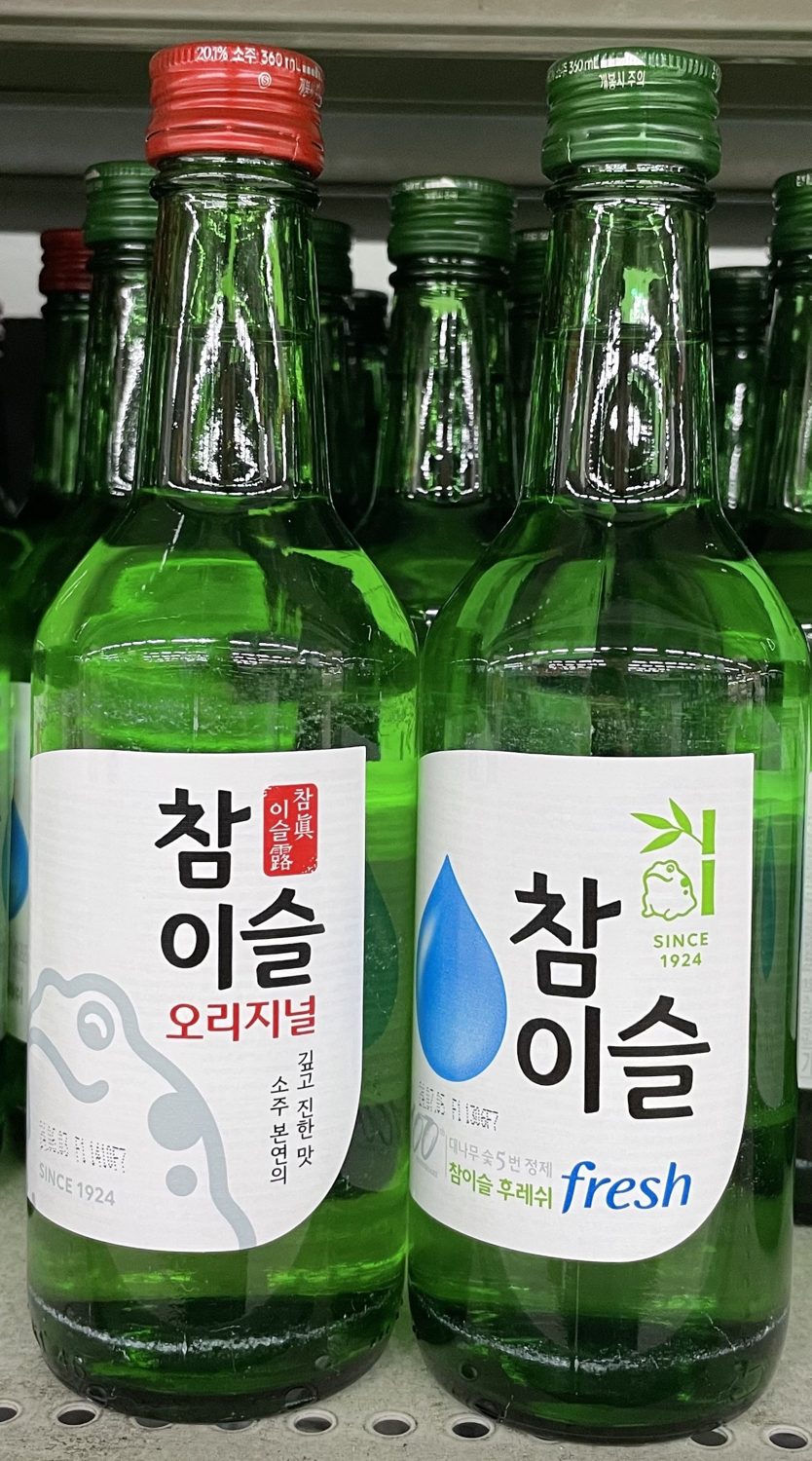
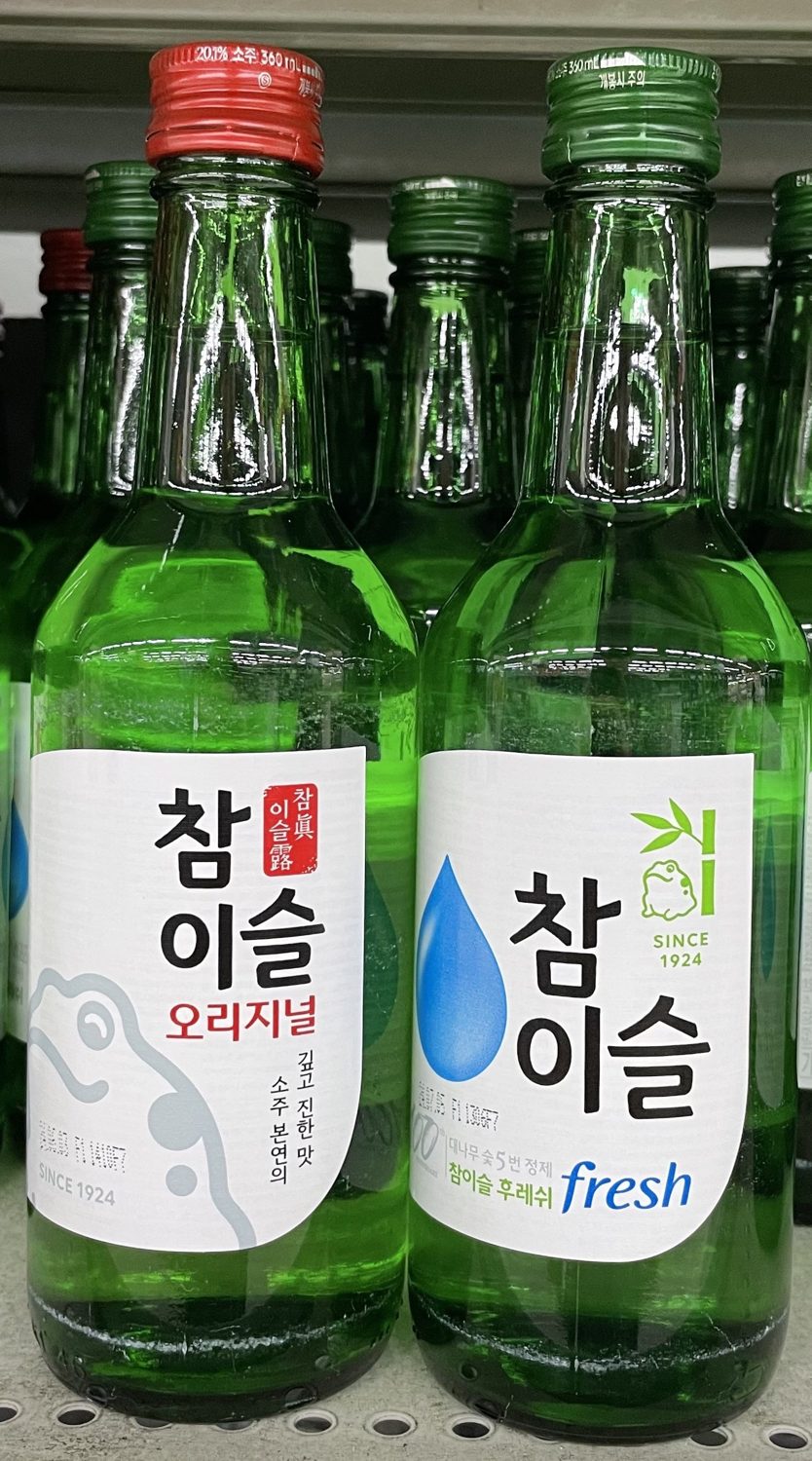
Two Chamisuls on a mart shelf in 2024: Original at 20.1 percent, Fresh at 16. Fresh has since gone to 15.7. Photo: CC BY-SA 4.0, via Wikimedia Commons.
If you drink it at home: the Jinro soju glass set with the toad bottle opener is the 50 ml glass every Korean restaurant uses, and the toad is the brand's mascot since 1955. As an Amazon Associate, EpicKor earns from qualifying purchases.
Watch the 7-minute episode: Soju Alcohol Percentage: Why It Fell From 35% to 15.7% — this article on screen: the 1924 Jinro bottle, the ethanol-and-water arithmetic behind every cut, and why the drink is cheap but the seat is expensive.
Quick Guide: a hundred years in one table
| Year | Strength | What happened |
|---|---|---|
| 1924 | 35% | Jinro (진로) founded in Pyongan Province; the label was a monkey |
| 1955 | 35% | Jinro moves south after the war; the monkey becomes a toad |
| 1965 | 30% | Grain law bans distilling from rice; soju becomes diluted ethanol plus water plus sweetener, and still is |
| 1973 | 25% | The "soju equals 25 degrees" era; lasted a quarter-century |
| 1998 | 23% | Chamisul launches; the first break below 25 |
| 2006 | 19.8% | Chamisul Fresh breaks the 20-degree floor; Chum-Churum (처음처럼) launches at 20 |
| 2014 to 2018 | 17% | The 17-degree generation |
| 2019 | 16.9% | Jinro Is Back (진로이즈백) revives the 1970s label in a sky-blue bottle; the 16s begin |
| 2023 | 14.9% | Sunyang (선양), a Daejeon brand, goes lowest in the market |
| 2024 | 15.5% | Jinro Gold, the lowest from a national brand |
| 2026 | 15.7% | Saero in January, Jinro in February, Chamisul Fresh in June: the market leader itself goes under 16 |
For reference, a standard bottle is 360 ml and the glass is 50 ml, which is where the Korean folk arithmetic of "seven and a half glasses to a bottle" comes from. At 15.7 percent, one bottle is about 57 ml of pure alcohol, roughly three and a half 355 ml cans of Cass.
You might like: Korean Drinks Guide: what to buy in a Korean convenience store, with the price, sugar and caffeine of every bottle
The slide: from 35 to 15.7 in a hundred years
Soju was not always a light drink. The Jinro that opened in 1924 in what is now North Korea made a 35 percent distilled spirit and put a monkey on the label, because in the north-west the monkey was a lucky animal that understood people and knew how to drink. When the company fled south during the war and re-established itself in Seoul, the monkey had to go: in the south it read as a cheat. In 1955 it was replaced by the toad, a symbol of fortune and healthy sons, and the toad is still on the bottle.
The first big drop was not a marketing decision. In 1965 the Park Chung-hee government, short of rice, banned distilling spirits from grain. Soju makers switched overnight to buying industrial ethanol, mostly from tapioca, cutting it with water and adding sweetener. That is what a green bottle of soju still is today: diluted spirit, or 희석식 소주, as the tax code calls it. The strength settled at 30 and then, in 1973, at 25, and for the next twenty-five years "soju" and "25 degrees" meant the same thing.
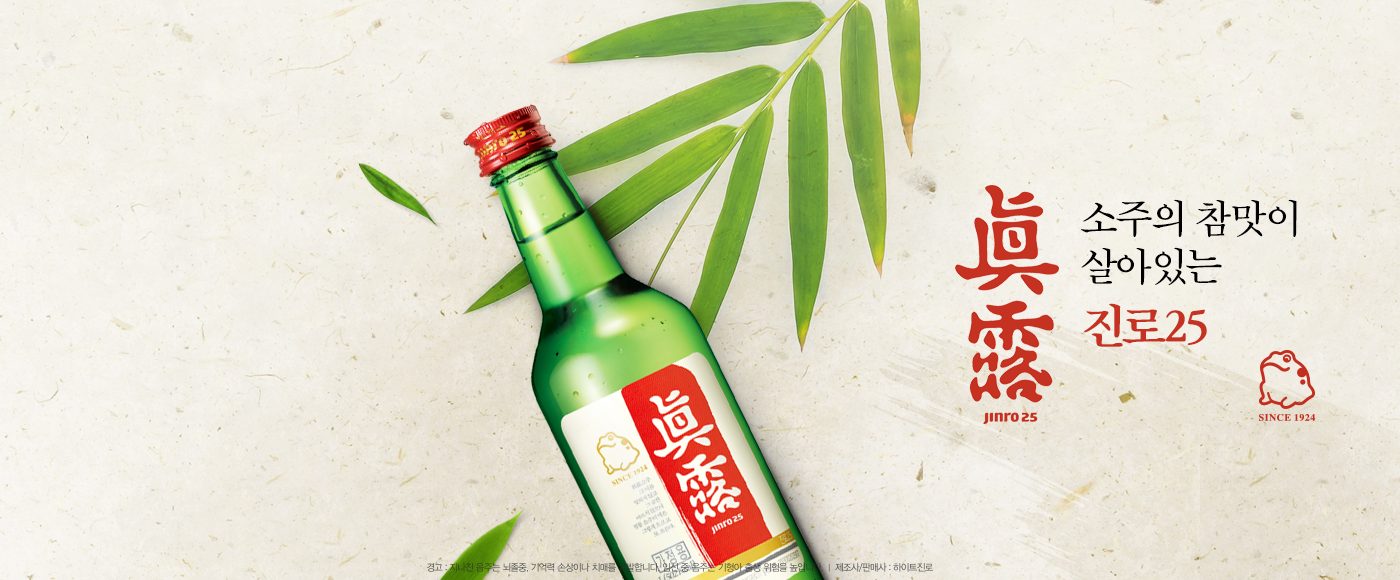
Jinro 25, still on sale for people who remember what soju used to be. It is the same 25 percent the country drank from 1973 to 1998. Product image: Hite Jinro, shown for identification.
Everything since has been competition. Chamisul launched in 1998 at 23 percent and took the market; Lotte's Chum-Churum launched in 2006 at 20; Chamisul Fresh went to 19.8 the same year and broke the psychological floor. After that the two companies cut in alternating steps, a few tenths of a degree at a time, roughly every two to four years: 17 in the mid-2010s, 16.9 with Jinro Is Back in 2019, 16.5 in 2021, 16 by 2024. In 2026 the floor moved again. Lotte's Saero went to 15.7 in January, Jinro followed in February, and on 2 June Hite Jinro announced that Chamisul Fresh, the country's best-seller, would go from 16 to 15.7 "in response to consumers' growing preference for lower-alcohol drinks." Korean papers have run the same headline about every cut for twenty years: how low can it go? The trade's own answer, quoted in the Hankook Ilbo's centenary series, is about 14, below which soju stops being distinguishable from cheongju at 13 or plum liqueur at 12.
Jinro soju glass set with the toad bottle opener — the 50 ml glass, and the mascot Three pieces: two of the small straight glasses that make "seven and a half to a bottle" true, and a cast-metal toad opener. It is the set on the table in every scene of every Korean drama, and the toad has been Jinro's mark since 1955. As an Amazon Associate, EpicKor earns from qualifying purchases.
See the glass set on AmazonWhy weaker: the reason they give, and the arithmetic they do not
The official reason is demand. Company dinners (회식) are rarer and shorter, more people drink alone or lightly, and women and younger drinkers, the industry says, prefer a softer bottle. All of that is true and none of it is the whole story.
The other half is that soju is ethanol and water, and ethanol costs money while water does not. The Daehan Economic Daily put a number on it in February 2024: every 0.1 degree cut saves about ₩0.6 per 360 ml bottle. That sounds like nothing until you multiply it by more than two billion bottles a year and by the twenty-odd tenths of a degree the market has shed since 2006. The clearest evidence came from Hite Jinro's own filings, reported by Newsway in July 2025: the company's soju revenue rose 5.4 percent from 2023 to 2024, from ₩1.469 trillion to ₩1.548 trillion, while its spending on ethanol fell 0.1 percent, from ₩276.7 billion to ₩276.3 billion. It sold more soju with less spirit. A columnist in the Safe Times put the objection bluntly: the industry has cut the strength a dozen times and has never once cut the price to match.
There is a structural reason the ethanol number matters so much. Almost every soju maker in Korea buys its spirit from a single company, Daehan Ethanol Sales (대한주정판매), a joint venture of the ten domestic distilleries that holds the exclusive right to distribute it. When that company raised prices 7.8 percent in 2022, its first increase in a decade, and another 9.8 percent in 2023, every brand's costs moved together, and every brand's factory price followed within months. Watering the product is the one lever each company controls alone.
Pricier: what a bottle costs at the factory, the fridge and the table
Soju's reputation as the cheapest drink in Korea is still true and still misleading. The bottle leaves the factory for about ₩1,250. The same bottle is ₩1,900 in a convenience store and ₩5,000 to ₩7,000 in a restaurant. Each of those numbers has its own history.
The factory price. Hite Jinro's price for a 360 ml Chamisul has moved five times since December 2012, and each move was reported in Korea like an interest-rate decision: ₩961.7 to ₩1,015.7 in November 2015 (up 5.62 percent, the first rise in three years), to ₩1,081.2 in May 2019 (up 6.45 percent), up 7.9 percent in February 2022, and up 6.95 percent in November 2023, to about ₩1,247, with the company citing a 10.6 percent rise in ethanol and a 21.6 percent rise in the cost of new bottles. That is about 30 percent in eleven years, which is slightly less than Korean consumer prices rose over the same period. The factory is not where the money is.
The convenience store. Chamisul Fresh is ₩1,900 for a 360 ml bottle at CU and GS25 as of September 2026; Jinro Gold is ₩1,800. It was ₩2,100 in 2023 before the government leaned on the industry and the shelf price came down ₩200 in January 2024, a rare event in Korean retail. So the fridge price is roughly 1.5 times the factory price, and it moves with the factory price, slowly.
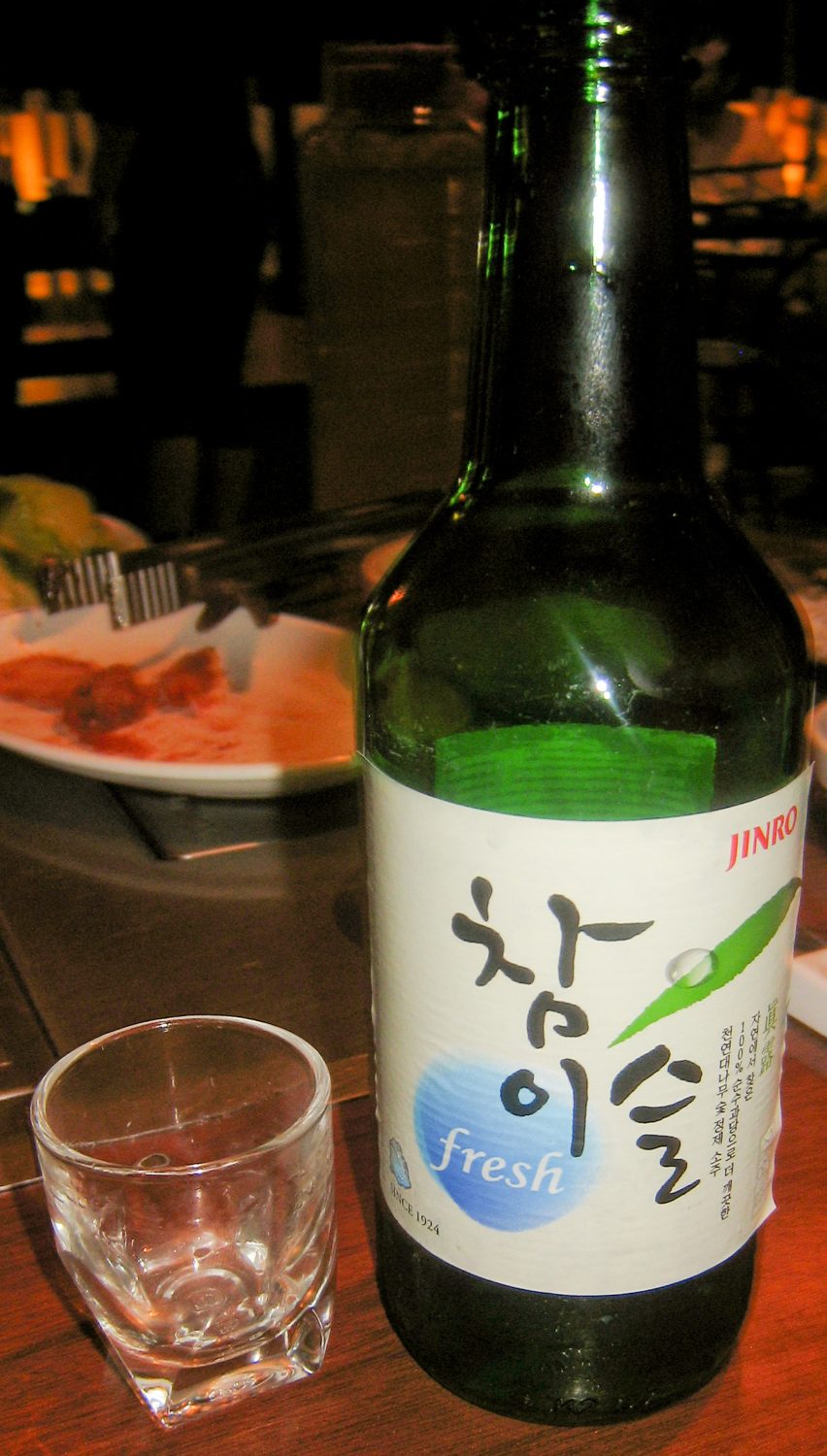
The bottle that costs ₩1,900 in the fridge and ₩6,000 on this table. Photo: CC BY-SA 2.0, via Wikimedia Commons.
The restaurant. This is where the price of soju actually rose. When the factory price went up ₩65 in 2019, the Money Today noted that restaurants selling at ₩3,000 to ₩4,000 would put their price up by ₩1,000. When it went up ₩85 in 2022, the Kyunghyang Shinmun asked whether "the ₩5,000 soju era" had arrived, and New Daily answered that in parts of Seoul it was already ₩6,000. By early 2024 the Farmers' Newspaper was interviewing restaurants "selling at ₩6,000 a bottle" about whether they would pass on the ₩200 cut; most did not. A newspaper column in February 2026 put the range at ₩4,000 to ₩7,000, with ₩8,000 at the top end, and told the story of a 1983 Suwon street stall that sold "half bottles" assembled from customers' leftovers because a whole one was already a luxury. Dining-out prices in Korea have risen more than 3 percent a year for four straight years and 7.7 percent in 2022; the soju on the table is where restaurants recover it, because a bottle at four to five times its wholesale cost is the best margin on the menu. The meal is the loss leader. The soju pays for it.
So the honest statement of soju's price in 2026 is: the drink is cheap, the place you drink it is not. That is also why the convenience-store-and-riverbank version of Korean drinking, a bottle and a bag of snacks on the Han River grass, is not a tourist economy. It is what Koreans do with the ₩4,000 gap.
Less drunk: who stopped, and how fast
Now the third thing, which is the one the industry is actually afraid of.
The National Tax Service's shipment figures for 2025, published in August 2026, show total liquor output at 2,987,726 kilolitres. The last time Korea shipped less than three million was 1998, the year of the IMF bailout, and the peak was 4,073,615 in 2015: a 26.7 percent fall in ten years. Diluted soju went from 862,000 kilolitres in 2022 to 844,000, 816,000 and 793,000 in 2025, down every year and below 800,000 for the first time. Beer fell 7.2 percent in 2025 alone.
The demographic numbers behind that, from the Korea Disease Control and Prevention Agency's national health survey, are the ones that shocked Korean commentators. Koreans in their twenties drank an average of 64.8 grams of alcohol a day in 2024, down from 95.5 grams the year before, a fall of more than 30 percent in a single year, and lower than the 66.8 grams of Koreans in their sixties. The share of nineteen-to-twenty-nine-year-olds who do not drink at all, or drink once a month or less, reached 56.0 percent in 2024, the highest since the survey began in 2005, when it was 37.9 percent. A Nonghyup Bank spending report found that people in their twenties spent 20.9 percent less in bars last year than the year before, and people in their thirties 15.5 percent less. Among Koreans who do drink, the average is now 8.8 drinking days a month and 6.6 glasses a session, both falling.
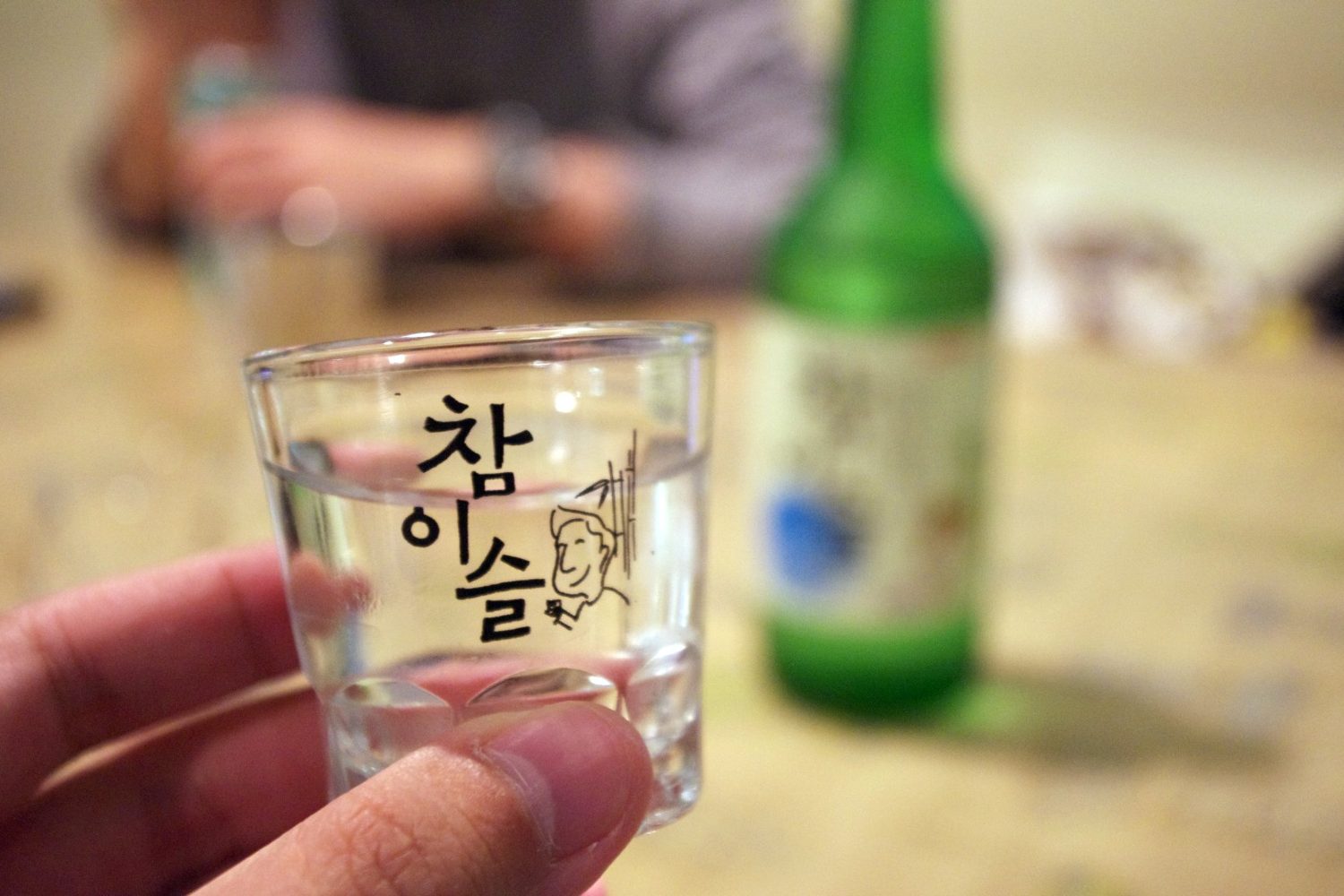
The toast, 2010. The survey that year found 37.9 percent of Koreans under thirty drank monthly or less; in 2024 it was 56 percent. Photo: CC BY-SA 2.0, via Wikimedia Commons.
The reasons Koreans give are the ones you would expect and one you might not. The company dinner has lost its grip since the pandemic, and with it the obligation to keep pace with the boss. Running clubs, reading clubs, gyms and streaming filled the evenings that soju used to. Whisky and highballs took the drinkers who wanted flavour, which is the subject of our highball post. And the drink itself changed: Lotte's Saero (새로), launched in September 2022 with no sugar and a snow-fox on the label, sold 100 million bottles in seven months and 800 million by the end of 2025, and pulled Lotte's soju share from 16.6 percent to 20.7 percent. A generation that reads nutrition labels bought the soju that had one. Hite Jinro answered by relaunching Jinro as a zero-sugar soju in January 2024; the sky-blue bottle has sold about 2.5 billion units since 2019, roughly twelve a second. The strength cuts belong to the same story: a drink trying to follow customers who are walking away from it.
And yet: the best-selling spirit on earth
Here is the paradox. In June 2026 the British trade magazine Drinks International named Jinro the world's best-selling spirit brand for the twenty-fifth consecutive year, with 94.5 million nine-litre cases in the previous year, more than every gin brand on the planet combined and more than any vodka, whisky or rum. Hite Jinro ships to 91 countries. Chamisul holds around 60 percent of the Korean market and has been number one for twenty-five years. In the Korean market it is a drink in slow decline; on the world market it is the biggest thing there is, and the gap between those two facts is where the industry's whole strategy now lives: fruit soju at 13 percent for export, K-pop sponsorships, the toad on a T-shirt in Los Angeles.
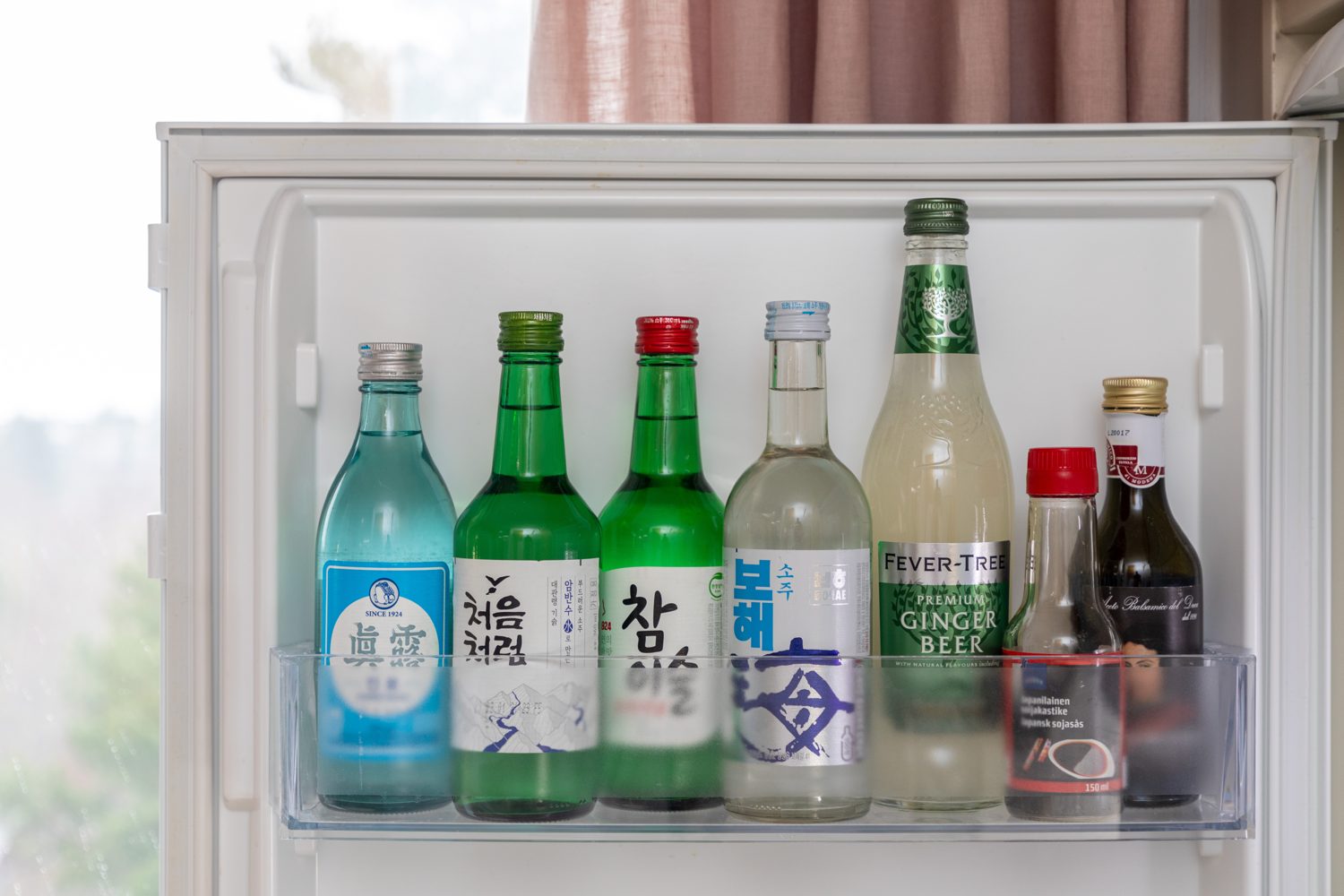
The shelf in 2024: Jinro's sky-blue bottle at the left, the one that broke the green-bottle agreement, and the three green ones that kept it. Photo: CC BY-SA 4.0, via Wikimedia Commons.
Why every bottle is green, and the one that is not
One more piece of soju economics, because it explains the photograph above. The green bottle dates from January 1994, when Doosan, having bought a Gangneung distillery, launched a brand called Green Soju in a green bottle to signal cleanliness. It sold so well that every other maker changed colour within a couple of years. In 2009 the industry went further and signed a voluntary agreement with the Ministry of Environment to use one standard 360 ml green bottle across all brands, so that empties could be collected, washed and refilled by whichever company got them back. It is why the recycling bins outside Korean apartment blocks look the way they do.
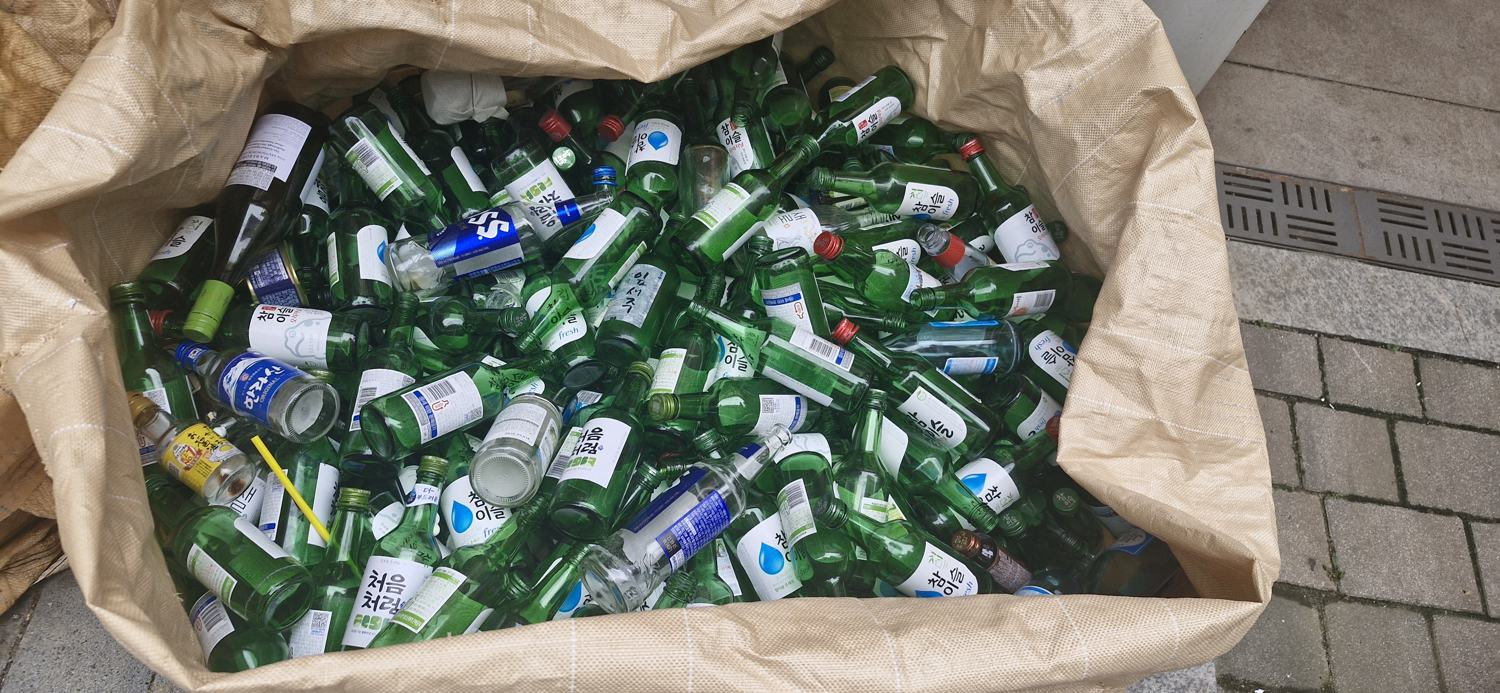
Empties outside a Korean apartment complex. Since 2009 any maker can wash and refill any of these. Photo: CC BY-SA 4.0, via Wikimedia Commons.
Then in April 2019 Hite Jinro launched Jinro Is Back, a retro brand in the sky-blue bottle of the 1970s, sold 10 million bottles in seventy days, and broke the agreement. By that autumn Lotte was holding two million empty Jinro bottles it could not refill and the two companies were in a public fight over who owed whom. The agreement survives, loosely; the sky-blue bottle survives too, and so, since 2022, does Saero's clear one. If you want to see the whole history of Korean soju in one glance, the fridge door in the photograph has it: the green ones, the blue one, and the clear one, in order of arrival.
You might like: Soju, Makgeolli, and Anju: How a Korean Drinking Table Works
What to order in 2026
| You want | Order | Strength | Notes |
|---|---|---|---|
| The default | Chamisul Fresh (참이슬 후레쉬) | 15.7% | Green cap. What arrives when you say "soju" |
| The old taste | Chamisul Original (참이슬 오리지널) | 20.1% | Red cap. The last 20-percent soju from a national brand; ask for 오리지널 |
| What soju was in 1990 | Jinro 25 (진로25) | 25% | Not on every menu; convenience stores and older restaurants |
| No sugar | Saero (새로) or Jinro Is Back (진로이즈백) | 15.7% | Saero is clear-bottled and cleaner; Jinro is the retro sky-blue one |
| The Lotte one | Chum-Churum (처음처럼) | 16% | Slightly softer than Chamisul; regional loyalties run deep |
| The lowest on the market | Sunyang (선양) | 14.9% | A Daejeon brand; the floor, for now |
| Something actually distilled | Ilpum Jinro (일품진로), Hwayo (화요) | 25% and up | Real distilled soju from rice, roughly ₩10,000 to ₩30,000 a bottle; a different drink |
Two practical notes. First, when the factory price is ₩1,250 and the restaurant charges ₩6,000, a bottle bought at a convenience store and drunk on the Han River grass at Yeouido or Ttukseom is not a budget hack, it is the national pastime, and it is legal. Second, the somaek ratio in a Korean bar is usually one part soju to three of beer in a 300 ml glass, which at today's strengths is about a 7 percent drink; nobody adjusted the recipe when the soju got weaker, so a 2026 somaek is meaningfully lighter than a 2006 one. If you feel you are drinking a lot and not much is happening, that is why.
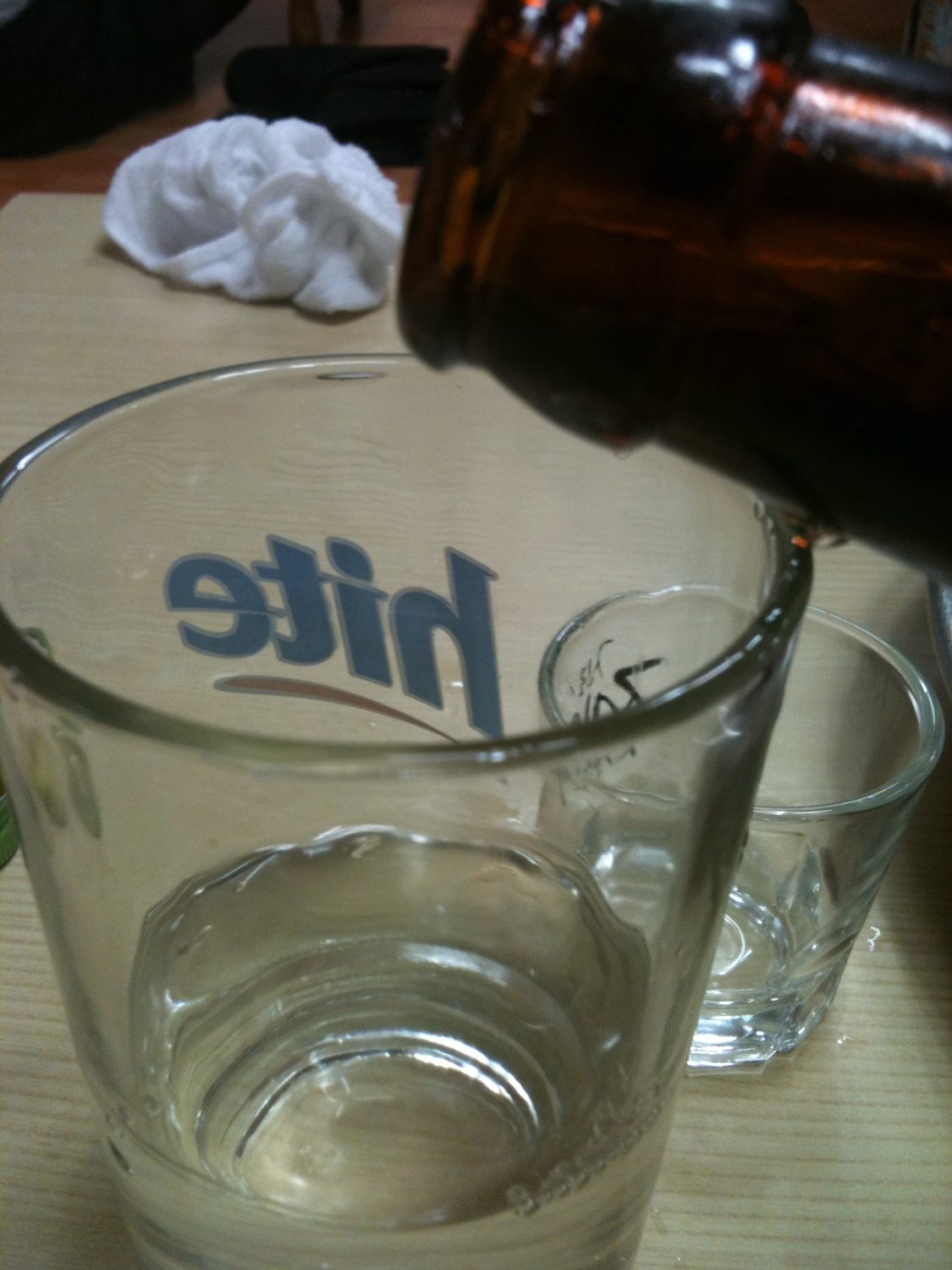
Somaek being built, 2010: the soju goes in first, the beer on top. Photo: CC BY 2.0, via Wikimedia Commons.
Jinro retro-style soju glass, set of four — the 1970s glass for the sky-blue bottle The heavier, slightly tapered 50 ml glass that came back with Jinro Is Back in 2019. If you are making somaek at home, this is the measure: one of these into a beer glass, then beer to the top. As an Amazon Associate, EpicKor earns from qualifying purchases.
See the retro glasses on AmazonIf you overdo it anyway, Korea's hangover-drink aisle is its own subject.
FAQ
Q: How strong is Korean soju now? Most green-bottle brands are 15.7 to 16 percent as of mid-2026: Chamisul Fresh, Jinro and Saero at 15.7, Chum-Churum at 16. Chamisul Original is 20.1 and Jinro 25 is 25. The lowest on the market is Sunyang at 14.9. A century ago it was 35.
Q: Why does soju keep getting weaker? The companies say drinkers want lighter alcohol, which is true. It is also cheaper to make: each 0.1 degree cut saves about ₩0.6 a bottle, and Hite Jinro sold 5.4 percent more soju in 2024 while buying 0.1 percent less ethanol. The price has never gone down with the strength.
Q: How much does a bottle of soju cost in Korea in 2026? About ₩1,250 at the factory, ₩1,900 in a convenience store, and ₩4,000 to ₩7,000 in a restaurant, with ₩5,000 to ₩6,000 typical in Seoul. The restaurant margin is where the price has risen; the shelf price actually fell ₩200 in January 2024.
Q: Are Koreans really drinking less? Yes, sharply. Liquor shipments in 2025 were the lowest since 1998 and 26.7 percent below the 2015 peak. Koreans in their twenties cut their daily intake by more than 30 percent between 2023 and 2024 and now drink less per day than Koreans in their sixties. Fifty-six percent of under-thirties drink monthly or not at all.
Q: Then how is Jinro the best-selling spirit in the world? Volume. Jinro sold 94.5 million nine-litre cases in a year, more than any whisky, vodka or gin brand, and has led the Drinks International list for twenty-five straight years. Korea drinks it in quantity, and 91 export markets are growing while the home market shrinks.
Bottom Line
The green bottle is a hundred years old and has never been weaker, dearer relative to what is in it, or less popular with the people who invented it. Every one of those trends is deliberate: the strength comes down because water is cheaper than spirit, the restaurant price goes up because the bottle is the margin, and the young are leaving because they have other things to do with an evening. If you want to taste the drink Korea made its reputation on, order Chamisul Original or a Jinro 25 while they still exist, pour it into the small glass, and do not be surprised when the person next to you is drinking something at 15.7 that they still call the same name.
You might like: Cass vs Terra vs Kelly: Korean Beer Compared — Corn Starch, ₩2,500 Cans, Which to Order, and Is Korean Beer Really Bad? and Korean Hangover Drinks: Which One to Grab, and What Korea Made Them Prove.
Sources
- Hankook Ilbo, "Korean Soju at 100" series on the ABV timeline (March 2023); Newspim and The Guru on the Chamisul Fresh 15.7 percent change (2 June 2026).
- Daehan Economic Daily on the ₩0.6 per 0.1 degree calculation (26 February 2024); Newsway on Hite Jinro's soju revenue and ethanol purchases (11 July 2025); Safe Times column on strength cuts and prices; Asia Economic Daily and Sisa Journal on Daehan Ethanol Sales' 2022 and 2023 price increases.
- MTN (27 November 2015), Money Today (24 April 2019), Kyunghyang Shinmun (18 February 2022) and KPI News (31 October 2023) on Chamisul factory price increases; Asia Economic Daily and Farmers' Newspaper on the January 2024 shelf-price cut; Convpick for September 2026 convenience-store prices; Kim Jong-gu's column on restaurant prices and "half-bottle keeping" (February 2026, via Daum News).
- Busan Ilbo on National Tax Service shipment statistics (23 August 2026) and on KDCA National Health and Nutrition Survey figures for drinkers in their twenties (16 July 2026).
- Money Today, Kyunghyang Shinmun and Seoul Shinmun on Saero's sales milestones (2024 to 2025); The Korea Times, Korea Herald and Korea JoongAng Daily on Drinks International's 2026 ranking of Jinro.
- Edaily, Kookje Shinmun and Asia Economic Daily on the 1994 Green Soju, the 2009 standard-bottle agreement and the 2019 Jinro Is Back bottle dispute; Kyunghyang Shinmun on the monkey-to-toad label history (2015).
You Might Also Like
Makgeolli Got Clean and Korean Traditional Liquor Got Beautiful: Why Koreans Still Rarely Drink It, and the One Alcohol Korea Lets You Buy Online
Makgeolli used to be cloudy, sour and cheap; now it is filtered, sweetener-free and up to ₩110,000 a bottle. Korean traditional liquor has never looked better and still sells 1.5% of the market. Why, the rice problem, and the one alcohol Korea sells online.
Why Korean Highballs Cost More Than Beer: A Tax Story
A canned highball in a Korean convenience store carries the same 72% liquor tax as single malt whisky, because Korea lost a WTO case in 1999. What that means for what you should actually buy from the chiller.
How to Buy Alcohol in Korea: The Rule Nobody Tells Tourists
Korea blocks alcohol delivery, permits app-order pickup for imported wine and whisky, excludes domestic soju and beer, and lets traditional liquor ship to your door. The rules, the prices, and what to do about them.