Why Korean Highballs Cost More Than Beer: A Tax Story
Stand in front of a Korean convenience store chiller and the arithmetic looks broken.
A 500 ml canned highball is ₩4,500, or ₩3,700 if you take three. A 500 ml bottle of Kelly beer is ₩2,500 (since June 2025). A 360 ml bottle of soju is ₩1,900.
The can is the most expensive thing in the chiller by a wide margin. English-language articles about Korea's highball boom generally explain this as a premium-positioning story, and at least one states that a 2026 tax reform made low-alcohol ready-to-drink cans cheaper than beer.
That is not what happened. A canned highball in Korea is taxed at 72%, exactly like a bottle of single malt whisky — and the reason traces back to a trade dispute Korea lost in 1999.
Libbey highball glasses, set of six, on Amazon — on AmazonAffiliate link. As an Amazon Associate, EpicKor earns from qualifying purchases at no extra cost to you.
Quick Guide: What You Are Actually Paying For
| Drink | Typical size | ABV | Convenience-store price | Liquor tax rate |
|---|---|---|---|---|
| Canned highball (EARP EARP lemon tonic / Earl Grey) | 500 ml | 9% | ₩4,500 · ₩3,700 on a 3-can deal | 72% — distilled-spirit rate |
| Strong canned highball (CU Strongball) | 500 ml | 10% | varies | 72% |
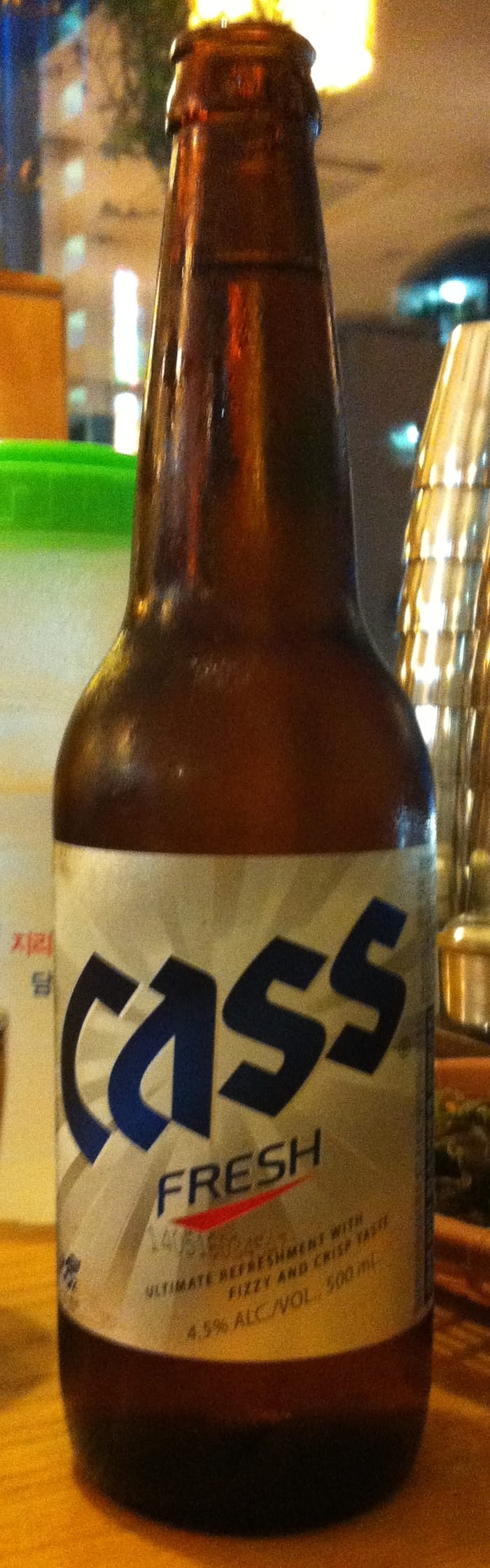
| Beer (Kelly, Cass) | 500 ml | ~4.5% | about ₩2,500, less on 2+1 | Beer rate, lower |
| Soju (참이슬, 처음처럼) | 360 ml | 16–17% | ₩1,900 | 72% — but on a far cheaper base |
Prices are 2026 Korean convenience-store figures. Promotions move them constantly; the ratios are the durable part.
The 72% Rule, and Why It Exists
Korea taxes distilled spirits at a flat 72% liquor tax, with a 30% education tax stacked on top of that. Whisky, gin, vodka, tequila, brandy and soju all sit at the same rate. So does anything classified as a diluted distilled spirit — which is what a canned whisky highball legally is.
This flat rate is not a domestic policy choice. It is the result of losing at the WTO.
Through the 1990s Korea taxed soju far more lightly than imported spirits. The European Communities and the United States challenged this in 1997 (WTO disputes DS75 and DS84), arguing that soju and imported whisky were directly competitive products being taxed differently to protect domestic producers.
Korea lost. The Panel report came in September 1998, the Appellate Body upheld it in January 1999, and Korea rewrote the Liquor Tax Law. At a Dispute Settlement Body meeting in January 2000, Korea confirmed it had implemented the ruling by imposing flat rates of 72% liquor tax and 30% education tax on all distilled alcoholic beverages on a non-discriminatory basis.
The point of that reform was to stop Korea from advantaging soju against Scotch. Twenty-seven years later, its practical effect is that a flavoured can with a cartoon bear on it pays the same tax rate as the Scotch.
Beer Is Not Even Taxed the Same Way
There is a second mechanism underneath the rate, and it matters more than the rate does.
For fifty years Korea taxed all alcohol by price — 종가세, an ad valorem system. On 1 January 2020 that changed, but only partly: beer and makgeolli moved to a volume-based tax (종량세, charged on how much liquid and alcohol you are selling), while soju, whisky and every other distilled spirit stayed on the price-based system.
So the highball and the beer beside it are not competing under the same rules at all.
- Beer pays a fixed amount per litre. Making it fancier — better hops, nicer can, a licensing deal — does not raise its tax. The volume rate is also indexed to inflation each year.
- A highball pays 72% of its price. Every cost inside it is taxed: the imported whisky, the flavouring, the printed can, the character licence, the marketing.
That is why premium beer can be cheap in Korea while a premium canned highball cannot. The beer's tax stops growing when quality goes up. The highball's does not.
The stated reason for the 2020 change was fairness between domestic and imported drinks: a Korean brewer's ex-factory price includes its own advertising, promotion and profit, while an importer's declared price does not, so the same percentage produced systematically higher tax on the domestic product. Beer got the fix. Spirits are still waiting, and Korean industry commentary has been calling the remaining ad valorem regime an unfinished job for years.
Why the Highball Still Loses to Soju on Value
Here is the part the tax rate alone does not explain.
Soju is also taxed at 72%. Soju is also cheap. Both are true because the 72% is charged on the manufacturer's price, not on the alcohol content. Diluted soju is made from inexpensive neutral spirit at industrial scale; its taxable base is tiny, so 72% of a small number stays a small number.
A canned highball's base is not small. It carries whisky or another imported spirit, flavouring, carbonation, a printed aluminium can, and frequently a licensed character or celebrity. Every one of those inputs sits inside the taxable price before the multiplier is applied.
So the honest ranking, per unit of alcohol:
- Soju is by a wide margin the cheapest way to drink in Korea.
- Beer is next, and only when a 2+1 promotion is running.
- Canned highballs are the most expensive thing on the shelf, and buying one is buying convenience, flavour and packaging — not value.
None of that makes highballs a bad purchase. It makes them a considered one. If you want something light, sessionable and not soju, the price is the price. If you are optimising for cost, the green bottle has never stopped being the answer.
The Category Is Enormous, and Very Young
The scale of this is easy to underestimate from outside Korea, and so is how recent it all is.
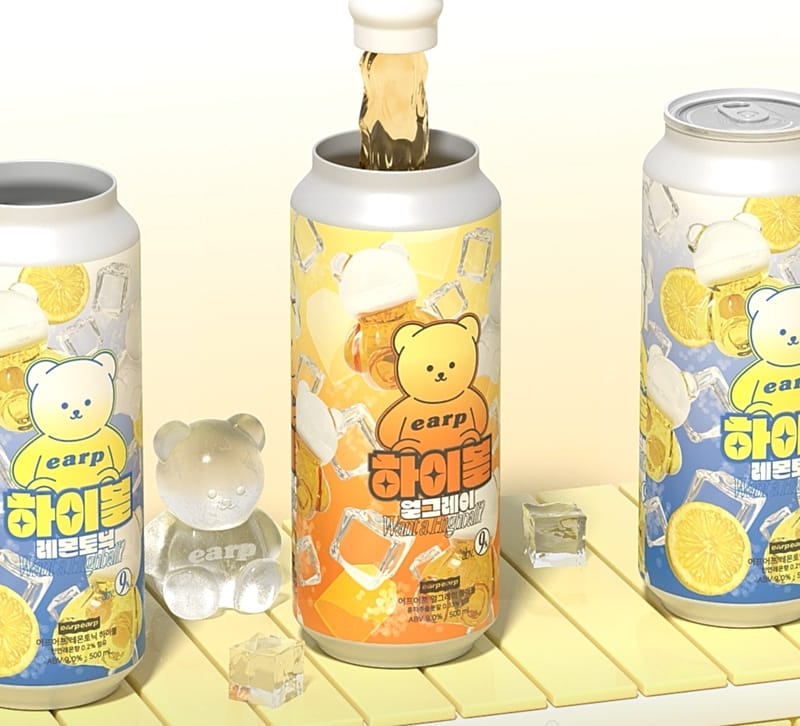
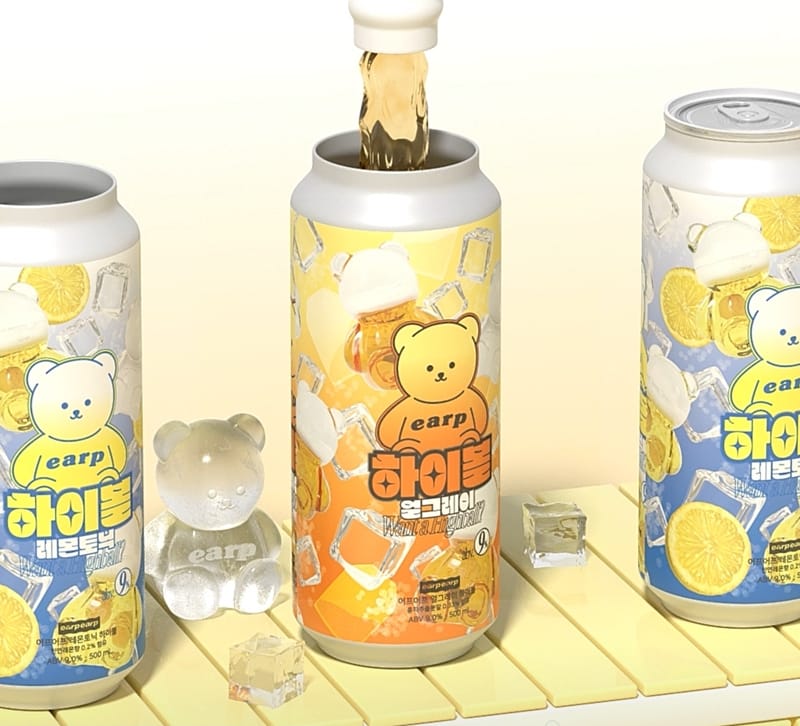
The category has a birthday. CU launched the EARP EARP lemon tonic and Earl Grey cans on 23 November 2022, billed as Korea's first convenience-store RTD highball — a collaboration with a lifestyle brand known for a bear character, brewed by a startup called Buruguru, at 9% ABV and ₩4,500 a can. Before that, a highball in Korea meant a bar.
Which makes the growth figures easier to read: they are not a category maturing, they are a category appearing.
Highballs went from 0.6% of convenience-store alcohol sales in 2022 to 11.3% in 2024, according to figures published in early 2026 — roughly a twentyfold increase in two years. At GS25, whisky outsold beer for the first time in 2025.
CU now carries around 30 different highball products. The range runs from collaborations — EARP EARP's lemon tonic and Earl Grey cans, made by the craft brewery Buruguru — through to CU's Strongball Lemon at 10% ABV, the strongest RTD highball sold in Korea. Asahi launched its own Korean RTD line in 2026.
That growth explains the shelf space. It does not change the tax arithmetic.
Why It Happened When It Did
Three things arrived together, and none of them was a tax change.
Whisky stopped being an older man's drink. Korean whisky consumption shifted sharply younger through the early 2020s, and a can that tastes of Earl Grey is a far lower barrier than a bottle of single malt and a set of glasses.
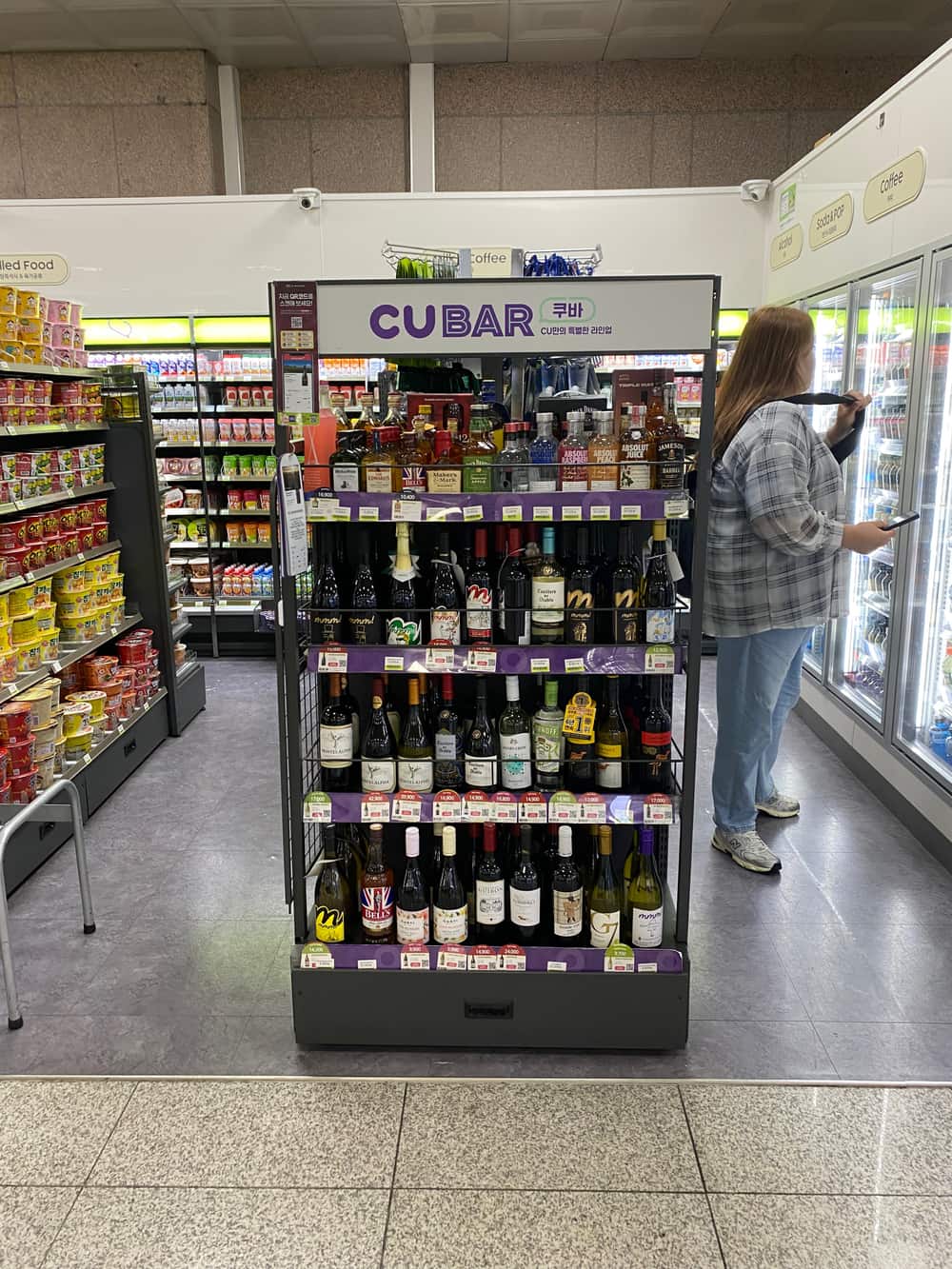
Convenience stores had just learned to sell liquor properly. The smart-order infrastructure built for wine — order in an app, collect at a store — normalised the idea that a convenience store is a place you buy alcohol on purpose rather than by accident. The highball can inherited that shelf.
And the drinking occasion changed. Korea's after-work drinking culture, 회식, has been shrinking for years. Something that is 9% and comes in a single 500 ml can suits drinking at home, alone or with one other person, in a way a 360 ml soju bottle meant for pouring in rounds does not.
That last point is the one most English coverage misses. The highball is not competing with whisky. It is competing with the second bottle of soju that nobody wanted to open.
What to Actually Buy
A practical way to use all of this:
- If you want to drink cheaply, buy soju. It is not a compromise; it is the entire reason soju is the national drink. See EpicKor's guide to how a Korean drinking table works.
- If you want beer, wait for the 2+1. Korean convenience stores rotate these monthly, and off-promotion beer is poor value.
- If you want a highball, buy it for the flavour, not the maths. The Earl Grey and lemon tonic versions are genuinely good, and there is nothing comparable in most Western convenience stores.
- If you want strength per won, the 10% Strongball is the outlier — same tax logic, considerably more alcohol per can.
- Do not buy a highball expecting it to be the cheap option. It is structurally the most expensive drink in the chiller, and the reason is a 1999 trade ruling rather than anything about the drink.
For the rules on where you can buy any of this — Korea blocks alcohol delivery but permits app-order pickup, and treats imported and domestic drinks differently — see EpicKor's guide to buying alcohol in Korea.
The cheapest highball is the one you build. Korea taxes the canned version as a spirit, which is the whole argument above — but a bottle of whisky and a tall glass at home escapes that maths entirely, and the Earl Grey and lemon-tonic ideas travel. As an Amazon Associate, EpicKor earns from qualifying purchases at no extra cost to you.
Libbey highball glasses, set of six, on Amazon
Libbey highball glasses, set of six, on AmazonYou might like: Is Korean Beer Really Bad? The North Korean Insult, Cass vs Terra vs Kelly, and the Craft Cans Worth Buying
The Part That May Change
None of this is settled.
Korean industry and policy commentary has argued for years that leaving distilled spirits on a price-based tax while beer moved to volume is an unfinished reform rather than a deliberate end state. The original fairness argument — that a domestic producer's ex-factory price carries costs an importer's declared price does not — applies to soju and whisky exactly as it applied to beer.
If spirits ever move to a volume-based system, the arithmetic in this article inverts. A 9% canned highball would be taxed on the alcohol it contains rather than on the marketing wrapped around it, and the gap against beer would narrow sharply.
There is a countervailing pressure too. Separately, the temporary tax reduction on draft beer was allowed to expire at the end of 2026 rather than being extended, which pushes in the opposite direction. So treat the numbers here as a snapshot of a system in motion, not a permanent state.
What will not change is the reason the 72% exists at all. That number is a treaty obligation, settled at the WTO, and Korea cannot lower it for soju without lowering it for Scotch.
Sources Checked
WTO dispute records DS75 and DS84 (Korea — Taxes on Alcoholic Beverages), including the Appellate Body report of 18 January 1999 and Korea's implementation statement at the Dispute Settlement Body in January 2000; Korean fact-checking coverage of how RTD highballs are classified under the Liquor Tax Law (주세법 제5조, 제8조) as diluted distilled spirits at the 72% rate; Korean convenience-store pricing and product data for 2026, including CU's Strongball and the EARP EARP line, with the EARP EARP launch date, ABV and price taken from BGF Retail's own announcement; Korean reporting on the 1 January 2020 shift of beer and makgeolli to a volume-based (종량세) tax while distilled spirits remained on the price-based (종가세) system, and on the stated domestic-versus-imported fairness rationale for that change. Tax classifications and retail prices change — confirm current figures before relying on them.
Frequently Asked Questions
Q: Why is a canned highball more expensive than beer in Korea?
Because it is taxed as a distilled spirit at 72%, while beer is taxed under a different and lower regime, and because a highball's taxable base includes imported spirit, flavouring, packaging and licensing costs. The 72% is applied to the manufacturer's price, not to the alcohol content.
Q: Is it true that Korea gave low-alcohol RTDs a tax break in 2026?
No. That claim circulates in English-language coverage but Korean reporting and the Liquor Tax Law both place whisky-based RTD highballs in the diluted-distilled-spirit category at 72%. Separately, the temporary tax reduction on draft beer was allowed to expire rather than extended.
Q: Why is soju cheap if it is taxed at the same 72%?
Because the tax is charged on price, not on alcohol. Diluted soju is produced from inexpensive neutral spirit at very large scale, so the taxable base is small and 72% of it stays small. A highball built on imported whisky starts from a much higher base.
Q: What is the strongest canned highball in Korea?
CU's Strongball Lemon, a 500 ml can at 10% ABV, is the strongest RTD highball sold in Korea. Most canned highballs sit around 5%.
Q: Is beer taxed the same way as soju in Korea?
No, and this is the bigger difference. Since 1 January 2020 beer and makgeolli have been taxed by volume — a fixed amount per litre, adjusted for inflation each year — while soju, whisky and other distilled spirits are still taxed by price at 72%. Improving a beer does not raise its tax. Improving a highball does.
Q: Does the tax explain why highballs got popular?
No. The tax works against them. The category grew because whisky drinking shifted younger, because convenience stores had already built the infrastructure to sell liquor deliberately, and because a single 500 ml can suits drinking at home in a way a soju bottle meant for pouring rounds does not.
Q: Why does Korea tax all distilled spirits at the same rate?
Because it lost a WTO case. The European Communities and the United States challenged Korea's lower taxation of soju in 1997; the Appellate Body ruled against Korea in January 1999, and Korea implemented flat 72% liquor tax and 30% education tax across all distilled beverages.
You Might Also Like
How to Buy Alcohol in Korea: The Rule Nobody Tells Tourists
Korea blocks alcohol delivery, permits app-order pickup for imported wine and whisky, excludes domestic soju and beer, and lets traditional liquor ship to your door. The rules, the prices, and what to do about them.
Maxim vs G7: Why Korea's Coffee Mix Tastes Nothing Like Vietnam's
Korea grows no coffee and drinks 405 cups a person a year. Vietnam is the world's second-biggest producer. That difference is why a Maxim stick is sweet and creamy and a G7 stick is bitter — and why one company holds 88% of Korea's coffee mix market.
Delaffe: Korea's Convenience-Store Coffee Brand That Cut Its Price to ₩900
델라페 is not a drink, it is CU's own label — 150 million units a year, sold as a pouch you pour into a separate cup of ice. In March 2026 five of them dropped to ₩900, which makes the convenience store cheaper than Korea's cheapest café chain.