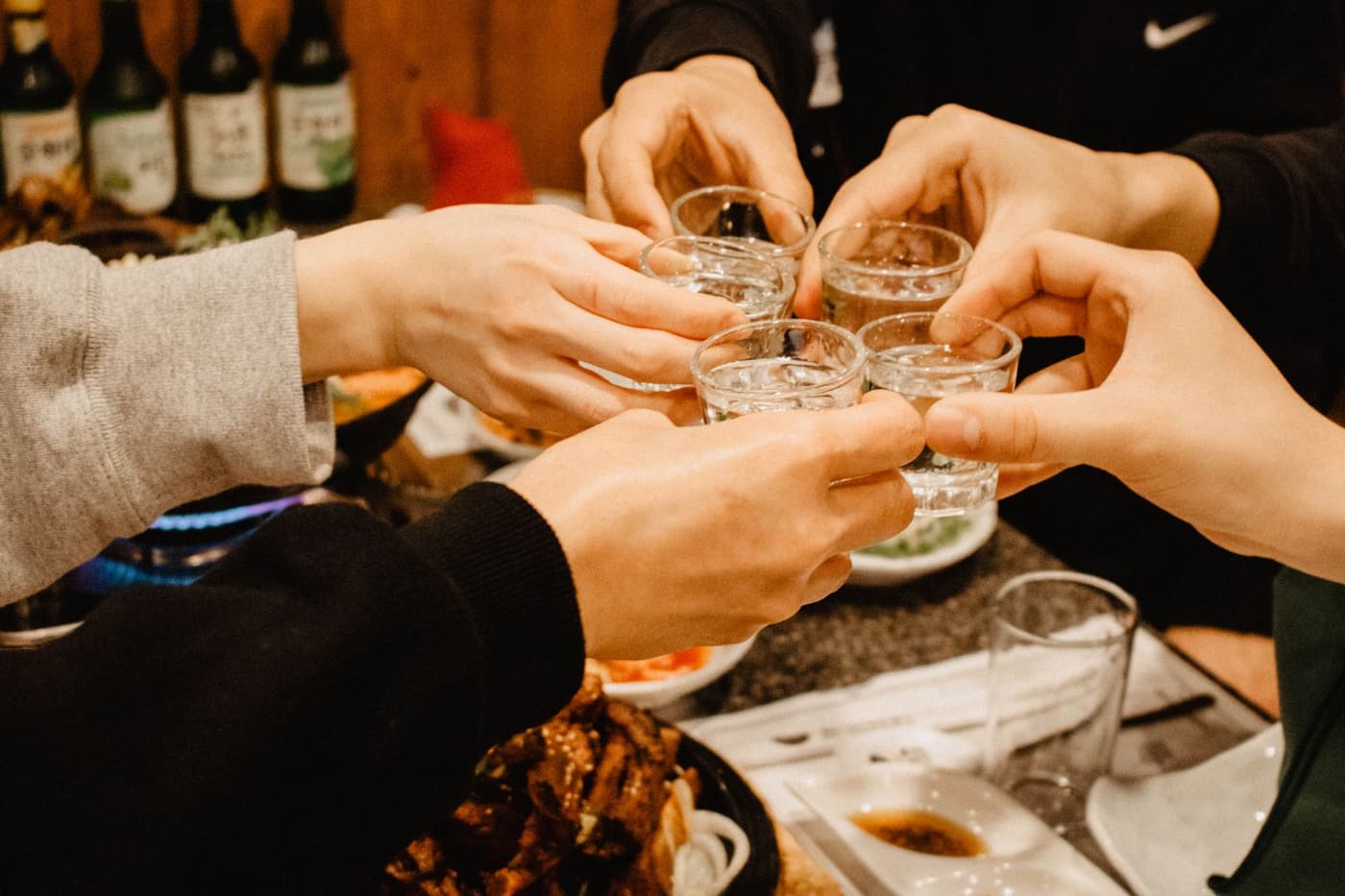
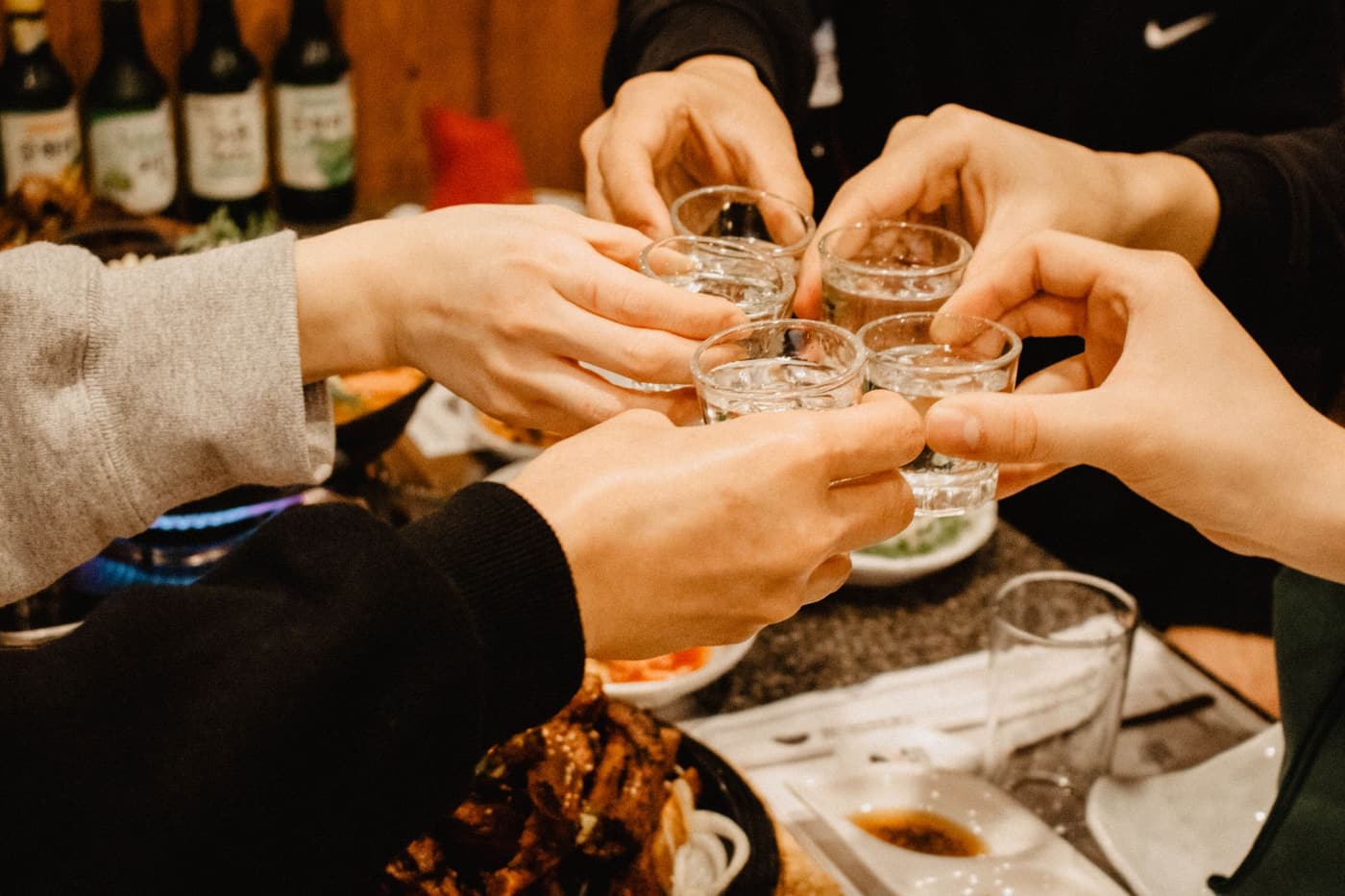
Soju, Makgeolli, and Anju: How a Korean Drinking Table Works
Korean drinking culture is not about how much you can handle. That is the lazy version.
The real version is about two things a visitor can actually learn: what is in the bottle, and what is on the plate beside it. Korea has been quietly making its national spirit weaker every few years — soju broke below 16% for the first time in 2026 — and it has a whole vocabulary for the food that keeps a drinking night from becoming a drinking session.
That food is called 안주 (anju), and it is the part most guides underrate.
ssamjang — on AmazonAffiliate link. As an Amazon Associate, EpicKor earns from qualifying purchases at no extra cost to you.
The Short Answer
| Question | Answer |
|---|---|
| How strong is soju now? | 15.7% for Chamisul Fresh and Jinro, as of 2026 — down from 20% in 2006 |
| Flavoured soju | 13–14% — 자몽에이슬 13%, 순하리 14% |
| Makgeolli | Around 6%, the gentlest option on most tables |
| What a bottle costs | ~₩1,900 convenience store, ₩5,000–7,000 restaurant |
| The word to learn | 안주 (anju) — the food that anchors the night |
| Easiest first experience | 치맥 (chimaek) — fried chicken and beer |
| Etiquette and refusing politely | Covered in depth in our hoesik and etiquette guide |
Watch the 7-minute episode: Soju Was 35%. Now It’s 15.7%. Here’s Where It Went. — the full story behind the next section: from 35 percent in 1924 to 15.7 today, and which Koreans are drinking less.
You might like: Korean Drinks Guide: what to buy in a Korean convenience store, with the price, sugar and caffeine of every bottle
Korea keeps making soju weaker, deliberately
This is the fact that has not made it into English guides, and it changes what you should expect from a green bottle.
소주 (soju) has been losing strength for twenty years, in visible steps. Taking 처음처럼 (Chum-Churum) as the clearest example: 20% in 2006 → 18% in 2014 → 17% in 2018 → 16.5% in 2021 → 16% in 2025.
Then in 2026 the psychological floor went. 참이슬 후레쉬 (Chamisul Fresh), the country's best-selling soju, dropped from 16% to 15.7% — about two years and four months after its previous cut. 진로 (Jinro) made the same move in February 2026, and 새로 (Saero) went to 15.7% in January.
Two reasons are given in Korean coverage, and they pull in different directions.
The cultural one: the 회식 (company-dinner) model of drinking has weakened, and more people drink lightly by choice. Weaker soju fits that.
The commercial one, stated plainly by the industry: less alcohol means less spirit to buy per bottle, and drinkers feel the effect later, so they drink more of it. A weaker soju is not automatically a gentler night.
For a visitor the practical reading is simple. Soju is weaker than its reputation and stronger than its glass size suggests, and the small cup exists precisely so someone else can keep refilling it.
What everything actually costs
| Drink | Strength | Convenience store | Restaurant |
|---|---|---|---|
| 소주 Chamisul / Jinro | 15.7% | about ₩1,900 | ₩5,000–7,000 |
| 과일소주 flavoured soju | 13–14% | similar | similar |
| 막걸리 makgeolli | around 6% | low single thousands | varies widely |
| 맥주 beer | 4–5% | varies | varies |
The gap in that table is the single most useful thing on this page. The same bottle is roughly three times the price once it is on a restaurant table — around ₩1,900 from a convenience store fridge against ₩5,000–7,000 with a meal, and ₩6,000–7,000 is normal in Gangnam, Gwanghwamun and the City Hall office districts.
That gap is also sticky. When soju wholesale prices were cut by around 10% and convenience stores passed the cut on, restaurants largely did not follow — margins on alcohol are what make the meal work. Do not expect a cheap bottle price to reappear on a menu because you read about a price cut.
None of which means drink in convenience stores instead. It means the convenience-store-and-riverside version of Korean drinking is not a budget compromise invented by tourists — it is a genuine and very common Korean choice, and the arithmetic is why.
You might like: Why Korean Soju Keeps Getting Weaker, Pricier, and Less Drunk: The 100-Year Slide from 35% to 15.7%
The anju table without the alcohol: As an Amazon Associate, EpicKor earns from qualifying purchases at no extra cost to you. The food half of this travels home far better than the drinking half — and the sauce that does the most work across pajeon, pork belly and lettuce wraps is ssamjang. Compare a jar before buying a full sauce set; one tub covers most of an anju table.
See ssamjang on AmazonSoju, makgeolli, beer, and what each one signals
소주 is everywhere: restaurants, convenience stores, dramas, barbecue scenes, plastic tables outside small pubs. Clear, fairly neutral, and built to sit next to strong food. At a barbecue it feels sharp and practical, cutting through grilled meat, garlic and ssamjang. At a 포차 (pocha) it becomes a rhythm — sip, eat, talk, refill. Our pojangmacha guide covers ordering and first-visit etiquette at the tent-bar version.
과일소주 (flavoured soju) deserves its own line because it is what most first-timers actually enjoy, and it is genuinely weaker: 자몽에이슬 (grapefruit) at 13%, 순하리 at 14%. Sweet, low, and sold in the same green bottles with fruit on the label. There is no shame in ordering it — it is a mainstream Korean product, not a tourist drink.
막걸리 (makgeolli) is the outlier: a milky, lightly sweet, slightly tangy rice brew at around 6%, served in bowls rather than shot glasses. It carries a rustic image but has become fashionable again, and it belongs to rainy days, hiking, traditional pubs and slow meals.
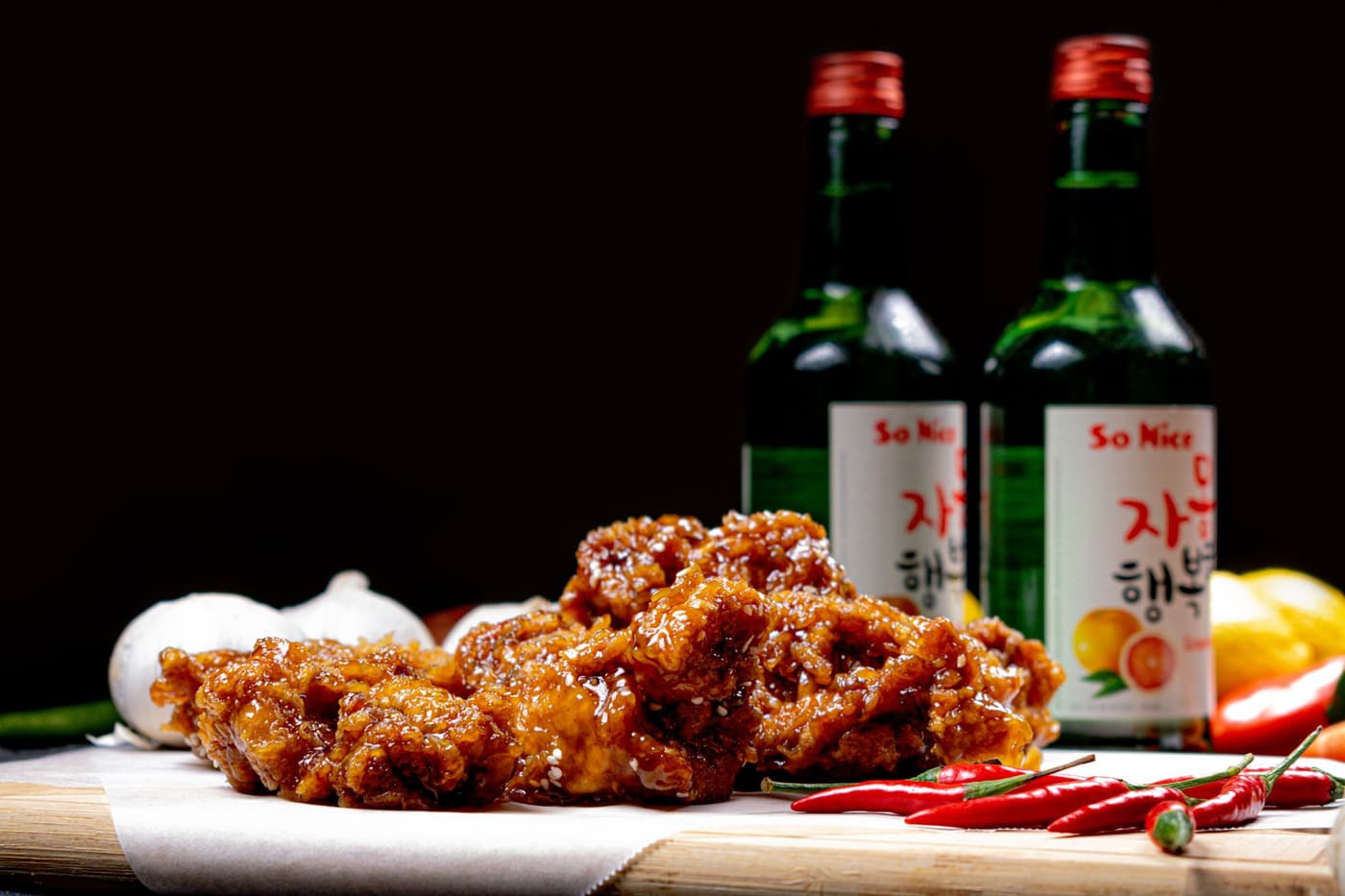
맥주 (beer) is the easiest bridge. The famous pairing is 치맥 (chimaek) — 치킨 plus 맥주 — and it is the single most reliable first Korean drinking experience for a visitor, because the food is the point and nobody is counting your glasses.
소맥 (somaek) mixes soju into beer. It is stronger than it tastes and it moves fast in groups. Joining is optional; "I'm pacing myself" is a complete sentence.
| Drink | Common setting | Typical anju | Traveller note |
|---|---|---|---|
| 소주 | Barbecue, pocha, late-night food | Grilled meat, spicy stew, fried dishes | Small glasses, refilled by others — they add up |
| 과일소주 | Casual, younger tables | Chicken, light fried food | 13–14%, sweet, completely normal to order |
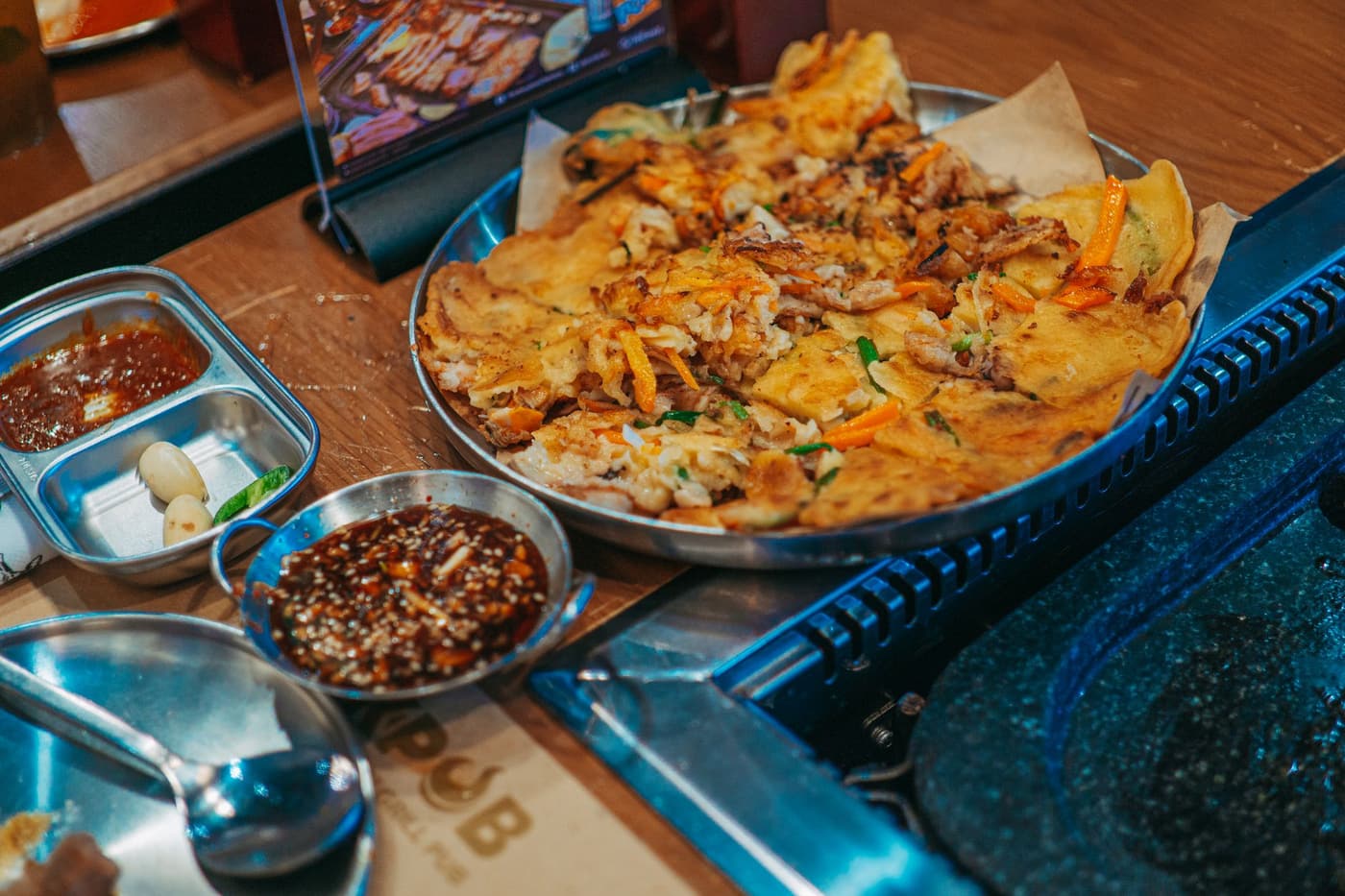
| 막걸리 | Rainy days, hiking, traditional pubs | 파전, 두부김치, 빈대떡 | Around 6%. Sediment is normal |
| 맥주 | Chicken nights, sports, group meals | Fried chicken, fries, dried snacks | Chimaek is the easiest starting point |
| 소맥 | Group energy, office dinners | Barbecue, shared pub food | Stronger than it looks |
Anju is the actual system
If you keep one Korean word from this page, keep 안주 (anju) — food eaten with alcohol. Translating it as "bar snacks" makes it sound far too small.
Anju is why Korean drinking nights feel more like meals than bar stops. You are not ordering drinks with something on the side; you are building a table that can last three hours. Some anju is salty and crunchy — dried squid, nuts, chips. Some is hot and filling — stews, ramyeon, tteokbokki, spicy stir-fries. Some is generous enough to anchor the entire evening: fried chicken, pork belly, 보쌈 (bossam), 족발 (jokbal), seafood pancakes.
The effect is structural. Food arriving in waves paces the alcohol, gives everyone something to do with their hands, and makes it normal to stop drinking without leaving. If you understand Korean BBQ as a system rather than a cooking method — our Korean BBQ guide makes that case — anju follows the same logic.
For a visitor this is genuinely good news: care about the food, order water, ask what the anju is, and eat slowly. You will understand more of the night than someone matching every toast.
Etiquette, in one paragraph
You do not need to perform Korean etiquette perfectly. You need to show attention.
If someone older or more senior pours for you, take the glass with two hands, or steady your wrist with the other hand. Pour for others the same way, and let them pour for you rather than filling your own glass at a formal table. Turn slightly away for the first drink with elders. With younger or casual groups, most of this loosens considerably — read the room. And if you do not want more, say so early and warmly: "I'm pacing myself" and "I have an early morning" both work everywhere.
That is the short version. The long version — 회식 dynamics, refusing without offending, alcohol-free options and getting home safely — is a separate guide: Korean hoesik, choice and safety. If you are going to be at a table with Korean colleagues rather than friends, read that one instead of this one.
Where visitors actually meet this
Most travellers never see a formal company dinner. You will meet Korean drinking culture in one of five places, in roughly this order of difficulty:
- Barbecue restaurant — easiest, because the food is the event. Works even if you do not drink.
- Chicken restaurant (치맥) — beginner-friendly, familiar pairing, no etiquette pressure.
- 포차 and casual pubs — louder and more energetic as the night goes on.
- 막걸리 bars — slower, more food-centred, often with 파전 or 두부김치.
- Convenience-store beer outdoors — the casual end. Follow local signs and venue rules.
Solo travellers should know that the last item on that list is Level 1 on Korea's own solo-dining difficulty scale, and a bar is Level 9 — our honbap and honsul guide explains that ladder and which rungs are comfortable alone.
The practical rules before you go out
The legal age. Alcohol sales in Korea use a year-based age, not your exact birthday: you may buy from 1 January of the year you turn 19. In 2026 that means anyone born in 2007 or earlier. Carry photo ID — convenience stores and bars do check, and a foreign passport is the reliable document. Clubs and some venues apply stricter rules of their own.
Never drive. Use taxis, the subway, or a 대리운전 (daeri unjeon) designated-driver service, which exists precisely because this rule is taken seriously.
Public drinking is not universally fine. Convenience stores selling alcohol does not mean every park, station or street permits drinking it. Follow posted signs and venue rules.
Do not film strangers at drinking tables. A good night out does not need to become content.
Eat before and during. The single most effective thing you can do is treat anju as the main order and alcohol as the accompaniment. If you want the shelf Koreans hit on the way into the night, our hangover drinks guide explains why they take it before drinking rather than after.
If the food side is what you want at home: the two objects that recreate an anju table are the table scissors Koreans cut everything with and the small pot that doubles as a serving bowl. Compare a Korean BBQ scissors and tongs set and a Korean ramyeon pot — between them they cover most of what a shared Korean table physically requires.
See Korean BBQ scissors and tongs set on AmazonHow to join without losing yourself
Do not try to outdrink Koreans. Do not treat every green bottle as a challenge. Do not accept every round because refusing feels rude — it is not, and younger Koreans refuse constantly.
Instead, notice things. Notice who pours for whom, and that nobody pours for themselves. Notice how food arrives before the table empties. Notice how a loud 포차 feels different from a quiet 막걸리 bar, and how fried chicken, grilled pork, pancakes and stew each produce a different kind of evening.
If you drink, drink slowly. If you do not, say so with confidence. If you are invited to pour, use two hands. If someone offers more than you want, be warm and clear.
Korean drinking culture is not a test. It is a table language — and the grammar is the food.
FAQ About Korean Drinking
Q: How strong is Korean soju?
As of 2026, Chamisul Fresh and Jinro are 15.7%, having dropped below the 16% mark that had held for years. Chum-Churum sat at 16% in 2025, down from 20% in 2006. Flavoured soju is weaker at 13–14%, and makgeolli is around 6%.
Q: Why does Korean soju keep getting weaker?
Two reasons appear in Korean coverage. Drinking culture has shifted away from heavy company dinners toward lighter social drinking. And producers benefit twice: less spirit per bottle, and drinkers who feel the effect later and therefore consume more.
Q: How much does soju cost in Korea?
Roughly ₩1,900 for a 360ml bottle in a convenience store, and ₩5,000–7,000 in a restaurant, reaching the top of that range in Gangnam, Gwanghwamun and central office districts. Restaurants did not pass on the wholesale price cuts, because alcohol margin is what makes the meal viable.
Q: What is anju in Korea?
안주 is food eaten with alcohol. It ranges from dried squid and nuts to fried chicken, pajeon, stew, pork belly, bossam and tofu kimchi. Anju is what turns Korean drinking into a shared meal rather than a bar activity.
Q: Do I have to drink to join a Korean drinking night?
No. Say your boundary early, keep water or a soft drink, and engage through food and conversation. Refusing is far more normal than older guidebooks suggest.
Q: What should a first-timer try?
치맥 — Korean fried chicken with beer — is the easiest. For something more traditional and slower, 막걸리 with 파전. If plain soju is too sharp, flavoured soju at 13–14% is a legitimate mainstream choice, not a compromise.
Q: What is the legal drinking age in Korea?
Nineteen, calculated by calendar year rather than birthday: you can buy from 1 January of the year you turn 19, which in 2026 means anyone born in 2007 or earlier. Carry photo ID.
Sources
- Soju ABV changes: Korean industry and press coverage of the 2026 reductions — Chamisul Fresh and Jinro to 15.7%, Saero to 15.7% in January 2026 — and the Chum-Churum trajectory from 20% (2006) through 16% (2025).
- Flavoured soju strengths: manufacturer product information for 자몽에이슬 (13%) and 순하리 (14%).
- Prices: convenience-store soju pricing following the wholesale reduction, and Korean reporting on restaurant soju pricing of ₩5,000–7,000 by district. Confirm current prices locally; restaurant pricing varies by neighbourhood and does not track wholesale changes.
- Korea Tourism Organization: food and drink guidance
You Might Also Like
How to Eat Korean BBQ Like a Local: Unwritten Rules
A practical Korean BBQ guide to ordering, grilling, wraps, banchan, sauces, and table etiquette so you can eat like a local.
Korean Drinks Guide: What to Buy in a Korean Convenience Store, With the Price, Sugar and Caffeine of Every Bottle
Korean drinks sorted by what you need, priced from CU's own catalogue on 2 October 2026: Bacchus ₩1,000, banana milk ₩1,800, Milkis ₩1,600 with 31 g of sugar. Which have caffeine, which only look like alcohol, and which to skip.
Why Korean Soju Keeps Getting Weaker, Pricier, and Less Drunk: The 100-Year Slide from 35% to 15.7%
Soju was 35% in 1924 and is 15.7% in 2026, and the price rose every time the strength fell. Why Korea's national drink is being watered, what a bottle costs from factory to table, and why Koreans in their twenties now drink less than their grandparents.