Kancho: The Korean Biscuit With 504 Names Printed On It, One Per Piece
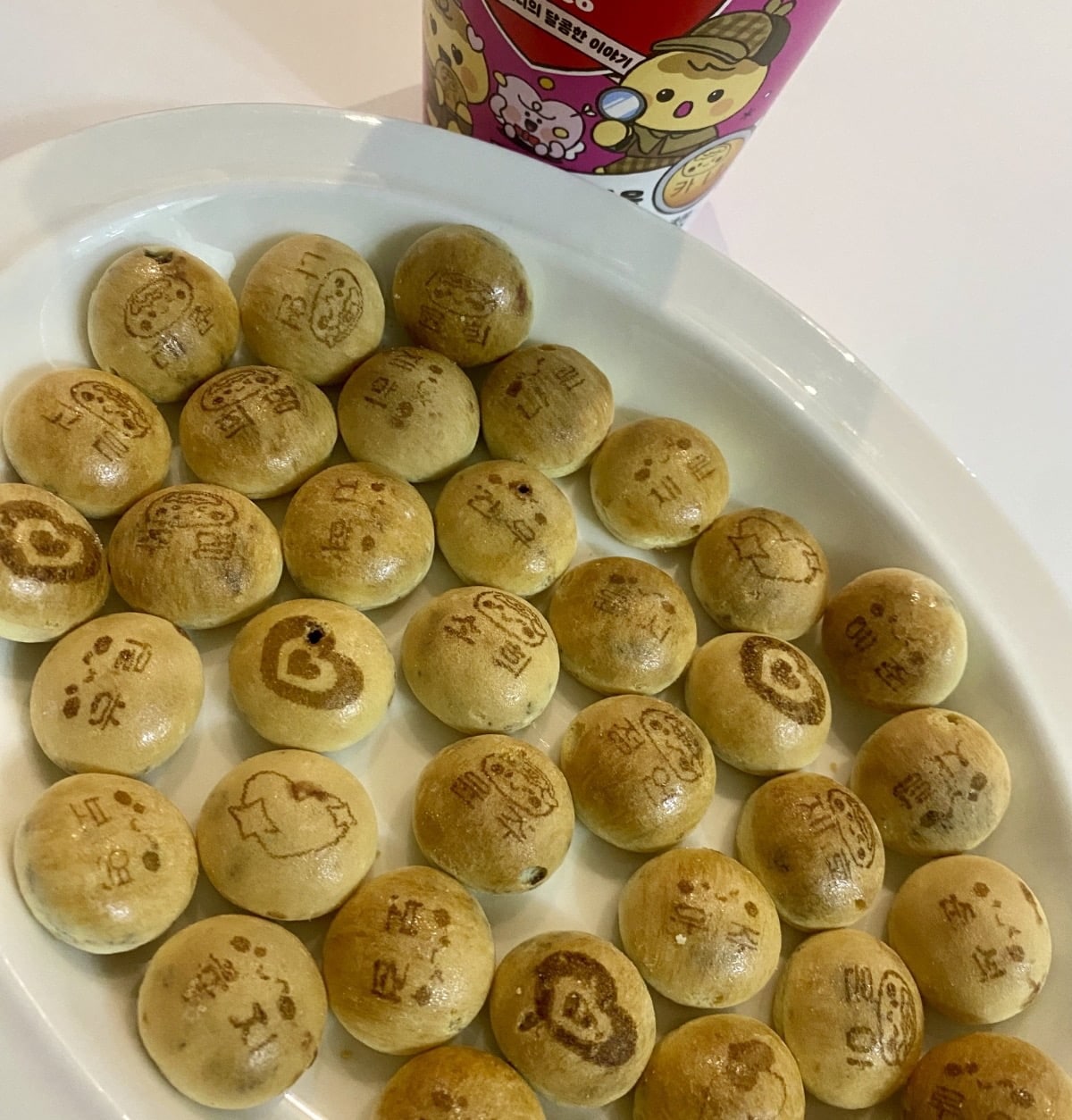
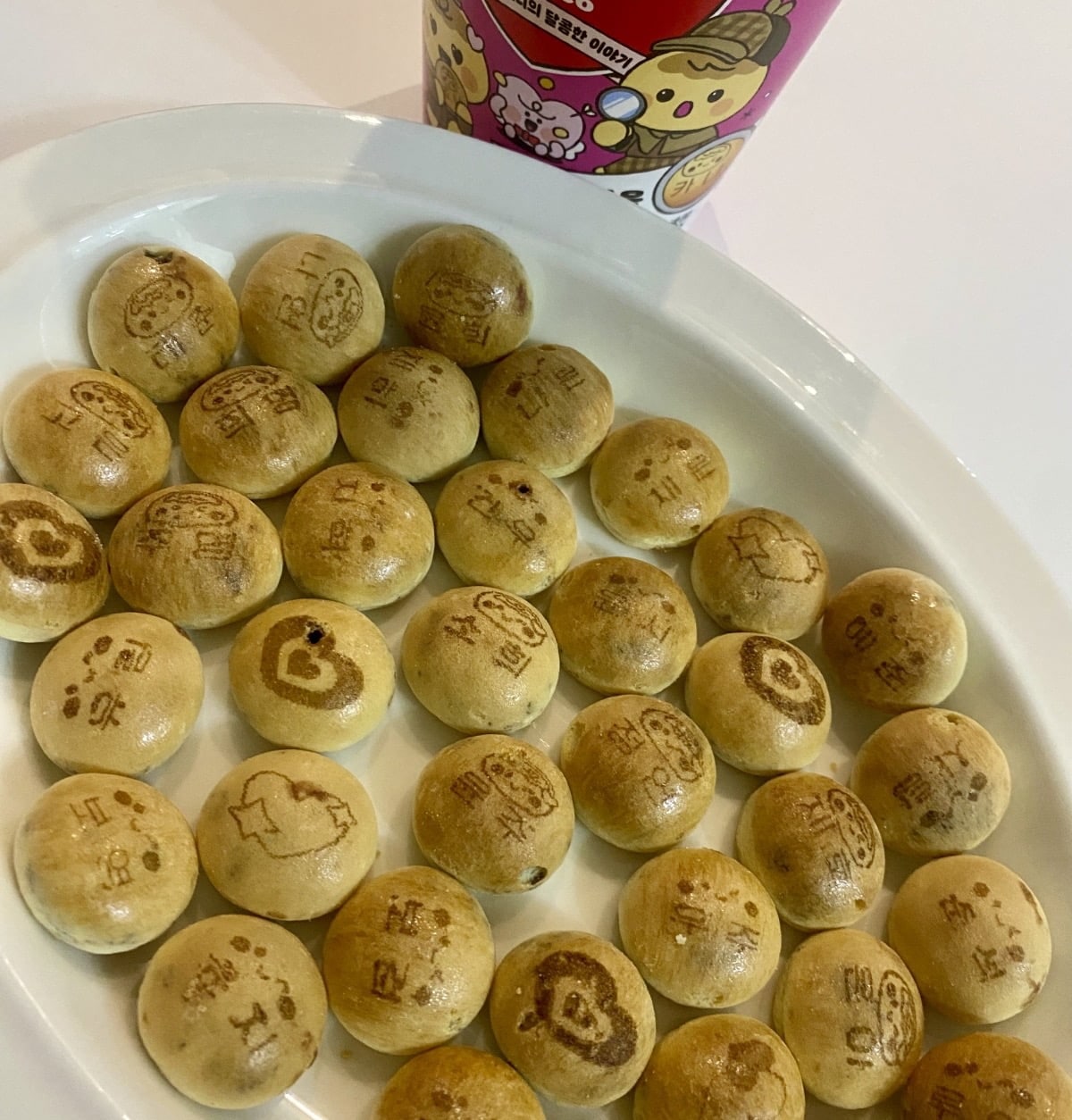
Every piece carries something. Names, faces, hearts — all printed in chocolate ink. Photo supplied by EpicKor.
Tip a box of 칸초 onto a plate and you will notice something no product listing mentions: there is writing on every single biscuit.
Not a logo. Different writing on each one. In September 2025 Lotte took that forty-year-old feature and did something specific with it — it printed 500 of the most common Korean newborn names, one per biscuit, and told the country to go and find theirs.
A million boxes moved in two weeks. By the end of October the figure was three million.
The Short Answer
| Detail | |
|---|---|
| Korean name | 칸초, also written 칸쵸 |
| Maker | 롯데웰푸드 (Lotte Wellfood) |
| Launched | 1984 |
| What it is | Small round biscuit shells with a chocolate filling |
| The feature | Characters, objects and words printed on each piece in chocolate ink |
| 2025 edition | 504 designs — 500 Korean newborn names + 4 official characters |
| Formats | Box 54 g · cup · bulk 196 g |
| Price, August 2026 | About ₩1,090 a box in bulk; ₩1,450–1,780 in small multipacks |
| Flavours now | Chocolate and melon. Seven others have been discontinued |
| Skip it if | You want a substantial biscuit, or you are searching the word in English |
The 504 Names
The mechanic is simple enough that it does not need explaining, which is why it worked.
Lotte took the 500 names most frequently registered for newborns in Korea in recent years, added its four official characters — 카니, 쵸니, 쵸비 and 러비 — and printed all 504 onto individual biscuits. Above each name it drew one of the characters' faces, with a different expression.
The edition ran across every format: the 54 g single box, the cup, and the 196 g bulk bag. So it was not a limited collector's item you had to hunt for — it was simply what Kancho was for a season.
Then it asked people to photograph the biscuit with their own name, or a partner's, or a child's, and post it. Prizes ran up to an iPad. Korean press covered it as a 40th-anniversary campaign, and one outlet framed the newborn-name angle as quietly pro-natalist messaging, which Korea's birth rate makes an unavoidable reading.
The numbers: one million boxes shipped within two weeks of launch, three million cumulative by 29 October. For a forty-year-old biscuit that had not been news in a decade, that is a considerable second act.
What Is Actually Printed on Them
Outside the name campaign, the standard product still carries printing on every piece — this is not new and it is not a gimmick added recently. It has been the identity of the product since the 1980s.
The stamps are made with chocolate ink and fall into three groups: the Kancho characters in various poses, objects — food, toys, hats, hearts — and short words. On the plate above you can see faces, a heart swirl, and Korean text on nearly every piece.
What there is not is a rare piece. No prize, no chase design, no odds printed anywhere. The pleasure is entirely in the sorting, which is why Korean children tip the box out rather than eating from it, and why the name edition landed so easily on top of a habit that already existed.
You might like: Goraebap: Korea's Whale Food Crackers Have 16 Shapes
The Mascots Have Changed Three Times
This is the part that dates a box instantly if you know it, and it is visible in the packaging.
| Era | Characters | What they were |
|---|---|---|
| Early years | A kangaroo | The original mascot |
| 1990s – mid 2000s | 로티 and 로리 | Lotte World's raccoon mascots, borrowed onto the box |
| 2004 – present | 카니 and 쵸니 | A boy and a girl, named by public contest |
| 2024 onward | Plus 쵸비 and 러비 | A redesign expanded the cast to four |
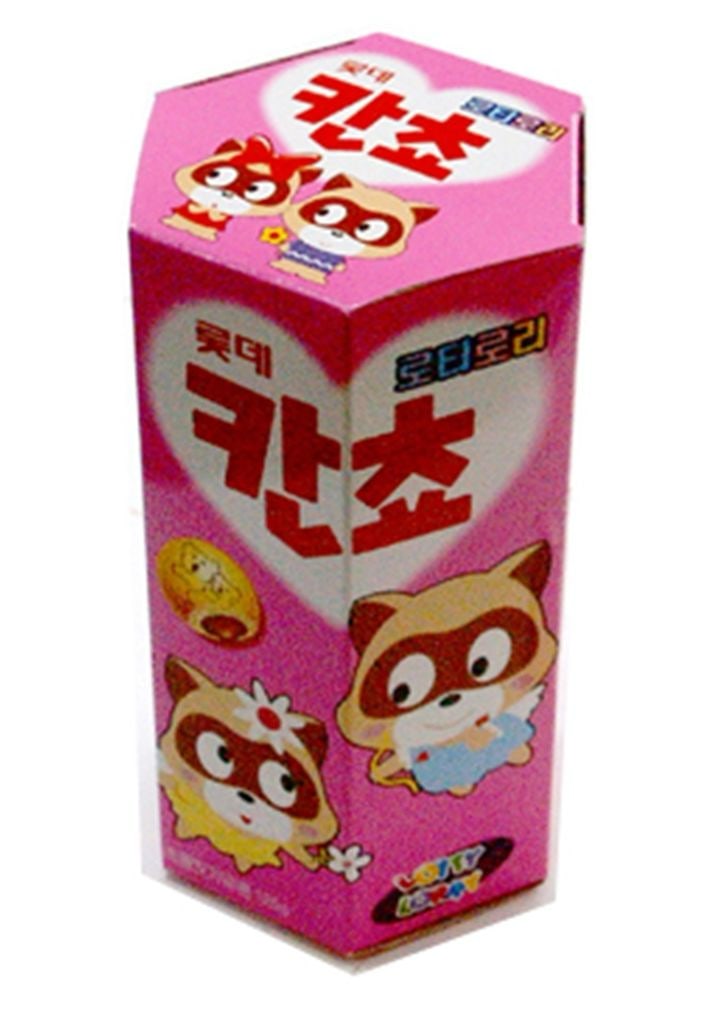
The Lotte World raccoon era — 로티 and 로리 on the box, which places this design somewhere between the 1990s and the mid-2000s. Photo supplied by EpicKor.
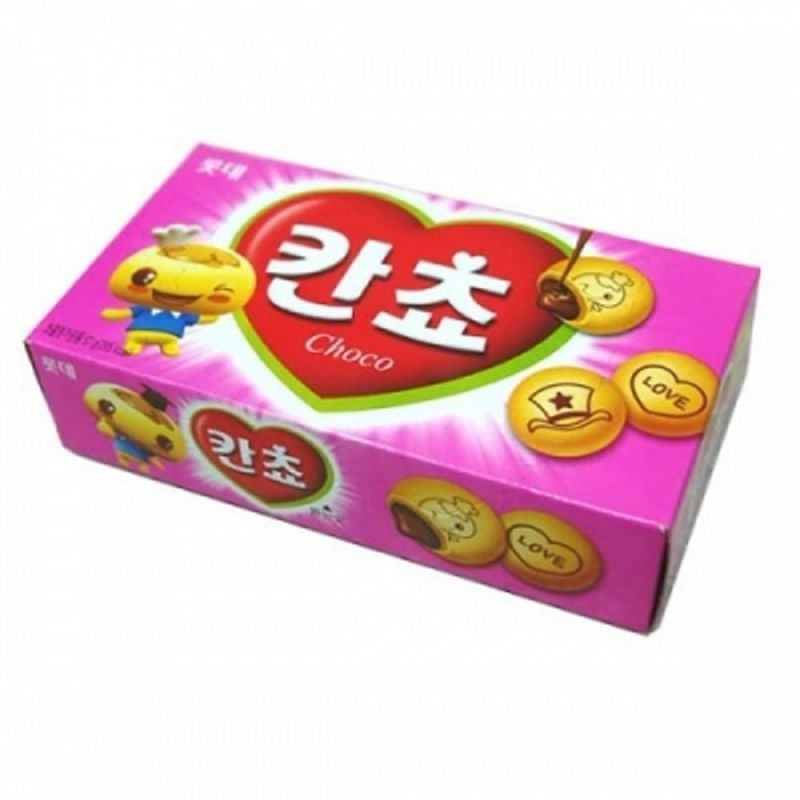
The current era: 카니 in the chef's hat, and the printing shown on the box itself — a hat, a heart, a LOVE. Photo supplied by EpicKor.
If you buy Kancho abroad from a shop with slow stock rotation, the characters on the box will tell you roughly what you are holding. Raccoons mean it has been sitting somewhere for a long time.
Buying Korean biscuits to share? Kancho is designed to be tipped out and sorted rather than eaten from the box, which makes it work better for a group than most snacks its size — worth checking whether a listing is the single box or the bulk bag before you order. As an Amazon Associate, EpicKor earns from qualifying purchases.
What It Actually Tastes Like
The product listings say "chocolate filled biscuit," which is accurate and useless.
The shell is a plain, dry, slightly crumbly biscuit — closer to a shortcrust than to a cookie, and deliberately bland. The filling is a soft chocolate cream, and there is less of it than the cross-section on the box suggests. The ratio is the point: this is a biscuit with chocolate in it, not a chocolate with biscuit around it, and anyone arriving expecting the second thing will find it underwhelming.
Two practical consequences follow. They are not rich, so a 54 g box disappears faster than its calorie count implies. And they do not crumble in your hand, which is why they end up on train tables and in car cupholders — the sealed cup format exists precisely because Kancho is a snack people eat while doing something else.
The size matters too. Each piece is roughly the diameter of a coin, so the printing has to be read close up. That is not a flaw; it is the reason the sorting behaviour exists at all. You have to look.
Why the Sorting Habit Came First
The 2025 campaign is often described as Lotte inventing a game. It is more accurate to say Lotte named a game people were already playing.
Because every biscuit carries a different design, and because they are small enough to spread out, the default way to eat a box of Kancho in Korea has always been to tip it out and look through it. Children compare. Someone finds a heart and gives it to someone. This is the ordinary use of the product, not a marketing construct.
What Lotte did was replace an unstructured set of characters and objects with a set that has a personal hit condition — your own name, or your child's, or someone you like. That converted a diffuse habit into a specific search with a photographable payoff, which is why the social-media mechanic worked without needing to be explained to anyone.
It is a useful lesson about the Korean snack aisle generally: the products that get second lives are usually the ones that already had a behaviour attached, waiting to be pointed at.
About Searching the Word in English
This has to be said plainly, because it is the first thing an English speaker will hit.
Searching "kancho" in English does not return the biscuit. It returns a Japanese schoolyard prank of the same romanisation, and the results are not what you are looking for. The two words are unrelated in use; the biscuit's name comes from a Japanese loan meaning ship's captain or director, and Lotte has been selling it under that name since 1984.
If you are searching, add the maker: Lotte Kancho, or 칸초. It will also appear as 칸쵸 — Lotte itself uses that spelling in its own campaign materials — so both are correct and you will see both on listings.
Formats and What Is Left of the Flavours
Kancho comes as a 54 g box at 260 kcal, a cup, and a 196 g bulk bag. The cup is the one worth knowing about for travel: it has a resealable lid, which no other format in this category has, and it is the version you will see on Korean train tables.
The flavour history is a graveyard. Nine versions have been released over forty years — original chocolate, sesame, banana milk, pineapple, sweet milk, strawberry yoghurt, blueberry cheese, chocolate hazelnut and melon. As of 2026 only chocolate and melon remain.
That attrition is worth reading as information rather than as failure. Kancho is a chocolate-filled biscuit, and the seven versions that died were all attempts to make it something else. The two survivors are the original and the one that is furthest from it.
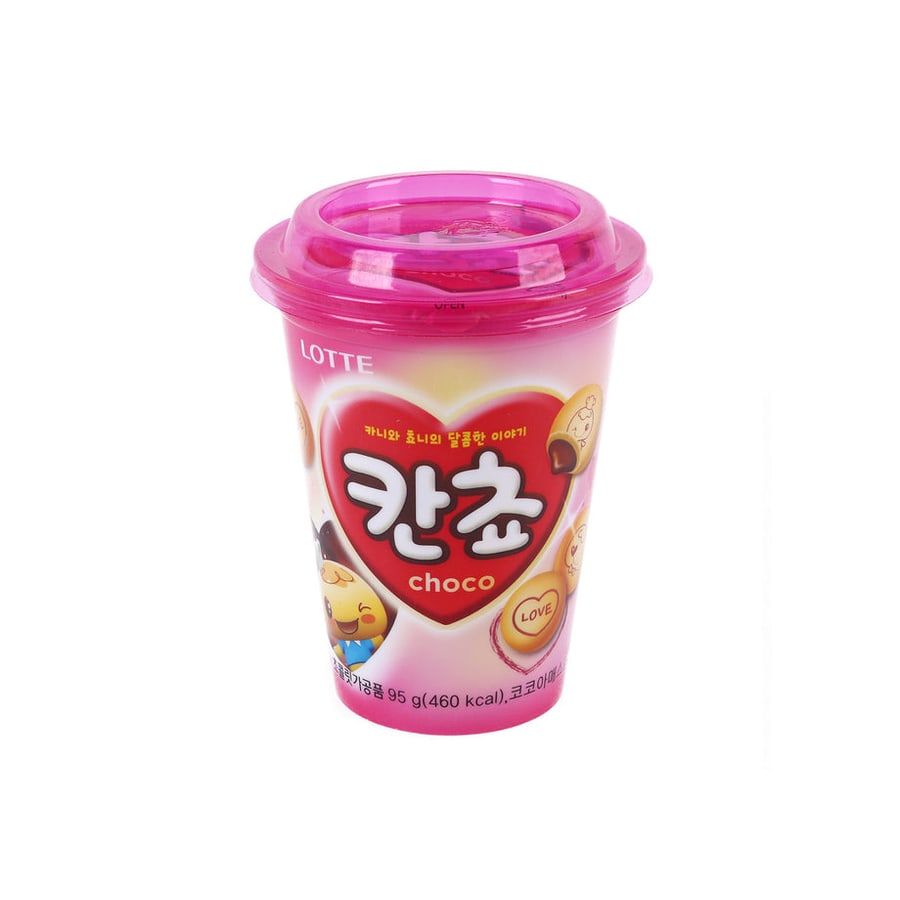
The cup format, with the resealable lid. The line under the heart reads 카니와 쵸니의 달콤한 이야기 — "the sweet story of Kani and Choni." Photo supplied by EpicKor.
You might like: Korean Snacks Guide: What to Buy, Taste, and Pack
What It Costs
As of August 2026, a 54 g box works out to about ₩1,090 buying in bulk — a 32-box case runs around ₩34,900. Smaller multipacks are dearer per unit: roughly ₩1,450 in a ten-pack and ₩1,780 in a five-pack.
Convenience stores charge more for a single box and discount it regularly. The name-edition boxes are still listed by some Korean retailers under the campaign title 내 이름을 찾아라, so if the printing is the reason you want it, that is the phrase to look for.
Sending a box overseas? The chocolate filling is the constraint, not the biscuit — Kancho does not travel well in a hot suitcase, and this is one Korean snack genuinely worth putting in an insulated pouch rather than trusting to a hold bag.
Who Should Skip It
Skip it if you want a serious biscuit. These are small, hollow-ish shells with a modest amount of filling. They are a children's snack that adults keep buying, not a patisserie item.
Skip it if the printing is the only draw and you are buying abroad. Export boxes carry the standard character and object printing, not the 504-name edition, and the names are Korean — the point of finding yours does not transfer.
Skip it in summer heat. Chocolate filling in a thin shell is exactly as fragile as it sounds.
Do not skip it if you have any interest in how a forty-year-old product gets a second life. Lotte did not reformulate anything, change the price or run a celebrity campaign. It printed different words on the same biscuit and sold three million boxes.
Frequently Asked Questions
Q: What is printed on Kancho biscuits? A: Characters, objects — food, toys, hats, hearts — and words, stamped in chocolate ink, with a different design on each piece. The September 2025 edition replaced most of that with 504 designs: 500 popular Korean newborn names plus the four official characters 카니, 쵸니, 쵸비 and 러비.
Q: Can I still buy the "find your name" Kancho? A: Some Korean retailers still list boxes under the campaign name 내 이름을 찾아라. It ran across all formats rather than as a limited run, so stock persisted, but availability is no longer guaranteed and it was never exported.
Q: Why does searching "kancho" show something else? A: The romanisation collides with a Japanese schoolyard prank, which dominates English results. Search Lotte Kancho or the Korean 칸초 — or 칸쵸, which Lotte uses itself.
Q: When did Kancho launch and why did the mascots change? A: 1984. The mascot was a kangaroo at first, then Lotte World's raccoons 로티 and 로리 from the 1990s to the mid-2000s, then 카니 and 쵸니 from 2004 after a public naming contest, with 쵸비 and 러비 added in a 2024 redesign.
Q: What Kancho flavours exist? A: Nine have been released over the years. Only chocolate and melon are current as of 2026 — sesame, banana milk, pineapple, sweet milk, strawberry yoghurt, blueberry cheese and chocolate hazelnut are all discontinued.
Q: How much does Kancho cost in Korea? A: About ₩1,090 per 54 g box buying a 32-box case, or roughly ₩1,450–1,780 per box in smaller multipacks, as of August 2026. Convenience stores charge more.
Sources
The 1984 launch, the name's Japanese derivation, the mascot sequence from kangaroo to 로티·로리 to 카니·쵸니 and the 2024 addition of 쵸비 and 러비, the chocolate-ink printing method, format weights and calorie figures, and the nine-flavour history with the two survivors from Korean-language reference sources. The September 2025 campaign details — 504 designs comprising 500 recent Korean newborn names plus four official characters, application across the 54 g single, cup and 196 g bulk formats, the character faces drawn above each name, the social-media mechanic and prizes, the 40th-anniversary framing, one million units within two weeks and three million cumulative by 29 October — from Korean business and consumer press, September and October 2025. Retail pricing checked August 2026 across Korean online retailers.
Product photographs supplied by EpicKor. Formats, flavours and prices change, and the export range differs from the Korean range. Check the box in front of you.
You Might Also Like
Postick: The Korean Snack That Used to Come With a Ketchup Packet
Postick (포스틱) has been on Korean shelves since 1980, it is only 23% potato, and it shipped with a ketchup sachet until the sachet got too expensive. What it costs now, and the ramyun-powder trick Koreans use on it.
Hetbahn: What Korea's Instant Rice Is Made Of, and How to Heat It Without a Microwave
햇반 is 99.9% Korean rice and water plus 0.1% rice bran extract, sealed in a room cleaner than a hospital ward. The lid prints three cooking times and one of them needs no microwave at all. Prices, varieties, and the mistake almost everyone makes with the film.
Korean Food Prices in August 2026: What Already Rose, and What Changes on the 25th
Four Korean food makers raised prices within three weeks, and Paris Baguette's 127-item increase lands on 25 August. The exact brands, dates and won amounts, why wheat and corn are behind it, and what it actually changes for a visitor.