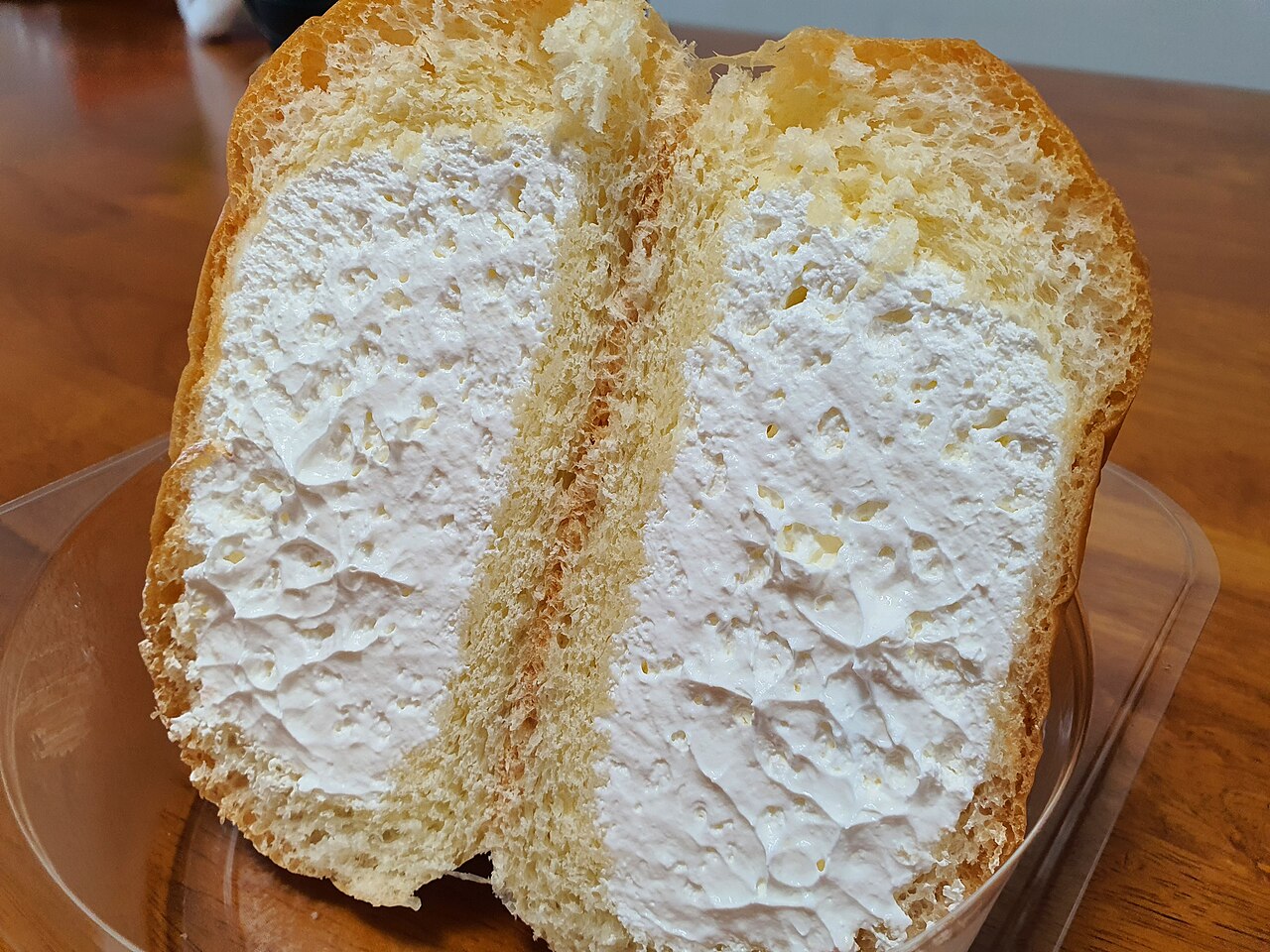
Yonsei Cream Bread: Korea's 100-Million-Unit Convenience Store Bun
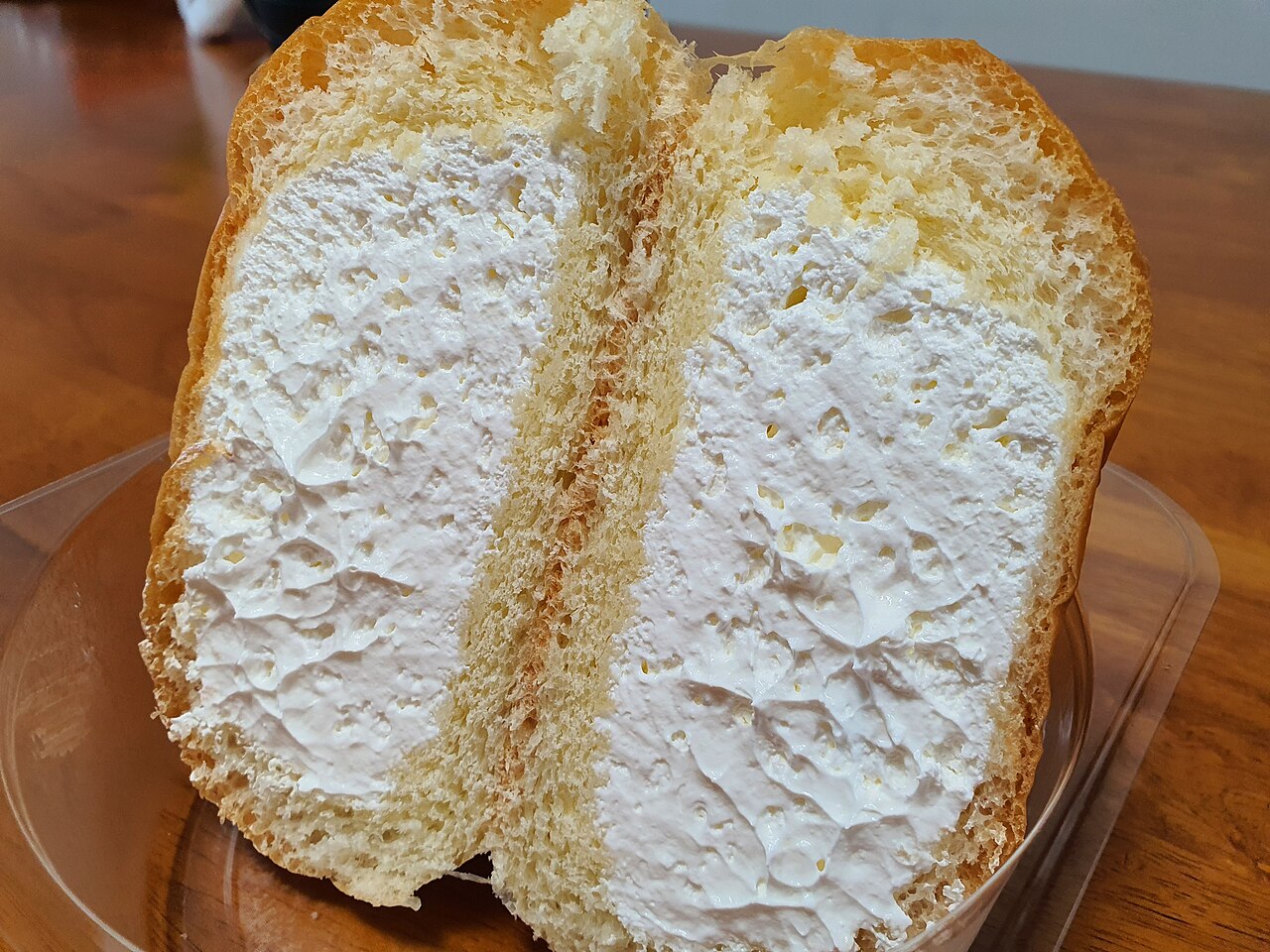
Yonsei milk cream bread, cut open. Around 80% of the bun's weight is the cream. Photo by 이분의일디자인, CC BY 2.0 KR.
There is a bun in Korean convenience stores that outsells almost everything around it, and most visitors walk straight past it because it looks unremarkable in its plastic tray.
Yonsei Cream Bread (연세우유 크림빵) launched in January 2022 as a collaboration between the convenience store chain CU and Yonsei Milk, the dairy brand run out of Yonsei University. In April 2026 it crossed 100 million units sold — reaching that number faster than any product in CU's history. That works out to roughly 64,500 buns a day, or about 45 every minute, continuously, for four years and three months.
It now accounts for roughly 40.8% of CU's entire dessert revenue. One product line, four out of every ten dessert won.
The reason is simple and slightly absurd: about 80% of the bun's total weight is cream. It is barely a bread product. It is a cream delivery system with a thin bread shell, and once you cut one open, the sales figures stop being surprising.
The Short Answer
| Question | Answer |
|---|---|
| Where can I buy it? | CU convenience stores only — it is a CU exclusive |
| Korean name | 연세우유 크림빵 (Yonsei-uyu keurimppang) |
| Price (July 2026) | roughly ₩2,600–3,000 depending on variety |
| How many varieties? | 39 to date, with a new one roughly every two months |
| Best-selling flavour | Milk (우유), followed by chocolate, matcha, yellow cheese, corn |
| How do locals eat it? | Chilled — and very often frozen |
50-piece Korean snack box — on AmazonAffiliate link. As an Amazon Associate, EpicKor earns from qualifying purchases at no extra cost to you.
Why It Is a CU Exclusive
This is the first thing to understand, because it determines where you have to walk.
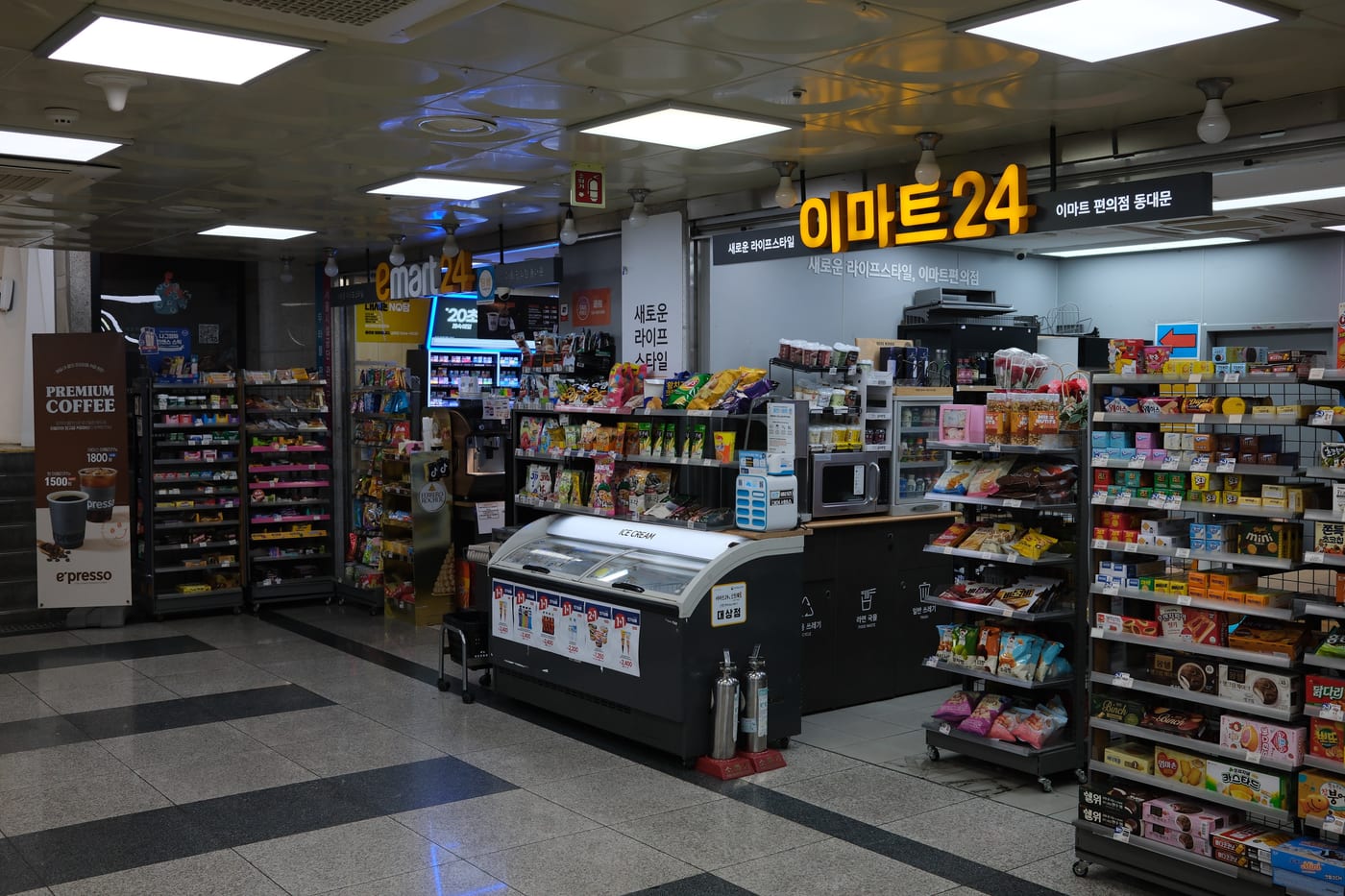
Yonsei Cream Bread is not a general Korean bakery product you can pick up anywhere. It is a collaboration product sold only through CU, one of Korea's three largest convenience store chains. GS25, 7-Eleven, and Emart24 do not carry it, and neither do bakeries or supermarkets.
CU stores are marked with a purple and green sign and are extremely common — in any Seoul neighbourhood you are rarely more than a few minutes from one. But if you are standing in a GS25 wondering why you cannot find the famous cream bun, that is why.
The exclusivity is also the business logic. A product that pulls 40.8% of a chain's dessert revenue is a reason to choose that chain, and that is precisely what CU bought.
What Is Actually Inside
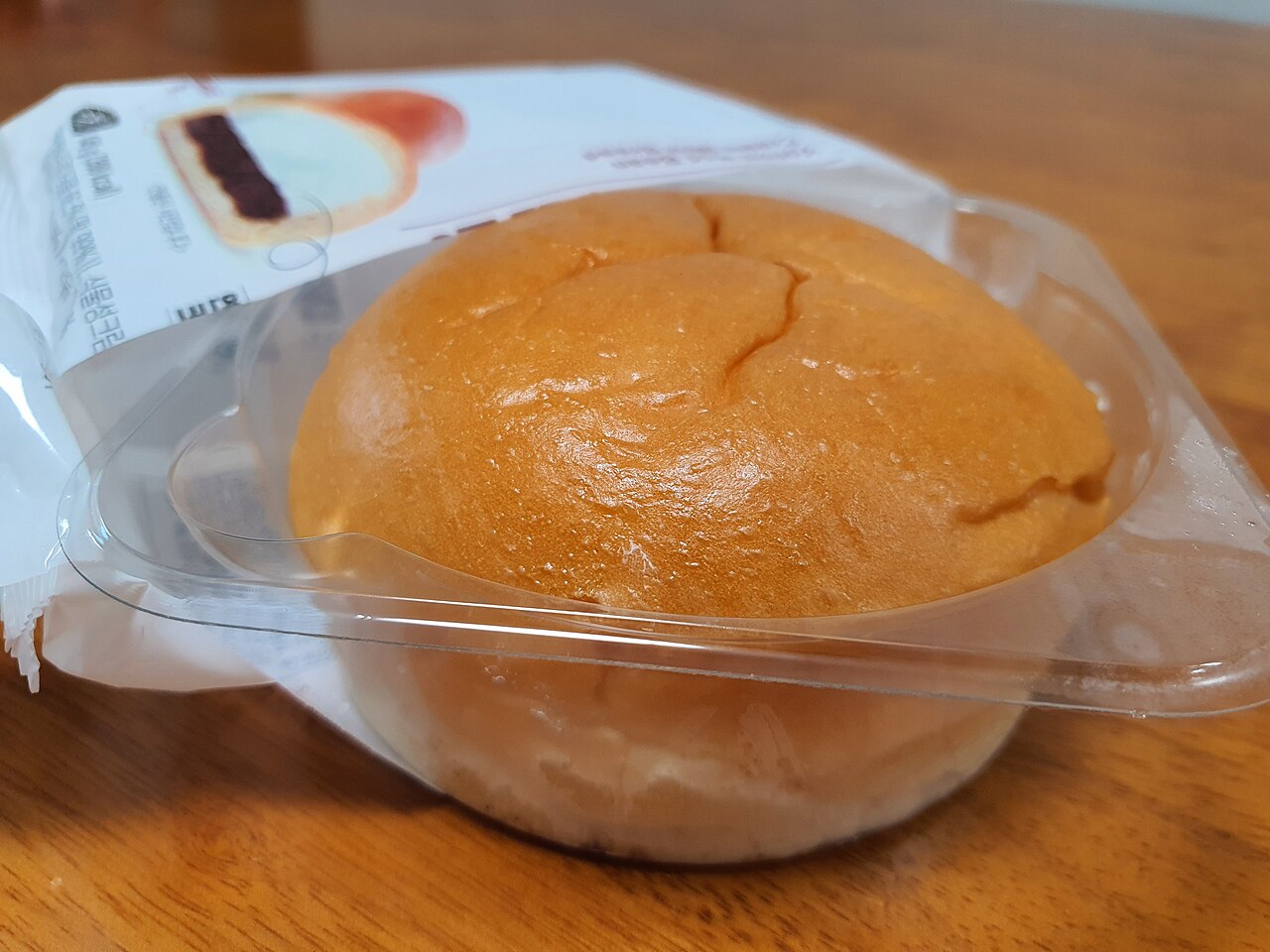
How you find it on the shelf — a clear tray, a Korean label, and a diagram of the cross-section. Photo by 이분의일디자인, CC BY 2.0 KR.
The construction is the whole product.
A soft, mild, faintly sweet bread shell is split and packed with fresh cream until the cream, not the bread, is the dominant ingredient by weight. Korean coverage puts that share at about 80%. The bread is deliberately understated — it exists to hold the cream and to give you something to bite.
That ratio explains several things at once:
- It is heavier than it looks. Pick one up and it has real weight for its size.
- It must be refrigerated. This is a chilled product in the cold case, not a shelf-stable packaged bread.
- It does not travel well. Warm cream separates and the texture collapses. This is not a souvenir.
- It is genuinely rich. One is a dessert, not a snack. Two in a row is a mistake most people make exactly once.
What That Means in Numbers
The 80% figure is the interesting one, but people search for the calorie count, and English pages do not carry it. Korean nutrition databases do.
| Per bun (130g), 우유생크림빵 | Amount | Share of the Korean daily reference value |
|---|---|---|
| Calories | about 400 kcal | — |
| Fat | 25–26g | 47% |
| Saturated fat | 12g | 80% |
| Carbohydrates | 36–38g | 11% |
| Sugars | 11g | 11% |
| Protein | 6g | 11% |
| Sodium | 200–210mg | 10% |
| Cholesterol | 60–65mg | 21% |
Fat supplies roughly 56% of the calories, which is what an 80%-cream product should look like and what the packaging does not spell out. The number that matters is not the 400 kcal — a sandwich reaches that too. It is the 12g of saturated fat, about 80% of a full day's reference intake in one bun, which is a dessert-shaped number, not a breakfast-shaped one.
The chocolate version (초코생크림빵, 128g) lands in the same band at roughly 400–420 kcal. The larger seasonal buns run higher: matcha around 420 kcal at 145g, red bean about 440 kcal, melon about 460 kcal at 155g.
The variety determines what else joins the cream. The red bean version adds a core of sweet red bean paste through the middle, which cuts the dairy with something earthier.
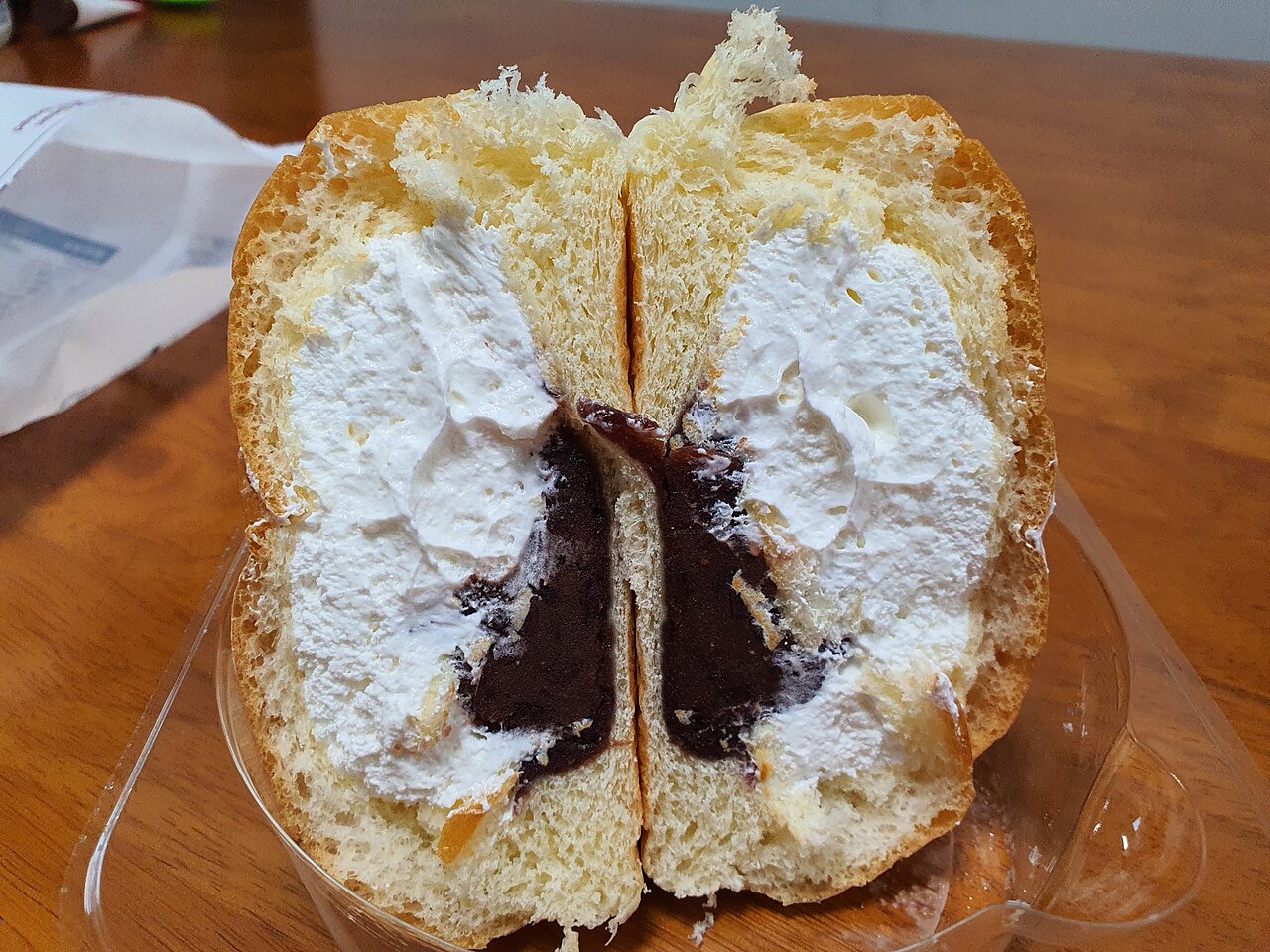
The red bean variety adds a paste core through the cream. Photo by 이분의일디자인, CC BY 2.0 KR.
The 39 Varieties, and Which One to Actually Buy
CU has released 39 varieties since launch, adding roughly one new flavour every two months. That rotation is deliberate — it is what keeps a four-year-old product feeling like a new release, and it is why the lineup you find in July 2026 will not be the lineup a guide described last year.
Recent Korean sales rankings put the order as:
- Milk (우유) — the original and still the best seller
- Chocolate (초코)
- Matcha (말차)
- Yellow cheese (황치즈)
- Corn (옥수수)
If it is your first one, buy milk. It is the version the product was built around, it is the cleanest expression of the cream-to-bread ratio, and it is the one that will be in stock. Treat the seasonal flavours as a second visit, not a first.
That yellow cheese entry at number four is worth noticing. 황치즈 — a sweet-savoury yellow cheese flavour — has been running through the entire Korean snack market rather than staying in one category. If you want the wider story of that trend, EpicKor covered it in the Orion moist yellow cheese chip guide.
You might like: Korean Convenience Store Food Guide: Dosirak and Snacks
Eat It Frozen — This Is Not a Trick
Here is the part that no English-language page explains, and it changes the product completely.
Koreans freeze it. The habit is common enough to have its own shorthand, 얼먹 (eol-meok), a contraction of 얼려 먹기 — "freeze-and-eat." It is a standard enough search in Korea that it appears as an autocomplete suggestion on the product's own name.
What happens is straightforward. Freezing turns the fresh cream from soft and rich into something closer to ice cream, while the bread shell stays chewy rather than going hard. The result is a different dessert from the same package, and many Koreans prefer it that way — particularly in summer.
How to do it:
- Freeze it in the packaging, flat, for a few hours
- Do not thaw it fully. Take it out five to ten minutes early. Rock-solid is unpleasant; slightly softened at the edges is the target
- It works best with the cream-forward varieties — milk, chocolate — where the filling is the point
If you are staying somewhere with a freezer, buy two: eat one chilled, freeze one. That comparison, done back to back, is the actual experience of this product, and it costs about ₩6,000.
Korean snack shopping note: As an Amazon Associate, EpicKor may earn from qualifying purchases. Yonsei Cream Bread is a chilled CU-exclusive that does not export, so there is no online version to buy — but if you want Korean sweets that actually reach your door, a 50-piece Korean snack box is the shelf-stable answer, instead of hoping a chilled cream bun makes the trip.
See it on AmazonWhat It Costs
As of July 2026, expect roughly the following at a CU.
| Variety | Korean | Price (July 2026) |
|---|---|---|
| Milk cream bread | 우유생크림빵 | around ₩2,600 |
| Red bean cream bread | 단팥생크림빵 | around ₩2,600 |
| Chocolate cream bread | 초코생크림빵 | around ₩2,700 |
| Corn cream bread | 옥수수생크림빵 | around ₩3,000 |
Prices move with the rotating lineup, and limited or collaboration varieties usually sit at the top of the range. Treat these as a band rather than fixed figures, and check the shelf label.
For context, that puts one bun at roughly the price of a convenience store lunch box's cheaper end — it is a real purchase, not pocket change, which is worth knowing before you buy four.
When to Skip It
Being honest about this saves you money and a bad first impression.
- Skip it if you do not like heavy dairy. There is no version of this product that is light. The cream is the point, and 80% by weight is not a figure that leaves room for restraint — in nutrition terms that is 12g of saturated fat, about 80% of a day's reference intake, in one bun.
- Skip it as a souvenir, completely. It is chilled, cream-filled, and short-dated. It will not survive a flight, and it will not survive an afternoon in a warm bag either.
- Skip a tray that looks squashed or has separated cream visible at the seam. These are handled products in soft packaging; a mistreated one is genuinely worse.
- Skip buying four flavours at once on day one. Richness compounds fast. Buy one, decide honestly whether you want a second, then expand.
- If the CU near you is out of the milk variety, wait rather than substituting. Stock rotates constantly and the seasonal flavours are not the same experience.
Trying the 얼먹 method at home: The freeze-and-eat habit works on any cream-filled bun, not just this one — if you want to test it before your trip, Lotte Custard cake is the closest cream-filled Korean thing that actually ships. Put one in the freezer for a few hours and you will understand 얼먹 immediately.
See it on AmazonWhy This Product Explains Korean Convenience Stores
Step back and Yonsei Cream Bread is a fairly precise illustration of how Korean convenience stores actually work, which is different from how they work almost anywhere else.
They are product developers, not just shelf space. CU did not stock someone else's hit — it built one with a partner brand and kept it exclusive.
Rotation is the business model. Thirty-nine varieties in four years is not indecision, it is a deliberate engine for keeping a mature product in the news cycle and on social media.
Dessert is a serious category. A single product line taking 40.8% of dessert revenue only makes sense in a retail culture where people buy dessert at a convenience store as a normal daily act.
Chilled fresh food is the differentiator. The cold case — lunch boxes, sandwiches, cream buns — is what separates a Korean convenience store from a Western one, and it is why the fresh case is where you should be looking.
If you want the wider picture of what is worth buying in that cold case, EpicKor's Korean convenience store breakfast guide covers the morning side, and the convenience store food guide covers lunch boxes and the slang Koreans use to judge value.
FAQ About Yonsei Cream Bread
Q: How many calories are in Yonsei cream bread?
A: About 400 kcal for the standard 130g milk cream bun (우유생크림빵) — Korean nutrition databases list 401–402 kcal. The chocolate version is similar at roughly 400–420 kcal, and the larger seasonal buns run to 440–460 kcal. The more useful figure is the saturated fat: 12g, roughly 80% of a full day's reference intake, because about 80% of the bun's weight is cream.
Q: Where can I buy Yonsei Cream Bread?
A: CU convenience stores only. It is an exclusive collaboration between CU and Yonsei Milk, so GS25, 7-Eleven, Emart24, supermarkets, and bakeries do not carry it. Look for the purple and green CU sign and check the refrigerated case.
Q: How much does Yonsei Cream Bread cost?
A: Roughly ₩2,600 to ₩3,000 as of July 2026, depending on the variety. Milk and red bean sit at the lower end, corn and limited-edition collaborations at the upper end. Check the shelf label, since the lineup rotates.
Q: Why is it so popular in Korea?
A: The construction. About 80% of the bun's weight is fresh cream rather than bread, which makes it far richer than it looks. It passed 100 million units sold in April 2026 — roughly 45 buns a minute since its January 2022 launch — and accounts for about 40.8% of CU's total dessert revenue.
Q: Should I eat it frozen?
A: Try it at least once. Freezing is a mainstream Korean habit for this product, known as 얼먹 (freeze-and-eat), because it turns the fresh cream into something close to ice cream while the bread stays chewy. Take it out of the freezer five to ten minutes before eating rather than letting it thaw completely.
Q: How many flavours are there?
A: Thirty-nine varieties have been released since launch, with roughly one new flavour every two months. Only a handful are on the shelf at any given time. Recent sales rankings put milk first, then chocolate, matcha, yellow cheese, and corn.
Q: Can I bring it home as a souvenir?
A: No. It is a chilled, cream-filled, short-dated product that does not export and will not survive a flight. If you want Korean sweets to take home, buy shelf-stable packaged snacks instead.
The One Thing to Remember
If you take one fact from this guide: it is CU-only, and about 80% of it is cream.
Everything else follows. That ratio is why it is refrigerated, why it is heavier than it looks, why it does not travel, why freezing it turns it into a different dessert, and why one product line took four out of every ten dessert won at a national convenience store chain.
Buy the milk one, eat it cold, then freeze the second.
Sources and Further Reading
- Korean-language reporting on Yonsei Cream Bread passing 100 million cumulative units in April 2026, including the daily average of about 64,500 units and the per-minute figure
- Korean coverage of the product line's share of CU dessert revenue (approximately 40.8%), the 39-variety count, and the internal sales ranking by flavour
- Korean product coverage on the roughly 80% cream-to-total-weight construction
- Nutrition figures cross-checked against two Korean nutrition databases in August 2026 — 인아웃 and 지니어트 — which agree at 401–402 kcal per 130g bun. Daily reference shares are calculated against Korea's 1일 영양성분 기준치
- Image sources and licensing are documented in this post's
image-sources.md
Prices checked July 2026; nutrition figures added August 2026. The variety lineup rotates continuously; confirm current flavours and prices at the shelf.
Yonsei Cream Bread is part of EpicKor's Korean convenience store guide — the four chains compared, current prices, and what each product actually is.
Also in the section: Samgak kimbap and Convenience store ice cream.
You Might Also Like
Postick: The Korean Snack That Used to Come With a Ketchup Packet
Postick (포스틱) has been on Korean shelves since 1980, it is only 23% potato, and it shipped with a ketchup sachet until the sachet got too expensive. What it costs now, and the ramyun-powder trick Koreans use on it.
Hetbahn: What Korea's Instant Rice Is Made Of, and How to Heat It Without a Microwave
햇반 is 99.9% Korean rice and water plus 0.1% rice bran extract, sealed in a room cleaner than a hospital ward. The lid prints three cooking times and one of them needs no microwave at all. Prices, varieties, and the mistake almost everyone makes with the film.
Korean Food Prices in August 2026: What Already Rose, and What Changes on the 25th
Four Korean food makers raised prices within three weeks, and Paris Baguette's 127-item increase lands on 25 August. The exact brands, dates and won amounts, why wheat and corn are behind it, and what it actually changes for a visitor.