Pulmuone Deep Dive: The Korean Company That Quietly Owns America's Tofu Aisle
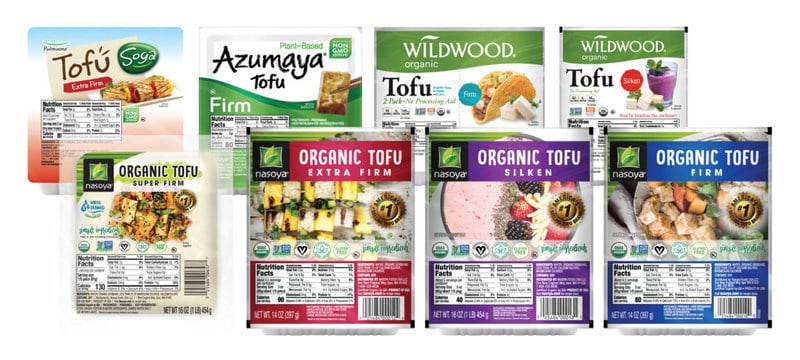
Nasoya, Wildwood, Azumaya and Soga are all owned by one Korean company, and none of them say so on the pack. Pulmuone has led the US tofu market for 11 straight years. Its overseas division still lost money in 2025. Both facts are true.
Quick Answer
If you have bought tofu in an American supermarket, you have probably bought Korean tofu without knowing it.
Nasoya, Wildwood, Azumaya, Soga and Pulmuone are all owned by Pulmuone Co., Ltd., a Korean company that has held the number one position in the US tofu market for eleven consecutive years. Its own 2021 press release put the share at close to 70%.
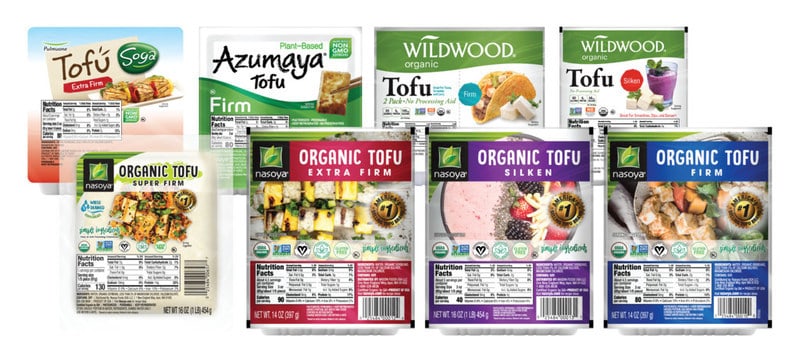
Look at that lineup again. Nasoya reads American. Azumaya reads Japanese. Wildwood reads Californian. This is the opposite of the K-food export playbook that Samyang Foods and Otoki run, where the whole point is that the product is visibly Korean.
And here is the part almost no English article mentions: being number one has not made the overseas business profitable. Pulmuone's international food division posted an operating loss of about ₩16.3 billion in 2025. Both things are true at once, and the tension between them is the actual story.
This is a public-information-only company spotlight. EpicKor is not implying any client relationship with Pulmuone, and none of this is investment advice.
Where Pulmuone Came From
The company begins with an organic farm, not a factory.
Pulmuone Farm (풀무원농장) was established in 1976 by Won Kyung-sun (원경선) as an organic farming collective. In May 1981, his son Won Hye-young (원혜영) and Won's friend Nam Seung-woo (남승우) opened a shop in Apgujeong-dong, Gangnam, to sell the farm's produce directly. It was Korea's first organic produce store. Pulmuone Foods Co., Ltd. was incorporated in May 1984.
The product that made the company was tofu, and specifically the packaging of it.
Until then, Korean tofu was 판두부 — a large block sitting in water at a market stall, cut to order with a knife. Pulmuone sold Korea's first packaged tofu. That sounds like a marketing decision. It was really a logistics decision, and it is the single most useful thing to understand about this company.
Tofu in Korea is an everyday ingredient rather than a specialty item — it turns up in stews, as a side dish, and in the Korean pantry basics most households keep stocked. That ubiquity is what made a packaged version worth building a delivery network for.
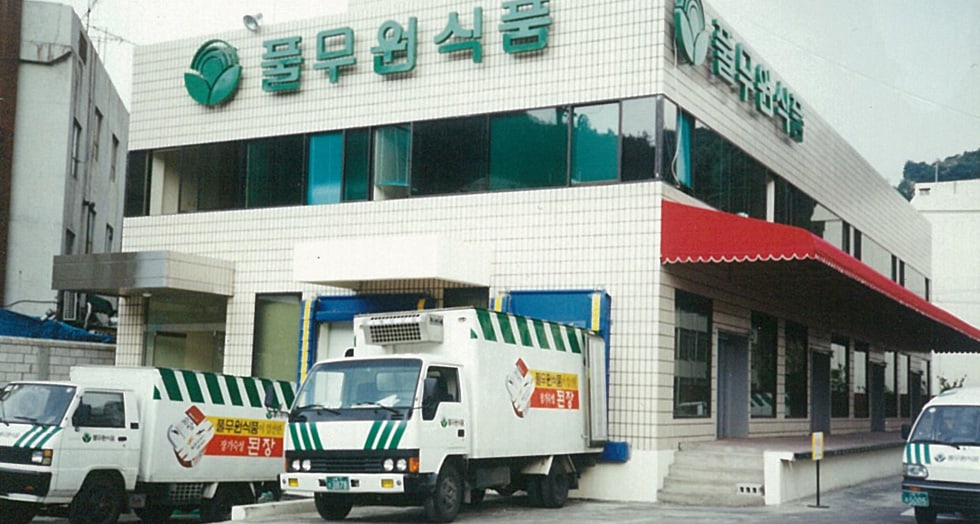
Packaged fresh tofu has a short shelf life and must stay cold from the plant to the shelf. To sell it you need refrigerated trucks, temperature-controlled warehouses, tight delivery frequency, and enough turnover to sell the stock before it expires. Get any of that wrong and you are not running a low-margin business — you are destroying inventory.
Pulmuone built that cold chain in Korea over four decades. It now runs 14 domestic plants and 19 logistics centres, and passed ₩1 trillion in revenue in 2009 and ₩2.2 trillion in 2018. For 2025 the group reported ₩3.3802 trillion in revenue, up 5.2%, with operating profit of ₩93.2 billion, up 1.5%.
Remember the cold-chain point. It explains the American losses later.
Try the product the company is built on: As an Amazon Associate, EpicKor may earn from qualifying purchases. If you want to understand why tofu texture grades matter commercially, the cheapest experiment is to cook silken and extra-firm side by side — our Korean pantry starter kit covers the sauces that go with them, and a Korean earthenware pot is the standard vessel for soft-tofu stew.
The American Route: Buy The Brand, Don't Build One
Pulmuone opened Pulmuone USA in January 1991, headquartered in Fullerton, California. For most of the next twenty-five years it was not a success. Korean reporting on the period is blunt about why: disposal costs from short shelf life, and logistics burden. Exactly the two things that make packaged fresh tofu hard.
The turn came in March 2016, when Pulmuone USA bought America's leading tofu brand — Nasoya — from Vitasoy USA for roughly USD 50 million. It already held Wildwood and Monterey Gourmet Foods.
That purchase is the strategic fork. Samyang and Otoki spend money making foreign consumers recognise a Korean brand. Pulmuone spent money buying brands Americans already recognised, then supplied them from plants inside the United States.
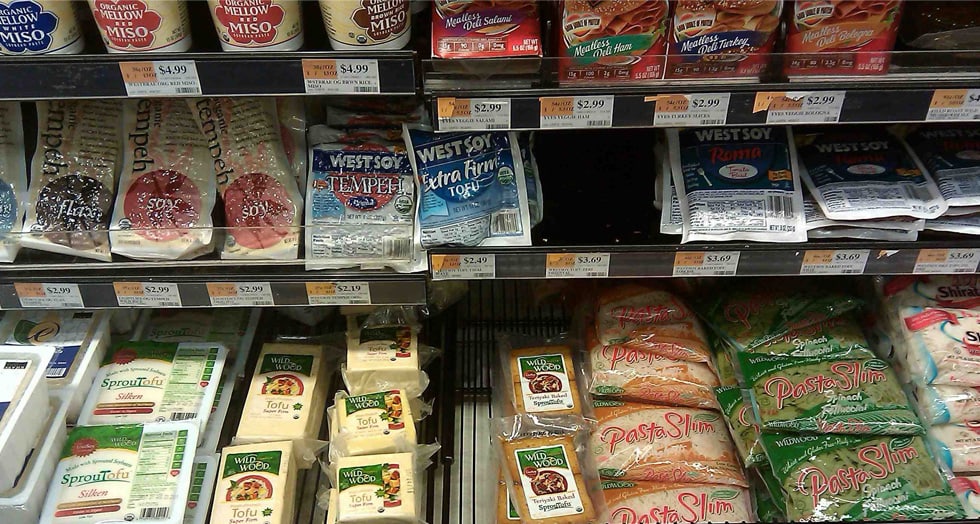
The reason this works for tofu specifically is that tofu is not a Korean-identity product in the American mind. A US shopper buying extra-firm tofu is usually buying protein, not cuisine. There is no marketing advantage in the pack saying Korea, and a lot of advantage in it saying something familiar. Buldak sells because it is foreign. Tofu sells despite being foreign, so the sensible move is to stop looking foreign.
The numbers say it worked:
| Measure | Figure |
|---|---|
| US tofu revenue, 2025 | ₩224.2 billion (about USD 155 million), up 12% — roughly double 2021 |
| High-protein tofu, 2025 vs 2021 | ₩41.5 billion vs ₩15.6 billion |
| Cumulative tofu sales, January–May 2026 | ₩107.8 billion, up 16.8% |
| — water-pack tofu | ₩79.9 billion, up about 24% |
| — high-protein tofu | ₩19.2 billion, up about 13% |
| — processed tofu | ₩8.8 billion, up about 9% |
| US retail footprint (2026) | About 15,000 locations including Walmart, Whole Foods, Kroger, Target and Publix |
| US production sites | Ayer, Massachusetts; Tappan, New York; Fullerton, California |
One caution on that store count. A 2021 Pulmuone press release described its non-GMO and organic tofu as available in 22,300 grocery stores, a bigger number than the 2026 figure of about 15,000. The two are not measuring the same thing — brand scope and product scope differ between releases — so do not read a decline into it. Ask the company which basis applies if the number matters to you.
Cho Gil-soo, CEO of Pulmuone Foods USA, attributes the growth to demand rather than marketing: "The demand for tofu in the US is steadily increasing as the flexitarian population grows and the trend of consuming high-protein, plant-based foods instead of meat spreads."
The high-protein line growing from ₩15.6 billion to ₩41.5 billion in four years supports him. That is not a Korean-food trend. That is an American protein trend, and Pulmuone happened to own the aisle when it arrived.
Number One, And Still Losing Money
This is the section most coverage skips.
In 2025, Pulmuone's overseas food manufacturing and distribution division produced ₩666.9 billion in revenue — 19.7% of the group — and an operating loss of about ₩16.3 billion.
The trend is not a clean line either:
| Year | Overseas operating loss |
|---|---|
| 2022 | ₩45.5 billion |
| 2023 | ₩22.2 billion |
| 2024 | ₩5.5 billion |
| 2025 | ₩16.3 billion |
Three years of steady improvement, then a step backwards. Analysts covering the company expect the loss to narrow again to roughly ₩7.6 billion in 2026, but that is a forecast, not a result.
Why does a category leader lose money? Because tofu's economics are the cold-chain economics described earlier, transplanted into a country the size of the United States. Short shelf life plus long distances equals either expensive logistics or expensive waste. Pulmuone's stated fix has been to move production closer to demand — hence plants on both coasts — and to add frozen dumplings and shelf-stable convenience items whose logistics are far more forgiving than fresh tofu's.
There is also a debt dimension. Korean financial reporting through 2026 has flagged rising borrowings against expanded overseas investment, with credit metrics under pressure. If you are assessing Pulmuone as a supplier or partner, this is the part to look at directly rather than take on trust.
China Worked. Japan Has Not.
The overseas division is three quite different businesses, and only the American one is usually discussed in English.
| Market | Entered | 2025 revenue | Status |
|---|---|---|---|
| United States | 1991 | ₩466 billion (70% of overseas) | Category leader; recovering toward profit |
| China | 2010 (Shanghai) | ₩110.9 billion (16.6%) | Up 25.2% from ₩88.6 billion; profitable |
| Japan | 2014 (acquired Asahico) | ₩86.6 billion (13%) | Declining and still lossmaking |
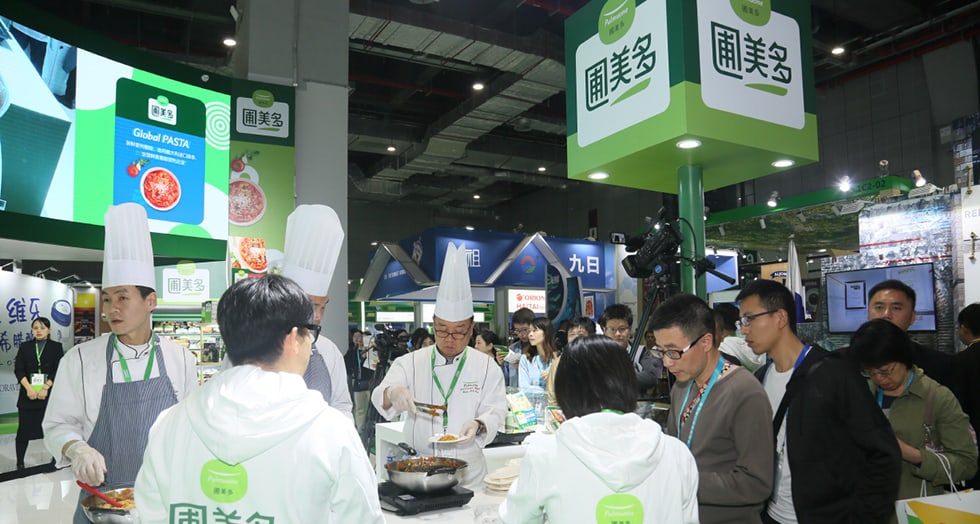
China is the quiet success, trading under the name Pumeiduo (圃美多) and built largely on chilled dumplings and noodles rather than tofu.
Japan is the difficulty. Pulmuone acquired Asahico in June 2014, gaining five plants. Its Tofu Bar product passed 70 million cumulative units by 2024 — a genuine hit. But revenue has fallen from over ₩100 billion in 2023 to ₩98.3 billion in 2024 and ₩86.6 billion in 2025, in a saturated market with limited channel access. Japan is the last piece of the overseas turnaround and the one with no clear date on it.
Build the operator file: If you are studying Pulmuone as an acquisition-led market entry rather than a food brand, compare cross-border acquisition strategy books with cold-chain logistics references — the second one explains this company better than the first.
What Overseas Buyers And Researchers Should Check
Know which legal entity you are actually dealing with. Pulmuone Foods USA, Nasoya Foods USA, Asahico and Shanghai Pumeiduo are separate operating companies. Contracts, certifications and product specifications sit with the entity, not with "Pulmuone."
Match the plant to the product. Fresh tofu is made regionally because it cannot travel far. Frozen and shelf-stable lines may come from elsewhere entirely. Ask which site produces the specific item.
Do not assume the Korean and American ranges match. The US brands were acquired with their own recipes, certifications and formats. Organic and non-GMO claims apply per product line, per market.
Separate the market position from the financial one. Being number one in US tofu for eleven years and posting an overseas operating loss are both current facts. Any assessment that only cites one is incomplete.
For the wider sourcing workflow, our guide to finding suppliers in Korea covers verification steps, and Korea trade shows for overseas buyers covers where these conversations actually happen.
The Honest Assessment
Pulmuone is the counter-example to almost everything written about K-food exports right now.
It did not ride a viral moment. It did not lean on Korean identity — it deliberately hid it. It bought incumbent American brands instead of building recognition from scratch, and it competed on a product with no cultural hook and punishing logistics. Forty-five years after a Gangnam produce shop, it leads a US grocery category outright.
It also has not yet made that leadership pay. The overseas division lost money in 2025, the improvement trend broke, and Japan is going backwards.
The useful lesson for anyone studying Korean companies abroad is that there are two viable routes and they look nothing alike. Otoki and Samyang sell Korea. Pulmuone sells tofu and keeps Korea off the label. The second route buys you shelf space faster and margin much more slowly.
Frequently Asked Questions
Q: Is Nasoya a Korean company? A: Nasoya is an American brand, founded in Massachusetts, that has been owned by the Korean company Pulmuone since March 2016. Pulmuone USA bought it from Vitasoy USA for about USD 50 million. The brand name and packaging stayed American; the ownership is Korean.
Q: Which US tofu brands does Pulmuone own? A: Nasoya, Wildwood, Azumaya and Soga, plus tofu sold under the Pulmuone name itself. It also owns Monterey Gourmet Foods. Only the Pulmuone-branded line makes the Korean connection visible on the pack.
Q: How big is Pulmuone in the US tofu market? A: It has been the number one tofu company in the United States for eleven consecutive years as of 2026. The company's own 2021 press release described its share as close to 70%. US tofu revenue reached ₩224.2 billion, about USD 155 million, in 2025, roughly double the 2021 figure.
Q: Is Pulmuone's overseas business profitable? A: Not as a whole. In 2025 the overseas food manufacturing and distribution division generated ₩666.9 billion in revenue and an operating loss of about ₩16.3 billion. China is profitable, the US business has been moving toward break-even, and Japan is still lossmaking. Losses narrowed from ₩45.5 billion in 2022 to ₩5.5 billion in 2024 before widening again in 2025.
Q: What was Pulmuone's first product? A: Organic produce, sold from a shop that opened in Apgujeong-dong, Seoul in May 1981 — Korea's first organic produce store. The company was incorporated as Pulmuone Foods in May 1984, and the product that built it was Korea's first packaged tofu, sold at a time when Korean tofu was cut to order from a block at market stalls.
Q: Why does Pulmuone not market itself as Korean in the United States? A: Because tofu is not bought as Korean food by most American shoppers. It is bought as plant protein, and the fastest-growing part of Pulmuone's US business is high-protein tofu, which grew from ₩15.6 billion in 2021 to ₩41.5 billion in 2025. A Korean origin story adds little to that purchase, so the company competes on brands American shoppers already trust.
More Business Guides
Ottogi (Otoki) Deep Dive: The Korean Food Giant That Wins at Home and Lags Abroad
Ottogi renamed itself Otoki in English in 2024. It sells more curry, mayonnaise and instant rice inside Korea than almost anyone, yet only about 11% of revenue comes from overseas while Samyang Foods runs at 84.5%. Here is why, and what changes by 2030.
Samyang Foods Deep Dive 2026: How Buldak Became a Global Export Engine
A public-info deep dive on Samyang Foods, covering Buldak's viral growth, export network, factories, financial expansion, localization, and business risks.
Kovea Deep Dive: The Korean Burner Maker That Took Apart a Swedish Stove — and Now Builds for MSR
Look at the box your Snow Peak LiteMax came in and it says Made in Korea. Kovea started in 1982 when its late founder took apart a Swedish SVEA burner, now supplies MSR and Decathlon, and still earned a 21% operating margin after Korea's camping market halved.