Chung Ju-yung, Korea's Hyundai Founder: The Turtle-Ship Banknote, 1,001 Cattle and Where to See the Story Today
Last updated: 16 October 2026. The shipyard story comes from HD Hyundai's own corporate history, Hyundai Heavy Industries Group 50-Year History (현대중공업그룹 50년사), vol. 1, read in the Korean original. His early life comes from the Asan Chung Ju-yung Memorial site, and the 1998 crossings from the Encyclopedia of Korean Culture. Visiting details come from official Bank of Korea, Ulsan, Hyundai Motor and Korea Tourism Organization pages read on 16 October 2026. Sources are listed at the end.
In 1971 a Korean road builder sat across a table in London from a British shipbuilding consultant who had just told him no. Korea had no big shipyard. His company had never built a ship.
So, the story goes, Chung Ju-yung (정주영) reached into his trouser pocket and unfolded a ₩500 banknote. On the back was the turtle ship (거북선), the armoured warship of the 1590s. Korea, he said, had built iron-clad ships in the 16th century. It had only industrialised late.
Koreans know the scene as the moment a banker handed over the money. Hyundai's own official history tells it differently, and the difference explains how Korea got rich. It also points to what you can still see: a bank museum in Seoul, the spot at Imjingak where an 82-year-old spoke before driving cattle into North Korea, and a hilltop in Ulsan above the beach he sold.
The full life in English: Richard M. Steers, Made in Korea: Chung Ju Yung and the Rise of Hyundai (Routledge), on AmazonAffiliate link. As an Amazon Associate, EpicKor earns from qualifying purchases at no extra cost to you.
Quick Guide: the story in numbers, and where to see it
| What | The number |
|---|---|
| Money from the family cow, which Chung took when he ran away | ₩70 (very roughly $15–24 at early-1930s rates) |
| The banknote on the table, 1971 | ₩500 ≈ $1.44 at the 1971 rate |
| Foreign money the shipyard plan needed | $43 million (₩17.2 billion), more than Hyundai Construction's entire ₩13.6 billion capital |
| First order: two 260,000-ton tankers | $30.95 million each, about 16% below world prices |
| Groundbreaking to finished shipyard | 2 years 3 months (23 Mar 1972 – 28 Jun 1974) |
| Cattle driven north through Panmunjom, 1998 | 500 + 501 = 1,001 |
| Bank of Korea Money Museum, Seoul | Free, Tue–Sun 10:00–17:00 |
| Ulsan Bridge Observatory, over the shipbuilding district | Free, 09:00–21:00 |
| Tour of the HD Hyundai Heavy Industries yard | Not open to the general public |
Korea: The Impossible Country — Daniel Tudor For the bigger picture behind this story. Tudor, The Economist's former Korea correspondent, explains how fast growth, the family-run business groups and the state fitted together in the decades Chung worked in. As an Amazon Associate, EpicKor earns from qualifying purchases at no extra cost to you.
See the book on AmazonOne cow, seventy won (1915–1946)
Chung was born on 25 November 1915 in Tongcheon (통천), a farming village on the east coast that is now in North Korea, the eldest of six sons and two daughters. The eldest son of a farmer had one career: the farm.
He disagreed, and kept running away. His father kept bringing him back. On the last run, in his late teens, he went for good. The Encyclopedia of Korean Culture records what he took with him: ₩70, the money his father had just been paid for the family cow.
In Seoul he delivered rice for a shop called Bokheung Sanghoe (복흥상회), practising at night on the bicycle so he wouldn't drop the sacks. Six months later the delivery boy was keeping the books. In January 1938, aged 22, he took over the shop's regular customers and opened his own store, Kyungil Sanghoe (경일상회).
In December 1939 the colonial government rationed rice and every rice shop in the country had to close. In 1940 he bought a car-repair garage, A-do Service (아도서비스). Twenty days later it burned down, with customers' trucks inside. He borrowed again, reopened in Dongdaemun and ran it until a wartime order merged it away in 1943. A decree ended his first business, and a fire and another decree his second. In April 1946, after liberation, he hung a new sign over a repair shop in central Seoul: Hyundai Auto Industry (현대자동차공업사). Hyundai means "modern." A year later came Hyundai Civil Works (현대토건사), the forerunner of Hyundai Construction, which spent the next 20 years building Korea's roads, bridges and power plants.
You might like: South Korea Explained: K-Pop, Growth, Tragedy, and Resilience
The ₩500 note: the legend and the paperwork
By 1970 Chung wanted to build ships. The plan needed $63 million, $43 million of it from abroad. In March 1971 Hyundai opened a London office.
English retellings often have Chung walking into Barclays with the banknote. Hyundai's official history doesn't. The version below comes from pages 38–41 of Hyundai Heavy Industries Group 50-Year History, which HD Hyundai publishes as a free PDF. It is the company telling its own legend.
| The legend | What Hyundai's own history records |
|---|---|
| He showed the note to a banker | He showed it to Charles Longbottom, chairman of the ship consultancy A&P Appledore and a former member of the House of Commons, who had just turned him down. |
| The note won the loan | It won a visit. Longbottom came to Korea, toured power plants and refineries Hyundai had built, and wrote to Barclays recommending the project. |
| Barclays said yes | Barclays agreed, but Britain's export credit agency, the ECGD, which pays British lenders if a borrower defaults, set one condition: prove someone will buy the ships. The history calls this "practically a refusal". |
| He sold ships with a photo of a beach | True. The history lists the whole kit: one photograph of the Ulsan beach, one 1:50,000 map, and one tanker drawing borrowed from the Scottish yard Scott Lithgow. |
| A buyer believed in him | Greek shipowner George Livanos wanted cheap ships from a new shipbuilding country. In mid-October 1971, in Switzerland, he set his own terms: $30.95 million a ship against $36 million asked, delivery in two and a half years, full refund if Hyundai failed. That was 16% below world prices. |
| One man's nerve | The Spanish, French, British and German loans took effect only when the Korean government approved the project in December 1971. A Swedish loan in 1972 brought the total to $50.57 million. |
So the banknote was real, but it didn't get the money. It opened one door, to a consultant. The money came through a guarantee system that wanted a paying customer, Hyundai bought that customer with a 16% discount it meant to earn back by building fast, and a government signed at every step. That is Korea's growth model in one deal: cheap, fast, backed by the state, and sold before it existed.
The note was the ₩500 note issued on 16 August 1966, turtle ship on the back. It is long out of circulation. Today ₩500 is a coin.
Building the yard and the ships at once (1972–1974)
They broke ground on the beach at Mipo Bay (미포만), Ulsan, on 23 March 1972. President Park Chung-hee (박정희) called it the most important project in Korea's heavy-industry strategy. Hyundai built the docks and the first two tankers side by side to meet a delivery date only two and a half years away. In August 1973 a storm surge with waves over 8 metres took 40% of the new breakwater, and about ten bulldozers were parked blade-up against the sea to hold back the water.
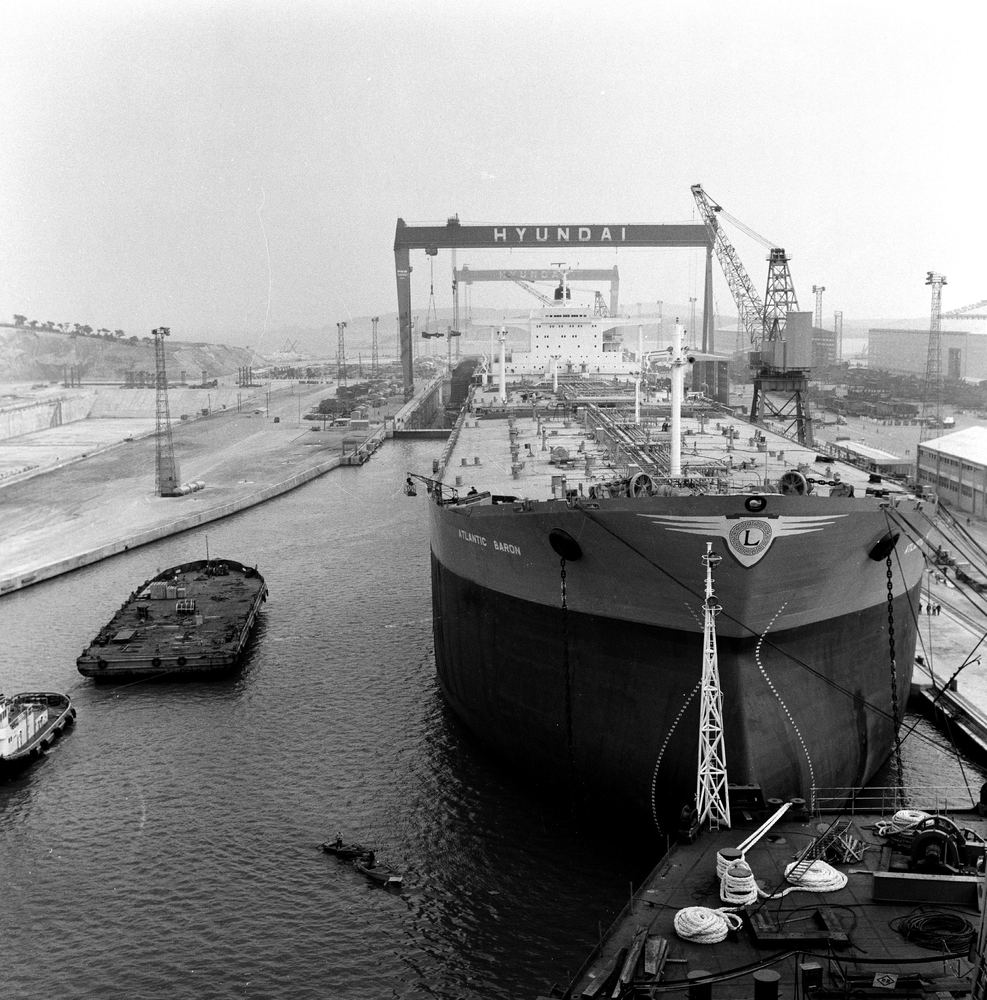
At 11 a.m. on 28 June 1974, the shipyard's completion and the naming of its first two ships were one ceremony, broadcast live on national television, with about 50,000 people on site. First Lady Yuk Young-soo named ship No. 1 Atlantic Baron. Ship No. 2 had gone into the water eight days earlier without a propeller, painted only on the side facing the stands. Park wrote four characters for the yard, 造船立國, "build the nation on ships", later carved in stone outside the main office.
The car side moved as fast. Hyundai showed the Pony, Korea's first mass-produced car of its own design, at the Turin Motor Show on 30 October 1974. Mass production began in Ulsan in December 1975, and in July 1976 five Ponys went to Ecuador, the start of regular exports.
He kept improvising. In 1984, on a land-reclamation project at Seosan on the west coast, the last 270 metres of a sea dyke wouldn't close against the tide. Hyundai sank a 230,000-ton-class tanker bought for scrap into the gap and closed it in two days. In Baden-Baden on 30 September 1981, with Chung leading the private bid committee, the IOC voted Seoul 52, Nagoya 27 for the 1988 Olympics. In 1992 he ran for president and came third with 16.3%. Not every pitch closed.
1998: one cow becomes a thousand and one
In June 1998 Chung was 82. On the morning of 16 June, at Imjingak (임진각) near the border, he told reporters he hoped the trip would lay a foundation for reconciliation. Then 50 trucks carrying 500 cattle drove to Panmunjom, the truce village, and at 9:22 a.m. the cattle trucks crossed into its northern side. Chung followed on foot across the Military Demarcation Line. The Encyclopedia of Korean Culture records it as the first time since the division that a civilian had gone north through Panmunjom under a private agreement.
He explained the cattle himself: he had left home with his father's money from the sale of a cow, and now "one cow has become 1,000 cattle, and I am going to repay that debt."
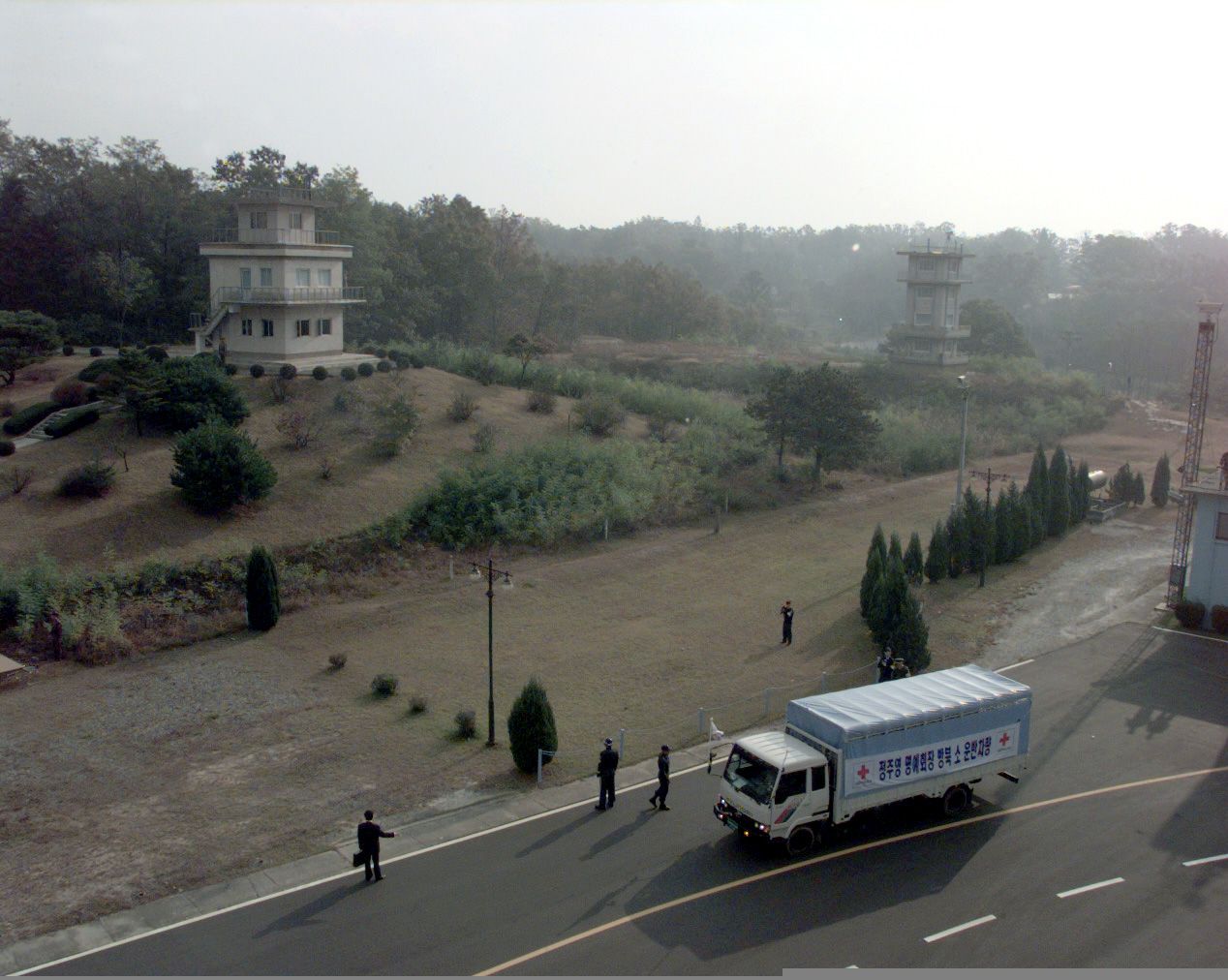
On 27 October 1998 he went again with 501 more. Seoul Shinmun's archive photos show that convoy crossing the Unification Bridge (통일대교), with the cattle from Hyundai's Seosan farm. On the night of 30 October, Kim Jong-il came to his Pyongyang guesthouse for a surprise 45-minute meeting. On 18 November 1998 the first tour ship sailed for Mount Kumgang (금강산).
Why 1,001? The usual reading in Korea is that a thousand is an ending and one more is a beginning. In the records we read, Chung never said. He died on 21 March 2001, aged 85.
Where to see the Chung Ju-yung story today
His birthplace is in North Korea; these places can be visited. Details were checked on official pages on 16 October 2026; confirm before you go.
| Place | Link to the story | Address | Hours and cost |
|---|---|---|---|
| Bank of Korea Money Museum (화폐박물관), Seoul | Korea's banknote history | 39 Namdaemun-ro, Jung-gu | Tue–Sun 10:00–17:00, last entry 16:40. Closed Mondays, Seollal, Chuseok, Labor Day, election days, 29 Dec–2 Jan. Free. |
| Imjingak (임진각), Paju | Where Chung spoke on 16 June 1998 | 177 Imjingak-ro, Munsan-eup | Open all year. Parking ₩1,000–5,000 by vehicle size. |
| Ulsan Bridge Observatory (울산대교 전망대) | View over Dong-gu, the shipyard district | 155-1 Bongsu-ro, Dong-gu, Ulsan | 09:00–21:00. Closed 2nd and 4th Mondays, Seollal and Chuseok days. Free. |
| Hyundai Motor Ulsan Plant tour | Where Pony production began in 1975 | 700 Yeompo-ro, Buk-gu, Ulsan | Weekdays, booked in advance. Free. |
| HD Hyundai Heavy Industries yard | The beach itself | Dong-gu, Ulsan | No general tours (safety and security) |
Bank of Korea Money Museum, Seoul
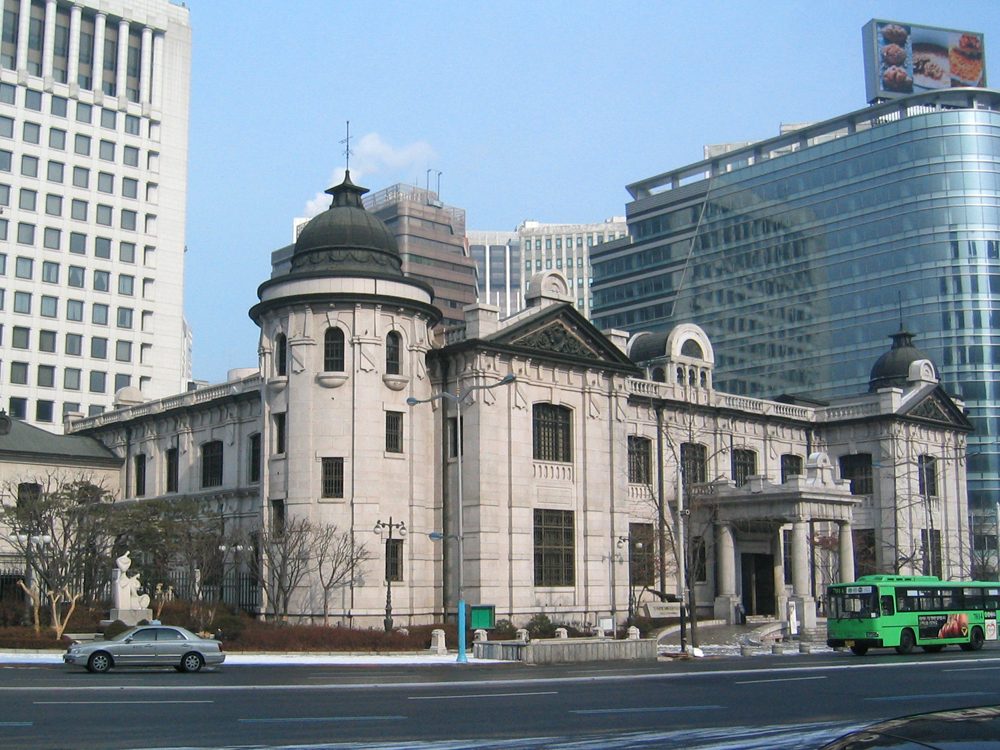
This is the place to understand the money Chung put on the table. Entry is free and self-guided, and the museum runs a 30-minute guided tour for foreign visitors at 14:00, booked online. Use Exit 7 at City Hall (Lines 1 and 2), Euljiro 1-ga (Line 2) or Hoehyeon (Line 4). We couldn't confirm from the museum's online catalogue that the 1966 turtle-ship note is on display now, so ask at the desk.
Imjingak, Paju
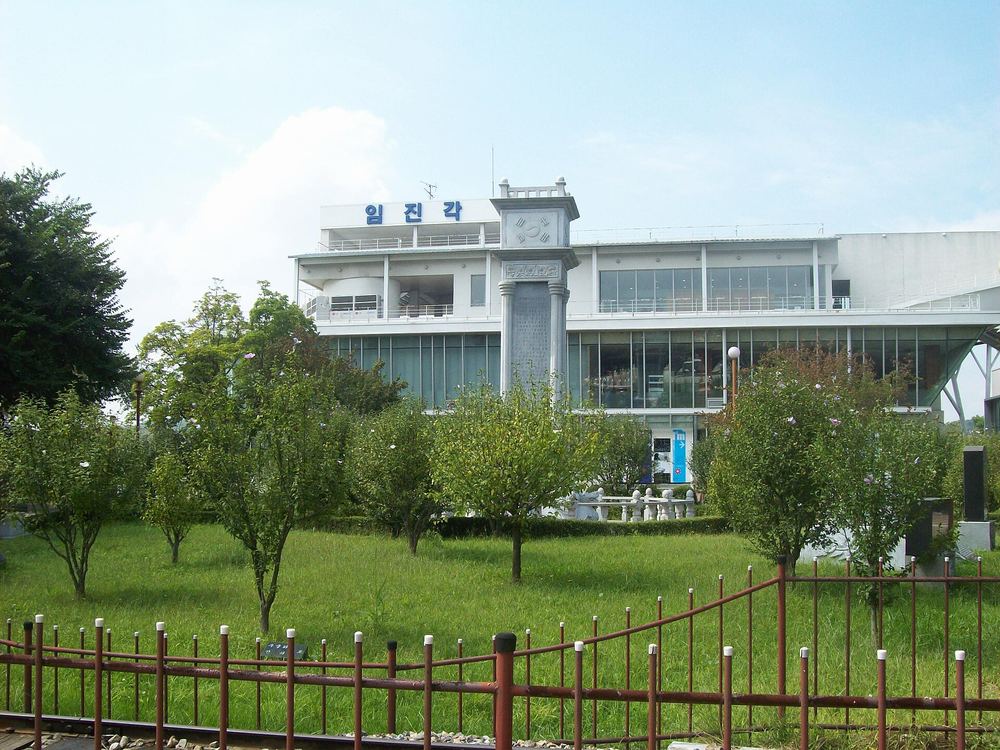
Imjingak is as close to the cattle route as you can get without a tour. It is about 56 km from Seoul City Hall and 7 km from the DMZ, and open all year. Beyond it the road to the border is military-controlled. Civilian tours of Panmunjom itself have been suspended and resumed several times in recent years, so read our DMZ tour guide and what to know before a DMZ visit before booking anything that promises the JSA.
Ulsan: the view, the car plant, and what you can't do
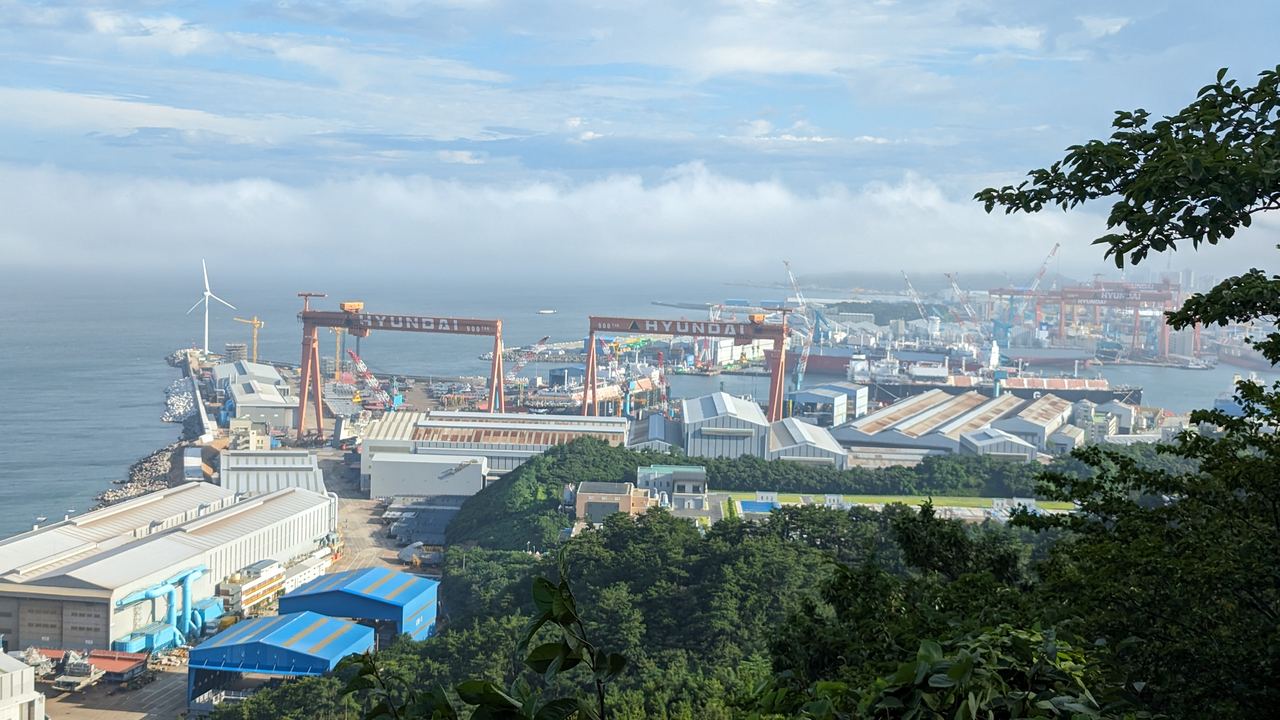
Ulsan's official tourism page (updated 4 August 2026) says general tours of HD Hyundai Heavy Industries are not available for safety and security reasons. The founder's memorial exhibition, opened inside the Ulsan headquarters in 2009, is out of reach for the same reason. What you can do:
- Ulsan Bridge Observatory, on Hwajeongsan in Dong-gu. Dong-gu's official page says the upper floors look over the bridge and the city's petrochemical, car and shipbuilding districts. It is free. If its car park is full, park at the public lot and walk about 15 minutes, the same walk as from the Dong-gu Office bus stop.
- Hyundai Motor Ulsan Plant tour. Hyundai's booking page (Korean) offers free weekday tours with no meals, transport or souvenirs, and no photography inside. Slots open three months ahead, released at 9 a.m. on the first working day of each month. Individual bookings take up to four people and ride round the plant on a company bus. Groups with foreigners are a separate category, with English or Chinese as options. If you don't read Korean, email ulsantour@hyundai.com or call 052-215-1021~1024 on weekdays.
Plant tours run in office hours, so from Seoul plan a night in Ulsan.
Ulsan on Agoda: stay on the east side for an early plant tour The shipyard and the observatory are in Dong-gu and the car plant is in Buk-gu, both on the east side of the city, while Ulsan's KTX station is well outside town to the west. EpicKor may earn a commission if you book through this Agoda link, at no extra cost to you. Confirm dates, taxes, cancellation terms, room type and the final price on Agoda before booking.
Compare Ulsan stays on AgodaSeosan, where the tanker went down, is farmland with no visitor site. In June 2026 its mayor proposed naming the reclaimed land and the dyke after Chung (Newsis). That is a proposal, not an attraction.
What the story tells you about Korea's economy
If you want one story that explains Korea's fast growth, use the Livanos deal, not the banknote. A private company sold what it couldn't yet build, at a discount it couldn't yet afford, counted on speed to make the money back, and moved once the state had signed. Its strains still show in stories like our Hyundai, Kia and GM bonus report.
The cattle are the other half. In his own account, the ₩70 was a debt, and he repaid it at 1,001 cattle for one cow.
FAQ
Q: Did Chung Ju-yung really get a shipyard loan by showing a ₩500 banknote? A: He showed the note, but to a consultant, Charles Longbottom of A&P Appledore, not to a banker, according to Hyundai Heavy Industries' official history. Longbottom then recommended Hyundai to Barclays. Britain's export credit agency still demanded a buyer, and Hyundai found one by pricing two tankers 16% below market. The Korean government approved the loans in December 1971.
Q: How many cattle did Chung Ju-yung send to North Korea, and when? A: 1,001: 500 in 50 trucks through Panmunjom on 16 June 1998, and 501 on 27 October 1998.
Q: Can I tour the Hyundai shipyard in Ulsan? A: Not as a member of the public. Ulsan's official tourism page says general tours of HD Hyundai Heavy Industries are not available. You can see the shipbuilding district from the free Ulsan Bridge Observatory, and book a free weekday tour of the Hyundai Motor Ulsan Plant.
Q: Where can I see the turtle-ship ₩500 note? A: The 1966 note is out of circulation. The Bank of Korea Money Museum in Seoul covers Korea's banknote history and is free, Tuesday to Sunday. Ask at the desk whether that note is on display.
Sources
All pages were read on 16 October 2026 unless a date is given.
- Loan, banknote, Longbottom, ECGD, the photo, map and drawing, Livanos terms, government approval, groundbreaking, breakwater, completion and naming, 造船立國: HD Hyundai, 현대중공업그룹 50년사, vol. 1 (PDF), pp. 36–64.
- Birth, runaways, rice store, rationing, garage fire, 1946–47 signs, 1992 vote, death: Asan Chung Ju-yung Memorial, life chronology.
- The ₩70, the 1998 crossings, Imjingak remarks, "one cow" quote, Kim Jong-il meeting, Mount Kumgang: Encyclopedia of Korean Culture, 정주영 소떼 방북사건.
- Unification Bridge and Seosan farm photo captions: Seoul Shinmun, 26 April 2018.
- Pony: Hyundai Motor Group, 포니 스토리.
- Seosan, 1984: Newsis, 24 May 2013; naming proposal: Newsis, 16 June 2026.
- 1981 IOC vote: Kyunghyang Shinmun, 29 September 2011.
- 1966 ₩500 note issue date and design (Namdaemun / turtle ship): Bank of Korea, banknote chronology 1962–1970.
- Exchange rates: 1971 average ₩347.15 per dollar, FRED XRNCUSKRA618NRUG. The ₩70 range uses the colonial won's par with the yen and the yen's 1932–33 range of 21–34 US cents (NBER Working Paper 2683), and is approximate.
- Bank of Korea Money Museum: visitor information, directions.
- Imjingak: VisitKorea. Ulsan Bridge Observatory: Ulsan Dong-gu.
- Shipyard tours: Ulsan city tourism (updated 4 August 2026); memorial exhibition: Aju Business Daily, 23 March 2009.
- Hyundai Motor plant tour: Hyundai Motor booking page; Ulsan city tourism.
The short version: the banknote got Chung a meeting, a discount got him a buyer, and the state's signature got him the money. Twenty-seven years later he paid back a cow with 1,001 cattle. You can stand where he spoke at Imjingak and look over his shipyard from a hill in Ulsan, but you can't walk the beach itself.
You Might Also Like
Why Korea Has a Real-Name Banking Law: The 1982 Jang Young-ja Promissory-Note Scandal
In 1982 a Seoul couple ran ₩711.1 billion ($985M) of promissory notes through 14 months, sank two firms and cost 11 ministers their jobs. Korea announced real-name banking that July. The law waited until 1993, then caught her again.
Gisa Sikdang in Seoul: Where Korean Taxi Drivers Eat, What to Order and What It Costs
Seoul's taxi-driver diners aren't cheap any more: the pork bulbaek Yeonnam-dong's 24-hour Gamnamujip sold for ₩9,000 in 2019 is listed at ₩13,000 now. Where gisa sikdang still cluster, what to order, and how they work.
Where to Stay in Yeosu, Korea: Expo Station vs Yi Sun-sin Square vs Dolsan, by KTX and Cable Car
Yeosu's own room-rate register puts the median autumn weekend room at ₩60,000–70,000 near Expo station and the old town, and ₩245,000 on Dolsan. Plus the ₩45,400 KTX, the ₩17,000 cable car, cash-free buses and the Island Expo crowds.