Seoul Subway With a Stroller: Every Seoul-Run Station Now Has a Street-to-Platform Elevator — at Half of Seoul Metro's on Just One Exit — and Only 108 Have a Nursing Room
Last updated: September 2026. The elevator exits are from Seoul Metro's own elevator register (서울교통공사 엘리베이터 설치현황, dated 11 February 2026) and the nursing rooms from its nursing-room file (dated 16 June 2026), both published on Korea's public data portal; the station totals are Seoul Metropolitan Government's, as reported on 29 December 2025 and 11 September 2026; fares are from the Seoul Metro tariff revised on 7 March 2026. Sources are listed at the end.
On 29 December 2025, when Seoul marked Kkachisan station on Line 5 as the last to be done, it completed an 18-year, ₩175.1 billion project: every one of the 338 stations on the lines Seoul runs now has an elevator route from the street to the platform. For anyone pushing a stroller, that is the best news the Seoul subway has had in a generation, and many English guides have not caught up, still describing elevators as found at "the majority" of stations.
The official name for the project explains the catch. It is 1역사 1동선, "one station, one route": one continuous elevator path per station, not one per exit. In Seoul Metro's own elevator register, 116 of the 217 stations that list a street-level elevator have it at exactly one exit. At Myeongdong it is exit 1. At Gyeongbokgung it is exit 4. At Hongik University it is exit 8. Walk out of the wrong exit with a stroller and you meet a staircase. And on the same network, only 108 of 338 stations have a nursing room; Hongik University, Myeongdong, Gyeongbokgung and Seoul Station's Line 1 platforms have none.
This guide gives you the elevator exit and the nursing room at the stations visitors actually use, and everything else a parent needs to ride Seoul's subway with a stroller.
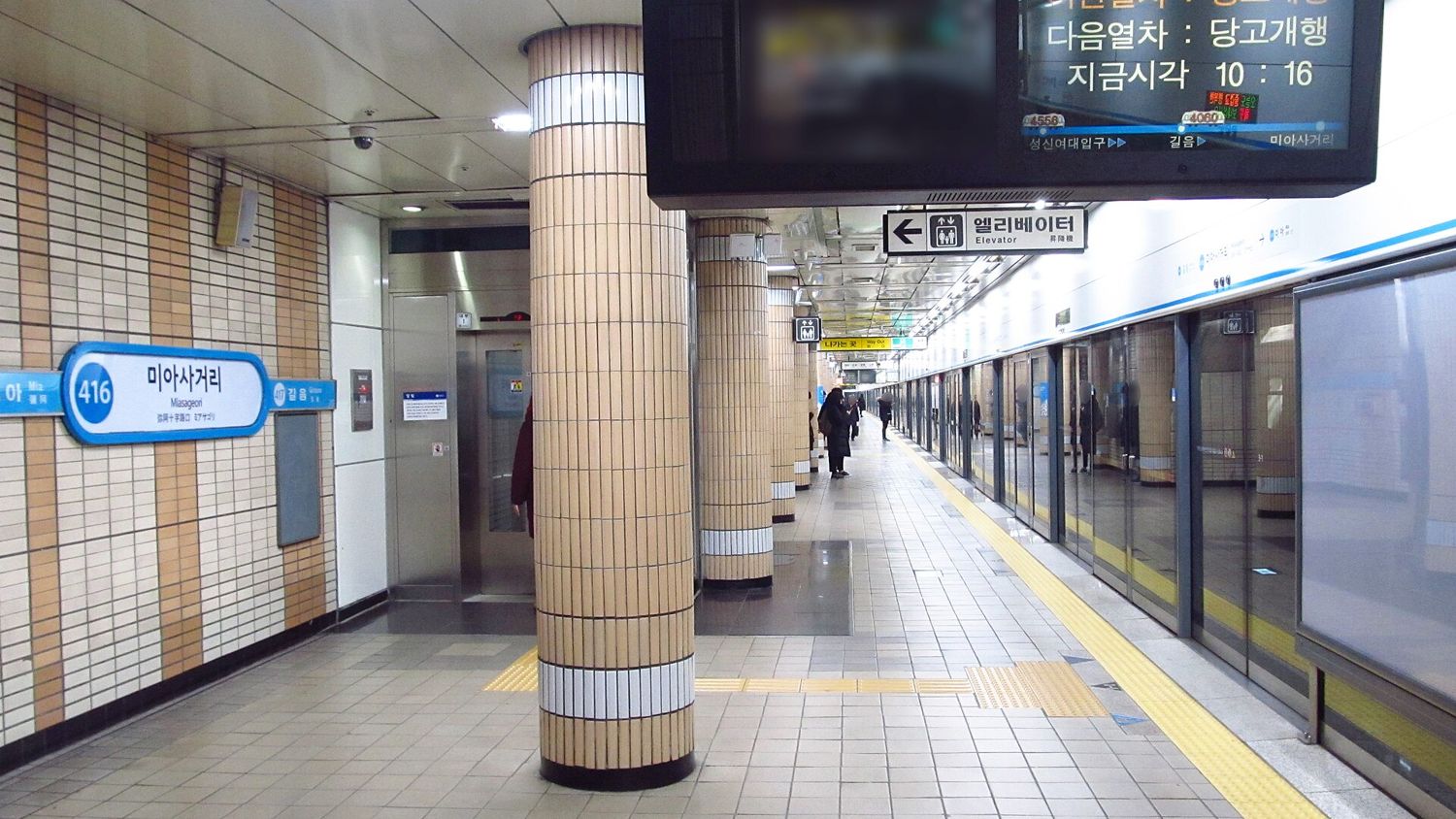
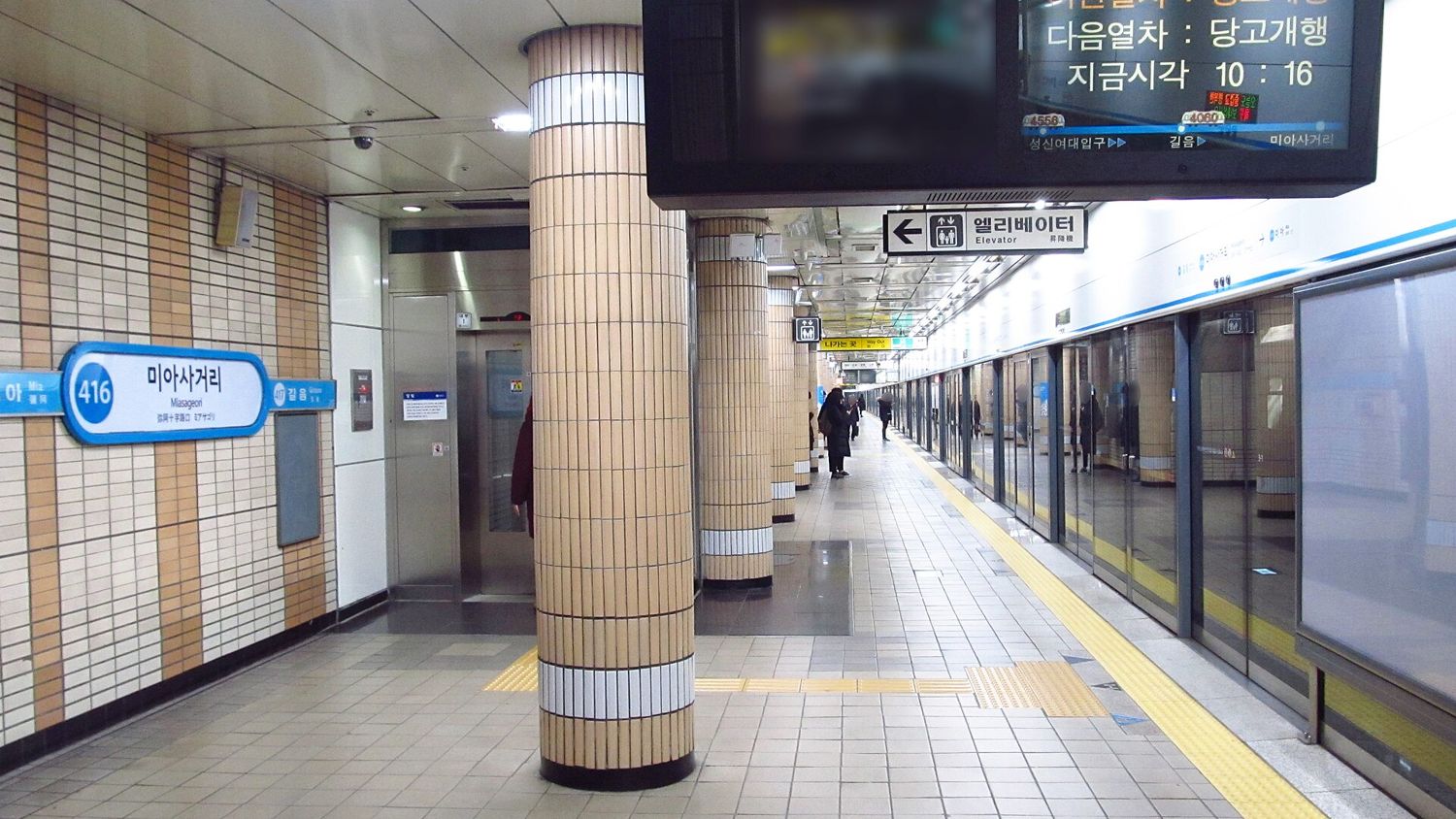
The platform elevator at Miasageori station on Line 4. Every Seoul-run station now has at least one continuous elevator route from platform to street. Photo: LERK, Wikimedia Commons, CC BY-SA 4.0.
The stroller that makes a one-elevator station painless: the BABYZEN YOYO2 folds with one hand to cabin-bag size, so when the elevator is at the other end of the concourse you can fold it and carry it up the stairs instead. As an Amazon Associate, EpicKor earns from qualifying purchases.
Quick Guide: the Seoul subway with a stroller, 2026
| Question | Answer | Source |
|---|---|---|
| Does every station have an elevator? | Yes, all 338 Seoul-run stations (Lines 1–9, Ui-Sinseol, Sillim) since 29 Dec 2025 | Seoul Metropolitan Government |
| At every exit? | No. 116 of 217 Seoul Metro stations have the street elevator at one exit only | Seoul Metro register, Feb 2026 |
| Korail-run stations in Seoul | Outside the project; Namyeong, Sinimun and Hankuk Univ. of Foreign Studies on Line 1 had no elevator as of December 2025 | Korean press, Dec 2025 |
| Nursing rooms | 108 of 338 stations (32%); none on Line 9 phase 1 or the Ui-Sinseol line | National Assembly data, Sep 2026 |
| Children's fares | Under 6 free (up to 3 per adult) · 6–12 ₩550 · 13–18 ₩900 · adult ₩1,550 (card) | Seoul Metro tariff, Mar 2026 |
| Escalators | Seoul Metro asks stroller users to take the elevator | Seoul Metro safety campaign |
| Wide platform gap | Ask station staff for a portable ramp | Seoul Metropolitan Government |
Ergobaby Omni Classic — the backup for the stairs-only exit At half of Seoul Metro's stations the only street elevator is at one exit, and on a few Korail stations there is none. A carrier lets one parent take the baby while the other folds the stroller. The Omni works from newborn to 48 months. As an Amazon Associate, EpicKor earns from qualifying purchases.
See the Ergobaby Omni Classic on AmazonWhat "one station, one route" really means
Seoul's definition is precise: 1역사 1동선 is a route by which "a person with limited mobility can travel from street level to the platform by elevator without anyone's help". It guarantees one such route per station. Korea's design guideline for subway lifts calls for a street elevator on each side of a road, or only one where people can cross at street level, which is why most stations end up with one or two.
Seoul Metro's register, which lists every elevator on the lines it runs with the exit it stands beside, shows how that plays out:
| Street-level elevators | Stations | Share |
|---|---|---|
| At one exit | 116 | 53% |
| At two exits | 81 | 37% |
| At three or more exits | 20 | 9% |
Seoul Metro register of 11 February 2026: 217 stations that list a street-level elevator; transfer stations counted once. The file covers Lines 1–8 only; Line 9, the Ui-Sinseol line and the Sillim line are run by other operators and are not in it.
Three more things the 338 figure does not cover:
- Korail-run stations. The project covered the lines Seoul runs. Stations inside Seoul but operated by Korail, including the above-ground sections of Line 1, the Gyeongui–Jungang line and the Suin–Bundang line, were outside it, and a December 2025 report named Namyeong, Sinimun and Hankuk University of Foreign Studies (외대앞) on Line 1 as still having no elevator at all.
- Transfers. Changing lines inside a big station can still mean long corridors and a separate elevator for each level. Seoul says transfer complaints concentrate at 13 big stations, such as Nowon, Konkuk University and Express Bus Terminal, and has set a target of under ten minutes for every transfer.
- Recent routes. Some central stations only got their route recently: Myeongdong's was completed in 2022.
The elevator exit and nursing room at 16 stations visitors use
This is the table to screenshot. "Elevator exit" is the exit beside which the street elevator stands. "Nursing room" gives where it is and whether it is inside the paid gates or outside them (outside means you can use it without tapping in).
| Station (line) | Street elevator at exit | Nursing room | Near |
|---|---|---|---|
| Myeongdong (4) | 1 only | None | Myeongdong shopping, N Seoul Tower bus |
| Gyeongbokgung (3) | 4 only | None | Gyeongbokgung, National Folk Museum |
| Anguk (3) | 6 only | None | Bukchon, Insadong, Seoul Museum of Craft Art |
| Gwanghwamun (5) | 1 only | Yes, B2, outside the gates | Gwanghwamun Square, Gyeongbokgung |
| Jonggak (1) | 1, 3 | None | Cheonggyecheon, Insadong |
| City Hall (1 / 2) | Line 1: between 1 and 2 · Line 2: 9 only | Line 2 only, B2, inside the gates | Deoksugung, Seoul Plaza |
| Seoul Station (1 / 4) | Line 1: 2, 3, 4 · Line 4: 12 only | Line 4 only, B1, outside the gates | KTX, AREX |
| Hongik Univ. (2) | 8 only | None | Hongdae (AREX and Gyeongui–Jungang parts not covered) |
| Itaewon (6) | 2 only | Yes, B1, inside the gates | Itaewon |
| Euljiro 1-ga (2) | 1, 5 | None | Myeongdong north, Lotte Department Store |
| Dongdaemun History & Culture Park (2 / 4 / 5) | Line 2: 1 only · Line 4: 4 only | Yes, Lines 4 and 5, outside the gates | DDP, Dongdaemun markets |
| Hyehwa (4) | 2, 3 | None | Daehangno theatres |
| Ichon (4) | 1, 2 | Yes, inside the gates | National Museum of Korea (Korail part not covered) |
| Gangnam (2) | 1, 10 | Yes, B1, inside the gates | Gangnam |
| Jamsil (2 / 8) | Line 2: 1, 6 · Line 8: 9 only | Yes, on both lines, outside the gates | Lotte World |
| Seongsu (2) | 1, 4 | Yes, inside the gates on the exit 1 side | Seongsu cafés and pop-ups |
Seoul Metro elevator register (11 February 2026) and nursing-room file (16 June 2026). Lines run by Korail, AREX and the Line 9 operator are not in these files.
Ten of these sixteen stations have their street elevator at only one exit on at least one line, and seven have no nursing room at all. The pattern is worst in the old centre and Daehangno: Myeongdong, Gyeongbokgung, Anguk, Jonggak and Hyehwa have no nursing room between them.
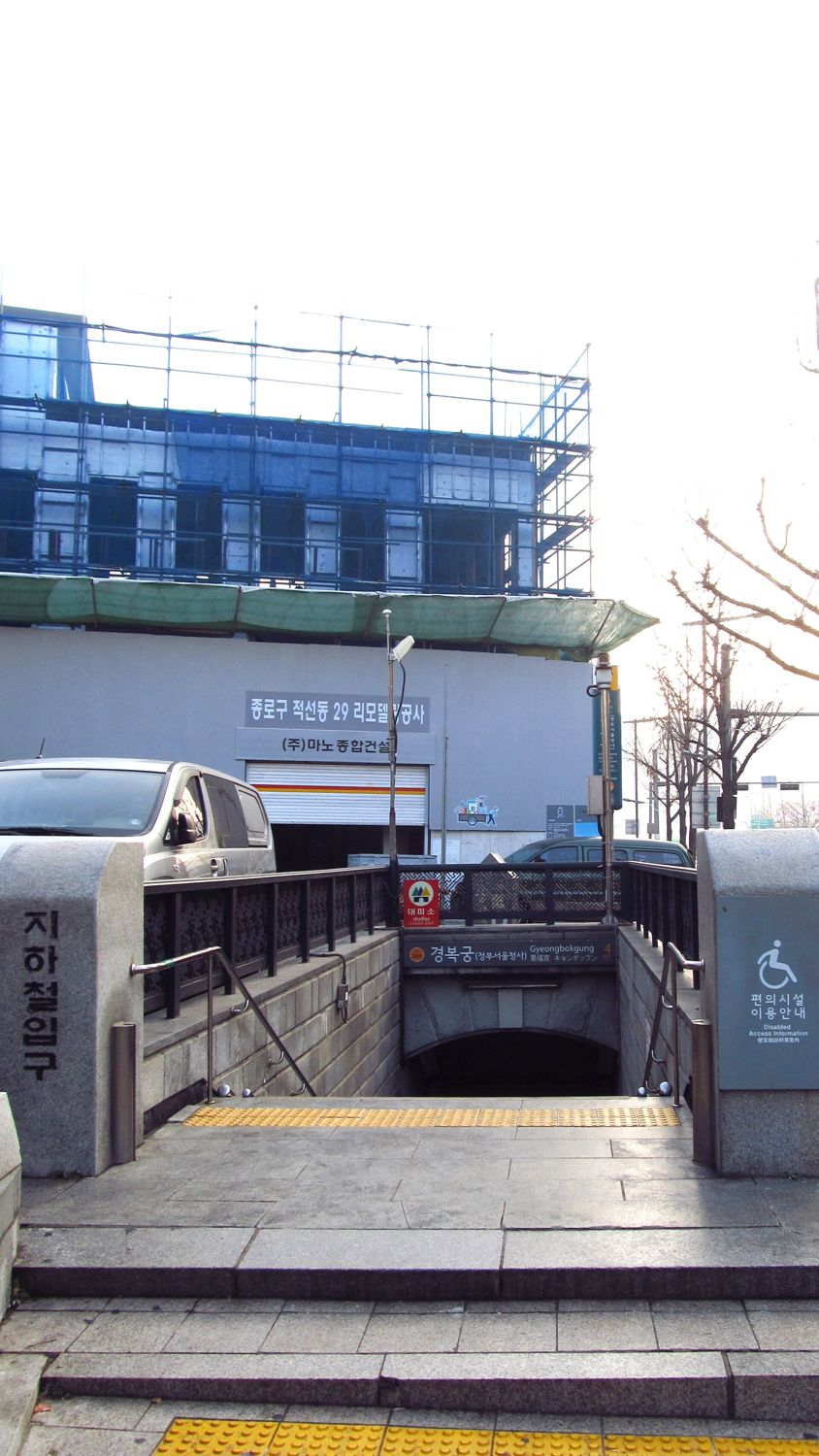
Exit 4 at Gyeongbokgung station, with its "Disabled Access Information" panel. Seoul Metro's register places the station's only street elevator beside this exit, though it is not in the photo. Photo: LERK, Wikimedia Commons, CC BY-SA 4.0.
Nursing rooms: 108 out of 338
Figures released on 11 September 2026 by the office of National Assembly member Hwang Un-ha, from Seoul City and Seoul Metro data, give the picture:
- 108 of 338 stations have a nursing room, 32 percent.
- On Seoul Metro's Lines 1–8, 86 of 276; on Line 9 phase 1, 0 of 25; on the Ui-Sinseol line, 0 of 13. (Line 9's newer phases and the Sillim line do better, at 12 of 13 and 10 of 11.)
- Of the 30 busiest stations, 21 have none, including Hongik University, Seoul Station's Line 1 side, Sindorim, Euljiro 1-ga, Jonggak, Yeoksam, Seolleung and Guro Digital Complex.
- Seoul Metro's reason for not adding more: rooms averaged 0.21 users a day in 2025.
The rooms that do exist are small family rooms, each with a diaper-changing table, and most sit beside the station's customer safety office (고객안전실). Many are outside the gates, so you can use them without paying a fare. When the station has none, the reliable fallbacks above ground are department stores, which run free nursing lounges (Lotte Department Store's are next to Euljiro 1-ga station), and big malls.
Gates, platforms and escalators
- Gates. Korea's design guideline puts an automatic gate at least 900 mm wide, for wheelchairs and strollers, next to the ticket machines in each station. Tap your card at that gate like any other; look for the wheelchair symbol.
- Boarding. Platform screen doors mark the accessible boarding spot with a wheelchair symbol; the cars behind those doors have space for wheelchairs and strollers.
- Platform gaps. On curved platforms the gap can be wide. Seoul Metropolitan Government says that passengers with wheelchairs or strollers can ask station staff to lay a portable ramp.
- Escalators. Seoul Metro's safety campaign tells passengers with strollers or hand carts to use the elevator. Its own figures, released in February 2026, count 43 escalator accidents in 2023, 54 in 2024 and 86 in 2025, and it names forcing strollers and carts onto escalators among the causes.
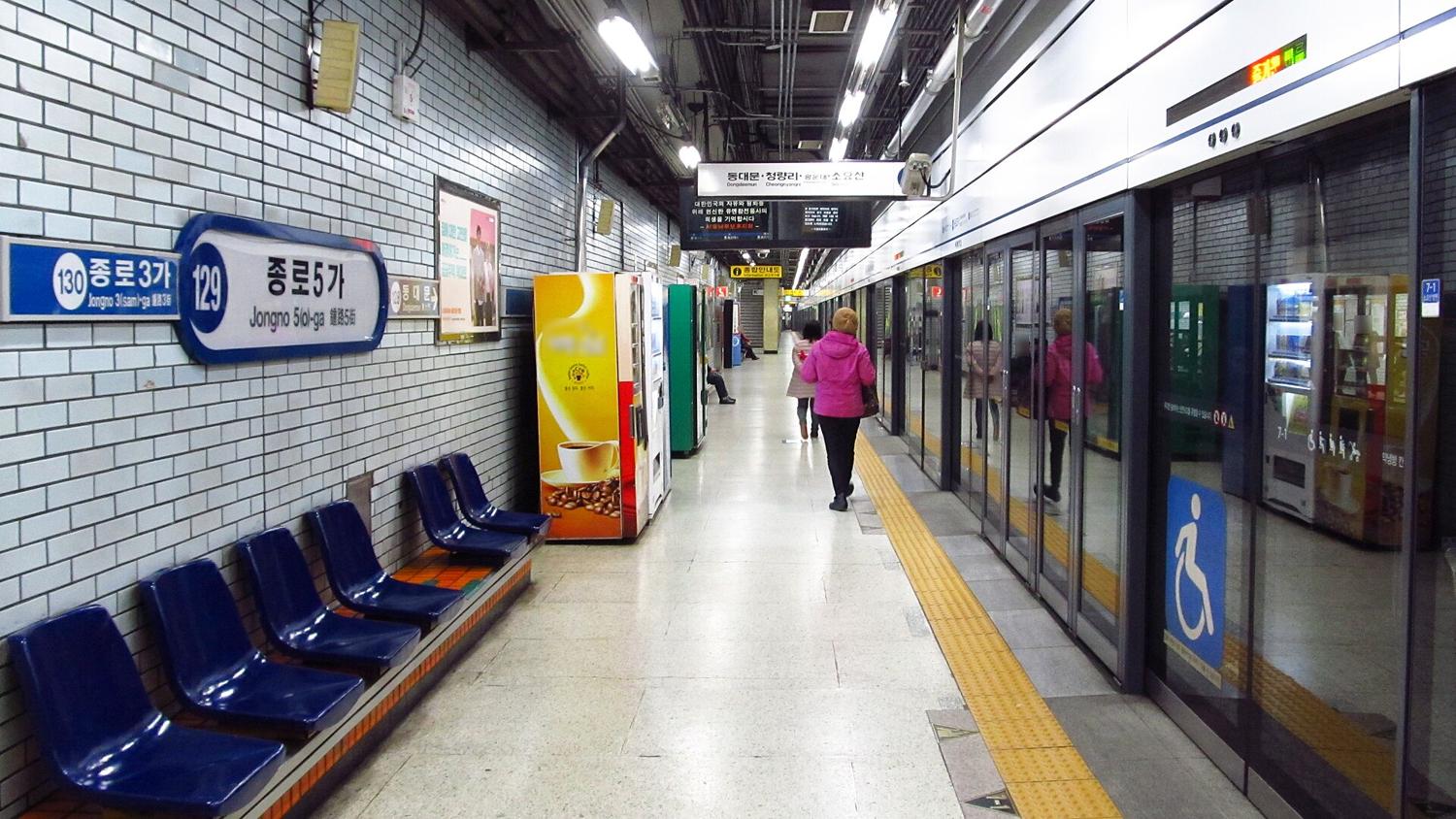
The wheelchair symbol on a platform screen door at Jongno 5-ga, Line 1, marking where the accessible car stops. Photo: LERK, Wikimedia Commons, CC BY-SA 4.0.
Fares for children, and the T-money trap
Seoul Metro's tariff, revised on 7 March 2026:
- Under 6: free, up to three children per accompanying adult; a fourth pays the child fare.
- 6 to 12: ₩550 by card. 13 to 18: ₩900 by card. Adults: ₩1,550 by card (₩1,650 on a single-journey ticket).
- The trap: a T-money card charges the adult fare unless it has been registered as a child card. T-money's foreigner guide says to register the card with the child's date of birth at a convenience store or a station information centre, showing the card and an ID. Using a child card as an adult carries a penalty of 30 times the base fare.
On the AREX Express (the non-stop airport train), the rule is stricter: only one free infant per guardian, and a second infant, or one who needs a seat, needs a child ticket. The AREX all-stop train follows the subway rule: up to three under-6s ride free with each adult. For cards and top-ups, see our Korea payment guide.
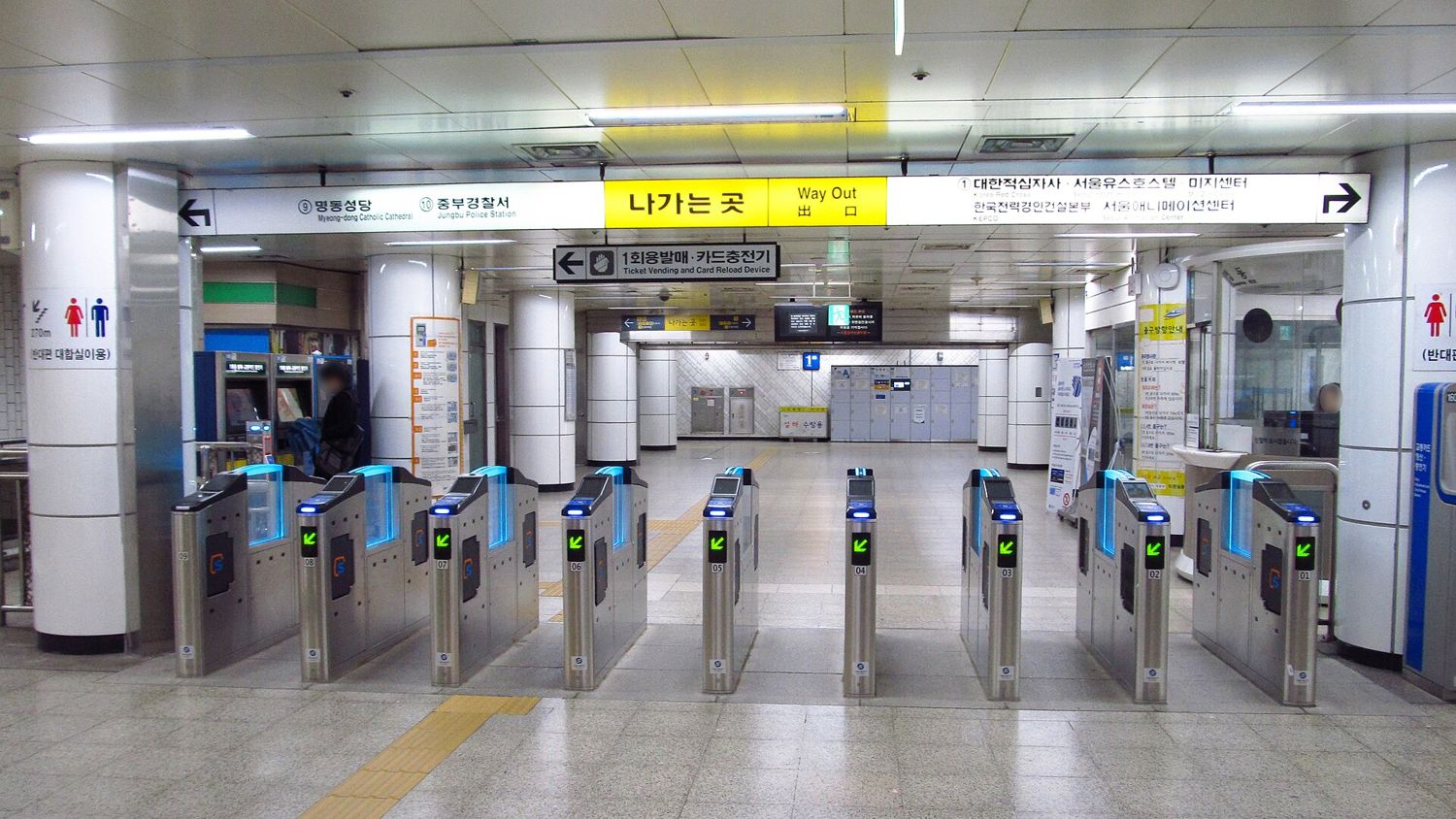
The gates at Myeongdong station. Its only street elevator is at exit 1, so check the exit signs before you head up. Photo: LERK, Wikimedia Commons, CC BY-SA 4.0.
How to find the elevator exit before you go
- Station signs. Every station's exit signage and the "Disabled Access Information" (편의시설 이용안내) panels show where the elevator is. Check them on the platform, before you choose a direction.
- Naver Map. Since 1 August 2025 its transit directions have had a stair-avoiding (계단회피) option that routes you through stations' elevator exits, and the app works in English.
- Seoul Metro's Ttota app (또타지하철). Its accessible-route button shows which exit has the elevator and whether any elevator is out of service. It is mainly in Korean.
- Seoul Donghaeng Map (서울동행맵). Seoul's own step-free routing app, launched in November 2024.
- The official English accessibility table on Seoul's English site lists how many elevators each station has, but not which exits, so it will not answer the question that matters.
A plan that works
- Choose your hotel by its elevator exit. A hotel two minutes from Myeongdong exit 1 is a different trip from one two minutes from exit 8. Our Seoul with kids guide covers where families base themselves.
- Know your elevator exit before you ride. Use the table above, or the station signs when you arrive on the platform.
- Avoid the rush hours. Weekday mornings from roughly 7 to 9 a.m. and evenings from roughly 6 to 8 p.m. are the hardest times to fit a stroller into a car or an elevator queue.
- Watch for Korail lines. On Line 1 north and south of central Seoul, the Gyeongui–Jungang line and the Suin–Bundang line, check the station before you go; a few still have no elevator.
- Carry a plan B. A carrier, or a stroller you can fold with one hand, turns a stairs-only exit into a minor delay.
For the car journeys you cannot avoid, see our guide to car seat taxis in Korea; for airport transfers, the Incheon Airport to Seoul guide.
FAQ
Q: Is the Seoul subway stroller friendly? Largely, and much more so than a few years ago. Since 29 December 2025 all 338 stations on the lines Seoul runs have a continuous elevator route from street to platform. The catch is that at about half of Seoul Metro's stations that elevator is at one exit only, so you need to know which exit to use.
Q: Does every Seoul subway station have an elevator? Every station on the Seoul-run lines does (Lines 1–9, Ui-Sinseol, Sillim). Some Korail-run stations inside Seoul, such as Namyeong, Sinimun and Hankuk University of Foreign Studies on Line 1, did not as of December 2025.
Q: Which exit has the elevator at Myeongdong station? Exit 1, according to Seoul Metro's February 2026 elevator register. At Gyeongbokgung it is exit 4, at Anguk exit 6, at Hongik University exit 8 and at Itaewon exit 2.
Q: Are there nursing rooms in Seoul subway stations? In 108 of 338 stations. Among stations visitors use, City Hall (Line 2), Seoul Station (Line 4), Gwanghwamun, Itaewon, Gangnam, Jamsil, Dongdaemun History & Culture Park, Ichon and Seongsu have one; Myeongdong, Gyeongbokgung, Anguk, Jonggak, Hongik University and Euljiro 1-ga do not.
Q: Do children ride the Seoul subway free? Children under 6 ride free, up to three per accompanying adult. Children aged 6 to 12 pay ₩550 by card, but only on a T-money card registered as a child card; otherwise the card charges the adult fare.
Q: Can I take a stroller on the escalator in the Seoul subway? Seoul Metro asks passengers with strollers to use the elevator, and names forcing strollers onto escalators among the causes of escalator accidents.
Sources
- Seoul Metropolitan Government, completion of 1역사 1동선 at all 338 stations, 29 December 2025, as reported by Asia Economy (asiae.co.kr, 2025122914563196138): definition, Kkachisan last, ₩175.1 billion on 79 stations since 2008.
- Seoul Metro (서울교통공사), elevator installation register, data.go.kr dataset 15044261, file dated 11 February 2026: street elevators by exit (EpicKor count: 217 stations with a street-level elevator, 116 at one exit).
- Seoul Metro, nursing-room register, data.go.kr dataset 15044264, file dated 16 June 2026: 86 rooms with location and paid/unpaid area.
- Office of National Assembly member Hwang Un-ha, figures reported by Daily Environment (dailyt.co.kr) and M-Economy News on 11 September 2026: 108/338 stations, operator breakdown, 21 of the 30 busiest stations without a room, 0.21 users a day.
- Nextday (ntoday.co.kr), 31 December 2025: Korail-run sections outside the project; Namyeong, Sinimun and Hankuk Univ. of Foreign Studies without elevators.
- Seoul Metropolitan Government transport news (news.seoul.go.kr/traffic/archives/509491): portable ramps on request; Myeongdong route secured in 2022.
- Railway Economy (redaily.co.kr), 12 February 2026: Seoul Metro escalator accidents 43 (2023), 54 (2024), 86 (2025); safety campaign. Seoul Shinmun, 24 September 2025: causes including strollers and hand carts.
- Newspim and Asia Economy, 1 August 2025: Naver Map stair-avoiding transit option.
- Seoul Metro passenger tariff, revised 7 March 2026: under-6 free up to three per guardian; fares.
- T-money, foreigner guide: registering a child card at convenience stores or station information centres; T-money Korean guide (pay.tmoney.co.kr): unregistered cards charge the adult fare.
- AREX (airportrailroad.com): Express ticket rules (one free infant per guardian) and all-stop fare page (up to three free infants per guardian).
You Might Also Like

Is Korea Kid-Friendly? What Foreign Parents Report — and What Korean Data Shows: Strangers Who Hand Out Tangerines, 114 No-Kids Zones, and the 68% Who Accept Them
Foreign parents say older Koreans shower babies with snacks and department-store nursing rooms beat London's. Korean data adds 114 no-kids zones, 68% public acceptance, and 64% of Korean parents who feel watched. What that means for your trip.
Car Seat Taxis in Korea: The Law Requires a Seat for Every Child Under 6, Ordinary Taxis Don't Carry One — What Tourists Can Actually Book in Seoul
Korea's Road Traffic Act requires a car seat for children under 6 in any car, taxis included, and fines the driver ₩60,000. Ordinary taxis carry none and police paused taxi enforcement in 2018. TADA, whose app takes foreign phones and cards, runs about 300 car-seat vans.
Seoul Palaces Free on Wednesdays in 2026: Deoksugung Since 5 August, Changdeokgung, Changgyeonggung and Jongmyo From 7 October — Gyeongbokgung Still Only the Last Wednesday
Korea made every Wednesday Culture Day in April 2026, and the palace office is phasing in free entry: royal tombs since 27 May, Deoksugung since 5 August, three more from 7 October. Gyeongbokgung has no date. English guides get it wrong both ways.