Is Korea Kid-Friendly? What Foreign Parents Report — and What Korean Data Shows: Strangers Who Hand Out Tangerines, 114 No-Kids Zones, and the 68% Who Accept Them
Last updated: September 2026. The parents' experiences are 50 first-hand accounts from 16 sources published between 2023 and 2026 (Reddit, family-travel blogs and Lemon8 posts), summarised and linked rather than quoted at length. The Korean data is from Hankook Research's national surveys (2021, 2023, 2025), the Korea Institute of Child Care and Education's 2024 report, a 2023 Ministry of Health and Welfare survey of no-kids-zone operators, a 2025–26 civic-group count, and the laws cited. Sources are listed at the end.
Ask foreign parents whether Korea is kid-friendly and most will say yes, often with a story: a grandmother on a bus who hands a crying toddler a piece of bread, a restaurant owner who brings a free bowl of mild broth, a department-store nursing room that beats anything back home. Ask Korean data and you get a more complicated country: 114 counted no-kids zones, 68 percent of Koreans who say those zones are acceptable, and 64 percent of Korean parents who say they watch other people's reactions whenever they are out with their child.
Both are true, and they fit together once you see who is being kind, where, and to which children. We collected 50 first-hand accounts from foreign parents who travelled or lived in Korea with babies and young children between 2023 and 2026, sorted them by theme, and set them next to the Korean numbers. The short answer: for a family with a baby or toddler on a trip, Korea is one of the warmest places you can go. The physical city and a minority of cafés are the harder parts, and knowing both makes the trip easier.
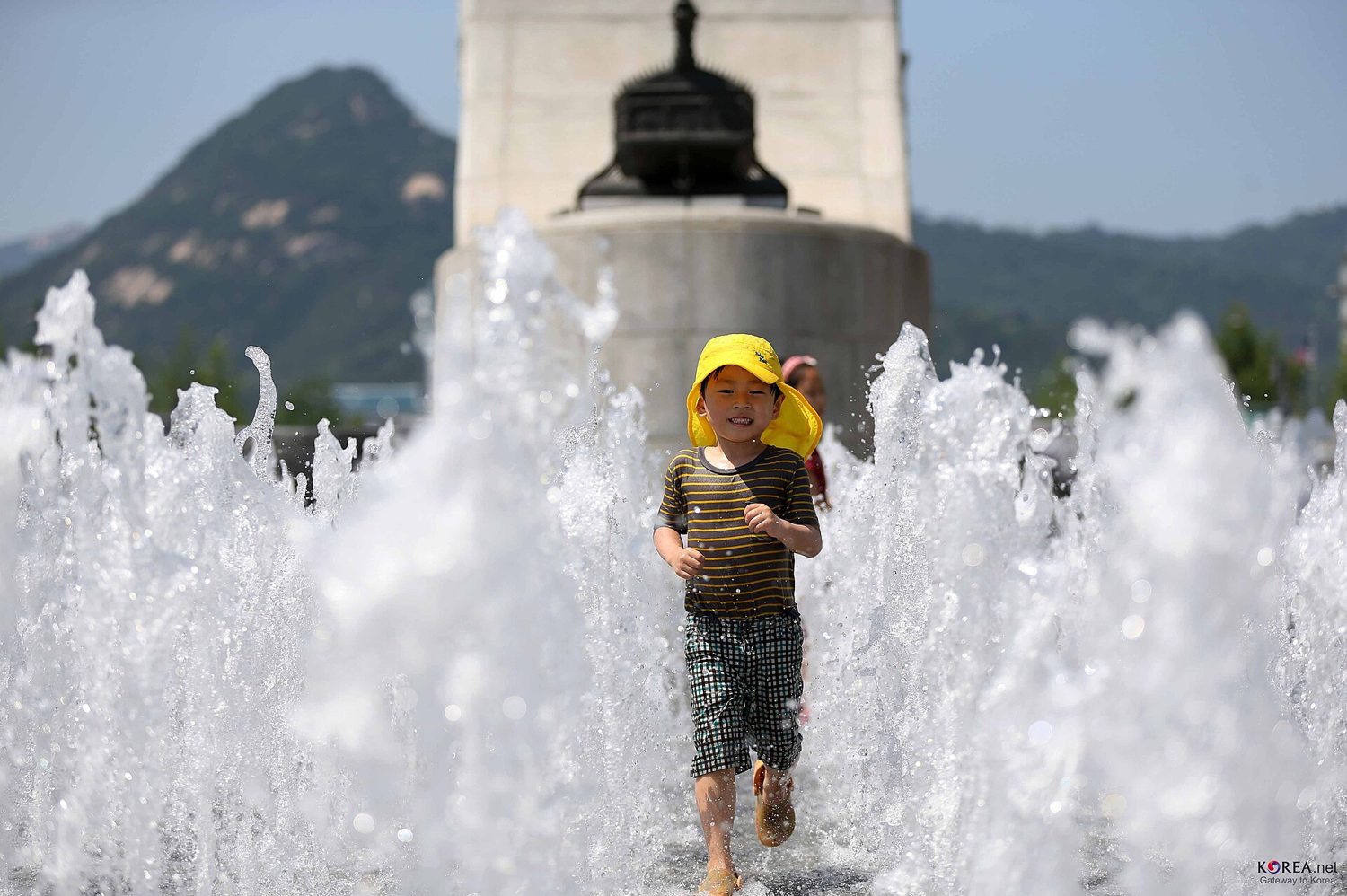
A boy running through the fountains on Gwanghwamun Square, June 2013. Photo: Jeon Han, Korea.net (Korean Culture and Information Service), Wikimedia Commons, CC BY-SA 2.0.
The one gap nearly every parent mentions is high chairs: big and mall restaurants have them, small places often don't, and many seat you on the floor. The Pop 'N Sit portable booster folds flat and works as a floor seat or a chair-top seat, for about 6 months to 3 years. As an Amazon Associate, EpicKor earns from qualifying purchases.
Quick Guide: what parents report vs what the data shows
| Topic | What foreign parents report | What Korean data shows |
|---|---|---|
| Strangers | Older Koreans dote on babies, hand out snacks, give up seats (the most common positive theme) | Children are rare: fertility rate 0.80 in 2025, 0.63 in Seoul |
| No-kids zones | Real but rarely met on a trip; one expat parent was refused three times in three years | 114 counted nationwide (late 2025), 74% cafés; 68% of Koreans accept them, down from 73% |
| How parents are seen | Some side-eye for noise, some rudeness in crowds | 64.3% of Korean parents watch others' reactions when out with a child; 40.8% have avoided going out |
| Nursing and changing | Department-store nursing lounges are the single most praised facility | 3,019 registered nursing rooms nationwide, 508 in Seoul; changing tables required by law in men's and women's toilets at stations, airports and hospitals |
| Getting around | Stairs, hills and crowds are the top complaint | All 338 Seoul-run subway stations step-free since Dec 2025, but often at one exit only |
| Restaurants | High chairs split: common in big restaurants, rare in small ones; no kids' menus | Seoul's Kids OK Zone scheme signs up restaurants with child-friendly food and pays for high chairs and tableware |
| Safety | Parents feel safe | 12 children under 13 died in road crashes in 2024; overall road deaths were the lowest since 1970 |
Skip Hop Pronto changing pad — for the toilets that don't have a table Stations, airports, motorway rest areas and general hospitals must have changing tables in both men's and women's toilets; small restaurants and cafés don't have to. A zip-off cushioned pad with a diaper pocket covers the gap. As an Amazon Associate, EpicKor earns from qualifying purchases.
See the Skip Hop Pronto on AmazonHow we built this
We kept 50 first-hand data points from 16 sources: Reddit threads in r/koreatravel and r/Living_in_Korea, family-travel blogs, expat parent blogs, and parents' posts on Lemon8, almost all from 2023 to 2026. Each point was sorted by theme and tone. Overall, 21 were positive, 17 negative and 12 mixed.
| Theme | Mentions | Mostly |
|---|---|---|
| Strollers, stairs, elevators, crowds | 13 | Negative or mixed |
| Strangers' warmth and attention | 11 | Positive |
| Nursing rooms and changing tables | 9 | Strongly positive |
| Food or gifts given to children | 8 | Positive |
| Restaurants: high chairs, staff attitude | 8 | Split |
| No-kids zones, refusals, noise disapproval | 7 | Negative |
| Practical help (seats, stroller help) | 5 | Positive |
| Touching and unsolicited comments | 4 | Mixed |
| Rudeness in transit | 3 | Negative |
A point can touch more than one theme, so the mentions add up to more than 50. Two limits are worth stating. We could not read TripAdvisor's forums, and Reddit only through an archive, so the sample leans on blogs, which skew positive. And the people who post are self-selected: happy tourists and frustrated residents both write more than the middle. Treat the counts as a map of what comes up, not a poll.
The warmth: older Koreans, snacks and seats
The most consistent story, told by tourists from London to Sydney, is attention from strangers, and it comes mostly from older people.
- Food and small gifts (8 accounts). An older woman gave a toddler a tangerine (r/Living_in_Korea, Nov 2024); another on a bus handed a crying toddler bread (r/Living_in_Korea, Dec 2025); a bus driver gave a baby snacks and a Jeju orange (JC and the Squirrel, Jan 2026); other diners played with a baby and then bought the parents iced coffee (04woodr, Nov 2024). The Soul of Seoul, written by a mother raising her daughter in Korea, says to expect staff to bring a free bowl of plain broth for a child (The Soul of Seoul).
- Attention (11). Parents describe people smiling, playing peekaboo, asking the baby's age, and one blogger's line is that with a baby you should be prepared to feel like a celebrity.
- Practical help (5). Bus passengers giving up their seats "every time" to a mother carrying her one-year-old (r/koreatravel, May 2026); a train employee helping a parent carry a stroller up the stairs (r/Living_in_Korea, Nov 2024).
One commenter in the same r/Living_in_Korea thread about the bread (December 2025) summed up the age split that runs through the accounts: people under 60 may walk straight past you, while people over 60 will come over if you so much as sneeze and "button your coat up for you".
Part of the reason is simply how rare young children have become. Korea's total fertility rate was 0.75 in 2024 and 0.80 in 2025, the second year of increase but still among the lowest in the world, and Seoul's was 0.63. A baby on a Seoul bus is an event.
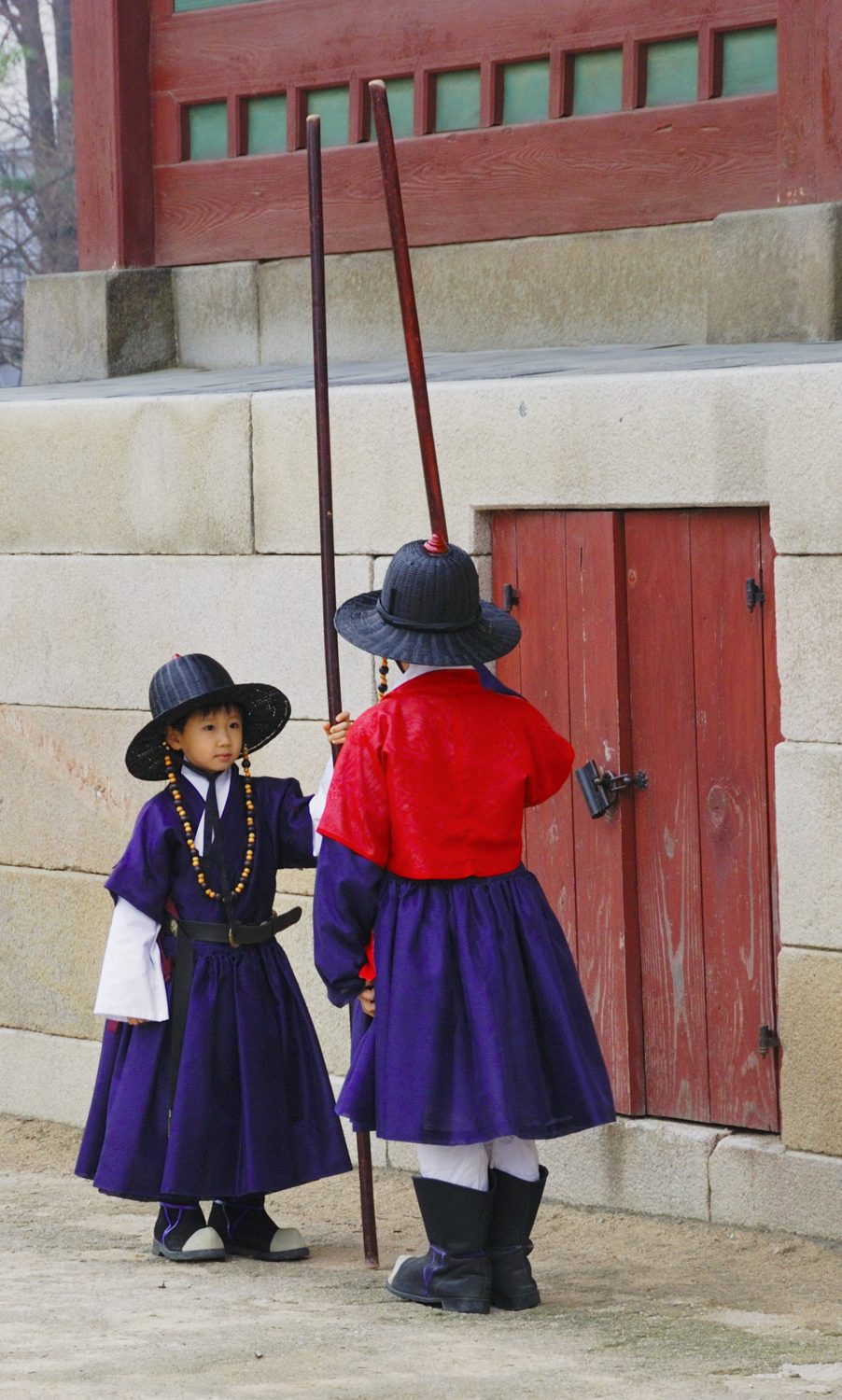
Two children in palace-guard costume at Gyeongbokgung. Children in hanbok enter Seoul's palaces free, and foreign children 18 and under are free anyway. Photo: Richard Fisher, 2009, Wikimedia Commons, CC BY 2.0.
The friction: touching, comments and crowds
The same attention has a flip side that some parents find overwhelming.
- Touching and comments (4). Head pats and waves from strangers, "very sweet, just a little overwhelming" for one family's two- and four-year-old (r/koreatravel, Nov 2025). Grandmothers telling an expat parent that a four- or six-year-old was too old for a stroller (Rosy ReSpark, 2023). Unsolicited advice that a baby is cold is a classic.
- Rudeness in crowds (3). A resident's rant about being cut off with a stroller and healthy, mostly older adults filling the elevators meant for strollers (r/Living_in_Korea, Nov 2024); in the same thread, another parent said people let them go first and gave up seats, and a girl entertained the baby for 15 stops.
- Noise. A Korean American parent said train staff asked them to take a chatty two-year-old to the space between carriages (r/koreatravel, Aug 2026); replies were split, and one parent called Korea one of the most kid-friendly places they had been, with side-eye reserved for genuinely disruptive children.
- Breastfeeding. In the one recent first-hand account, another diner complained to the waitress about a mother breastfeeding at the table; nothing came of it, but the blogger now advises covering up (JC and the Squirrel, Jan 2026).
A pattern runs through all of it: in our sample, residents are more negative than tourists. People commuting with a stroller every day meet the rush hour and the elevator queue; people on a two-week trip mostly meet the grandmothers.
No-kids zones: the numbers behind the signs
Korea's no-kids zones (노키즈존) are cafés and restaurants that refuse children, and they are the part of this story English guides usually either ignore or exaggerate. The numbers:
- How many. A civic-group survey from September to December 2025, published in January 2026, counted 114 nationwide (122 on its live map by May 2026): 74 percent cafés, 19 percent restaurants, and more than 60 percent in Seoul (30), Gyeonggi (26) and Jeju (15). The government's first estimate in 2023 was "about 400", and crowd-sourced map counts have run to about 500, because every count uses a different method. Treat it as a range, not a trend.
- Why. In a 2023 Ministry of Health and Welfare survey of 205 operators, 68 percent cited the owner's excessive liability if a child is hurt, and 35.9 percent friction caused by noisy children. The most common cut-off, used by 46 percent of operators, is 10 to 13 years old, so these are not only toddler bans.
- The law. In 2017 the National Human Rights Commission ruled that a Jeju restaurant's ban on children aged 13 and under was discrimination without reasonable grounds, but its recommendation is not binding. Jeju's 2023 bill to prohibit no-kids zones was watered down into an ordinance on "preventing their spread and raising awareness". There is no national law either way.
- Public opinion. In Hankook Research's national surveys, the share who say no-kids zones are acceptable went from 71 percent (2021) to 73 percent (2023) to 68 percent (2025), while agreement that they spread discrimination rose. Koreans draw a sharp line between behaviour and identity: in the 2025 survey only about 30–33 percent accept a "no-seniors", "no-middle-aged" or "no-foreigners" zone, and 88 percent back a "no bad manners" rule that removes only disruptive customers. 83 percent want map apps to show whether a place is a no-kids zone.
- The counter-schemes. Seoul's Kids OK Zone signs up restaurants that serve food children can eat and gives them a one-off ₩300,000 for child tableware, high chairs and safety items; it passed 500 places in 2023. Jeju's Yes Kids Zone scheme had 64 restaurants apply in 2025.
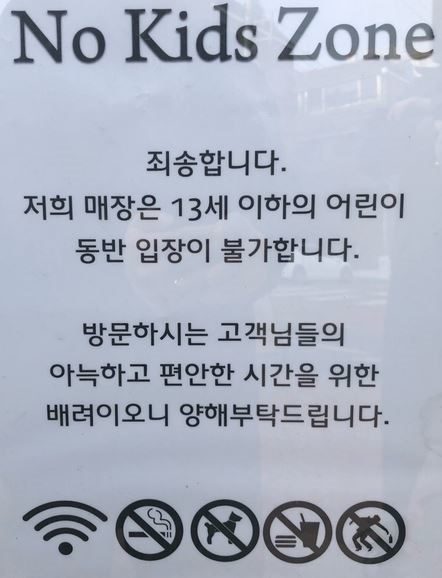
A shop's "No Kids Zone" notice, 2021. The Korean reads: "Sorry. Our shop cannot admit customers accompanied by children aged 13 and under. This is for a cosy, comfortable time for all our customers; thank you for understanding." Photo: Choi Won-seok, Wikimedia Commons, public domain.
What it means on a trip: you are most likely to meet a no-kids zone at a quiet, design-led café, especially in Jeju or a trendy Seoul neighbourhood. One expat parent who wrote about three years in Korea with a toddler counted three refusals in that time, and notes that child-free sections are often on upper or rooftop floors (South of Seoul, 2023). Check a café's reviews or photos before you go, and if a sign says "노키즈존", move on; it is not personal, and the next café will be glad to see you.
Korean parents feel watched too
The most useful context for a visiting parent comes from Korean parents themselves. In the Korea Institute of Child Care and Education's 2024 report on children's social exclusion:
- 64.3 percent of parents said they watch other people's reactions (눈치, nunchi) when out in public with their child.
- 42.8 percent said their child had bothered other people in public in the past year.
- 40.8 percent had avoided going out for fear their child would run around or throw a tantrum.
- Among the general public, the places people most often felt inconvenienced by young children were restaurants (50.5 percent), cafés (24.3 percent), shops and malls (23.9 percent) and public transport (22.9 percent).
So the side-eye some foreign parents describe is not aimed at foreigners. It is part of a Korean debate about children in public that Korean parents live with every day, and one reason the same society that tolerates no-kids zones also hands your toddler a tangerine.
Facilities: nursing rooms, changing tables and high chairs
This is where Korea scores highest with foreign parents. Department-store and mall nursing lounges are the single most praised facility: private rooms with sofas, cots, sinks, hot water, microwaves and changing tables, which one London family called much better than anything in London or other European cities (Lemon8, r/koreatravel, Nov 2025). One family also found a nursing and changing room on the KTX family carriage.
The numbers behind that:
- Nursing rooms: 3,019 registered nationwide, 508 in Seoul, in the national directory run by the Korea Population, Health and Welfare Association. In the Seoul subway, though, only 108 of 338 stations have one; our guide to the Seoul subway with a stroller lists the elevator exit and nursing room at 16 stations visitors use.
- Changing tables: Korea's Public Toilet Act requires at least one changing table in both the men's and the women's toilets at stations, airports, road rest areas, cultural and assembly facilities, general hospitals, libraries, public offices and tourist rest areas, in force since December 2021. Small restaurants and cafés are not covered, which is why older complaints about changing a diaper on a park bench still ring true there.
- High chairs split parents: common in larger and mall restaurants, rare in small ones. There are no kids' menus in most places, but staff will usually bring mild dishes or plain rice.
- Diapers: parents found convenience-store packs expensive and limited; supermarkets and pharmacies stock more.
The physical city: the real hard part
Terrain is the top complaint (13 accounts): stairs and hills in Bukchon, Ihwa and around Namsan, alleys with no pavement where you wheel on the road, and crowds in Myeongdong and Seongsu. Some of the older complaints are now out of date. Since 29 December 2025 every station on the subway lines Seoul runs has an elevator route from street to platform, so accounts of "minimal elevators" from 2023 and 2024 no longer hold. The new catch is that the elevator is often at one exit only, and transfers can still mean long corridors.
Practical answers: a stroller you can fold with one hand, a carrier for the hills and the stairs-only exits, and a hotel near a station's elevator exit. Our Seoul with kids guide covers where to stay, and our guide to car seat taxis covers the car journeys.
Safety
Parents almost universally feel safe in Korea, and the road figures back the feeling up. In 2024, 12 children under 13 died in road crashes, and road deaths overall were the lowest since records began in 1970. Korea has 15,856 school zones with a 30 km/h limit and higher fines for speeding inside them. And 110 Korean local governments are certified as UNICEF Child Friendly Cities, out of 129 taking part, as of March 2026.
The verdict, by age
- Babies and toddlers: the easiest age for a Korea trip. Expect attention, snacks and help, excellent nursing rooms, and a physical city that needs a light stroller and a carrier.
- Preschool and early school age: still welcomed, but noise tolerance in quiet cafés and on trains is lower, and the most common no-kids-zone cut-off is 10 to 13.
- Everyone: plan cafés with a quick check of reviews, use big and mall restaurants when you need a high chair, carry a changing pad, and let the grandmothers do what they do.
FAQ
Q: Is Korea kid-friendly? For families visiting with babies and young children, largely yes. In 50 first-hand accounts from foreign parents, warmth from strangers and excellent nursing rooms were the most praised points; stairs, hills and a minority of no-kids cafés were the main problems.
Q: How many no-kids zones are there in Korea? A civic-group survey counted 114 nationwide in late 2025, 74 percent of them cafés and more than 60 percent in Seoul, Gyeonggi and Jeju. Other counts, using different methods, range from about 100 to about 500.
Q: Are no-kids zones legal in Korea? Yes. The National Human Rights Commission called one such ban discrimination in 2017, but its ruling is not binding, and there is no national law banning or regulating them.
Q: Do Koreans like children? Older Koreans in particular are famously affectionate with babies and toddlers. At the same time, 68 percent of Koreans accept no-kids zones, and 64.3 percent of Korean parents say they watch other people's reactions when out with their children.
Q: Is breastfeeding in public accepted in Korea? Nursing rooms are widespread in department stores, malls, stations and airports, and are the easiest option. In the one recent account we found of breastfeeding at a restaurant table, a diner complained to staff, though nothing came of it.
Q: Is Seoul safe for children? Parents in our sample almost universally reported feeling safe, and child road deaths are low: 12 children under 13 died in road crashes nationwide in 2024.
Sources
Parents' accounts (summarised, 2023–2026): Reddit threads in r/koreatravel (1p7fz1x, 1v1mczk, 1vxp03d, 1tmxmq4, 1p2j64h) and r/Living_in_Korea (1gru9ds, 1pd2lgt); blogs JC and the Squirrel, 04woodr, Little Chicken Studio, Tofu V Travels, The Twirling Traveler, The Soul of Seoul, South of Seoul, Rosy ReSpark; Lemon8 parents' posts.
Korean data:
- Hankook Research, national surveys on no-kids zones (n=1,000), published 2021, 22 February 2023 and 1 April 2025 (hrcopinion.co.kr): acceptance 71% / 73% / 68%; 83% for map disclosure; 30–33% for no-senior, no-middle-aged and no-foreigner zones; 88% for a no-bad-manners rule.
- Korea Institute of Child Care and Education (육아정책연구소), "아동에 대한 사회적 배제의 실태와 대응과제", November 2024 (report 2024-12): parents 64.3% / 42.8% / 40.8%; public inconvenience by place.
- Ministry of Health and Welfare, survey of 205 no-kids-zone operators, released 28 December 2023, as reported by Kookmin Ilbo.
- 정치하는엄마들 and partner groups, nationwide no-kids-zone survey (September–December 2025), as reported by Kyunghyang Shinmun on 6 May 2026.
- National Human Rights Commission of Korea, decision of 24 November 2017; Jeju Special Self-Governing Province ordinance of September 2023, as reported by Kyunghyang Shinmun and Jeju Sori.
- Seoul Metropolitan Government, Kids OK Zone; Jeju Yes Kids Zone (Korea Herald, 16 October 2025).
- Statistics Korea (국가데이터처), 2025 birth statistics, 26 August 2026: TFR 0.80, Seoul 0.63.
- Ministry of the Interior and Safety, Public Toilet Act art. 7-2 and Enforcement Decree art. 6-2 (changing tables in men's and women's toilets). 수유정보 알리미 (sooyusil.com): 3,019 nursing rooms, 508 in Seoul.
- UNICEF Korea, Child Friendly Cities, March 2026: 110 certified of 129 participating.
- Korea Road Traffic Authority figures for 2024, as reported by Pressian (28 May 2025); National Police Agency school-zone figures, 2026.
You Might Also Like
Car Seat Taxis in Korea: The Law Requires a Seat for Every Child Under 6, Ordinary Taxis Don't Carry One — What Tourists Can Actually Book in Seoul
Korea's Road Traffic Act requires a car seat for children under 6 in any car, taxis included, and fines the driver ₩60,000. Ordinary taxis carry none and police paused taxi enforcement in 2018. TADA, whose app takes foreign phones and cards, runs about 300 car-seat vans.
Seoul Subway With a Stroller: Every Seoul-Run Station Now Has a Street-to-Platform Elevator — at Half of Seoul Metro's on Just One Exit — and Only 108 Have a Nursing Room
Since December 2025 all 338 Seoul-run subway stations have a lift route from street to platform, but in Seoul Metro's own register 116 of 217 stations have it at one exit only: Myeongdong exit 1, Gyeongbokgung 4, Hongik 8. Just 108 have a nursing room.
Seoul Palaces Free on Wednesdays in 2026: Deoksugung Since 5 August, Changdeokgung, Changgyeonggung and Jongmyo From 7 October — Gyeongbokgung Still Only the Last Wednesday
Korea made every Wednesday Culture Day in April 2026, and the palace office is phasing in free entry: royal tombs since 27 May, Deoksugung since 5 August, three more from 7 October. Gyeongbokgung has no date. English guides get it wrong both ways.