Seoul With Kids 2026: The Numbers That Matter — a Step-Free Subway, Nursing Rooms at Only 108 Stations, Car Seat Taxis, Free Strollers, and Where to Stay
Last updated: September 2026. Figures are from Seoul Metropolitan Government, Seoul Metro's published registers, Korea's Road Traffic Act, Incheon International Airport and the venues named, as detailed in the linked guides and the sources at the end.
Most parents who bring children to Seoul say afterwards that it was easier than they expected, and that the hard parts were never the ones they planned for. In 2026 the city got measurably easier. Since 29 December 2025 every one of the 338 stations on the subway lines Seoul runs has an elevator route from street to platform. Children under 6 ride free, up to three per adult. Incheon Airport lends strollers free at every information desk.
It is still a dense, vertical city, and the details catch families out. At about half of Seoul Metro's stations the street elevator is at one exit only. Only 108 of the 338 stations have a nursing room. Korean law requires a car seat in taxis for children under 6, yet ordinary taxis carry none. And the city's cheap public kids cafes are for Seoul residents, people who work or study in Seoul, and visitors who come with a Seoul resident. This guide is the overview, with the numbers that matter; each topic links to a detailed guide.
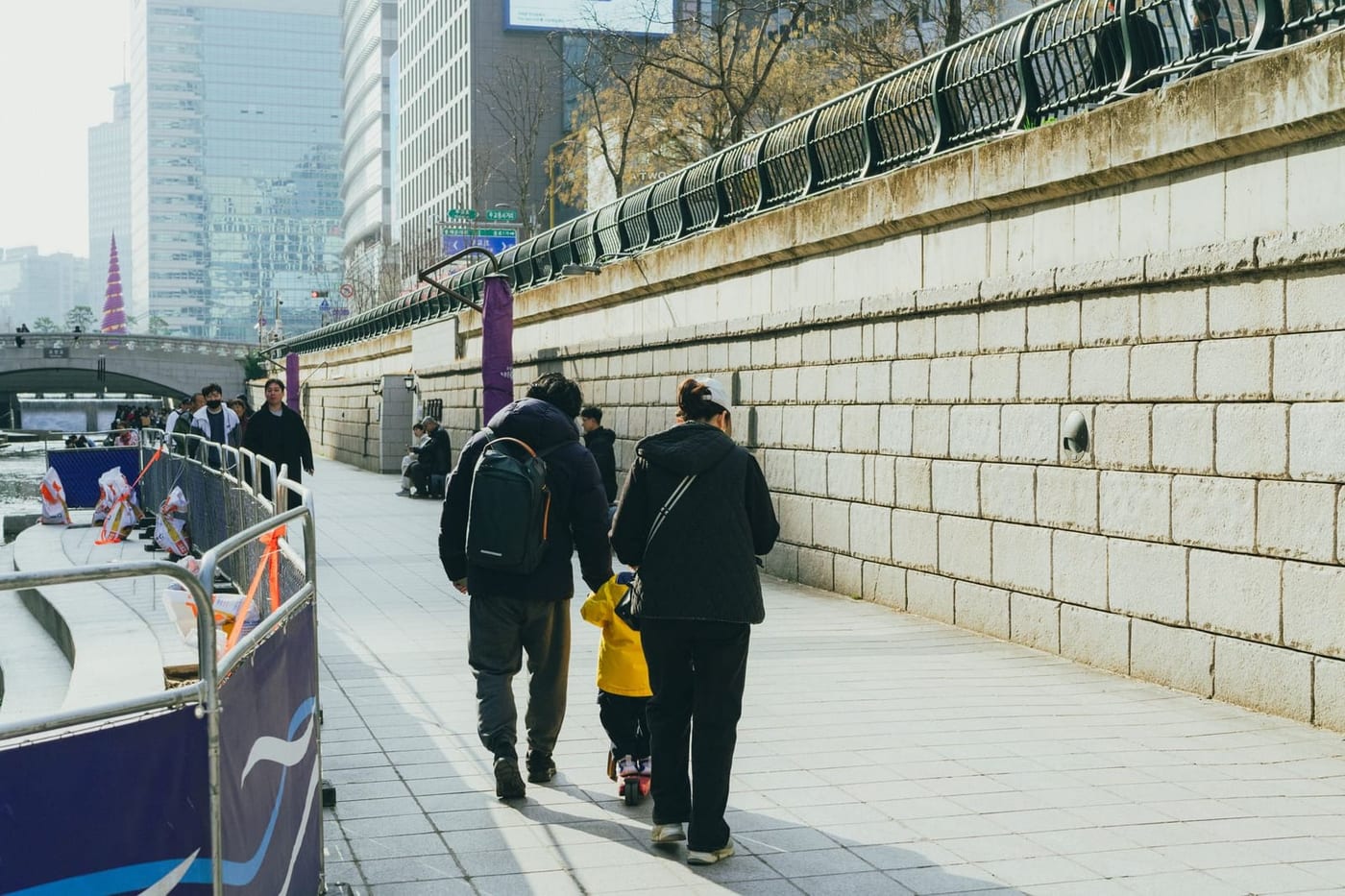
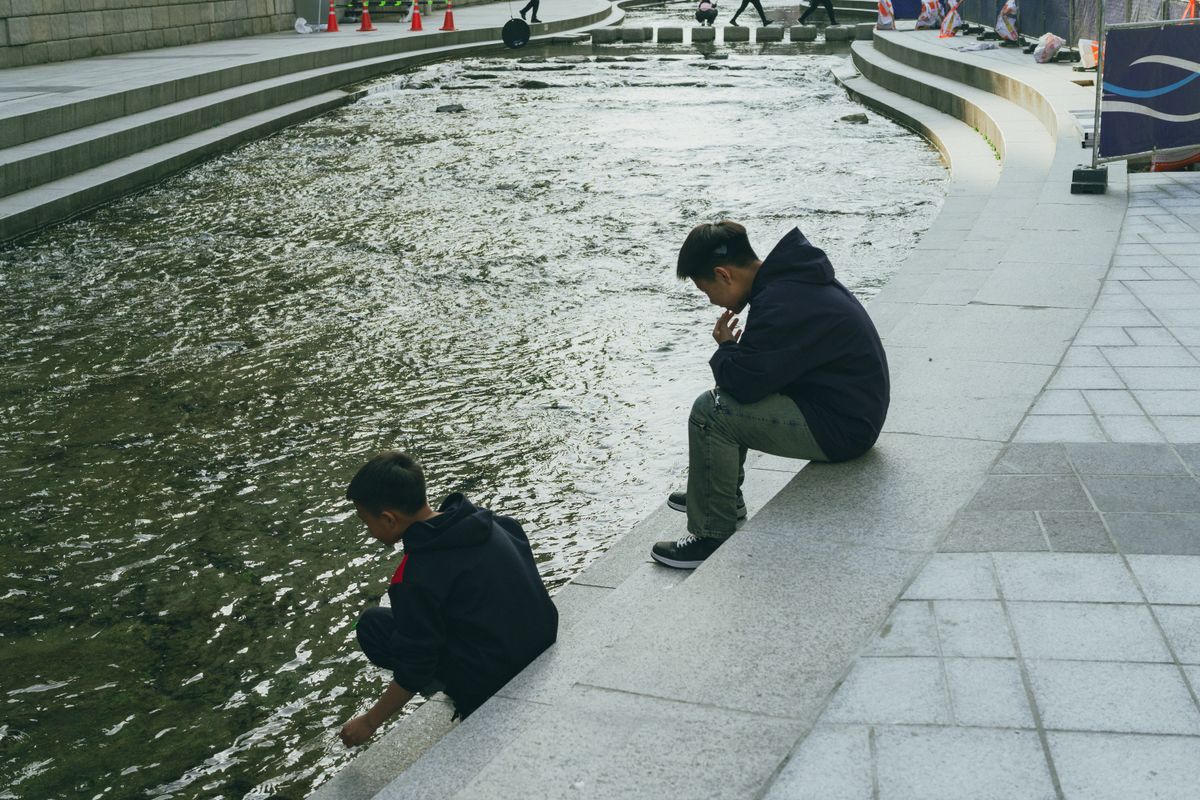
Seoul's stream paths and wide sidewalks make easy, low-stress walks with children. Photo by Theodore Nguyen on Pexels.
The one piece of kit that matters most in Seoul: a stroller that folds small enough to carry. The gb Pockit+ All-Terrain folds to a package smaller than a cabin bag, which turns a stairs-only subway exit or a café doorway into a ten-second job. As an Amazon Associate, EpicKor earns from qualifying purchases.
Quick Guide: Seoul with kids in numbers, 2026
| Topic | What to know | Detailed guide |
|---|---|---|
| Subway access | All 338 Seoul-run stations have a street-to-platform elevator since Dec 2025; at about half of Seoul Metro's stations it is at one exit only (Myeongdong 1, Gyeongbokgung 4, Hongik Univ. 8) | Subway with a stroller |
| Nursing rooms | 108 of 338 stations; none at Myeongdong, Gyeongbokgung, Hongik Univ., Jonggak | Subway with a stroller |
| Fares | Under 6 free (up to 3 per adult); 6–12 ₩550 on a child-registered T-money card, otherwise the adult fare | Subway with a stroller |
| Taxis | Car seat required by law under 6; ordinary taxis carry none; book TADA's car-seat vans or a Kakao T Venti car-seat driver | Car seat taxis |
| Free strollers | Incheon Airport (all information desks) · Changdeokgung (24 months and under) · National Museum of Korea · Lotte Department Store (24 months and under) | Below |
| Kids cafes | Indoor public branches: Seoul residents, Seoul workers and students, and visitors who come with a Seoul resident · outdoor weekend kids cafes in Han River parks: anyone aged 4–9, ₩5,000, Sep–Nov | Kids cafe guide |
| Museums for kids | National Museum of Korea Children's Museum: free, book 14 days ahead, no walk-ins · Seoul Children's Museum: ₩4,000 | Below |
| Night-time illness | 20 "moonlight" children's hospitals in Seoul; call 119 (emergencies and medical advice) or 1330 (interpreter) | Below |
Ergobaby Omni Classic — the carrier for the exits a stroller can't do Stairs-only subway exits, palace hills and crowded markets are where a carrier earns its space in the suitcase. The Omni carries from newborn to 48 months in four positions. As an Amazon Associate, EpicKor earns from qualifying purchases.
See the Ergobaby Omni Classic on AmazonYou might like: Getting Around Korea in 2026: Subway Fares, Last Trains, KTX Booking, Bus Prices and Which App to Use
Getting around with a stroller
The subway is now the best way to move a stroller around Seoul. Every station on the Seoul-run lines has at least one continuous elevator route from street to platform, completed at Kkachisan station on 29 December 2025 after an 18-year programme. The catch is in the name of that programme, 1역사 1동선, "one station, one route": in Seoul Metro's own register, about half its stations (116 of 217) have their street elevator at a single exit. Know that exit before you ride. Our guide to the Seoul subway with a stroller lists the elevator exit and the nursing room at 16 stations visitors use.
A few rules of thumb:
- Children under 6 ride free, up to three per adult. A child aged 6 to 12 pays ₩550, but only on a T-money card registered as a child card at a convenience store or station information centre; an unregistered card charges the adult ₩1,550.
- Use the elevator, not the escalator, with a stroller; Seoul Metro's safety campaign asks exactly that.
- Avoid rush hours: roughly 07:30–09:00 and 18:00–19:30 on weekdays.
- Korail-run lines (Line 1 outside the centre, Gyeongui–Jungang, Suin–Bundang) were not part of Seoul's programme, and a few of their stations still have no elevator.
- Buses: city buses have no seatbelts by design, and the doors close quickly; hold on before the bus moves.
Taxis and car seats
Korea's Road Traffic Act requires a car seat for every child under 6 in a car, taxis included, and fines the driver ₩60,000. But ordinary taxis carry no seats, and the police suspended car-seat enforcement in taxis in 2018 and have not announced resuming it. So a street-hail taxi will take your family, and the child will not be in a seat.
If you want one, book it: TADA's car-seat van line (about 300 vans in 2025, with up to 500 planned for 2026, with rotating seats for newborns to 12-year-olds, in an app that accepts foreign phone numbers and cards), or a Kakao T Venti reservation with a driver who carries a seat (foreign cards often fail in Kakao T itself). Seoul's "Parents Taxi" credit is for Seoul-registered families only. Everything is in our guide to car seat taxis in Korea.
Where to stay with young children
The single best filter for a family hotel in Seoul is its distance from the station exit that has the elevator. A hotel two minutes from an elevator exit saves you a stair carry every day; one on the wrong side of a big road can add a ten-minute detour each way. Some station areas that work well for families:
- Myeongdong and Euljiro (Line 2 and 4): central, walkable to Deoksugung and Cheonggyecheon, with Lotte Department Store's free nursing lounges and strollers at Euljiro 1-ga. Myeongdong station's street elevator is at exit 1; Euljiro 1-ga has two, at exits 1 and 5.
- Seoul Station (Line 1, Line 4, AREX): the airport train runs direct, and Line 4 has a nursing room. The AREX Express allows only one free infant per adult.
- Jamsil (Lines 2 and 8): Lotte World and the lake park, with nursing rooms on both lines, outside the gates.
- Gangnam: a nursing room on Line 2, and elevators at exits 1 and 10.
- Hongdae is lively but hard work with a stroller: one street elevator (exit 8) and no nursing room on the Line 2 side.
When you compare hotels, check three things on the map: the walking route from the elevator exit, whether the hotel has a lift and step-free entrance, and whether rooms take a cot or an extra bed.
Compare family rooms near the right exit EpicKor may earn a commission if you book through this Agoda link, at no extra cost to you. Search Seoul, then use the map to check the walk from the station's elevator exit, cot and extra-bed options, cancellation terms, taxes and the final price for your dates. Agoda partner link.
Compare Seoul family stays on AgodaFree and cheap strollers to borrow
If you would rather not fly with a stroller, several places lend one:
- Incheon Airport: free at every information desk. Families with a child under 7 can use the priority departure exit with up to three companions; ask your airline's check-in counter for the priority card.
- Changdeokgung Palace: free, for children 24 months and under, with an ID; the desk is inside Donhwamun gate on the left. The Secret Garden's paths climb steeply in places, so a carrier is easier there.
- National Museum of Korea: free strollers and wheelchairs to borrow on the first floor, and a first-floor nursing room.
- Seoul Children's Grand Park: ₩3,000 (twin ₩5,000, wagon ₩8,000) at the main and rear gates, leaving ID or a ₩20,000 deposit; the rear-gate desk takes cash or ZeroPay only. Entry to the park is free.
- Lotte Department Store: free for children 24 months and under, plus free nursing lounges.
- Lotte World rents strollers for children under 36 months (reported at ₩3,000 plus a refundable deposit; check on arrival).
Where kids actually enjoy going
Children's museums are the reliable rainy-day answer, and all three take bookings (the National Museum's is booking-only):
- National Museum of Korea Children's Museum: free, but online booking only, opening 14 days ahead at midnight, with no tickets on the day.
- National Folk Museum of Korea Children's Museum, on the Gyeongbokgung grounds: free, booking required, 09:30–16:50.
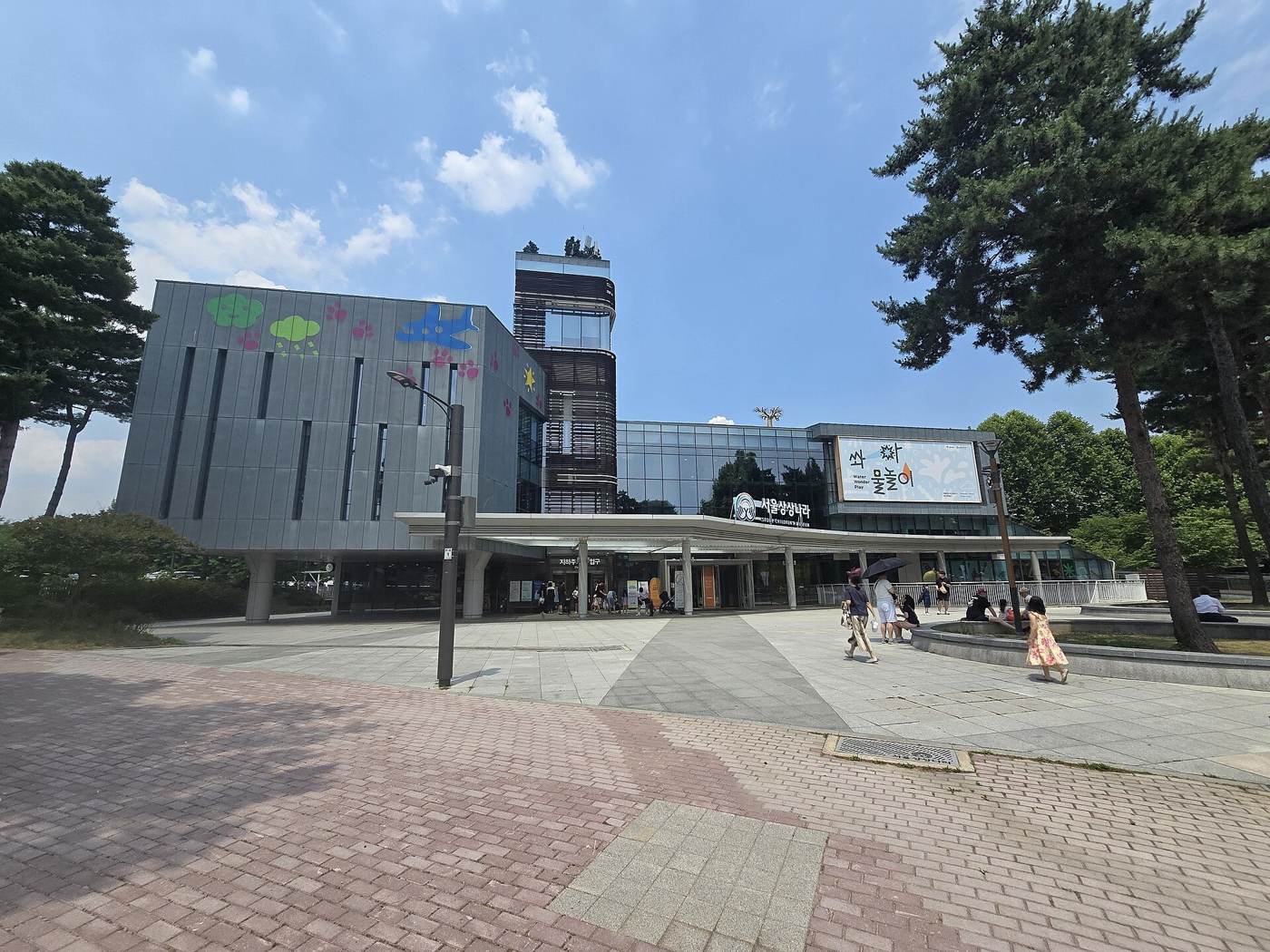
- Seoul Children's Museum (서울상상나라) in Children's Grand Park: ₩4,000 for everyone aged 36 months and over, closed Mondays.
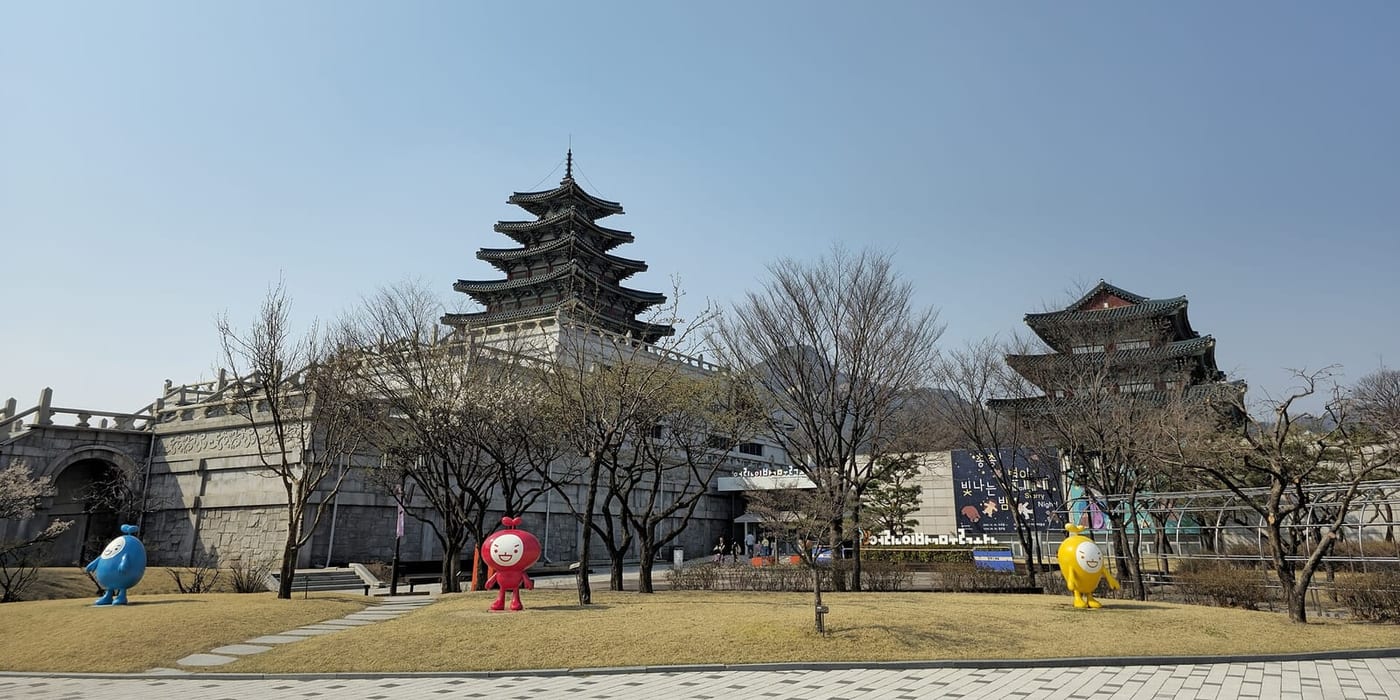
The National Folk Museum's children's museum sits on the Gyeongbokgung grounds, so you can combine it with a palace visit. Photo via Wikimedia Commons (CC0).
Palaces with hanbok turn a history stop into a costume adventure: anyone wearing hanbok enters the palaces free, and foreign children 18 and under are free anyway. Kid-size hanbok is easy to rent near Gyeongbokgung; see our hanbok rental guide.
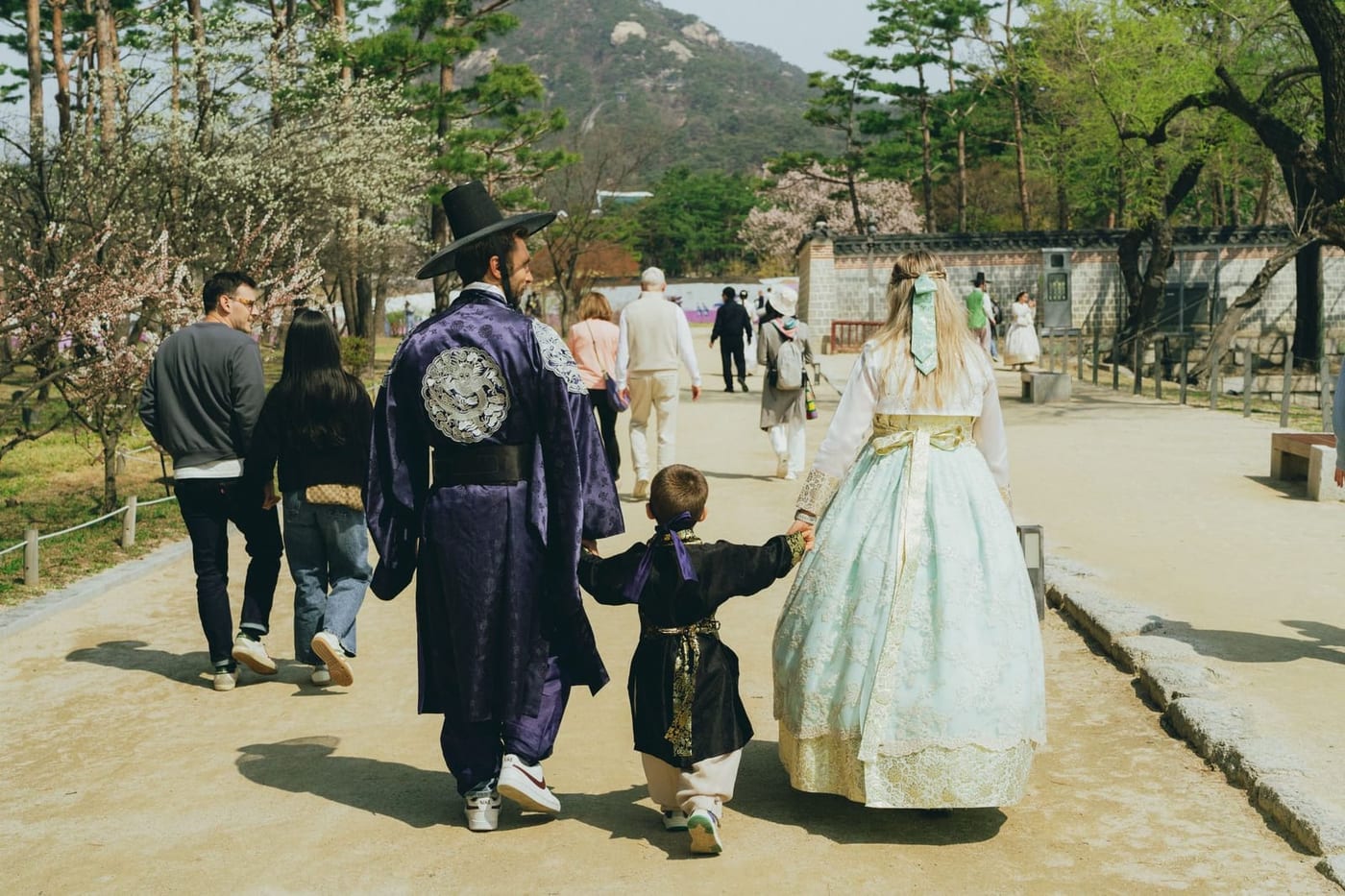
Kid-size hanbok is widely available near Gyeongbokgung, and hanbok wearers enter the palaces free. Photo by Nuhyil Ahammed on Pexels.
Han River parks are the free option at every age, and on weekends from September to November eight of them host the city's outdoor kids cafes: ₩5,000 per child aged 4 to 9, guardians free, with some places kept for walk-ins. The indoor public kids cafes are a different story: the city limits them to Seoul residents, people who work or study in Seoul, and visitors who come with a Seoul resident. Our Seoul kids cafe guide sorts out which ones you can use.
Seoul Grand Park's zoo costs ₩5,000 for adults and ₩2,000 for children aged 6 to 12; strollers fold for the elephant train and go to staff on the sky lift.
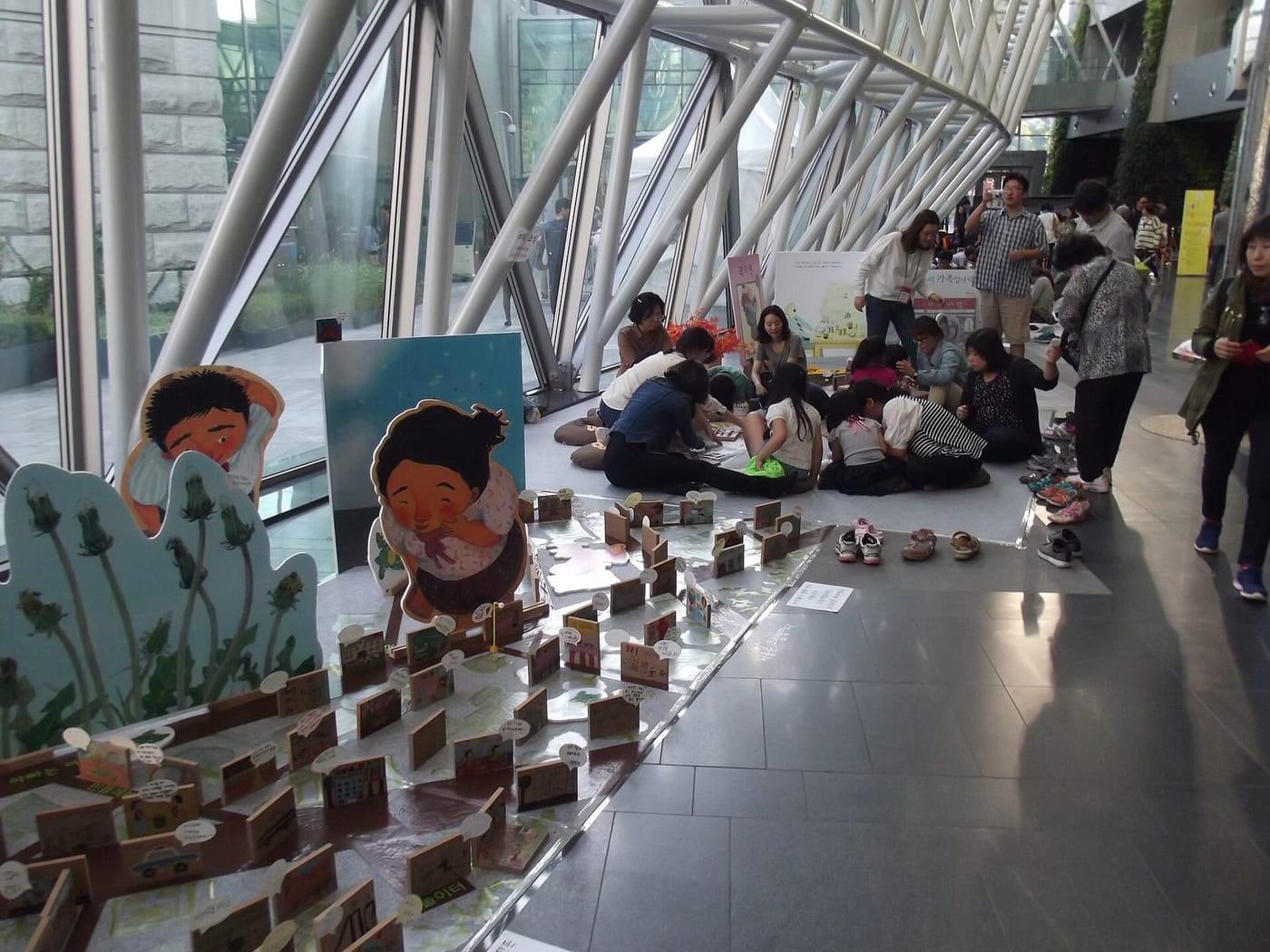
A children's picture-book and craft activity in the atrium of Seoul City Hall. Photo: Smiley.toerist, Wikimedia Commons, CC BY-SA 4.0.
Eating out with kids
Most restaurants are relaxed about small children and staff are kind to them, though quiet cafés are where no-kids zones cluster (see our guide to how kid-friendly Korea is); shared dishes make ordering easy. The obstacle is chili, but plenty of Korean food is mild: gimbap, mandu (dumplings), galbi and bulgogi, japchae, kalguksu, donkatsu, samgyetang, and rice with egg. Ask for an maewoyo (not spicy) and expect mild rather than zero. Free, refillable banchan side dishes quietly solve the "my child only eats one thing" problem.
Many restaurants have floor seating, so ask for a table if your child won't manage it. Convenience stores are the safety net for milk, yogurt, bananas and triangle gimbap, and department store food halls give you variety, air conditioning, clean restrooms and nursing rooms in one stop.
If a child gets sick at night
Seoul runs a night and holiday children's care network: 20 "moonlight" children's hospitals (달빛어린이병원) that see children into the evening and at weekends, plus hospitals with 24-hour minor-emergency care and three specialist paediatric emergency centres (Asan, Severance and Seoul National University hospitals), according to the city's page updated in August 2026. For advice at any hour call 119, which took over general medical advice from the old 1339 line (1339 is now the disease-control agency's infectious-disease number); for interpretation, the tourist helpline 1330 answers in eight languages, including English, Japanese and Chinese, and can help you communicate with 119; hours vary by language, so save the number before you need it. Our Korean healthcare guide for tourists explains pharmacies and clinics.
A simple 3-day Seoul family plan
Build days around one big thing plus one easy thing.
| Day | Morning | Afternoon | Evening |
|---|---|---|---|
| Day 1 | Gyeongbokgung in hanbok (use Gyeongbokgung station exit 4 for the elevator) | National Folk Museum children's museum on the same grounds (booked) | Easy dinner near Insadong, early night |
| Day 2 | National Museum of Korea and its children's museum (booked 14 days ahead; Ichon station) | Han River park; outdoor kids cafe on autumn weekends | Convenience-store picnic by the river |
| Day 3 | Seoul Children's Museum or Seoul Grand Park | Cheonggyecheon walk and a market snack | Department store food hall dinner |
If the weather turns or someone melts down, swap a block for a museum or a department store play floor; in Seoul the indoor backup is rarely more than two subway stops away.
FAQ
Q: Is Seoul a good city for a family trip with young children? Yes. It is safe, the subway is now step-free at every Seoul-run station, children under 6 ride free, and there are free strollers at the airport and major sights. Plan for elevator exits, nursing rooms and car seats, which are where families get caught out.
Q: Can you use a stroller on the Seoul subway? Yes. All 338 Seoul-run stations have an elevator route from street to platform since December 2025, but at about half of Seoul Metro's stations it is at one exit only, so check which exit first. Use elevators rather than escalators.
Q: Do children pay for public transport in Seoul? Children under 6 ride free, up to three per adult. Children aged 6 to 12 pay ₩550 per subway ride, but only on a T-money card registered as a child card; otherwise the adult fare is charged.
Q: Do taxis in Seoul have car seats? Ordinary taxis do not, although the law requires a car seat for children under 6. Book TADA's car-seat vans or a Kakao T Venti reservation with a car-seat driver, or bring your own seat.
Q: Where can I borrow a stroller in Seoul? Free at every Incheon Airport information desk, at Changdeokgung Palace (24 months and under), at the National Museum of Korea and at Lotte Department Store (24 months and under); ₩3,000 at Seoul Children's Grand Park.
Q: What should we do in Seoul if it rains all day? Book a children's museum (the National Museum of Korea's is free but must be booked 14 days ahead), or use department store play floors and food halls, which also have nursing rooms.
The bottom line
Seoul rewards families who plan the details rather than the sightseeing volume: know your elevator exit, register the T-money card, book the children's museums early, and decide in advance how you will handle car journeys. Start with the subway stroller guide, which does most of the work.
Sources
- Seoul Metropolitan Government, completion of step-free routes at all 338 stations, 29 December 2025; Seoul Metro elevator and nursing-room registers (data.go.kr 15044261, 15044264); National Assembly figures on nursing rooms, 11 September 2026 — details in the subway stroller guide.
- Road Traffic Act Art. 50 and its Enforcement Decree and Rule; car-seat taxi services — details in the car seat taxi guide.
- Seoul Metro passenger tariff, revised 7 March 2026 (children's fares); T-money foreigner guide (child card registration).
- Incheon International Airport, family services (free strollers, priority lane). Changdeokgung convenience facilities and FAQ (Korea Heritage Service). National Museum of Korea accessibility page. Seoul Children's Grand Park and Seoul Grand Park visitor information. Lotte Department Store service guide.
- National Museum of Korea, National Folk Museum of Korea and Seoul Children's Museum admission and booking pages.
- Seoul Metropolitan Government, night and holiday children's medical care network (updated August 2026); Government 1330 tourist helpline; Korea Disease Control and Prevention Agency 1339 call centre. Seoul Metropolitan Government, Seoul Kids Cafe eligibility (news.seoul.go.kr, 5 February 2026).
You Might Also Like
Seoul Kids Cafe Guide 2026: Which Public Play Spaces Tourists Can Actually Use — the ₩5,000 Weekend Outdoor Cafes, and the Indoor Branches That Ask for Seoul ID
Seoul's public kids cafes cost ₩0–5,000, but the indoor branches are for Seoul residents, people who work or study there, and visitors who come with a Seoul resident. The outdoor weekend cafes in eight Han River parks take walk-ins, ₩5,000 per child aged 4–9, until November.

Korea Travel Cheat Codes: Build a Better Trip by Interest
A Korea travel guide for building better itineraries by interest, from food and shopping to Hallyu, history, wellness, and slow stays.
Hangang Swimming Pools 2026: Seoul Summer Guide
A 2026 Hangang swimming pool guide covering dates, hours, fees, sites, swim-cap rules, weather pauses, and what to bring.