Korea's Century-Old Restaurants (Nopo): The 1,545 Shops the Government Certified as Baengnyeon Gage, Seoul's 50 Future-Heritage Restaurants, and What a Bowl Costs in 2026 at Imun Seolnongtang (1904), Hadongkwan (1939), Woo Lae Oak (1946) and the Others Koreans Actually Queue For
Last updated: September 2026. Designations are from the Ministry of SMEs and Startups' 백년가게 programme (list on sbiz.or.kr, 2026 round announced 24 July 2026) and the Seoul Metropolitan Government's 서울미래유산 register. Prices and hours are from Korean review-platform listings dated 2025–26; nopo raise prices and change hours without notice, so check before you go.
Koreans have a word for the restaurant that has been in the same place, serving the same dish, for longer than anyone can remember: nopo (노포), "old shop." The English internet has the "oldest restaurants in Seoul" listicle, which is the same ten names every year. What it does not have is the fact that Korea's government now certifies these places. Since 2018 the Ministry of SMEs and Startups has been designating 백년가게 (baengnyeon gage, "hundred-year shops"): businesses at least 30 years old that pass an evaluation of quality, stability and succession, and receive a plaque for the door. By the July 2026 round 1,545 shops had been designated since 2018; of the 1,139 on the public list, 721 (six in ten) are restaurants, and Seoul has the most restaurants at 94. Separately, Seoul City has put 50 restaurants on its Future Heritage register, from a seolleongtang house that opened in 1904 to a fried-chicken shop from 1977.
This guide is built on those two lists rather than on a blogger's memory. It explains what the plaques mean, then walks through the oldest and best-loved restaurants on them with the things a visitor actually needs: what the bowl costs in 2026, when the door is open and when it is locked, and which subway exit.
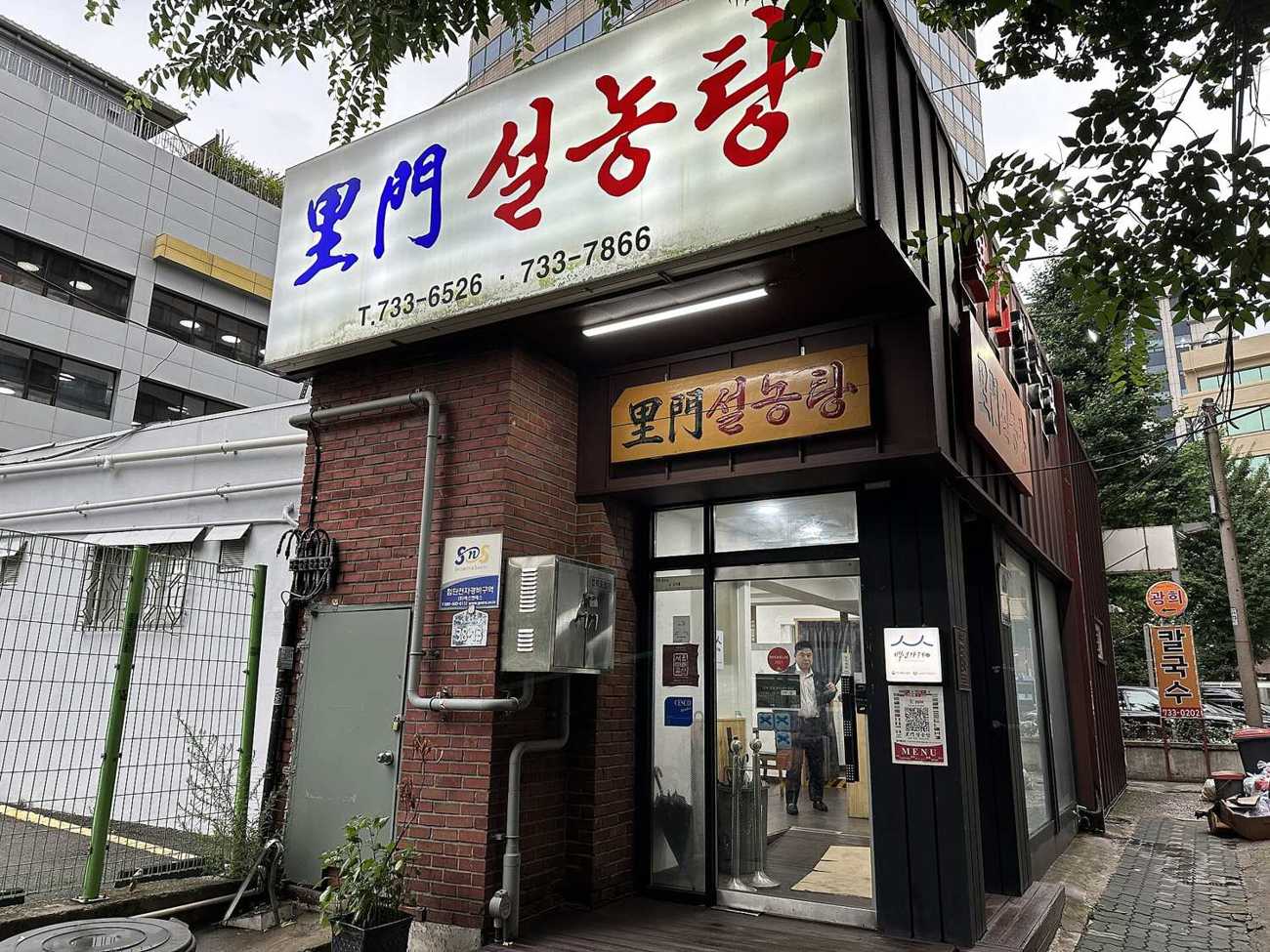
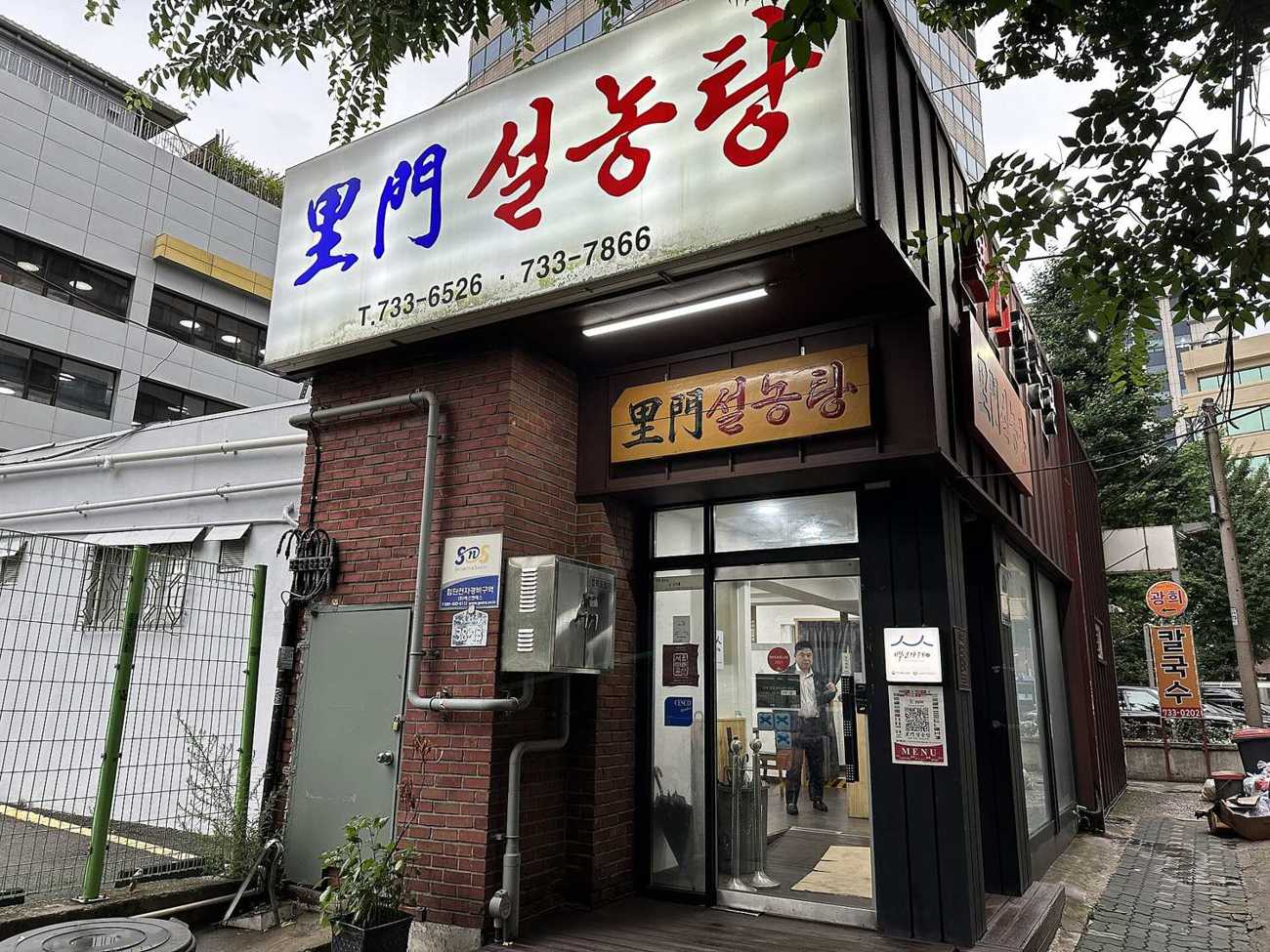
Imun Seolnongtang (이문설농탕), Jongno: the oldest restaurant still operating in Korea. The Seoul Future Heritage plaque (2013) and the 백년가게 plaque (2021) are on the wall by the door. Photo: Seefooddiet, Wikimedia Commons, CC BY-SA 4.0 (2024).
Every one of these bowls arrives with the same two tools: a long flat steel spoon for the broth and rice, and steel chopsticks for the meat, laid in a drawer under the table. Koreans who want the same at home buy a polished stainless-steel spoon and chopstick set, the same style every nopo in this guide sets out. As an Amazon Associate, EpicKor earns from qualifying purchases.
Quick Guide: the nopo, the dish, the 2026 price
| Restaurant | Since | The dish and 2026 price | Hours and closing | Nearest exit | Certifications |
|---|---|---|---|---|---|
| Imun Seolnongtang (이문설농탕) | 1904 | Seolleongtang ₩14,000; doganitang ₩17,000; special sizes about ₩3,000 more | 08:00–21:00 (Sun to 20:00), break 15:00–16:30; closed public holidays | Jonggak (Line 1) exit 3-1 | Seoul Future Heritage 2013; 백년가게 2021; Michelin Guide 2026 |
| Hadongkwan (하동관) | 1939 | Gomtang ₩18,000; "25-gong" with extra meat ₩25,000; "30-gong" ₩30,000 | 07:00–16:00, closed Sundays and public holidays; closes early when the pot runs out | Euljiro 1-ga (Line 2) or Myeongdong (Line 4) | Michelin Guide 2026 |
| Woo Lae Oak (우래옥) | 1946 | Pyongyang naengmyeon ₩18,000; bulgogi ₩46,000 a portion | 11:30–21:00, closed Monday; 30–60 minute queue most days | Euljiro 4-ga (Line 5) exit 4 | Seoul Future Heritage |
| Yonggeumok (용금옥), Da-dong | 1932 | Chutang (Seoul loach soup) ₩12,000; fried loach ₩18,000 | 11:00–22:00; closed 2nd, 4th and 5th Sundays | Euljiro 1-ga (Line 2), 3–5 min | Seoul Future Heritage |
| Cheongjinok (청진옥) | 1937 | Haejangguk ₩12,000, special ₩15,000 | 06:00–22:00 daily, last order 21:30 | Jonggak (Line 1) | Seoul Future Heritage 2013 |
| Yeolchajip (열차집) | 1954 | Mung-bean bindaetteok, 3 pieces ₩19,000; assorted ₩22,000 | Mon–Fri 11:00–23:00, Sat 14:00–22:30, Sun 14:00–21:00 | Jonggak (Line 1) exit 2 | Seoul Future Heritage |
| Taegeukdang (태극당) | 1946 | Monaka ice cream ₩3,300; red-bean bun ₩3,000; butter cake from ₩26,000 | 08:00–21:00, no closing day | Dongguk University (Line 3) exit 2 | 백년가게, the first by public nomination |
| Hanilkwan (한일관) | 1939 | Seoul-style bulgogi in broth; galbi | Lunch and dinner service, Apgujeong main branch | Apgujeong (Line 3) | Seoul Future Heritage |
Choung Soo mul-naengmyeon kit — Woo Lae Oak's dish, at home The Pyongyang naengmyeon that Woo Lae Oak has sold since 1946 is buckwheat noodles in cold beef broth, and the supermarket version Koreans keep in the fridge is this kit: noodles, broth sachet, mustard and vinegar. It is the closest thing to the ₩18,000 bowl you can post home. As an Amazon Associate, EpicKor earns from qualifying purchases.
See the naengmyeon kit on AmazonWhat the plaque on the door means
백년가게 (Baengnyeon Gage). Run by the Ministry of SMEs and Startups through the Small Enterprise and Market Service since 2018. A business applies or is nominated, must have operated for 30 years or more (15 for artisan manufacturers, who get the sister title 백년소공인), must not be a franchise branch, must be clean of tax, wage and labour violations for three years, and is scored on product quality, management stability and whether the recipe and skills have been formally handed to a successor. The reward is a certification plaque, a story board, sales and promotion support, Onnuri gift-certificate eligibility and priority in the agency's support programmes. The 2026 round, announced on 24 July, added 150 shops and 150 artisans, taking cumulative designations to 1,545 shops and 1,053 artisans. A newspaper count of the public list this month found 721 of 1,139 listed shops are restaurants, and by region Seoul leads with 94 restaurant designations, then Gyeonggi 80, North Gyeongsang 71, South Gyeongsang 64 and Gangwon 54; per head of population Gangwon has the most, at 35.8 per million people, and Gyeonggi the fewest at 5.8. The full list is searchable by district and trade at sbiz.or.kr.
서울미래유산 (Seoul Future Heritage). Seoul City's own register, started in 2013, of things that "hold the memory of citizens and deserve to be passed to the next generation," chosen from public nominations by a committee. It covers buildings, shops, songs and books, and among them 50 restaurants, listed with founding year and dish: the oldest is Imun Seolnongtang (1904), then a Chinese restaurant in Jongno from 1925, and the list runs through gomtang houses of the 1930s, the naengmyeon restaurants opened by northern refugees after 1946, the pork-rib and tteokbokki shops of the 1950s, an Italian restaurant from 1967 and a fried-chicken shop from 1977. A Future Heritage restaurant gets a bronze plaque and the city's promotion, not money.
서울 오래가게 (Seoul Orae Gage). A third, smaller Seoul list, run since 2017 for shops over 30 years old with a story.
The three lists overlap but do not match, and none of them is a quality ranking: Michelin's Bib Gourmand is a separate judgement, and several nopo hold that too. What the lists do is answer the question the "oldest restaurant" listicles fudge: which places are documented, still run by the founding family or a formal successor, and still serving the dish they opened with.
Imun Seolnongtang, 1904: the oldest bowl in Korea
The oldest restaurant in Korea is a seolleongtang house in an alley off Ujeongguk-ro in Jongno, behind the Jogyesa temple block. It opened as Imun Sikdang in the last years of the Joseon dynasty; Seoul's heritage register says 1904, the Michelin Guide says 1902, and some records say 1907. It has had four owners and has moved more than once, most recently in 2011, when the Gongpyeong-dong redevelopment pushed it to Gyeonji-dong, and it kept the old spelling seolnongtang (설농탕) on the sign when everyone else switched to seolleongtang. The broth is the point: ox bones and meat simmered for seventeen hours until the fat is gone and what is left is a pale, almost clear soup with no salt in it. You season it yourself at the table with the salt, pepper and chopped spring onion in the tins, add the kkakdugi radish kimchi, and eat it with the rice already in the bowl. Vice-president Yi Si-yeong ate here; so did the marathon champion Son Ki-jeong.
In 2026 the seolleongtang is ₩14,000, doganitang (knee cartilage) ₩17,000, meoritang (head meat) ₩16,000, each about ₩3,000 more in the special size. It opens at 08:00, which makes it the best breakfast in the palace district (our breakfast guide has the rest), closes for a break from 15:00 to 16:30, and shuts at 21:00 (20:00 on Sunday) and on public holidays. Jonggak Station exit 3-1, three minutes. It has been on the Seoul Future Heritage register since the register began in 2013, was certified a 백년가게 in 2021, and is in the Michelin Guide for 2026.
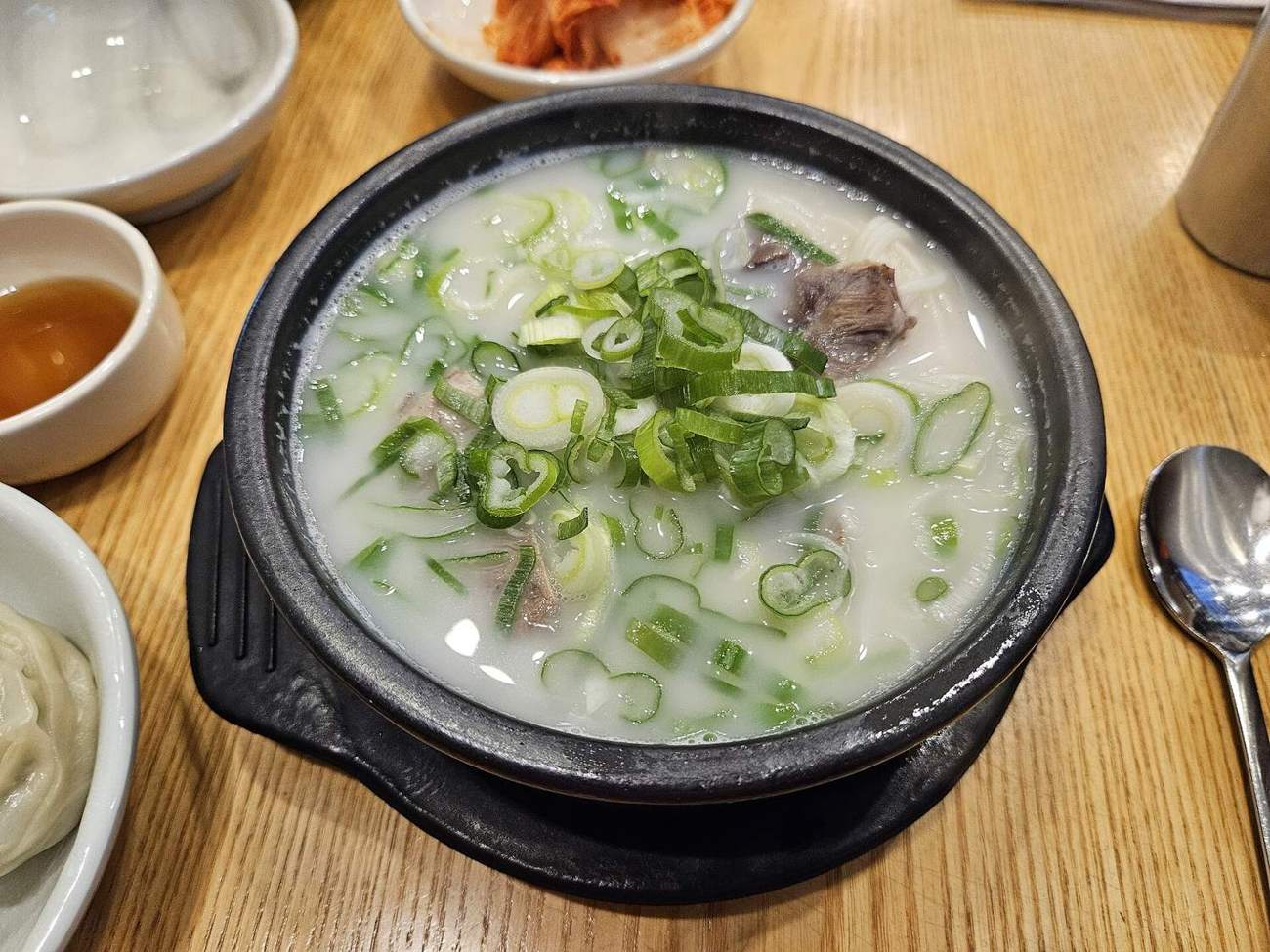
Seolleongtang with thin noodles and spring onion. The broth arrives unsalted; salt and pepper are on the table for you to add. Photo: Kimhs5400, Wikimedia Commons, CC BY 4.0 (2024).
Hadongkwan, 1939: gomtang, and a restaurant that closes when the pot is empty
Hadongkwan is Seoul's gomtang, the clearer, meatier cousin of seolleongtang, made from brisket and tripe rather than bones, and it has been made the same way since Kim Yong-taek and Ryu Chang-hee opened on the Cheonggyecheon bank in 1939. The original building was demolished in the 2007 redevelopment and the restaurant moved to Myeongdong 9-gil, where it still serves the way it did: you pay at the counter as you come in, the bowl comes with the rice in it, and the menu is one soup in three sizes. In 2026 the gomtang is ₩18,000; "25-gong" (₩25,000) and "30-gong" (₩30,000) are the same soup with more meat, and the numbers are how you order. The old code words, tongdak for a raw egg dropped in, naengsu for a half-bottle of soju in a cup, kkakguk for kimchi juice ladled into the broth, have faded since 2021 but the staff still understand them.
The hours are the famous part: 07:00 to 16:00, Monday to Saturday, closed Sundays and public holidays, and the day ends when the pot does, which on a busy day can be before 14:00. Go for breakfast or an early lunch. Euljiro 1-ga (Line 2) and Myeongdong (Line 4) are both a five-minute walk. Hadongkwan is in the 2026 Michelin Guide; it also has branches in Yeouido and at COEX that keep later hours and slightly different prices.
Woo Lae Oak, 1946: the naengmyeon of the refugees
After liberation in 1945, families from Pyongyang opened restaurants in Seoul that served the cold buckwheat noodles of the north, and the ones that survived the war became the most argued-over restaurants in the city. Woo Lae Oak (우래옥, "the house you come back to") is the oldest of them still running, opened in November 1946 as Seobukgwan by Jang Won-il, a Pyongyang restaurateur, and renamed after the war. Its trademark, registered in November 1969 by the founder's son, is the oldest restaurant trademark still held in Korea, and it is the reference point for the whole "Woo Lae Oak school" of naengmyeon.
The Pyongyang naengmyeon is ₩18,000 in 2026, the kimchi-broth version the same, and the bulgogi, grilled at the table in its own broth, ₩46,000 a portion. Hours are 11:30 to 21:00, closed Monday, and the queue is real: 30 to 60 minutes at lunch and dinner most days unless you are there at opening. Euljiro 4-ga Station (Line 5) exit 4, in Jugyo-dong. It is on the Seoul Future Heritage register. If you have never had Pyongyang naengmyeon, our naengmyeon guide explains why the broth tastes of almost nothing on purpose and how to add the mustard and vinegar.
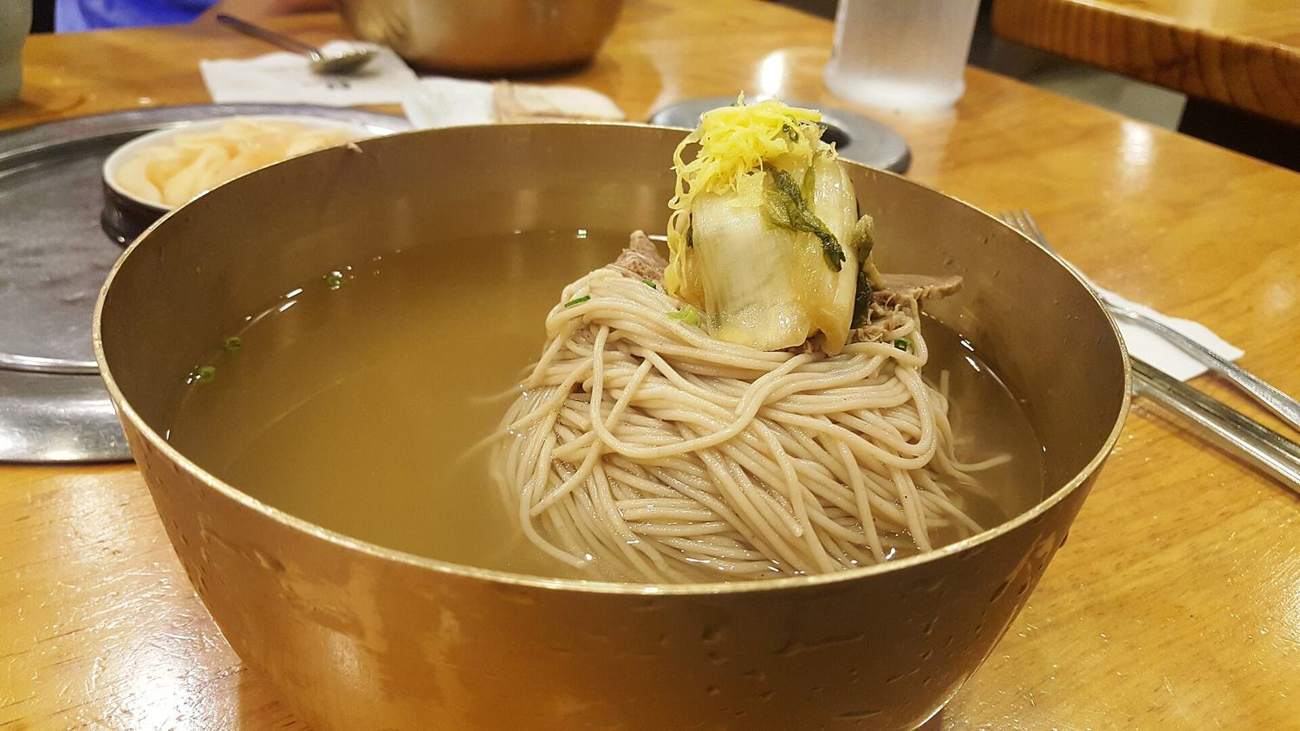
Pyongyang-style naengmyeon: cold beef broth, buckwheat noodles, beef and kimchi under shredded egg, at a Seoul restaurant in 2017. The dish Woo Lae Oak has served since 1946. Photo: CYAN, Wikimedia Commons, CC BY-SA 4.0.
Yonggeumok, 1932: the loach soup of the Cheonggyecheon bridges
Chutang (추탕) is the Seoul version of loach soup: the loach are cooked whole in a beef-bone broth with tofu, mushrooms and a chilli-bean paste, instead of being ground into the smooth southern chueotang. Yonggeumok opened in 1932 near the Cheonggyecheon in Mugyo-dong, the next block to its present Da-dong alley, and, the story goes, fed the kkokjidan, the beggars who lived under the stream's bridges and caught the loach. It has been run by the founder's family for three generations; the founder's youngest daughter-in-law runs a second Yonggeumok in Tongin-dong near Gyeongbokgung, so check which one you are walking to.
At the Da-dong original the chutang is ₩12,000, fried loach ₩18,000, and the room is floor seating at low tables. 11:00 to 22:00, closed on the second, fourth and fifth Sundays of the month. Euljiro 1-ga (Line 2), three to five minutes, at Dadong-gil 24-2. On the Seoul Future Heritage register.
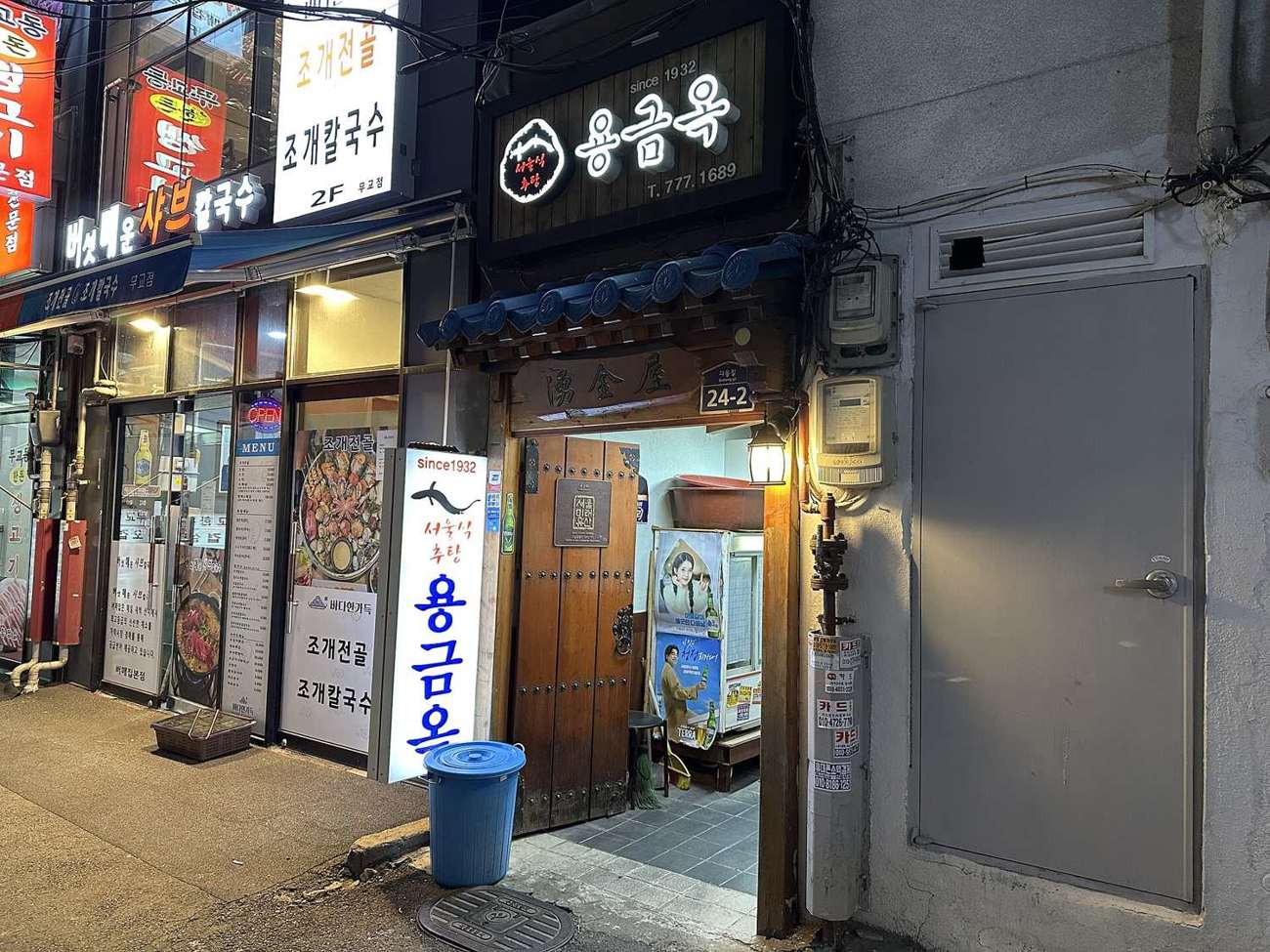
Yonggeumok, Da-dong. Loach soup here since 1932, in a building the size of a living room. Photo: Seefooddiet, Wikimedia Commons, CC BY-SA 4.0 (2025).
Cheongjinok, 1937: the hangover soup that survived its own street
Cheongjin-dong, the blocks north of Jongno by Gwanghwamun, was Seoul's haejangguk (hangover soup) street for seventy years, a row of low houses where the pots of ox-blood soup never went off the fire. The 2000s redevelopment flattened the street; Cheongjinok, opened there in 1937 by Choi Dong-seon and Lee Gan-nan and run by the third generation, moved into the ground floor of the new Le Meilleur Jongno Town at Jongno 3-gil 32 and kept the recipe. The soup is beef bone broth with cabbage, blood cake and offal, served toryeom-style, the rice warmed by ladling broth over it repeatedly instead of being heated in a microwave.
Haejangguk is ₩12,000, the special ₩15,000, and a plate of bindaetteok ₩20,000. It ran 24 hours from 1982 for decades; in 2026 it opens 06:00 to 22:00, last order 21:30, every day, which still makes it the earliest hot meal at Gwanghwamun. Jonggak Station. On the Seoul Future Heritage register since 2013.
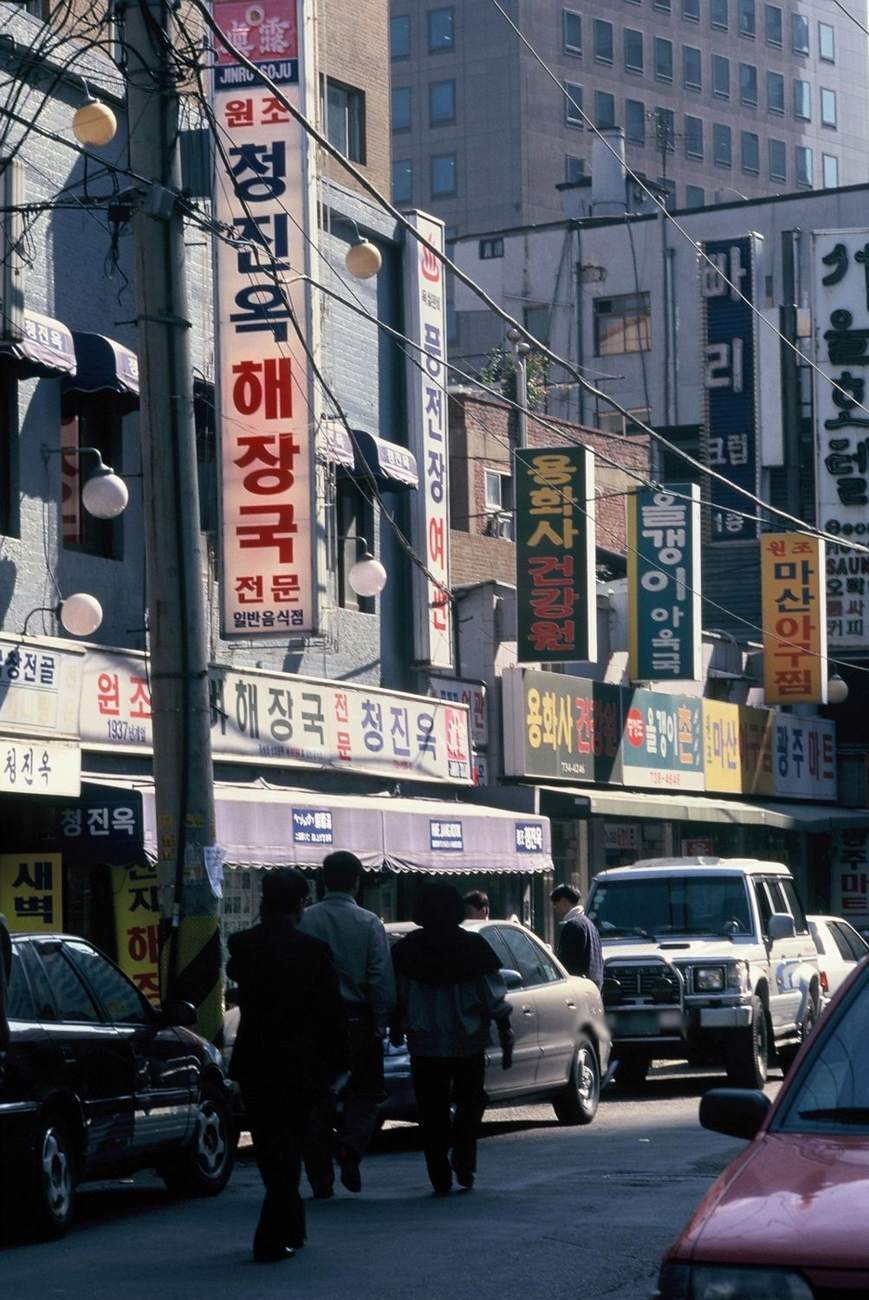
Cheongjin-dong's haejangguk street in October 1999, a decade before the towers. Cheongjinok is the one that carried on. Photo: Seoul Institute, Wikimedia Commons, CC BY 4.0.
Yeolchajip, 1954, and Taegeukdang, 1946: the pancake alley and the oldest bakery
Yeolchajip (열차집, "train house") is the bindaetteok survivor of Pimatgol, the alley behind Jongno where commoners ate out of sight of the officials' processions; when Pimatgol was redeveloped it moved a block to Jongno 7-gil. The mung-bean pancakes are fried in pork fat to order, three to a plate for ₩19,000 (assorted ₩22,000), and come with eorigul-jeot, salted young oysters, which is the reason to go. Makgeolli from around the country by the bottle. Mon–Fri 11:00–23:00, Sat 14:00–22:30, Sun 14:00–21:00; Jonggak exit 2, two minutes. Seoul Future Heritage lists it from 1954.
Taegeukdang (태극당) is Seoul's oldest bakery, opened in 1946 in Myeongdong and in Jangchung-dong since 1973, now run by the founder's grandson, Shin Gyeong-cheol. It was the first shop certified a 백년가게 by public nomination and the interior, restored rather than modernised, is a 1970s tea room with the original signage. The thing to order is the monaka ice cream, ₩3,300, vanilla between two wafer shells; the red-bean bun is ₩3,000, the butter cream cake from ₩26,000, an Americano ₩4,600. 08:00–21:00, no closing day, Dongguk University Station (Line 3) exit 2, five minutes, at Dongho-ro 24-gil 7.
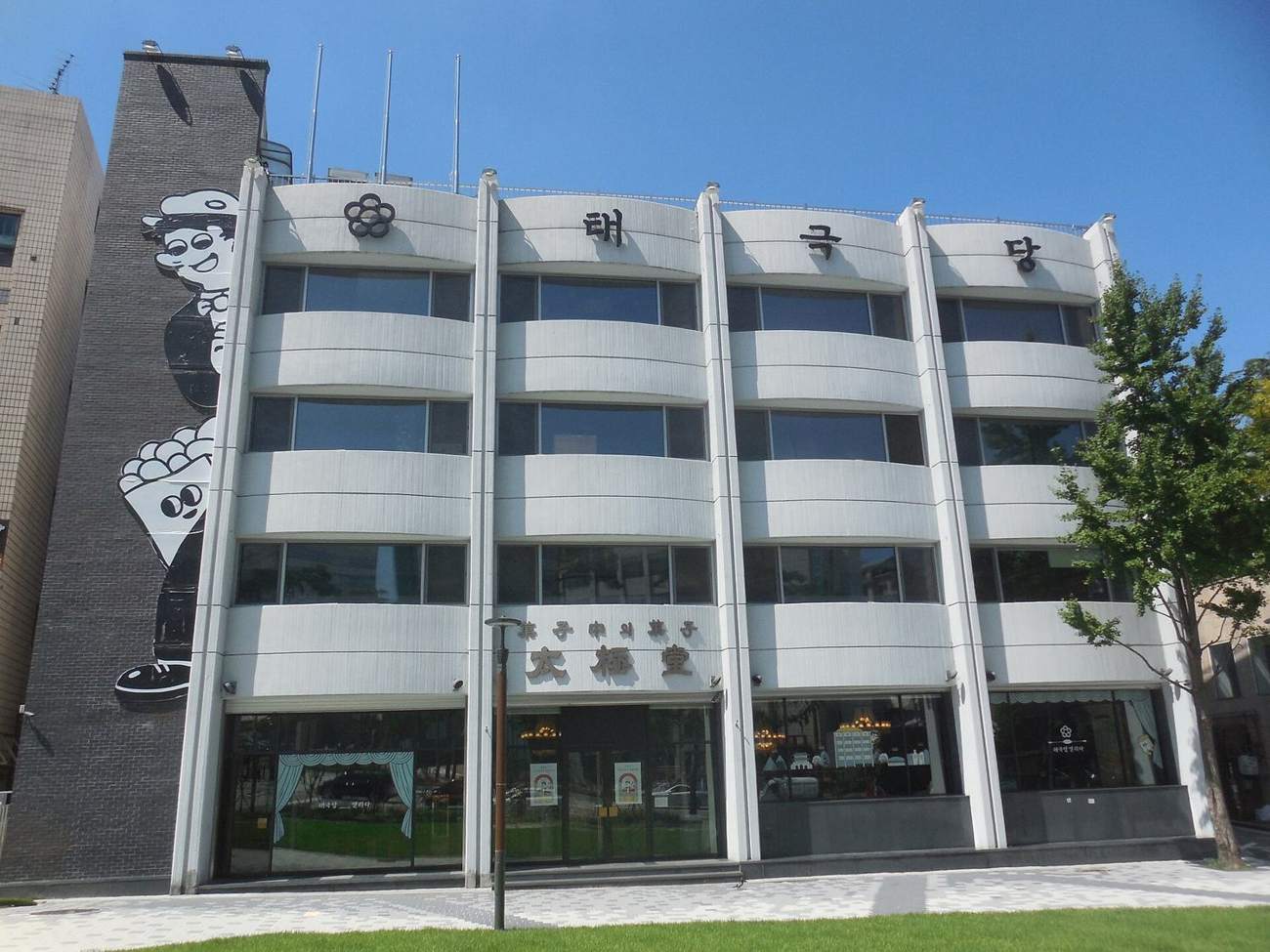
Taegeukdang, Jangchung-dong: Seoul's oldest bakery, and the first 백년가게 chosen by public nomination. Photo: 오모군, Wikimedia Commons, CC BY 3.0.
The rest of Seoul's Future Heritage restaurants, by decade
| Decade | Restaurant (district, dish, year) |
|---|---|
| 1900s–1930s | Imun Seolnongtang (Jongno, seolleongtang, 1904); Jin-a-chun (Jongno, Chinese, 1925); Yonggeumok (Jung-gu, chutang, 1932); Eunho Sikdang (Jung-gu, oxtail gomtang, 1932); Jaembaeok (Jung-gu, seolleongtang, 1933); Cheongjinok (Jongno, haejangguk, 1937); Hanilkwan (Gangnam, galbi and bulgogi, 1939) |
| 1940s | Yujin Sikdang (Jongno, Pyongyang naengmyeon, 1944); Sangol Makguksu (Jung-gu, 1944); Daeseonggwan (Dongjak, makguksu, 1946); Woo Lae Oak (Jung-gu, Pyongyang naengmyeon, 1946); Buyeojip (Yeongdeungpo, gomtang, 1947) |
| 1950s | Mapo-ok (Mapo, seolleongtang, 1950); Pyeongnae-ok (Jung-gu, naengmyeon, 1950); Munhwa-ok (Jung-gu, gomtang, 1952); Yeonnamseo Sikdang (Mapo, galbi, 1953); Ojang-dong Heungnamjip (Jung-gu, naengmyeon, 1953); Yeolchajip (Jongno, bindaetteok, 1954); Mijin (Jongno, buckwheat noodles, 1954); Wangsimni Daedo Sikdang (Seongdong, grilled beef, 1954); Choidaepo (Mapo, pork ribs, 1956); Wonjo Halmeoni Tteokbokki (Jongno, 1956); Bumin-ok (Jung-gu, yukgaejang, 1956); Samgeori Meonjimak Sundaeguk (Yeongdeungpo, 1957); Taejo Gamjaguk (Seongbuk, 1958); Ojang-dong Hamheung Naengmyeon (Jung-gu, 1958) |
| 1960s | Goryeo Samgyetang (Jung-gu, 1960); Yurim Myeon (Jung-gu, noodles, 1960); Chogajip (Gangbuk, hanjeongsik, 1960); Hwanghae (Yongsan, steak and budae-jjigae, 1960); Seobuk Myeonok (Gwangjin, naengmyeon, 1960); Tongsuljip (Seodaemun, pork ribs, 1961); Yeokjeon Hoegwan (Mapo, bulgogi, 1962); Jinju Hoegwan (Jung-gu, kongguksu, 1962); Yeongdong Snack Car (Gangnam, 1962); Andongjang (Jung-gu, Chinese, 1964); La Cantina (Jung-gu, Italian, 1967); Mugyo-dong Bugeoguk-jip (Jung-gu, dried-pollock soup, 1968); Seongbuk-dong Guksijip (Seongbuk, noodles, 1968); Daemunjeom (Yeongdeungpo, Chinese, 1969) |
| 1970s–1980s | Changseong-ok (Yongsan, haejangguk, 1970); Seoncheonjip (Jongno, hanjeongsik, 1971); Cheongiljip (Jongno, bindaetteok, 1973); Jungnimjang (Jung-gu, seolleongtang, 1974); Sunheung-ok (Jung-gu, oxtail gomtang, 1976); Rim's Chicken (Jongno, fried chicken, 1977); Yetnaljip Nangwon Agujjim (Jongno, 1977); Wondae-gu Tang (Yongsan, cod soup, 1979); Donghung-gwan (Geumcheon, Chinese, 1983); Ssangdari Sikdang (Seongbuk, pork bulgogi, 1986) |
Three from that list are worth a visitor's detour beyond the big names: Yujin Sikdang in Nakwon-dong, the cheap Pyongyang naengmyeon of the old men's district next to the Nakwon instrument arcade; Mugyo-dong Bugeoguk-jip, which has served one dish, dried-pollock soup, since 1968 and is where City Hall eats breakfast; and Jinju Hoegwan, whose summer-only kongguksu (noodles in cold soy-milk) has a queue down the street in July.
How to eat at a nopo
- Go early, and on a weekday. Hadongkwan closes at 16:00 or when the pot empties, Imun opens at 08:00, Cheongjinok at 06:00. Lunch is 12:00 to 13:00 for the office crowd; 11:30 or 14:00 is empty. Most take no reservations.
- Check the closing day. Monday at Woo Lae Oak, Sundays and holidays at Hadongkwan, certain Sundays at Yonggeumok, public holidays at Imun, and the three-day closures at Seollal and Chuseok; our restaurant hours guide explains the break-time and holiday pattern.
- Order by the number. At the soup houses the menu is one dish in sizes: 보통 (regular), 특 (special, more meat), or a price ("25-gong"). Say the size and the number of bowls.
- Season it yourself. Seolleongtang and gomtang come unsalted; salt, pepper, spring onion and chilli are on the table, and the kimchi and kkakdugi are free and refillable.
- Pay first where the counter is by the door (Hadongkwan), otherwise at the counter on the way out. Cards are taken everywhere on this list; there is no tipping.
- One dish each is the norm, sharing is fine. A bowl of soup with rice is a full meal; bindaetteok and bulgogi are for the table. Eating alone at a soup house is normal (our eating-alone guide covers the rest).
- Prices move. Nopo raise prices every year or two, usually in January; the numbers above are from 2025–26 listings.
FAQ
Q: What is the oldest restaurant in Seoul? Imun Seolnongtang in Jongno, open since 1904 (the date on Seoul's heritage register; other records give 1902 and 1907). It serves seolleongtang for ₩14,000 in 2026, opens at 08:00, and is on the Seoul Future Heritage register and the government's 백년가게 list.
Q: What is a 백년가게 (hundred-year shop)? A business at least 30 years old certified by Korea's Ministry of SMEs and Startups for quality, stability and succession. 1,545 had been designated by July 2026; of the 1,139 on the current public list, 721 are restaurants, and Seoul has the most at 94. The plaque on the door is the sign.
Q: What does nopo mean? 노포, literally "old shop": a restaurant or store that has served the same thing in the same place for decades, usually family-run. It is a compliment, and the word Koreans use when they recommend one.
Q: How much is gomtang at Hadongkwan? ₩18,000 for the regular bowl in 2026, ₩25,000 and ₩30,000 for the larger "25-gong" and "30-gong" servings. It opens 07:00 to 16:00, closed Sundays and public holidays, and closes early when the soup runs out.
Q: Do I need a reservation at Woo Lae Oak? No, it does not take them; you queue. Expect 30 to 60 minutes at meal times, less at 11:30 opening. It is closed on Mondays. Pyongyang naengmyeon is ₩18,000.
Q: Are Seoul's old restaurants expensive? No. The soups are ₩12,000 to ₩18,000 with rice and kimchi included, bindaetteok ₩19,000 for three, a monaka ice cream ₩3,300. Only the table-grilled bulgogi at Woo Lae Oak (₩46,000) and Hanilkwan is a splurge.
Sources
- Ministry of SMEs and Startups, 2026 백년가게·백년소공인 designation (24 July 2026; Newspim, Money Today): 300 new, totals 1,545 and 1,053; programme criteria on sbiz.or.kr and bizinfo.go.kr.
- Segye Ilbo (7 September 2026), analysis of the public 백년가게 list: 721 of 1,139 listed shops are restaurants; regional counts and per-capita figures.
- Seoul Metropolitan Government, 서울미래유산 register and Seoul Media Hub, "서울미래유산 속 식당 50" (list of 50 restaurants with founding years).
- Korea.kr (May 2026), "믿고 떠나는 대한민국 백년가게 미식 여행" (Taegeukdang as the first public-nomination 백년가게).
- Restaurant menus and hours as listed on Korean review platforms (DiningCode, September 2026) and Namu Wiki entries for Imun Seolnongtang, Hadongkwan and Woo Lae Oak; Korean Wikipedia (Woo Lae Oak founder and trademark); Hankook Ilbo (May 2022) on Yonggeumok's founding; Michelin Guide Seoul & Busan 2026.
You Might Also Like
Korean Restaurant Hours Explained: Break Time, Last Order, Monday Closures, Chuseok and Seollal Closures, 24-Hour Options, and Korea's New No-Show Fine
Why the Seoul restaurant is shut at 3:30 (break time, usually 15:00 to 17:00), why it is closed on Monday (31%, the most common day off), what last order means, how Chuseok closures work, and the no-show fine Korea raised to 40% in December 2025.
Is Korea Kid-Friendly? What Foreign Parents Report — and What Korean Data Shows: Strangers Who Hand Out Tangerines, 114 No-Kids Zones, and the 68% Who Accept Them
Foreign parents say older Koreans shower babies with snacks and department-store nursing rooms beat London's. Korean data adds 114 no-kids zones, 68% public acceptance, and 64% of Korean parents who feel watched. What that means for your trip.
Car Seat Taxis in Korea: The Law Requires a Seat for Every Child Under 6, Ordinary Taxis Don't Carry One — What Tourists Can Actually Book in Seoul
Korea's Road Traffic Act requires a car seat for children under 6 in any car, taxis included, and fines the driver ₩60,000. Ordinary taxis carry none and police paused taxi enforcement in 2018. TADA, whose app takes foreign phones and cards, runs about 300 car-seat vans.