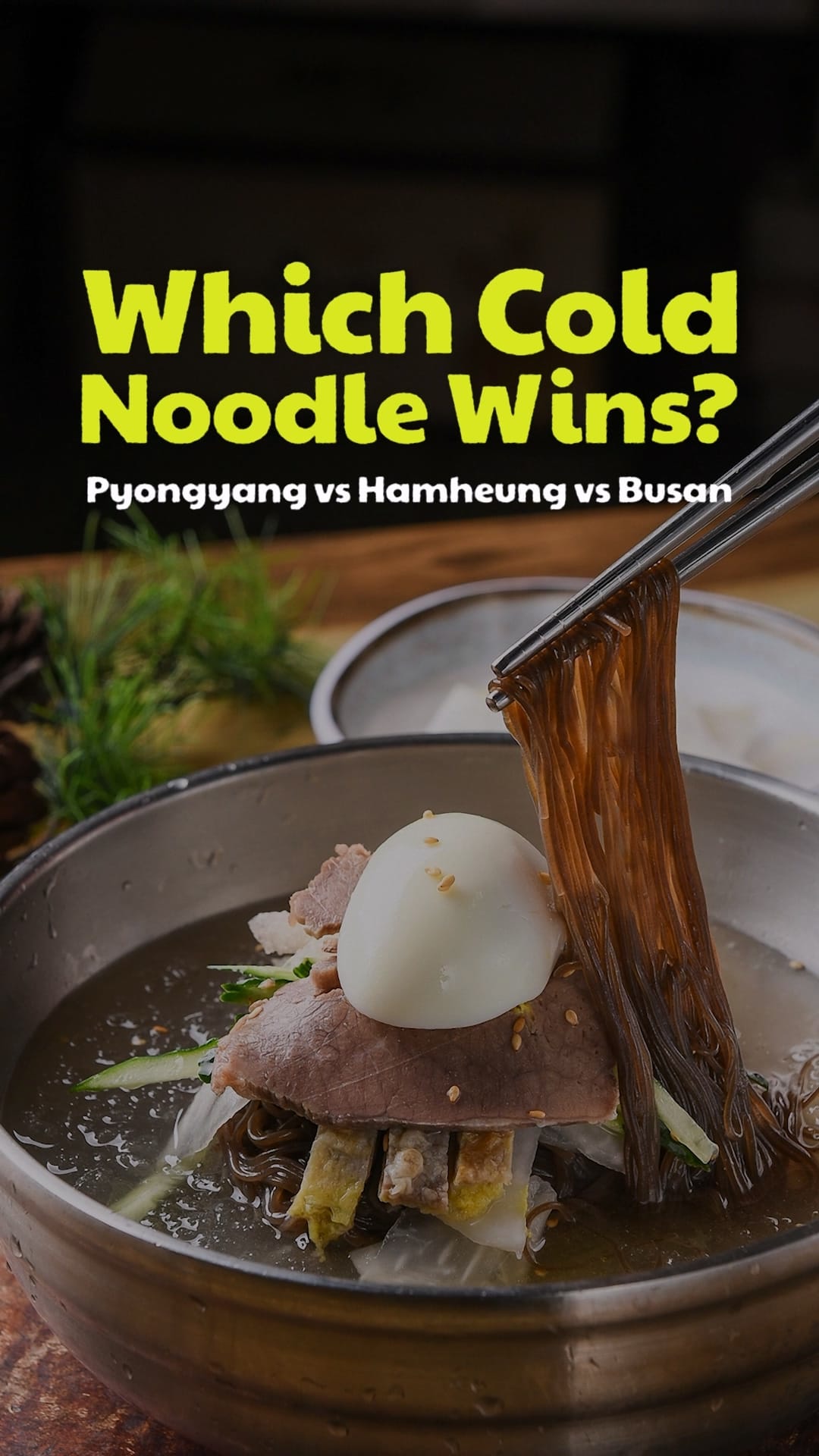
Pyongyang vs Hamheung Naengmyeon: Which Korean Cold Noodle to Order
Pyongyang vs Hamheung naengmyeon is the only choice that matters when you sit down, and the two are barely the same dish. Pyongyang style (평양냉면) is buckwheat noodles in a cold, clear, deliberately restrained beef or dongchimi broth — it tastes like almost nothing on the first spoonful, and that's the point. Hamheung style (함흥냉면) is chewy sweet-potato-starch noodles with almost no broth at all, tossed in a spicy-sweet gochujang sauce, usually with raw skate or beef on top.
Here is what almost no English guide tells you: the mild one is the expensive one. A bowl at Seoul's famous Pyongyang houses runs ₩15,000–18,000 as of August 2026. The spicy Hamheung bowl at the equally famous Ojang-dong shops is ₩11,000. You are being told to work your way up to a dish that costs about 50% more.
That changes the advice, so let's start there.
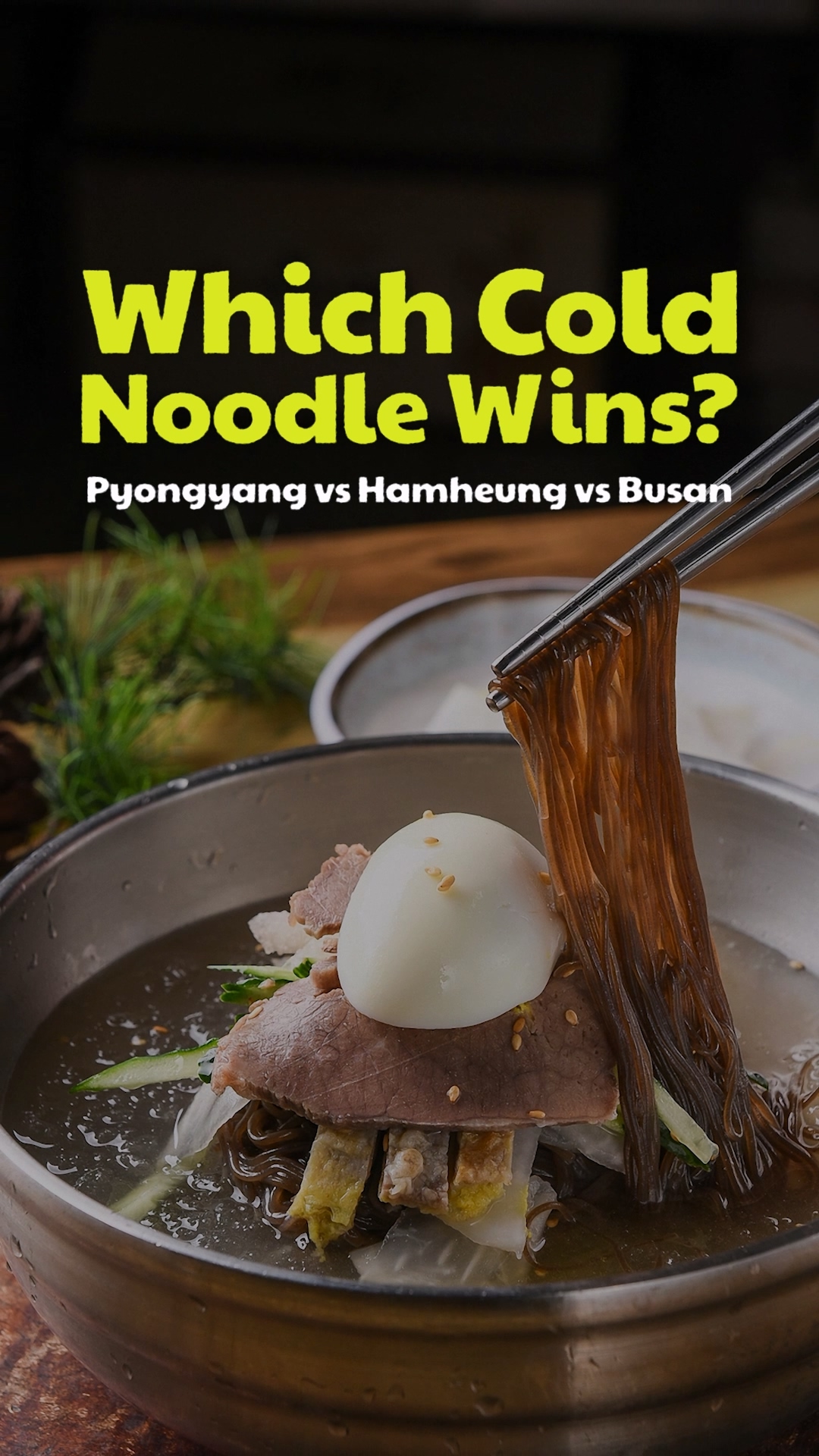
How most Koreans actually eat it at home — the Choung Soo mul-naengmyeon kit, on AmazonAffiliate link. As an Amazon Associate, EpicKor earns from qualifying purchases at no extra cost to you.
The Short Answer
| Question | Answer |
|---|---|
| First timer, one bowl? | Hamheung (함흥) — immediate flavour, and ₩4,000–7,000 cheaper |
| Pyongyang price | ₩15,000–18,000 at the famous Seoul houses, August 2026 |
| Hamheung price | ₩11,000 at the Ojang-dong shops, August 2026 |
| Broth or sauce? | Pyongyang = cold clear broth. Hamheung = sauce, barely any broth |
| Noodle | Pyongyang = buckwheat, tears easily. Hamheung = sweet-potato starch, very chewy |
| Third option | 밀면 (milmyeon) — Busan's wheat-flour version, cheaper again |
| Biggest mistake | Pouring vinegar and mustard in before tasting |
Noodle-flation: why the bland one costs the most
Korean media has a word for what has happened to this dish — 누들플레이션 (noodle-flation) — and cold noodles are the headline example. Food-industry coverage in Korea now runs stories with titles like "the ₩18,000 bowl of naengmyeon."
The specifics, as of August 2026:
| Restaurant | Style | Price | Note |
|---|---|---|---|
| 우래옥 (Woo Rae Ok) | Pyongyang | ₩18,000 | Raised from ₩16,000 in April 2026 |
| 남포면옥 (Nampo Myeonok) | Pyongyang | ₩16,000 | Raised from ₩15,000 |
| 필동면옥 (Pildong Myeonok) | Pyongyang | ₩15,000 | ₩13,000 in 2022, ₩14,000 in 2025 |
| 오장동함흥냉면 | Hamheung | ₩11,000 | Michelin Bib Gourmand since 2017 |
Two things worth taking from that table.
The climb is recent and steep. Pildong Myeonok went ₩13,000 → ₩14,000 → ₩15,000 in about three years. Woo Rae Ok added ₩2,000 in a single step this April.
The gap between the two styles is real, not a rounding error. At the top houses you are paying a ₩4,000–7,000 premium for the bowl that tastes of less. Koreans know this and argue about it every summer.
None of which means don't order it — plenty of people think it is worth every won. But you should walk in knowing that "try the subtle one first" is advice that costs money, and that a first-timer who bounces off it has spent ₩18,000 to learn they do not like it yet.
Pyongyang vs Hamheung: what actually differs
| 평양냉면 Pyongyang | 함흥냉면 Hamheung | |
|---|---|---|
| Noodle | Buckwheat-forward, greyish, breaks easily | Sweet-potato starch, translucent, very chewy |
| Liquid | Cold clear broth, beef and/or dongchimi | Almost none — a sauce, not a soup |
| Flavour | Restrained, clean, savoury | Spicy, sweet, sharp with vinegar |
| Classic topping | Sliced beef, egg, pear, cucumber | Seasoned raw skate (회냉면) or beef |
| Origin story | Northern winter dish, buckwheat country | Hamheung refugees selling hometown raw-fish noodles in the South |
| Scissors? | Purists say no — buckwheat gives way anyway | Usually yes — starch noodles resist teeth |
The origin story explains the noodles. Buckwheat grows where rice does not, which is why the northern interior ate it; buckwheat noodles have almost no gluten, so they snap cleanly and cannot be twirled. Hamheung is coastal, and its refugees rebuilt their dish in the South around potato and sweet-potato starch, which produces a noodle so elastic that restaurants hand you scissors as standard equipment.
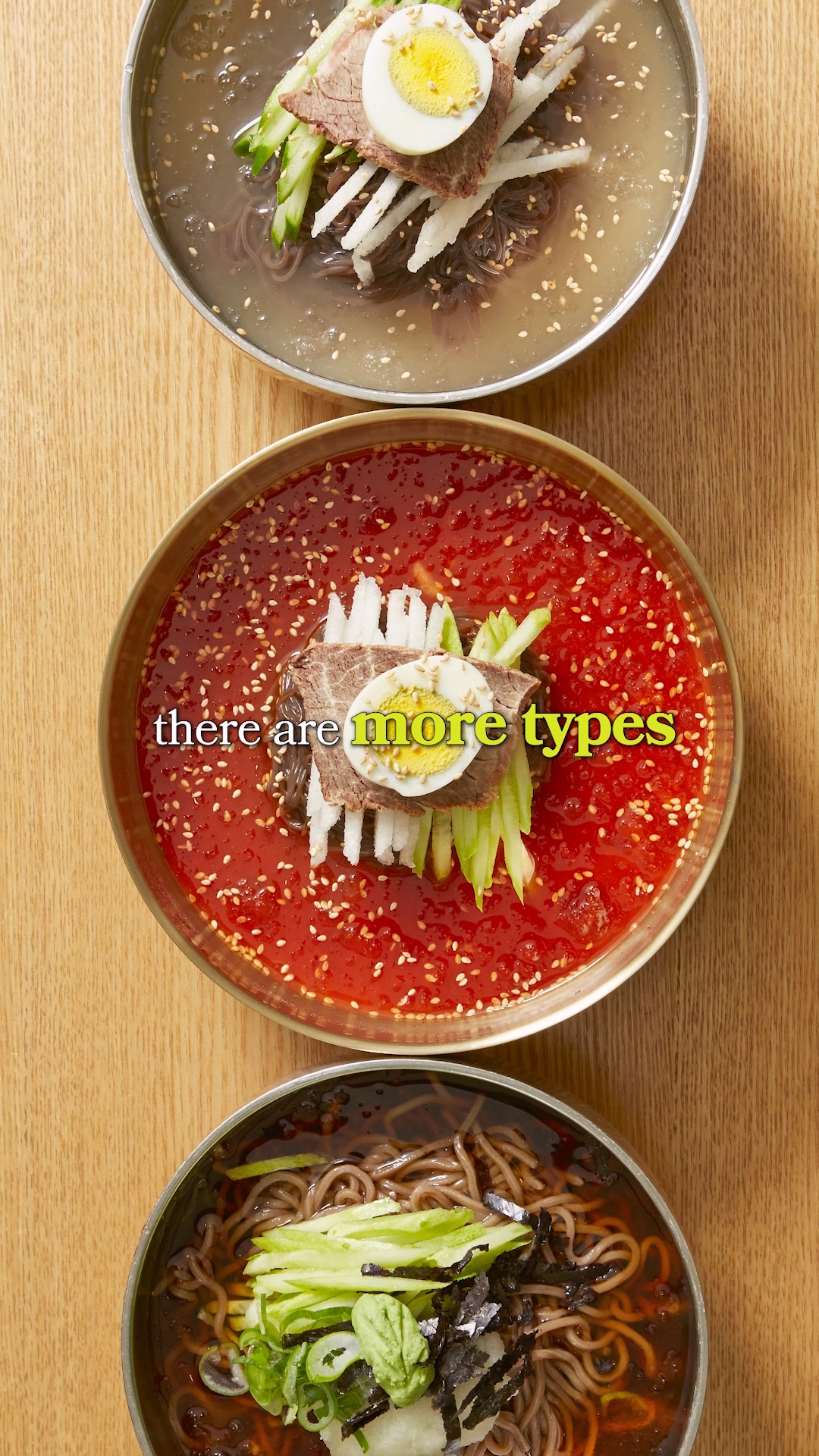
The third one: Busan's milmyeon
If you get to Busan, there is a third cold noodle that is not naengmyeon at all: 밀면 (milmyeon), short for 밀국수 냉면 — wheat-noodle cold noodles.
It exists for a specific historical reason. Korean War refugees who ended up in Busan wanted their northern cold noodles, but buckwheat and starch were expensive and American aid flour was cheap and everywhere. So they rebuilt the dish in wheat.
You can identify it instantly by colour. Naengmyeon noodles are grey or pale brown with visible buckwheat flecks. Milmyeon noodles are pure white and completely clean — no flecks at all. It also costs less than naengmyeon, because wheat is cheaper than buckwheat, which is the same economics that created it in the first place.
If Busan is on your itinerary, our Busan versus Seoul guide covers what else the city does differently.
Choung Soo mul-naengmyeon kit (물냉면) — noodles plus a concentrated broth sachet you dilute with iced water. The honest cheap version: a fraction of the ₩15,000 restaurant bowl, and genuinely how most Koreans eat it at home in summer. Buckwheat and starch kits behave differently, so check which you are buying. As an Amazon Associate, EpicKor earns from qualifying purchases at no extra cost to you.
See the naengmyeon kit on AmazonWhy some Koreans call Pyongyang naengmyeon "bland"
Pyongyang-style broth does not shout. It is cold, pale, and quiet. (Foreigners, oddly, find this the easier bowl — it is the chewy Hamheung style that most never learn to love, and we wrote up why.) If you are used to spicy jjigae, sweet barbecue sauce, or instant ramyeon, the first sip can feel under-seasoned.
That quietness is the point. Fans look for beef depth, dongchimi brightness, buckwheat aroma, and a clean finish. This is why people say the flavour "opens up" after several bowls — you are not chasing one dramatic bite, you are learning a calm flavour language.
Korean has a word for the devotees who take this too far: 면스플레인 (myeon-splain) — 냉면 plus "explain", a local parody of mansplain. It names a specific behaviour: the Pyongyang purist who informs you that you must not cut the noodles with scissors, must not add vinegar, and that the other styles are not really naengmyeon. Korean media has run pieces titled, roughly, "we are tired of the cold-noodle hipsters' myeon-splain," and there is a companion term, 평냉부심, for the pride itself.
Keep that in mind for the next two sections, because the two rules the myeon-splainers police — vinegar and scissors — are exactly the two you are allowed to break.
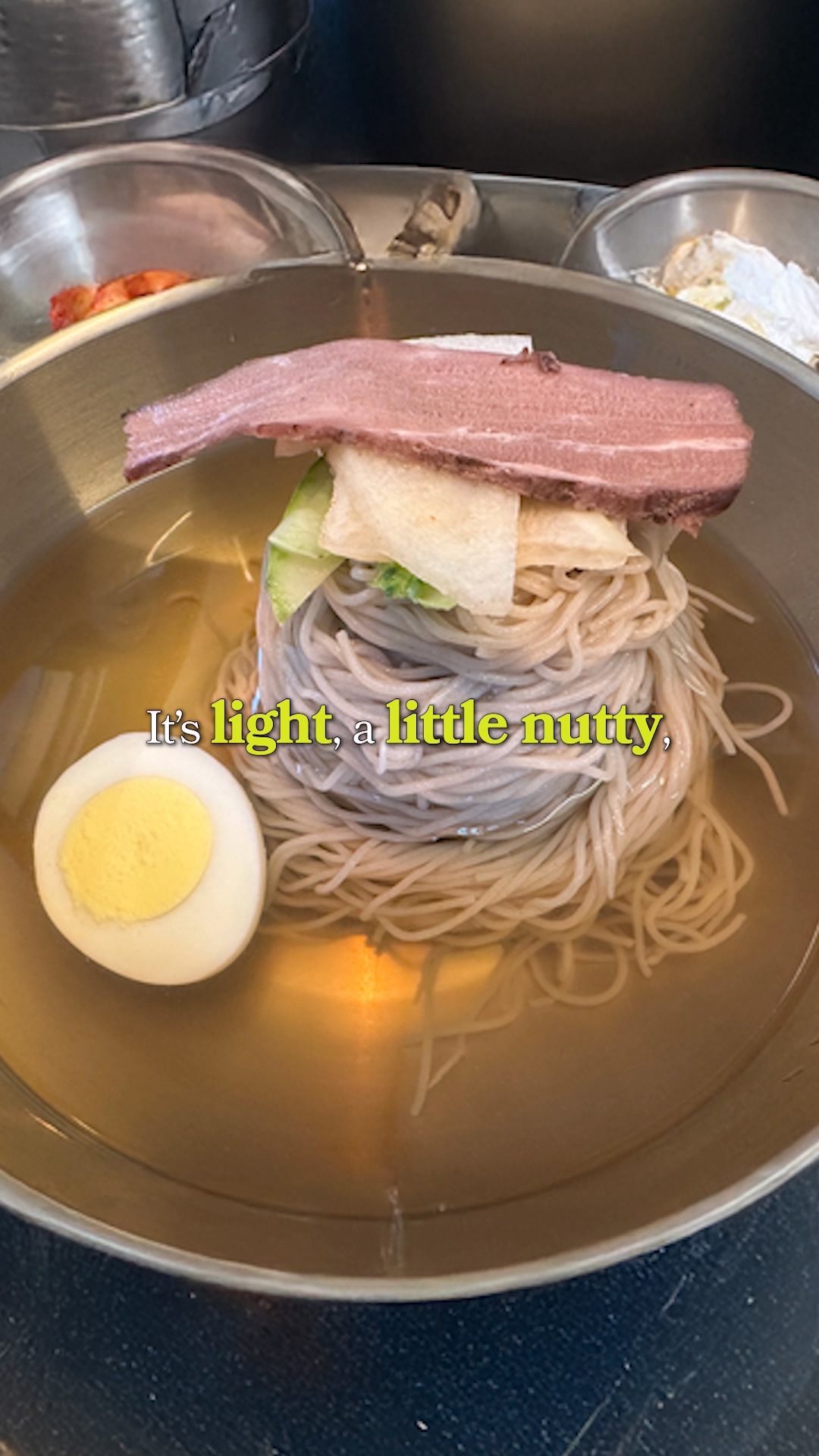
Where to eat, with the details you actually need
Verified as of August 2026. Restaurants change hours and prices, so treat these as a starting point — but they are specific enough to plan around, which is more than "check locally."
오장동함흥냉면 — Hamheung style, ₩11,000 Jung-gu, Mareunnae-ro 108. Dongdaemun History & Culture Park Station, Exit 6, about 350m. Open 11:00–20:30, closed the 1st and 3rd Tuesday of the month plus Seollal and Chuseok. Michelin Bib Gourmand since 2017. Hoe naengmyeon and mul naengmyeon are both ₩11,000; suyuk is ₩20,000.
오장동흥남집 — the rival, same street Mareunnae-ro 114, five minutes from the same Exit 6. Open 11:30–20:30, closed Wednesdays. Ojang-dong has two famous Hamheung houses about fifty metres apart, and Koreans have opinions about which is which.
필동면옥 — Pyongyang style, ₩15,000 Jung-gu, Seoae-ro 26. Chungmuro Station, Exit 1, about five minutes on foot. Open 11:00–19:50 with a break from 15:00 to 17:00, closed Sundays. Naengmyeon, bibim and onmyeon are all ₩15,000; an extra noodle portion (사리) is ₩9,000.
우래옥 — Pyongyang style, ₩18,000 Jung-gu, Changgyeonggung-ro 62-29, a minute from Euljiro 4-ga Station. Open 11:30–21:00, closed Mondays. Founded in 1946 by a Pyongyang native, and the most expensive of the famous four.
That break time at Pildong Myeonok is the detail that ruins afternoons. Arrive at 15:30 and the door is shut for ninety minutes.
The map changed: what happened to Euljimyeonok
If you are following an older guide, you may be sent to 을지면옥 (Euljimyeonok) in Euljiro. It is not there.
After 37 years, it served its last bowl on 25 June 2022 and closed — pushed out by the Sewoon district redevelopment, after a legal fight with the developer. It reopened later near Jongno 3-ga Station, in the Nagwon-dong area beside the Jongno tax office.
This is worth knowing beyond one restaurant. Seoul's old noodle houses sit on exactly the central blocks that redevelopment wants, and several have moved or closed in the last few years. Check that a naengmyeon shop still exists at the address before you cross the city for it — the reviews stay online long after the building comes down.
Vinegar and mustard: taste first, adjust second
Most naengmyeon restaurants put vinegar (식초) and hot mustard (겨자) on the table. Do not pour both in immediately. Taste the broth or sauce as served — the restaurant already made a decision, and your job is to understand that starting point before editing it.
Then adjust lightly:
- Vinegar if the bowl feels flat or fatty.
- Mustard if you want a sharper, nose-clearing kick.
- Both, slowly, if you are eating bibim style and want more snap.
- Stop early. It is easier to add than to undo.
That restraint matters most with Pyongyang naengmyeon. If you drown a ₩18,000 subtle broth in vinegar in the first ten seconds, you have bought the expensive bowl and then removed the reason it costs that much.
The scissors question
Naengmyeon noodles are long and can be very chewy. Most restaurants provide scissors, or staff offer to cut for you. The scissors themselves are a Korean kitchen instrument with a serrated edge and a detachable pivot — see our guide to Korean kitchen scissors. With starch-heavy Hamheung noodles, cutting is genuinely practical. In stricter Pyongyang circles, some diners refuse, wanting the full noodle length and the way buckwheat gives way on its own.
For travellers the rule is simple: if the noodles are hard to eat, cut them once. You are not failing Korean culture. You are eating dinner.
If you are curious why scissors appear on Korean tables so often, our Korean cookware guide covers how scissors and tongs fit barbecue, noodles, kimchi, and home cooking.
Korean BBQ scissors and tongs set — the table tool this dish explains. Cutting food at the table is standard in Korea, not improvised, and the scissors are built for it. Look for blades that separate for cleaning; the one-piece ones trap food at the hinge. As an Amazon Associate, EpicKor earns from qualifying purchases at no extra cost to you.
See the scissors set on Amazon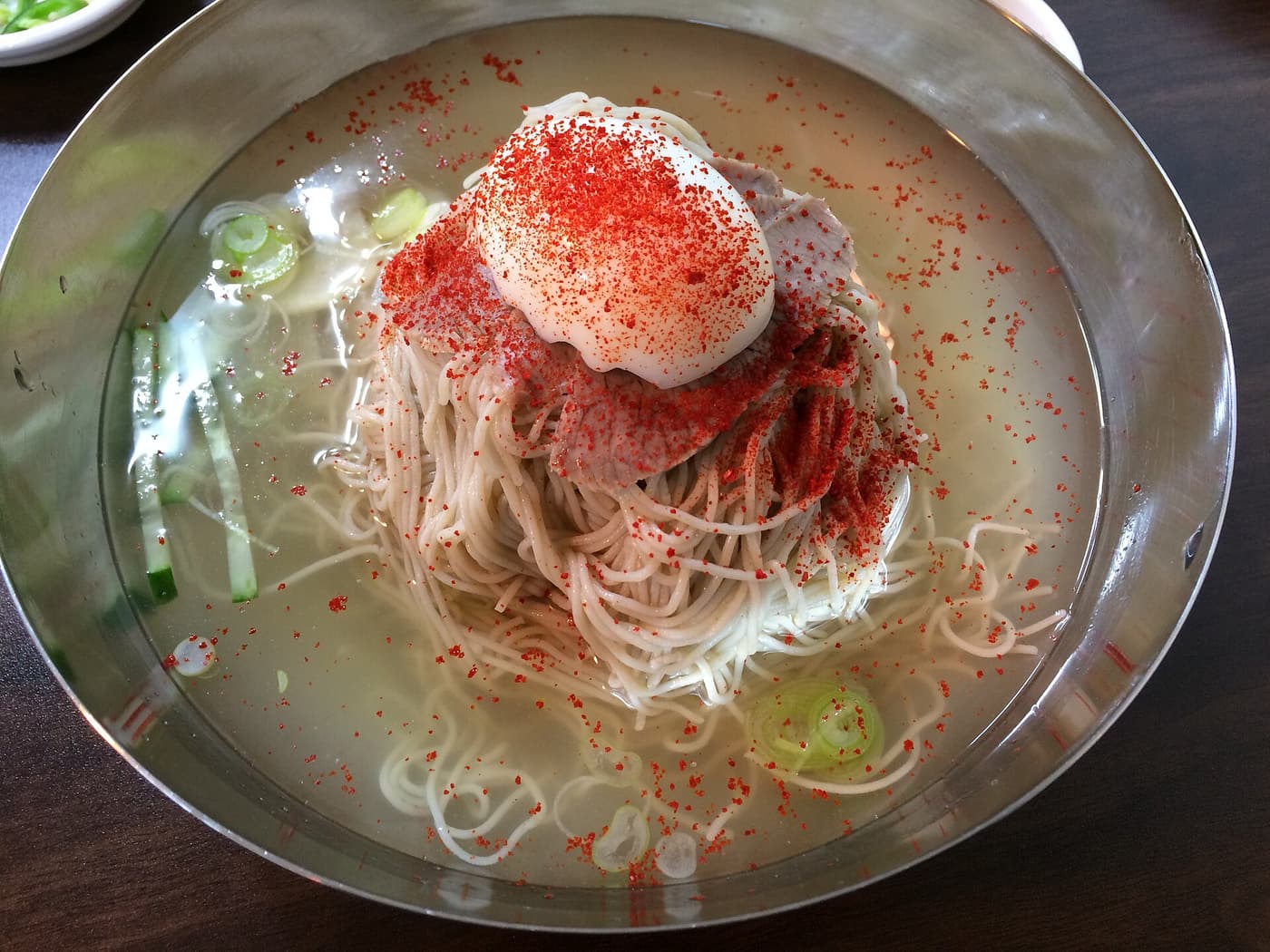
When Koreans actually eat it
Naengmyeon has winter roots. Korea.net notes it was historically a winter specialty, tied to dongchimi — the radish water kimchi that was a winter preservation food. Eating icy noodles in a heated room in January was the original form.
Modern practice has flipped it to summer, and added a second setting that matters more for travellers: after Korean barbecue. Cold noodles following grilled meat feel clean and sharp, and the acidity cuts the fat. Many barbecue restaurants sell a smaller, cheaper naengmyeon precisely for this — it is not the same as a dedicated noodle house bowl, and it is not trying to be.
For the drinks side of that meal, our Korean drinks beyond soju guide helps match beer, makgeolli, soju, and non-alcoholic options.
How to order without stress
| Korean | Meaning | What arrives | Note |
|---|---|---|---|
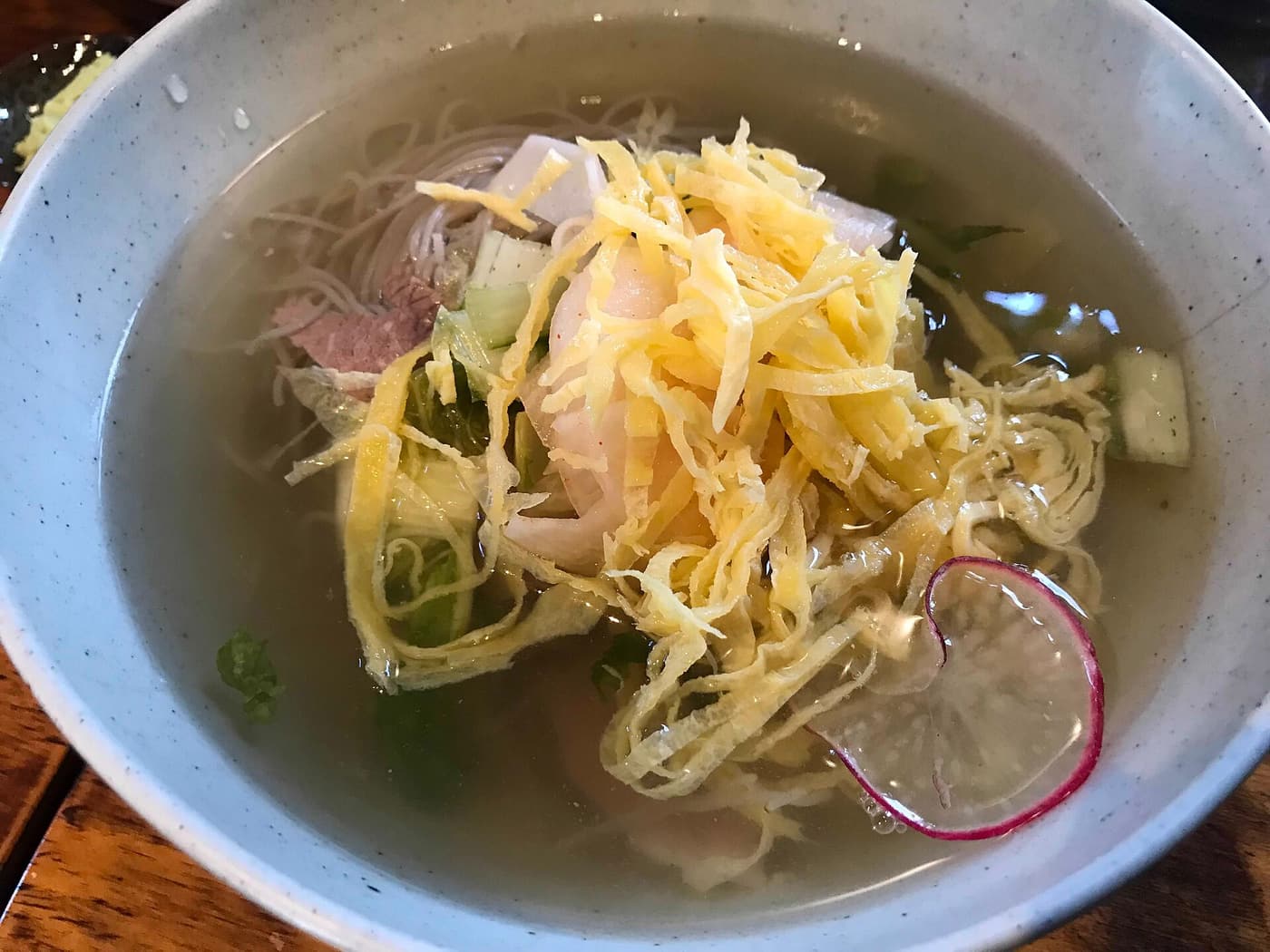
| 물냉면 mul naengmyeon | Water cold noodles | Noodles in chilled broth | The safe first order on a hot day |
| 비빔냉면 bibim naengmyeon | Mixed cold noodles | Noodles in spicy sauce | Immediate flavour, no broth |
| 회냉면 hoe naengmyeon | Raw-fish mixed cold noodles | Spicy noodles with seasoned skate | Check your seafood comfort first |
| 온면 onmyeon | Warm noodles | Same noodles, hot broth | Exists at Pyongyang houses year-round |
| 사리 sari | Extra noodles | One more noodle portion | ₩9,000–10,000 at the famous shops |
| 수육 suyuk | Boiled sliced meat | Sliced pork or beef | The standard side, around ₩20,000–33,000 |
If you are two people, order one broth style and one mixed style and taste both before seasoning. That is the fastest education, and it costs less than ordering the ₩18,000 bowl twice.
Common mistakes
Treating it as a barbecue afterthought. It can be that. But a serious noodle shop expects you to notice the bowl: sip, lift the noodles, check the chew, then decide about vinegar.
Assuming red means better. Bibim naengmyeon is fun. If you never try a clean broth style, you will miss why Pyongyang houses have queues.
Judging the category from one bowl. Some shops lean sweet, some meaty, some dongchimi-sharp, some care only about noodle texture. Naengmyeon is a category, not one fixed taste.
Going at 15:30. See the break times above.
First-timer recommendation
- Want the immediate, obvious version and the cheaper bill? Hamheung bibim or hoe naengmyeon, ₩11,000.
- Want to understand what Koreans argue about? Pyongyang mul naengmyeon, ₩15,000–18,000 — go hungry, go early, and do not season it for the first three bites.
- Just finished barbecue? One mul and one bibim for the table.
- Nervous about raw fish? Avoid hoe naengmyeon first time.
- In Busan? Have milmyeon instead and save money.
There is no single correct bowl. There is only the bowl that teaches you what you enjoy — and now you know what each one costs before you sit down.
FAQ
Q: How much does naengmyeon cost in Seoul?
As of August 2026, Pyongyang-style naengmyeon at the famous houses is ₩15,000–18,000 — Pildong Myeonok ₩15,000, Nampo Myeonok ₩16,000, Woo Rae Ok ₩18,000 after an April increase. Hamheung-style at the Ojang-dong shops is ₩11,000. Ordinary neighbourhood restaurants and barbecue-house versions cost less.
Q: Is naengmyeon always spicy?
No. Mul naengmyeon is served in cold broth and is mild. Bibim and hoe naengmyeon are spicy and sauce-forward.
Q: Should I add vinegar and mustard right away?
Taste first. Add slowly, after you understand the broth or sauce as served. This matters most with Pyongyang style, where the seasoning is the point of the price.
Q: Is Pyongyang naengmyeon supposed to taste bland?
It tastes subtle to first-timers. Fans look for clean broth, buckwheat aroma, and restrained depth rather than sweetness or spice. Whether that is worth ₩4,000–7,000 more than the spicy version is a genuine question, and Koreans disagree about it too.
Q: What is the difference between naengmyeon and milmyeon?
Milmyeon is Busan's wheat-flour cold noodle, created by Korean War refugees when American aid flour was far cheaper than buckwheat. The noodles are pure white with no buckwheat flecks, and it costs less than naengmyeon.
Q: Why do restaurants give scissors with naengmyeon?
Starch noodles are extremely chewy and long. Cutting makes them manageable. Buckwheat noodles break on their own, which is why Pyongyang purists often decline.
Q: Is naengmyeon a summer food or a winter food?
Historically winter, tied to dongchimi radish water kimchi. In modern practice it is a summer dish and a post-barbecue dish.
Sources
- Korea.net: Korean recipes - Naengmyeon
- VISITKOREA: Hamheung Cold Buckwheat Noodles
- VISITKOREA: Korea's favorite noodles
- Visit Seoul: Ojangdong Hamheung Naengmyeon
- Michelin Guide: Pildong Myeonok
- Prices, opening hours and station exits verified against Korean restaurant listings and Korean food-industry press, August 2026. Korean coverage of 누들플레이션 and the 2026 price increases informed the pricing section.
Naengmyeon compared is part of EpicKor's Korean ramyun guide — every packet compared by soup base and verified Scoville, with current Korean prices.
Also in the section: Rainy-day noodles and The ramyun guide.
You Might Also Like
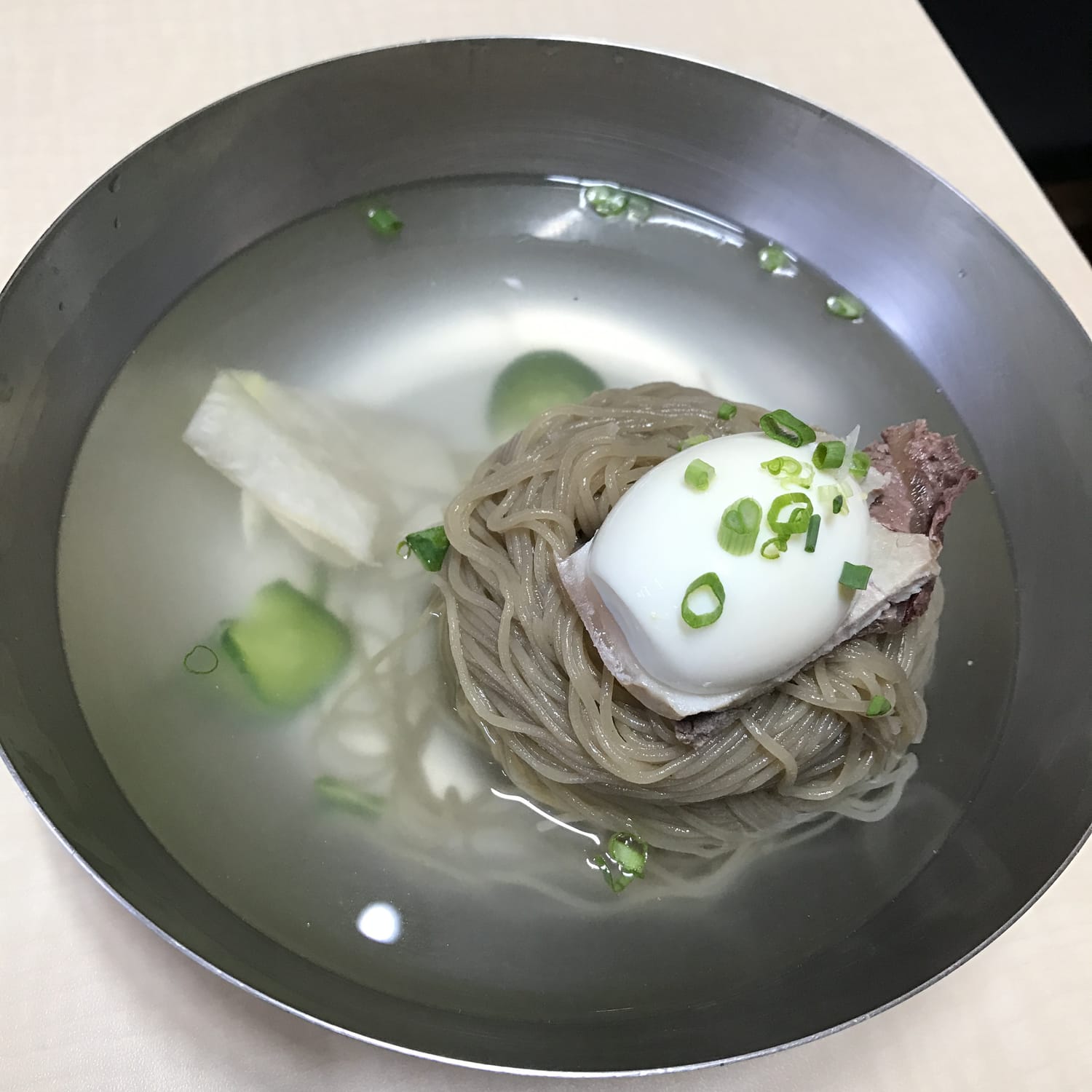
The One Korean Food Foreigners Never Learn to Love: Hamheung Naengmyeon, and Why Koreans Can't See the Problem
Foreigners who eat cheonggukjang and even hongeo still will not pay for this twice. A Korean creator who fed foreigners for years says naengmyeon was the overwhelming number one refusal, and Koreans, who rank it first every summer, cannot see why.
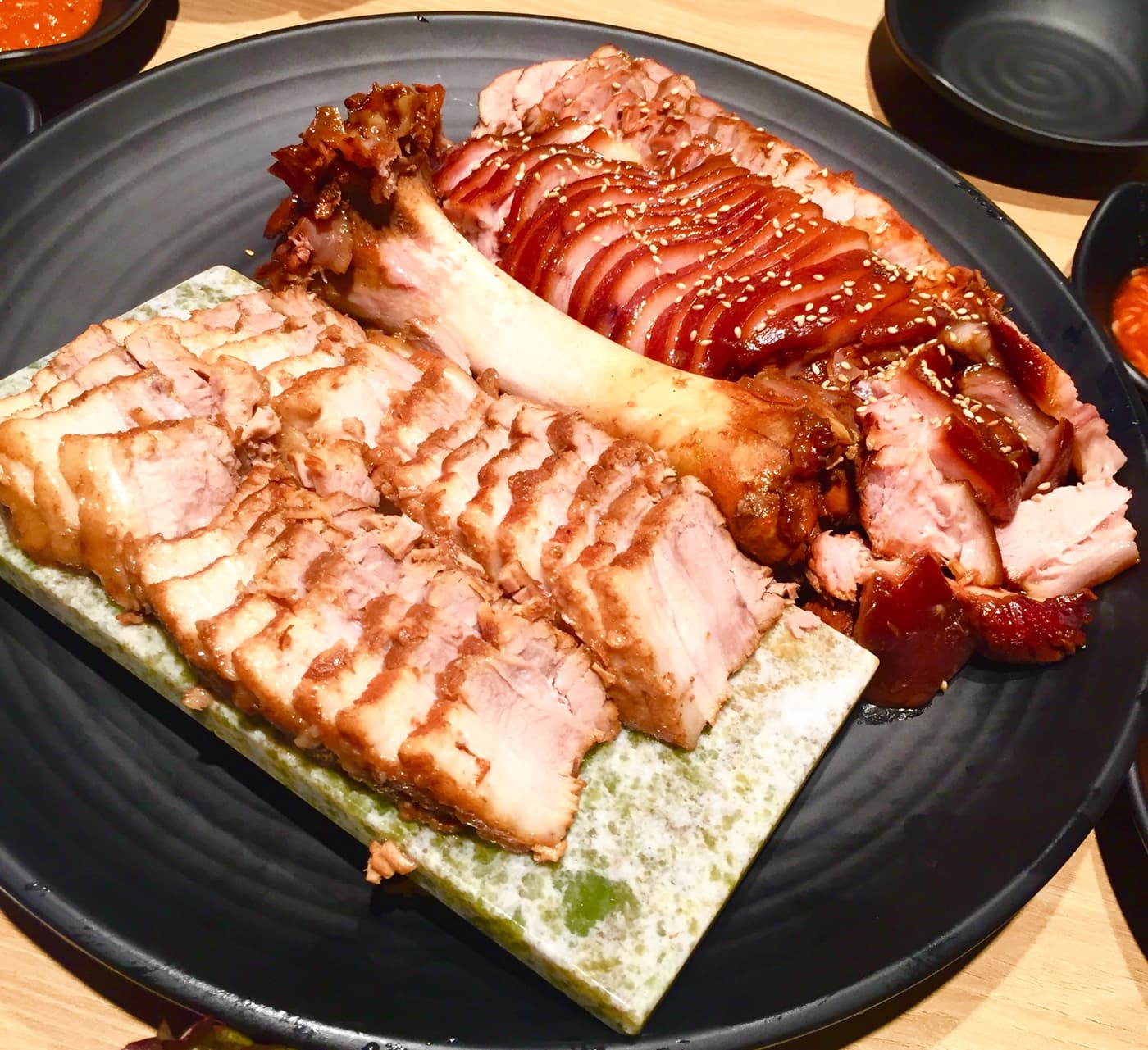
Jokbal vs Bossam: Which Korean Pork Dish Should You Order?
Jokbal and bossam share a menu, a price, and the same side dishes — but one is soy-braised trotter and the other is plain-boiled belly. Which to order, what a portion costs in August 2026, and why they are always sold together.
What Do Koreans Eat for Breakfast? 12 Real Meals, and Why a Third Skip It
About a third of Korean adults skip breakfast entirely, and people in their 20s score worst of any age group in the national health survey. What the other two-thirds eat, with August 2026 prices: gimbap ₩3,800, kimchi-jjigae set ₩8,654, abalone juk ₩18,900.