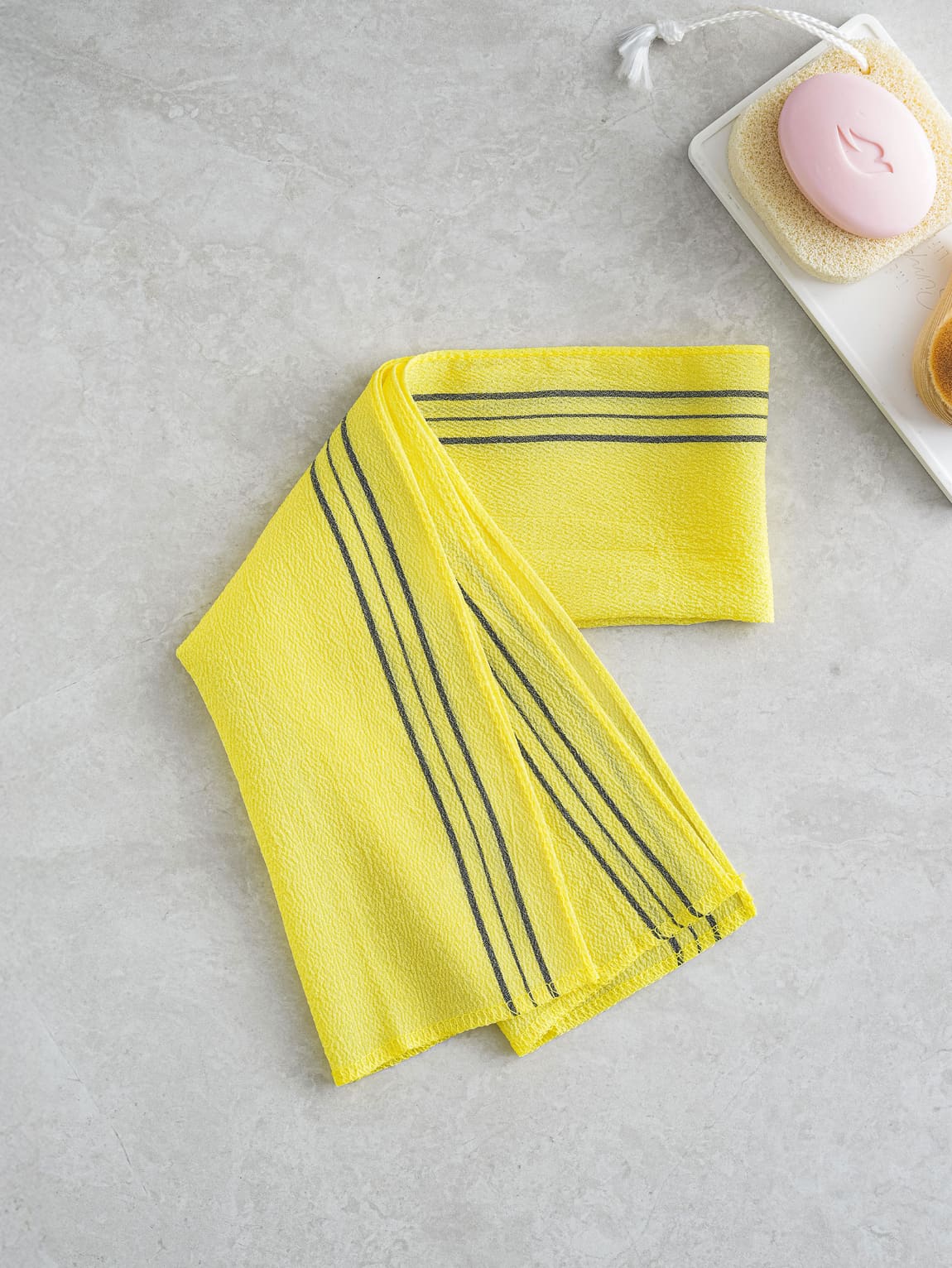
Korean Exfoliating Towels: What the Colours Mean, and How Often to Use One
Search for a Korean exfoliating towel and the listings will hand you a system. Pink is gentle. Green is standard. Blue is aggressive. One Amazon listing puts it right in the product name: "Blue — Strong".
It reads like a manufacturer's grading scale, so people buy on it.
Korean sources do not have that scale. In Korea the cloth came in green because green is what the first batch was, and the other colours arrived later as colours. The variable that actually decides whether this thing polishes your skin or injures it is not printed on the packet at all — it is how long you sat in the water first.
Here is the whole object: what it is, where it came from, what the colours actually indicate, and the frequency rule that Korean dermatologists are unusually blunt about.
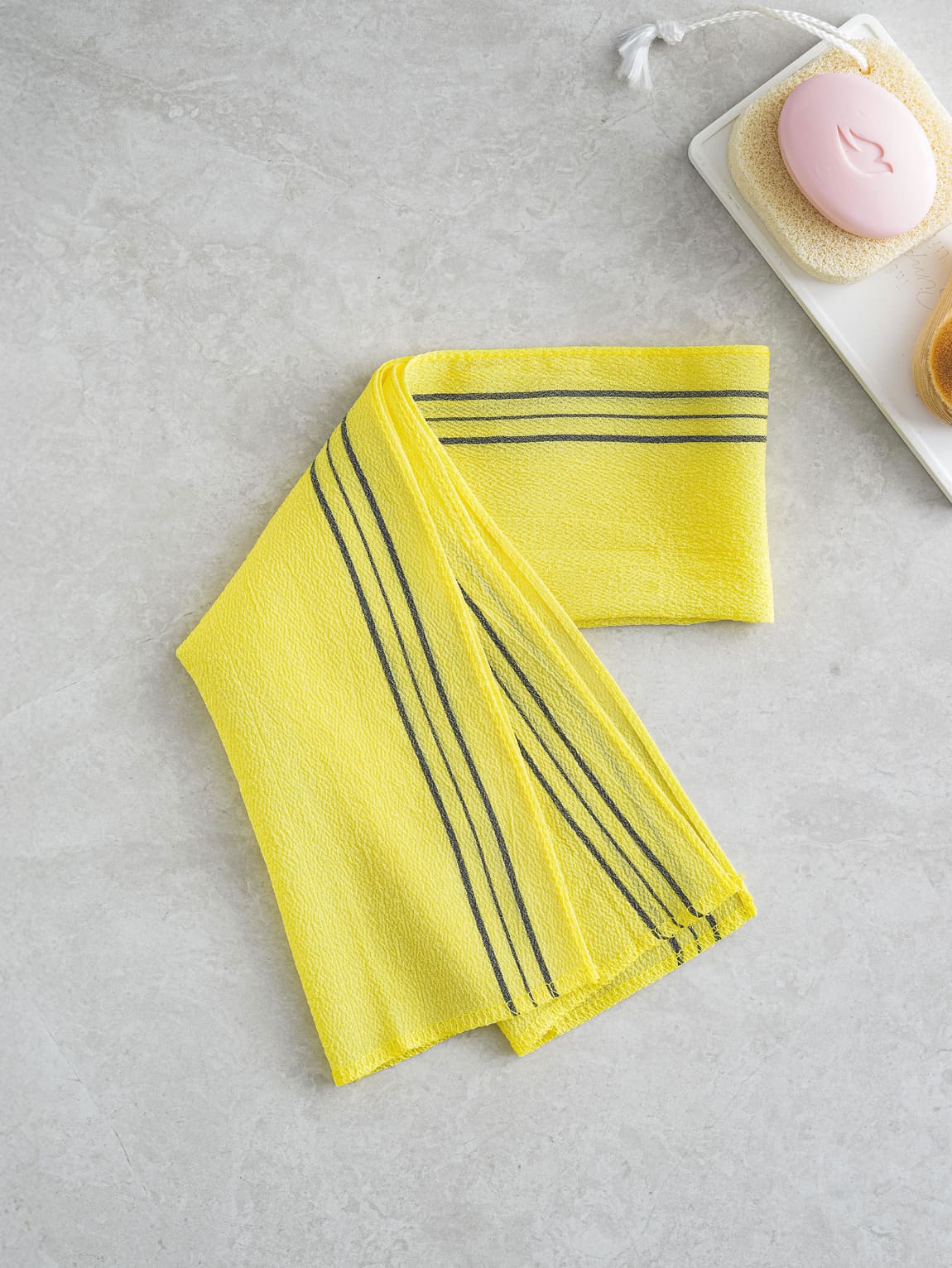
Quick Guide
| Question | Short answer |
|---|---|
| Korean name | 때수건 (ttae-sugeon) or 이태리타월 (Italy towel) |
| What do the colours mean? | In Korea, nothing. Green was first; the rest are colours |
| What it is made of | 100% viscose on Korean listings; some export versions blend sisal or nylon |
| The actual technique | Soak first. Softened skin scrubs smooth; dry skin tears |
| How often | Once a week at most — Korean dermatologists' ceiling, and many say less |
| On the face? | No. This is a body tool |
| Price in Korea | Bath cloth ₩1,000; long back towel or handled scrubber ₩2,000 |
| Done professionally | 세신 at a bathhouse, commonly around ₩25,000 |
Genuine Korean Italy towel mitts, green, 20-packAffiliate link. As an Amazon Associate, EpicKor earns from qualifying purchases at no extra cost to you.
Where it came from, and why it is called Italy
The origin is unusually well documented for a household object, and it is not a tradition. It is an accident with a date.
In 1967, a textile company called 한일직물 (Hanil Textile), run by 김원조 (Kim Won-jo), was operating in 초읍동, Busan — the site of what is now Changgok Market. The company had imported a batch of viscose rayon fabric from Italy intended for clothing. It arrived far too coarse to wear, and it could not simply be written off.
Someone at the company suggested rubbing it on skin.
That is the entire invention. The name 이태리타월 — "Italy towel" — refers to where the fabric came from, not to any Italian bathing habit. The cloth is a Korean product with an Italian material bill.
One footnote worth knowing, because you will run into it: a lot of English-language material dates this to 1962 and credits a different person. Even the description on the Wikimedia photograph used further down this page says 1962. Korean and English encyclopaedic entries now both give 1967 and Kim Won-jo, and that is the attribution used here.
You might like: Seoul Deleted Its Women-Only Parking: What Korean Gender Policy Actually Is in 2026
The colour question, answered
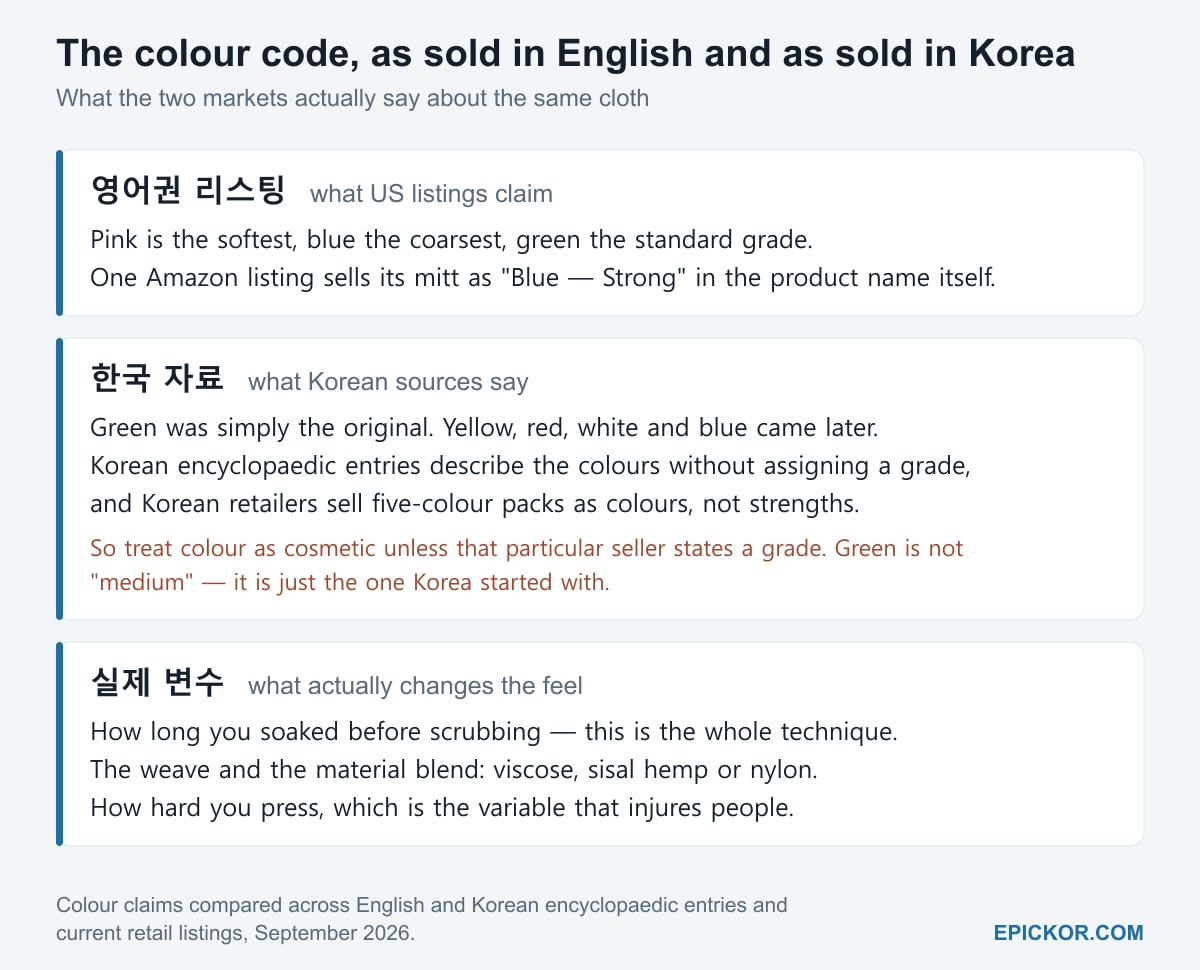
This is the single most-searched thing about these towels in English, so it deserves a direct answer rather than a hedge.
In English-language retail, colour is presented as a coarseness grade. Pink for sensitive skin, green for normal, blue for heavy-duty. It is stated confidently and consistently enough that it has become common knowledge.
In Korean sources, colour is not a grade. The Korean-language description of the product is that green was the original and remains the most common, with yellow, red, white and occasionally blue appearing later. Korean retailers routinely sell five-colour packs — red, green, pink, yellow, blue — as a colour assortment, which is not how you would sell a set of graded abrasives.
So the honest guidance is this: colour is cosmetic unless the particular seller explicitly states a grade. If a listing says "Blue — Strong", believe that seller about that product. Do not carry the code across to a Korean shop, where a shelf of colours is just a shelf of colours.
Green is not "medium". Green is what Korea started with.
What actually changes how it feels
Three things, in order of how much they matter:
- How long you soaked. This is not a minor preparation step; it is the technique. A properly soaked stratum corneum comes away readily. An unsoaked one does not, so you press harder, and pressing harder is how people hurt themselves.
- The weave and material. Korean listings specify 비스코스 100% — pure viscose. Export versions sometimes blend in sisal hemp or nylon, which changes the bite far more than dye does.
- How hard you push. The variable nobody sells you, and the one that decides the outcome.
The four shapes, and what each is for
The flat rectangle is the classic, but Korean bathrooms usually hold two or three of these, because the flat cloth cannot reach everything.
- The flat cloth (때수건) — the original rectangle. Cheapest, most common, and what a Korean bathhouse hands out.
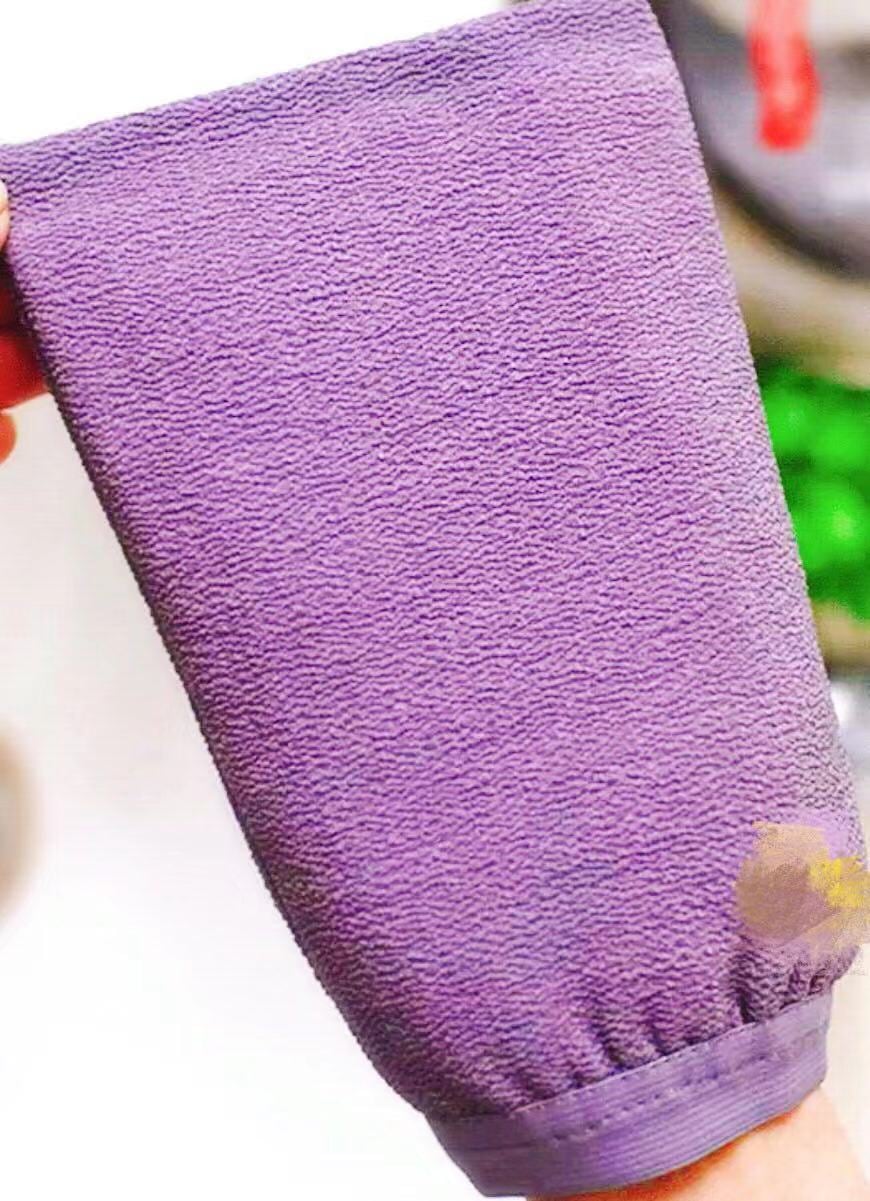
- The mitt (장갑형) — the same fabric sewn into a glove so it stays on your hand. This is the form most commonly exported, which is why English listings usually show a mitt when Korean ones show a cloth.
- The long back towel (등밀이용) — a strip you hold at both ends and saw across your own back. Daiso's is 비스코스 100%, about 88 × 24cm, ₩2,000 (checked on Daiso's own store, 2 September 2026).
- The handled scrubber (핸들형) — a plastic wand with a detachable scrub head, for the same problem when you would rather not saw.
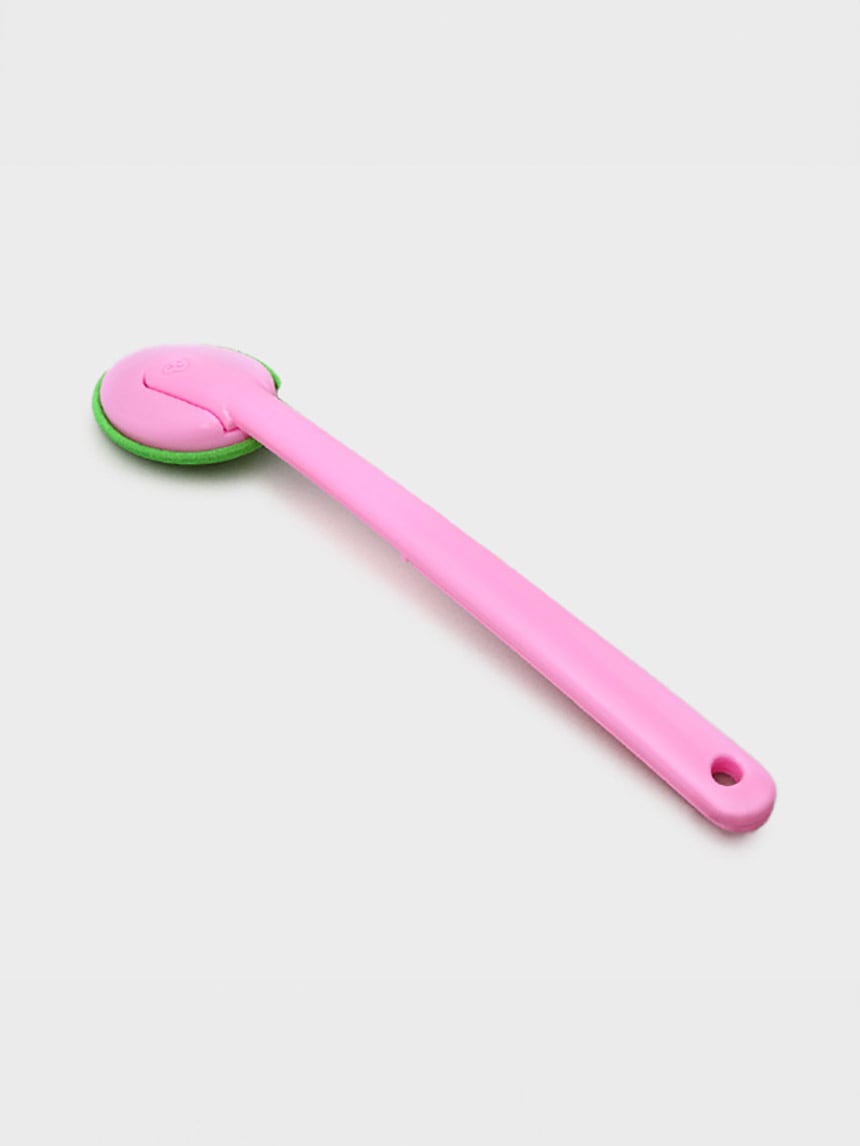
Prices at Daiso, read on the company's own store on 2 September 2026: a plain bath cloth ₩1,000, the long back towel ₩2,000, the handled scrubber ₩2,000. These are not premium objects in Korea. They are a coin.
How to use it
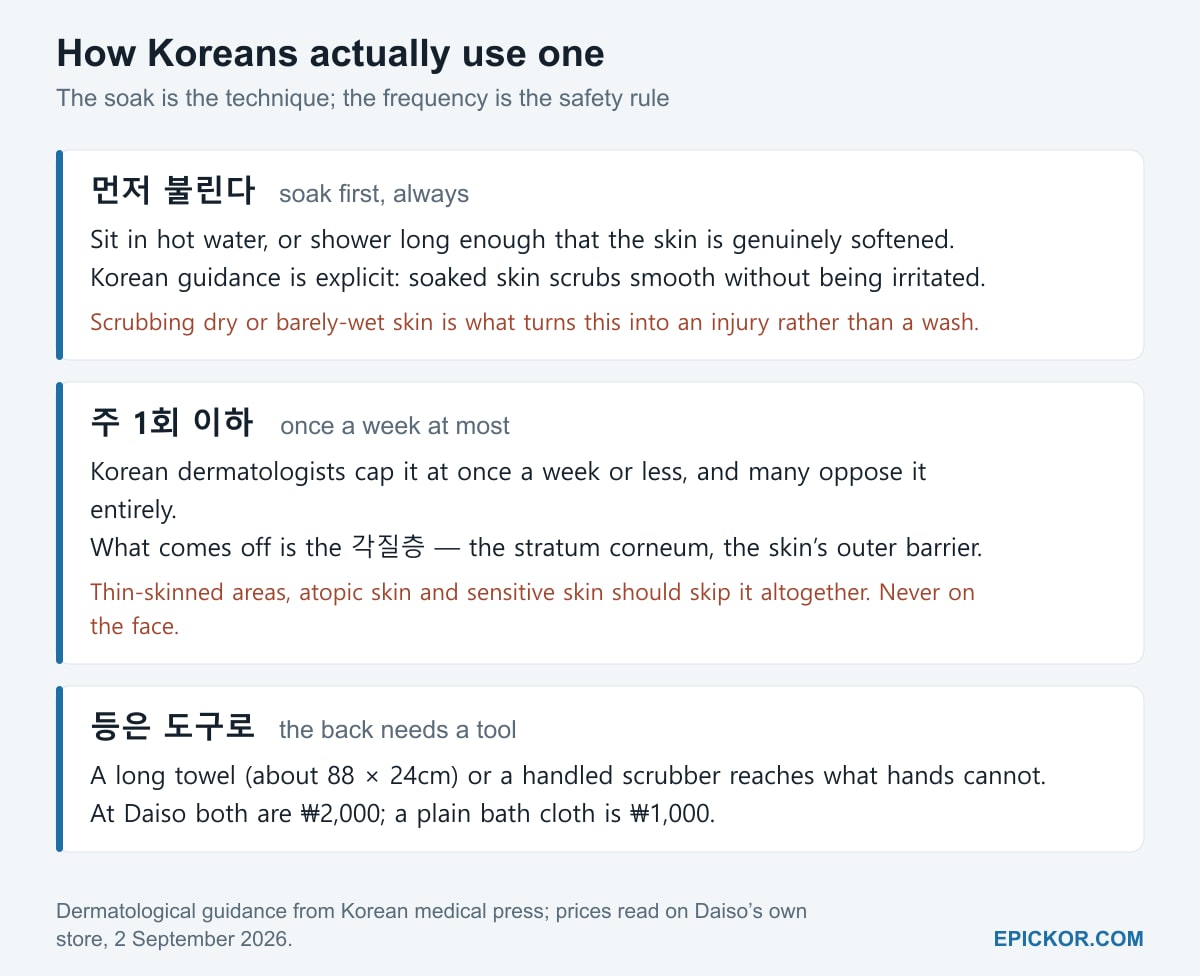
- Soak. Sit in hot water for ten to fifteen minutes, or take a long hot shower. Korean guidance is explicit that skin softened in water can be scrubbed smooth without being irritated. This step is the difference between the two outcomes.
- Scrub in short strokes, with light pressure. Arms, legs, torso. You will see grey rolls come off. That is not dirt — see the next section.
- Skip the thin places. Neck, chest, anywhere the skin is fine. And not the face.
- Rinse, then moisturise immediately. You have just removed the layer that holds water in. Replacing it is not optional.
How often — the part Korean dermatologists are blunt about
This is where a Korean source says something an English shopping guide will not.
Korean dermatologists broadly oppose the practice, and their objection is specific: what people call 때 — the grey rolls — is largely 각질층, the stratum corneum, the outermost layer of skin. It is not accumulated grime. It is the barrier.
Their warning about over-scrubbing is concrete. Scrub hard or often and the barrier is damaged; the skin looks immediately smooth, then loses water rapidly through the microscopic scratches you just created, which are also entry points for bacteria and irritants.
The published ceiling is once a week or less. For thin-skinned areas, atopic skin and sensitive skin, the advice is to skip it entirely and use a gentle chemical exfoliant or simply hands.
That is the honest version, and it does not make the towel useless — it makes it a weekly tool rather than a daily one. Korea's own medical press is where that limit is stated most plainly, which is exactly why it is worth carrying across.
If you are buying one, buy the form that matches the problem. As an Amazon Associate, EpicKor earns from qualifying purchases at no extra cost to you. For general use the classic green mitt is what Korea actually sells — Modu's five-pack is the standard article in viscose. If your reason for wanting one is your back, get the larger mitt marked made in Korea instead of a hand-sized one. Buy a multipack either way; these wear out, and they are meant to.
See Modu's five-pack on AmazonHaving it done for you: 세신
The other way to meet this cloth is to not hold it yourself.
세신 is the professional scrub performed at Korean bathhouses by a 목욕관리사, a trained attendant, on a vinyl-covered table. You soak first — the same rule, enforced by the queue — and then a stranger scrubs you thoroughly, efficiently and without ceremony.
What it costs, from Korean reporting: most bathhouses land around ₩25,000, with some under ₩20,000; Gyeonggi Province tends to run ₩30,000–50,000; large spa facilities sit higher. The recent wave of 1인 세신숍 — private single-person scrub studios — charges roughly ₩50,000–80,000 for a 50–60 minute basic course, and well past ₩100,000 once massage or steam is added.
One thing worth knowing before you budget: the women's side is frequently charged more than the men's side for the same service, a gap Korean newspapers have covered and criticised. Prices are typically negotiated between the attendant and the bathhouse rather than set centrally, so confirm on the day rather than assuming.
If a scrub is on your list because you are planning a Korean beauty-shopping trip more broadly, EpicKor's Korean body care guide covers what to buy for after the scrub — the moisturising step above is the one most visitors skip — and our guide to Korea's tourist shopping route explains where Olive Young and the pharmacies fit into the same afternoon.
The aftercare matters more than the towel. As an Amazon Associate, EpicKor earns from qualifying purchases at no extra cost to you. Scrubbing removes the layer that holds water in your skin, so the thing to have ready before you start is a plain fragrance-free ceramide body lotion, applied while the skin is still damp. If you want the Korean set-up exactly, add a green mitt multipack and keep one for the back only — the fabric that has scrubbed heels should not be the fabric you use on your shoulders.
See green mitt multipack on AmazonYou might like: Korea's Neighbourhood Bathhouses Are Disappearing, and the Bath Is Not: Where the Hot Water Went
FAQ About Korean Exfoliating Towels
Q: What do the colours of a Korean exfoliating towel mean?
In Korea, nothing. Green was the original colour and remains the most common; yellow, red, white and blue came later, and Korean retailers sell mixed-colour packs as an assortment. The pink-soft, green-standard, blue-coarse scale is an English-market convention. If a specific seller states a grade, trust that seller for that product — but do not carry the code into a Korean shop.
Q: Why is it called an Italy towel if it is Korean?
Because the fabric was Italian. Hanil Textile in Busan imported viscose rayon from Italy in 1967 for clothing, found it far too rough to wear, and turned it into a bath cloth instead. The name records the material's origin, not a bathing tradition.
Q: How often should I use one?
Once a week at most. Korean dermatologists set that ceiling and many argue for less, because what comes off is the stratum corneum — the skin's outer barrier — rather than dirt. Atopic, sensitive and thin-skinned users should skip it.
Q: Can I use a Korean exfoliating towel on my face?
No. It is a body tool, and facial skin is exactly the thin skin the frequency warnings are about. Use a gentle facial exfoliant instead.
Q: What is the difference between the mitt and the flat cloth?
The fabric is the same; only the sewing differs. The flat rectangle is what Korean bathhouses hand out and what Korean shops mostly stock. The mitt stays on your hand, which is easier for a first-timer, and is the form most often exported — which is why English listings show mitts while Korean ones show cloths.
Bottom Line
The colour code is the wrong question, honestly asked. It exists because English listings needed a way to differentiate identical cloths, and it stuck.
The Korean version of the same information is simpler and more useful: the cloth is one thing, and how you use it is three things. Soak properly, press lightly, and do it about once a week. Do that and this is a ₩1,000 object that does something a much more expensive product cannot. Do the opposite — dry skin, hard pressure, every morning — and you are sanding off the layer that keeps water in your body.
Buy green if you want the one Korea actually uses. Buy the long towel if the real reason you want one is your back. And keep the lotion within reach before you start.
Sources
- ko.wikipedia 「때수건」 and en.wikipedia "Italy towel" — invention in 1967 in 초읍동, Busan, by 한일직물 under 김원조; imported Italian viscose rayon too coarse for clothing; green as the standard and most common colour.
- Korean-language reference entries and current Korean retail listings — colours available (green, yellow, red, white, blue), five-colour assortment packs, and the absence of a colour-to-coarseness grade in Korean descriptions.
- Daiso Korea official store (daisomall.co.kr) — 등밀이용 긴 때 타월: 비스코스 100%, about 88 × 24cm, ₩2,000; 핸들형 때타올 ₩2,000; plain bath cloth ₩1,000. Prices read 2 September 2026.
- Korean medical press and dermatological commentary — 때 as 각질층 rather than dirt; barrier damage and moisture loss from over-scrubbing; the once-a-week-or-less ceiling; advice to avoid entirely on atopic, sensitive and thin skin.
- Korean press reporting on 세신 pricing — typical bathhouse rates around ₩25,000, regional variation, 1인 세신숍 course pricing, and the documented gap between men's and women's rates.
You Might Also Like
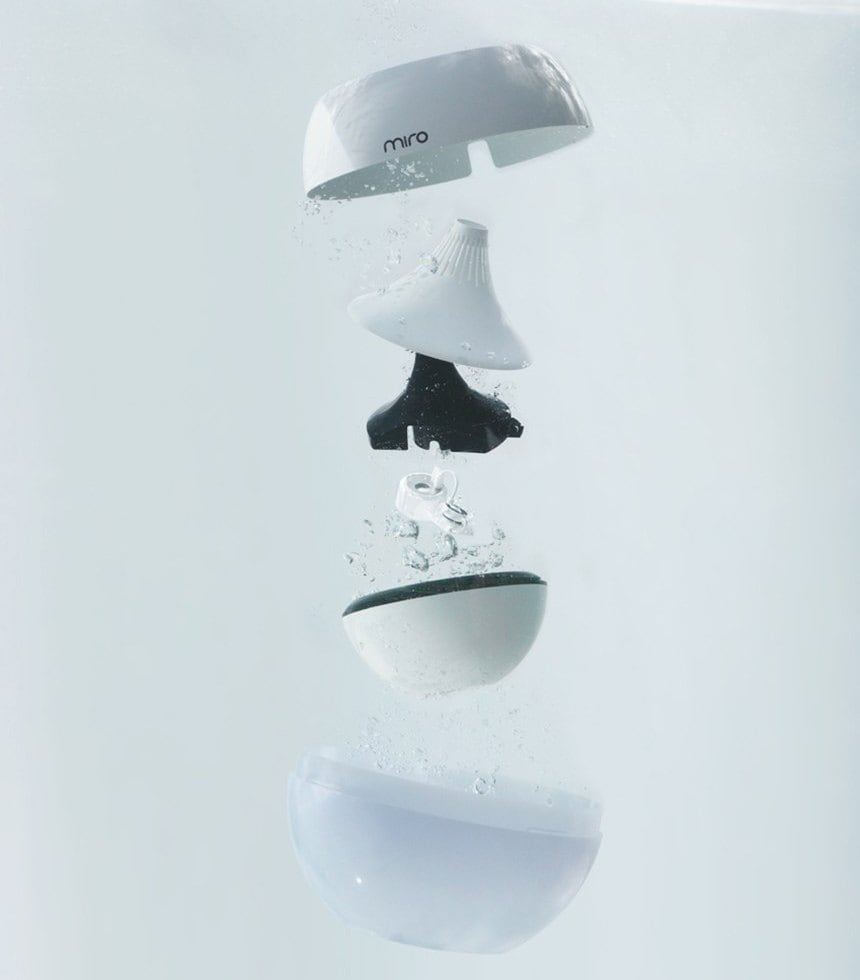
Korean Humidifiers: Buy the One That Comes Apart
Korean humidifiers pull apart into six washable pieces, the humidifying engine included. Korea's consumer agency measured why: daily water changes cut bacteria 87.3%, washing every second day 98.8%. What Amazon lists is a generation behind Korea's shelves.
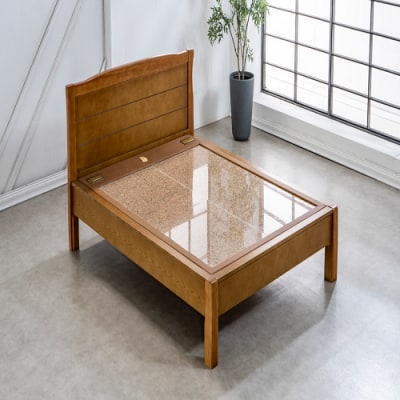
Korean Stone Beds: What They Cost, and Why Anyone Sleeps on Rock
A Korean stone bed is a slab of granite in a wooden frame, heated from underneath, and the entry model costs ₩3,470,000 — about $2,510. Here is what 돌침대 actually is, why Koreans buy it, and the one thing Korean doctors say you must add to it.
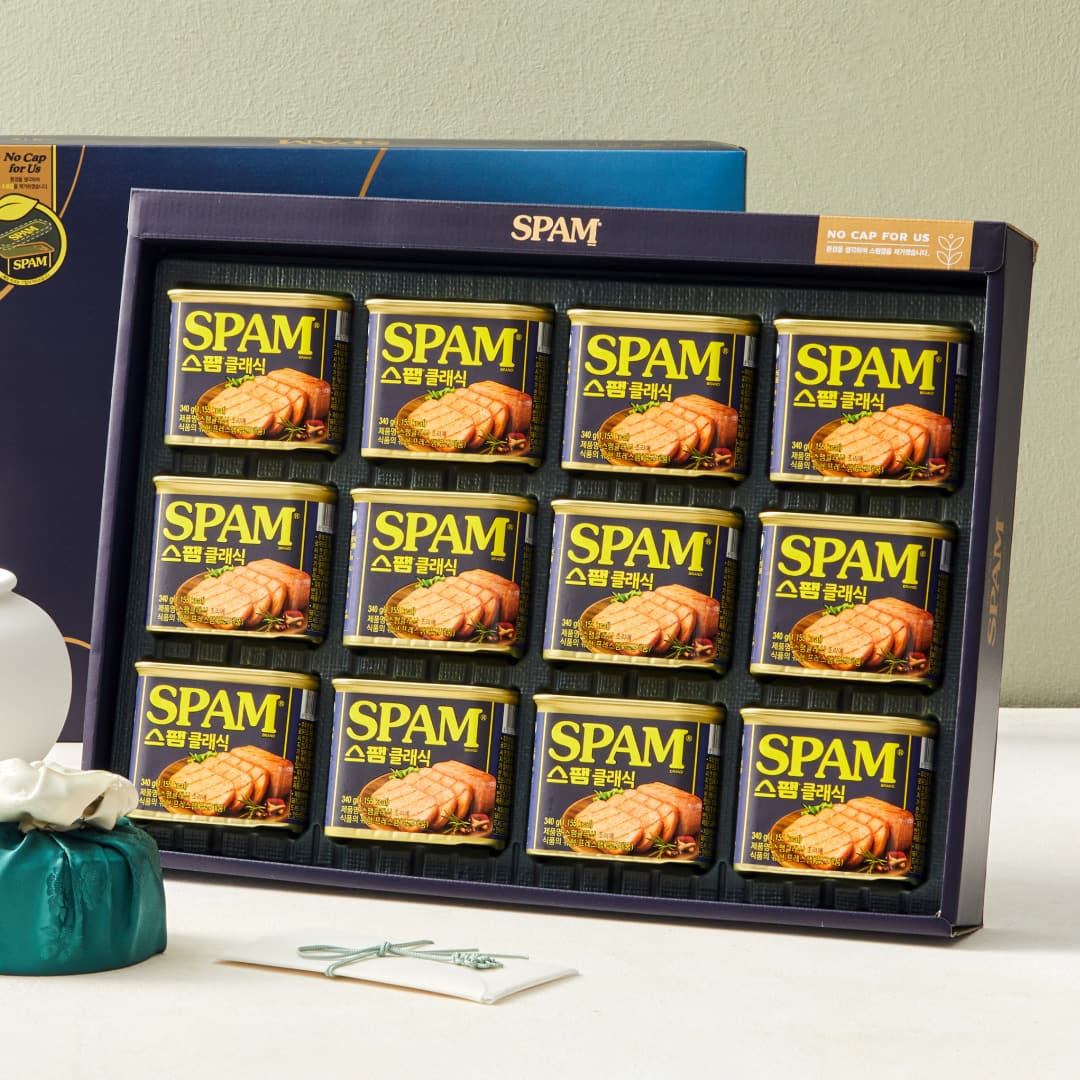
Korea's Spam Gift Sets Explained: What the Numbers Mean and Which One to Buy
Spam is a serious Chuseok gift in Korea, and the sets are sold by number. Lower number means bigger box — 1호 is twelve 340g cans, 12호 is eight 200g. The price printed on the box is fiction: every set is selling 40-45% below it right now.