Seoul Deleted Its Women-Only Parking: What Korean Gender Policy Actually Is in 2026
If you read about Korean gender policy in English, you will meet a familiar set of claims. Korea has a Ministry of Women. Korean car parks have pink women-only bays. Korean women get bonus points on civil service exams. Korea's subways reserve seats you are not allowed to sit in.
Every one of those is out of date, imprecise, or was never true. Not because Korea is being misrepresented by outsiders — mostly because Korea changed the policies and the English-language internet did not notice. Seoul abolished women-only parking three years ago. The ministry's Korean name changed last October. The five-point exam bonus everyone argues about was real, went to men, and was struck down in 1999.
This is not an argument about who has it worse. It is a record of what the rules currently say, checked against the ordinances, the court ruling, and the government's own statistics — because the arguments on both sides are mostly being fought over a version of Korea that has already moved on.
The Short Answer
| What you have probably read | What is actually true, August 2026 |
|---|---|
| "Korea has a Ministry of Women" | The English name has always been Ministry of Gender Equality and Family. The Korean name dropped 여성 (women) for 성평등 (gender equality) on 1 October 2025 |
| "Korean car parks have women-only spaces" | Seoul converted all 69 public lots, 1,988 spaces, to family-consideration parking in 2023. The idea came from Germany, which still has it |
| "Korean women get 5 bonus points on exams" | No such bonus exists or ever has. The 3–5% bonus was for discharged soldiers, and the Constitutional Court struck it down unanimously in 1999 |
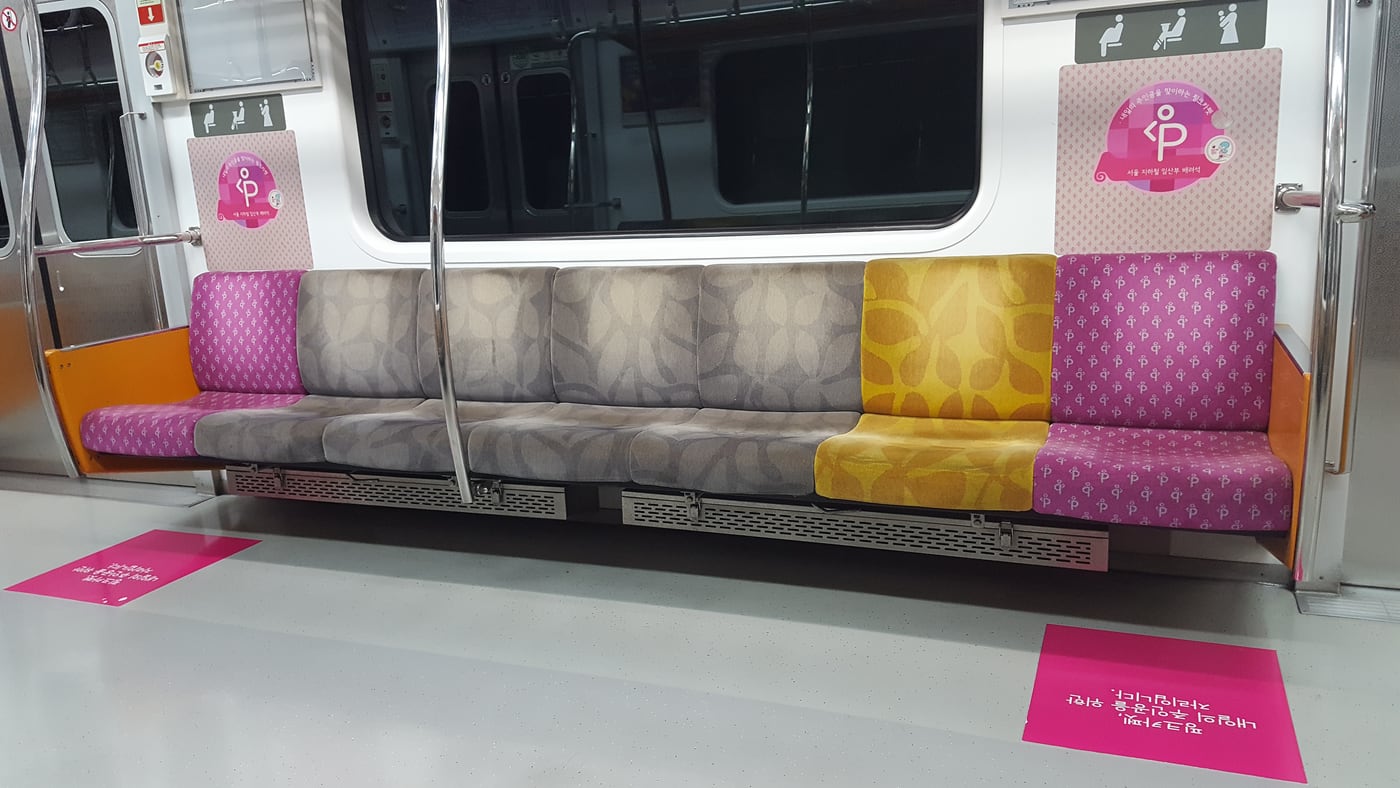
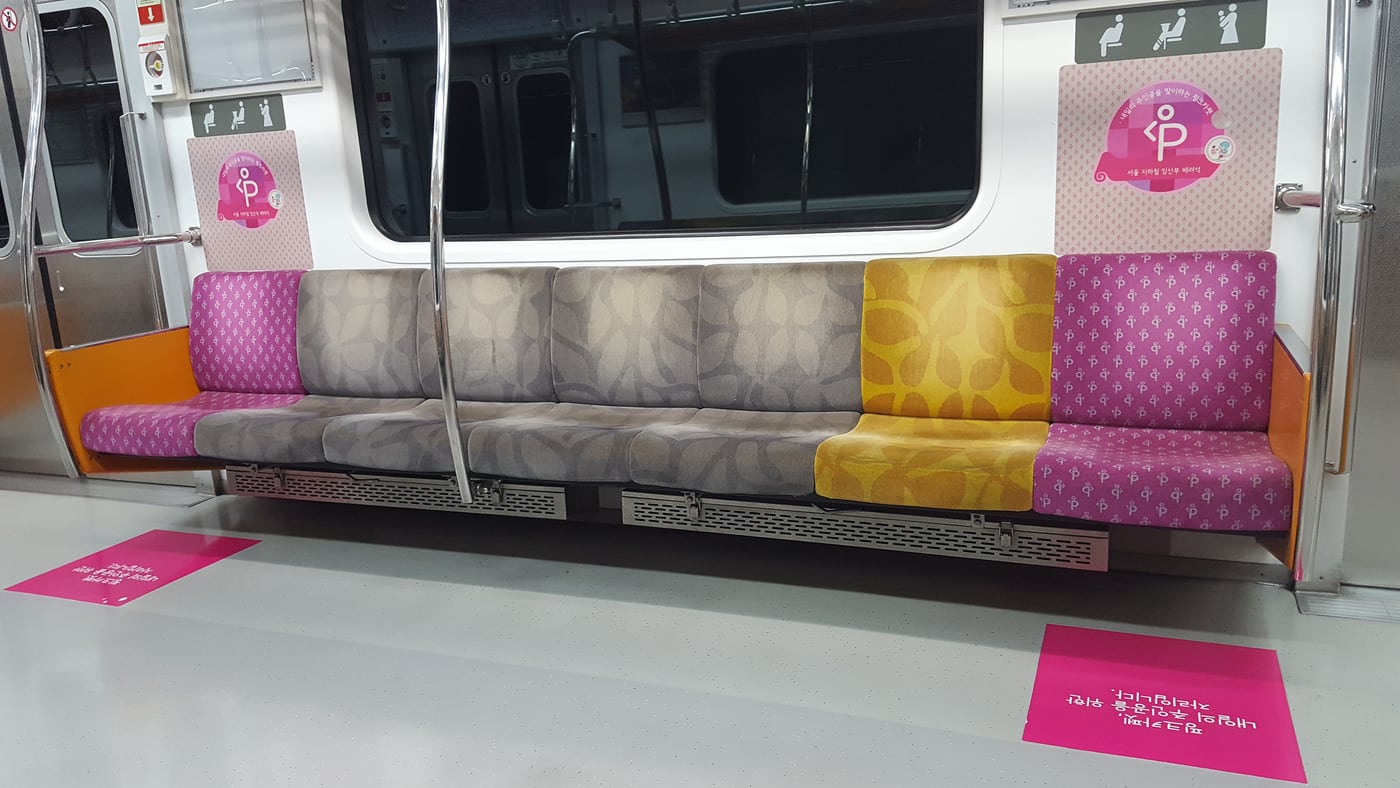
| "Pregnant-only seats you cannot sit in" | 배려석 means consideration seat, not reserved seat. There is no fine. Anyone may sit in an empty one |
| "Korea uniquely privileges women" | Brazil has a literal Ministry of Women; India, Peru, Australia, New Zealand, the UK, Malaysia, Nepal, Denmark and Sweden all have dedicated ministers |
The Ministry: the Korean Name Changed, the English Name Never Did
The body foreigners call the "Ministry of Women" has been rendered in English as the Ministry of Gender Equality and Family (MOGEF) for years. The mismatch was on the Korean side: the domestic name was 여성가족부, literally Women and Family Ministry.
On 1 October 2025 the Korean name became 성평등가족부 — Gender Equality and Family Ministry — bringing it into line with the English that was already on the door. The official English name did not change at all.
What is more interesting is how it got there. Yoon Suk-yeol campaigned in 2022 on abolishing the ministry outright, and that pledge was a central plank of his appeal to young men. It never happened. After the change of government, the State Affairs Planning Committee reversed the position on 30 June 2025, and the reorganisation that followed did not shrink the ministry — it expanded it. The women's policy bureau was upgraded to a full gender-equality office, the structure went from two offices to three, and staffing rose from 277 to 294.
So the single most-cited example of Korean gender policy is a ministry that was promised for abolition, survived, and came out larger with a different name. Its current minister is 원민경 (Won Min-kyong).
Women-Only Parking: Germany's Invention, and Seoul Deleted It
This is the one that surprises people most, in both directions.
Women's parking spaces were not a Korean idea. They were introduced in Germany in 1990, to reduce the risk of assault in dark and empty multi-storey car parks. In parts of Germany the law still requires operators to set aside at least 30 per cent of spaces for women — a far higher share than Korea ever mandated — and Germany's Federal Anti-Discrimination Agency has ruled that the practice does not breach the country's General Equal Treatment Act. Korea, China and Switzerland adopted versions later.
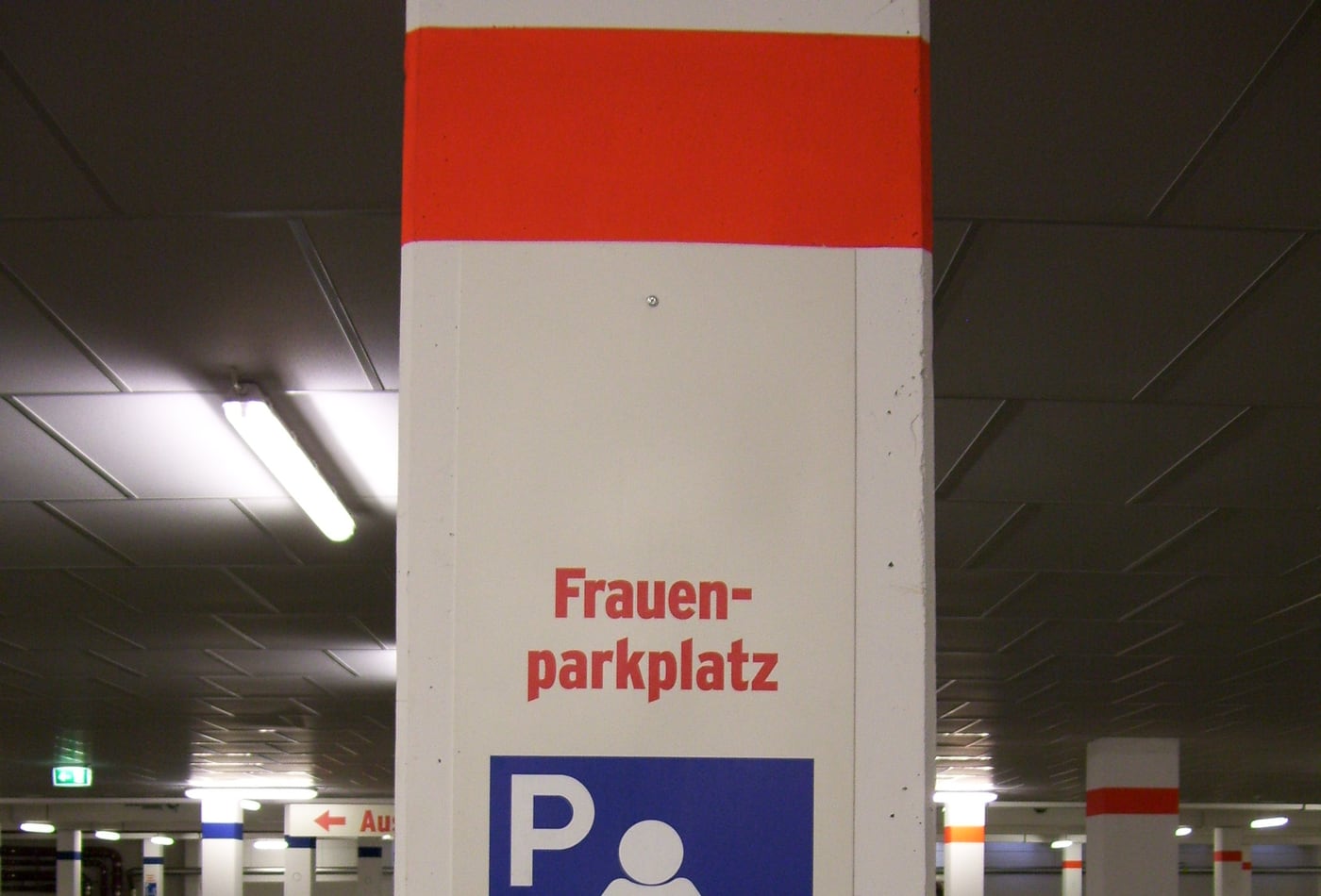
And Seoul removed its version. Mayor Oh Se-hoon announced the decision in August 2022; the revised Seoul parking ordinance took effect on 18 July 2023, and every women-priority bay in the city's public car parks — 69 locations, 1,988 spaces — was converted to 가족배려주차장, family-consideration parking.
The replacement is broader, not narrower. It is for pregnant women and those within six months of giving birth, anyone with a child under six, people with mobility difficulties from age or illness — and whoever is accompanying them. A father alone with a toddler qualifies. Under the old signage he did not.
Korea's own feminist press covered the change as an ending rather than an attack: 여성신문 headlined it "역사 속으로 사라지는 여성우선주차장 논쟁의 14년" — fourteen years of argument passing into history.
Two honest caveats. This was a Seoul ordinance, so women-priority bays still exist in some other Korean cities and in privately operated car parks, where local rules and owners decide. And the pink paint outlives the policy: a bay repainted in 2023 can still look pink in a photograph taken since.
If this is the Korea you want to understand properly: As an Amazon Associate, EpicKor earns from qualifying purchases at no extra cost to you. The English-language reporting on Korean society ages badly, which is exactly the problem this article is about — book-length work by Korea correspondents and researchers holds up better than the blog posts search engines surface.
Compare books on Korean society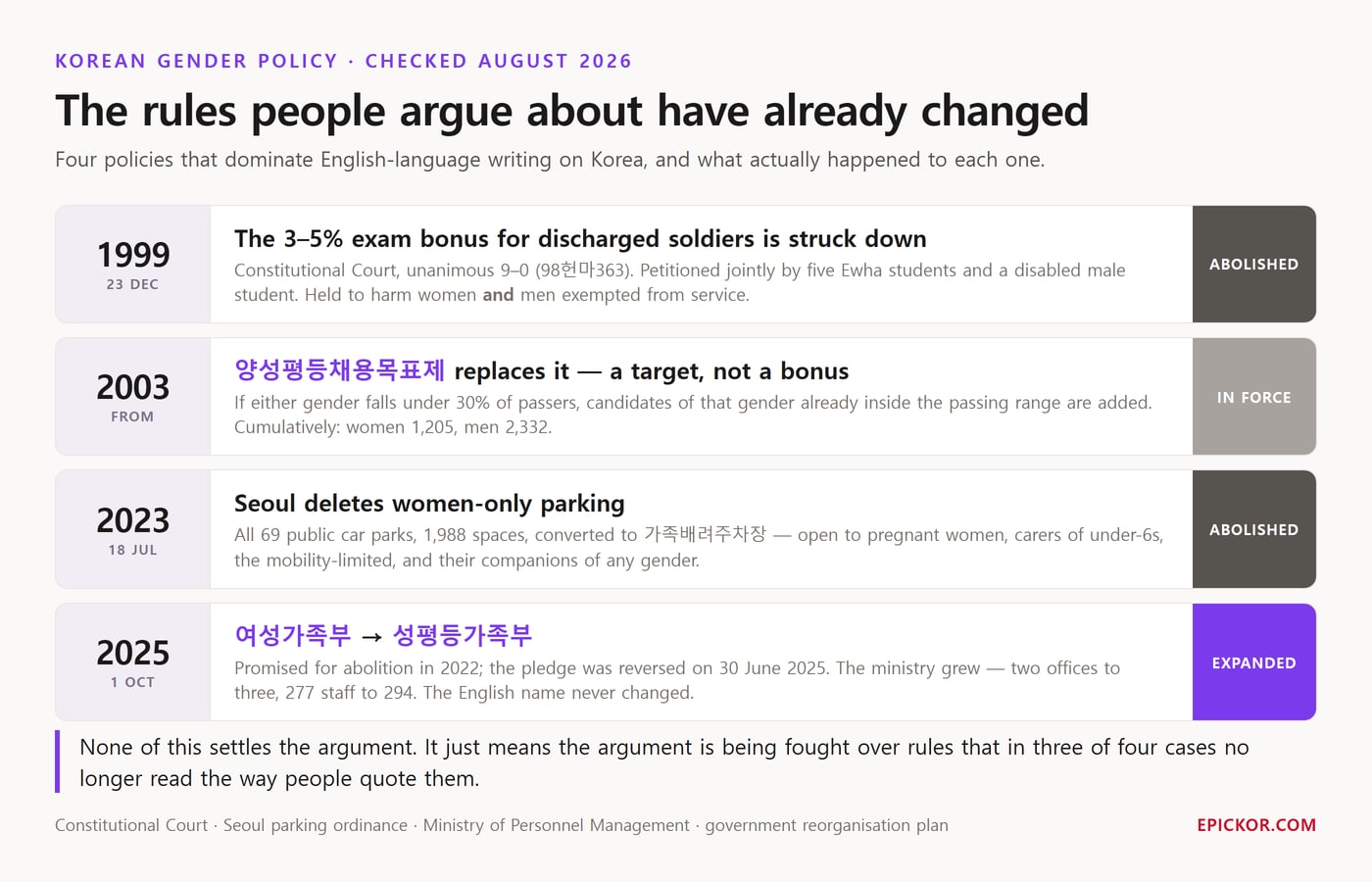
The Pink Seats: No Fine, and Busan Has Something Seoul Does Not
Korean subway cars have pink seats marked 임산부 배려석. The word that matters is 배려 (baeryeo), consideration — not 전용 (jeonyong), exclusive use.
There is no fine and no legal penalty for sitting in one. In principle anyone may sit in an empty consideration seat, exactly as with a priority seat anywhere else. Enforcement is entirely social, which is why the seats are a permanent argument inside Korea too: keep them empty and they are wasted, fill them and a pregnant passenger has to ask.
Priority seating itself is not remotely a Korean peculiarity. Japan has had priority seats since the 1970s, renamed and broadened in the 1990s to cover expectant mothers and passengers with injuries; New York's MTA hands out "Baby on Board" buttons for the same problem. What is unusual in Korea is one local solution:
Busan installed a beacon system called 핑크라이트 in late 2017. A registered pregnant passenger carries a small beacon; pressing it lights a pink signal above the seat and plays an announcement asking for it to be given up. Surveys have found more than half of riders aware of it and satisfied. Seoul declined to adopt it, opting for awareness campaigns instead — so if you have read that Korean subways light up for pregnant passengers, that is Busan, not the capital.
The Five Points Were Real. They Went to Men, and They Ended in 1999
This is the claim that appears in almost every online argument about Korean gender policy, usually as "women get five bonus points on the civil service exam."
There has never been such a bonus. But the number is not invented, and its actual history explains a great deal.
Under the Support for Discharged Soldiers Act, men who completed military service received 3 to 5 per cent of the perfect score added to each subject on public employment exams. On 23 December 1999 the Constitutional Court struck it down, unanimously, nine to nothing (98헌마363). The Court's reasoning was blunt: where outcomes turn on fractions of a point, a 3–5 per cent addition is decisive, and the scheme guaranteed jobs to discharged soldiers by taking them from everyone else.
Two details from that case are worth knowing before anyone uses it as a talking point.
The petition was filed jointly by five Ewha Womans University students and a disabled male student from Yonsei. It was not women against men.
And the Court held that the bonus discriminated against women and against men who had not served — those exempted for disability or health. That is why the disabled male petitioner was a party to it. Article 11 of the Constitution was found to be breached on both counts at once.
So the five points existed, went to men, and were removed by a court partly on behalf of other men. Restoring the military bonus has been proposed repeatedly since and has never passed.
What the Exam System Actually Is, and Who It Actually Helps
What exists today is the 양성평등채용목표제, the Gender Equality Employment Target System, introduced under the Civil Service Examination Decree amended in December 2002 and run from 2003.
It is not a point bonus. If either gender falls below 30 per cent of those who pass, additional candidates of that gender who are already within the passing score range are added until the target ratio is met. It applies to exams recruiting five or more people, and it names no gender in its mechanism — whichever side is under 30 per cent is the side that is topped up.
Then there are the numbers, and they are the reason both sides of this argument can cite the same system honestly. From the Ministry of Personnel Management's own balanced-personnel annual report:
| Period or grade | Women added | Men added |
|---|---|---|
| 2003–2010 | 1,095 | 614 |
| 2011–2020 | 650 | 1,725 |
| Cumulative, all grades and levels | 1,205 | 2,332 |
| National grade 7 exam | 194 | 20 |
| National grade 5 exam (the 고시) | 43 | 19 |
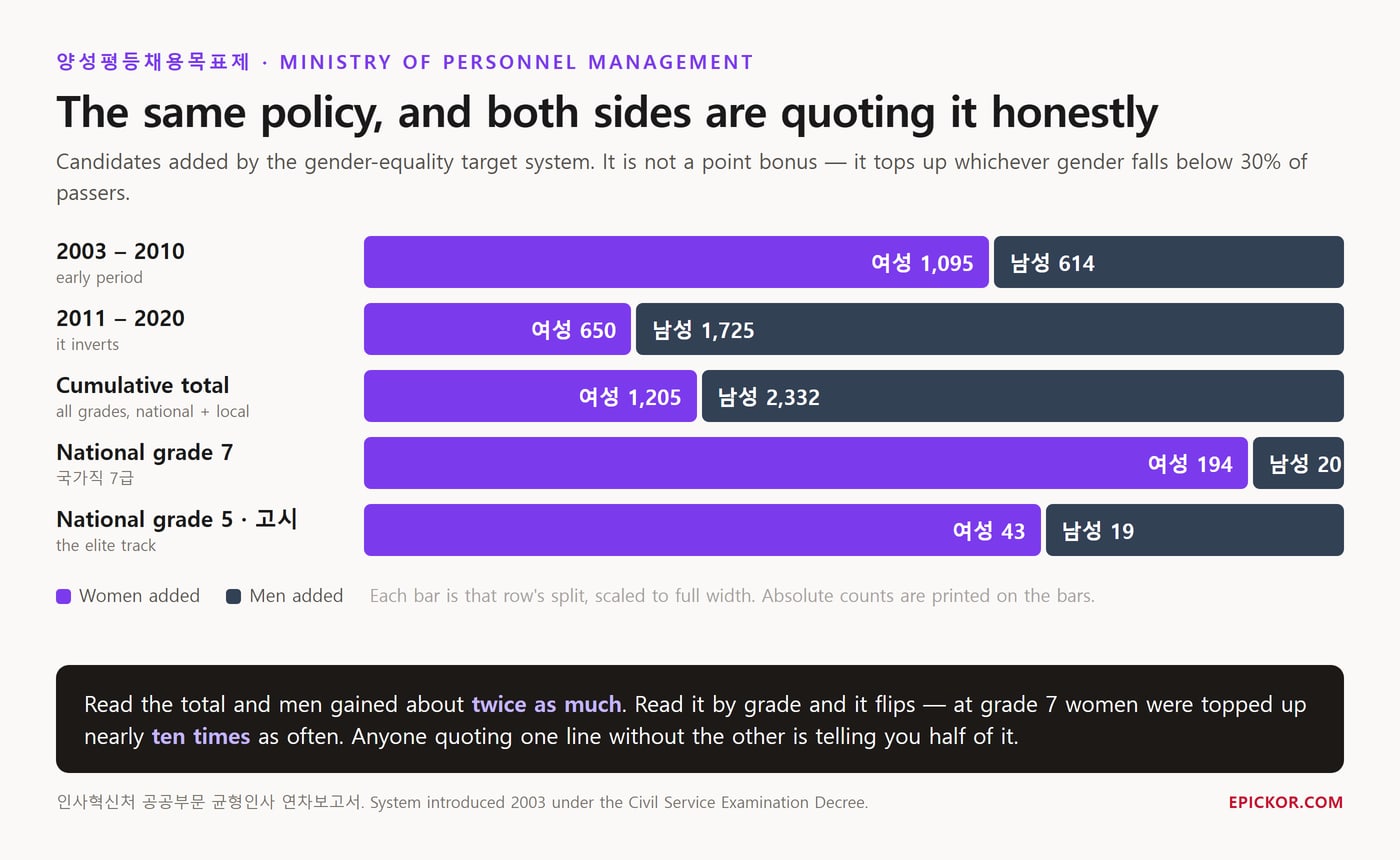
Read the total and men have benefited roughly twice as much. Read it by grade and it inverts: at grade 7, women were topped up nearly ten times as often, and at grade 5 — the elite track — more than twice as often.
Neither reading is dishonest. They describe the same policy operating on two different applicant pools: women pass the high-grade written exams in large numbers, men apply in large numbers to the lower grades and local government positions. Anyone quoting one line of that table without the other is telling you half of it.
Why Korean Men and Women in Their Twenties Vote Differently
The argument in Korea is not evenly distributed across the population. It is concentrated in one age band, and elections make that visible.
In the 2022 presidential election, exit polls put men in their twenties at 58.7 per cent for Yoon Suk-yeol against 33.8 per cent for Lee Jae-myung, while women in the same age group went 58.0 per cent for Lee against 33.8 per cent for Yoon — a near-mirror image. In their thirties the gap was much smaller. In the 2025 presidential election it widened rather than closed: broadcasters' exit polling put men in their twenties at 76 per cent for the conservative candidate and women in their twenties at 58 per cent for Lee Jae-myung.
The concrete grievance underneath it is not hard to state. Military service is 18 months for the army and marines, 20 for the navy and 21 for the air force — reduced from 24 months in stages completed in December 2021. It is compulsory for men, it lands squarely on the years when peers are building careers, and since 1999 it has carried no hiring bonus at all.
And the countervailing figure is just as concrete. Korea's gender pay gap, measured on median earnings, was 29.3 per cent in 2023 — the largest in the OECD, against an average of 11.3 per cent, and roughly 2.6 times that average. It has narrowed from 34.1 per cent in 2018 and is still the widest among member countries.
Both of those are true at once, and they are what makes the argument so hard to settle. A 24-year-old man who has finished his service and is job-hunting is not the person who benefits from a wage structure that pays men more at 45. He is being asked to answer for it anyway. And a 24-year-old woman entering that same labour market is not responsible for conscription policy either.
One observation gets made inside Korea and rarely translates: the age group generating the sharpest gender divide in voting is not the age group that wrote any of these policies. The people who designed the military bonus, the target system, the ministry and the parking ordinances are decades older, and their own generation does not split along gender lines anywhere near as sharply at the ballot box.
Going deeper than a news cycle: As an Amazon Associate, EpicKor earns from qualifying purchases at no extra cost to you. Korea's demographic and labour-market pressures are the frame this argument actually sits inside, and the reporting worth reading on it is longer than an article — worth comparing before trusting a search result.
Compare books on Korea's economy and societyWhat to Do With This If You Are Visiting or Reading About Korea
Do not plan around the pink parking bay. In Seoul it is a family-consideration bay and you may use it with a small child or an elderly parent regardless of your gender. Outside Seoul, check the sign rather than the paint.
You may sit in the pink subway seat when it is empty. Nobody will fine you. Stand up when someone needs it, which is the same rule as a priority seat in Tokyo, London or New York.
Date every claim you read about Korean policy. The five-point bonus argument is 27 years old. The parking policy changed in 2023. The ministry was renamed in 2025. An undated blog post about Korean gender policy is not slightly stale — it is likely describing a country that no longer exists in that form.
You might like: Korean Convenience Store Breakfast: What Locals Buy
FAQ About Korean Gender Policy
Q: Does Korea still have a Ministry of Women?
A: It never had one under that name in English. The body has been the Ministry of Gender Equality and Family in English for years, and its Korean name changed from 여성가족부 to 성평등가족부 on 1 October 2025. It was promised for abolition in 2022, the pledge was reversed on 30 June 2025, and the reorganised ministry is larger than before — three offices instead of two, and 294 staff instead of 277.
Q: Is women-only parking still a thing in Korea?
A: Not in Seoul's public car parks. The city's ordinance took effect on 18 July 2023 and converted all 69 locations and 1,988 spaces to family-consideration parking, open to pregnant women, carers of children under six, people with mobility difficulties and their companions of any gender. Some other Korean cities and private operators still run women-priority bays. The policy originated in Germany in 1990, where parts of the country still require a share of spaces to be set aside.
Q: Do Korean women really get five bonus points on civil service exams?
A: No, and no such rule has ever existed. The 3–5 per cent bonus was for men who had completed military service, and the Constitutional Court struck it down unanimously on 23 December 1999, holding that it discriminated against women and against men exempted from service alike. What exists now is a gender-neutral target system that tops up whichever gender falls below 30 per cent of successful candidates.
Q: Can I sit in the pink seat on the Seoul subway?
A: Yes, when it is empty. 배려석 means consideration seat, not reserved seat, and there is no fine or legal penalty. The expectation is that you give it up when a pregnant passenger boards. Busan runs a beacon system called 핑크라이트 that signals when one is nearby; Seoul does not use it.
Q: Why do young Korean men and women vote so differently?
A: Exit polls in 2022 showed men and women in their twenties choosing opposite candidates by almost identical margins, and the gap widened again in 2025. The most commonly cited factors are 18 months of compulsory military service for men with no hiring bonus since 1999, set against a gender pay gap of 29.3 per cent — the widest in the OECD. Both figures are accurate, which is part of why the argument does not resolve.
The Bottom Line
Korean gender policy is genuinely contested, and the contest is real enough to move actual rules: a ministry survived an abolition pledge and grew, a parking policy imported from Germany was deleted in the capital, an exam bonus was struck down by a unanimous court and never came back.
What does not survive contact with the documents is the idea that Korea is doing something no other country does. Brazil has a Ministry of Women. Germany invented the parking bay and still requires it in places. Tokyo and New York both reserve seats for pregnant passengers. Korea's distinctive features are the speed at which it changes these rules, and the sharpness of the age band arguing about them.
If you take one thing from this page, make it the habit rather than the position: put a date on it. Everything above is checked to August 2026, and some of it will be wrong by this time next year — which is exactly the point.
Sources checked: Seoul Metropolitan Government on the parking ordinance effective 18 July 2023 and the 69-location, 1,988-space conversion; 여성신문 on the fourteen-year debate; Ministry of the Interior and Safety and Korean press on the 1 October 2025 reorganisation and the 30 June 2025 reversal; MOGEF's own English-language site for the ministry name; Constitutional Court decision 98헌마363, 23 December 1999; Ministry of Personnel Management balanced-personnel annual report for the target-system figures; National Archives of Korea on the Civil Service Examination Decree amendment of December 2002; broadcasters' exit polls for 2022 and 2025; OECD data on the gender wage gap; Korean Military Manpower Administration service periods. All figures checked August 2026.
You Might Also Like
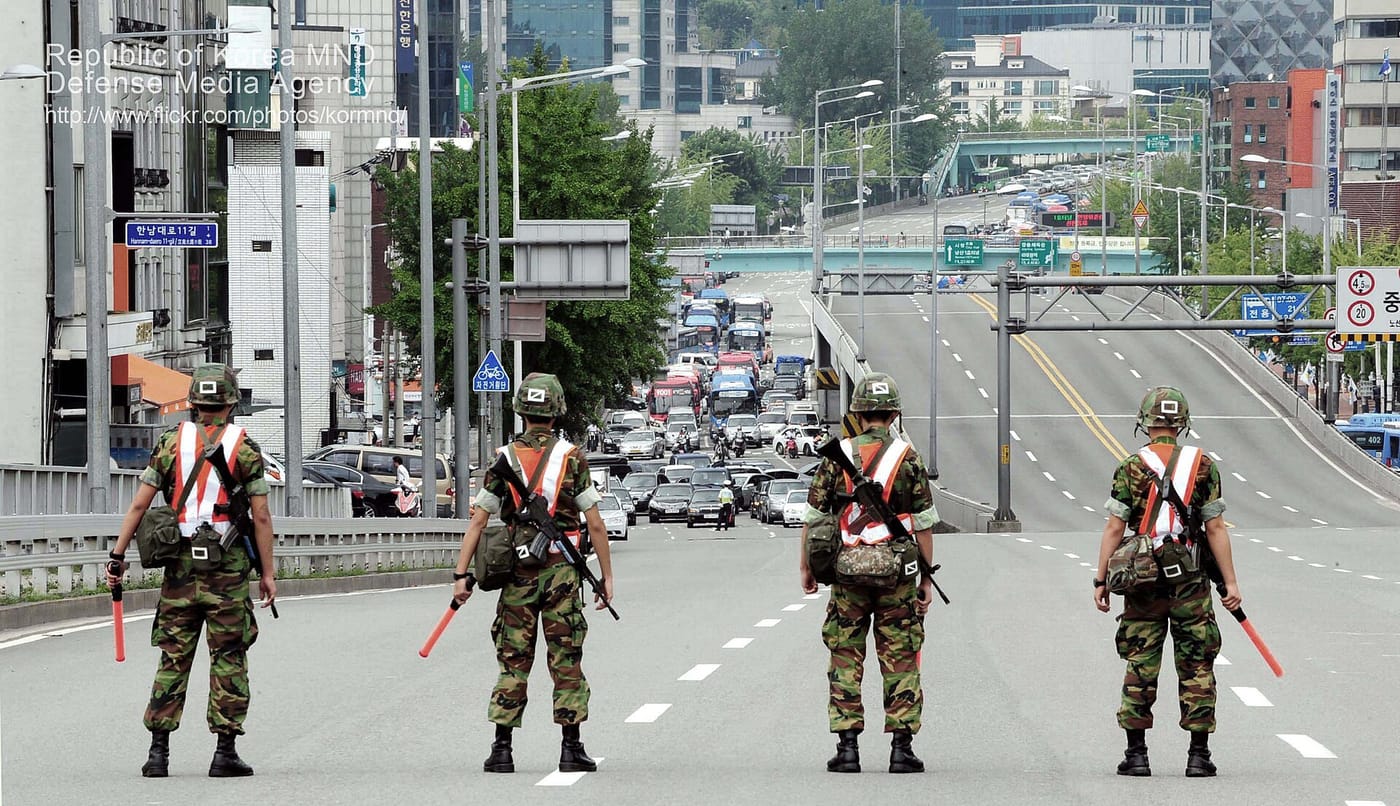
Why Your Phone Screams in Korea: Emergency Alerts, Air-Raid Sirens, and Telling Them Apart
Korea has two alarm systems and visitors confuse them constantly. One is a text on your phone, usually a heat advisory. The other is a street siren that stops traffic. On 20 August 2026 both go off at 2pm, and neither means what you fear.
Kkondae (꼰대) Explained: Korea's Word for the Boss Who Knows Best
Kkondae (꼰대) explained: Korea's word for a condescending senior who won't listen — and why survey data shows it's about behavior, not age.
Jeong (정) Explained: The Korean Bond That Has No English Word
Jeong (정) explained: the untranslatable Korean bond of warmth and attachment, where you'll feel it as a visitor, and why it can turn sour too.