Hangul Day in Seoul: What's Open on Korea's October 9 Holiday
October 9 is 한글날 (Hangeullal), Hangul Day: the day Korea marks the publication of its writing system. It is a real public holiday, not a symbolic observance. Banks shut, government offices shut, schools shut. In 2026 it falls on a Friday, which turns it into a three-day weekend and changes how the whole week behaves.
And almost every English-language "what to do on Hangul Day" article will tell you to visit the National Hangul Museum in Yongsan.
Do not go. The building has been closed since October 2024, a fire gutted part of it in February 2025, and the museum's own notice says it stays shut until the second half of 2028.
The staffed help desks close on a public holiday — a Lonely Planet Korean phrasebook does notAffiliate link. As an Amazon Associate, EpicKor earns from qualifying purchases at no extra cost to you.
The Short Answer
| Date | October 9, every year. Fixed, not lunar |
| In 2026 | Falls on a Friday — a natural three-day weekend |
| Holiday status | Full public holiday (공휴일), restored in 2013 after 22 years without one |
| Closed | Banks, government offices, post offices, schools, embassies |
| Open as normal | Subway, buses, shops, department stores, restaurants, cafés, convenience stores |
| National Hangul Museum | Closed until late 2028. Fire damage plus expansion work |
| Go here instead | 세종이야기 (The Sejong Story), under Gwanghwamun Square — free, and open until 21:00 on Fridays |
| Ceremony | Government commemoration in the morning; Gwanghwamun Square hosts the public events |
| Watch out | October 3–5 is also a long weekend in 2026. Two in a row |
| Not what you think | There is no giant street festival. It is mostly a quiet day off |
What Actually Closes on October 9
Korean public holidays do not work the way holidays work in much of Europe. The commercial layer of the city barely notices.
Closed: banks, all government and district offices, post offices, public schools, universities, embassies, and most clinics that are not in a hospital. If you need to extend a visa, register an address, collect a parcel from a post office, or open a bank account, that day is gone.
Open and running normally: the entire subway and bus network, taxis, department stores, Olive Young, convenience stores, restaurants, cafés, cinemas, markets, and every major shopping district. Holidays are the days Korean retail earns money, so retail shows up.
Open, and busier than usual: the palaces. Gyeongbokgung, Changdeokgung, Deoksugung and Changgyeonggung all run on holidays. So do the big national museums — note that national museums normally close Mondays, but when a holiday lands on a Monday they open and take the following weekday off instead. In 2026 Hangul Day is a Friday, so this does not bite.
One practical note that catches visitors out: pharmacies. Many neighbourhood pharmacies close on public holidays, and the rota of 당번약국 (on-duty pharmacies) is thin. If you take anything daily, buy it before the holiday rather than during it.
The Museum Everyone Still Recommends Is a Building Site
This is the single most useful thing to know about Hangul Day right now, and English-language travel writing has almost entirely missed it.
국립한글박물관 (the National Hangul Museum) sits beside the National Museum of Korea in Yongsan. It is the obvious Hangul Day destination and it appears in nearly every list. It has not been open to visitors since October 2024, when it closed for a planned expansion.
On 1 February 2025, during welding work for that expansion, the building caught fire. It took roughly six and a half hours to bring under control. One firefighter was injured by falling rebar. Because the museum was already closed and the collection had been secured, no heritage items were lost — a genuinely lucky outcome given what the building holds.
The museum's own homepage now carries a single-line notice: 국립한글박물관은 화재 피해 시설 복구 및 기존 증축공사를 위해 2028년 하반기까지 휴관합니다 — closed until the second half of 2028 for fire recovery and the expansion. Reporting points to a target of October 2028 for reopening. Staff are working out of a temporary office on the 25th floor of Central Park Tower in Yongsan, and the museum runs education programmes and small exhibitions in borrowed venues.
So: four Hangul Days will pass with the Hangul museum shut. If a guide published this year tells you to go, it was not checked.
Lonely Planet Korean Phrasebook & Dictionary — worth more on a public holiday than on any normal day. The staffed information desks that would otherwise help you are exactly the things that close on October 9. A pocket phrasebook does not. As an Amazon Associate, EpicKor earns from qualifying purchases at no extra cost to you.
See the phrasebook on AmazonGo Here Instead: The Sejong Story, Under the Square
The good replacement is free, central, and open late on exactly the right day.
세종이야기 (The Sejong Story) is an exhibition hall built into the basement level beneath Gwanghwamun Square, running through to the second basement of the Sejong Center. It shares the space with 충무공이야기, the Yi Sun-sin hall, so you get two exhibitions in one visit.
| Admission | Free |
| Hours | 10:00–18:30, last entry 18:00 |
| Fridays | 10:00–21:00, last entry 20:30 |
| Closed | Mondays. If Monday is a holiday it opens, and closes the next weekday instead |
| Getting there | Gwanghwamun Station (Line 5). Exits 1 and 8 for the rear entrance; exit 9 comes up into Gwanghwamun Square itself |
| Phone | 02-399-1177 |
Because October 9, 2026 is a Friday, the hall runs its late schedule until 21:00 that day. That is a genuinely good use of a holiday evening: the exhibition below, the illuminated Sejong statue and the square above, and Gyeongbokgung a two-minute walk north.
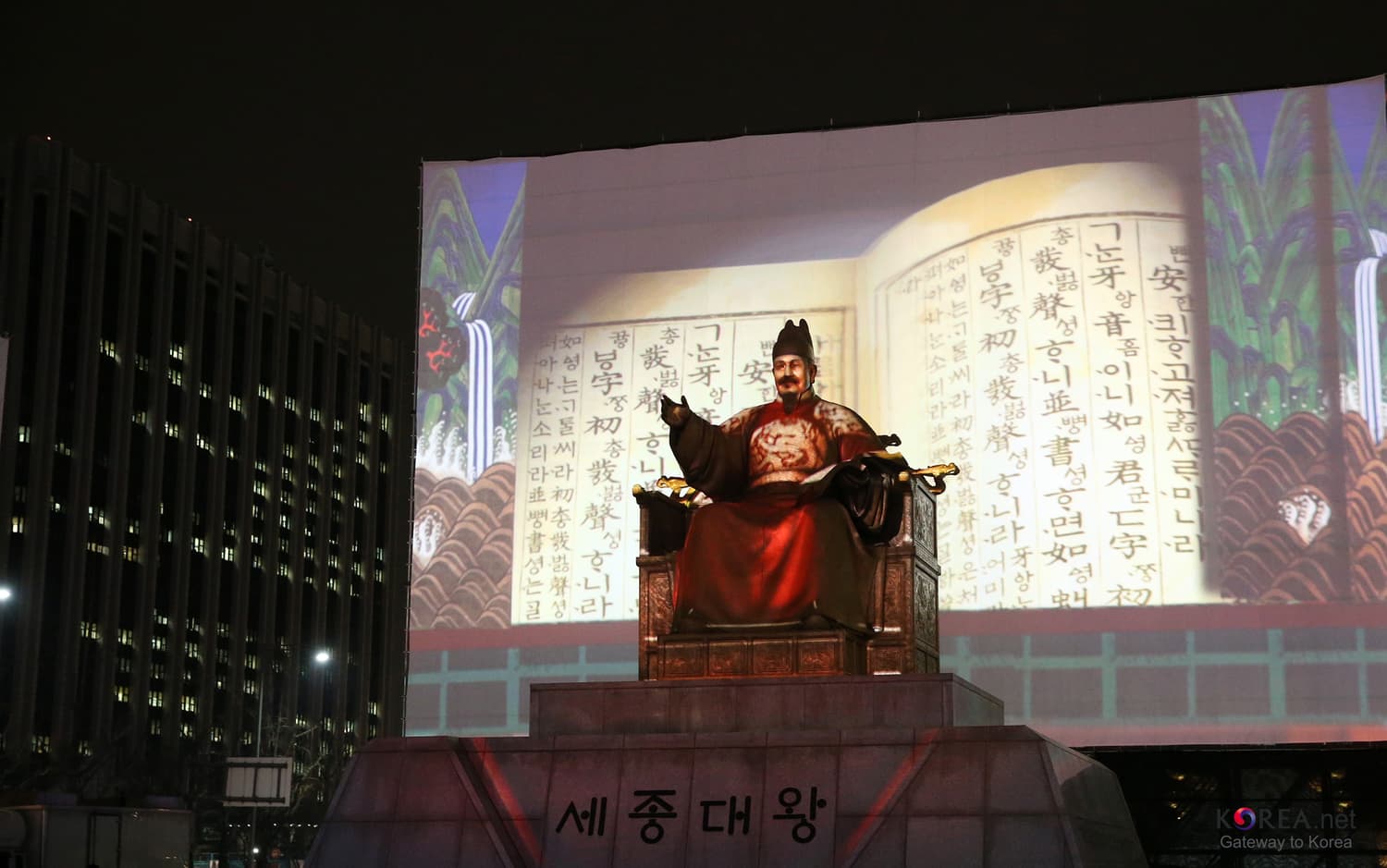
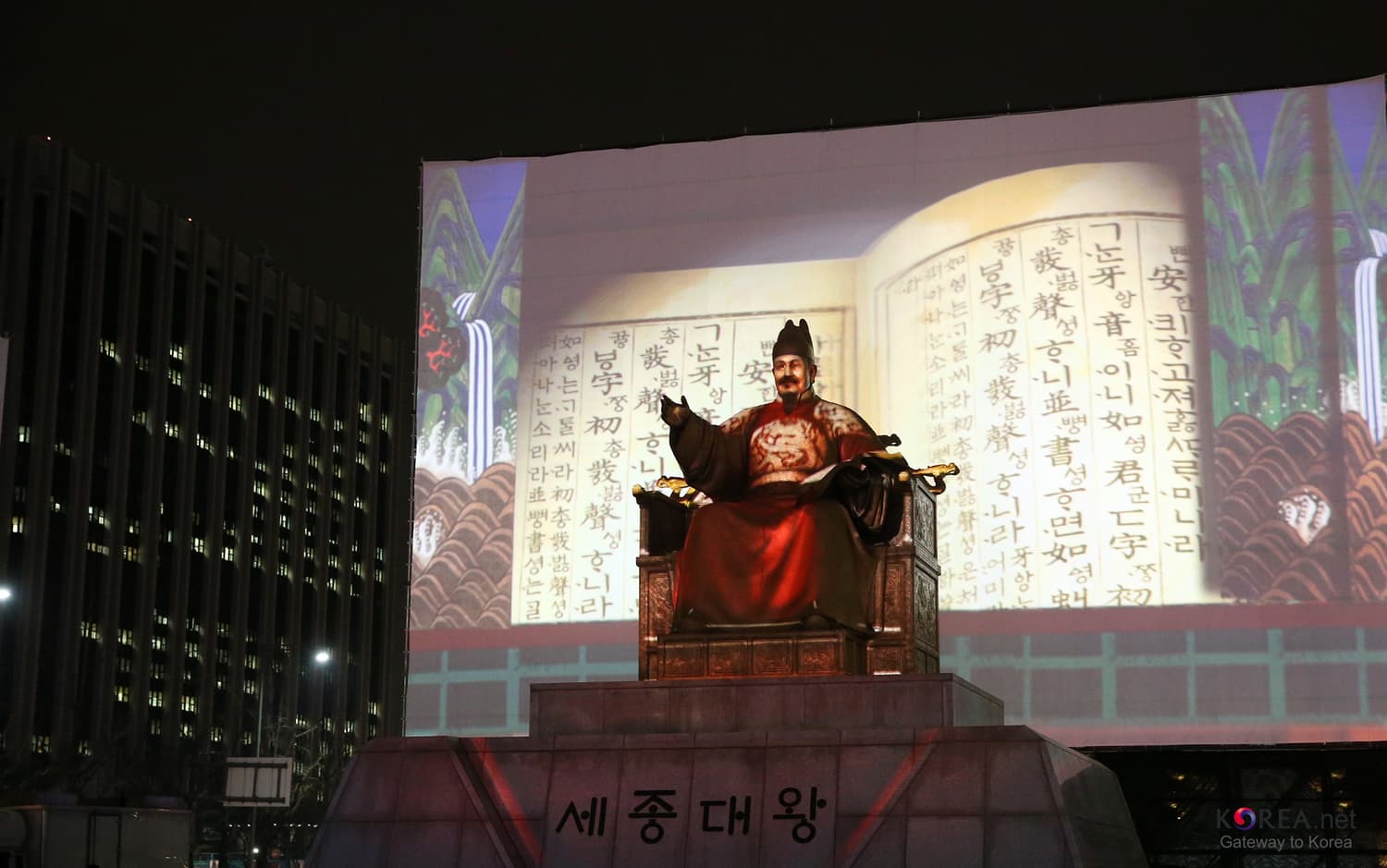
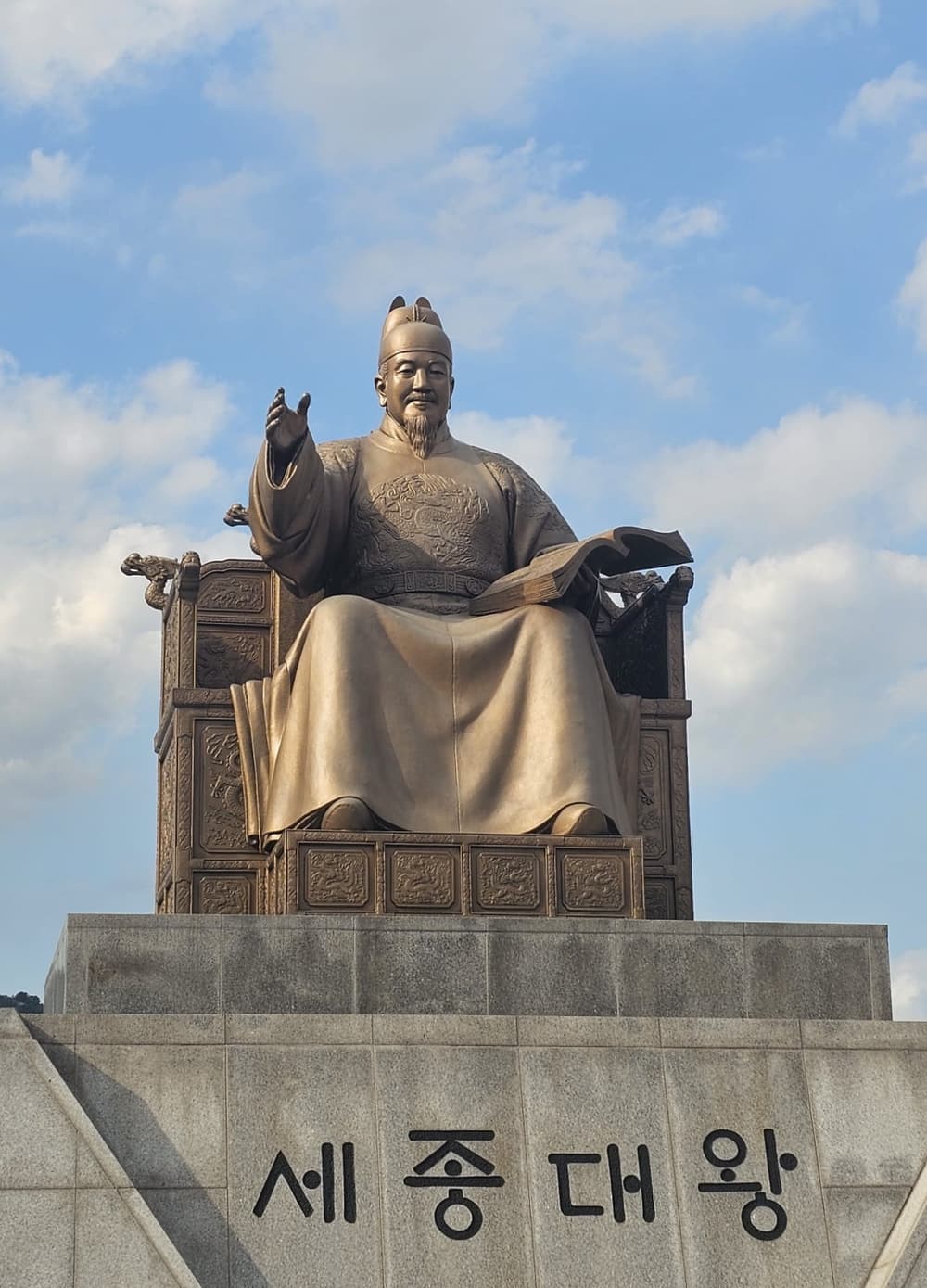
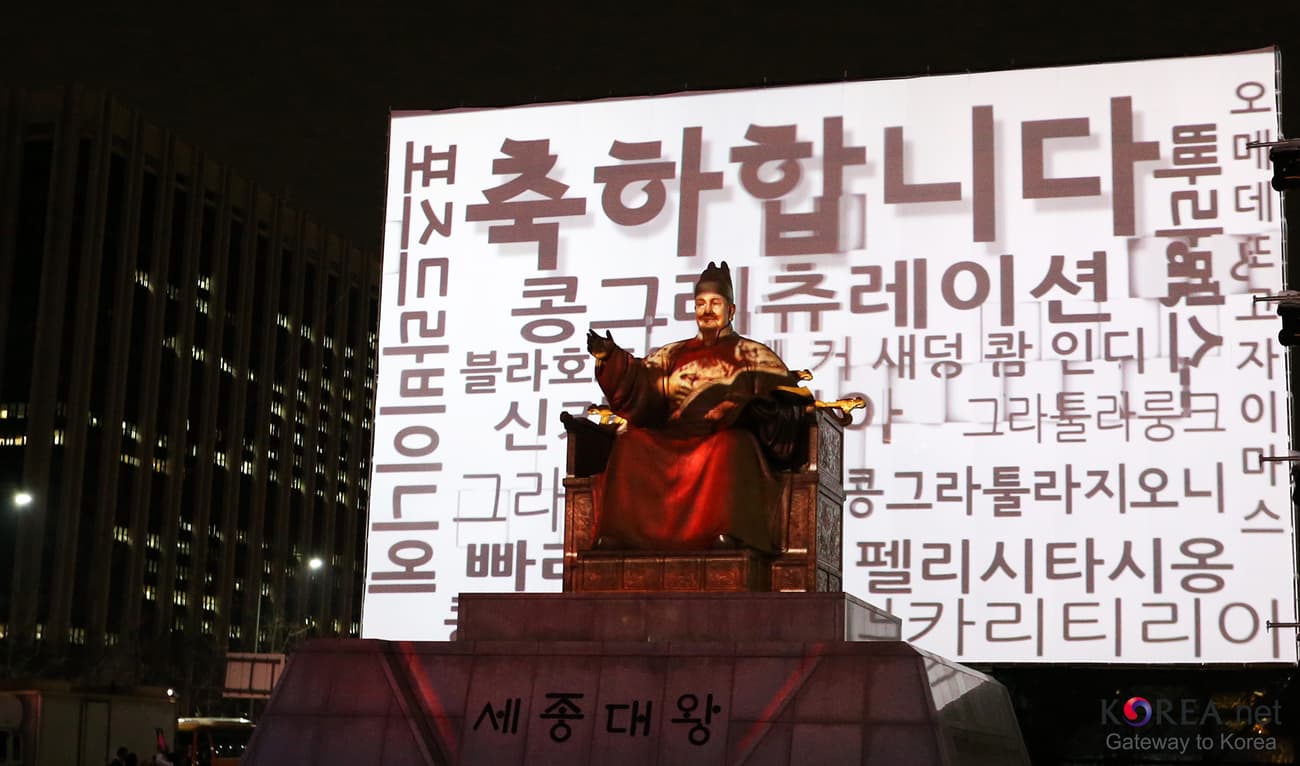
Above ground, the 세종대왕 statue is the thing people actually photograph. Sejong sits holding an open book, one hand raised, the pedestal reading 세종대왕 in plain Hangul. On Hangul Day the Sejong Center facade behind it has been used as a projection surface for the Hunminjeongeum text itself, which is how the photograph at the top of this article happened.
October 2026 Has Two Long Weekends, Back to Back
This is the planning fact that matters more than anything about the holiday itself.
개천절 (National Foundation Day) falls on Saturday, October 3, 2026. Under Korea's substitute-holiday rules, a national holiday that lands on a Saturday moves the day off to the following Monday, so Monday October 5 is a public holiday. That gives Korea a three-day weekend of October 3–5.
Then Hangul Day is Friday October 9, giving a second three-day weekend of October 9–11.
2026 has four substitute holidays in total — March 2, May 25, August 17 and October 5 — and two of them cluster with October. The practical consequences:
- KTX seats and intercity buses sell out for both Friday evenings and both Monday returns. Book well ahead rather than on the day.
- Hotel rates in Busan, Gyeongju and Jeju rise across both weekends.
- Palace and hanbok-rental queues are long, especially Gyeongbokgung in the late morning.
- Highways out of Seoul are slow on the Friday morning and back into Seoul on the Sunday evening.
If your trip is flexible, the middle week — roughly October 6 to 8 — is the calmest stretch of the month and still has good autumn weather.
While you are pricing the trip: palace admission is one of the few things in Seoul that has not moved in twenty years. As of August 2026, Gyeongbokgung and Changdeokgung are ₩3,000 for an adult; Changgyeonggung, Deoksugung and Jongmyo are ₩1,000; royal tombs run ₩500–2,000. Those prices have been effectively frozen since 2005. The Korea Heritage Service has said it will announce a revised schedule in November 2026, to take effect January 1, 2027. If you are visiting in late 2026, you are catching the last of the old pricing — check the gate rather than trusting an older guide.
Why October 9 — and Why It Used to Be November 4
Here is the part that gets flattened in English coverage into "Hangul Day is October 9." The date has moved, and it moved because of a book found in a house in Andong.
Korea first observed the anniversary in 1926, when the 조선어연구회 held a commemoration under the name 가갸날 — from 가갸거겨, the way children were drilled through the syllable chart. They set the date from the Sejong Sillok, the royal annals, which recorded the alphabet's promulgation in the ninth lunar month of 1446. Converting that gave November 4.
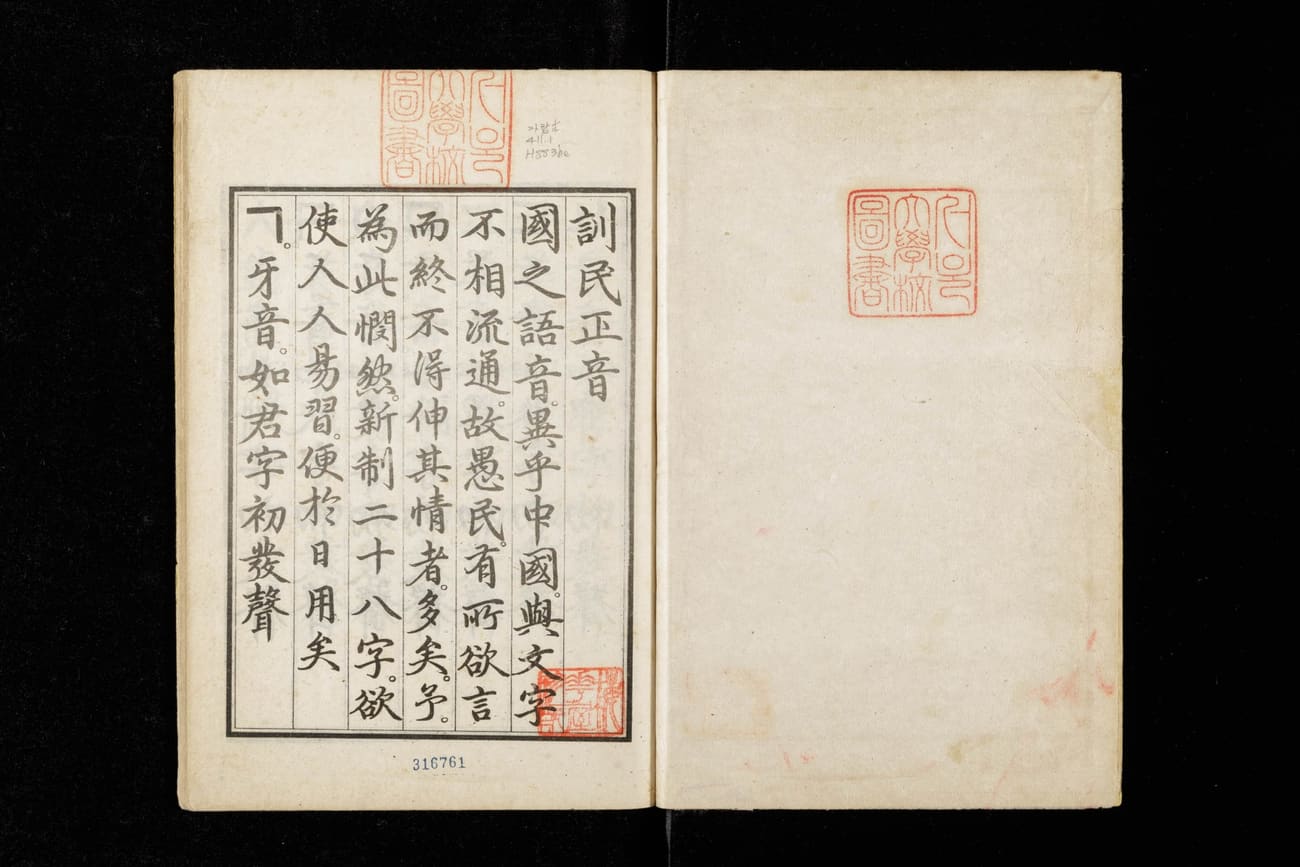
Then, in 1940, a copy of the 훈민정음 해례본 (Hunminjeongeum Haerye) surfaced in Andong, North Gyeongsang Province — roughly five hundred years after it was printed. Its postface carries a specific date: 정통 11년 9월 상한, "the first third of the ninth month in the eleventh year of the Zhengtong reign." Taking the last day of that period and converting it to the solar calendar gives October 9. Korea has used that date since 1946.
North Korea kept neither. It marks January 15, taken from the creation of the alphabet in 1443 rather than its publication in 1446, and calls the script 조선글 rather than 한글.
The holiday status has swung too. Hangul Day became a public holiday, was stripped of it in 1990 when business groups argued Korea had too many days off, spent 22 years as a commemorative day only, was raised to national-day status (국경일) in 2005, and was restored as a paid public holiday in 2013. The photographs in this article are from the December 2012 event at Gwanghwamun celebrating that restoration — which is why they show a winter crowd rather than an October one.
You might like: Learn Korean With Hangeul: Alphabet, Honorifics, and Apps — the alphabet takes an afternoon; it is everything after it that takes time.
1443 and 1446 Are Not the Same Event
The two dates you will see quoted are both correct and they describe different things.
1443 is 창제 — the alphabet was designed and completed. 1446 is 반포 — the year the explanatory volume was published and the system was formally issued.
What was published in 1446 is the 훈민정음 해례본, and its importance is easy to understate. It is not a proclamation. It is a design document: 33 pages that state why the alphabet was made, list every letter, and then explain the reasoning behind each shape. Almost no writing system on earth comes with a surviving account of its own invention written by its inventors.
It was designated 국보 제70호 in 1962 and inscribed on the UNESCO Memory of the World register in 1997. The Andong copy is held by the 간송미술관 in Seoul, and it is rarely on display — treat any given exhibition as a lucky break rather than something you can plan around.
The Design Is the Whole Point
Most alphabets are inherited and reshaped over centuries. Hangul was designed, on purpose, by people who wrote down their reasoning — and the reasoning is genuinely unusual.
The consonants are diagrams of your mouth. ㄱ is the shape of the tongue root blocking the soft palate. ㄴ is the tongue tip against the ridge behind the teeth. ㅁ is the outline of the mouth. ㅅ is a tooth. ㅇ is the throat. Then aspiration is added as an extra stroke on the same shape, so the letters get louder as they get more complicated: ㄱ→ㅋ, ㄴ→ㄷ→ㅌ, ㅁ→ㅂ→ㅍ, ㅅ→ㅈ→ㅊ. Related sounds look related, which is why the chart is so fast to learn.
The vowels are built from three strokes: a dot for heaven, a horizontal line for earth, a vertical line for the standing human. Everything else is a combination.
The original set had 28 letters. Four fell out of use — ㆍ (아래아), ㆆ (여린히읗), ㅿ (반시옷), ㆁ (옛이응) — leaving the 24 in use today.
The postface by 정인지 makes a claim that sounds like marketing until you try it: a wise man can learn it before the morning is out, and even a slow learner within ten days. For the alphabet itself, that holds up. Reading Korean fluently does not, but decoding the letters really is an afternoon's work.
It also met resistance. In 1444, 최만리, deputy head of the Hall of Worthies, submitted a memorial opposing the new script — arguing it broke with Chinese letters, that only "barbarians" used their own scripts, and that scholarship would suffer. Sejong overruled him. The name 한글 itself is modern, coined in the early twentieth century and associated with the linguist 주시경; before that the script was commonly called 언문, "vulgar writing," and sometimes 암클, "women's letters," because it was the writing of people who had not been taught classical Chinese.
Korean Alphabet with Writing Workbook — a cheap workbook and two evenings gets you to "I can sound out a menu." Hangul is the rare alphabet where that is literally true, and doing it before the trip changes how much of Korea is legible to you. As an Amazon Associate, EpicKor earns from qualifying purchases at no extra cost to you.
See the Hangul workbook on AmazonWhat the Day Actually Looks Like
Manage your expectations. Hangul Day is not Chuseok and it is not a street carnival.
The government holds a commemorative ceremony in the morning, typically with the Ministry of Culture, Sports and Tourism, where calligraphers and Korean-language scholars receive awards. Gwanghwamun Square is the centre of whatever public programming exists: calligraphy tables, typography and design exhibitions, Hangul-themed installations around the statue, and stalls from language institutes. Scale varies year to year, and the programme is usually published only a couple of weeks in advance on the Seoul city and Ministry sites.
For most Koreans, October 9 is a day off in good autumn weather. That is the honest version. The reason to be at Gwanghwamun is not that there is a spectacle — it is that the statue, the square, the free exhibition beneath it, and Gyeongbokgung are all within a few hundred metres of each other, and on this one Friday the exhibition stays open into the evening.
You might like: Seoul Palace Night Guide: Which Royal Palace to Visit and Hanbok Rental in Seoul: Palace Photos and Etiquette — both within walking distance of the Sejong statue.
Frequently Asked Questions
Q: Is Hangul Day a public holiday in South Korea? Yes. It is a full public holiday with paid leave, restored in 2013 after 22 years as a commemorative day only. Banks, government offices, post offices and schools close. Shops, restaurants and public transport run normally.
Q: Can I visit the National Hangul Museum on Hangul Day? No. The museum has been closed to visitors since October 2024 and, after a fire in February 2025, will remain closed until the second half of 2028. Its own website carries the notice. Go to 세종이야기 under Gwanghwamun Square instead — it is free, and on Fridays it stays open until 21:00.
Q: Will shops and restaurants be open on October 9? Yes. Korean public holidays are strong retail days. Department stores, malls, convenience stores, cafés and restaurants all trade normally, and the subway and buses run a normal or near-normal schedule. The things that close are administrative: banking, government services, post, schools. Pharmacies are the common gap — stock up beforehand.
Q: Is there a big Hangul Day festival in Seoul? Not in the sense of a major street festival. There is a government ceremony in the morning and a modest programme of calligraphy, typography and language-related events around Gwanghwamun Square. The scale changes year to year and details are usually published only a few weeks ahead.
Q: Why is Hangul Day on October 9? The date comes from the postface of the Hunminjeongeum Haerye, which dates the publication to the first third of the ninth lunar month of 1446. That converts to October 9. Before the Haerye was rediscovered in Andong in 1940, Korea observed the anniversary on November 4 instead, based on the royal annals.
Q: Does North Korea celebrate Hangul Day? It marks the alphabet on January 15, dated from the script's creation in 1443 rather than its publication in 1446, and calls it 조선글날. The two Koreas therefore celebrate the same alphabet on different days under different names.
Q: How long does it actually take to learn Hangul? The letters themselves take a few hours to a few days — the design is systematic enough that related sounds look related. Being able to read Korean is a different project. The realistic gain from an afternoon of study is sounding out signs, menus, station names and brand names, which is a large practical improvement on a trip.
You Might Also Like
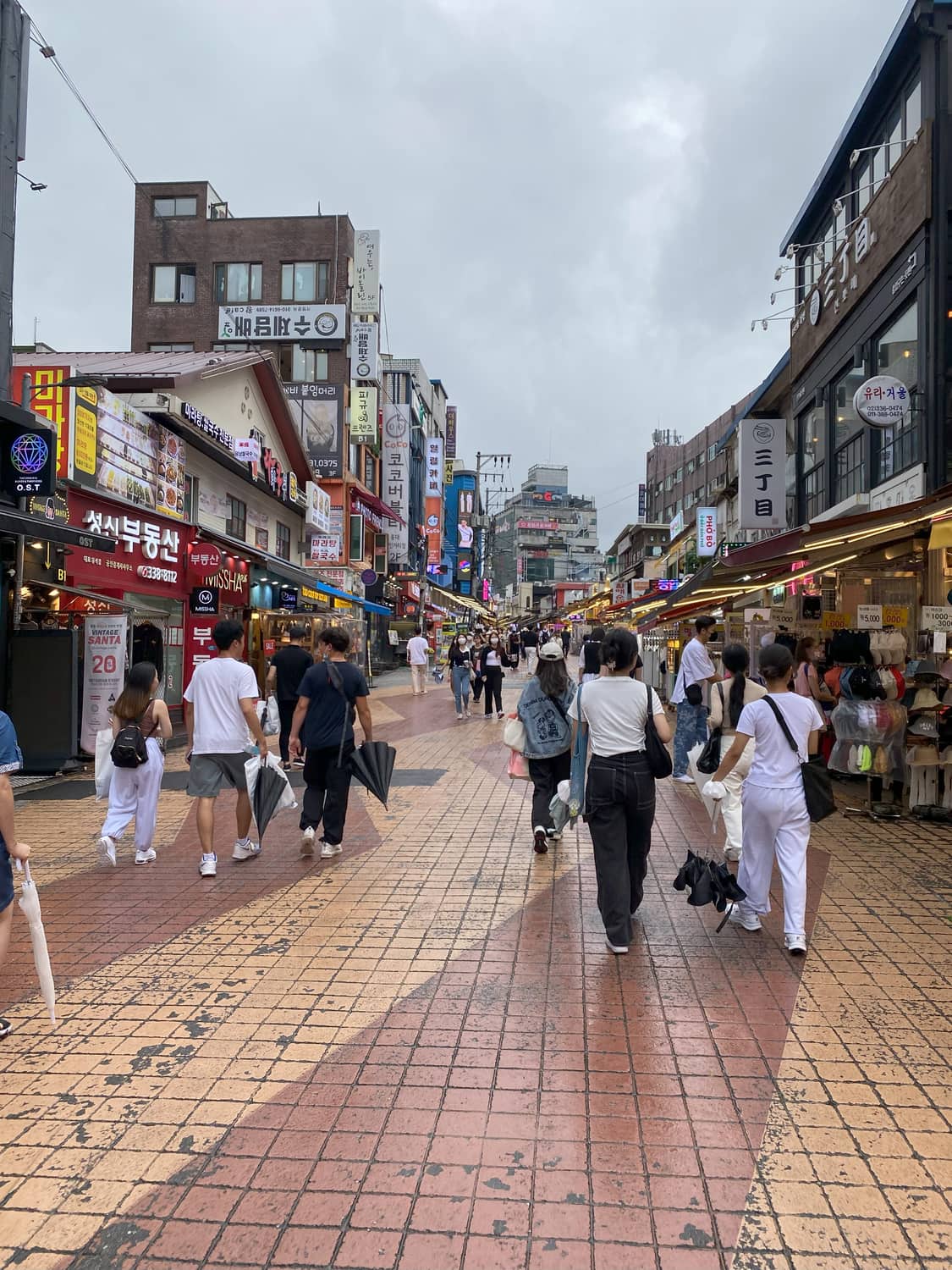
Do Koreans Speak English? Ask Someone Under 35 — What Actually Happens on a Seoul Street
Yes, if you ask the right person. Stop a Korean in their twenties or thirties on a Seoul street and you will almost always get an answer in English. The forum answer that says otherwise is twenty years old. Who to ask, how to ask, where English is built in.

Learn Korean With Hangeul: Alphabet, Honorifics, and Apps
A beginner-friendly guide to Hangeul, Korean pronunciation, honorifics, study apps, and realistic ways to start learning Korean.
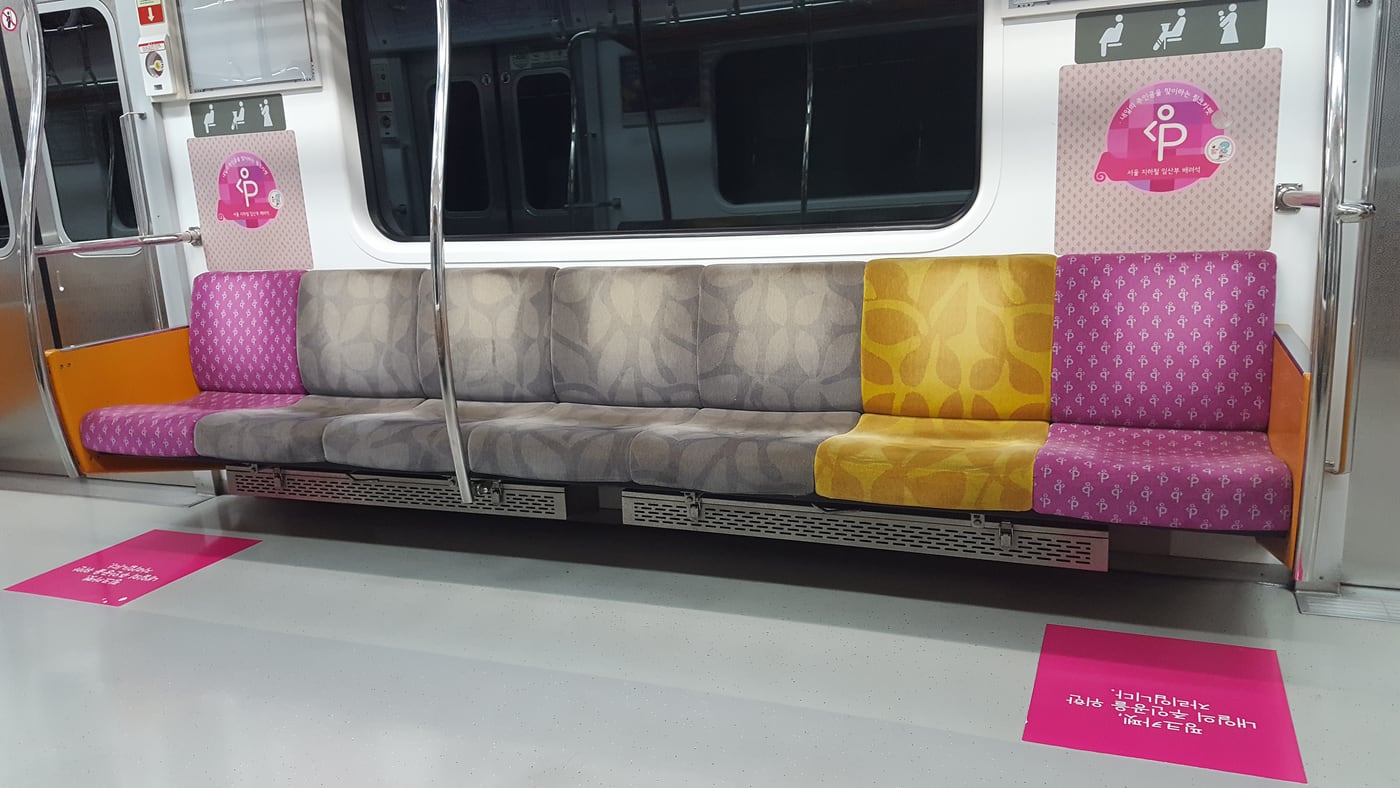
Seoul Deleted Its Women-Only Parking: What Korean Gender Policy Actually Is in 2026
Most English writing on Korean gender policy describes rules that were removed, renamed, or never existed. Seoul scrapped women-only parking in 2023, the ministry was renamed in 2025, and the famous five-point exam bonus went to men and ended in 1999.