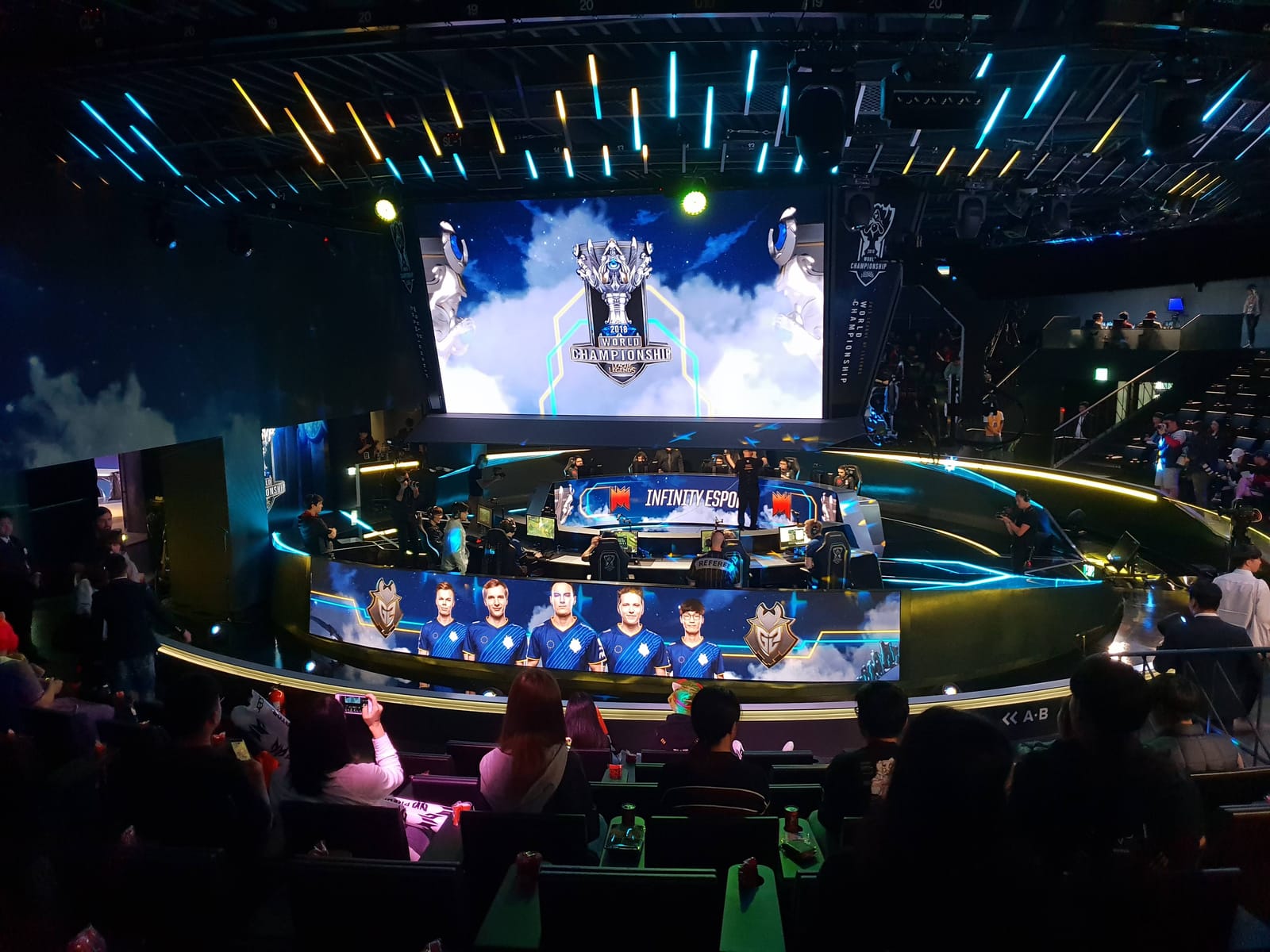
LoL Park Seoul: 450 Seats, One-Minute Sellouts, and How to Actually Get In
LoL Park is the smallest famous arena you will ever try to get into. It holds 450 people. Tickets cost ₩10,000. They are gone in roughly a minute.
That combination is the entire practical problem, and most English guides skip straight past it to describe the atmosphere. So here is the useful version: what the venue actually is now, what a ticket costs, when booking opens, and the twice-a-year situation where the match you flew for is not in Seoul at all.
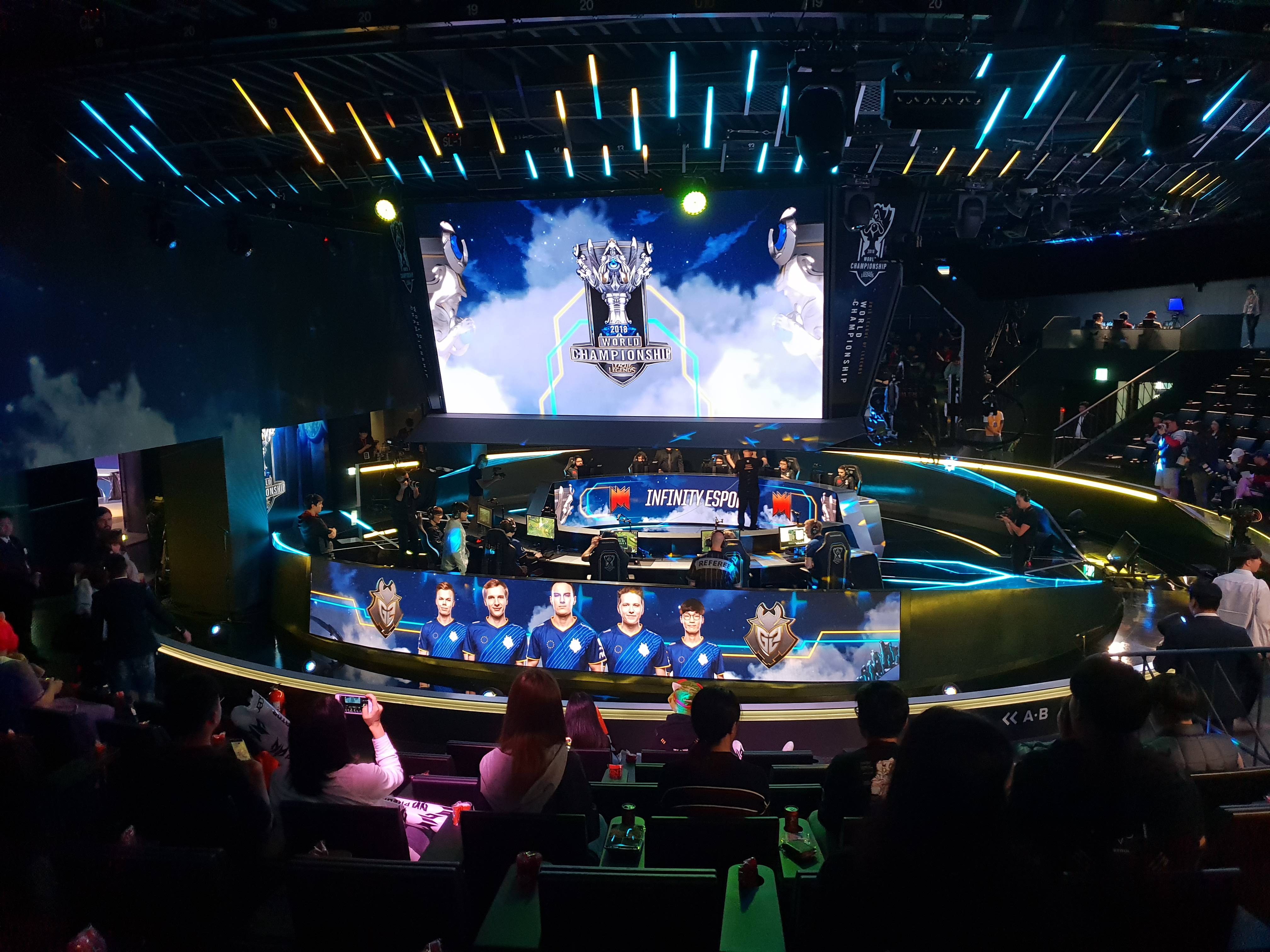
450 seats in a half-circle around the stage. The size is why it feels like this, and why the tickets behave the way they do. Image: Wikimedia Commons / CC BY-SA 4.0.
Watching the LCK from home instead? The HyperX Cloud III is the audio upgrade that mattersAffiliate link. As an Amazon Associate, EpicKor earns from qualifying purchases at no extra cost to you.
The Short Answer
| Detail | |
|---|---|
| Current name | 치지직 롤파크 (CHZZK LoL Park) since 16 December 2025, through 2030 |
| Where | 종로구 종로 33 (청진동), 그랑서울 3F — arena runs up to 4F |
| Capacity | 450 seats |
| Standard ticket | ₩10,000 (일반석) |
| Restricted view | ₩7,500 (시야방해석) |
| Booking | NOL 티켓 (Interpark), opens around 17:00 KST ahead of each match |
| Sellout speed | About one minute for popular fixtures |
| Not always in Seoul | Twice a year a team's 홈그라운드 moves to a large arena — 2026's first was Incheon |
| Finals | Larger external venues such as KSPO DOME |
The Venue Was Renamed in December 2025
If you are reading older guides, note the change. On 16 December 2025 Naver's streaming platform 치지직 (CHZZK) took naming rights, and the venue is now 치지직 롤파크 under a deal running through 2030. The renovation added branded seating zones and a CHZZK lounge inside the building.
The address is unchanged: 서울 종로구 종로 33, in the 그랑서울 complex, arena on the third floor extending to the fourth. It is a few minutes from Gwanghwamun, Cheonggyecheon and Jonggak, which is why an LCK night slots so easily into a central Seoul evening.
Opened in 2018, it was built as a permanent broadcast home rather than a hall the league rents. The building also holds a PC room, a café, merchandise shops and exhibition space.
Why 450 Seats Changes Everything
This is the number that explains the ticketing.
For comparison, the LCK's previous home — the OGN e-Stadium — seated 756. LoL Park is smaller than the venue it replaced, deliberately: it was designed for broadcast intimacy, not for volume. Every camera angle has a crowd in it because the crowd is close.
The consequence is that LoL Park is one of the hardest tickets in Korean live entertainment on a per-seat basis. Korean fan sources describe popular fixtures selling out within a minute of the sale opening. That is not a queue you win by refreshing faster on the day; it is one you win by having everything ready beforehand.
HyperX Cloud III — if the 450 seats are gone, the free broadcast plus this is the next-best seat. Tickets sell out in about a minute, so most people watch from home; the difference between an average setup and a good one is almost entirely audio, and the Cloud line is the headset the esports crowd defaults to (the Cloud II listing is currently unavailable; the Cloud III is its successor). As an Amazon Associate, EpicKor earns from qualifying purchases at no extra cost to you.
See the HyperX Cloud III on AmazonYou might like: Korean PC bang culture guide
What It Costs
| Seat type | Korean | Price |
|---|---|---|
| Standard | 일반석 | ₩10,000 |
| Restricted view | 시야방해석 | ₩7,500 |
Both rose in 2024, from ₩8,000 and ₩5,000 respectively. Even after the increase this is remarkably cheap for a live professional sports fixture anywhere — roughly the price of a bowl of noodles in central Seoul.
The floor is laid out in a half-circle around the stage. Zone A is the dedicated cheering section (응원석), zones C to E are standard seating, and B and F are the Woori Bank zone. Because of the semicircle and the room's size, there is no genuinely bad seat — which is part of why the restricted-view tickets sell too.
Booking: The Part That Actually Decides It
The mechanics matter more than the strategy.
Tickets go through NOL 티켓 (Interpark). Sales open at a published time ahead of each match, commonly 17:00 KST. Sources differ on the lead time — some describe roughly 48 hours before the match, others about a week — so read the notice for your specific fixture rather than assuming a rule.
Make the account before booking day. This is where most overseas fans lose. Korean ticketing platforms are built around Korean identity verification, and sorting that out at 16:58 on sale day does not work. Create and verify the account days ahead, log in, and have your payment method already saved.
Have a second choice. If you are travelling and any LCK night will do, you have a much better chance than someone who needs one specific team on one specific date.
Check where the match is before you book anything else — see the next section.
Twice a Year, the Match Is Not in Seoul
This is the trap, and it is the reason this guide was rewritten.
The LCK regular season is played at 치지직 롤파크, but each season a team hosts a 홈그라운드 — a home-ground roadshow staged at a full-size arena, with the fixtures played there instead.
2026's first was T1's, on 24–26 April at 인스파이어 아레나 (Inspire Arena) in Incheon — a three-day festival with fan zones and partner booths, with the actual matches against 한진 브리온 on the 25th and BNK 피어엑스 on the 26th. Inspire has now hosted T1's home ground two years running. A second home ground is scheduled for the 2026 season.
Playoffs and finals also move, to larger venues such as KSPO DOME.
The practical instruction: confirm the venue before you book flights or hotels around a fixture. Incheon is not a short hop from central Seoul, and a home-ground event is a different ticket, at a different price, on a different sales page.
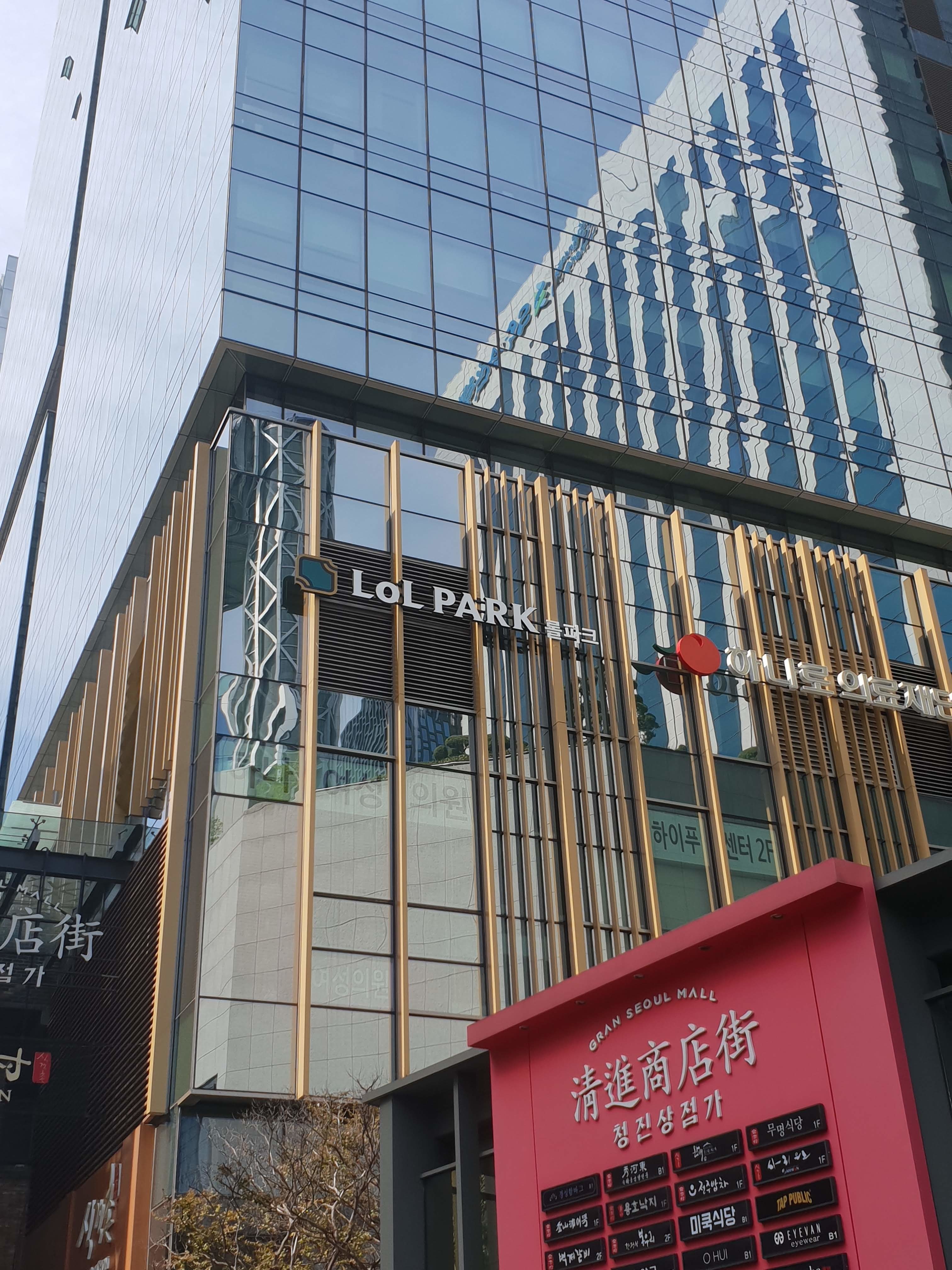
The entrance sits inside an office complex rather than on a stadium concourse. Look for the escalators up, not for a stadium gate. Image: Wikimedia Commons.
What a Match Night Feels Like
Arrive earlier than you think you need to. The building is an office complex, so the first five minutes are spent finding the right escalator rather than a stadium gate.
Inside, the room is small enough that you register individual voices. Zone A does organised cheering with team calls; the rest of the room reacts more spontaneously. For a newcomer, the crowd is the tutorial — when the room suddenly reacts, look at the minimap, the objective timer, or the player cam, because something happened that the broadcast has not caught up with yet.
Korean esports audiences read tempo unusually well. They notice a team setting up vision, baiting a fight, protecting a carry, or conceding one objective to trade for another. You do not need to follow the game closely to feel when a series turns.
Build the Rest of the Evening Around It
The venue's location does most of the work.
Eat first, near 광화문, 종로 or 인사동, and keep it simple — a slow multi-course meal before a ticket window is a bad plan. After the match, 청계천 is a two-minute walk and is pleasant in the evening. If you want the gaming mood to continue, Jongno has PC bangs within walking distance.
That last step is worth doing at least once. LoL Park makes far more sense after an hour in a PC방 — EpicKor's PC bang guide covers prices, rules and how to order food at the counter — because the arena is the professional tip of that pyramid rather than a separate world. A child plays in a PC bang, a student watches highlights, a fan follows a team, a city builds a venue, a broadcast turns it into a league.
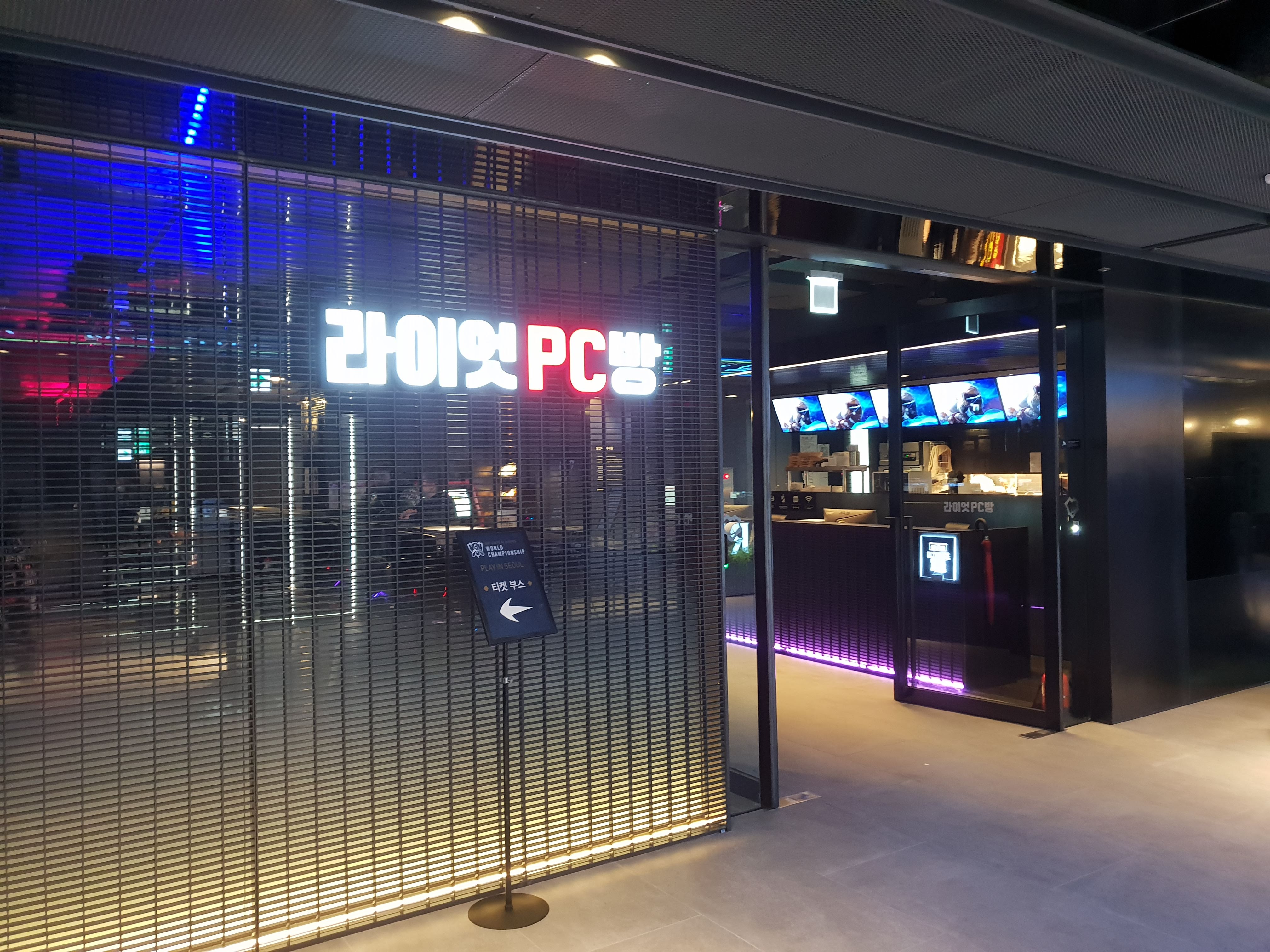
The PC room inside the building connects the professional arena to ordinary Korean gaming-room culture. Image: Wikimedia Commons.
You might like: Seoul by neighbourhood — all twelve compared
If You Do Not Get a Ticket
Plan for this, because it is the likely outcome. Four hundred and fifty seats against a global fanbase is not a fight you are favoured in.
Watch it in a PC방. Korean PC bangs run the LCK broadcast on the wall screens during match nights, and the room reacts. An hour costs roughly ₩1,000–₩2,000 depending on the district and the time of day, which makes it the cheapest live-sport atmosphere in Seoul. You do not need to play anything; nobody will mind you sitting with a drink watching the screen.
Watch it in a chicken shop. LCK nights get the same treatment as football in a 치킨집 — screens on, tables full, a room that groans together. This is closer to how most Koreans actually consume the league than the arena is.
Watch it on the official stream, which is free and carries an English broadcast. If your trip cannot be built around a fixture, the honest answer is that the match is not the scarce thing — the room is.
Go to the building anyway if you are in Jongno. The PC room, café, merchandise shops and exhibition space are open outside match hours, and it takes twenty minutes.
League of Legends official Jinx figure, 4-inch — know the price before you are in the venue shop deciding fast. Jerseys and figures are what people regret not buying, and the shop inside LoL Park is not open at all hours. Checking the Amazon price first tells you whether the venue exclusive is worth the queue. As an Amazon Associate, EpicKor earns from qualifying purchases at no extra cost to you.
See the official Jinx figure on AmazonYou might like: Korean screen sports guide
What to Bring
- Phone with battery, and your ticket or account access already loaded.
- Passport or ID — Korean ticketing often ties a booking to the buyer.
- A small bag. Oversized bags and professional camera gear slow entry.
- Transit card or payment set up in advance.
- A light layer; the room runs cool.
Venue rules beat blog advice. If an official notice contradicts anything here, follow the notice.
Who Should Skip It
Skip it if you need certainty. Between one-minute sellouts, Korean-account verification and the home-ground venue changes, this is not a fixture you can reliably build a trip around from overseas.
Skip it if you want scale. LoL Park is famous for being tight, not big. If you want a stadium spectacle, target a finals at KSPO DOME or a 홈그라운드 at Inspire instead — those are large-arena events.
Skip it if you do not like screens. It is a broadcast room. That is the point.
Do not skip it if you want to see the version of esports that Korea built on purpose. For ₩10,000, in a room of 450 people, it is the best-value live sport in the city.
Frequently Asked Questions
Q: How much are LCK tickets at LoL Park? A: ₩10,000 for a standard seat (일반석) and ₩7,500 for a restricted-view seat (시야방해석). Both went up in 2024 from ₩8,000 and ₩5,000.
Q: Why is LoL Park called CHZZK LoL Park now? A: Naver's streaming platform 치지직 took naming rights on 16 December 2025, in a deal running through 2030. The renovation added branded seating and a CHZZK lounge. The venue and address are otherwise the same.
Q: How hard is it to get LCK tickets? A: Hard. The arena seats 450, and popular fixtures are reported to sell out within about a minute. The decisive step is creating and verifying your NOL 티켓 account days in advance, not reacting quickly on the day.
Q: Where is LoL Park? A: 서울 종로구 종로 33 (청진동), third floor of the 그랑서울 complex, with the arena extending to the fourth. It is walkable from Gwanghwamun, Jonggak and Cheonggyecheon.
Q: Are all LCK matches played at LoL Park? A: No. Each season a team stages a 홈그라운드 roadshow at a large arena — T1's 2026 event ran 24–26 April at Inspire Arena in Incheon, with a second scheduled that season. Playoffs and finals move to bigger venues such as KSPO DOME. Confirm the venue before booking travel.
Q: Can foreigners buy LCK tickets? A: In practice the obstacle is the account, not the nationality. Korean ticketing platforms are built around Korean verification flows, so set up and verify your account well before sale day rather than on it.
Q: Is LoL Park worth visiting without a match ticket? A: The building also holds a PC room, café, merchandise shops and exhibition space, so there is something to see. But without a match the room is just a room — pair it with a PC bang and a Jongno evening rather than travelling for the building alone.
Sources
The 16 December 2025 CHZZK naming-rights agreement and its 2030 term, the 종로구 종로 33 (청진동) / 그랑서울 3F address, the 450-seat capacity and the comparison with the OGN e-Stadium's 756, the NOL 티켓 sales channel and the reported one-minute sellouts from Korean-language reference sources. Ticket prices of ₩10,000 and ₩7,500 and the 2024 increase from ₩8,000 and ₩5,000, plus the A/C–E/B–F zone layout, from Korean ticketing and fan coverage. The 2026 T1 홈그라운드 at Inspire Arena on 24–26 April, the fixtures against 한진 브리온 and BNK 피어엑스, the festival format and the second scheduled home ground of the season from Korean sports and esports press, checked August 2026.
Esports schedules, venues, ticket platforms and prices change every season. Confirm the fixture, the venue and the sale time on official LCK channels before committing money or travel.
You Might Also Like
Do Koreans Speak English? Ask Someone Under 35 — What Actually Happens on a Seoul Street
Yes, if you ask the right person. Stop a Korean in their twenties or thirties on a Seoul street and you will almost always get an answer in English. The forum answer that says otherwise is twenty years old. Who to ask, how to ask, where English is built in.
Seoul Deleted Its Women-Only Parking: What Korean Gender Policy Actually Is in 2026
Most English writing on Korean gender policy describes rules that were removed, renamed, or never existed. Seoul scrapped women-only parking in 2023, the ministry was renamed in 2025, and the famous five-point exam bonus went to men and ended in 1999.
Gwangjang Market's Second Floor: Seoul's Vintage Arcade, and the One Day It's Shut
Everyone knows Gwangjang for the food alley that never closes. Above it is a vintage arcade signed 수입구제 where most items run under ₩20,000 — and it shuts every Sunday, which is exactly when visitors turn up.