Korean Kimchi Containers: The Press Plate Matters More Than the Lid
Search for a kimchi container in English and you will get a dozen ranked lists, all sorted by the same criteria: airtight lid, gas valve, material, capacity. They are not wrong. They are answering the question "which container ferments best", which is a reasonable question if you are choosing a fermenting vessel from scratch.
It is not the question Korean households answer.
In a Korean kitchen the container is chosen by the appliance it has to live in, and the component that decides whether the kimchi is still good in three months is not on the outside of the box at all. It is a flat plate that sits inside, on top of the kimchi, holding it under its own brine.
Neither of those shows up in an English buying guide, and both change what you should buy.
Quick Guide
| Question | Short answer |
|---|---|
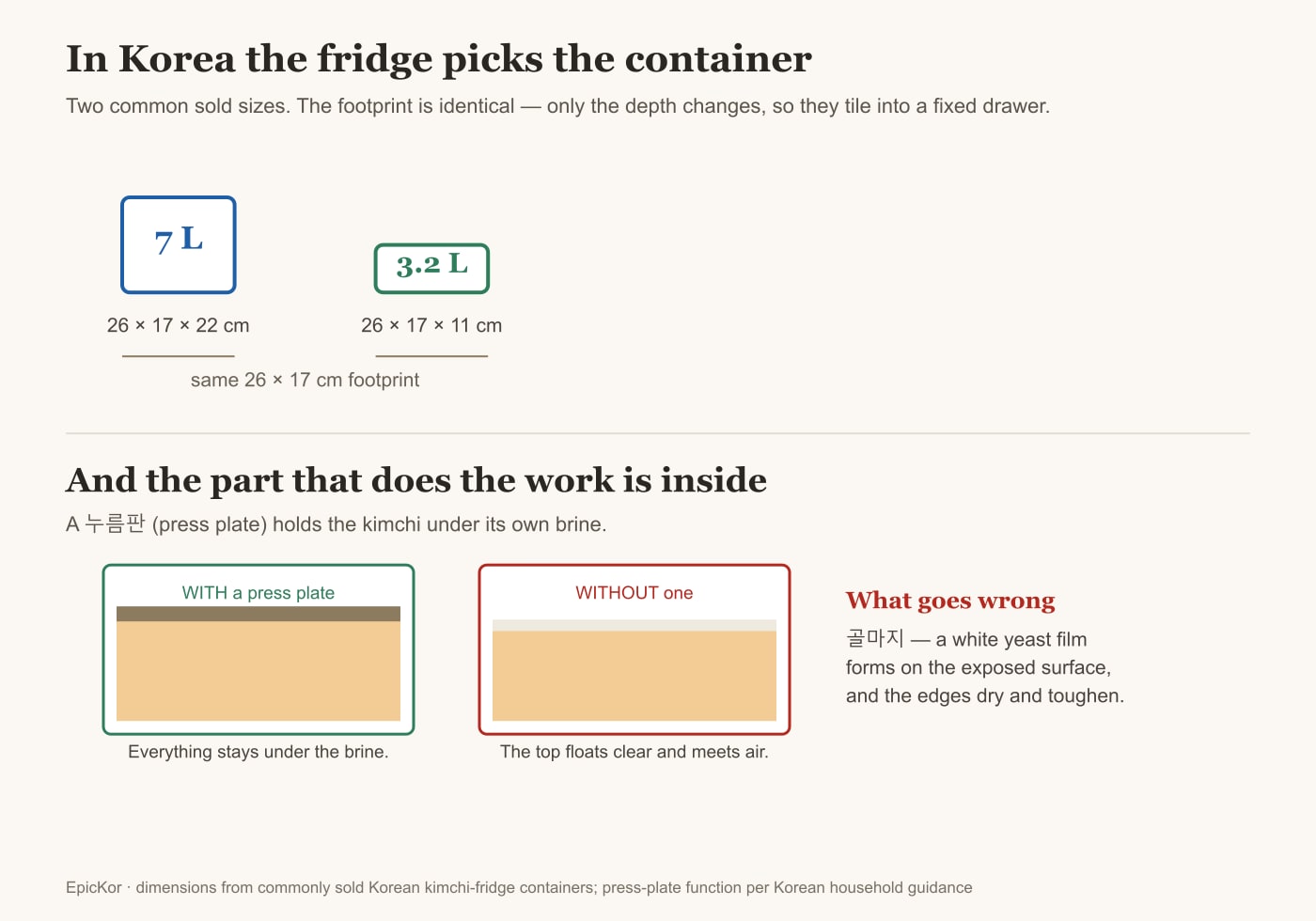
| What decides the size? | Your fridge. Korean containers are sold to tile into kimchi-fridge drawers |
| Common sold sizes | 7L (26 × 17 × 22cm) and 3.2L (26 × 17 × 11cm) — same footprint |
| The part that matters most | The 누름판 (press plate) that holds kimchi under the brine |
| What happens without one | 골마지, a white yeast film on the exposed surface; dry, tough edges |
| Why the lid has a button | A one-way valve vents fermentation CO2 without letting air back in |
| Stainless or plastic? | Stainless resists odour and staining; plastic is cheaper and will stain |
| Price in Korea | Stainless from about ₩23,500; a 3L runs ₩33,700–36,400 |
| Buying abroad | Ignore the fridge-fit rule — you have no kimchi fridge. Buy on plate and valve |
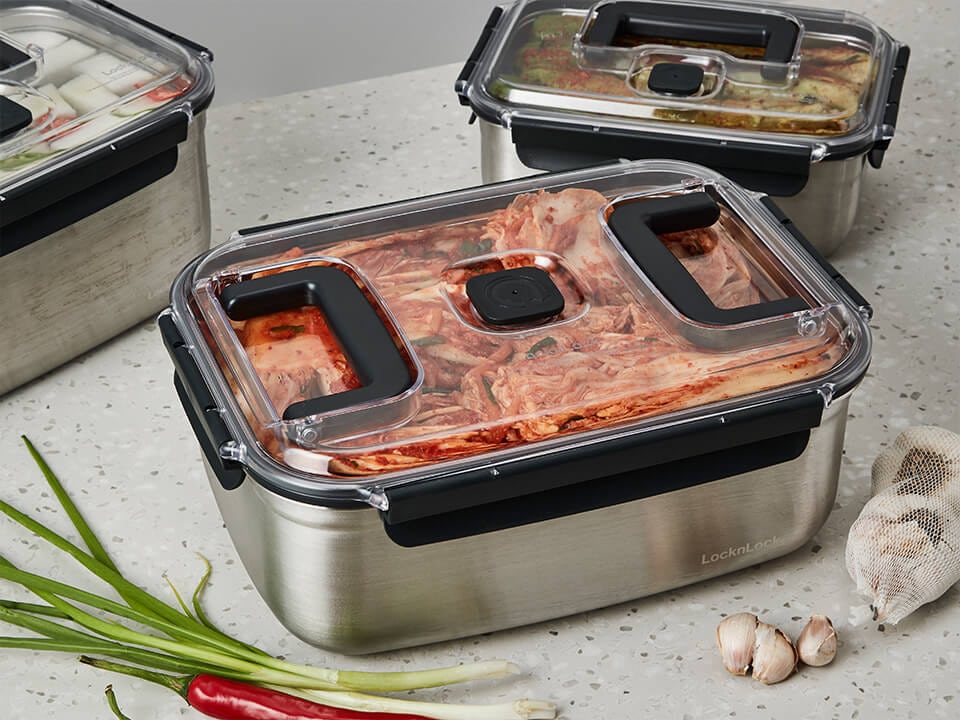
E-Jen kimchi container with an inner press lid — the design this guide says matters mostAffiliate link. As an Amazon Associate, EpicKor earns from qualifying purchases at no extra cost to you.
The fridge picks the size
Korea has a second refrigerator that exists to hold one food. That is not a figure of speech — it is a normal appliance in an ordinary apartment, and our guide to why Korea built a fridge for one food covers how it happened.
The consequence for containers is direct. A kimchi fridge is a set of fixed compartments, not open shelves, so the containers that go in it are made to tile. Look at the two sizes sold everywhere:
- 7L — 26 × 17 × 22cm
- 3.2L — 26 × 17 × 11cm
The footprint is identical. Only the height changes. You can fill a drawer with one deep container, or two shallow ones, and the base dimensions still line up. That is a design constraint imported from the appliance, and it is why Korean containers look so uniform compared with the assortment of shapes an English "best of" list will show you.
Two practical notes follow.
If you live in Korea, measure the drawer before buying. Manufacturers of kimchi fridges — Winia's Dimchae, Samsung's RQ series, LG's models — supply their own containers sized for their compartments, and third-party makers publish compatibility. Korean shoppers search for 딤채 김치통 and 삼성 김치통 for exactly this reason.
If you do not live in Korea, this rule does not apply to you — and that is worth saying plainly, because it means half the reason Korean containers are shaped the way they are is irrelevant to your kitchen. Buy on the two things that follow instead.
One sizing rule does travel. For a full kimjang batch, Korean guidance leans large: a 10L or bigger container uses a direct-cooling kimchi fridge's space more efficiently than several small ones. If you are making kimchi in quantity rather than storing a shop-bought pack, size up.
The press plate, and what happens without one
Here is the component English guides almost never mention, and it is the one Korean buying advice puts alongside capacity and seal as a top-three criterion.
A 누름판 is a flat plate that goes inside the container, on top of the packed kimchi. Its whole job is to keep the kimchi submerged in its own brine.
That matters because of what kimchi does as it ferments: it rises. Gas production lifts the mass, the top of it clears the liquid, and that exposed surface meets air. Two things then happen, both bad and both familiar to anyone who has kept kimchi for a while:
- 골마지 (golmaji) — a white film forms on the surface. It is a yeast growth, not mould, and Korean households treat it as a spoilage-adjacent nuisance rather than a disaster, but nobody wants it.
- The edges dry and toughen. The parts sitting above the brine lose moisture and go leathery.
Press the kimchi down under the liquid and neither happens. That is the entire mechanism, and it is why the difference shows most on long storage — a kimjang batch meant to last months, rather than a tub you will finish in two weeks.
The improvised version is a plastic bag. Plenty of Korean kitchens lay cling film or a food bag directly onto the kimchi surface, which achieves the same air exclusion. It works. A rigid plate is simply the version that does not need re-doing every time you open the tub.
When you are buying, look for whether a plate is included. It is a cheap part with an outsized effect, and its absence is easy to miss on a product photo showing the box closed.
The button on the lid is not a gimmick
The second thing that separates a kimchi container from an ordinary food box is a one-way air valve.
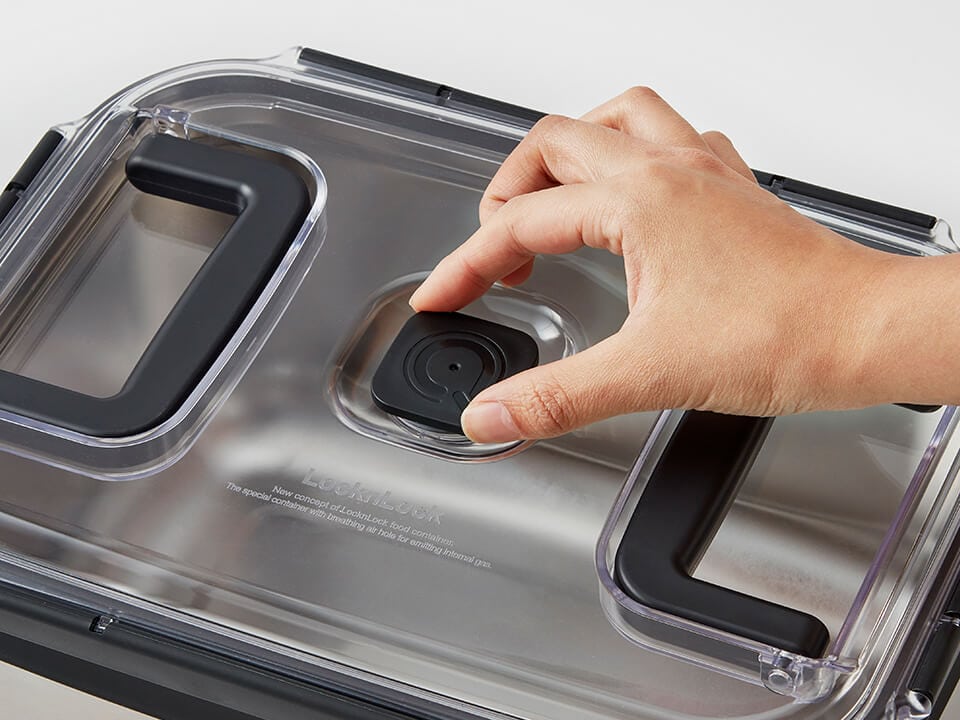
Kimchi keeps fermenting after it is packed, and fermentation produces carbon dioxide. A genuinely airtight box with no relief has two failure modes: pressure builds until the lid pops or the container deforms, or brine forces its way out of the seal and into the fridge.
A vent valve solves it in one direction. Fermentation gas escapes; outside air does not come back in. Lock&Lock markets this as a 숨밸브 — a "breathing valve" — on its 숨쉬는 김치통 line, and the same idea appears across Korean brands.
What to check on a listing: whether the lid vents at all, and whether it vents one way. A plain airtight lid and a vented lid look identical in a thumbnail.
Stainless or plastic, and the odour problem
This is the trade Korean shoppers actually argue about, and the honest answer is that it depends on how long you keep red kimchi in the thing.
| Stainless steel | Plastic | |
|---|---|---|
| Odour | Does not absorb it | Absorbs it over time |
| Staining | None | Red staining is permanent |
| Reacts with acid? | No | No, but see above |
| See the contents? | Only through a clear lid | Yes |
| Price | Roughly 2–3× plastic | The cheap option |
Korean advice is blunt about the plastic case: if you are going to keep red seasoned kimchi in a plastic tub long-term, you have to accept some smell and some colour transfer. If the staining itself bothers you, that is the argument for stainless rather than anything about flavour. Glass and Tritan sit in the same non-absorbing category as stainless; glass is heavy and breakable in a packed fridge, which is why Korean kitchens use far less of it than a Western fermenting guide would suggest.
Prices in Korea, September 2026. Lock&Lock's stainless breathing containers start around ₩23,500, with a 2.4L at about ₩30,700 and a 3L around ₩33,700 to ₩36,400 depending on the retailer and shape. That is genuinely expensive for a food box, and it is the price of never dealing with a stained tub again. Plastic equivalents cost a fraction and are what most Korean households actually own in quantity.
If you are buying one outside Korea, the checklist shrinks to two items. As an Amazon Associate, EpicKor earns from qualifying purchases at no extra cost to you. The fridge-fit rule does not apply to you, so what is left is: does it have a one-way vent, and does it come with a press plate. Compare airtight kimchi containers on those two before capacity, and check stainless versions if you plan to keep red kimchi in it for months rather than weeks — the staining is the part you cannot undo.
Getting the smell out of the one you already own
김치통 냄새제거 — removing kimchi-container odour — is one of the most-searched phrases about these things in Korean, which tells you how universal the problem is. The advice that circulates in Korean households:
- Wash it the same day you empty it. Odour sets in as residue dries into the surface.
- Rice water (쌀뜨물) is the standard first move, exactly as it is for a ttukbaegi — the starch lifts oil and residue.
- Baking soda, either as a paste or dissolved in warm water and left to stand.
- Sunlight. Leaving a washed container open in direct sun is the oldest Korean method and works better than it has any right to.
- Accept the limit on plastic. None of these reverses staining, and a plastic tub that has held red kimchi for a year is not coming back to white. Demote it to a non-kimchi job rather than fighting it.
For the rest of a Korean kitchen, our Korean cookware starter guide covers the pots and tools that go alongside these, and Korean ttukbaegi vs dolsot explains the pot the kimchi eventually ends up cooking in.
FAQ About Korean Kimchi Containers
Q: What size kimchi container should I buy?
If you have a kimchi fridge, the fridge decides — measure the compartment, because containers are made to tile into fixed drawers. The two sizes sold everywhere are 7L (26 × 17 × 22cm) and 3.2L (26 × 17 × 11cm), which share a footprint. For a full kimjang batch, Korean guidance favours 10L or larger.
Q: What is a 누름판 and do I need one?
A press plate that sits inside the container on top of the kimchi, holding it under the brine. Yes, if you keep kimchi more than a couple of weeks. Without it the kimchi rises above the liquid, the exposed surface grows 골마지 (a white yeast film) and the edges dry out. Cling film pressed onto the surface is a workable substitute.
Q: Why does a kimchi container need an air valve?
Because kimchi keeps fermenting and produces carbon dioxide. A fully sealed box will build pressure until it deforms or leaks brine. A one-way valve lets the gas out without letting air back in.
Q: Stainless steel or plastic for kimchi?
Stainless does not absorb odour and does not stain; plastic does both with red kimchi over time. Stainless costs roughly two to three times as much. If you are storing seasoned kimchi long-term and the permanent red staining would bother you, pay for stainless; otherwise plastic is what most Korean households use.
Q: How much does a kimchi container cost in Korea?
Stainless breathing containers start around ₩23,500, with a 2.4L about ₩30,700 and a 3L roughly ₩33,700–36,400 as of September 2026. Plastic costs a fraction of that.
Q: How do I get the kimchi smell out of a container?
Wash it the same day you empty it, use rice water or baking soda rather than relying on detergent alone, and leave it open in direct sunlight. None of this reverses staining on plastic — that part is permanent.
Q: Can I just use glass jars?
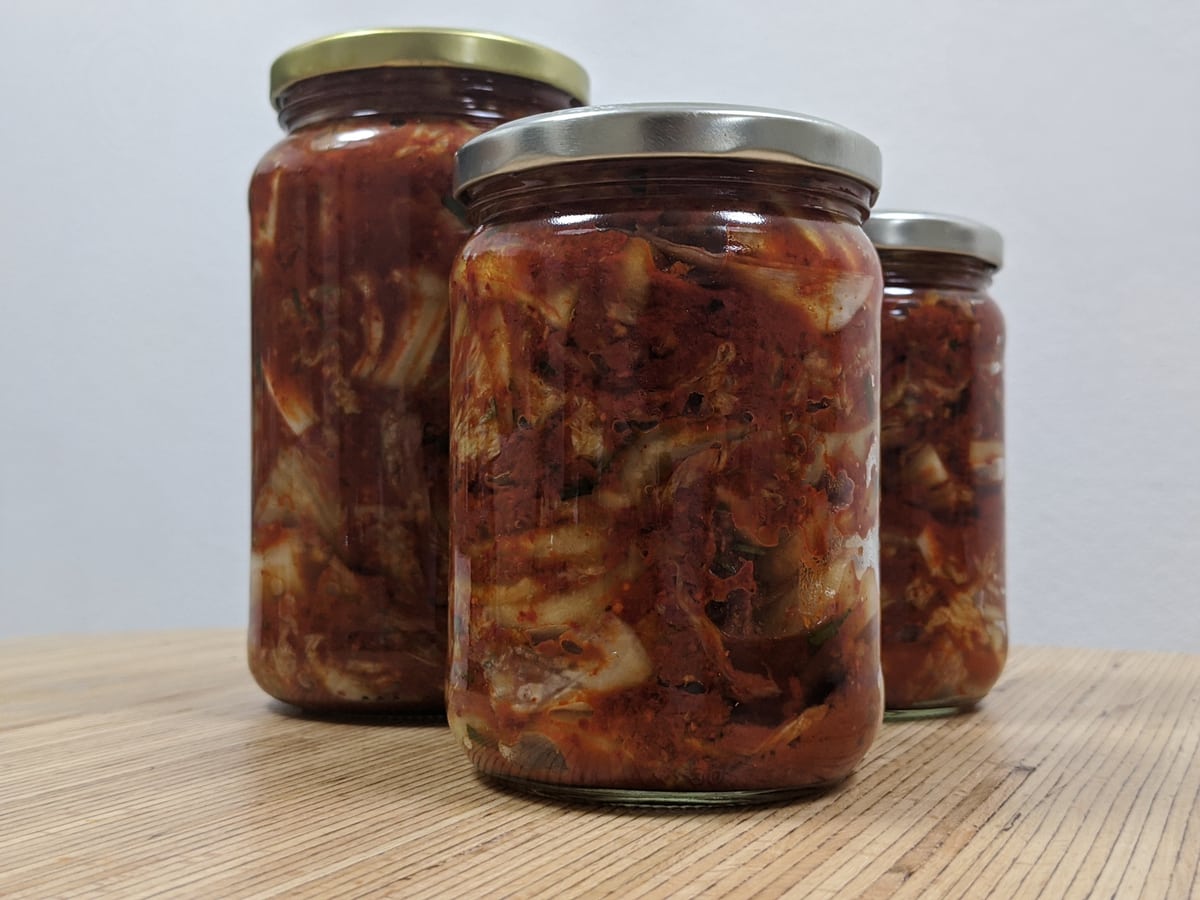
Yes, and glass never absorbs odour, which makes it the best material on that one axis. It is also heavy, breakable in a packed fridge, and does not tile into a kimchi-fridge drawer, which is why Korean kitchens use far less glass than Western fermenting guides assume.
Bottom Line
An English buying guide will hand you a ranked list of lids. That is the right answer to the wrong question.
In Korea the size is settled before you start shopping, because the appliance settles it, and the component that decides whether a batch survives three months is a flat plate you cannot see in the product photo. If you are buying outside Korea, drop the first constraint entirely and keep the second: a one-way vent and a press plate, in that order, ahead of material and capacity.
And if you buy plastic, buy it knowing it will end up red. Every Korean household has that tub, and nobody has ever got the colour out.
Sources: container dimensions from commonly sold Korean kimchi-fridge-compatible containers; press-plate function, 골마지 formation on exposed kimchi surfaces and odour-removal practice per Korean household and consumer guidance; one-way valve function and stainless-versus-plastic odour and staining comparison per Lock&Lock product information and Korean consumer press; retail prices from Korean retailer listings, September 2026. Fridge compartments and product ranges vary by manufacturer and model — measure before you buy.
You Might Also Like
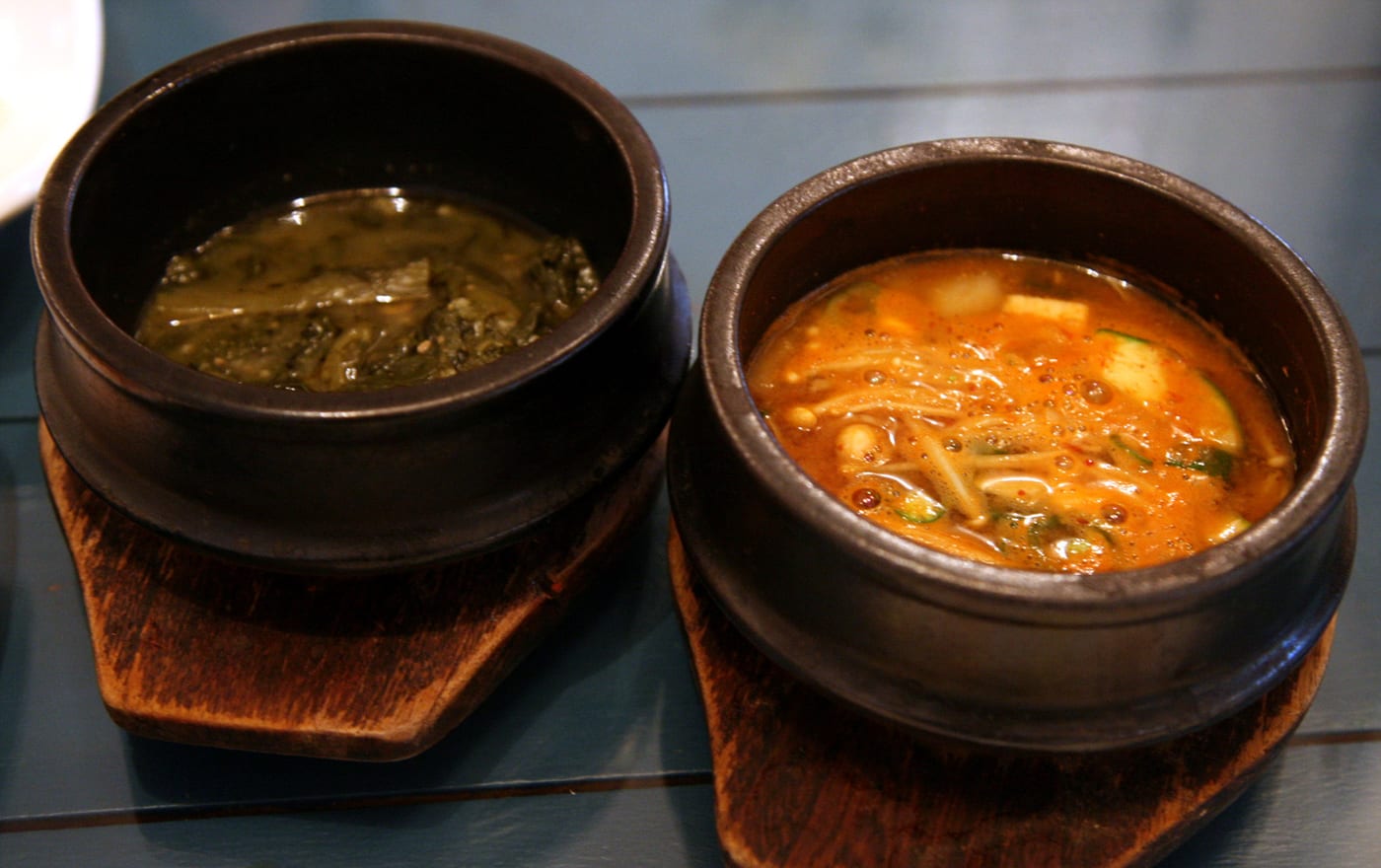
Korean Ttukbaegi vs Dolsot, and Why Koreans Never Use Dish Soap
A ttukbaegi is fired clay, and fired clay is porous — which decides everything about owning one. No dish detergent, never water it while hot, and it will not work on induction. Here is how it differs from a dolsot and which one you actually want.
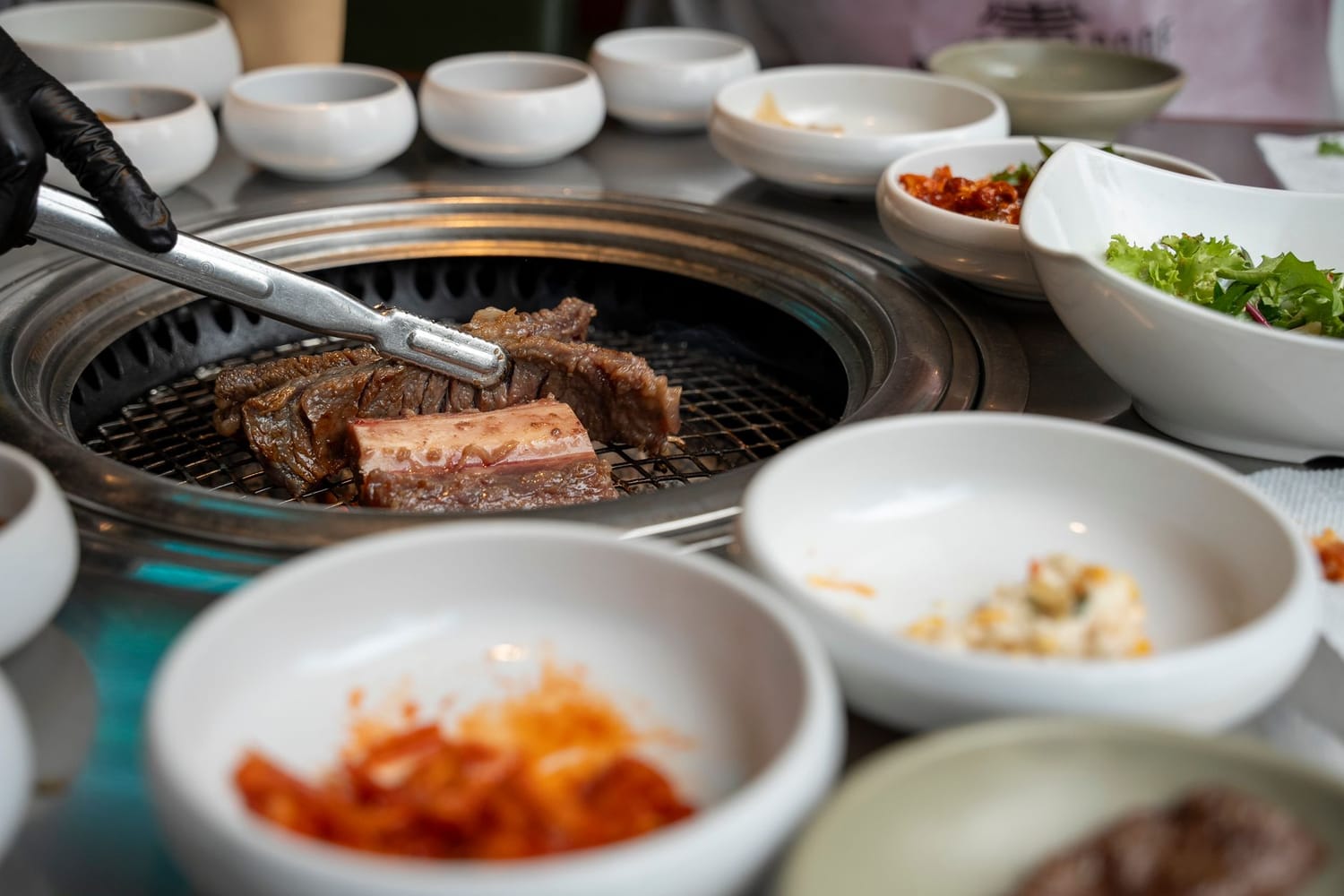
Korean Kitchen Scissors: Why Koreans Cut Meat and Noodles at the Table, and Why It Is Not an Office Scissor
Scissors on a restaurant table look wrong to most of the world and normal to every Korean. The tool is not a desk scissor: thick blades, one serrated edge, big rings, often detachable, built for galbi and cold noodles. Where it came from, and which one to buy.
Korean Sesame Oil: The Label Word That Means It Isn't Sesame Oil
A bottle can look like Korean sesame oil and legally be corn oil carrying a sesame smell — Korea files that as 향미유, a separate food type. Imported oil runs ₩700–1,100 per 100ml; Korean-grown runs ₩5,500–6,700, because Korea grows 8–12% of its own sesame.