Hwalmyungsu: Korea's Oldest Medicine Reaches America Without the Fizz
There is a small brown bottle that has been sold in Korea since 1897. It predates the Korean Empire's collapse, the colonial period, the division of the peninsula, and every company you associate with modern Korea. It is a digestive remedy called 활명수 (Hwalmyungsu), and Koreans drink it after eating too much.
This month it goes on sale in the United States — in supermarkets, pharmacies, Olive Young and on Amazon — under a new name, K.O.D, short for Korea Original Digestive.
And the bottle America is getting is not the bottle Koreans drink.
The Korean default is 까스활명수, where 까스 means gas: it is carbonated, and it has been the country's go-to since 1967. The export product is the non-carbonated 1897 liquid, with L-aspartic acid and vitamin C added. Korea kept the fizzy one and sent the old one abroad, which is a strange and interesting decision worth understanding before you buy either.
Quick Guide
| Question | Short answer |
|---|---|
| What is it? | 활명수 — a herbal digestive liquid, launched 1897 |
| Made by | Dongwha Pharm (동화약품), Korea's oldest pharmaceutical company |
| What Koreans actually buy | 까스활명수-큐, the carbonated version from 1967 |
| What the US is getting | K.O.D — the non-carbonated 1897 liquid, from September 2026 |
| Where to buy it in Korea | A pharmacy. It is 일반의약품, not a soft drink |
| The convenience-store bottle | A different product — 까스활, 미인활 and others are 의약외품 |
| Dose | One 75mL bottle, three times a day, after meals (age 15+) |
| One caution | Contains 현호색 (corydalis) — not for use in pregnancy |
Korea: A History — the 1897–1919 story the Hwalmyungsu bottle belongs toAffiliate link. As an Amazon Associate, EpicKor earns from qualifying purchases at no extra cost to you.
What is actually in the bottle
Hwalmyungsu is a herbal medicine, not a soda with a health claim attached. Dongwha Pharm's product information lists a set of traditional botanicals in each 75mL bottle, including:
- 현호색 (corydalis tuber) — 180.0mg, the largest single component
- 진피 (dried citrus peel) — 150.0mg
- 육계 (cinnamon bark) — 30.0mg
plus further herbs in the same family of digestive botanicals. The approved indications are specific and unglamorous: 식욕감퇴 (loss of appetite), 위부팽만감 (stomach bloating), 소화불량 (indigestion), 과식 (overeating), 체함 (that particular Korean sense of food being stuck), 구역 and 구토 (nausea and vomiting).
The dose is one 75mL bottle, three times daily after meals, for ages 15 and up, with reduced amounts for children. There is a dedicated children's version, 꼬마활명수액, sold in small stick pouches.
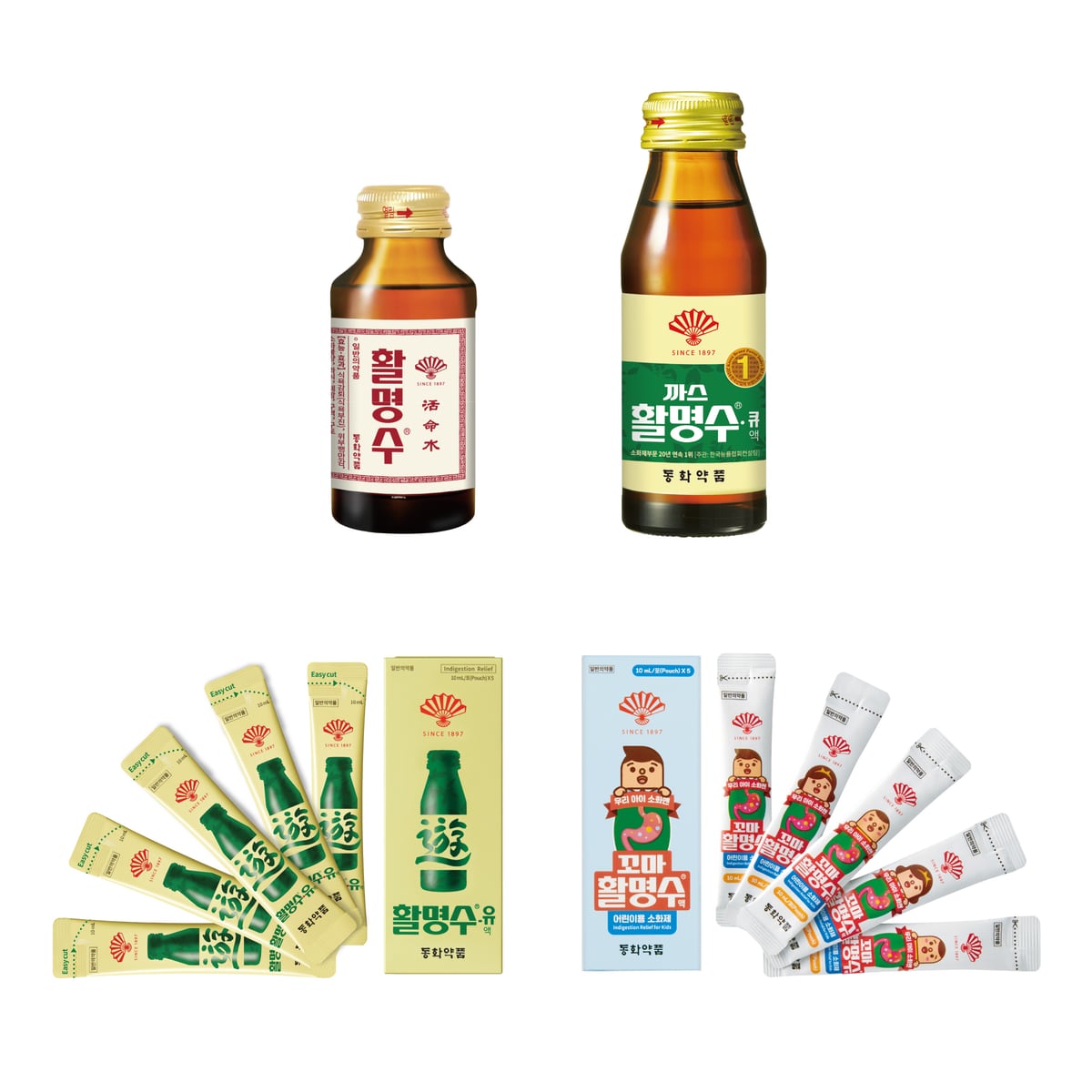
One caution matters more than the rest. Corydalis is not recommended during pregnancy, and Korean pharmacists routinely flag this. It is the reason the pharmacy version is a medicine rather than a beverage, and the reason the next section matters.
The bottle in the convenience store is not the same bottle
This is where visitors get caught, and it is the same trap Korea sets in several aisles at once.
까스활명수-큐 is 일반의약품 — an over-the-counter medicine, which in Korea means pharmacy-only. A convenience store cannot legally sell it.
What convenience stores do sell are look-alikes with names built from the same syllables — 까스활, 미인활 and others — which are classified as 의약외품, quasi-drugs. They are lawful, they are not fakes, and they are not the same thing: the active content is lower, and the product is a different registration entirely.
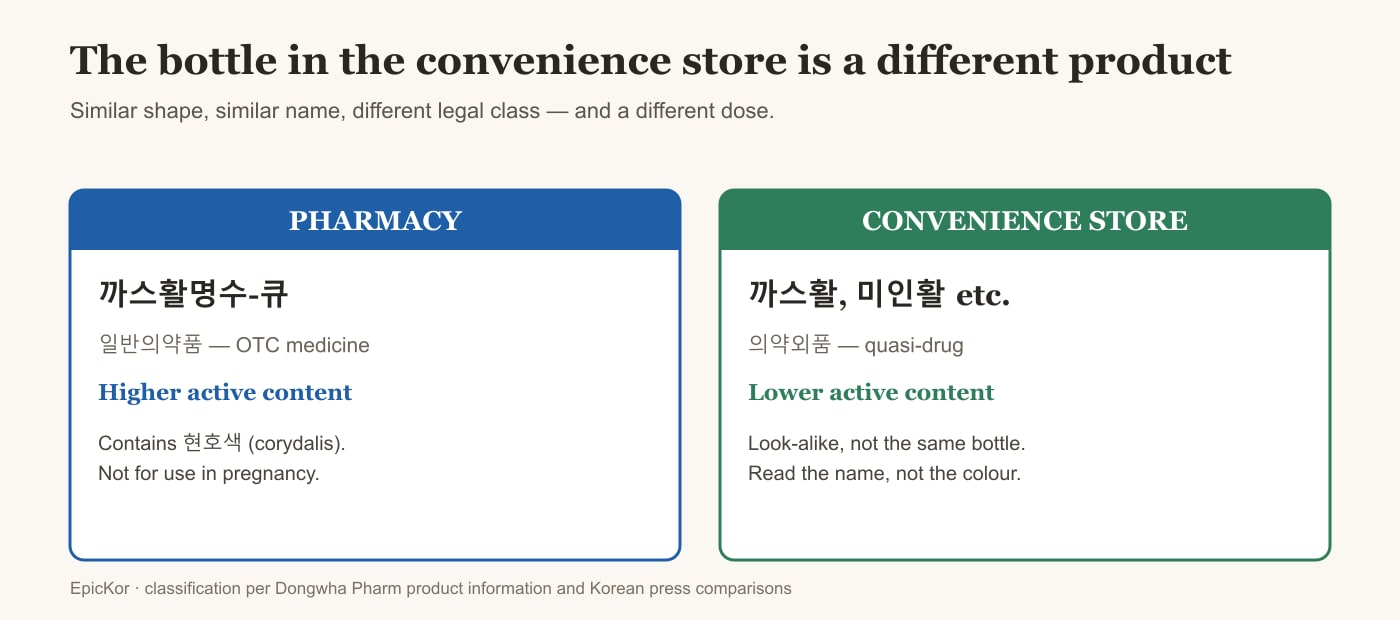
If you have read our guides to Korean pain patches and Fucidin vs Madecassol, the shape will be familiar: Korea's legal classification decides which shelf a product may sit on, and the convenience-store version is almost always the milder one. The bottle that works is the one behind the pharmacy counter.
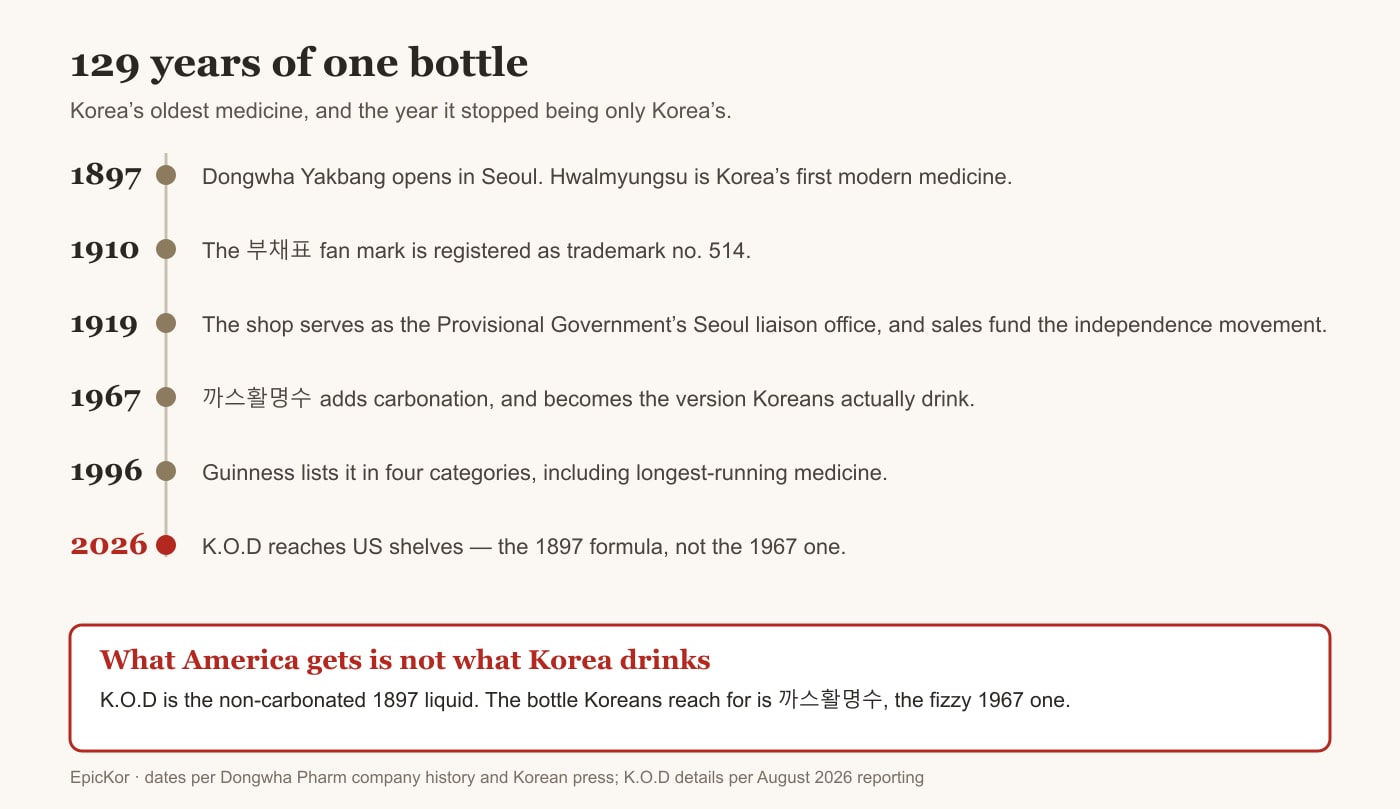
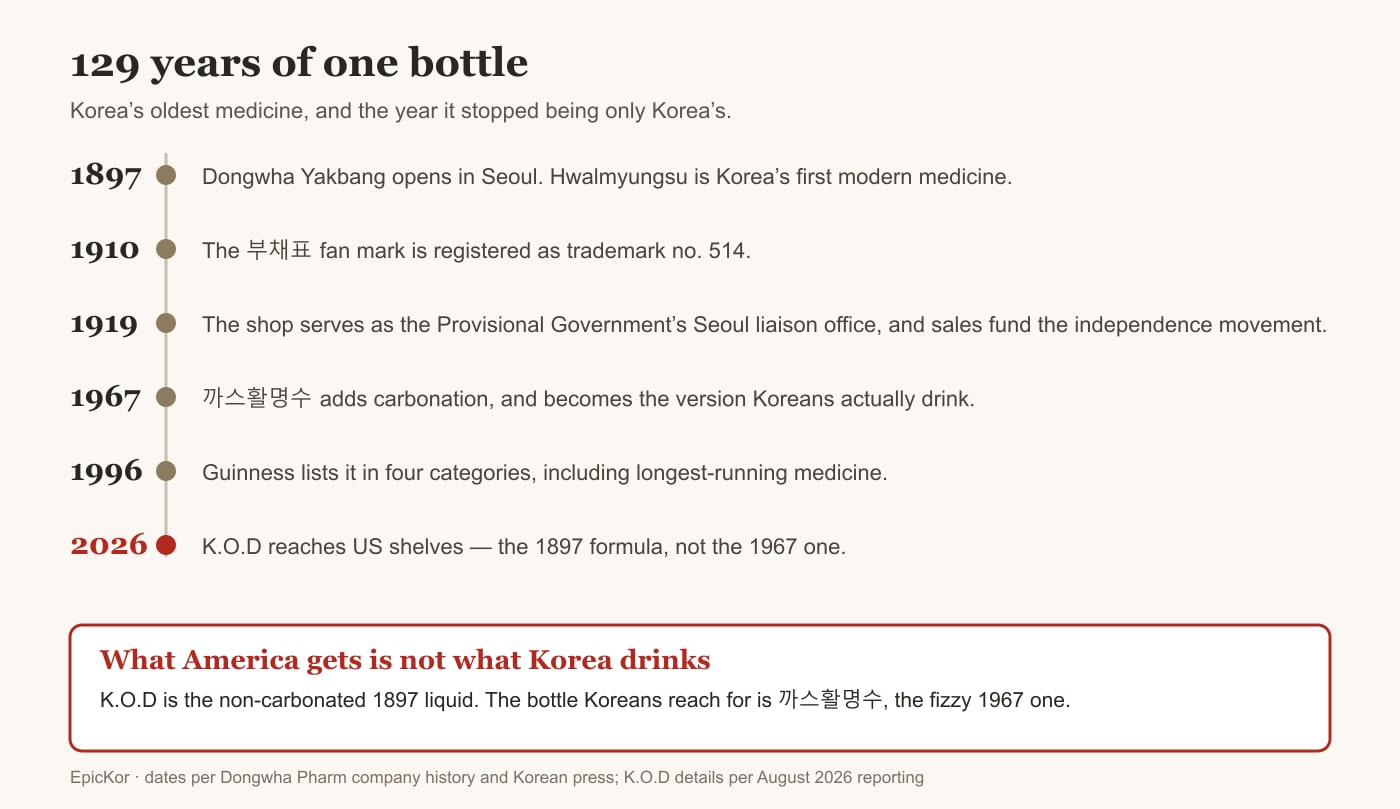
1897, and why this bottle is in Korean history books
Hwalmyungsu is not old in the marketing sense. It is old in the archival sense.
In 1897, a former royal court official named Min Byeong-ho and his son Min Gang opened 동화약방 (Dongwha Yakbang) in Seosomun, Hanseong — the city now called Seoul. The product they launched, Hwalmyungsu, is recorded as Korea's first modern medicine. The name means, roughly, the water that saves life.
In August 1910, the company registered its 부채표 — the fan mark still printed on every box — as trademark number 514. The Hwalmyungsu name itself was registered that December.
Then the history gets less commercial. Min Gang (1883–1931) was an independence activist, and the money the bottle earned went into the independence movement. After the Provisional Government formed in Shanghai, 동화약방 served as its 서울 연통부 — the domestic liaison post in Seoul, used for passing information and funds. In 1919 the company opened a branch on Jongno near Tapgol Park, which was used as a distribution point for the Declaration of Independence, with takings paying for the printing.
There is one detail that reads like fiction and is well attested in Korean accounts: when Japanese surveillance made it too dangerous to send money to Shanghai, Min Gang shipped the medicine itself, so that funds could be raised by selling it on the ground in China.
In 1996, Guinness recognised the company and product in four categories, including Korea's oldest manufacturer, oldest pharmaceutical firm, oldest registered trademark, and longest-running medicine.
None of that makes the drink work better. It does explain why a Korean pharmacy has stocked the same brown bottle for over a century, and why "129 years old" appears on the American packaging.
1967: the year carbonation won
For seventy years Hwalmyungsu was a still liquid. Then in 1967 Dongwha launched 까스활명수, and the carbonated version became the one Koreans mean when they say the name.
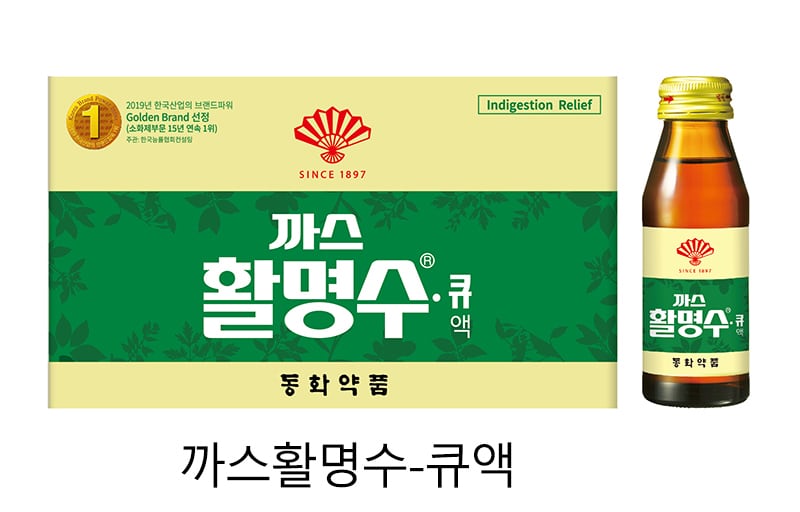
The carbonation is not decoration. A burst of gas produces the belch that Korean digestive culture treats as the signal that the blockage — 체함 — has broken, and the sensation of relief arrives before any herb could plausibly act. Whether that is pharmacology or theatre is a fair question, and it is also beside the point: it is what made the product a habit.
That is what makes the export decision interesting.
K.O.D: what is actually launching, and where
Dongwha released Hwalmyungsu 1897 Liquid domestically in August 2026, through pharmacies and duty-free shops, and is taking it to the United States in September 2026 under the name K.O.D — Korea Original Digestive.
| Details | |
|---|---|
| Product | Hwalmyungsu 1897 Liquid, sold as K.O.D |
| Format | Non-carbonated, with added L-aspartic acid and vitamin C |
| Korea launch | August 2026 — pharmacies and duty-free |
| US launch | September 2026 |
| US channels | Supermarkets, pharmacies, Olive Young, Amazon |
| Campaign | K-pop group CORTIS as the model |
A company representative framed the significance precisely: Korean-made Hwalmyungsu has been sold in Korean grocery stores abroad for years, but this is the first product designed for an overseas market. That is the difference between a diaspora item and a launch.
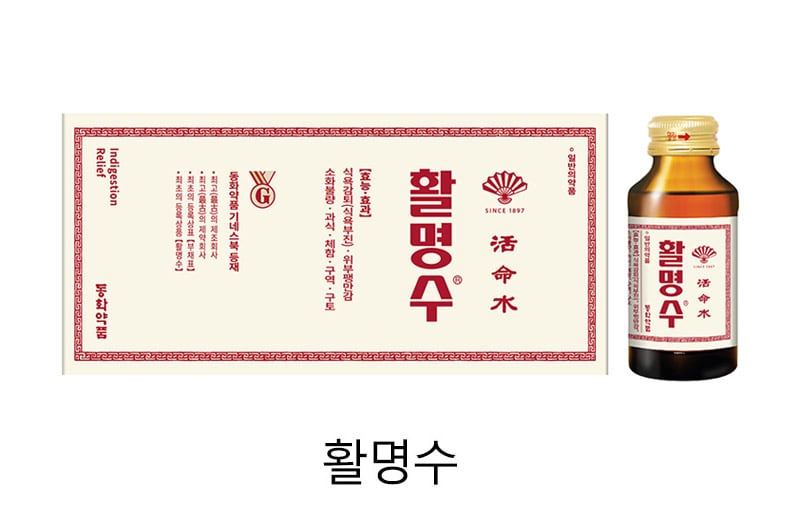
Why send the still one? The company has not published its reasoning, so what follows is inference rather than fact, and worth reading as such. Two things are plainly true: a carbonated liquid is heavier, more fragile and more awkward to ship and shelf-stack than a still one, and the belch-as-relief convention that makes 까스활명수 satisfying in Korea does not exist as a shared expectation in an American supermarket. A still bottle with vitamin C added reads to a US shopper as a wellness shot, which is a category that already exists there. The fizz is the part that needs cultural translation, so it is the part that got left behind.
If you want to try it before it reaches your shelf: As an Amazon Associate, EpicKor earns from qualifying purchases at no extra cost to you. Korean grocery importers already list Korean digestive drinks including Hwalmyungsu, and the thing to check on the listing is whether it says carbonated — the imported bottles and the new K.O.D are not the same format. If you are building a Korea trip kit rather than a medicine cabinet, compare it with Korean barley tea, which is what Korean households actually drink alongside heavy meals day to day.
Drinking it in Korea
It is cheap, and the spread between pharmacies is real. A single 75mL bottle of 까스활명수-큐 runs roughly ₩600 to ₩1,600 depending on the shop, and a ten-bottle box lands around ₩11,000, on Korean pharmacy price-comparison listings checked for 2026. Korean pharmacies set their own prices, so the range is genuine rather than a discount — but at this level the difference is small enough that convenience should win.
Practical notes for a trip:
- Buy it at a pharmacy (약국), not a convenience store, if you want the real thing. Say "까스활명수" and you will be handed the green box.
- It is taken after a meal, not during. The Korean use case is very specific: you overate, or something feels stuck, and you want it moving.
- 75mL is one dose. It is a small bottle by design and it is not a beverage to sip.
- It is bitter and sweet at once, with a strong herbal finish. The carbonated version hides much of that; the still one does not.
- Skip it if you are pregnant, because of the corydalis, and ask the pharmacist if you are unsure about anything else you take.
For the wider context of what Korean pharmacies stock and how to navigate one, our Korea healthcare guide for tourists covers the system, and the Korea tourist shopping route puts the pharmacy on a normal shopping day between Olive Young and Daiso. If you would rather understand the convenience-store shelf itself, start with the Korean convenience store food guide.
One boundary, stated plainly: this describes what a Korean product label says and where Korean law lets it be sold. It is not medical advice. Persistent digestive symptoms need a doctor, not a bottle that has been on sale since 1897.
FAQ About Hwalmyungsu
Q: What is Hwalmyungsu?
A Korean herbal digestive liquid launched in 1897 by Dongwha Pharm, recorded as Korea's first modern medicine. It is taken after overeating or indigestion, in 75mL bottles, and the name translates roughly as "the water that saves life".
Q: What is the difference between 활명수 and 까스활명수?
까스 means gas: 까스활명수, launched in 1967, is the carbonated version, and it is what most Koreans mean by the name today. The original 활명수 is still (non-carbonated). The new US product, K.O.D, is based on the non-carbonated original.
Q: Can I buy Hwalmyungsu in a convenience store?
Not the real one. 까스활명수-큐 is 일반의약품, an over-the-counter medicine that Korean law restricts to pharmacies. Convenience stores stock similarly named quasi-drug (의약외품) alternatives such as 까스활 and 미인활, which have lower active content and are a different product.
Q: When is Hwalmyungsu available in the US?
September 2026, as K.O.D (Korea Original Digestive), in supermarkets, pharmacies, Olive Young and on Amazon. It launched in Korea in August 2026 through pharmacies and duty-free shops.
Q: Is Hwalmyungsu safe in pregnancy?
It contains 현호색 (corydalis), which is not recommended during pregnancy, and Korean pharmacists flag this routinely. Ask a pharmacist or doctor rather than assuming a 129-year-old product is automatically gentle.
Q: Why is Hwalmyungsu in Korean history books?
Its founders funded the independence movement with it. 동화약방 served as the Provisional Government's Seoul liaison office (서울 연통부), its 1919 Jongno branch was used to distribute the Declaration of Independence, and when sending money to Shanghai became too dangerous, the founder's son shipped the medicine itself so it could be sold there to raise funds.
Q: How much does Hwalmyungsu cost in Korea?
Roughly ₩600–₩1,600 for a single 75mL bottle of 까스활명수-큐, and about ₩11,000 for a ten-bottle box, on Korean pharmacy price comparisons for 2026. Korean pharmacies price independently, so the spread between shops is real.
Q: What does it taste like?
Sweet and bitter together, with a strong herbal finish and, in the carbonated version, a sharp fizz. It is medicine that tastes like medicine. The still version tastes more so, which is worth knowing before the American bottle surprises anyone.
Bottom Line
Most 129-year-old products survive as heritage. This one survived as a habit — a specific bottle for a specific feeling, kept behind a pharmacy counter, with a fan on the box and a story about the independence movement attached to it.
What is happening this month is that the story is being sold abroad for the first time as a product rather than as an import. If you are in Korea, buy the green box at a pharmacy and get the fizz. If you are in America in September, what will be on the shelf is the older, quieter version — the 1897 one, which Koreans mostly stopped choosing in 1967.
Sources: composition, classification, indications and dosage from Dongwha Pharm's official product information for 활명수 / 까스활명수-큐액 / 꼬마활명수액; company history including the 1897 founding, the 1910 registration of the 부채표 mark as trademark no. 514, the 1919 Jongno branch and Seoul liaison-office role, the 1967 launch of 까스활명수 and the 1996 Guinness listings, per Dongwha Pharm's published company history and Korean press; K.O.D product name, format, launch months, retail channels and campaign details per Korean press reporting of 20 August 2026; pharmacy-versus-convenience-store product distinction per Korean consumer press comparisons. Product availability and formulations change — check the label, and this article is not medical advice.
You Might Also Like
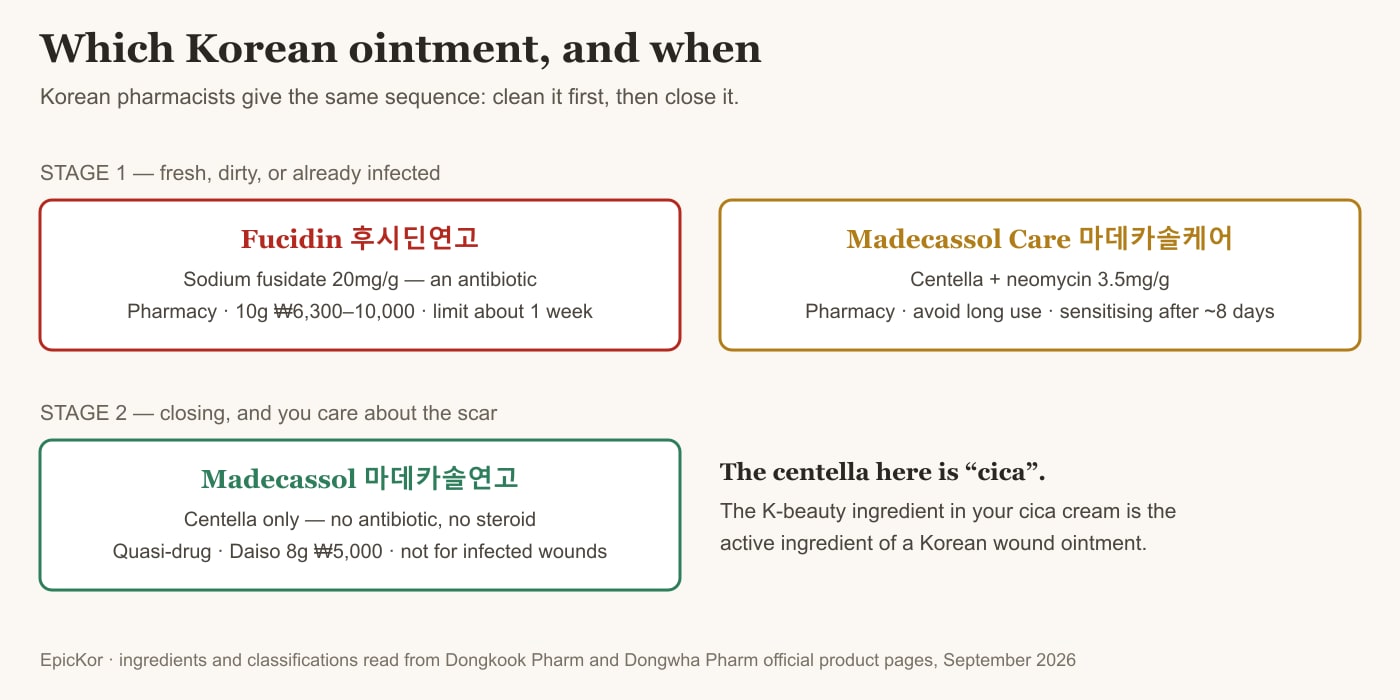
Fucidin vs Madecassol: Which Korean Ointment for Which Wound
Korea's two famous wound ointments are a sequence, not rivals: Fucidin (fusidic acid) while the wound is dirty, Madecassol (centella) once it closes. And Madecassol is two tubes — one contains an antibiotic, and their labels say opposite things.
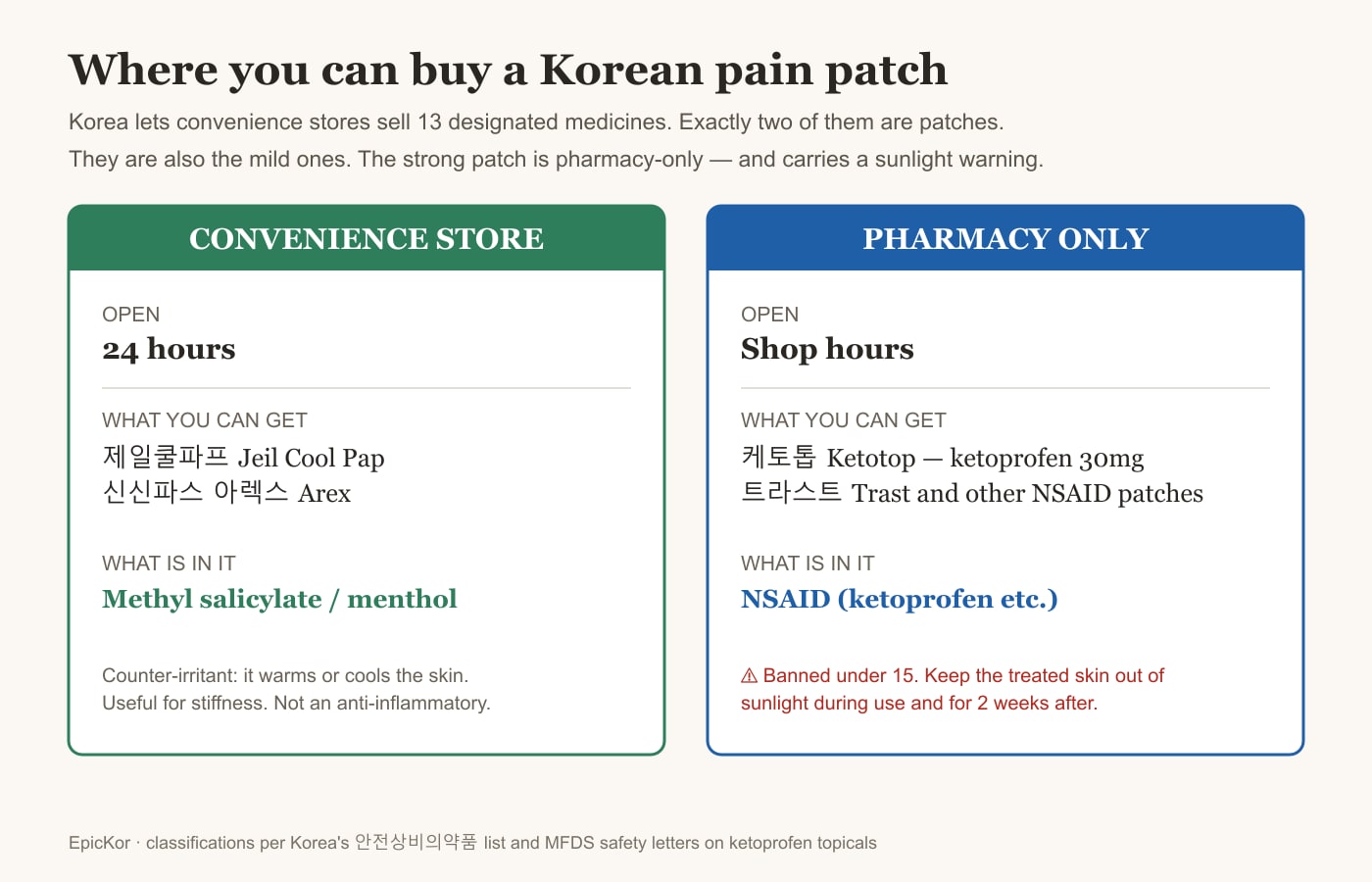
Korean Pain Patches: Only Two Are Sold Outside a Pharmacy
Korea lets convenience stores sell 13 designated medicines and exactly two are pain patches, both mild. The one everyone recommends — Ketotop, 30mg ketoprofen — is pharmacy-only and warns you to keep the treated skin out of sunlight for two weeks.
Korean Yuja Tea: The Jar Says 80%, the Fruit Is 40%
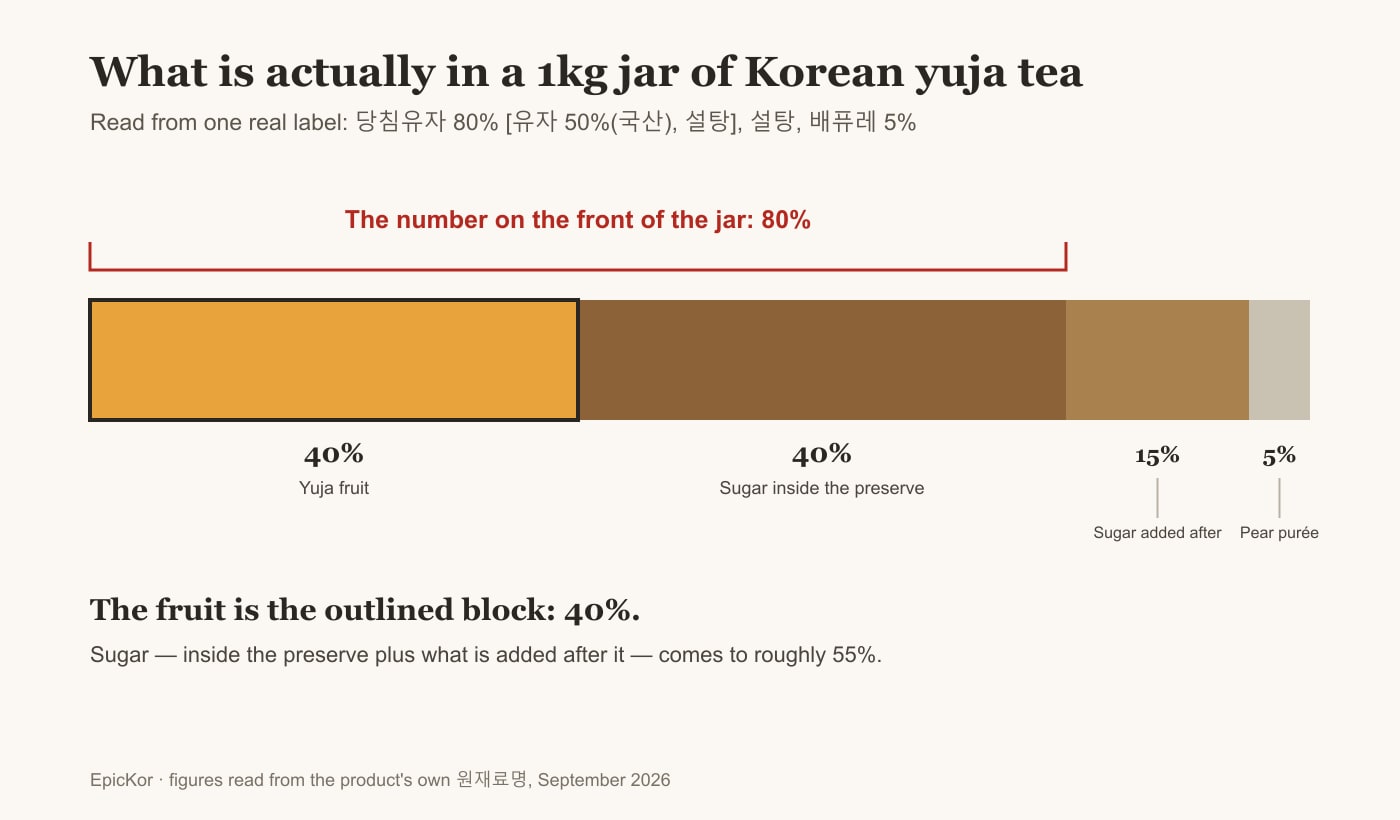
Korean yuja tea jars print a big percentage on the front, but it measures sugar-preserved yuja, not fruit. One real label reads 당침유자 80% [유자 50%] — the fruit is 40% and sugar is roughly 55%. Here is the two-second multiplication to do before you buy.