Fucidin vs Madecassol: Which Korean Ointment for Which Wound
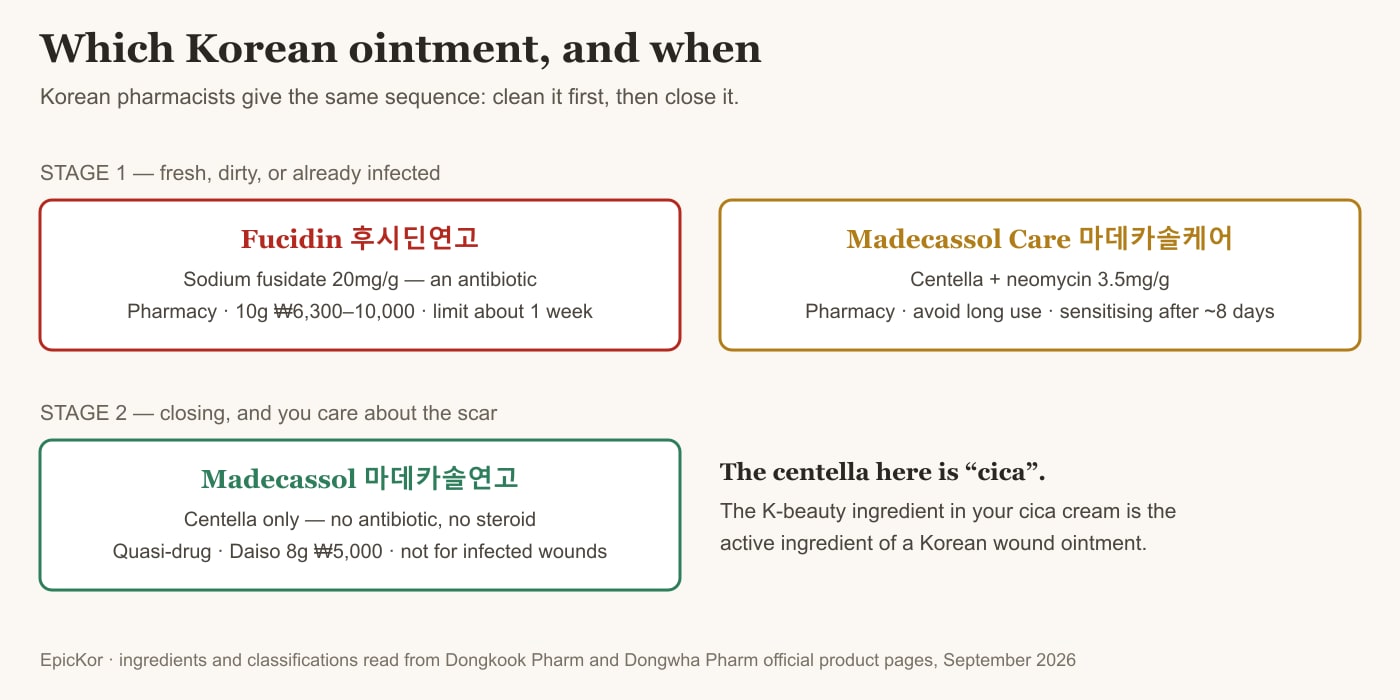
Ask a Korean which ointment to put on a scrape and you will get one of two brand names: 후시딘 (Fucidin) or 마데카솔 (Madecassol). Ask which is better and you will usually get a pause, because it is the wrong question — Koreans use them in sequence, not instead of each other.
That much is findable. What is not findable in English is the part that actually matters at the counter:
"Madecassol" is not one product. There is a green box that contains centella and nothing else, sold in Daiso for ₩5,000. There is a yellow-green box, same brand name across the front, that contains centella plus an antibiotic and is pharmacy-only. Their labels say opposite things: the green one tells you not to use it on an infected wound; the yellow one is specifically for infected wounds.
If you cannot read Korean, the front of the box will not tell you which one you are holding.
Quick Guide
| Question | Short answer |
|---|---|
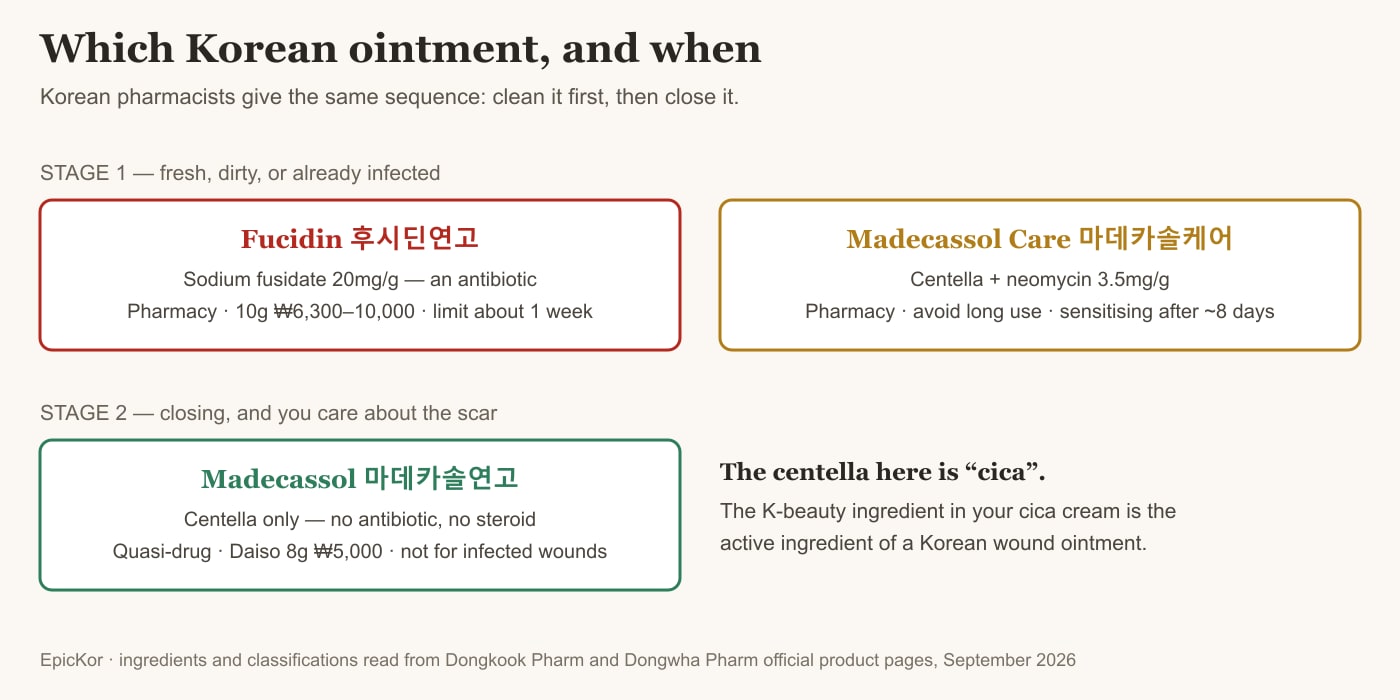
| Fresh, dirty scrape | 후시딘 Fucidin — sodium fusidate 20mg/g, an antibiotic |
| Wound closing, worried about scarring | 마데카솔연고 Madecassol — centella only |
| Already infected and you want both | 마데카솔케어 Madecassol Care — centella + neomycin |
| Where to buy the plain one | Daiso, marts, convenience stores — it is a quasi-drug (의약외품) |
| Where to buy the other two | Pharmacy only — both are 일반의약품 |
| Price (Sept 2026) | Madecassol 8g ₩5,000 at Daiso; Fucidin 10g ₩6,300–10,000 |
| How long can I use it? | Antibiotic ones: Fucidin's own label says about one week |
| The K-beauty link | Madecassol's centella is cica — the same ingredient |
Centellian 24 Madeca Cream — the centella skincare from Madecassol's maker, DongkookAffiliate link. As an Amazon Associate, EpicKor earns from qualifying purchases at no extra cost to you.
Fucidin: the antibiotic half, with a time limit printed on it
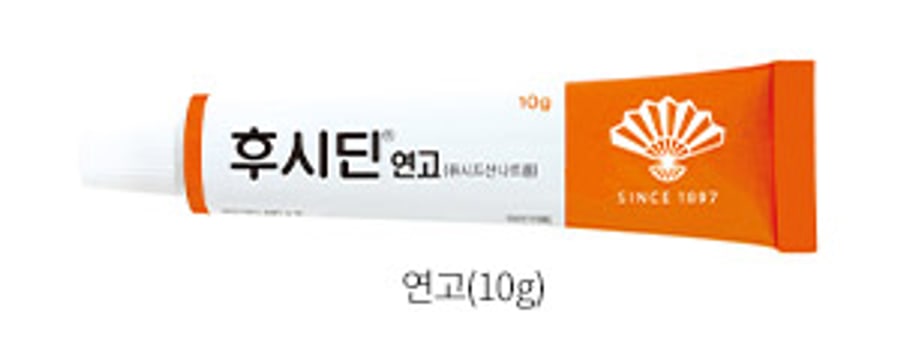
후시딘연고 is made by Dongwha Pharm, whose tubes carry "SINCE 1897" because the company is Korea's oldest pharmaceutical firm. The active ingredient is sodium fusidate at 20mg per gram — 2% fusidic acid, a genuine topical antibiotic. It is 일반의약품: no prescription, but pharmacy-only.
The approved indications are specific and bacterial: impetigo, infectious eczematous dermatitis, acne vulgaris, folliculitis, boils, and — the one that covers a traveller's scraped knee — secondary infection of burns, trauma, sutured wounds and grafts, caused by staphylococci, streptococci, corynebacteria or clostridia.
Two limits are printed in the official directions, and both are easy to ignore.
Do not spread it thickly, and limit treatment to about one week. That is not a cautious blogger's addition; it is in the 용법·용량 section of the product information. Fusidic acid is absorbed well through skin, so the label also warns against applying it over large areas or for extended periods.
The reason is resistance. Korean regulatory documentation on this ingredient is unusually direct about it: confirm susceptibility, use the shortest period clinically necessary, and stop if a non-susceptible organism overgrows. Fucidin is in a lot of Korean bathroom cabinets and gets used on things that are not bacterial infections at all — athlete's foot, eczema, acne someone decided to squeeze — and that is exactly the pattern that breeds resistance.
Practical version: use it while the wound is dirty or looks infected. Then stop. It is not a general-purpose healing cream.
Madecassol: two tubes, one name, opposite instructions
Here is the part that sends people home with the wrong tube.
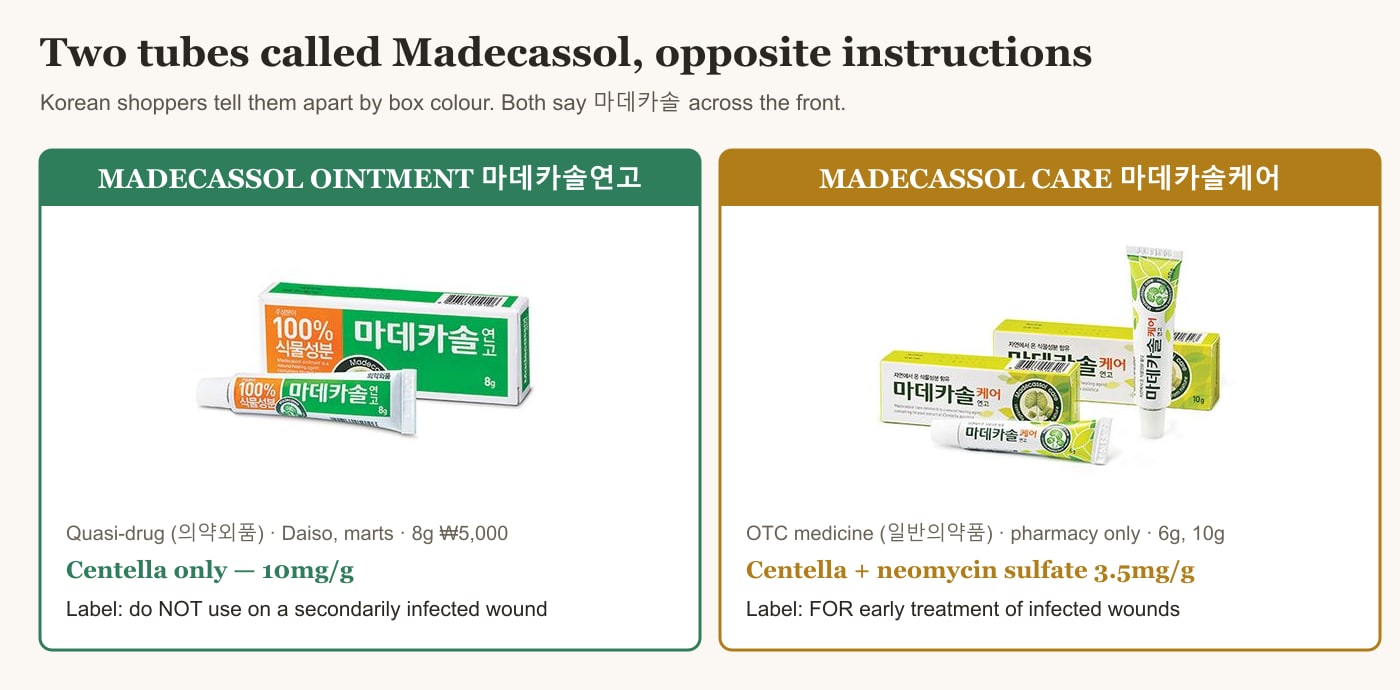
마데카솔연고 — the green box. Centella quantified extract, 10mg per gram (4mg as asiaticoside), and nothing else. Its legal class is 의약외품, a quasi-drug rather than a medicine, which is why it can sit on a Daiso shelf next to plasters instead of behind a pharmacy counter. The indication is modest and honestly worded: "보조적 부분 치료" — supplementary local treatment of wounds and skin ulcers. And its label says plainly not to use it on a secondarily infected wound.
마데카솔케어 — the yellow-green box. Same centella at 10mg/g, plus neomycin sulfate at 3.5mg per gram. That is an aminoglycoside antibiotic, and it moves the product into 일반의약품, pharmacy-only. Its indication inverts the first one: early treatment of skin conditions secondarily infected by neomycin-susceptible bacteria — small lacerations, grazes, sutured wounds, superficial second-degree burns.
The Care version carries warnings the plain one does not:
- Avoid prolonged continuous use, because of kidney and hearing risks associated with the aminoglycoside class.
- Sensitisation risk rises after about eight days of use — neomycin is one of the more common contact allergens in topical products.
- Not for wounds on or near the eye, and not on the breast while breastfeeding.
There is also a 복합마데카솔 in the family which adds a corticosteroid to the antibiotic. If you are reaching for a tube in Korea without reading Korean, the safe default is the green box: the one that is only centella.
The cica in your skincare and the ointment in the drawer are the same thing
If you have bought Korean skincare in the last few years you have met cica — cica creams, cica balms, cica pads, marketed for redness and a compromised skin barrier.
Cica is centella asiatica. The same plant extract, standardised to the same active compounds, that Dongkook Pharm has been putting in a wound ointment for decades. The K-beauty category did not invent the ingredient; it borrowed a pharmacy product's active and moved it into a cosmetic format.
This is worth knowing in both directions. It explains why cica products are pitched at damaged skin rather than at glow — the heritage is wound repair, not brightening. And it means that if what you actually want is centella at a therapeutic concentration on a specific scrape, the ₩5,000 tube in Daiso is a more direct route than a ₩30,000 jar of cream. Our K-beauty ingredients guide covers where cica sits among snail mucin, propolis and the rest.
If you are stocking a travel kit rather than standing in a Korean pharmacy: As an Amazon Associate, EpicKor earns from qualifying purchases at no extra cost to you. Fusidic acid is prescription-only in a lot of countries, so the part of this you can reasonably buy abroad is the centella half — Korean centella creams and balms are worth comparing on centella percentage rather than on the word "cica" in the name. Pair it with a compact first-aid kit so the ointment has somewhere to live and something to clean the wound with first — the cleaning matters more than the tube.
What it costs and where it actually sits, September 2026
| Product | Class | Sold at | Price |
|---|---|---|---|
| 마데카솔연고 8g | 의약외품 (quasi-drug) | Daiso, marts, pharmacies | ₩5,000 at Daiso |
| 마데카솔케어 6g / 10g | 일반의약품 | Pharmacy only | Varies by pharmacy |
| 후시딘연고 10g | 일반의약품 | Pharmacy only | ₩6,300–10,000 |
The Daiso detail is the useful one. Korea's ₩1,000-and-up chain carries the plain Madecassol in its 상비약품 section, because a quasi-drug is not restricted to pharmacies. That means the centella tube is available at Daiso hours in tourist districts, when pharmacies are shut — the same gap our guide to Korean pain patches describes, solved the same way by the same legal distinction.
Korean pharmacy prices are not fixed. The Fucidin range above is real spread between shops, not a discount — the same 10g tube runs from about ₩6,300 to ₩10,000 depending on the neighbourhood.
Buying it without Korean
Find the green cross and the sign 약국 (yakguk), then:
- Say the brand name. "후시딘" and "마데카솔" both work as spoken words and are instantly understood. Brand names travel far better than ingredients here.
- Show the wound if you can. The pharmacist's first question is whether it is dirty or already closing, because that is exactly the fork this article describes.
- If you want the plain centella one, say "마데카솔연고" and add "케어 아니에요" ("not Care") if you want to be sure — or just buy the green box in Daiso.
- Say if you have a neomycin or antibiotic allergy before accepting Madecassol Care. This is the single question worth preparing.
For pharmacies, hospitals and what to do if the scrape turns into something worse, our Korea healthcare guide for tourists covers the system; the Korea tourist shopping route has where Daiso and Olive Young sit on a typical day.
A boundary, stated plainly: this describes what Korean product labels say and which shops may sell what. It is not medical advice. Deep wounds, animal bites, anything with spreading redness or fever, or a wound that is not improving needs a doctor rather than a shelf.
FAQ About Korean Wound Ointments
Q: Fucidin or Madecassol — which is better?
Neither, because they do different jobs and Koreans use them in order. Fucidin is an antibiotic for a wound that is dirty or infected. Madecassol is centella for a wound that is closing, aimed at the scar. The usual sequence is Fucidin first, then switch.
Q: What is the difference between Madecassol and Madecassol Care?
마데카솔연고 contains only centella extract (10mg/g) and is a quasi-drug you can buy outside a pharmacy. 마데카솔케어 contains the same centella plus neomycin sulfate 3.5mg/g, an antibiotic, which makes it a pharmacy-only medicine. Their labels are opposite: the plain one is not for infected wounds, the Care one is specifically for them.
Q: Can I buy Korean wound ointment outside a pharmacy?
Yes — the plain 마데카솔연고 is classed as 의약외품 (quasi-drug), so Daiso, marts and some convenience stores carry it. 8g costs ₩5,000 at Daiso. Fucidin and Madecassol Care are 일반의약품 and pharmacy-only.
Q: Is Madecassol the same as cica?
Effectively yes. Madecassol's active is centella asiatica extract, which is what the K-beauty industry sells as "cica". The ointment came first; the cosmetic category borrowed the ingredient.
Q: How long can I use Fucidin?
Its own directions say to apply a thin layer and limit treatment to about one week. It is a topical antibiotic, and the product information is explicit about using the shortest necessary course to avoid resistance.
Q: How much does Fucidin cost in Korea?
About ₩6,300 to ₩10,000 for a 10g tube as of September 2026, depending on the pharmacy. Prices are set per shop, so the spread is real.
Q: Is Fucidin available over the counter?
In Korea, yes — it is 일반의약품, which needs no prescription but must be bought in a pharmacy. In many other countries fusidic acid is prescription-only, which is why visitors often stock up here.
Bottom Line
The Korean answer to a scraped knee is a two-step, and the steps are sold in different places.
Dirty wound: 후시딘, from a pharmacy, thin layer, about a week and no longer. Closing wound and you care about the mark it leaves: 마데카솔, and specifically the green box with centella and nothing else, which Daiso will sell you for ₩5,000 at ten at night.
The one thing worth memorising is that the brand name on the front is not the ingredient list. Two tubes say 마데카솔. Only one of them has an antibiotic in it, and it is not the one you probably meant to buy.
Sources: 마데카솔연고 and 마데카솔케어 composition, classification, indications and warnings from Dongkook Pharm's official product pages; 후시딘연고 composition, classification, indications and the one-week duration guidance from Korean pharmaceutical product information and Dongwha Pharm; Daiso retail listing for 마데카솔 8g at ₩5,000; Fucidin 10g pharmacy price range from Korean pharmacy price-comparison services, 2026. Formulations, classifications and prices change — read the box, ask the pharmacist, and treat this as a shopping guide rather than medical advice.
You Might Also Like
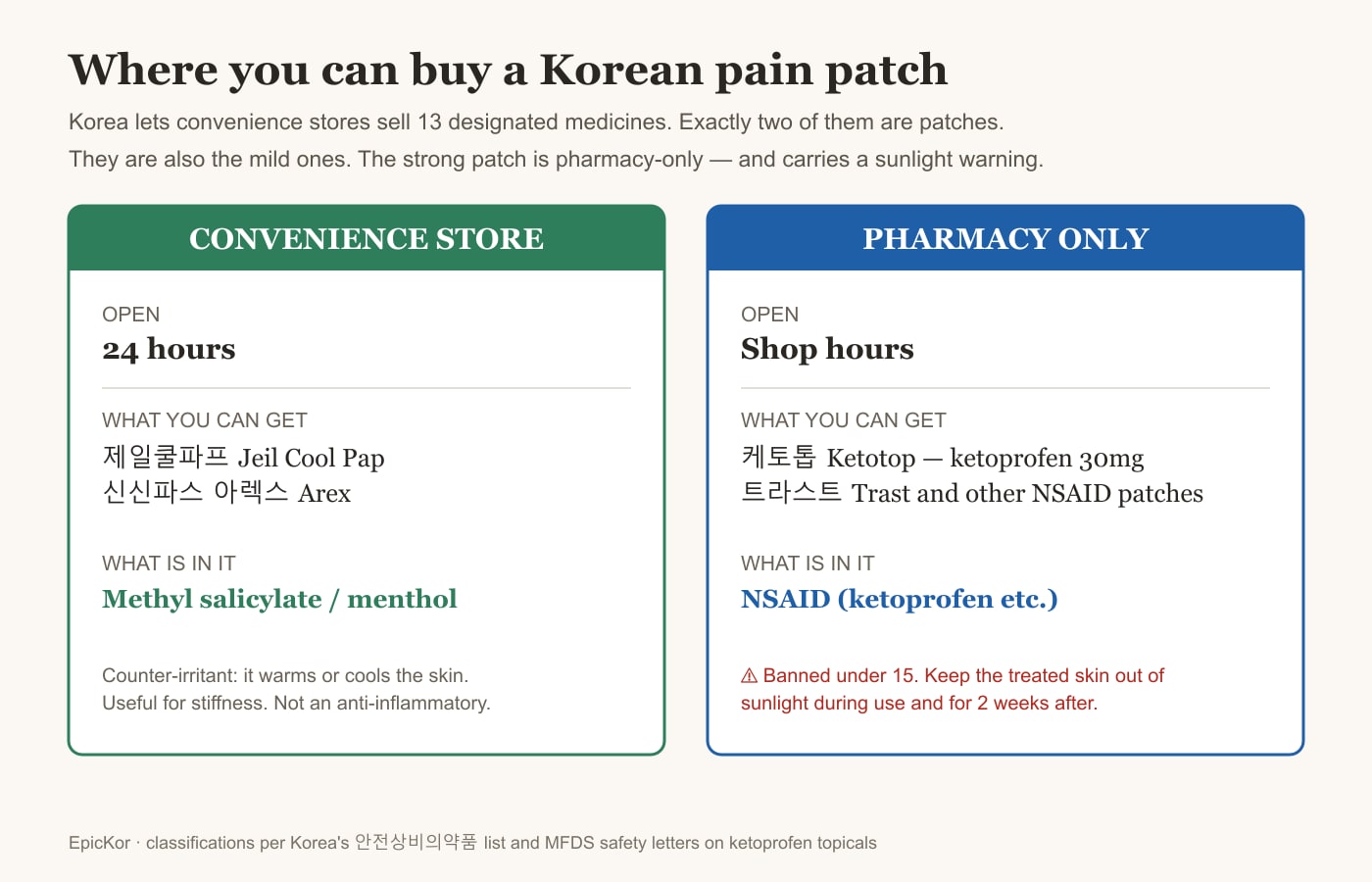
Korean Pain Patches: Only Two Are Sold Outside a Pharmacy
Korea lets convenience stores sell 13 designated medicines and exactly two are pain patches, both mild. The one everyone recommends — Ketotop, 30mg ketoprofen — is pharmacy-only and warns you to keep the treated skin out of sunlight for two weeks.
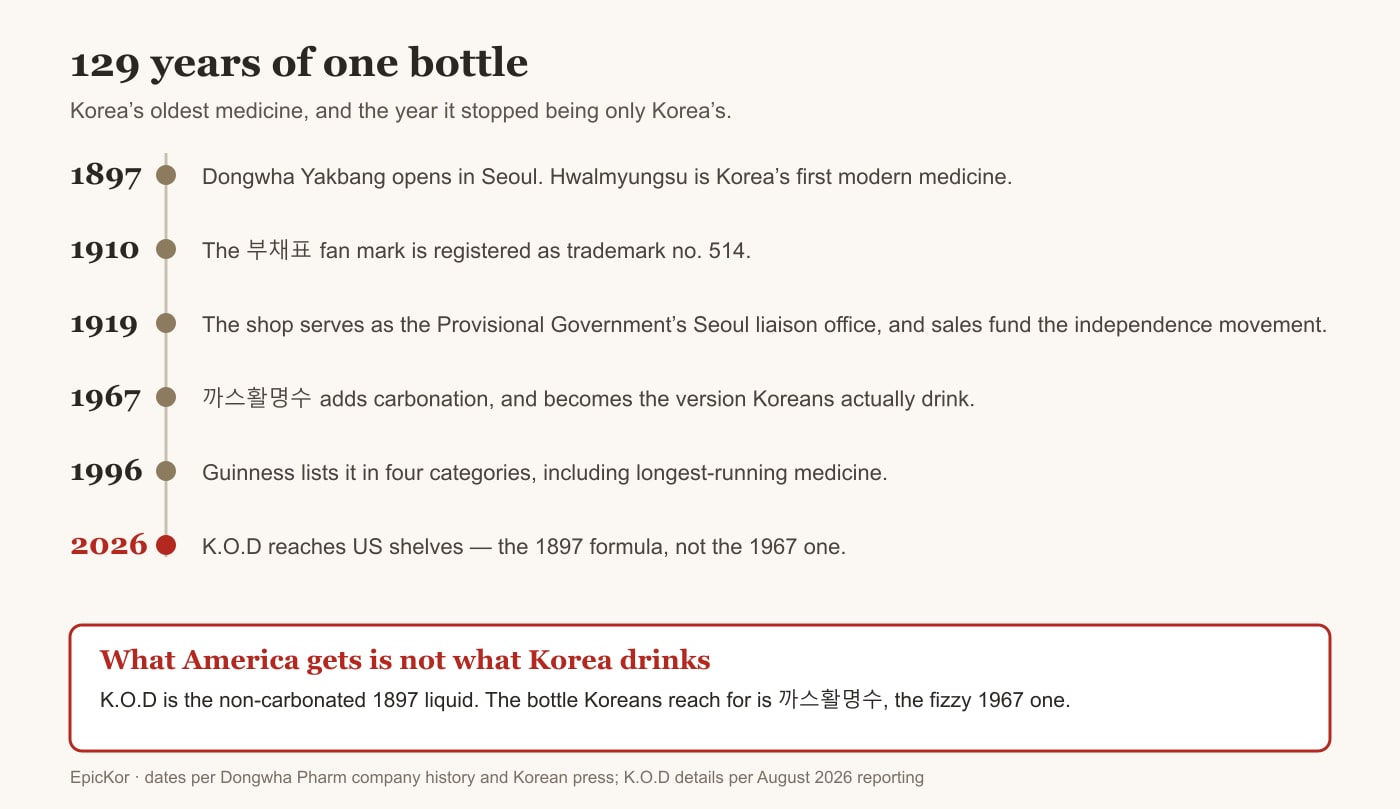
Hwalmyungsu: Korea's Oldest Medicine Reaches America Without the Fizz
Hwalmyungsu is 129 years old, Korea's first modern medicine, and it lands on US shelves this month as K.O.D. The version America gets is the non-carbonated 1897 one — not 까스활명수, the fizzy 1967 bottle Koreans actually reach for.
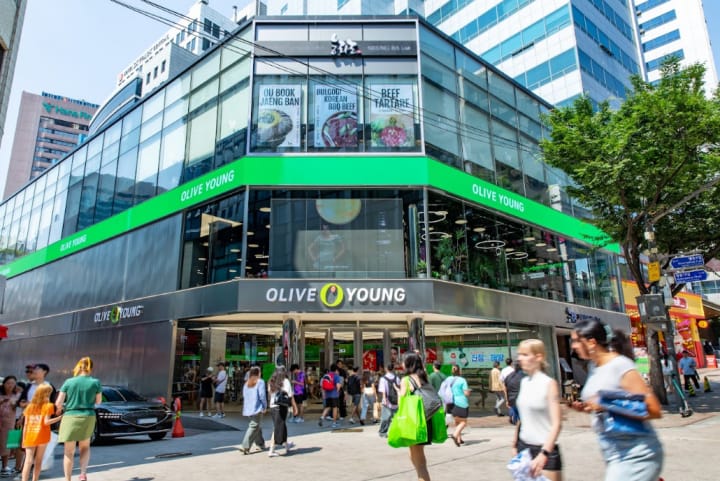
Korea Tourist Shopping Route: Olive Young, Daiso, Musinsa
A practical guide to Korea's new tourist shopping route: Olive Young, Daiso, Musinsa, pharmacies, skin clinics, tax refunds, and what to buy.