Korean Yuja Tea: The Jar Says 80%, the Fruit Is 40%
Every English guide to Korean yuja tea (유자차) tells you the same three things: it is a citrus marmalade, you stir a spoonful into hot water, and Koreans drink it for colds. All true, all useless at the moment that actually matters — standing in front of six jars that cost between ₩8,000 and ₩13,000, trying to work out which one is worth it.
The jars make that look easy. Each one prints a large percentage on the front. One says 80%. Another says 65%. Obviously you want the 80% one.
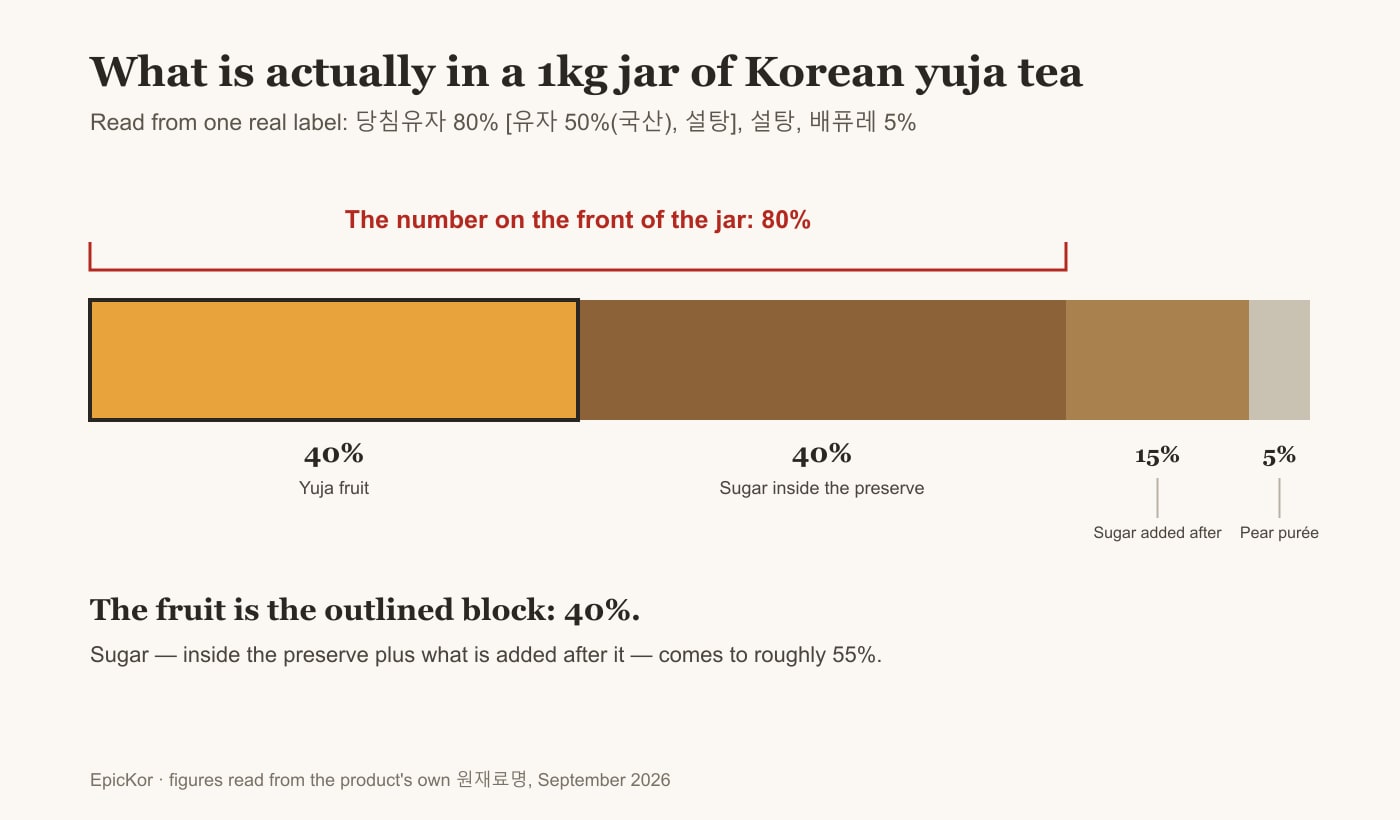
Except that number is not the fruit. On a Korean label it is the percentage of sugar-preserved yuja, and sugar-preserved yuja is, by definition, about half sugar. The jar that says 80% contains roughly 40% fruit. Korean labelling law makes manufacturers print the sub-percentage that lets you work this out, in small type, inside a bracket. Almost nobody multiplies.
This article is the multiplication, done on a real label, with the current prices — and one thing that matters if you are buying from outside Korea: the jars sold on Amazon usually do not carry the numbers you would need to do the same sum.
Quick Guide
| Question | Short answer |
|---|---|
| What the front number means | Sugar-preserved yuja (당침유자), not fruit |
| How to get the fruit figure | Multiply it by the smaller 유자 % inside the bracket |
| Worked example | 80% × 50% = 40% fruit |
| How much is sugar | Roughly 55% on that same label |
| Korean price (Sept 2026) | ₩8,110–₩13,000 per 1kg jar |
| US price (Sept 2026) | about $14 per 1kg jar |
| Where the fruit comes from | Goheung (고흥), about 60% of Korea's crop |
| Is it tea? | Legally yes — food type 액상차 (liquid tea). No leaves, no caffeine |
| The catch when buying abroad | US labels often print no percentages at all |
Damtuh honey citron (yuja) tea, 2.2 lb jar — on AmazonAffiliate link. As an Amazon Associate, EpicKor earns from qualifying purchases at no extra cost to you.
You might like: Korean Drinks Guide: what to buy in a Korean convenience store, with the price, sugar and caffeine of every bottle
First, the fruit is not a citron
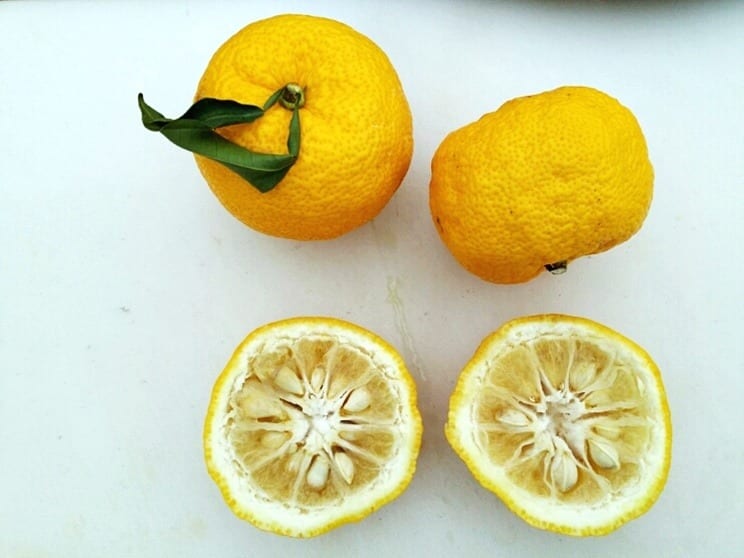
A quick correction, because it affects what you type into a search box. The English name on almost every jar is "citron tea", and that is a translation error that stuck. Yuja (유자) is Citrus junos — the same fruit the Japanese call yuzu. A citron is Citrus medica, a different, much thicker-skinned fruit used mostly for candied peel.
So "Korean citron tea", "yuja tea" and "yuzu tea" on a Korean jar all mean the same thing. If a search only turns up recipes, try the other two names. The mistranslation is old enough that the export industry standardised on it, and no one is going to reprint a decade of packaging over a botanist's objection.
Nearly all of it comes from one county. Goheung (고흥) in South Jeolla Province grows about 60% of Korea's yuja, and Goheung yuja is registered as geographical indication No. 14 (지리적표시 제14호) — the same protected-origin system that covers Boseong green tea. In a good year the county harvests around 14,000 tonnes. If a jar says 국산 (domestic), there is a strong chance the fruit came from there.
The label maths, done on a real jar
Here is the ingredient line from a jar you can buy in Korea right now — 복음자리 과육담은 꿀유자차, 1kg:
당침유자 80% [유자 50%(국산), 설탕], 설탕, 배퓨레 5% [배 99.95%(국산), 비타민C]
Read it in the order Korean law requires. Ingredients are listed heaviest first. Where an ingredient is itself a mixture — a 복합원재료, a compound ingredient — its own components go in the bracket immediately after it.
So:
- 당침유자 80% — sugar-preserved yuja is 80% of the jar's weight.
- [유자 50%] — and inside that preserve, half is fruit.
- 80 × 0.50 = 40%. That is the fruit.
- The other half of the preserve — another 40% of the jar — is sugar.
- Then 설탕 appears again as its own ingredient, listed after the 80% and before the 5%, so it sits somewhere in that gap. With 80 + 5 = 85 accounted for, roughly 15% is left for it.
- Total sugar: about 55%. More than the fruit.
None of this is hidden, and none of it is illegal. The manufacturer printed every number needed. The trick is purely that the big friendly figure on the front is measuring the preserve and your eye reads it as fruit.
The rule you can carry into any Korean supermarket: find the bracket, take the smaller number inside it, and multiply. If there is no bracket and no inner percentage, the front number is the fruit — those exist too, and they cost more.
A consumer-group comparison of five brands found the average real yuja content across the shelf was 40.2%, with individual products ranging from the high twenties to the mid forties. That test is from December 2013, so treat it as evidence that the pattern is old and industry-wide, not as a current ranking — formulations change, and the only percentage that binds is the one on the jar in your hand.
What this costs, September 2026
Prices for the standard 1kg jar, read this week:
| Product | Size | Price | Where |
|---|---|---|---|
| 복음자리 유자차 | 1kg | ₩8,110 (lowest listed) | Korean price comparison |
| 오뚜기 유자차 | 1kg | ₩9,880 | Ottogi's own store |
| 복음자리 과육담은 꿀유자차 | 1kg | ₩10,610 (list ₩13,000) | Cafe supplier |
| Damtuh honey citron tea | 1kg / 2.2 lb | $13.99 (reg. $14.99) | Damtuh's US store |
Two things to notice. First, the spread inside Korea is only about ₩2,500 on a jar that lasts a household a month or more — which means paying up for the higher-fruit jar is one of the cheapest quality upgrades in a Korean supermarket. Second, the US price is close to the Korean one once you convert, which is unusual for a Korean grocery item abroad and makes the buying decision genuinely the same decision.
If you are buying the jar rather than flying to Goheung: As an Amazon Associate, EpicKor earns from qualifying purchases at no extra cost to you. The 2.2 lb Damtuh jar is the standard family size and the one most Korean households would recognise; the 1.7 lb jar is the sensible first purchase if you are not sure you will finish it, and there is a ginger version that is noticeably less sweet on the finish. Compare the ingredient lists before the pictures — see the next section for exactly what to look for.
See 2.2 lb Damtuh jar on AmazonThe problem with buying it outside Korea
Here is the part that surprised us, and the reason this article exists in English rather than only in Korean.
The jar sold on the Korean market must print the compound-ingredient breakdown. The same brand's export jar frequently does not. Damtuh's US listing gives its ingredients as:
Preserved citron, sugar, purified water, honey, sodium carboxymethyl cellulose, citric acid, concoction, vitamin C
There is not a single percentage in that line. No 80%, no bracket, no 유자 50%. The multiplication this whole article teaches is simply not available to you — the label is compliant with US rules, which order ingredients by weight but do not require the sub-breakdown Korea requires.
You can still read it, though, and it tells you things:
- Preserved citron is listed first, so it is the largest single component — but you cannot tell whether that is 80% or 55%.
- Purified water appears third. The Korean premium jar quoted above has no added water at all. Water in the list means the preserve has been let down.
- Sodium carboxymethyl cellulose is a thickener. It is there to give a watered mixture the body that fruit and sugar alone would have provided. Its presence is a reasonable proxy for "there is less fruit in here than in the Korean domestic version."
- "Concoction" is an unhelpfully translated catch-all; it usually renders 조제 or a flavour preparation.
So the practical rule when buying abroad inverts. In Korea, do the multiplication. Outside Korea, where the numbers are missing, read for what should not be there: water high in the list, a cellulose thickener, or fruit that is not named as the first ingredient. A jar whose list runs simply yuja, sugar, honey is the good one, whatever the front of the label says.
How Koreans actually drink it
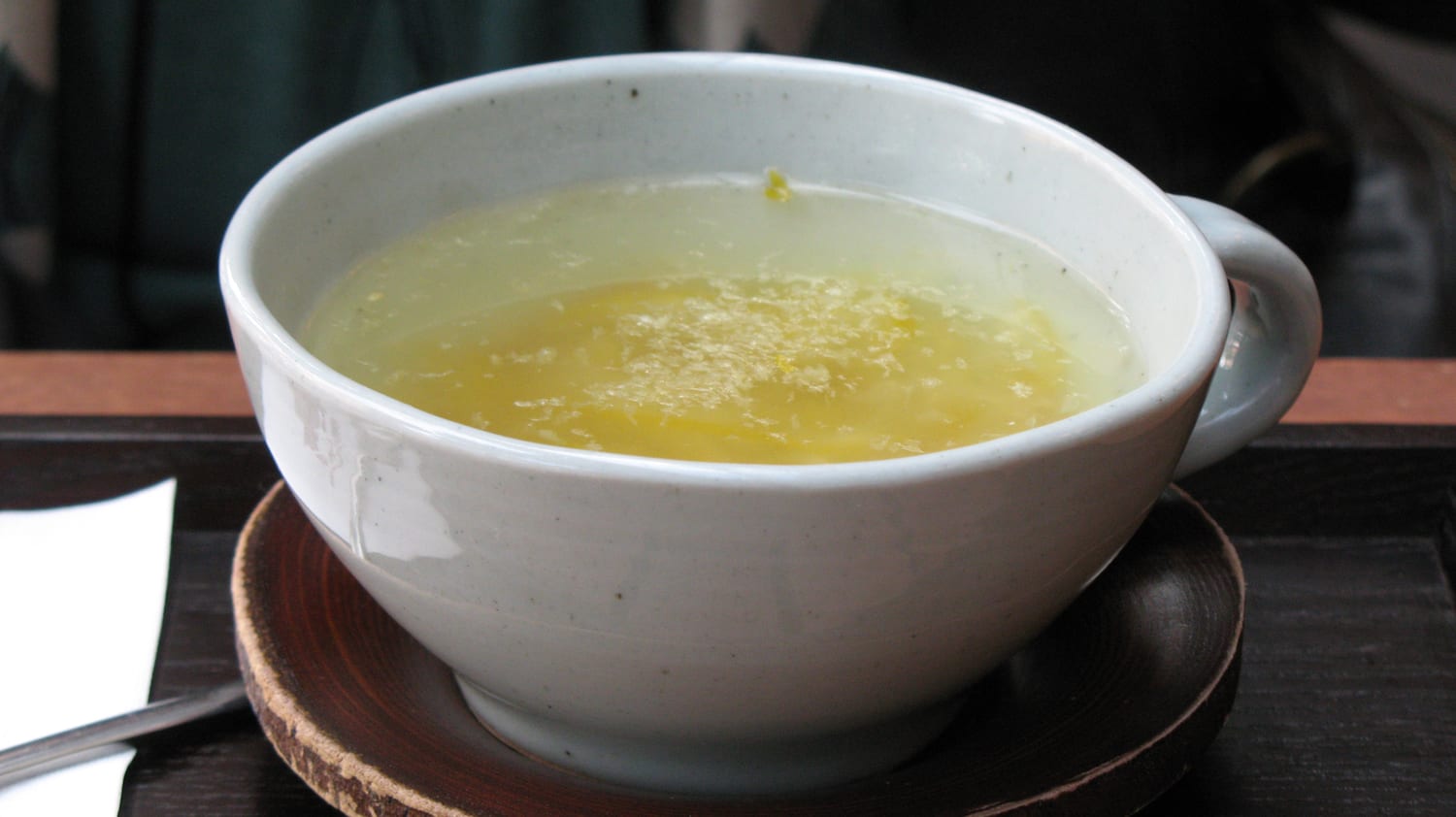
Not as a delicate tea. The standard serve is 1–2 heaped tablespoons of the preserve into a mug of hot water, stirred hard enough to break the peel up, and the peel is meant to be eaten at the end — leaving it in the bottom of the cup is the giveaway of someone who has not had it before.
Other things it is genuinely used for in Korean homes and cafes, which the recipe posts tend to skip:
- Iced. Same two spoons, cold water, ice. In summer this is more common than the hot version, and it is why cafe menus list 유자차 year-round.
- In the cafe, mixed. Naver's search suggestions right now are full of 사과유자차 (apple-yuja) and chain-specific versions — it has become a base ingredient rather than only a home drink.
- On things. It works as a jam on toast and spooned over plain yogurt, which is a more honest use of something that is half sugar than pretending it is a health tonic.
- As a marinade component, where the citrus and the sugar do the same job as an orange glaze.
It is naturally caffeine-free — there are no tea leaves in it at any point. And despite the "tea" in the name, the Korean food code files it as 액상차 (liquid tea), a category that covers fruit and grain concentrates rather than steeped leaves. So the name is legally fine; it just does not mean what an English speaker assumes.
Before you treat it as a health drink
The honest counterweight, because the marketing rarely provides one.
Yuja does carry real vitamin C, and a hot cup of it is a genuinely comforting thing when you have a cold — which is exactly why Korean households keep a jar. But by weight, the jar we measured is more sugar than fruit. Two heaped tablespoons is a meaningful amount of sugar in a single mug, closer to a soft drink than to a herbal infusion. If you are drinking three or four cups a day through a Korean winter, that adds up in a way "vitamin C tea" does not suggest.
Two practical consequences:
- If you want the vitamin C, eat an orange. If you want the drink, drink it because it is delicious and warming, and count it as a sweet.
- If the sugar is the problem but you want the flavour, the ginger versions and the higher-fruit jars are both less cloying — not because they contain less sugar in absolute terms, but because more of the volume is actually doing something.
There is one more thing worth saying plainly: you do not need to make it yourself. English coverage of yuja tea is dominated by from-scratch recipes, often substituting Meyer lemons because fresh yuja is nearly impossible to buy in the West. Korean households overwhelmingly buy the jar. Making it with a different fruit produces a nice lemon marmalade, but it is not this.
For other Korean products where the label is doing more work than the marketing, our Korean red ginseng buying guide applies the same read-the-ingredients approach, and Maxim vs G7 does it for Korea's instant coffee sticks. If you are working through Korean drinks more broadly, start with the Korea drinks guide.
FAQ About Korean Yuja Tea
Q: What does the percentage on the front of a yuja tea jar mean?
It is the proportion of 당침유자 — yuja already preserved in sugar — not the proportion of fruit. Since the preserve is typically half sugar, the fruit content is roughly half the advertised figure. A jar reading 당침유자 80% [유자 50%] contains about 40% fruit.
Q: How much sugar is in Korean yuja tea?
On the label examined here, about 55% of the jar by weight: the 40% that sits inside the sugar-preserve, plus roughly 15% more added separately. That is more sugar than fruit. Treat two tablespoons in a mug as a sweet drink, not a health tonic.
Q: Is yuja the same as yuzu?
Yes. Yuja (유자) and yuzu are the same fruit, Citrus junos — the names differ only by language. It is not a citron (Citrus medica), despite "citron tea" being the standard English name on the packaging.
Q: How much does yuja tea cost in Korea?
As of September 2026, standard 1kg jars run about ₩8,110 to ₩13,000. The gap between the cheapest and the higher-fruit jars is small enough that paying up is usually worth it.
Q: Why do the jars sold on Amazon not show percentages?
US labelling requires ingredients in descending order of weight but not the compound-ingredient breakdown Korean law requires. Read for absences instead: purified water high in the list and a cellulose thickener both indicate a more diluted preserve than the Korean domestic version.
Q: Does yuja tea have caffeine?
No. There are no tea leaves in it. Korea's food code classifies it as 액상차 (liquid tea), a fruit-concentrate category, so the word "tea" describes the format rather than the plant.
Q: How do you actually drink it?
One to two heaped tablespoons stirred into hot water, or into cold water over ice, which is how it is most often served in summer. Eat the peel at the bottom — that is the part you paid for.
Bottom Line
Yuja tea is one of the easiest Korean things to bring home: it keeps for a year, it needs no equipment, and it tastes like the fruit rather than like a flavouring. It is also one of the easiest to overpay for, because the number designed to catch your eye is measuring the wrong thing.
Find the bracket. Multiply. In Korea, the arithmetic takes two seconds and the label gives you everything you need. Outside Korea, where the numbers are stripped out, read for water and thickener instead — and buy the jar whose ingredient list is short enough to finish in one breath.
Sources: product 원재료명 and pricing read from 복음자리 과육담은 꿀유자차 1kg and 오뚜기 유자차 1kg retail listings, and from Damtuh's US store, September 2026; Goheung yuja production share and geographical-indication registration from Korean agricultural and broadcast reporting; five-brand yuja-content comparison from 소비자가만드는신문, 11 December 2013 (cited as historical evidence of the labelling pattern, not as a current ranking); food-type classification per Korea's 식품공전. Prices and formulations change — check the jar in front of you.
You Might Also Like
Korean Kitchen Scissors: Why Koreans Cut Meat and Noodles at the Table, and Why It Is Not an Office Scissor
Scissors on a restaurant table look wrong to most of the world and normal to every Korean. The tool is not a desk scissor: thick blades, one serrated edge, big rings, often detachable, built for galbi and cold noodles. Where it came from, and which one to buy.
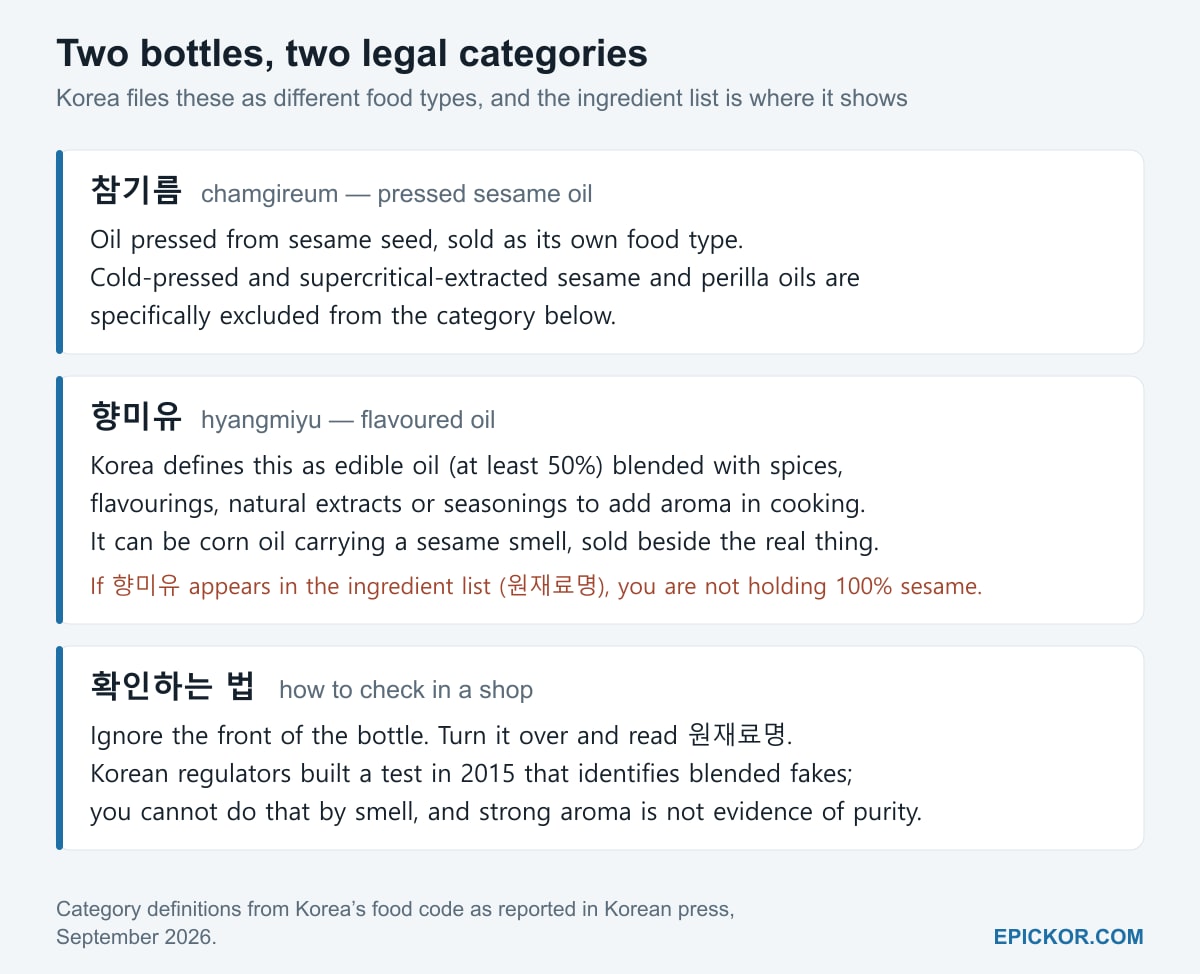
Korean Sesame Oil: The Label Word That Means It Isn't Sesame Oil
A bottle can look like Korean sesame oil and legally be corn oil carrying a sesame smell — Korea files that as 향미유, a separate food type. Imported oil runs ₩700–1,100 per 100ml; Korean-grown runs ₩5,500–6,700, because Korea grows 8–12% of its own sesame.
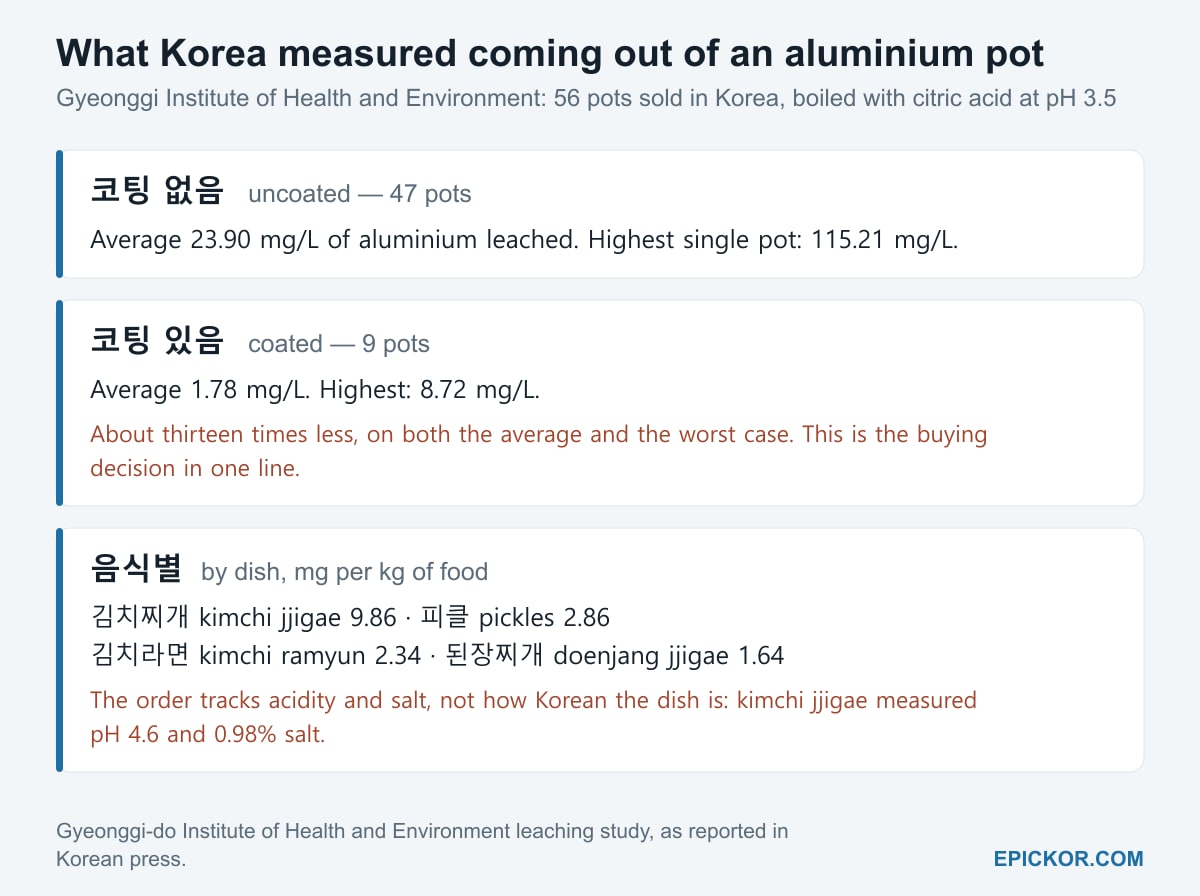
Korean Ramen Pots: Is the Aluminium One Safe?
Korea tested 56 aluminium pots with acid at pH 3.5. Uncoated ones leached 23.90 mg/L on average, coated ones 1.78 — thirteen times less. Kimchi jjigae pulled the most of any dish, against Korea's own safe figure of about 17 mg a day.