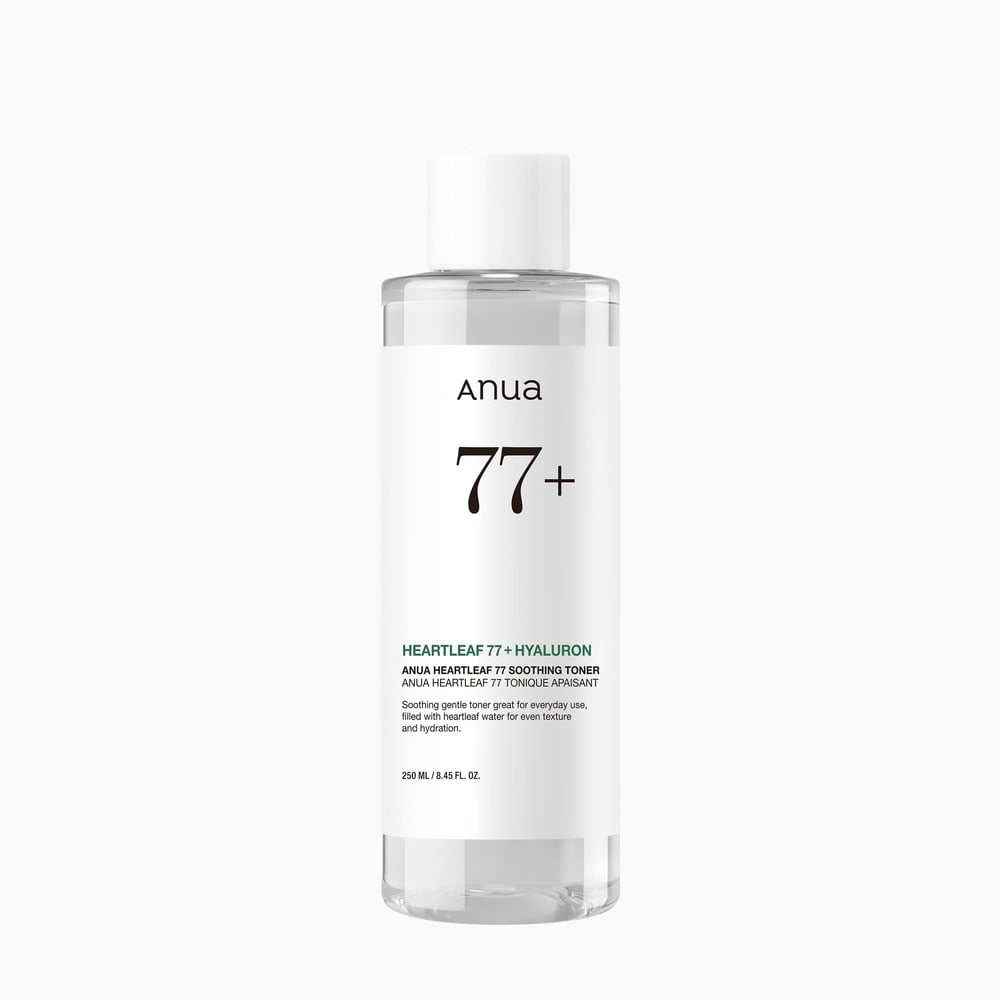
Anua Heartleaf 77 Toner: The Korean Weed That Smells Like Fish and Topped Amazon
The second-most-famous ingredient in Korean skincare right now is a roadside weed whose Korean name means, literally, "fish-smell grass."
어성초 (eoseongcho) — heartleaf, the plant botanists call Houttuynia cordata — earned that name honestly: crush the leaves and they smell like fish. Koreans have used it in folk medicine for skin trouble for centuries. And since roughly 2023, a clear bottle containing 77 percent of it has been one of the best-selling toners on Amazon, made by a brand most buyers assume is a decades-old K-beauty house.
It is not. 아누아 (Anua) belongs to a company started in 2017 by two Seoul National University classmates — an anthropology major and an economics major, both born in 1988 — who took no outside investment and rode this one bottle to ₩717.7 billion in revenue last year.
This is the explanation the listing does not carry: what heartleaf actually is and does, what the 77 means (and the ingredient list that proves it), what Koreans pay versus what you pay, the margin problem the Korean business press is now writing about, and — as with every product this site covers — who should not buy it.
| Question | Short answer |
|---|---|
| What is it | A watery, pH 5.5 calming toner — 77% heartleaf (어성초) extract |
| What is heartleaf | *Houttuynia cordata* — a Korean herb used traditionally for skin inflammation; the name means "fish-smell grass" |
| Does the toner smell like fish | No — the extract is processed and the toner is fragrance-free and nearly scentless |
| Who makes it | Anua, by The Founders Inc (더파운더즈) — Seoul, founded 2017, no outside investment |
| What it does | Calms redness and irritation, light hydration, preps skin at the right pH |
| What it does not do | It is not an exfoliant or a treatment — it will not clear acne or fade spots on its own |
| Korea price | ₩25,000 list at Olive Young; promotions routinely land near ₩19,900 — August 2026 |
| US price | $23 on Anua's own store; check the Amazon listing for its current price |
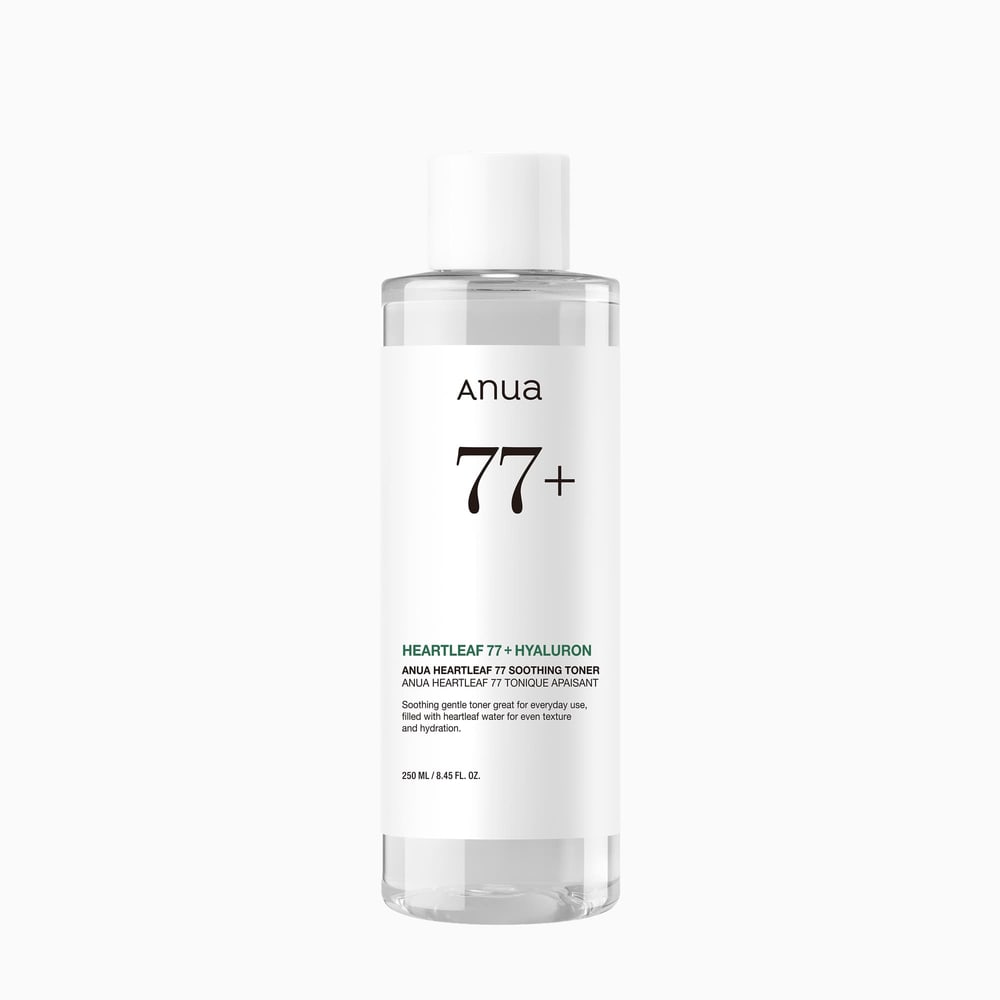
HEARTLEAF 77+ HYALURON — the renewed formula adds hyaluronic acid to the original 77% heartleaf base. Manufacturer product image, Anua.Anua Heartleaf 77 Soothing Toner, 250ml — on AmazonAffiliate link. As an Amazon Associate, EpicKor earns from qualifying purchases at no extra cost to you.
The Weed Itself: 어성초
Heartleaf grows wild and low across Korea — damp ground, forest edges, the unglamorous margins of rice fields. Korean folk medicine used it for generations on inflamed skin, wounds, and heat rashes, and older Koreans know it less as a skincare ingredient than as something a grandmother boiled.
The fish smell is real and chemical — the plant's aldehydes are close cousins of the compounds in fish — and it vanishes in processing. What survives into a cosmetic extract is the part dermatology cares about: quercetin and related flavonoids with measurable anti-inflammatory and antioxidant activity. That is why heartleaf became Korean skincare's default answer for redness specifically, the way cica is for barrier repair and snail mucin is for hydration.
If you want the full map of these calming ingredients — cica, mucin, propolis, heartleaf — our K-beauty ingredient decoder places them side by side. And the philosophical opposite of this plant-based bottle is the one we covered last: COSRX's snail essence, animal-derived where this one is marketed vegan. The two are the poles of the same Korean soothing shelf, and the choice between them is more about texture and ethics than efficacy.
What "77" Means — and the Document That Proves It
Marketing numbers on K-beauty bottles are often garnish. This one is the recipe, and the proof is on the regulated part of the label.
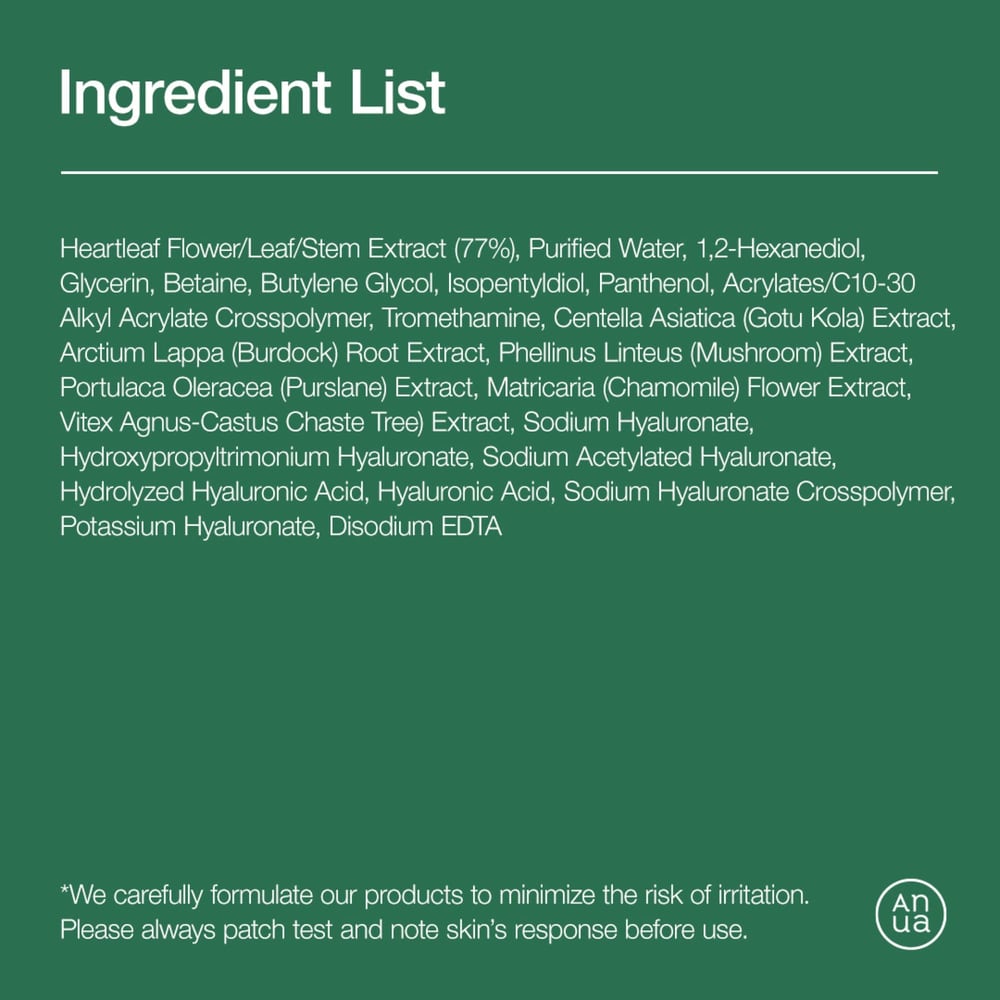
Heartleaf Flower/Leaf/Stem Extract (77%), which means the extract, not water, is the base of the formula. On most toners, water is the first ingredient. Manufacturer ingredient disclosure, Anua.Ingredient lists are ordered by concentration and regulated, so the first line is the honest one: the heartleaf extract is the bulk of the bottle, with purified water second. The renewed version layers hyaluronic-acid derivatives and panthenol on top of that base, at a skin-matching pH of 5.5.
What that composition delivers, used consistently: visible calming of redness and reactive skin, light watery hydration, and a well-behaved first layer under serums and moisturizer. What it structurally cannot deliver: exfoliation, acne treatment in the clinical sense, or pigment fading. Like the snail essence, its bad reviews are mostly the sound of the wrong expectation meeting the right product — it soothes the skin you have; it does not renovate it.
You might like: Torriden Dive-In Serum: Korea's Most-Awarded Hydrator, Explained Honestly
You might like: Round Lab Dokdo Toner: Korea's Six-Time No.1 Toner Is Named After a Date
Two Classmates, No Investors, ₩717 Billion
The company story is unusual even by K-beauty's standards.
이창주 (Lee Chang-ju) and 이선형 (Lee Sun-hyung) — Seoul National University classmates, one from anthropology, one from economics, both born in 1988 — founded 더파운더즈 (The Founders Inc) in 2017 and spent two years building Anua before launch. The premise was the same consumer-first instinct that built COSRX, aimed at a different niche: sensitive, redness-prone skin, treated with a traditional Korean herb rather than a lab novelty.
The growth curve bent at Amazon. Korean coverage records the brand's 2023 Amazon revenue at five times the prior year's, a 537 percent surge in one Prime Day, and by 2026, number-one rankings in major categories on both US and Japanese Amazon Prime Day events. Consolidated revenue reached ₩717.7 billion with ₩129.5 billion in operating profit — built, the Korean business press notes with some wonder, without a won of outside investment.
The honest counterweight, from the same press: the marketing that fueled this — Korean actress Suzy, then Kendall Jenner as global face — is expensive, and operating margins have been compressing as the company spends to hold its position against every K-beauty brand now launching a heartleaf line. None of that changes what is in the bottle. It does mean the brand premium you pay partly funds the billboard, which is true of every beauty giant and worth saying out loud about this one.
As an Amazon Associate, EpicKor may earn from qualifying purchases. The bottle this article is about is the Anua Heartleaf 77 Soothing Toner, 250ml — sold through Anua's official Amazon storefront. If your skin runs dry as well as red, the Gentle Moisture Duo pairs it with the Heartleaf 70 cream that seals it in. The listing's price moves often — check the current price rather than assuming.
See Anua Heartleaf 77 Soothing Toner, 250ml on AmazonWhat Koreans Pay vs What You Pay
August 2026, both sides of the Pacific:
- In Korea: the 250ml lists at ₩25,000 at Olive Young, and the promotion cycle routinely lands it near ₩19,900 — frequently bundled with a bonus lotion or cream, because Olive Young plans move this brand constantly.
- In the US: $23 list on Anua's own site; the Amazon listing's price moves, so compare before paying list.
At list-to-list, Americans pay modestly more; at promotion-to-promotion, the gap nearly closes. The bigger buying note is size and version confusion: the product exists as 250ml, 350ml and 500ml, in original and renewed (77+ HYALURON) labels, plus toner-pad and mist spinoffs. Lookalike third-party listings price small bottles near big-bottle prices. Check the milliliters before the price, and prefer the official storefront — the same advice as for every heavily copied K-beauty bestseller.
Buying in Seoul instead? The Olive Young guide covers how those promotion cycles work — this brand is one of the ones worth timing.
How Koreans Actually Use It
The 7-skin trick predates the product. Layering a watery toner in multiple thin passes — 겹바르기 — is a Korean habit this bottle happens to suit perfectly. Two or three passes pressed in with palms beats one splashed-on pass.
As a rescue mask. Soak cotton pads, lay them on cheeks for three to five minutes after too much sun or an over-enthusiastic exfoliation night. This is the use case Korean reviewers rate highest, and it is where the calming is most visible.
Fridge-cold in summer. Like the snail essence, it needs no refrigeration but rewards it — cold heartleaf pads on a flushed August face are a small Korean-bathroom luxury that costs nothing.
Not a treatment step. Koreans run it as the quiet first layer under actives, not instead of them. If redness is severe, persistent, or medical (rosacea, dermatitis), the toner is comfort, not care — a dermatologist outranks any bottle.
Who Should Skip It
- Anyone expecting acne treatment. Heartleaf calms the redness around breakouts; it does not treat the breakout. A BHA or benzoyl peroxide does different work.
- Fans of rich, cushiony textures. This is water-thin by design. If the snail essence's slip appeals to you, this will feel like nothing — that is the point, and it is not yours.
- Anyone whose budget covers one product. The permanent EpicKor answer: sunscreen first, always. A calming toner is the garnish of a routine, not its foundation.
- Plant-allergy caution. Rare, but heartleaf is a botanical extract at very high concentration — patch-test if your skin reacts to plant extracts generally.
The stepped path, as ever: if you are new to the brand, the smaller bottle or the starter duo with the azelaic-acid serum answers whether heartleaf suits your skin before you commit to the 500ml value size — the per-ml winner once you know you will finish it. EpicKor may earn from qualifying purchases at no extra cost to you.
See starter duo with the azelaic-acid serum on AmazonFAQ
Q: What is heartleaf in Korean skincare?
어성초 (eoseongcho), the herb Houttuynia cordata — a plant used in Korean folk medicine for inflamed skin, now processed into extracts rich in quercetin and flavonoids with documented anti-inflammatory activity. It is K-beauty's signature ingredient for redness, alongside cica for barrier repair and snail mucin for hydration.
Q: Does the Anua toner smell like fish?
No. The plant earns its Korean name — fish-smell grass — when crushed fresh, but the cosmetic extract is processed and the toner is fragrance-free and close to scentless. The name is the best trivia in your bathroom, not a warning.
Q: Is Anua a big Korean brand?
Bigger than most buyers guess and younger than they assume. Parent company The Founders Inc was started in 2017 by two Seoul National University classmates, took no external investment, and reached ₩717.7 billion in revenue with ₩129.5 billion operating profit — driven by Amazon, where the heartleaf line hit number-one category rankings on US and Japanese Prime Day in 2026.
Q: What does the 77 in Heartleaf 77 mean?
Heartleaf extract is 77 percent of the formula — confirmed by the regulated ingredient list, where Heartleaf Flower/Leaf/Stem Extract (77%) appears first, ahead of water. Current bottles are labeled 77+ HYALURON, the renewed version with added hyaluronic-acid derivatives at pH 5.5.
Q: How much does the Anua heartleaf toner cost?
As of August 2026: ₩25,000 list at Olive Young with promotions near ₩19,900, and $23 list on Anua's US store; check Amazon for the current price. Watch the size — 250ml, 350ml and 500ml versions exist, and third-party listings sometimes price small bottles near big-bottle money.
Q: Anua heartleaf toner vs COSRX snail essence — which one?
Different jobs, different textures, different ethics. Heartleaf is plant-derived, marketed vegan, water-thin, and aimed at calming redness. Snail mucin is animal-derived, slippery, and aimed at hydration and barrier comfort. Reactive, flushed skin leans heartleaf; dehydrated, tight skin leans snail. Plenty of Korean routines simply run both, toner first.
Sources Checked
- Korean business coverage of The Founders Inc: the 2017 founding by Lee Chang-ju and Lee Sun-hyung, the SNU-classmates background, no-external-investment growth, consolidated revenue of ₩717.7 billion with ₩129.5 billion operating profit, and the margin pressure from global marketing spend — Insight Korea, Huffington Post Korea, K-경제신문 profile
- Korean industry reporting on the Amazon trajectory: 2023 revenue five times the prior year, the 537% Prime Day surge, and 2026 US/Japan Prime Day category-number-one results — Beautynury
- Anua's own product materials for the 77% concentration, the ingredient list order, pH 5.5, and current US pricing ($23), checked August 2026
- Olive Young listings for Korean pricing (₩25,000 list; ~₩19,900 promotional), checked August 2026
- Standard phytochemistry references for Houttuynia cordata's quercetin/flavonoid content and its traditional use in Korean folk medicine
You Might Also Like
Round Lab Dokdo Toner: Korea's Six-Time No.1 Toner Is Named After a Date
The 1025 in Korea's best-selling toner means October 25 — Dokdo Day. Deep-sea water from Ulleungdo, six straight Olive Young toner awards, a word-of-mouth rise with no ad budget, and a ₩600 billion acquisition by the Beauty of Joseon company.
Torriden Dive-In Serum: Korea's Most-Awarded Hydrator, Explained Honestly
Thirteen million bottles, four straight Olive Young awards, and a formula built by leaving things out. What low-molecular hyaluronic acid actually does, what Koreans pay versus you, and who should skip the most-awarded serum in Korea.
COSRX Snail Mucin: The Korean Essence That Tops Amazon, Explained Honestly
The best-selling Korean beauty product on Amazon is 96% snail secretion. What the number on the bottle really means, how the mucin is actually collected, what Koreans pay versus what you pay, and who should skip it.