
Korean Trot Music Explained: Why the Retro Genre Had Its Biggest Comeback
On March 12, 2020, a cable TV singing competition finale in Korea pulled an average rating of 35.7% — beating the previous all-time record for Korean cable television, a hit prestige drama that had drawn 27%. Not a K-pop show. Not a drama. Trot (트로트) — a genre so thoroughly associated with grandparents that most Koreans in their 20s had spent their whole lives treating it as background noise at family gatherings, not something you'd choose to watch.
That show was Mr. Trot, and its unlikely winner became one of the biggest concert draws in the country within four years. If you've only ever encountered Korean trot music as an afterthought in a noraebang song list, there's a much bigger, stranger, and more contested story behind it — one that runs through Japanese colonial rule, a genuinely disputed origin debate among musicologists, and a survival-show format nobody expected to work on a genre this unfashionable.

What Trot Actually Sounds Like
Trot runs on a simple, insistent two-beat rhythm — Koreans nickname the sound 뽕짝 (ppongjjak), an onomatopoeia for the "oom-pah, oom-pah" pulse underneath almost every trot song. Layered on top is a distinctive vocal technique called 꺾기 (kkeokgi), where a singer bends and ornaments a note mid-phrase to heighten the emotion of a line — musicologists describe it as splitting a single note into a run of smaller, wavering ones, and it's close to essential; a trot singer who can't do it convincingly doesn't really sound like a trot singer.
Lyrically, trot leans hard into longing, separation, and homesickness, tied to the Korean emotional concept of han — a kind of accumulated, historically rooted sorrow. But that's only half the picture. After Korea's liberation, postwar governments actually banned overly mournful lyrics in popular music, which pushed songwriters toward "hope and the joy of life" themes even while keeping the same aching melodic style underneath. That tension between a melancholy sound and deliberately hopeful words — Korean commentators sometimes frame it as han versus heung (흥, joyful energy) — is arguably trot's real signature, more than sadness alone.
Portable Bluetooth karaoke microphones — compare on AmazonAffiliate link. As an Amazon Associate, EpicKor earns from qualifying purchases at no extra cost to you.
From Foxtrot to Ppongjjak — Trot's Complicated Origin Story
Trot's name literally comes from the American foxtrot, whose two-beat dance rhythm the genre borrowed — though, as one peer-reviewed musicology paper on the subject notes, "except two-beat rhythm, trot and foxtrot do not share any other notable characteristics." It's a rhythm borrowed in name only, not a wholesale style lift.
The genre itself emerged in the 1930s, while Korea was under Japanese colonial rule, developing out of Korean folk traditions while absorbing influence from Japanese enka and Western jazz. That much is widely agreed on. What's genuinely contested — and worth knowing, because most casual explainers flatten it — is which direction that influence actually ran. Koga Masao, considered the father of enka, spent part of his childhood in colonial Korea and openly credited Korean folk melodies as an influence on his own compositions. That means the popular "trot is just Korea's version of Japanese enka" story may have it backwards, or at least oversimplified — Korean musicologists refer to this ongoing argument as the "ppongjjak debate," over how authentically Korean the genre's colonial-era roots really are.
That contested relationship with Japan had real consequences after liberation. For roughly 20 years after 1945, Korea banned Japanese cultural imports outright, including music — trot survived that period because it had already been absorbed into Korean popular culture as something distinctly Korean, whatever its tangled colonial-era roots. It wasn't until Korea and Japan normalized diplomatic relations in 1965 that the "is trot too Japanese?" question became a live public debate rather than a moot one, a tension that still surfaces in Korean cultural commentary today.
Trot's first genuine idols, singers Nam Jin and Na Hoon-a, dominated from the late 1960s through the mid-1970s, riding a wave of new TV ownership — Korean households with a television set jumped from 6.4% in 1971 to 83.1% by 1980.
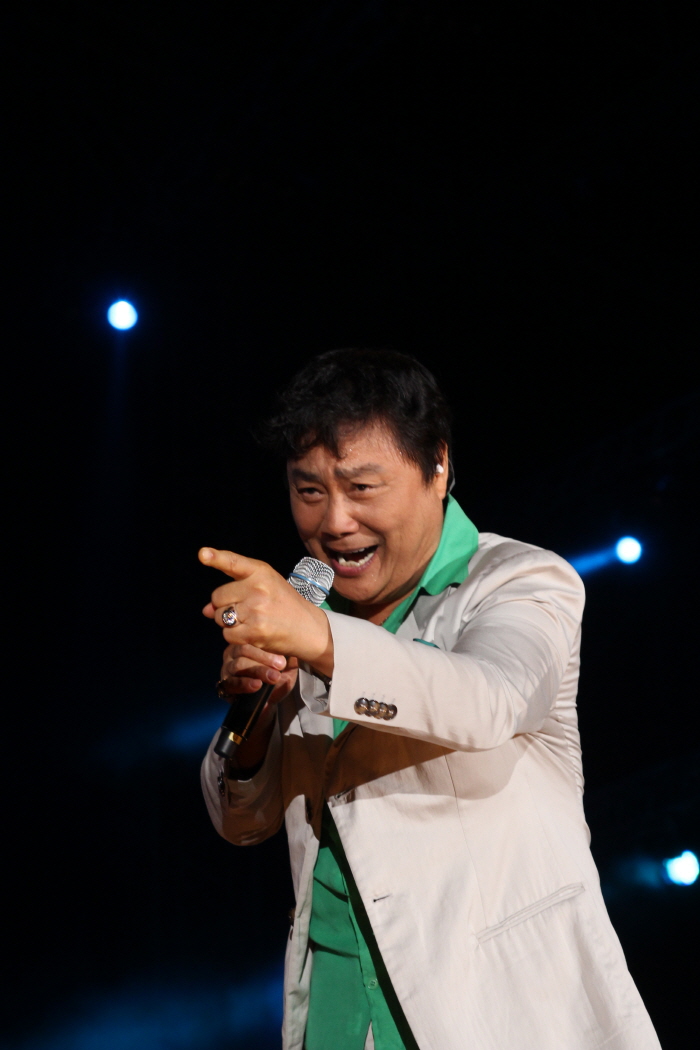
Then the tide turned: through the 1990s, trot was steadily pushed toward "old-fashioned" status by the rise of K-pop, even as singers like Jang Yoon-jeong and Hong Jin-young kept pockets of younger interest alive in the 2000s, years before anyone was talking about a full-blown revival.
Curious what trot actually sounds like in a real room? As an Amazon Associate, EpicKor may earn from qualifying purchases. Browse portable Bluetooth karaoke microphones — the easiest way to try a trot song's kkeokgi vocal runs for yourself before you ever set foot in a real noraebang.
The Shows That Brought Trot Back
The revival has two exact starting points, both on cable network TV Chosun. Miss Trot (미스트롯) premiered February 28, 2019 — a female-contestant singing competition that ran 100 hopefuls through elimination rounds toward a finale rating of about 18.1%, itself a cable-TV record at the time. Its winner, Song Ga-in, went on to release a fourth studio album, Gain; Dal, in early 2025, and returned as a judge on the franchise's fourth season in December 2025. Her reach has gone international too — she's held a concert titled "Gaindal The Rise" at the Pechanga Theater in Los Angeles, a genuine sign that trot's audience isn't purely domestic anymore.
Then came Mr. Trot (미스터트롯), premiering January 2, 2020, and this is the show that actually broke the genre wide open. Starting from 101 contestants and narrowing to 7 finalists — the eventual winner had reportedly beaten out 17,000 applicants just to get near the stage — the show's finale on March 12, 2020 pulled that 35.7% rating, decisively passing the drama SKY Castle's 27% as the new record for Korean cable television. Over 7.7 million text votes were cast during the finale alone. Producer Seo Hye-jin later put the appeal down to combining "a talent show format with trot" — a genre nobody had thought to package with the same audition-show mechanics that had already worked for K-pop. She also noted something the production team hadn't expected going in: the show pulled in real, organic fandom among younger viewers, not just its assumed older trot audience — a dynamic she called key to the show's success.
| Miss Trot (2019) | Mr. Trot (2020) | |
|---|---|---|
| Network | TV Chosun | TV Chosun |
| Premiered | Feb 28, 2019 | Jan 2, 2020 |
| Finale | May 2019 | March 12, 2020 |
| Format | 100 contestants, elimination rounds | 101 contestants down to 7 finalists |
| Winner | Song Ga-in | Lim Young-woong |
| Finale rating | ~18.1% (cable record at the time) | 35.7% (all-time Korean cable record) |
Lim Young-woong, Korea's Biggest Trot Star
Lim Young-woong's career after Mr. Trot is the clearest evidence the revival wasn't a one-season fluke. His debut full album, IM HERO, sold over 940,000 copies on its first day and passed 1 million within a week — making him the first solo male artist in Hanteo chart history to cross 1 million first-week album sales. By 2024, he was headlining solo concerts at Seoul World Cup Stadium, the same stadium tier played by acts like BIGBANG and SEVENTEEN, and in 2024 he became the face of Hana Financial Group, a brand deal explicitly aimed at reaching an older, 40-to-60-year-old demographic — his 16-second promo video hit 6.8 million YouTube views in nine days. He was also named the new face of Jeju Samdasoo, Korea's top bottled-water brand, taking over from IU.
His momentum hasn't slowed since. In 2025, he launched the "IM HERO" nationwide tour, opening at Songdo Convensia in Incheon in October and moving through Daegu, Seoul, Gwangju, and Daejeon, with further dates planned into early 2026 — a genuinely sustained arena-level touring career, not a one-album spike. He was also earlier the face of the KG Mobility Rexton SUV, giving him endorsement reach well outside the music industry entirely — an unusual position for any trot artist to hold, let alone one who debuted on a TV singing competition five years earlier.
None of this happened because a producer's gut instinct got lucky. Commentators offer at least three different, only partly overlapping explanations for why trot suddenly crossed generational lines: freelance culture commentator John Lee argues it's less about nostalgia and more that "their favorite singers are starting to get into this genre as well"; music critic Jung Minjae frames it as commercial necessity, since the genre's traditional older audience was shrinking and artists needed to reach younger and middle-aged listeners to survive; and producer Seo Hye-jin credits the survival-show format itself for creating fandom mechanics trot had simply never had before. All three are probably true at once, to different degrees, for different viewers.
Where You'll Actually Hear Trot Today
The single best-documented, ongoing home for trot in Korea isn't a festival or a chart — it's KBS's "가요무대" (Golden Oldies), a weekly trot and adult-contemporary program that's aired continuously on KBS 1TV every Monday night since November 4, 1985. By one reported milestone, it had already broadcast over 1,570 episodes and around 28,000 songs across 34 years — a genuinely uninterrupted institution, not a revival-era curiosity.
Outside of that, trot is still a noraebang (karaoke room) staple, especially for older patrons — Jang Yoon-jeong's "Eomeona" is commonly cited as a go-to trot pick when a mixed-generation group ends up passing the microphone around.


If you want the fuller etiquette rundown before you're handed a microphone yourself, our noraebang guide covers private rooms, coin noraebang, and how song order actually works in a group. Watching an older relative or coworker take the mic for a trot number, kkeokgi note-bends and all, while a younger group member waits their turn for a K-pop track, is a genuinely common noraebang dynamic — and now that you know the term, you'll actually recognize what's happening in the room.
And the TV format that revived the genre hasn't stopped: Miss Trot reached a fourth season in December 2025, with Song Ga-in back in the judge's chair, six years after she won the very first one. If that pattern looks familiar, it should — Korea had already spent years proving that audition-format shows with voting, elimination rounds, and manufactured contestant backstories could build real, lasting fandom, just almost always pointed at K-pop trainees rather than 60-year-old trot veterans. Mr. Trot's real innovation wasn't a new sound. It was aiming a format Korean audiences already trusted at a genre nobody had thought to point it at.
Want to actually sing along? As an Amazon Associate, EpicKor may earn from qualifying purchases. Browse wired in-ear headphones for vocal practice — useful for working out a trot song's kkeokgi note-bends at home before you ever pick up a noraebang microphone.
Frequently Asked Questions
Q: What does "trot" mean in Korean music? Trot (트로트) is Korea's oldest popular music genre, built on a simple two-beat rhythm (nicknamed ppongjjak) and an emotional, note-bending vocal style. Its name comes from the American foxtrot dance, though the genres share little beyond that rhythm.
Q: What TV show made trot popular again? Mr. Trot, a 2020 TV Chosun singing competition, is widely credited with the genre's revival. Its March 2020 finale drew a 35.7% average rating, breaking the all-time ratings record for Korean cable television.
Q: Who won Mr. Trot? Lim Young-woong, who beat out roughly 17,000 applicants to reach the competition. He's since headlined concerts at Seoul World Cup Stadium and became a major brand ambassador, including for Hana Financial Group and Jeju Samdasoo.
Q: Is trot Japanese or Korean? Its exact origins are genuinely debated among musicologists. Trot emerged in 1930s colonial Korea alongside influence from Japanese enka, but the direction of that influence isn't fully settled — some scholars note that enka's own "father," Koga Masao, credited Korean folk melodies from his own childhood in Korea as an influence on his work.
Q: Where can I hear trot in Korea today, besides on TV? Noraebang (karaoke rooms) remain a reliable place to hear it, especially with older participants in the group. KBS's "Golden Oldies" (가요무대), airing weekly since 1985, is the longest-running dedicated trot broadcast in the country.
The Bottom Line
Trot spent two decades written off as strictly your grandparents' music, and then broke a national ratings record anyway — not by changing what it sounds like, but by finally getting the kind of audition-show, fandom-building treatment K-pop had already proven works. The genre's colonial-era backstory is messier and more contested than most quick explainers let on, and that's exactly what makes it worth understanding properly instead of filing it under "old people's karaoke" and moving on.
Next time a noraebang session lands on a trot song nobody under 40 recognizes, you'll at least know why the person singing along knows every word.
Sources and further reading:
You Might Also Like
Korean Noraebang Guide: Karaoke Rooms, Ballads, and Etiquette
A practical Korean noraebang guide covering private karaoke rooms, coin noraebang, ballads, group etiquette, song choices, and first-visit tips.
Samulnori Explained: Korea's Four-Piece Percussion
A practical guide to samulnori: its 1978 stage origin, four instruments, nongak roots, rhythms, performances, beginner learning, and audience etiquette.

Beatpella House: How a Korean Beatbox Crew Reached 7.7 Million Subscribers
Beatpella House formed in October 2022 and has since posted around 2,668 videos to roughly 5.9 billion views. Four of the five are competitive beatbox champions. Here is who they actually are, how the format works, and where to start watching.