Have All BTS Members Finished Korean Military Service? 2026 Status
By the end of Part 2, BTS had done almost everything a group can do on the Billboard charts: seven No. 1 singles, a UN podium, an organized global fanbase that could out-vote pop's biggest names. Then, at close to the peak of all of it, the group did something no comparable Western pop act has ever had to do. They stopped, one by one, to become soldiers.
This is not a metaphor and not a scandal. It's how South Korea's mandatory military service law works, and it applies to BTS the same way it applies to almost every other able-bodied Korean man.
The Short Answer: All Seven Are Out
Yes. Every BTS member has completed South Korea's mandatory military service. The group has been fully reunited since 21 June 2025, and has been active as seven again through 2026.
| Member | Enlisted | Discharged | Service type |
|---|---|---|---|
| Jin | 13 Dec 2022 | 12 Jun 2024 | Active duty |
| J-Hope | Apr 2023 | 17 Oct 2024 | Active duty |
| RM | Dec 2023 | 10 Jun 2025 | Active duty |
| V | Dec 2023 | 10 Jun 2025 | Active duty |
| Jimin | Dec 2023 | 11 Jun 2025 | Active duty |
| Jung Kook | Dec 2023 | 11 Jun 2025 | Active duty |
| SUGA | Sep 2023 | 21 Jun 2025 | Social service agent (사회복무요원) |
Two things in that table surprise people.
SUGA enlisted three months before RM, V, Jimin and Jung Kook and came out last. That is not a penalty or a delay. He served as a 사회복무요원, a social service agent — an alternative-service category assigned on medical grounds, in his case a shoulder injury. That category runs 21 months against the army's 18, so an earlier start still finishes later.
Jin and J-Hope were already out while the other five were still serving. For about a year, from June 2024, BTS existed as a group with some members discharged and most still in uniform, which is why fan timelines from that period look confusing in hindsight.
This is Part 3 of EpicKor's BTS series. Part 1 covers seven unknown trainees at a label with no money; Part 2 covers the English-language gamble and the ARMY machine. The rest of this article is the service years and what came after.
Why Global Superstars Had to Enlist
South Korea has required most able-bodied men to complete around 18 to 21 months of military service since the 1950s, a policy tied directly to the country's unresolved state of war with North Korea. There is no wealth exemption and, ordinarily, no fame exemption. As BTS's fame grew into the billions of dollars in economic impact, a real legislative debate opened over whether they should be treated differently. In December 2020, lawmakers passed an amendment — informally called the "BTS law" — that let popular musicians honored with the Order of Cultural Merit defer enlistment from age 28 to 30. That bought time, not exemption.
The debate didn't stop there. By 2022, with the deferment window closing, a genuine national argument broke out over whether BTS should be excused from service entirely, given their documented economic and diplomatic value. Public polling at the time found a majority — around 61 percent — in favor of exempting them, against roughly a third opposed.
The two sides of that argument are worth understanding on their own terms, because they explain why Korea took this seriously enough to debate in its National Assembly rather than settling it quietly. The case for exemption was straightforward: BTS's own documented economic impact ran into the tens of billions of dollars, and supporters argued that cultural diplomacy and soft power of that scale was itself a form of national service. The case against it, made most directly by South Korea's own Defense Ministry, was about fairness — that extending a special exemption to pop stars would be difficult to justify to every ordinary citizen, and every other athlete or public figure, who had already served without one. South Korea's mandatory service system runs on the principle that the obligation applies regardless of individual achievement, and officials were unwilling to be the ones who broke that principle for entertainers, however globally significant. In the end, no blanket exemption was granted, and more importantly, BTS did not spend their remaining leverage fighting for one. Jin, the oldest member, enlisted first, on December 13, 2022. J-Hope followed in April 2023. SUGA enlisted that September. RM, Jimin, V, and Jung Kook enlisted together in December 2023, completing the group's full transition into uniform.
Following a story with real stakes: As an Amazon Associate, EpicKor may earn from qualifying purchases. The K-pop Dictionary is a useful reference if terms like "enlistment," "discharge," and the honorifics used around service dates are new to you.
See The K-pop Dictionary on AmazonOnly days before Jin's enlistment, the group had been standing in the Oval Office. On May 31, 2022, BTS met with President Biden at the White House to discuss anti-Asian hate crimes and inclusion — a diplomatic-level meeting, not a promotional stop, that showed exactly how far the group's platform had grown. Weeks later, that platform went on pause. The same seven men who had just discussed policy with a sitting US president reported for duty like any other conscript.
The Two-Year Question
For a group whose entire modern rise had been built on momentum — constant releases, constant fan engagement, an audience trained to expect near-continuous presence — a multi-year gap with all seven members simultaneously out of full-time promotion was a real risk, not a scheduling footnote. Comparable Western pop acts have never faced an equivalent mandatory pause at this scale. The honest open question, one that music trade press asked directly at the time, was whether an audience built on momentum would still be there on the other side.
By Korea.net's reporting, RM and V were discharged on June 10, 2025, Jimin and Jung Kook on June 11, and SUGA completed his service on June 21, 2025 — completing the reunion of all seven members. For the first time since late 2022, BTS existed again as a full group with no one in uniform.
The Comeback Had to Answer the Question Immediately
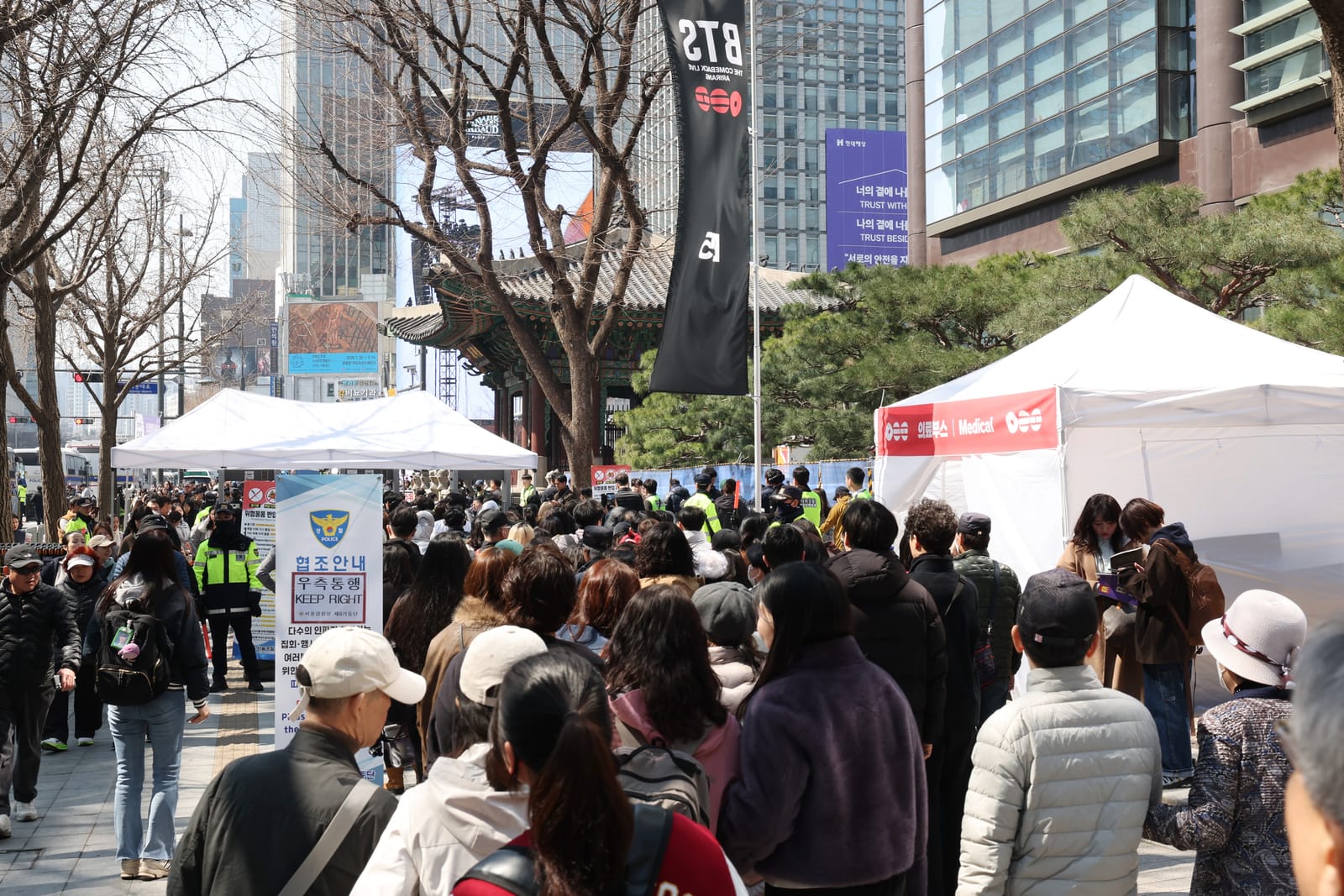
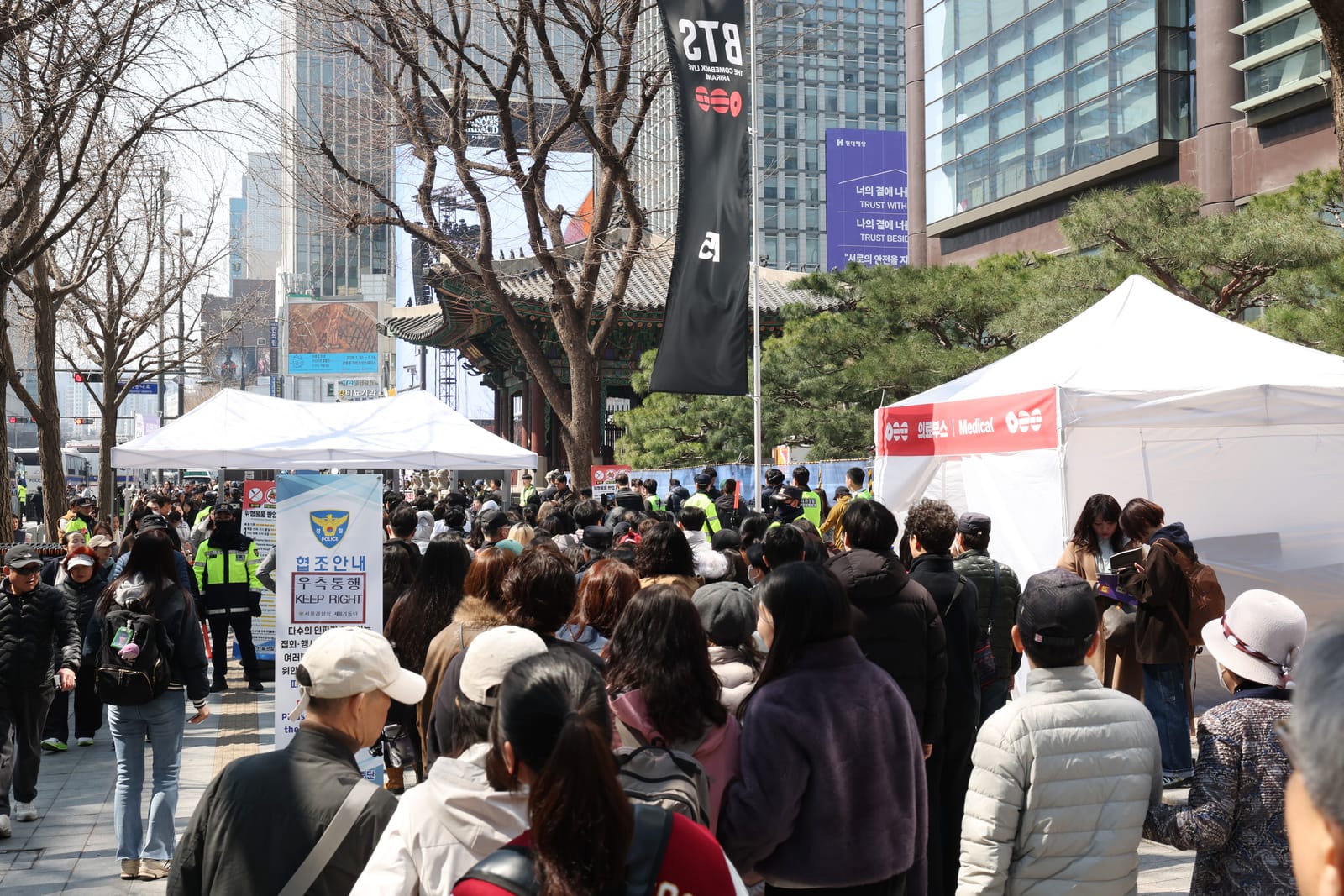
It did, and it did so in public. On March 21, 2026, BTS held their first full-group concert since reuniting: "BTS The Comeback Live: Arirang," staged outdoors at Gwanghwamun Plaza in central Seoul. It wasn't a small venue booked cautiously to test demand. It was one of Seoul's most visible public squares, secured with the kind of crowd-control infrastructure — police lines, medical tents, marked pedestrian routes — that only genuinely mass-scale events require.
The K-pop Dictionary — on AmazonAffiliate link. As an Amazon Associate, EpicKor earns from qualifying purchases at no extra cost to you.
The music answered the question too. Arirang, BTS's fifth full-group studio album, followed, led by the single "Swim." On the Hot 100 chart dated April 4, 2026, "Swim" debuted at No. 1 — BTS's seventh Hot 100 chart-topper, arriving nearly three years after the members had scattered into separate military units. An audience that had been asked to simply wait, with no new full-group music and no touring, still moved fast enough to put a comeback single straight to No. 1. That is a much harder thing to manufacture than a first hit ever was.
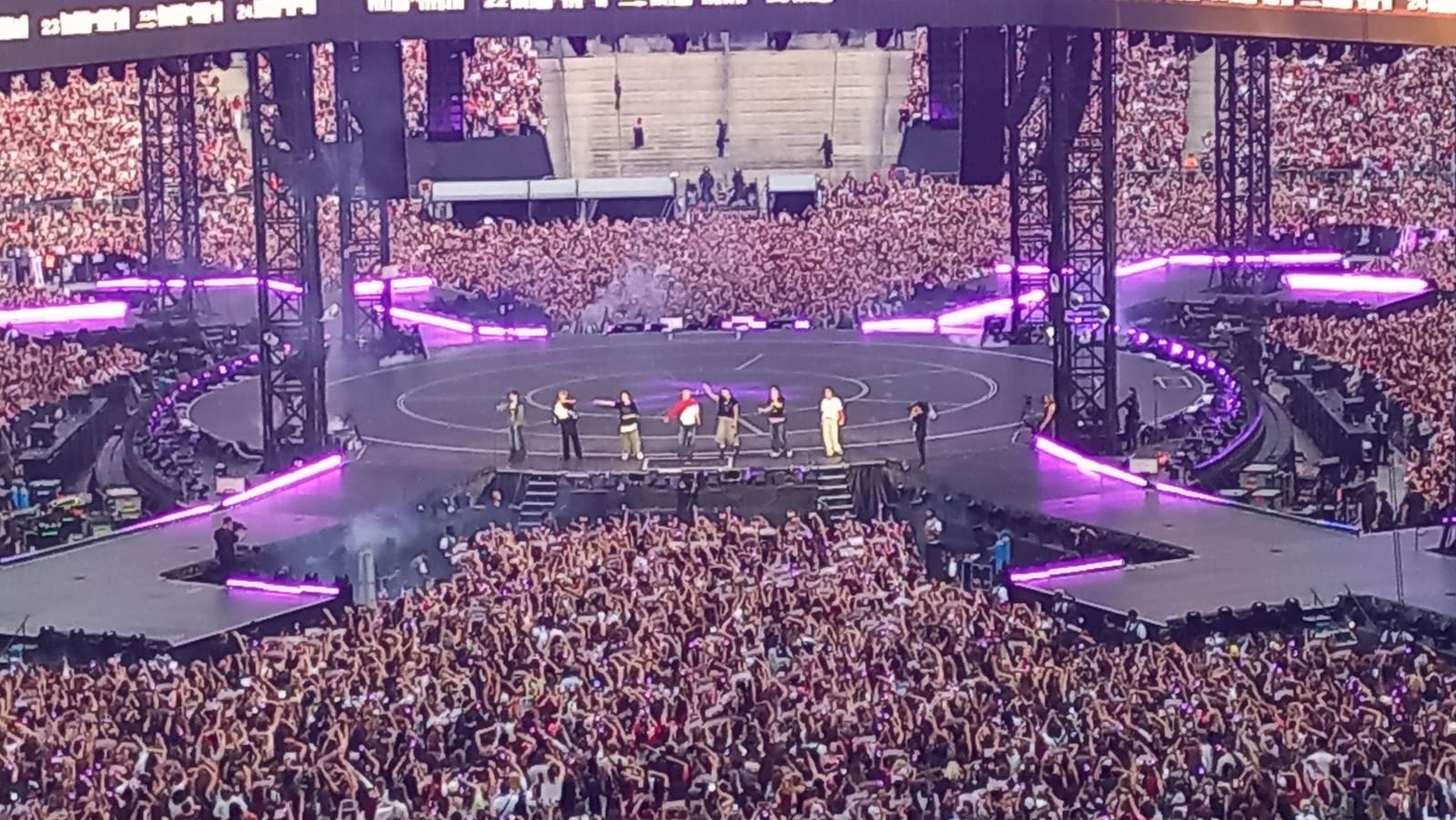
A world tour supporting Arirang followed the album, running from April 2026 into 2027. On July 17, 2026, the tour played Stade de France outside Paris — a full stadium, all seven members visible on the round center stage under purple light, surrounded on every side by a crowd that filled the pitch and every tier above it.
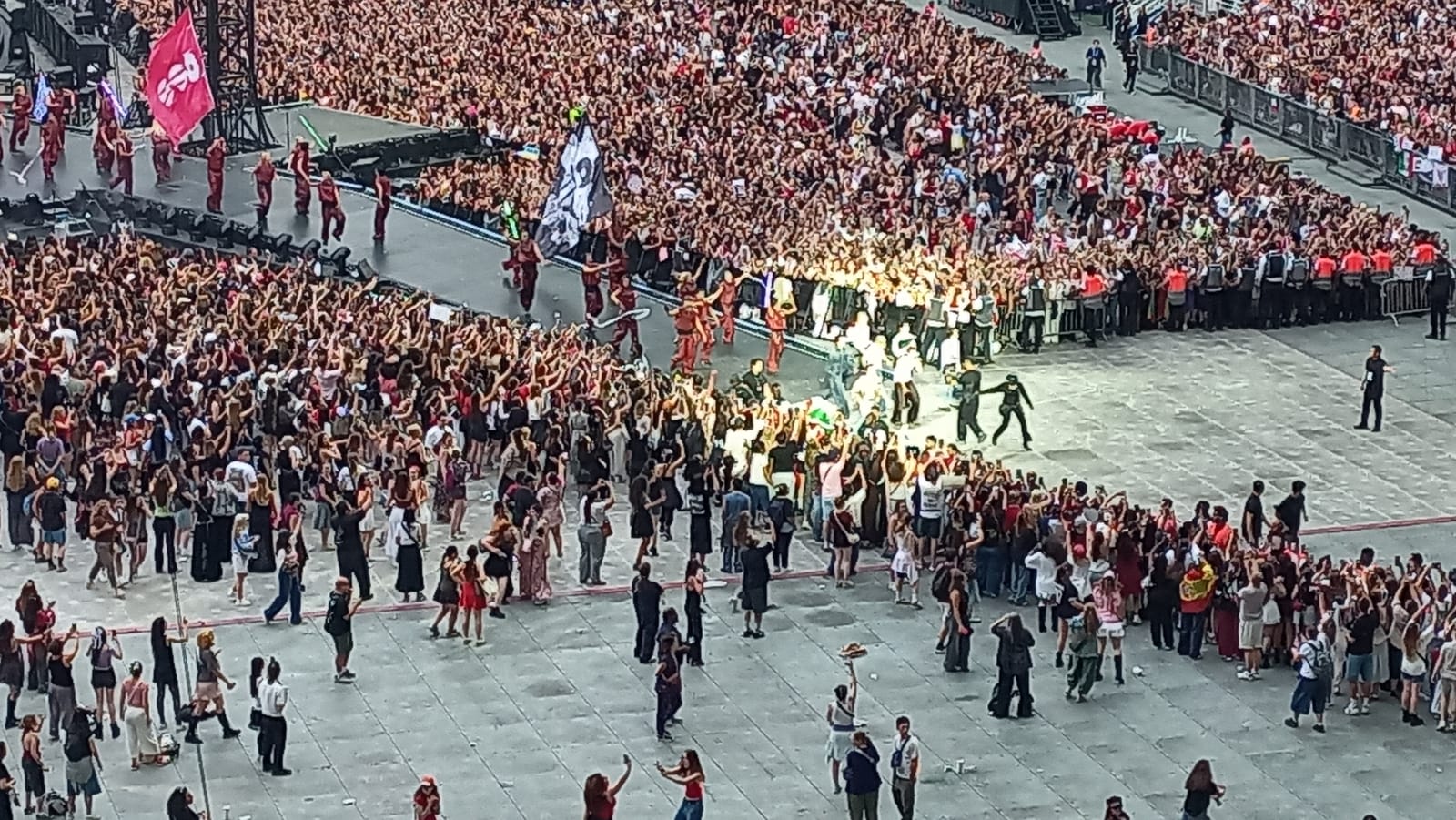
Earlier in that same Paris show, the members had walked an elevated runway straight into the middle of the crowd during "Idol," close enough that fans on both sides could reach up toward them.
Worth having before the reunion: As an Amazon Associate, EpicKor may earn from qualifying purchases. A 2026 comeback means album releases, and album releases mean photocards arriving faster than you can store them — a 168-pocket photocard binder is the unglamorous purchase every returning fandom makes about a month too late.
See 168-pocket photocard binder on AmazonTwo Days Later, MetLife Stadium
That Paris show was not a warm-up act for a separate story. It was the same tour, the same album cycle, and — two days later — the same seven men who walked onto the field at MetLife Stadium for the FIFA World Cup Final's first-ever halftime show, the scene Part 1 of this series opened with. Madonna, Justin Bieber, and Shakira shared that stage with them. Post Malone had opened the day's festivities separately, at the pregame ceremony. BTS's slot lasted about two minutes.
Read against everything in this series, those two minutes stop being just a booking coup. They're the answer to two separate open questions the group had faced, back to back, in less than a decade: could seven trainees from a nearly bankrupt label ever break into an industry controlled by three giant companies — and could that same group, after a mandatory multi-year absence at the height of their career, still command a stage that size on the other side of it. Both times, across completely different kinds of pressure, the answer came out the same.
What the Whole Arc Actually Adds Up To
The Hyundai Research Institute's oft-cited estimate — that BTS contributed close to $50 billion to South Korea's economy across their first decade, at points equivalent to roughly 0.3 percent of national GDP and comparable to a major national airline — gets repeated so often it risks becoming background noise. It's worth restating plainly, at the end of this series rather than the start: that figure describes the compounding effect of a small, broke label's one bet on a teenage rapper, sustained through public criticism, built without a marketing budget large enough to compete with the country's biggest entertainment companies, interrupted by mandatory military service that could easily have ended the whole thing quietly — and it didn't.
For readers who want the full reference picture — members, current status, and general FAQ — EpicKor's BTS guide remains the place to start. This series exists to answer a different question: not who BTS are, but how, specifically, they got here.
Frequently Asked Questions
Q: Have all BTS members completed their military service?
A: Yes. All seven are discharged. Jin finished first on 12 June 2024 and J-Hope on 17 October 2024; RM and V were discharged on 10 June 2025, Jimin and Jung Kook on 11 June, and SUGA on 21 June 2025. The group has been fully reunited since that date and active as seven throughout 2026.
Q: Why was SUGA discharged last when he enlisted before four other members?
A: He served as a 사회복무요원 (social service agent) rather than in the army, an alternative category assigned on medical grounds. It runs 21 months against active duty's 18, so his September 2023 start still finished after the December 2023 cohort.
Q: Why did BTS have to do military service if they're so famous?
South Korea requires almost all able-bodied men to complete mandatory military service, with no standard exemption for wealth or fame. A 2020 law let musicians with the Order of Cultural Merit defer enlistment from 28 to 30, but that was a delay, not an exemption, and no blanket exemption was ultimately granted despite public debate.
Q: Did BTS ever get an official exemption from military service?
No. A 2020 law let them defer enlistment from age 28 to 30, and a real public debate followed in 2022 over full exemption (roughly 61 percent of one poll favored it), but South Korea's Defense Ministry held that exempting entertainers would be unfair to ordinary citizens and other public figures who had already served without one. No blanket exemption was ever granted, and all seven members enlisted.
Q: When did each BTS member enlist?
Jin enlisted first, December 13, 2022. J-Hope followed in April 2023, and SUGA enlisted that September. RM, Jimin, V, and Jung Kook enlisted together in December 2023.
Q: When were all seven members reunited?
By June 2025. Korea.net reported RM and V discharged June 10, Jimin and Jung Kook June 11, and SUGA completing his service June 21, 2025.
Q: What was BTS's first concert after military service?
"BTS The Comeback Live: Arirang," held at Gwanghwamun Plaza in Seoul on March 21, 2026, ahead of their fifth full-group album, Arirang.
Q: Did BTS's audience actually come back after the hiatus?
Yes, measurably. "Swim," the lead single from Arirang, debuted at No. 1 on the Billboard Hot 100 (chart dated April 4, 2026) — BTS's seventh Hot 100 No. 1, arriving directly off a multi-year gap in full-group promotion.
Sources
- Newsweek: The "BTS law" and South Korea's military exemption debate
- Full BTS member enlistment and discharge timeline
- TODAY: BTS military service explained — Jin's 12 June 2024 and J-Hope's 17 October 2024 discharges
- Korea.net: BTS's June 2025 discharge and full reunion
- Korea Herald: "Swim" tops the Hot 100, BTS's seventh No. 1
- Rolling Stone: BTS at the 2026 FIFA World Cup Final halftime show
- BTS's economic impact on South Korea
You Might Also Like
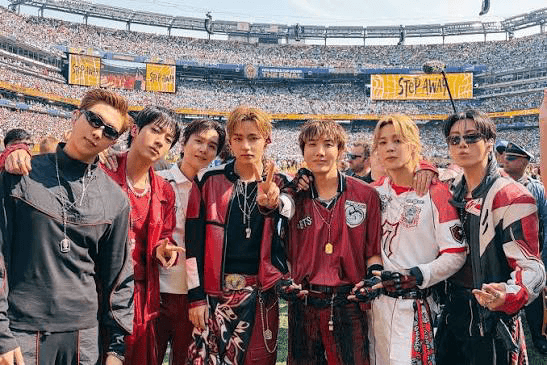
BTS Part 1: Seven Unknown Korean Trainees at a Label With No Money
How BTS went from a nearly bankrupt Korean label and one teenage rapper to the FIFA World Cup Final stage. Part 1 of EpicKor's BTS history series.
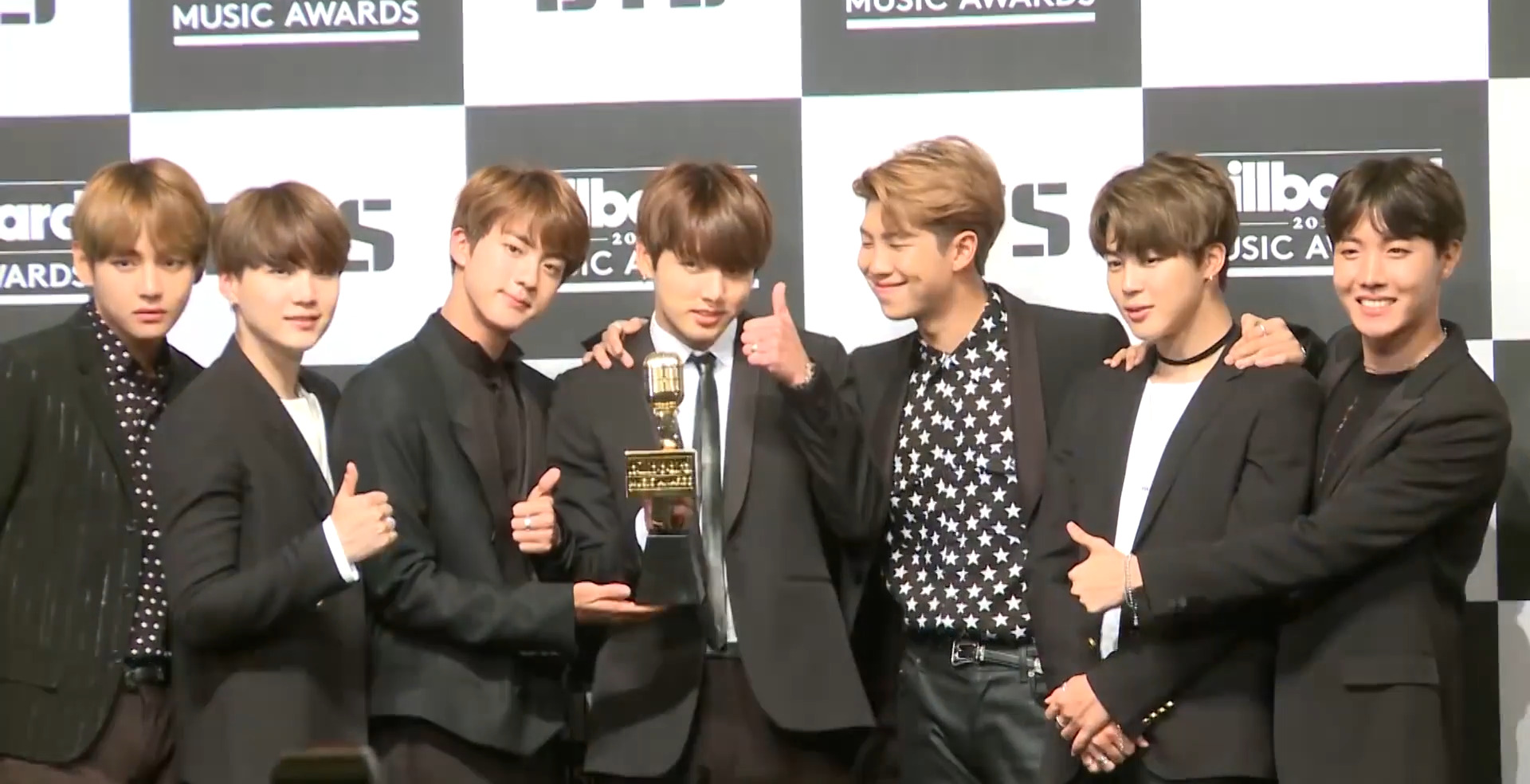
BTS Part 2: The Korean Group's English Gamble and the ARMY Machine
How BTS beat Justin Bieber's 6-year Billboard streak, spoke at the UN, and became the first Korean act to hit No. 1 on the Hot 100.
BTS Guide 2026: The Korean Group's Members, ARMY, and Military Return
A current BTS guide for new fans explaining the seven members, ARMY, military-service return, discography, social impact, K-pop context, and how to start.