Korean Cosmetics Wholesale Guide 2026: Authorized Distributors, Gray Market Risk, and Where Buyers Should Look
A Korean cosmetics wholesale guide covering authorized distributors, gray-market risk, sourcing platforms, category checks, and documents.
Quick Answer
If you are looking for Korean cosmetics wholesale, the safest first move is not to ask, "Who is the cheapest K-beauty wholesaler?" The safer question is, "Which seller is allowed to sell this brand, this batch, into my country, through my channel, with documents I can defend?"
That sounds less exciting than a supplier list, but it is the real buying problem. Korean cosmetics wholesale can mean at least four different things: buying finished branded products from an authorized distributor, buying stock from a trading company, sourcing private-label products through an OEM/ODM route, or buying marketplace inventory that may sit in the gray market. Those routes can look similar in a spreadsheet and behave very differently when a marketplace asks for proof, a brand challenges resale rights, customs holds a shipment, or customers ask why the expiry date is short.
This guide gives you both sides: where overseas buyers can actually start looking, and what to verify before money moves. Use the platform and category tables to build a broad candidate list, not to treat any single listing as a recommendation.
The practical rule is simple: build at least 10 candidates per product category before you decide. For skincare, build 10. For sunscreen, build 10. For cushions or lip tints, build 10. A short list of one or two names can accidentally become a recommendation. A broader list becomes buyer research.
What "Wholesale" Means In K-Beauty
The word "wholesale" is too broad for Korean cosmetics. One seller might be a brand owner. Another might be an official distributor. Another might be a Korean trading company that can source several brands. Another might be a retailer liquidating inventory. Another might be a marketplace seller with no right to support your channel.
Those differences matter because beauty products are not generic widgets. Cosmetics have batch numbers, expiry dates, ingredient lists, claim language, storage conditions, packaging versions, destination-market rules, marketplace policies, and brand-control issues. A low wholesale price can disappear quickly if the stock is short-dated, unauthorized for your territory, missing documents, or not accepted by the marketplace where you plan to sell.
For private label or new product development, use EpicKor's guide to K-beauty OEM/ODM in Korea. For general supplier discovery, use How to Find Suppliers in Korea. This article focuses on finished cosmetics wholesale and distribution risk: branded products, reseller supply, authorized channels, and the line between useful sourcing and dangerous gray-market buying.
Where Buyers Should Actually Look: 10 Starting Points
Start wide, then narrow. The table below is not a ranking and not an endorsement. It is a way to avoid depending on one seller's story.
| Route | Where To Look | Best Use | What To Verify |
|---|---|---|---|
| 1. KOTRA buyer services | KOTRA buyer page | Official buyer support, import inquiries, trade fairs, and Korea-office paths. | Whether the suggested seller is brand owner, authorized distributor, trading company, or manufacturer. |
| 2. buyKOREA | buyKOREA and its Korean seller/search surfaces | KOTRA-linked product discovery and seller contact across Korea export categories. | Seller identity, product category, business documents, batch proof, and whether branded-product authorization exists. |
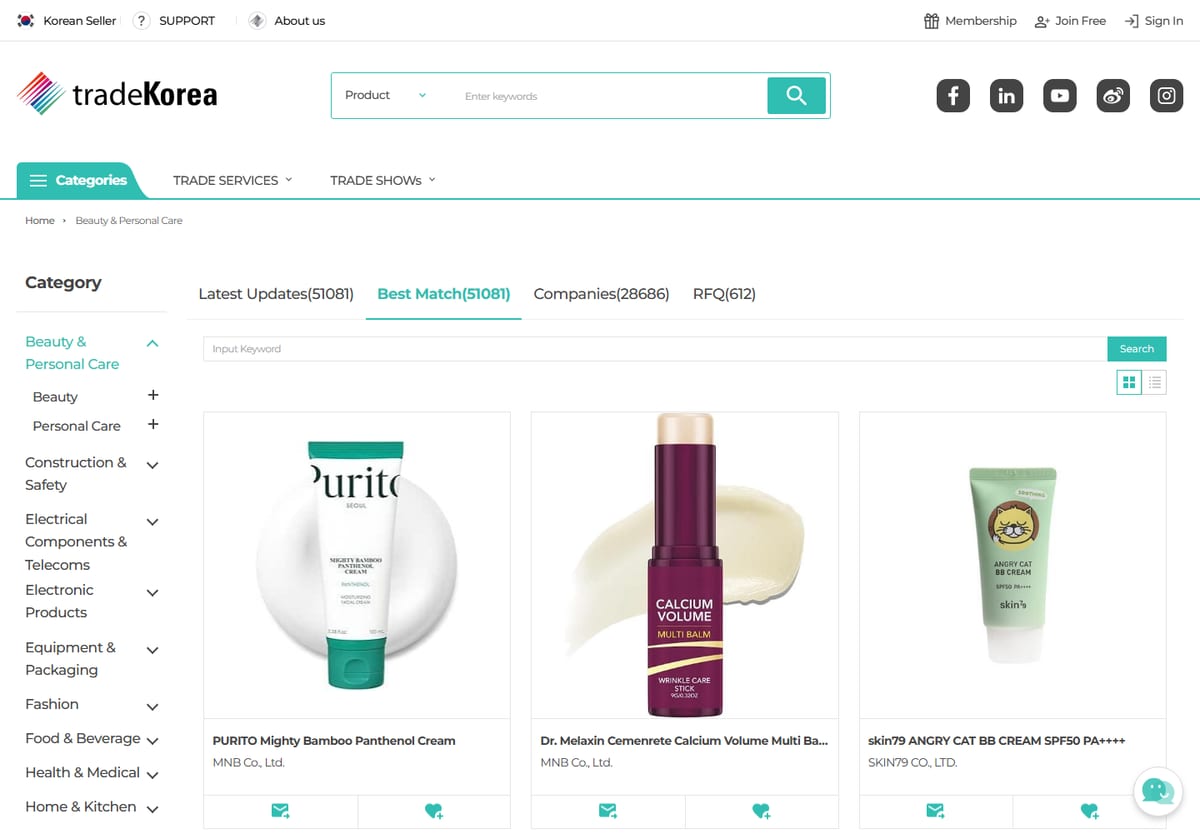
| 3. tradeKorea beauty categories | tradeKorea Beauty & Personal Care navigation | Category mapping for facial care, makeup, hair care, body care, fragrance, tools, and beauty appliances. | Whether the listing is a product offer, company profile, RFQ lead, or trade-show lead. |
| 4. GobizKOREA Health & Beauty | GobizKOREA | Korean SME export discovery, online exhibition, seller store, and business-matching paths. | SME export readiness, product documents, minimum order, and whether the seller can support your market. |
| 5. InterCHARM Korea | InterCHARM Korea homepage and exhibitor directory | Trade-show discovery for beauty, cosmetics, personal-care ingredients, and finished products. | Exhibitor role, category fit, meeting notes, sample trail, and post-show written quotation. |
| 6. KOTRA-linked trade fairs | KOTRA trade-fair and Korea Pavilion lists from the buyer page | Finding Korean beauty companies at overseas fairs or Korea-hosted buyer events. | Whether the booth contact has authority to quote wholesale supply or only marketing information. |
| 7. Brand-owner direct inquiry | Official brand or parent-company websites | Branded-product wholesale, territory rights, and marketplace authorization. | Distributor certificate, territory, sales channel, product version, and whether your account can resell. |
| 8. Authorized destination-market importer | Existing official importer or distributor in your country | Lower regulatory and authorization risk when the brand already has local representation. | Whether they can wholesale to your channel, what MAP or online policy applies, and whether you can use brand assets. |
| 9. OEM/ODM manufacturer inquiry | Manufacturer official sites and trade-show booths | Private label, exclusive formulas, or brand-owned products rather than resale of existing brands. | Formula ownership, claim support, packaging coordination, MOQs, and destination-market compliance role. |
| 10. B2B RFQ and matching services | RFQ, business matching, and open inquiry tools on Korea-focused platforms | When you know the product category but need several sellers to respond to one structured brief. | Do not accept vague "yes we can supply" replies. Ask for role, proof, batch trail, and documents. |
The best sourcing habit is to split "where can I find sellers?" from "which seller should I trust?" Platforms help with the first question. Documents, authorization, samples, payment terms, and repeat-supply checks answer the second.
A 10-Candidate Method For Each Product Category
Here is the method I would use before sending purchase money. For each product category, build a 10-name candidate sheet:
- Add 2 candidates from buyKOREA or KOTRA-linked discovery.
- Add 2 candidates from tradeKorea's relevant category.
- Add 2 candidates from GobizKOREA or another Korea SME export surface.
- Add 2 candidates from trade-show exhibitor directories or booth lists.
- Add 1 candidate from direct brand-owner or parent-company inquiry.
- Add 1 candidate from a destination-market authorized distributor or importer.
Then compare them on seller role, authorization, MOQ, expiry date, batch proof, documents, channel restrictions, and communication quality. You may end with only two serious suppliers, but you will know why.
Product Category Map: 10 K-Beauty Wholesale Lanes
The product category changes the risk. A toner lot, an SPF lot, a lip tint lot, and a clinic-adjacent cosmetic are not the same wholesale purchase.
| Category Lane | Search Terms To Try | Where To Look First | Extra Check |
|---|---|---|---|
| 1. Toners, serums, ampoules, creams | Korean skincare wholesale, serum supplier Korea, ampoule wholesale | tradeKorea Facial Care, buyKOREA Cosmetics, GobizKOREA Health & Beauty, brand owner inquiry | Batch number, expiry date, ingredient list, storage conditions, and whether the product version matches your market. |
| 2. Sunscreens and SPF products | Korean sunscreen wholesale, SPF 50 supplier Korea, sun stick wholesale | Brand-owner direct, authorized distributor, MFDS-informed document check, platform discovery only after claim review | SPF/PA support, destination-market sunscreen classification, label rules, and whether the seller can provide compliant documentation. |
| 3. Sheet masks, hydrogel masks, eye patches | Korean sheet mask wholesale, hydrogel eye patch supplier, mask pack Korea | tradeKorea Facial Care or Other Beauty Products, GobizKOREA, trade-show exhibitors | Large-lot expiry, leakage risk, packaging seal quality, carton count, and claims printed on sachets. |
| 4. Cleansing balms, oils, foams, pads | Korean cleansing balm wholesale, cleansing oil Korea supplier, toner pads wholesale | Beauty & Personal Care categories, brand direct, distributor inquiry | Texture stability, packaging leakage, unit-box condition, ingredient list, and customer-return risk. |
| 5. Cushion foundation, base makeup, compacts | Korean cushion foundation wholesale, makeup cushion supplier Korea | tradeKorea Makeup, brand owner, authorized distributor, trade-show booths | Shade range, refill compatibility, batch age, market-specific packaging, and whether testers/samples are available legally. |
| 6. Lip tints, palettes, eye makeup | Korean lip tint wholesale, K-beauty makeup distributor, eyeshadow palette Korea | tradeKorea Makeup, makeup brand direct inquiry, authorized importer | Color names, ingredient restrictions, counterfeit risk, channel policy, and image/brand-asset permission. |
| 7. Hair care and scalp care | Korean hair care wholesale, scalp tonic Korea supplier, shampoo distributor Korea | tradeKorea Hair Care, GobizKOREA Health & Beauty, brand direct | Hair-loss symptom wording, functional-cosmetic claims, bottle leakage, carton weight, and pump durability. |
| 8. Body care, hand care, bath products | Korean body care wholesale, hand cream supplier Korea, bath product wholesale | tradeKorea Body Care or Bath Supplies, buyKOREA search, SME export platforms | Fragrance allergens, volume/weight rules, shelf life, pump or tube quality, and destination-market label language. |
| 9. Derma-cosmetic and clinic-adjacent products | Korean derma cosmetic wholesale, PDRN cosmetic supplier, clinic skincare Korea | Brand owner, authorized distributor, trade-show meetings, regulatory review before platform sourcing | Do not confuse cosmetics with injectables or medical procedures. Check claims, product category, professional-use restrictions, and documents. |
| 10. Starter assortments and gift sets | Korean beauty gift set wholesale, K-beauty starter kit supplier, skincare set Korea | buyKOREA, tradeKorea, brand distributor, destination-market importer | Mixed expiry dates, bundle permission, barcode handling, set-box damage, and whether each brand allows resale in a set. |
This table is intentionally practical. It does not pretend every buyer needs the same seller. A small Amazon reseller, a boutique retailer, a spa distributor, and a private-label brand need different proof.
The Authorization Question
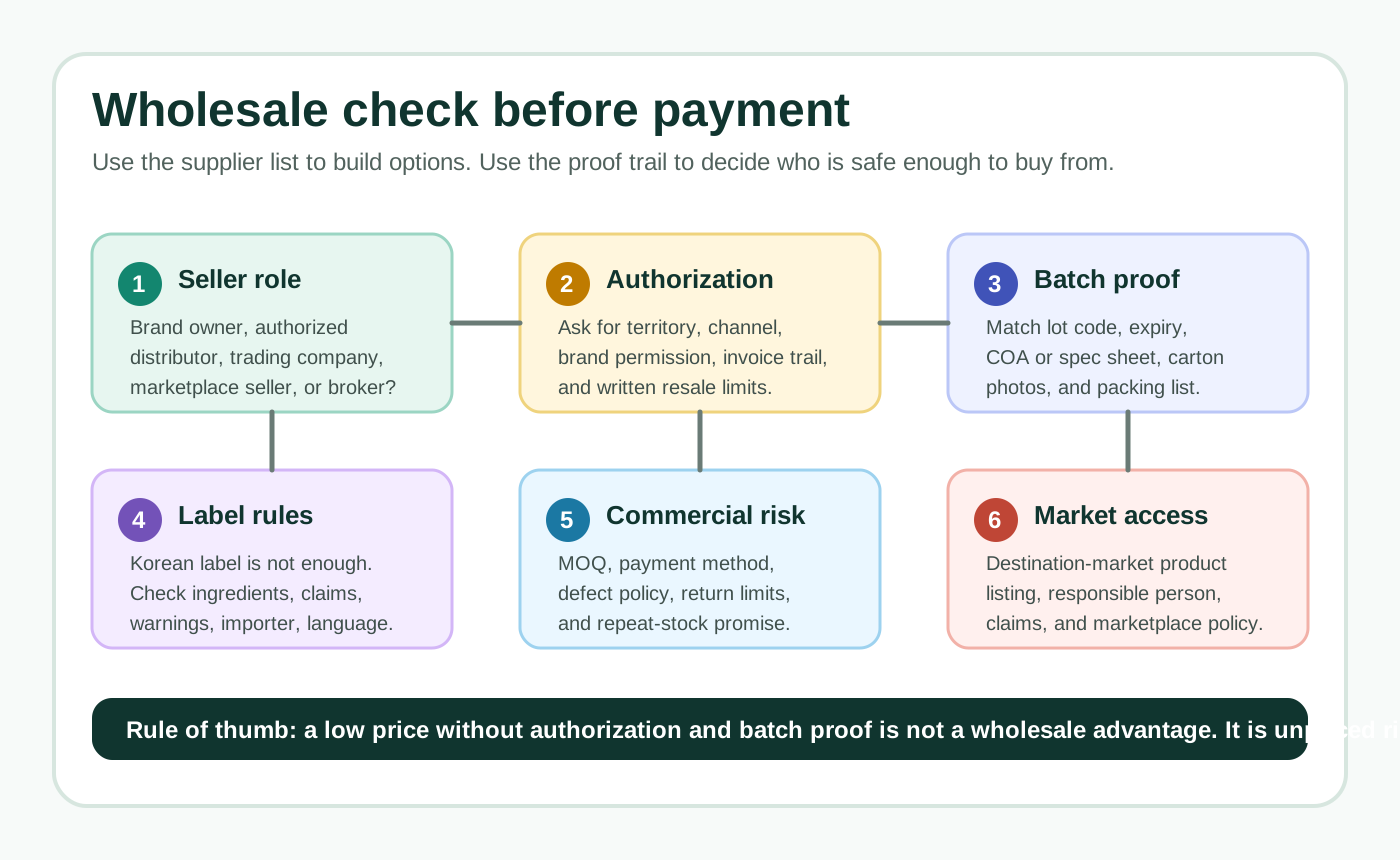
Authorization is the heart of Korean cosmetics wholesale. A seller may physically have stock and still not be the right source for your business.
Ask direct questions:
- Are you the brand owner, manufacturer, authorized distributor, trading company, marketplace seller, or broker?
- Which brand or product lines are you authorized to sell?
- Which territory does your authorization cover?
- Which sales channels are allowed: retail store, online store, Amazon, TikTok Shop, Shopee, Lazada, salon, spa, or wholesale to other resellers?
- Can you provide a distributor certificate, brand letter, invoice chain, or other proof that connects the product to the brand owner?
- Does the brand permit your buyer account to use official product photos, ingredient copy, logo assets, and claims?
- Are there minimum advertised price, marketplace, or region restrictions?
If the seller avoids the question, slow down. If the seller says "everyone sells it this way," slow down. If the seller can only provide product photos and a bank account, slow down. You are not only buying cartons. You are buying the right to sell without your channel collapsing later.
Gray Market Risk, Explained Without Panic
"Gray market" does not always mean fake. It usually means goods are genuine or claimed to be genuine, but the supply path is outside the brand's intended distribution channel. For Korean cosmetics, that can happen when stock moves from one country to another, when retail inventory is resold as wholesale, when online sellers buy from promotion channels, or when distributors sell beyond their territory.
The problem is not only ethics. The problem is business control. Gray-market stock can create five practical issues:
- The brand may not support product authenticity complaints.
- The marketplace may ask for authorization that the seller cannot provide.
- Product packaging may not match your destination-market label rules.
- Expiry dates and batch documentation may be weak.
- Your supply may disappear after one shipment.
That last point is common. A gray-market source can look attractive because the first order is cheap. But if the second order cannot be repeated, the buyer is not building a business. They are flipping inventory.
Branded Wholesale, Private Label, Or Marketplace Resale?
Before you request prices, decide what model you are actually pursuing.
| Buying Model | What You Are Buying | Good For | Main Risk |
|---|---|---|---|
| Authorized branded wholesale | Finished Korean brand products through the brand owner or authorized distributor. | Retailers, marketplace sellers, salons, spas, and specialty stores that need repeat supply. | Territory, marketplace policy, minimum order, channel limits, and proof of authorization. |
| Trading-company sourcing | Mixed branded inventory sourced through a Korean trader or export partner. | Buyers who need category breadth or lower coordination burden. | Unclear brand rights, variable stock, short expiry, and thin document trails. |
| OEM/ODM private label | A product made for your brand using a manufacturer route. | Brands that want ownership, differentiation, and long-term product control. | MOQs, formulation ownership, claims, testing, packaging, and launch compliance. |
| Marketplace resale | Inventory bought to resell on Amazon, Shopee, TikTok Shop, local marketplaces, or your own store. | Testing demand, but only when authorization and platform rules are clear. | Invoice acceptance, brand gating, listing takedowns, counterfeit complaints, and asset-use restrictions. |
| Retail arbitrage | Goods bought from retail promotions or consumer channels and resold. | Not a serious long-term B2B sourcing model. | Low repeatability, weak invoices, warranty/return issues, and possible platform enforcement. |
The cleanest model is not always the cheapest. But a clean model gives you repeat supply, clearer documents, and a better chance of surviving marketplace review.
Operator note: As an Amazon Associate, EpicKor may earn from qualifying purchases. If you are preparing your first wholesale beauty project, compare cosmetics business books and import/export sourcing books before sending RFQs, because weak paperwork can cost more than weak pricing.
Document Checklist Before Payment
Do not ask for every document in the world. Ask for the documents that match the product, channel, and country.
For most branded cosmetics wholesale inquiries, start with:
- Business registration or company profile.
- Seller role confirmation.
- Brand authorization or distributor proof where applicable.
- Pro forma invoice with exact company name, address, product name, SKU, quantity, unit price, currency, payment terms, and Incoterms.
- Batch or lot numbers.
- Manufacturing date and expiry date.
- Ingredient list and INCI names where needed.
- Product photos showing unit, box, barcode, lot code, expiry, and carton.
- Packing list and carton dimensions.
- Storage and handling requirements.
- Certificate of analysis, specification sheet, or test documentation when relevant.
- MSDS or transport documents only where relevant to the product and shipping mode.
- Claim-support materials if the product uses functional, SPF, acne, hair-loss, whitening, or wrinkle language.
For marketplace resale, also ask whether the supplier's invoice is accepted by the platform you use. Do not assume. Some platforms care about invoice source, brand authorization, product identity, and proof that the supply chain is legitimate.
MFDS And Claims: The Korean Side Still Matters
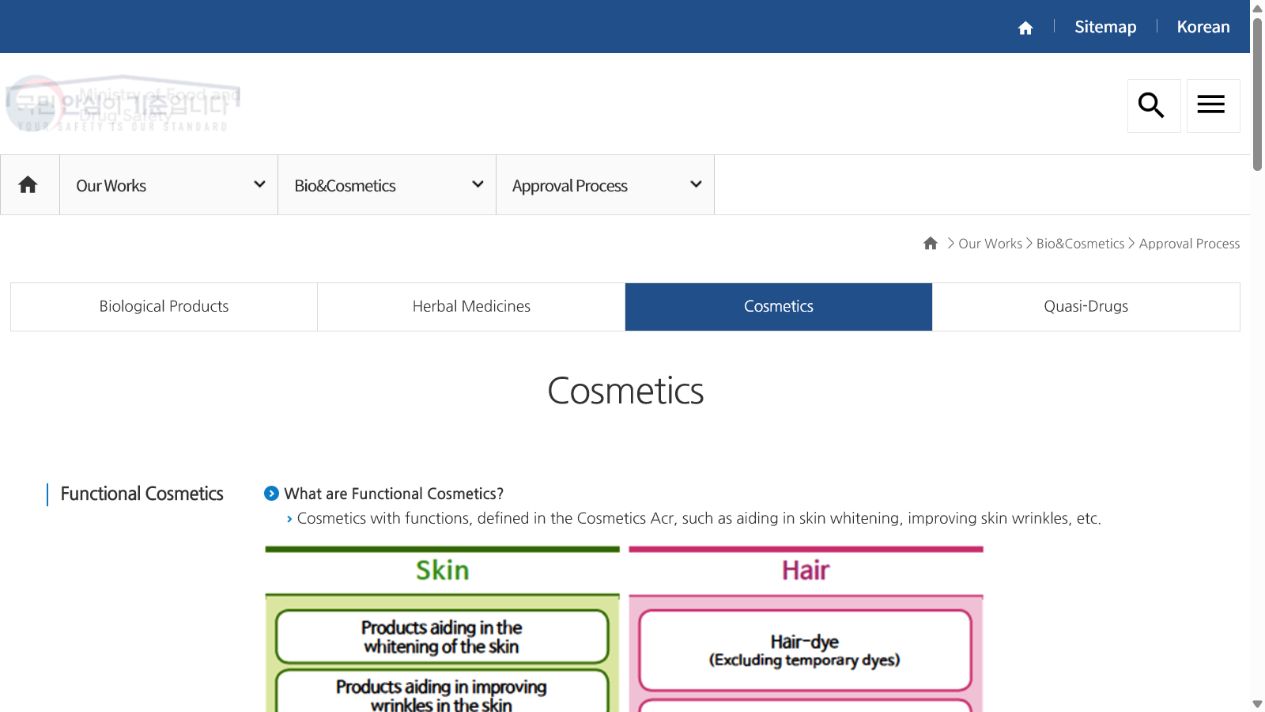
MFDS explains functional cosmetics as cosmetics with legally defined functions such as whitening, wrinkle improvement, UV protection, acne-related functions, atopic-prone dryness, stretch-mark-related functions, hair dye, hair-loss symptom categories, and certain hair-removal products. Its English cosmetics approval page also describes review/reporting paths and data requirements for functional cosmetics.
For a wholesale buyer, this matters because Korean product language can be more than marketing. If a seller offers "whitening," "anti-wrinkle," "SPF," "acne," or "hair loss" products, ask what claim basis exists, what documents can be shared, and whether the product is meant for your destination market.
This is not legal advice. The practical point is narrower: do not buy claim-sensitive cosmetics as if they were ordinary fashion accessories. Ask for documents early, and use a qualified regulatory reviewer for the market where you will sell.
Destination-Market Rules: Korea-Ready Is Not Enough
A Korean product can be legitimate in Korea and still not be ready for your market. The United States, European Union, United Kingdom, ASEAN markets, the Middle East, and other destinations have different rules for labeling, ingredients, product listing, responsible person, claims, language, adverse-event handling, and import responsibilities.
For example, the U.S. FDA's MoCRA page describes new requirements such as facility registration, product listing, adverse-event reporting, safety substantiation, and GMP-related rulemaking. If you are importing Korean cosmetics into the United States, this does not mean a Korean wholesaler automatically handles everything for you. It means you need to understand who is the responsible person, who has the records, and what your role is in the chain.
In the EU and UK, the "responsible person" concept and notification requirements can matter before a cosmetic product is placed on the market. For other countries, local importer, language, halal, safety, ingredient, or product-notification rules may apply. A good Korean supplier can support documents. The buyer still needs destination-market confirmation.
How To Read A Supplier Reply
A useful supplier reply is specific. It names the product version, MOQ, price, currency, order unit, batch or expected batch, expiry range, lead time, payment terms, available documents, and whether brand authorization applies.
A risky reply is vague:
- "We can supply all Korean brands."
- "Do not worry, authentic."
- "We have many warehouse stocks."
- "Payment first, documents later."
- "No need authorization."
- "Same product, different package is okay."
Sometimes a vague reply is just poor English. That is not automatically a deal breaker. But the next email should become more specific. If it does not, remove the candidate from the serious list.
First Email Template For Korean Cosmetics Wholesale
Use a short, structured first email. Do not send a giant essay. The goal is to force clarity.
Hello,

We are an overseas buyer researching Korean cosmetics wholesale supply for [country/market].

Product category:
- [Example: toner/serum/sunscreen/cushion/lip tint/sheet mask]

Sales channel:
- [Example: offline retail / own ecommerce / Amazon / salon / distributor]

Please confirm:
1. Are you the brand owner, authorized distributor, trading company, or other seller type?
2. Can you supply documentation showing authorization or legal supply chain for branded products?
3. What brands/SKUs are available for repeat wholesale supply?
4. MOQ, unit price, currency, Incoterms, lead time, and payment terms?
5. Manufacturing date, expiry date, lot code, and carton quantity?
6. Which documents can you provide before payment?
7. Are there territory, online marketplace, or resale-channel restrictions?

We are building a comparison sheet and will only review candidates that can provide written role and document confirmation.

Thank you.
This kind of email is not rude. Serious suppliers understand why buyers ask. If a seller cannot answer any of these questions, they may not be the right source for branded wholesale.
When Trade Shows Are Worth It
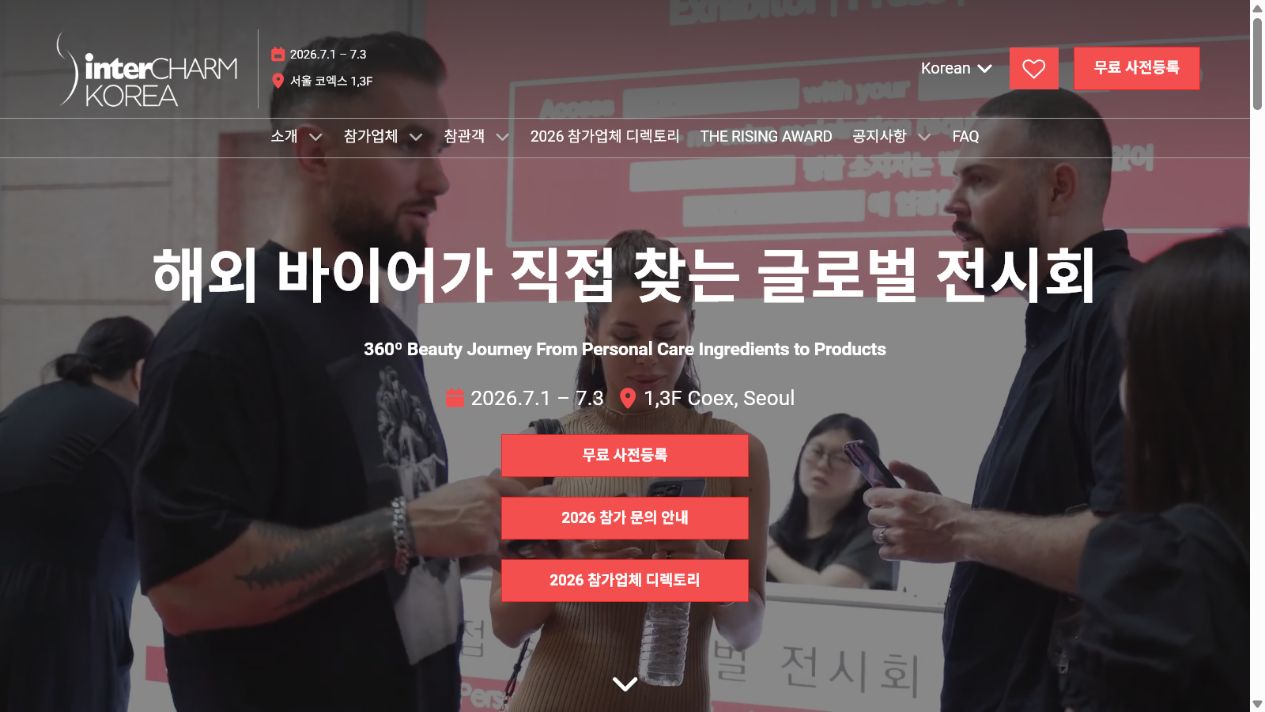
Trade shows are useful when you need to see packaging quality, compare many companies quickly, collect catalogs, and ask face-to-face questions about distribution rights. InterCHARM Korea positions itself as a beauty and cosmetics trade show with overseas buyer focus and a 360-degree beauty journey from personal-care ingredients to products. KOTRA also describes buyer support that includes online marketplace access, business meetings, trade fairs, and import inquiries.
The mistake is treating a booth conversation as proof. Use the trade show to collect candidates. Then send written follow-up:
- Please confirm your company role.
- Please send the exact product list and quotation.
- Please confirm authorization and territory.
- Please provide the documents available before payment.
- Please confirm whether these products can be sold through my intended channel.
If the show conversation and written answer do not match, trust the written evidence, not the excitement of the booth.
The Price Trap
Cosmetics wholesale price comparisons can be misleading because suppliers quote different things. One quote may include fresh stock and brand authorization. Another may be short-dated inventory. Another may exclude shipping. Another may be a limited one-time stock lot. Another may require a large MOQ to keep the price.
Compare quotes only after you normalize:
- Product version and barcode.
- Unit size and set composition.
- Lot and expiry range.
- MOQ and carton quantity.
- Whether the price is FOB, EXW, CIF, DDP, or something else.
- Payment terms and payment protection.
- Whether documents are included before payment.
- Whether repeat supply is possible.
- Whether brand authorization and channel permission exist.
If one quote is dramatically cheaper, do not celebrate first. Ask what is missing.
How To Avoid Counterfeit And Lookalike Problems
Korean beauty's popularity creates room for lookalike products, fake listings, copied packaging, misleading brand claims, and unauthorized online lots. A buyer should not become paranoid, but the proof trail should be boring and consistent.
Ask for high-resolution photos before payment:
- Front and back unit packaging.
- Barcode.
- Lot code.
- Expiry date.
- Inner carton.
- Master carton.
- Korean label.
- Export sticker or destination-market label if applied.
- Product texture only if relevant and safely shareable.
Then compare product names, shade names, packaging design, barcode, claim wording, and ingredient list against official brand or authorized-market references. Packaging can change, so do not reject a candidate only because a box looks updated. Ask for the explanation and supporting documents.
How To Build A Real Comparison Sheet
Use a table, not a chat thread. Every candidate should be scored in the same way.
| Check | Green Signal | Yellow Signal | Red Signal |
|---|---|---|---|
| Seller role | Clear brand owner, authorized distributor, or documented trading role. | Trading role is plausible but factory/brand relationship needs proof. | Seller avoids explaining where inventory comes from. |
| Authorization | Written brand/distributor proof with territory and channel clarity. | Invoice chain exists but brand permission is limited or unclear. | "No need authorization" for a controlled brand or marketplace channel. |
| Batch and expiry | Lot code, expiry range, carton photos, and packing list match. | Batch details available only after deposit. | No lot, no expiry, or mixed inventory without disclosure. |
| Documents | Supplier can provide the documents your channel and market need. | Some documents available, but claims or market listing need outside review. | Only product photos and bank details are offered. |
| Commercial terms | Quotation, Incoterms, MOQ, payment, lead time, defects, and repeat supply are clear. | Price is clear but defect policy or repeat supply needs work. | Urgent payment pressure, unclear company name, or changing bank details. |
A Note On Retailers And Consumer Platforms
Retailers such as beauty stores, global shopping sites, or cross-border consumer malls can be useful for product research: they show pricing, packaging, reviews, popularity, and how products are positioned to consumers. They are not automatically wholesale sources.
Use consumer-facing platforms to understand the market. Use B2B platforms, brand-owner channels, authorized distributors, and documented importers to build supply. The difference is important. A product that sells well at retail may have strict online channel controls. A brand may allow one distributor to sell offline but not permit marketplace resale. A retailer invoice may not satisfy a marketplace's wholesale proof requirement.
If You Are Small, Start Smaller But Cleaner
Small buyers often feel pressure to accept whatever seller will answer them. That is understandable, but dangerous. You can start small without starting sloppy.
For a first test, consider fewer SKUs, fresher stock, clearer authorization, and simpler claims. A 30-SKU launch from an uncertain seller is harder to defend than a 5-SKU launch from a source that can explain its role and documents.
If your goal is long-term K-beauty retail, you are not only buying inventory. You are building a supply file: seller identity, product documents, batch trail, authorization, label review, invoices, shipment records, and customer-response plan.
Sourcing desk setup: Before a Korea buyer trip or trade-show week, compare trade-show planner notebooks, travel document organizers, and barcode scanner inventory tools. Wholesale beauty work is much easier when samples, invoices, barcodes, and booth notes stay organized.
FAQ
Manufacturing and distribution are different layers. EpicKor Business's COSMAX company deep dive explains the ODM/manufacturing side; this guide remains focused on wholesale, authorization, and importer risk.
Q: Where can I find Korean cosmetics wholesale suppliers?
Start with Korea-focused discovery paths such as KOTRA buyer services, buyKOREA, tradeKorea, GobizKOREA, and beauty trade-show exhibitor directories such as InterCHARM Korea. Then verify each seller's role, authorization, batch trail, documents, and destination-market fit before payment.
Q: Is tradeKorea or buyKOREA enough to prove a seller is authorized?
No. A listing can help you discover a Korean seller, but it does not replace brand authorization, invoice-chain review, batch checks, compliance review, or marketplace policy checks. Treat platform discovery as the first step, not final approval.
Q: What is the safest way to buy branded K-beauty wholesale?
The safest route is usually the brand owner, an authorized distributor, or an importer/distributor already approved for your destination market and sales channel. The lowest-price route is not automatically the safest route.
Q: Can I buy Korean cosmetics wholesale and sell them on Amazon?
Possibly, but do not assume. Amazon and other marketplaces may request invoices, authorization, product identity proof, safety documentation, or brand approval. Ask the supplier whether their documents support marketplace resale in your country before you buy inventory.
Q: Are gray-market Korean cosmetics always fake?
No. Gray-market goods may be genuine but sold outside the brand's intended distribution path. The risk is that authorization, warranty, marketplace proof, label compliance, expiry control, and repeat supply may be weak.
Q: What documents should I ask for before paying?
Ask for company identity, seller role, brand authorization if applicable, pro forma invoice, lot or batch information, expiry dates, ingredient list, product and carton photos, packing list, storage conditions, and claim-support documents for claim-sensitive products.
Q: Are Korean sunscreens just normal cosmetics wholesale products?
Do not treat sunscreens casually. SPF products can trigger functional-cosmetic and destination-market requirements. Ask for SPF/PA support, product classification, label details, and market-specific compliance review before buying.
Q: Should I source from an OEM/ODM instead of a wholesaler?
Use OEM/ODM if you want your own brand, formula direction, packaging, and long-term product control. Use authorized wholesale if you want to sell existing Korean brands. The two paths need different documents and different questions.
Sources And Further Reading
More Business Guides
K-Beauty OEM/ODM in Korea: What Overseas Brands Should Check First
A practical K-beauty OEM/ODM guide for overseas brands covering manufacturer roles, MFDS cautions, samples, documents, and first contact.
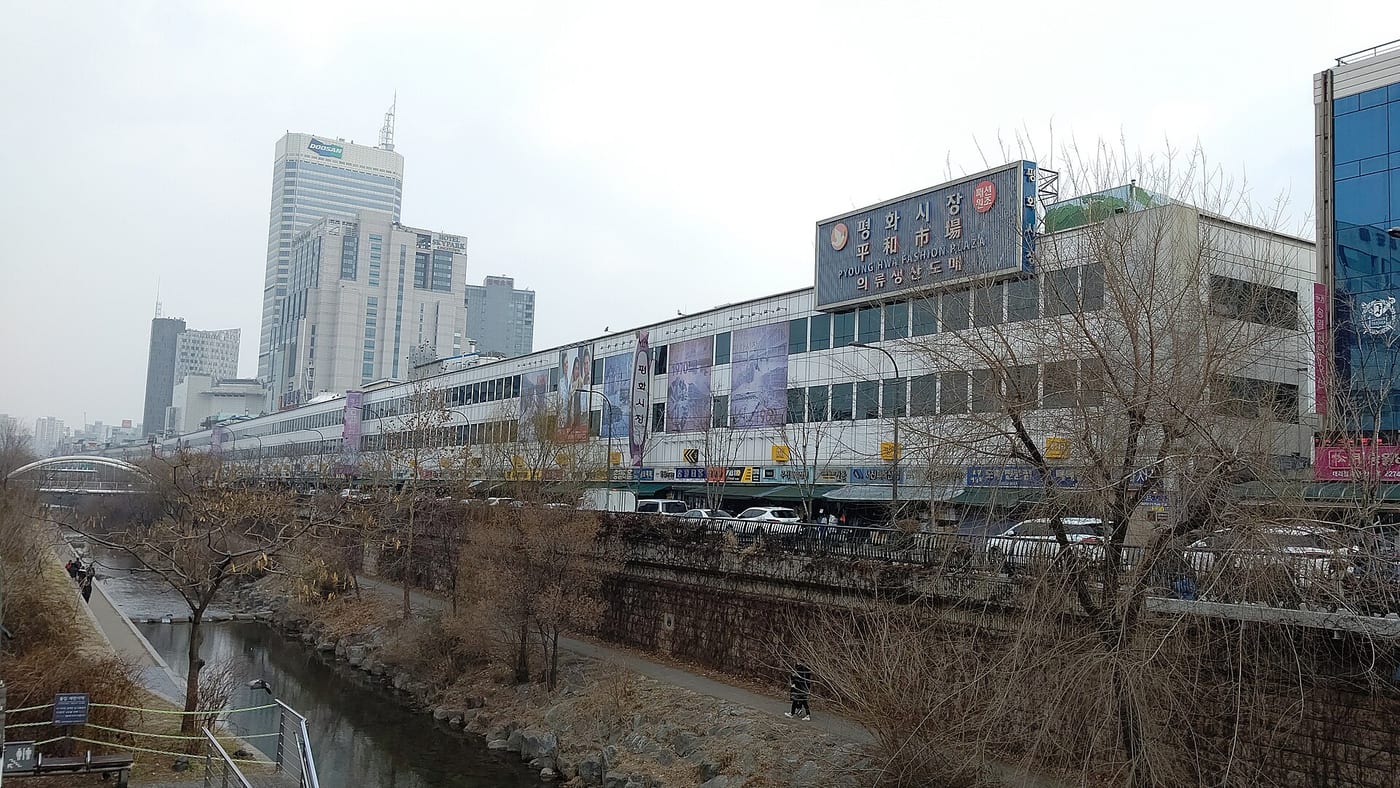
Korean Apparel Manufacturers 2026: Dongdaemun Sourcing Guide
An overseas-buyer guide to Korean apparel manufacturers and Dongdaemun sourcing: wholesale vs OEM, MOQs, sample rooms, quality checks, and export risk.
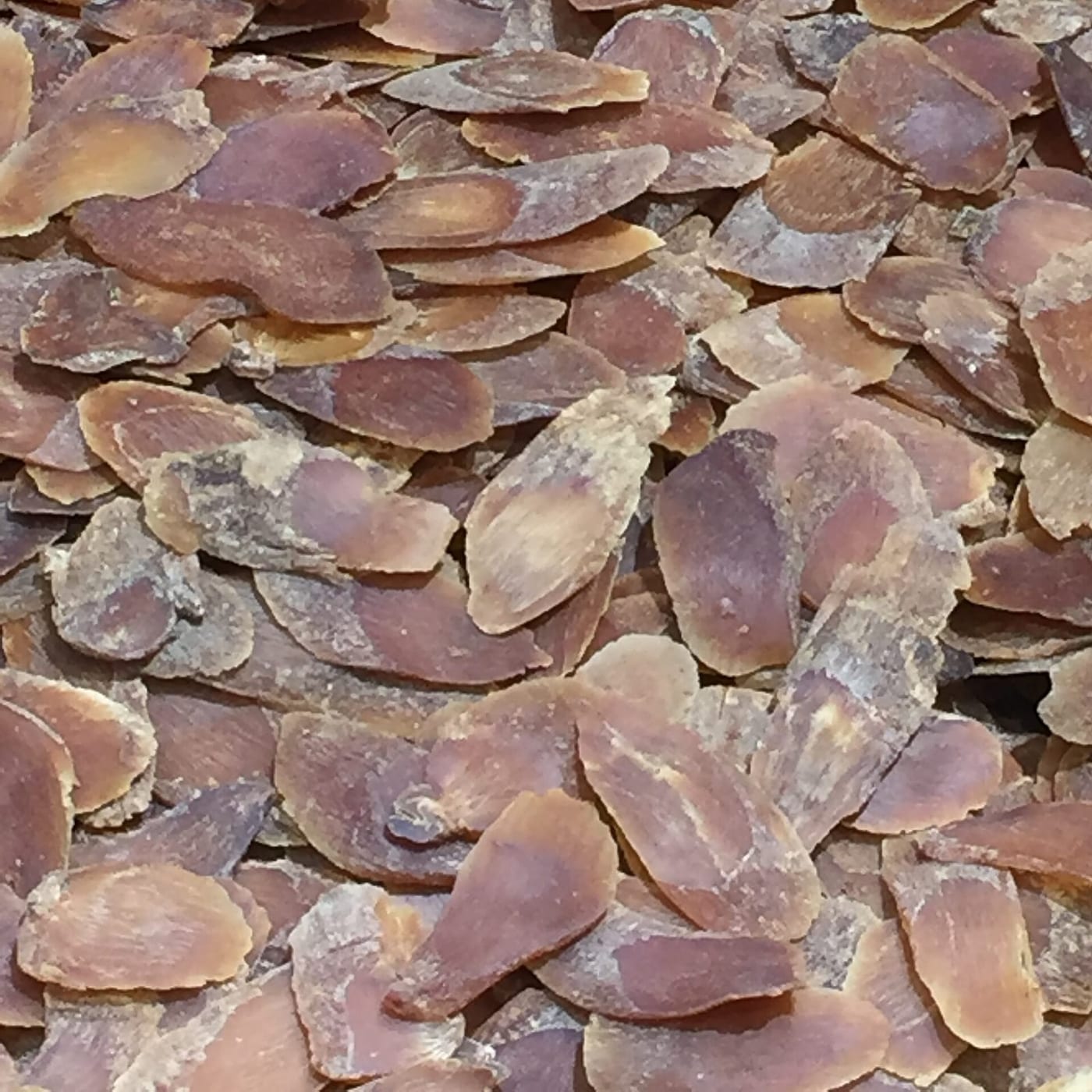
Korean Health Supplement Suppliers 2026: K-Supplement Sourcing Guide
An overseas-buyer guide to Korean health supplement suppliers: red ginseng, collagen, MFDS health functional food rules, GMP, and sourcing risk.