Coupang Deep Dive 2026: How Korea Built Its Own Amazon
A public-info deep dive on Coupang, Korea's dominant e-commerce company, covering Rocket Delivery, 2025-2026 financials, Farfetch/R.LUX, and real risks.
Quick Answer
Coupang is worth studying because it's the clearest real-world test of whether the "Amazon playbook" — owned logistics, same-day delivery, a huge product catalog — can be rebuilt from scratch outside the US. Founded in Seoul in 2010 by Harvard-dropout Bom Kim, Coupang built its own delivery network rather than relying on third-party couriers, went public on the NYSE in 2021 in one of the largest US IPOs of that year, and by 2025 was named to the Fortune Global 500 for the first time.
For overseas readers, Coupang is not just "Korea's online shopping site." It's a live case study in what it actually costs to build Amazon-style logistics in a new market, what happens when a platform this size gets breached, and what regulators do when a dominant e-commerce company is accused of favoring its own products in search results.
This is a public-information-only company spotlight. EpicKor is not implying a client relationship with Coupang, and this article is not investment advice. The goal is to explain what the company is, why it matters, what public data says as of mid-2026, and what overseas readers should independently verify before acting on anything below.
From Seoul Startup to NYSE Listing
Coupang was founded July 1, 2010, in Seoul by Bom Kim, a Harvard Business School dropout. The company relocated its headquarters to Seattle, Washington in 2022, though Korea remains the core of its actual business.
Coupang listed on the New York Stock Exchange (ticker: CPNG) on March 11, 2021, pricing 130 million shares at $35 — above the initial $32-34 range — and raising $4.6 billion in what was the largest US IPO of 2021. That pricing valued the company at roughly $60 billion; shares closed their first trading day up 40% at $49.25, pushing the market cap to about $84.5 billion. As of late July 2026, market-cap trackers place Coupang closer to $28-29 billion, reflecting a stock that's reportedly down roughly 45% over the trailing year — a useful reminder that IPO-day numbers and current reality can diverge sharply.
By its most recent 10-K filing, Coupang employed 108,000 people as of December 31, 2025, up from about 95,000 the year before — a 13.7% increase driven mostly by logistics hiring.
The Rocket Delivery Model
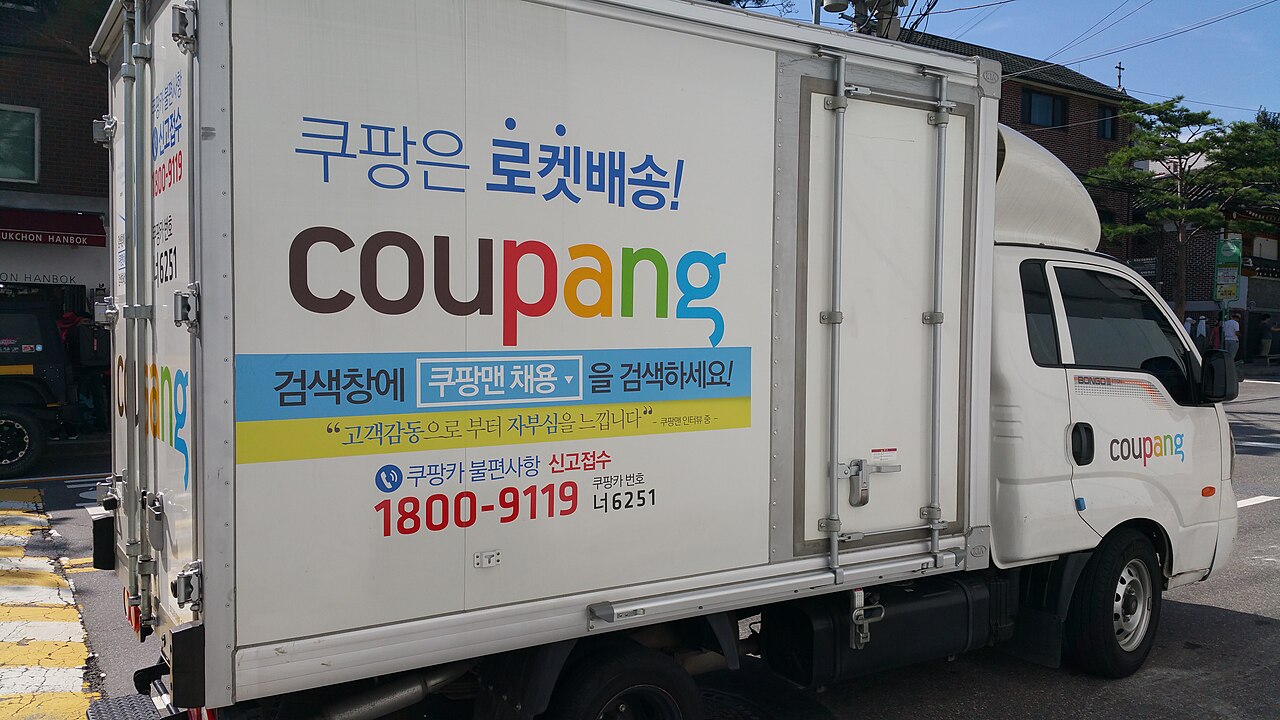
Coupang's core differentiator is that it owns and operates much of its own fulfillment and delivery network, rather than acting as a pure marketplace that hands orders to third-party couriers. The company's own materials describe 99% of orders delivered within a day, with orders placed by midnight arriving by 7am the next morning.
Geographic reach is a genuinely moving target, and it's worth being precise about which claim you're citing. Coupang has pledged ₩3 trillion to expand Rocket Delivery coverage from a current 70% of the country to 88% by 2027, growing from 182 to roughly 230 city/county/district-level service areas. A separate, commonly repeated shorthand — that "70% of the Korean population lives within 7 miles of a distribution center" — describes a similar-sounding but not identically measured reality; treat the two as related, not interchangeable.
The company's own site describes over 100 unique fulfillment and logistics centers covering tens of millions of square feet. (A higher figure of around 200 warehouses circulates in some secondary sources — the company's own count is the more authoritative one to cite.)
| Layer | What it is | Why it matters |
|---|---|---|
| Rocket Delivery | Owned-logistics same/next-day delivery, the core retail business | The structural basis of the entire "Amazon of Korea" comparison |
| Rocket Fresh | Grocery delivery, bundled into Coupang's WOW membership | Extends the owned-logistics model into perishables |
| Coupang Eats | Food delivery, competing directly with Baemin | Grew from roughly 17% to 35.3% credit-card transaction share by 2024, a real #2 position |
| Coupang Play | Streaming service launched Dec 2020, partly built on acquired HOOQ assets | Reached a reported 13% share of Korea's subscription video market by May 2025 |
| R.LUX + Farfetch | Luxury vertical (launched Oct 2024) partnered with Farfetch since June 2025 | Gives Coupang customers access to roughly 1,400 luxury brands via 4-7 day "Rocket Jikgu" shipping |
| Coupang Logistics Services (CLS) | Owned delivery fleet, established 2018 | Runs "Rocket Growth" (3PL-style fulfillment for outside sellers) and "CLS Milkrun" (pickup from small sellers) |
The Farfetch Deal and the Luxury Push
In one of Coupang's more unusual moves, the company and investment partner Greenoaks provided $500 million in December 2023 to take the struggling, NYSE-listed luxury e-commerce platform Farfetch private, completing the deal in early February 2024. The transaction wiped out Farfetch's prior public equity while eliminating roughly $1.6 billion of its debt — and it faced real investor pushback at the time from parties who objected to how the deal was structured.
Coupang's own luxury vertical, R.LUX, launched October 2024 focused initially on beauty. In June 2025, R.LUX and Farfetch announced a partnership giving R.LUX customers access to roughly 1,400 luxury brands — Dolce & Gabbana and Ferragamo among them — across categories from womenswear to fine jewelry, delivered through Coupang's international shipping service in 4 to 7 days depending on origin.
Researching Korea's e-commerce landscape? As an Amazon Associate, EpicKor may earn from qualifying purchases. Compare ecommerce strategy books before applying any single market's playbook elsewhere.
The 2025-2026 Financial Picture
Coupang's full-year 2025 results (released February 26, 2026) showed real, continued growth at the top line: total net revenue of $34.5 billion, up 14% year over year as reported (18% on a currency-neutral basis). Gross profit reached $10.1 billion, up 15%, with a 29.4% margin.
But the more recent quarters tell a sharper story. In Q4 2025, net revenue grew 11% to $8.8 billion, yet the company posted a $26 million net loss — a reversal from a $156 million profit in the same quarter a year earlier — which Coupang explicitly attributed to a data security incident that began in December 2025 (see Risks, below). By Q1 2026, revenue growth had slowed to 8% ($8.5 billion), and the net loss widened to $266 million, with adjusted EBITDA margin collapsing to just 0.3% from 4.8% a year prior. The company cited voucher programs used to win back customers after the breach, plus logistics-network inefficiencies, as the direct cause.
| Period | Revenue | Net income/(loss) | Note |
|---|---|---|---|
| Full Year 2025 | $34.5 billion (+14% YoY) | Gross profit $10.1B, margin 29.4% | Adjusted EBITDA margin 4.3%, down 23 bps YoY |
| Q4 2025 | $8.8 billion (+11% YoY) | ($26) million | vs. $156M profit in Q4 2024; company cites the data incident |
| Q1 2026 | $8.5 billion (+8% YoY) | ($266) million | vs. $107M profit in Q1 2025; breach-recovery vouchers cited |
This is a genuinely useful story for anyone trying to understand platform-scale risk: a company that grew revenue 14% for the full year got hit hard on the bottom line within months, specifically because of a security failure and its cleanup costs — not because the underlying retail business slowed down.
International Expansion: Taiwan
Taiwan is Coupang's clearest international bet outside Korea. The company entered with an app-based on-demand delivery pilot in July 2021, then launched its full Rocket Delivery service there in October 2022. It became Taiwan's most-downloaded app in the second quarter of 2023, and as of late 2025 Coupang was reportedly continuing to invest in Taiwanese logistics infrastructure and roll out a WOW-style membership program there. No other confirmed international market entry beyond Taiwan was found in current reporting.
Risks and Watchlist
The 2025 data breach. A former Coupang employee retained database access after leaving the company and, using overseas servers, accessed customer data without authorization for nearly five months starting June 24, 2025. The breach wasn't detected until November 6, 2025, and wasn't publicly disclosed until December 1, 2025. It affected 33.7 million customer accounts — full names, phone numbers, email addresses, physical addresses, and order details, though notably not payment information or passwords. In June 2026, Korean regulators fined Coupang ₩624.9 billion (roughly $400-450 million depending on the exchange rate used), described as the largest consumer data-breach fine in Korean corporate history. Coupang also separately committed to compensating affected users and faces a US class-action lawsuit from breach victims.
Labor and workplace safety. Union figures cite 27 Coupang worker deaths since 2020, including several recent, specifically reported cases in late 2025 tied to overwork conditions at logistics centers, and Korea's labor ministry has launched a task force investigating suspected labor-law violations. Coupang has publicized over $200 million invested in worker health and safety initiatives since 2020 as a counterpoint — a company claim worth noting alongside, not instead of, the independent reporting.
Fair Trade Commission scrutiny. In August 2024, Korea's Fair Trade Commission ruled that Coupang and its private-label subsidiary CPLB manipulated search-ranking algorithms to favor Coupang's own products, and had staff write tens of thousands of reviews for private-label items. Coupang's cumulative KFTC fines across 2022 through mid-2025 total roughly ₩162.87 billion, making it the single most-fined company under the KFTC in that period, separate from the specific 2024 case's own fine. Coupang and CPLB filed an administrative appeal in September 2024; as of the most recent available reporting, that litigation was still pending at the Seoul High Court.
| Watch Area | Why It Matters |
|---|---|
| Data security | The 2025 breach directly caused measurable revenue and profit damage in the following two quarters — a real, quantified example of security risk hitting the bottom line. |
| Labor practices | Ongoing government investigation into working conditions at logistics centers, with real, reported worker deaths. |
| Regulatory/antitrust exposure | Repeat KFTC fines for self-preferencing behavior, with litigation still unresolved as of the most recent reporting. |
| Structural profitability gap vs. Amazon | Coupang has no AWS-equivalent high-margin business subsidizing its logistics investment, which analysts cite as the core reason its profitability lags Amazon's despite a similar playbook. |
What Overseas Buyers and Sellers Should Know
A foreign brand without a Korean legal entity has three realistic paths onto Coupang: Coupang Global Services, which ships US-sourced inventory into Coupang's own logistics network and awards a "Purple Rocket Badge" that measurably improves conversion; Rocket Growth, a 3PL-style program storing inventory in Coupang's warehouses for Rocket-speed fulfillment; or working through a managed-service provider that acts as both Importer of Record and Seller of Record, handling registration, tax, and customs on the brand's behalf. Regardless of path, expect to handle business/seller registration, payment settlement, and — for imported goods — a legal importer of record.
On the "Amazon of Korea" comparison specifically: the label is fair as far as the owned-logistics, huge-catalog retail model goes. Where it breaks down is that Coupang has no AWS-equivalent side business — no high-margin cloud/infrastructure arm subsidizing the retail investment — which is exactly why Coupang's margins have historically lagged Amazon's despite pursuing a structurally similar playbook. Coupang has instead diversified horizontally (Eats, Play, Farfetch/R.LUX) rather than vertically into enterprise infrastructure.
Studying Korea's platform economy? As an Amazon Associate, EpicKor may earn from qualifying purchases. Browse e-commerce business books for the deeper playbook behind owned-logistics retail before comparing it to your own market.
FAQ
Q: What is Coupang?
Coupang is South Korea's dominant e-commerce and logistics company, founded in 2010 and listed on the NYSE since 2021. It built its own delivery network rather than relying on third-party couriers, which is the basis of its common "Amazon of Korea" nickname.
Q: Is Coupang the same as Amazon?
No, though the comparison is structurally reasonable. Both run owned-logistics marketplaces selling first- and third-party inventory. The key difference is that Amazon has AWS, a high-margin cloud business subsidizing its retail investment; Coupang has no equivalent, which is a major reason its profitability has historically lagged Amazon's.
Q: What happened with Coupang's 2025 data breach?
A former employee retained unauthorized database access for nearly five months in 2025, exposing 33.7 million customer accounts' personal information (not payment data or passwords). Korean regulators fined Coupang roughly ₩624.9 billion in June 2026 — the largest such fine in Korean corporate history — and the breach measurably hurt Coupang's Q4 2025 and Q1 2026 financial results.
Q: Can a foreign brand sell on Coupang without a Korean company?
Yes, through a managed-service provider that acts as Importer of Record and Seller of Record on the brand's behalf, or via Coupang Global Services for US-based sellers shipping into Coupang's own logistics network.
Q: Is Coupang profitable?
It has been in some periods and not others. Full-year 2025 revenue grew 14% with a positive adjusted EBITDA margin, but Q4 2025 and Q1 2026 both posted net losses, which the company attributes to costs from responding to the 2025 data breach.
Sources and Further Reading
More Business Guides
Kovea Deep Dive: The Korean Burner Maker That Took Apart a Swedish Stove — and Now Builds for MSR
Look at the box your Snow Peak LiteMax came in and it says Made in Korea. Kovea started in 1982 when its late founder took apart a Swedish SVEA burner, now supplies MSR and Decathlon, and still earned a 21% operating margin after Korea's camping market halved.

Mooto Deep Dive: Korea Still Dresses Taekwondo — Spain Makes the Part That Scores the Points
World Taekwondo recognises Mooto in six equipment categories. The two it is absent from are the electronic ones — and the scoring system at Tokyo 2020 and Paris 2024 came from Barcelona. A look at the Korean company that dresses the sport Korea exported.
Aurora World Deep Dive: The Korean Company Behind the Plush Toy on Your Shelf
Aurora's plush sits in zoo shops, bookstores and Target aisles worldwide, and its own American website never mentions Korea. A public-information deep dive on the Seoul company that owns its factories, built Palm Pals, and bought a 90-year-old Vermont brand.