Korea's Data Breach Crisis: From Coupang to TVING
South Koreans live inside one of the world's most connected consumer systems. A phone number can connect shopping, delivery, streaming, identity verification, banking alerts, transport, and government services. That convenience becomes a liability when a company keeps more personal data than it can safely govern.
The Coupang data breach and the more recent TVING data leak made that risk visible at national scale. The cases are different. Coupang has already received a detailed final decision from the Personal Information Protection Commission (PIPC), including a record-size fine and findings about key management, monitoring, notification, data retention, and evidence preservation. The TVING investigation is still in progress, so its reported 19.5 million affected people and the exact cause should not be treated as a final regulatory conclusion.
This article explains what is confirmed, what remains under investigation, why the public response has been so hostile, how the companies behaved after discovery, and what the Korean government is changing as of July 19, 2026.
Quick Answer: What Is Wrong With Korea's Personal-Data System?
The immediate problem is weak security and internal control. The deeper problem is data accumulation. Korean platforms often hold names, email addresses, phone numbers, delivery addresses, birth dates, bank-refund details, service histories, and identity-linking values across years of free, paid, dormant, partner, or former accounts. A breach can therefore affect far more people than a service's current paying-member count.
In the Coupang case, the regulator said the attack did not require a highly sophisticated hacking technique. A former employee who had worked on an alternative-authentication function obtained a signing key, forged authentication tokens, and accessed personal-information pages over months. The PIPC described failures in basic key access, rotation, anomaly detection, notification, data deletion, privacy-officer governance, and log preservation.
In the TVING case, unauthorized database access and file leakage were detected, and the exposed fields reportedly included unusually sensitive identity-linking and account information. But the PIPC investigation is not final. That difference in legal status must be preserved.
YubiKey 5 NFC — a phishing-resistant hardware key for your accountsAffiliate link. As an Amazon Associate, EpicKor earns from qualifying purchases at no extra cost to you.
Coupang: What the Regulator Confirmed
The PIPC announced its Coupang decision on June 11, 2026, after a meeting that included more than 13 hours of hearing and deliberation. It imposed a total administrative fine of 624.681 billion won on Coupang, plus a 16.8 million won administrative penalty, and a separate 248 million won fine on Coupang Fulfillment Services for other privacy violations.
The total included two large categories. The data-leak and related duty violations accounted for 423.575 billion won. A separate 201.106 billion won concerned Coupang Partners' unlawful collection and storage of 11.17 million members' activity on third-party websites and apps without a valid legal basis.
The breach itself ran from April to November 2025. According to the PIPC, a former employee who had developed an alternative-authentication feature obtained the feature's signing key and created forged tokens. The attacker used those tokens to access account-modification, delivery-address, and order-history pages.
The regulator confirmed personal information involving approximately 33.22 million members and at least 4.33 million nonmembers. The member data included roughly 33 million names and email addresses, at least 22.3 million delivery records, and about 58,000 order histories. Delivery records also contained the names, phone numbers, and addresses of family members, friends, and other people who had never opened Coupang accounts themselves.
That nonmember exposure is one of the most important facts. When a shopper sends a gift or saves another person's address, the platform becomes responsible for people who may not know their data is stored.
Why the Coupang Findings Were So Damaging
The PIPC concluded that this was not simply a story about one malicious former employee. It was a control failure.
The signing key could be viewed in plaintext by staff who did not need such access. Coupang did not immediately rotate or retire the key after the employee left. During the attack period, traffic to pages containing personal information increased abnormally, but the company did not identify the behavior before a customer complaint connected to an extortion email. Blocking thresholds were insufficient, and detected anomalies were not fully analyzed.
The regulator also found notification failures. Coupang delayed notice to about 160,000 members whose delivery information was later confirmed as leaked and did not notify affected nonmembers in the delivery-address data. Some information from former members remained after retention periods had expired.
The governance finding was equally serious. Coupang excluded its chief privacy officer from an internal decision process while conducting and publishing parts of its own investigation. The PIPC said that undermined the privacy officer's legally protected independence.
Finally, after the regulator ordered evidence preservation, Coupang manually deleted about five months of app-access logs and did not stop an automatic policy that removed application logs older than six months. The PIPC said this made the true scale harder to establish. It announced that a criminal complaint would follow for conduct that obstructed the investigation.
| Issue | Coupang: Final PIPC Finding | TVING: Status as of July 19 |
|---|---|---|
| Discovery | Company learned through a customer complaint linked to an extortion email | TVING detected unauthorized database access and file leakage on June 2 |
| Reported population | About 33.22 million members plus at least 4.33 million nonmembers | About 19.5 million people in materials obtained by a lawmaker; not yet a final PIPC determination |
| Key data | Names, emails, delivery information, and limited order histories | Reported fields include IDs, names, dates of birth, phone/email, password data, CI/DI, refund-account details, and service-use records |
| Cause | Forged tokens using a compromised authentication signing key; multiple basic-control failures confirmed | Unauthorized access confirmed; exact technical cause and legal violations remain under investigation |
| Regulatory status | Final PIPC decision and corrective orders announced June 11 | Joint public-private and PIPC investigation ongoing |
Coupang's Response and the Compensation Backlash
Coupang apologized and said it had strengthened preventive measures, but it also argued that important facts and improvements were not sufficiently reflected in the PIPC decision. The company defended the legality of its Coupang Partners advertising model and said it expected to use available legal procedures.
A company has a right to challenge a regulator. The public-relations problem was the contrast between the regulator's findings and the company's posture. When an authority documents plain-text key exposure, failure to rotate credentials, months of missed abnormal traffic, delayed notice, expired data, exclusion of the privacy officer, and deleted logs, a response centered on what the decision omitted can sound defensive even if legal objections exist.
Coupang's earlier customer-compensation plan also drew criticism. It offered vouchers nominally worth 50,000 won, but only 5,000 won applied to ordinary Coupang purchases and 5,000 won to Coupang Eats. The remaining 40,000 won was divided between Coupang Travel and luxury platform R.LUX, with a three-month expiration and use restrictions. Critics called it customer retention or marketing disguised as compensation. That criticism should be attributed, not presented as a court finding. The vouchers were a company program, not a final calculation of legal damages.
Group dispute-mediation cases involving Coupang users also resumed after the PIPC decision. That process is separate from the administrative fine and from any individual civil claim.
Protect the accounts you can control: As an Amazon Associate, EpicKor may earn from qualifying purchases. Compare a FIDO2 hardware security key and a practical password-security guide. They cannot repair a company's database controls, but they can reduce damage from reused passwords and account takeover.
TVING: What Is Confirmed and What Is Not
TVING detected unauthorized database access and file leakage on June 2, 2026. The PIPC received the report early on June 3 and began investigating with relevant authorities. The regulator's public notice listed potentially involved categories including IDs, names, dates of birth, sex, connecting information (CI), duplication information (DI), phone numbers, email addresses, refund bank-account information, password data, and service-use histories. Some fields were encrypted.
Materials obtained by Democratic Party lawmaker Lee Jeong-heon from the PIPC and Ministry of Science and ICT indicated that about 19.5 million people were affected. KBS World reported that figure as nearly four times TVING's paying-member count.
The phrase “about 19.5 million” needs a label. It is a reported estimate based on parliamentary materials, not the PIPC's final published finding. The investigation could refine the population, affected fields, cause, retention history, and violations.
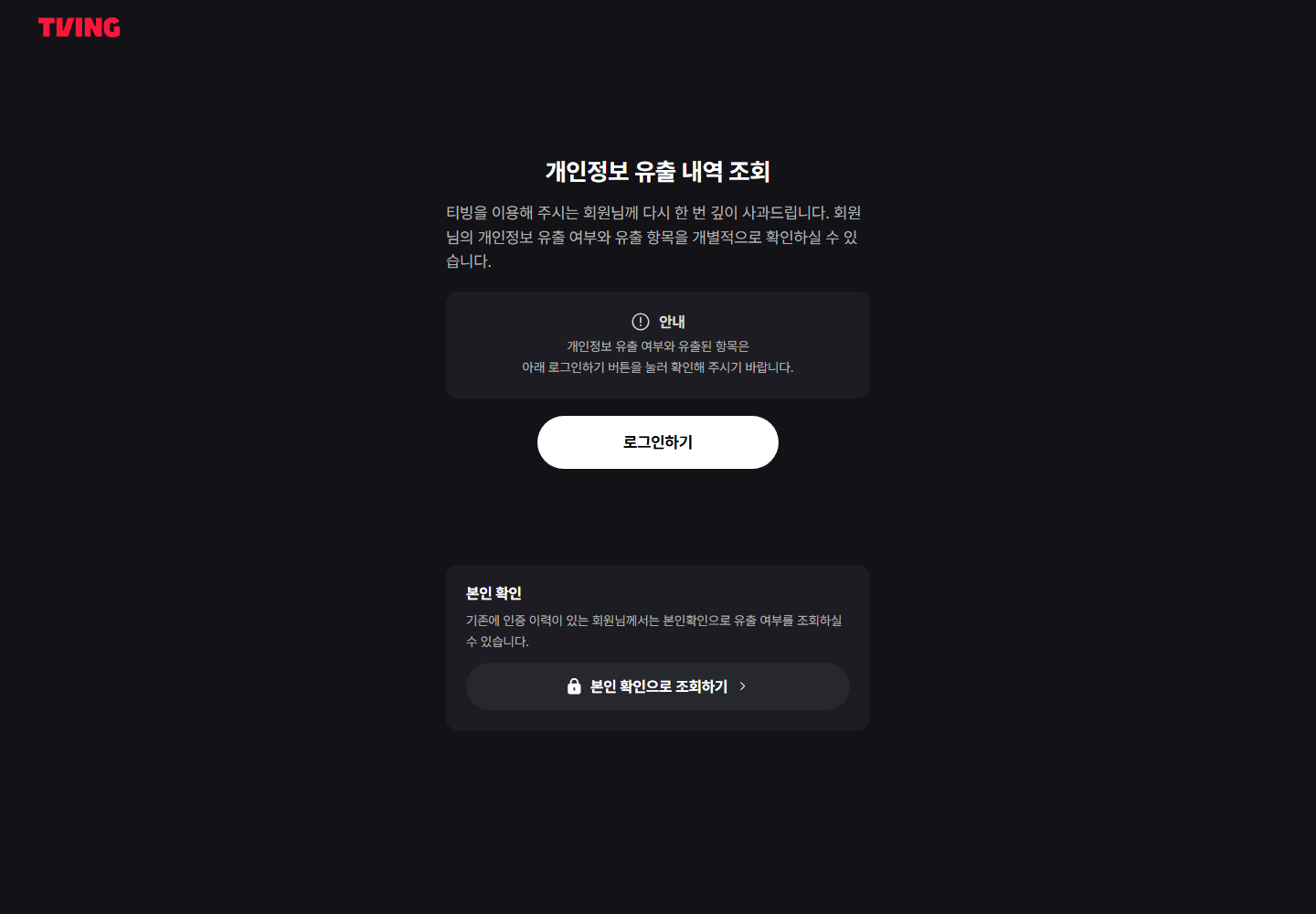
TVING apologized, said it would take responsibility and provide relief, and pledged to cooperate with the joint public-private investigation. It opened an official page where members can log in and check whether their information was exposed and which fields were involved. The company also advised users to change TVING passwords and any reused password on other services.
Why CI and DI Create Special Anxiety in Korea
Connecting information and duplication information are technical identity-linking values used in Korea's online verification ecosystem. They are not displayed like a resident registration number, but they can consistently distinguish or connect a person across services. Unlike a password, a person cannot simply choose a new CI or DI after a leak.
That does not mean every exposed CI or DI automatically enables identity theft. Exploitation still depends on other controls and data combinations. But the values increase long-term risk because they can help attackers correlate records, construct convincing phishing messages, or combine one breach with information from another.
The inclusion of refund-account details, dates of birth, phone numbers, and service histories can also make social engineering more persuasive. A message that names the correct streaming service, references a refund, and includes partial personal information is more believable than generic spam.
Why the Number Can Exceed Paying Subscribers
People often ask how TVING could report a population several times larger than its current paying membership. Paying subscribers are not the same as stored identities. A platform can retain records for free accounts, former subscribers, dormant users, promotional accounts, partner logins, migrated services, and refund transactions.
The final investigation must establish exactly which categories explain TVING's count and whether each retention period was lawful. It is reasonable to ask the question; it is not responsible to invent the answer before the regulator publishes evidence.
This is a core governance lesson. Companies should inventory not only active customers but everyone whose data remains in their systems. If executives track paying users more carefully than retained identities, security planning will underestimate the real blast radius.
How Koreans Are Reacting
Public reaction combines fatigue, anger, and practical fear. Korea experienced a series of major incidents across telecommunications, retail, finance, publishing, travel, gaming, and streaming. People increasingly feel that changing one password after one breach does not solve the systemic problem because the same phone number, identity values, and account history appear across many platforms.
That exposure sits inside the same app-centered daily life described in EpicKor's guides to Korean food-delivery culture and Naver Map and Kakao T. Those services are useful precisely because accounts, payments, addresses, and location-dependent actions connect so smoothly—which is also why data governance matters.
In the Coupang case, some users promoted or discussed “Talpang,” a Korean portmanteau meaning to leave Coupang. Consumer groups demanded stronger compensation and accountability. The restricted voucher plan then created a second wave of anger because it required affected customers to keep spending inside Coupang's ecosystem to receive most of the nominal value.
TVING triggered a different kind of alarm. Streaming can feel low risk compared with banking or telecom service, so reports involving CI, DI, password data, and refund accounts challenged the assumption that an entertainment subscription is a minor identity footprint.
Still, online outrage is not a scientific measure of all Koreans. The fact-based conclusion is that distrust has broadened from individual firms to the data economy itself.
The Pattern in Corporate Behavior
The two cases reveal several recurring behaviors.
First, companies often describe a breach as an external attack before the public understands internal control failures. Attackers are responsible for intrusion, but a mature post-incident account also explains why access was possible, why it was not detected, and why so much data was available.
Second, legal defense and customer communication can collide. A company's lawyers may avoid admissions while customers want direct responsibility. The result is language that sounds cautious or self-protective at the moment people want clarity.
Third, compensation can double as customer retention. Vouchers, credits, or expiring benefits may have real value, but they are not neutral if they require more purchases or funnel users into less-used services.
Fourth, the chief privacy officer can exist on an organization chart without real power. Coupang's case is a warning that privacy governance fails when the officer is excluded from decisions during the most important incident.
Finally, evidence preservation is part of security. Logs are not disposable operational clutter after a breach. They are the record needed to find victims, reconstruct the attack, and test company claims.
What the Korean Government Is Doing
Korea amended the Personal Information Protection Act in March 2026. Major provisions take effect on September 11. For repeated or grossly negligent large-scale violations meeting statutory conditions, the maximum administrative fine can rise from 3 percent to 10 percent of total revenue. The revised framework also strengthens chief-executive responsibility, the role of privacy officers, early notification, and information about redress. Major processors will face expanded ISMS-P certification duties on a later schedule.
The government also announced a broader privacy policy plan in July. It includes regular risk checks, dedicated task forces for incidents affecting more than 100 million records or other major cases, examination of hundreds of critical public systems, stronger evidence-preservation tools, victim-recovery mechanisms, and additional AI-era privacy support.
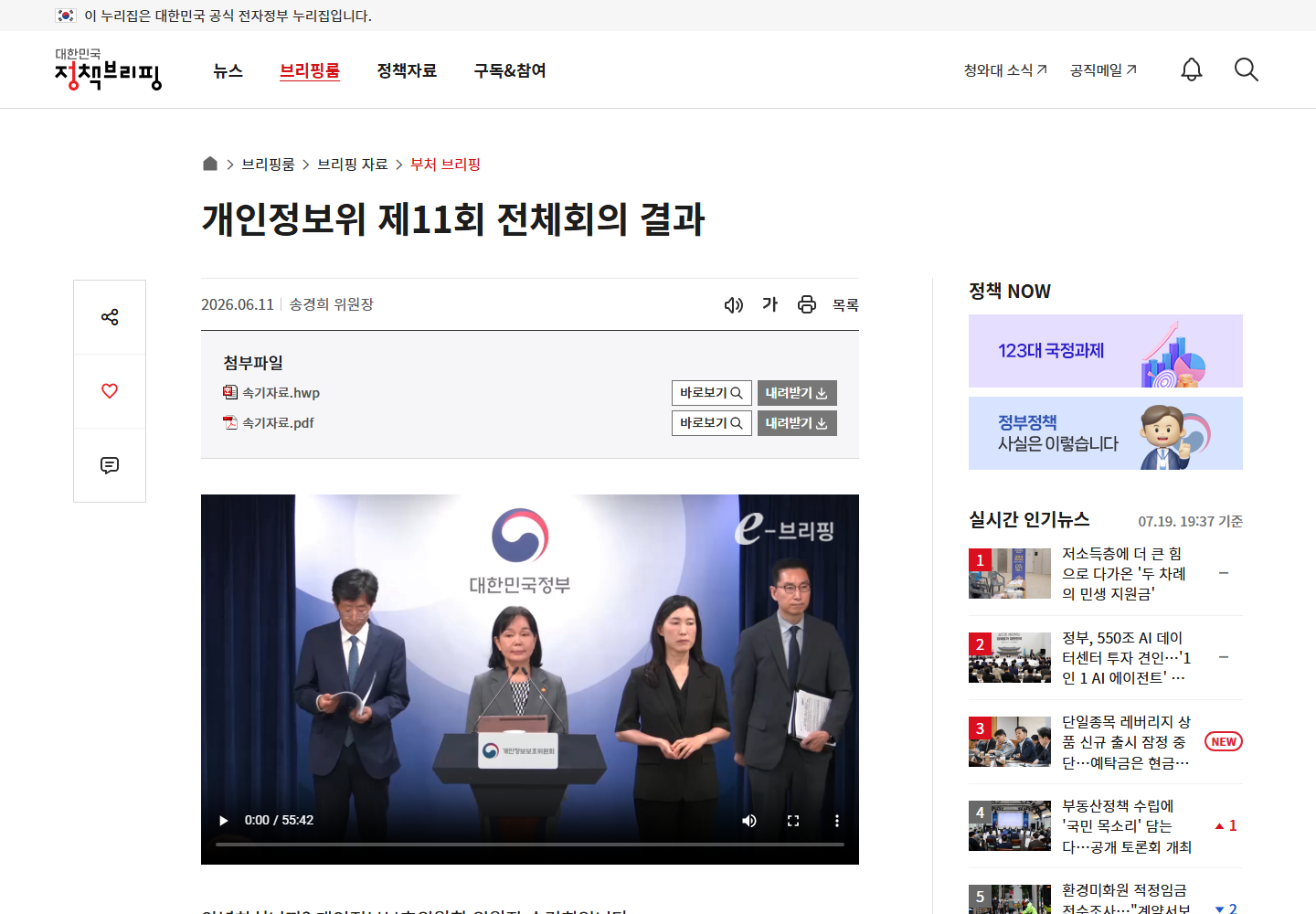
Those reforms are meaningful, but fine ceilings alone cannot solve the problem. Enforcement speed, technical expertise, evidence access, board accountability, and whether companies reduce unnecessary data will determine whether the law changes behavior.
The same distinction between public anger and documented institutional failure also matters in our guide to Hong Myung-bo and the Korea Football Association crisis.
| Needed Change | Why It Matters | Evidence Users Should Expect |
|---|---|---|
| Data minimization | Less retained data means a smaller breach | Published retention periods and verified deletion for former/dormant accounts |
| Credential and key governance | One privileged secret should not unlock millions of identities | Least-privilege access, rotation on staff departure, hardware-backed storage, audit trails |
| Anomaly detection | Months of abnormal access should not depend on a customer complaint | Rate limits, behavioral alerts, investigated detections, tested incident drills |
| Independent privacy leadership | The privacy officer must be able to challenge business and legal teams | Board reporting, documented authority, protected participation in incident decisions |
| Evidence preservation | Victims and regulators need a reliable timeline | Immediate legal holds, immutable logs, deletion suspension, third-party forensic review |
| Fair redress | Marketing credits do not equal loss-based compensation | Clear eligibility, cash or genuinely flexible options, no forced additional spending |
What Affected Users Should Do Now
TVING users should visit the official lookup page directly rather than through a text-message link. Change the TVING password and every other account using the same or a closely related password. Turn on multi-factor authentication where available. Review the email address, phone number, refund account, and other fields shown in the personalized notice.
Coupang users should remain skeptical of calls or messages that mention delivery addresses, refunds, vouchers, or compensation. Because nonmembers were also affected through saved delivery information, a person without a Coupang account should not assume a Coupang-themed phishing message is automatically irrelevant.
Monitor bank alerts and account-recovery emails. Do not provide a one-time code to someone claiming to be a company employee. Report suspicious messages through official channels. KISA's free 118 service provides guidance for privacy incidents, phishing, smishing, hacking, and related reporting.
Most importantly, do not blame yourself for a company's database failure. Password hygiene reduces account-takeover risk; it does not transfer responsibility for enterprise key management, retention, monitoring, or regulatory compliance to the user.
Final Take
Coupang is a completed regulatory case with unusually detailed findings. The PIPC identified basic security and governance failures, a vast member and nonmember impact, notification and deletion problems, and conduct that made the investigation harder. Coupang apologized but disputes parts of the decision and may pursue legal remedies.
TVING is a live investigation. Unauthorized access and a leak are confirmed, an official user lookup page exists, and parliamentary materials indicate roughly 19.5 million affected people. The exact scope, cause, violations, and final remedies remain open.
Together, the cases show that Korea's privacy crisis is not just a sequence of hacks. It is a governance problem: too much linked identity data, insufficient internal control, delayed accountability, and compensation designed without enough attention to trust.
Build a small recovery kit: Compare a basic personal privacy kit and a paper account-recovery organizer. Keep recovery codes offline and never store passwords in the same document.
FAQ
Q: How many people were affected by the Coupang breach?
The PIPC confirmed approximately 33.22 million members and at least 4.33 million nonmembers. Some nonmembers appeared in delivery-address records saved by Coupang users.
Q: Is the 19.5 million TVING figure final?
No. The figure came from materials obtained by a lawmaker from government bodies and was reported by KBS. The PIPC investigation remains ongoing, so the final affected population and fields may change.
Q: Were TVING passwords leaked?
Password data was among the categories identified in official and parliamentary reporting, with some fields described as encrypted. Users should still change their TVING password and any reused password elsewhere.
Q: Why was Coupang fined so much?
The total covered both the large data breach and related duty violations, plus a separate finding that Coupang Partners unlawfully collected and stored third-party online activity linked to 11.17 million members. The decision also considered the scale and seriousness of safety-control failures.
Q: Did Coupang pay every victim 50,000 won in cash?
No. Coupang offered restricted purchase vouchers with a nominal combined value of 50,000 won across several Coupang services. The plan was not cash and was criticized for expiration dates, use limits, and its customer-retention effect.
Q: Where can people get help in Korea?
KISA's free 118 service offers guidance on privacy incidents, phishing, smishing, hacking, and reporting. Users should also use TVING's official leak lookup page and company/regulator notices rather than links in unsolicited messages.
Sources and Further Reading
- Korea Policy Briefing / PIPC: final Coupang decision and detailed findings
- Coupang: company response to the PIPC decision
- Hankyoreh: criticism and conditions of Coupang's voucher plan
- PIPC: official notice on the TVING breach investigation
- KBS World: reported TVING impact based on parliamentary materials
- TVING: official personal-information leak lookup page
- PIPC: 2026 Personal Information Protection Act amendments
- PIPC: July 2026 privacy policy and enforcement plan
- KISA: Cyber Helper 118 reporting and support
You Might Also Like

Why Korean Fans Are Angry at Hong Myung-bo and the KFA
A fact-checked guide to South Korea's 2026 World Cup exit, Hong Myung-bo criticism, the KFA audit, fan anger, and reform measures now underway.

International School Tuition in Korea: Fees by School, Who Can Enrol
Seoul Foreign School's ₩33.37 million high-school fee is really ₩53.9 million once its $14,955 dollar part is added, the figure it files with the government. 2026–27 fees school by school, extra costs, and the 3-year rule for Korean children.
Korean English Kindergarten Ban: Why Korea Outlawed Entrance Tests for Preschoolers, and What Parents Pay
Since 1 October 2026 it is illegal in Korea to test a preschooler to get into an English kindergarten, the '4-year-old exam' (4세 고시). Fines reach ₩3 million. What the law says, what English kindergartens cost, and the ladder to medical school.