Korean Ingredient Label Guide: Allergens, Pork, Gelatin
Korean ingredient labels look like a wall of tiny text, so most visitors either photograph the whole thing for translation or give up and guess.
Neither is necessary, because Korean law has already done most of the work. Allergens must be printed in their own box, near the ingredient list, on a background colour that differs from the rest of the label — and they must be declared no matter how small the quantity. You are not looking for words buried in a paragraph. You are looking for a box that has been deliberately made to stand out.
This guide covers what is in that box, the 19 substances Korea legally requires it to name, the cross-contact wording that sits beside it, and the date-label change that still confuses people in 2026.
It is not medical advice. If you have a severe allergy, a religious dietary restriction, or a medical diet, use the official label, ask the manufacturer, carry a translated allergy card, and follow your clinician.
Anker 10,000mAh power bank — on AmazonAffiliate link. As an Amazon Associate, EpicKor earns from qualifying purchases at no extra cost to you.
The Short Answer
| Question | Answer |
|---|---|
| Where are allergens? | A separate box near 원재료명, with a background colour that differs from the label |
| How many must be declared? | 19, listed below, at any quantity |
| The word to find | 알레르기 유발물질 or just 알레르기 |
| "Made in the same factory"? | Look for 혼입 가능 — that is a cross-contact warning, not an ingredient |
| Ingredient list heading | 원재료명 |
| Date on the package | 소비기한 (use-by) on almost everything since 2023 — but milk still uses 유통기한 |
| Certified halal? | Requires certification; "할랄 프렌들리" is self-declared and different |
Find the box, not the words
This is the single most useful thing on this page, and almost no English guide says it.
Under Korea's food labelling rules, when an allergen is used as an ingredient — or as an extract, a derived component, or inside another ingredient — the manufacturer must set up a separate allergen box near the ingredient-name section, visually distinguished from the surrounding background, and name the allergen there. Crucially, this applies regardless of the amount used. There is no "too small to declare" threshold for the listed items.
What that means in a convenience store:
- Turn the package over.
- Find the block of small text headed 원재료명 (ingredient names).
- Immediately next to or below it, look for a box printed on a different background shade, usually headed 알레르기 유발물질 or simply 알레르기.
- Read the box. It is a short comma-separated list of nouns, not a paragraph.
If you learn only your own trigger words, you can check most packaged food in about five seconds without translating anything. That is worth practising before you need it — our convenience store food guide covers what is on those shelves in the first place.
The 19 that must be declared
Korea's legally mandated allergen list contains 19 items. This is not a list of "words you might see" — if one of these is in the product, it must appear in that box.
| Korean | English | Notes |
|---|---|---|
| 알류 | Eggs | Poultry eggs only (가금류에 한함) |
| 우유 | Milk | |
| 메밀 | Buckwheat | Naengmyeon, makguksu, some soba-style noodles |
| 땅콩 | Peanut | |
| 대두 | Soybean | Extremely common — sauces, oils, seasonings |
| 밀 | Wheat | |
| 잣 | Pine nut | Garnish on many traditional dishes |
| 호두 | Walnut | |
| 게 | Crab | |
| 새우 | Shrimp | Includes shrimp paste and powder |
| 오징어 | Squid | |
| 고등어 | Mackerel | The only fish named individually |
| 조개류 | Shellfish | Oyster, abalone, mussel (굴·전복·홍합) |
| 복숭아 | Peach | |
| 토마토 | Tomato | |
| 닭고기 | Chicken | |
| 돼지고기 | Pork | |
| 쇠고기 | Beef | Also written 소고기 |
| 아황산류 | Sulfites | Declared at 10mg/kg or more of sulfur dioxide in the final product |
Two things worth noticing.
아황산류 (sulfites) is on the list and is easy to miss. It matters for asthmatics and appears in dried fruit, some wines, pickled products and processed foods. It is the one item on this list that is a preservative rather than a food, and it carries the only quantity threshold: 10mg/kg.
Only one fish is named — 고등어, mackerel. Other fish are not on the mandatory list, so a general fish allergy is not covered by the box. Anchovy stock (멸치) in particular is everywhere in Korean cooking and is not a required declaration. If fish matters to you, read the full 원재료명 rather than trusting the box alone.
"Made in the same facility" has its own wording
Cross-contact gets a separate legally described sentence, and it is worth recognising because it means something different from the allergen box.
If a product is made on the same line, with the same equipment or in the same facility as a product containing an allergen, the label carries wording such as:
이 제품은 알레르기 발생 가능성이 있는 메밀을 사용한 제품과 같은 제조 시설에서 제조하고 있습니다. This product is manufactured in the same facility as products using buckwheat, which may cause allergies.
Short forms are also permitted: 메밀 혼입 가능성 있음 or 메밀 혼입 가능 — "buckwheat contamination possible."
The key word to recognise is 혼입 (mixing in / contamination). And there is a useful rule behind it: this sentence is not used when the allergen is an actual ingredient — in that case it goes in the allergen box instead. So 혼입 wording means trace risk, not contains.
The date on the package changed, and milk is the exception
This trips up returning visitors more than allergens do.
Until 2023, Korean packages carried 유통기한 (yutong-gihan) — a sell-by date, the deadline for retail distribution. From 1 January 2023, Korea switched to 소비기한 (sobi-gihan) — a use-by date, meaning the last date the food is safe to eat when stored correctly.
The practical consequence: 소비기한 dates are later than the old 유통기한 dates on the same product. A date that would once have meant "should already be off the shelf" now means "genuinely still fine."
The exception is milk. Refrigerated milk products were given until 1 January 2031 to make the switch, while the cold chain is upgraded. So in 2026 you will see 소비기한 on almost everything and 유통기한 on the milk carton beside it — and those two labels do not mean the same thing. Fortified and processed milk drinks did switch in 2023, so even within the dairy fridge it is inconsistent.
If a date label matters to you, read which word precedes it.
Where the other information sits
| Korean | What it is |
|---|---|
| 원재료명 | Ingredient names — scan this if your concern is not on the 19-item list |
| 함량 | Content or amount |
| 영양정보 | Nutrition information |
| 알레르기 유발물질 | The allergen box |
| 섭취 시 주의사항 | Cautions when consuming |
| 보관방법 | Storage method |
| 원산지 | Country of origin |
| 제조원 / 판매원 | Manufacturer / seller |
The Ministry of Food and Drug Safety runs the official food portal, 식품안전나라, which holds product records you can check before you are standing in an aisle deciding fast. Its English gateway is MFDS English.
Prepare before the snack aisle: As an Amazon Associate, EpicKor earns from qualifying purchases at no extra cost to you. The allergen box tells you what is in the packet; it cannot tell a restaurant kitchen what you cannot eat. A printed Korean allergy card does that job in one gesture, and works when your phone battery does not — which is the argument for carrying an Anker 10,000mAh power bank as well, since the translation app that reads Korean ingredient panels is the first thing to die on a long shopping day.
See Anker 10,000mAh power bank on AmazonPork: hidden in broths, powders and "flavour"
Pork is rarely obvious. It appears as meat, fat, bone stock, seasoning powder or flavour base in products whose front packaging says nothing about it.
돼지고기 pork · 돈육 pork meat · 돈지 pork fat · 돈골 pork bone · 돼지 pig
Pork is on the mandatory list, so in packaged food the allergen box will name it. The gap is prepared and restaurant food, where no box exists. A "kimchi flavour" or "seafood" product can still carry pork-derived seasoning, and the front image tells you nothing.
Instant noodles are the classic case, because the soup base is where the animal ingredients live rather than the noodles — our Korean ramyun guide compares the packets by broth type, which is the same distinction that matters here.
Gelatin: one word, a harder question
Gelatin is 젤라틴. Spotting it is easy; sourcing it is not, and 젤라틴 is not on the 19-item list, so it will not appear in the allergen box — it will be in 원재료명 only.
It turns up in gummies, marshmallow sweets, jelly desserts, yogurt toppings, capsules and supplements. If the animal source matters to you for religious or dietary reasons, the word alone does not answer the question. Check the manufacturer's product page or customer service; a shop assistant will not know.
젤라틴 들어갔어요? Jelratin deureogasseoyo? — "Does this contain gelatin?"
젤라틴 원료가 무엇인지 확인할 수 있어요? Jelratin wollyo-ga mueosinji hwaginhal su isseoyo? — "Can you check what the gelatin is made from?"
The second question is harder to ask and is the one that actually matters.
Dairy and caffeine
Dairy is on the mandatory list as 우유, so the box covers it. Within 원재료명 you may also see 유제품 dairy · 분유 milk powder · 탈지분유 skim milk powder · 치즈 cheese · 버터 butter · 크림 cream · 유청 whey · 카제인 casein.
Lactose intolerance and milk allergy are different problems: a trace of milk powder may be irrelevant for one and serious for the other. The box tells you presence, not quantity.
Caffeine is not an allergen and is not in the box. Look in the product name and cautions for 카페인 caffeine · 고카페인 high caffeine · 커피 coffee · 에너지드링크 energy drink. Korean convenience stores are extremely good at making caffeine look like a cute beverage decision, and high-caffeine products carry caution wording for children and pregnant people. One cheerful bottle at 6 p.m. is a 2 a.m. ceiling inspection.
Restaurants are a different problem entirely
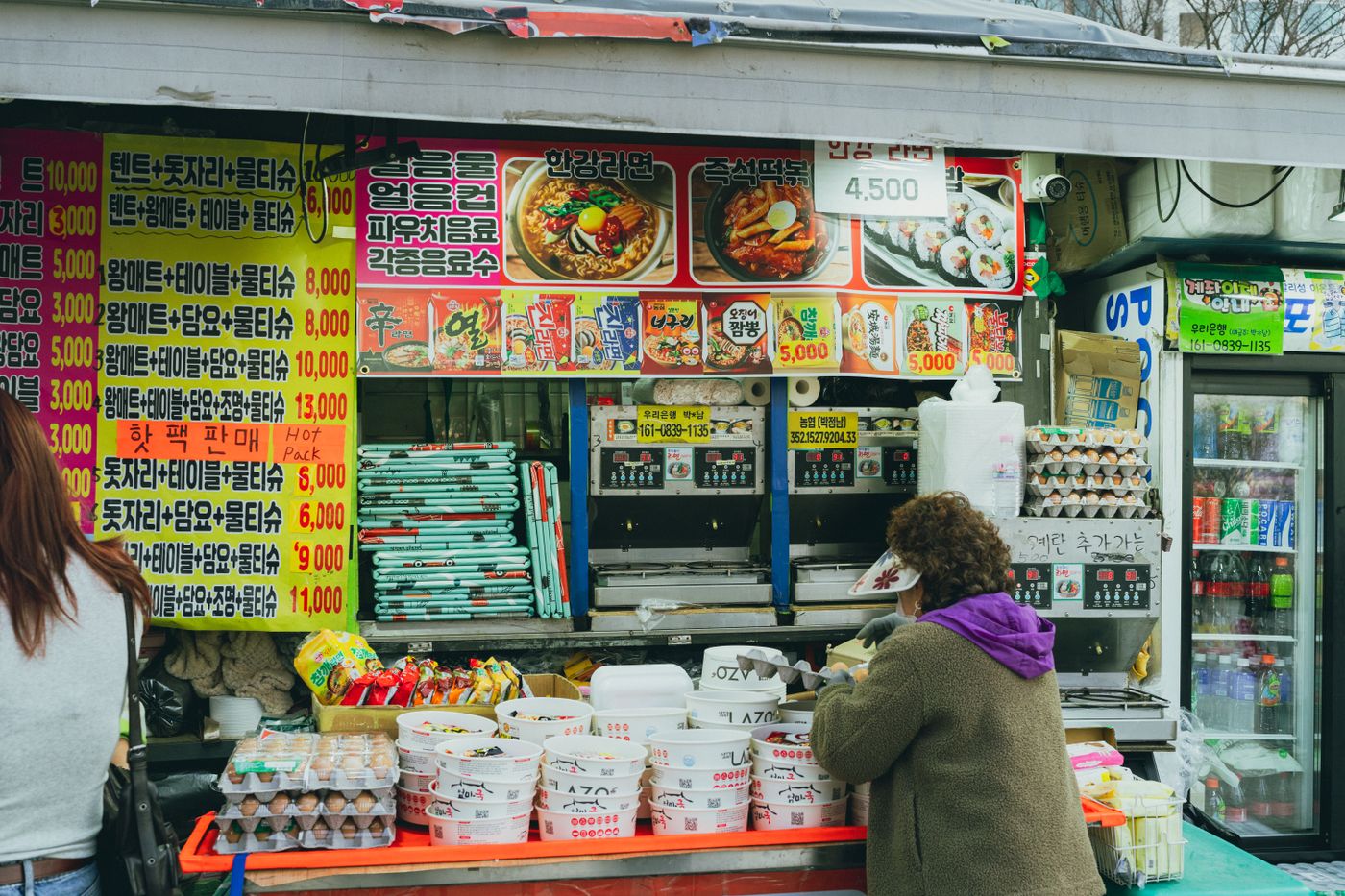
Packaged food is regulated. A restaurant dish is not labelled at all, and it can contain meat broth, fish sauce, shrimp paste, anchovy stock, beef seasoning, pork fat, egg garnish, dairy in modern sauces, or shared fryer and grill contact.
Staff will usually be kind and often cannot help. A server may know the main protein but not the stock base, and a small restaurant making broth in-house may genuinely not think of anchovy as an ingredient worth mentioning.
The honest rule: if your need is preference-level, ask. If it is safety-level, choose where you eat more carefully rather than relying on the answer.
Halal, vegetarian, vegan and kosher
For religious diets, reading ingredients is only one layer, and Korea makes one distinction that matters.
Certified halal is not the same as "halal friendly." Formal certification in Korea is issued by the Korea Muslim Federation, and full restaurant certification requires that the kitchen be run by Muslims and that no pork or alcohol be present in the restaurant at all. "할랄 프렌들리" (halal friendly) is a self-declared description used by restaurants that serve halal-certified ingredients or simply avoid pork, without holding certification themselves. Both can be useful; they are not equivalent, and only one is audited.
Vegetarian travellers need to watch meat broth, seafood stock, anchovy, gelatin, and chicken or beef seasoning — none of which the allergen box will flag as a problem, because the box flags allergens, not animal origin. Vegan adds dairy, egg, honey and fish sauce. Kosher requires certification standards that label reading cannot substitute for.
Alcohol is worth a separate note for halal travellers: it appears not only as a drink but as cooking wine (청주, 맛술) in marinades and sauces, and it is not a labelled allergen. Our soju and anju guide explains how central drinking is to the restaurant table, which is also why avoiding it takes planning rather than luck.
Seoul has considerably more dietary-aware restaurants than it did five years ago. Random convenience-store snacks still require the same care they always did.
What to say, in Korean
Write these on your phone and show them. Short and specific beats long and vague.
| Korean | Romanised | Meaning |
|---|---|---|
| 돼지고기 들어갔어요? | Dwaejigogi deureogasseoyo? | Does it contain pork? |
| 우유 들어갔어요? | Uyu deureogasseoyo? | Does it contain milk? |
| 새우 들어갔어요? | Saeu deureogasseoyo? | Does it contain shrimp? |
| 젤라틴 들어갔어요? | Jelratin deureogasseoyo? | Does it contain gelatin? |
| 고기 육수 들어갔어요? | Gogi yuksu deureogasseoyo? | Is there meat broth in it? |
| 멸치 육수예요? | Myeolchi yuksu-yeyo? | Is the stock anchovy-based? |
| 저는 ___ 알레르기가 있어요. | Jeoneun ___ allereugi-ga isseoyo. | I have a ___ allergy. |
If staff look unsure, do not press them into guessing. Choose something else.
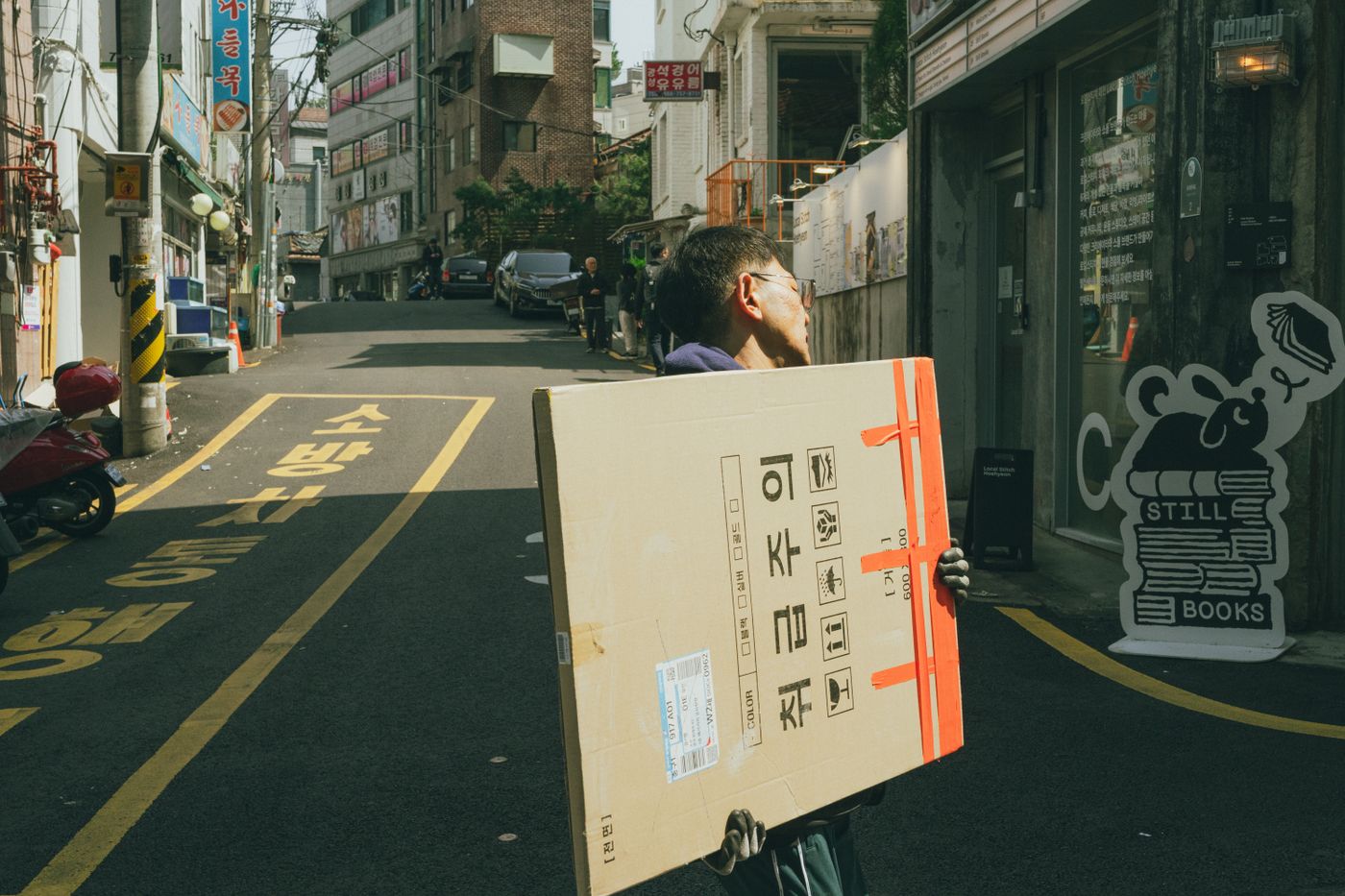
A five-second workflow
- Turn it over.
- Find 원재료명.
- Look for the differently shaded box beside it and read the nouns.
- If your concern is not among the 19 — gelatin, anchovy, other fish, honey, alcohol — read the full 원재료명.
- Check for 혼입 wording if traces matter.
- If it is still unclear and the risk is serious, put it back.
That last step is the one people skip. You do not need to win every snack.
Once you know which products clear your own list, the Korean grocery tourism guide and the pantry starter kit cover what is actually worth carrying home.
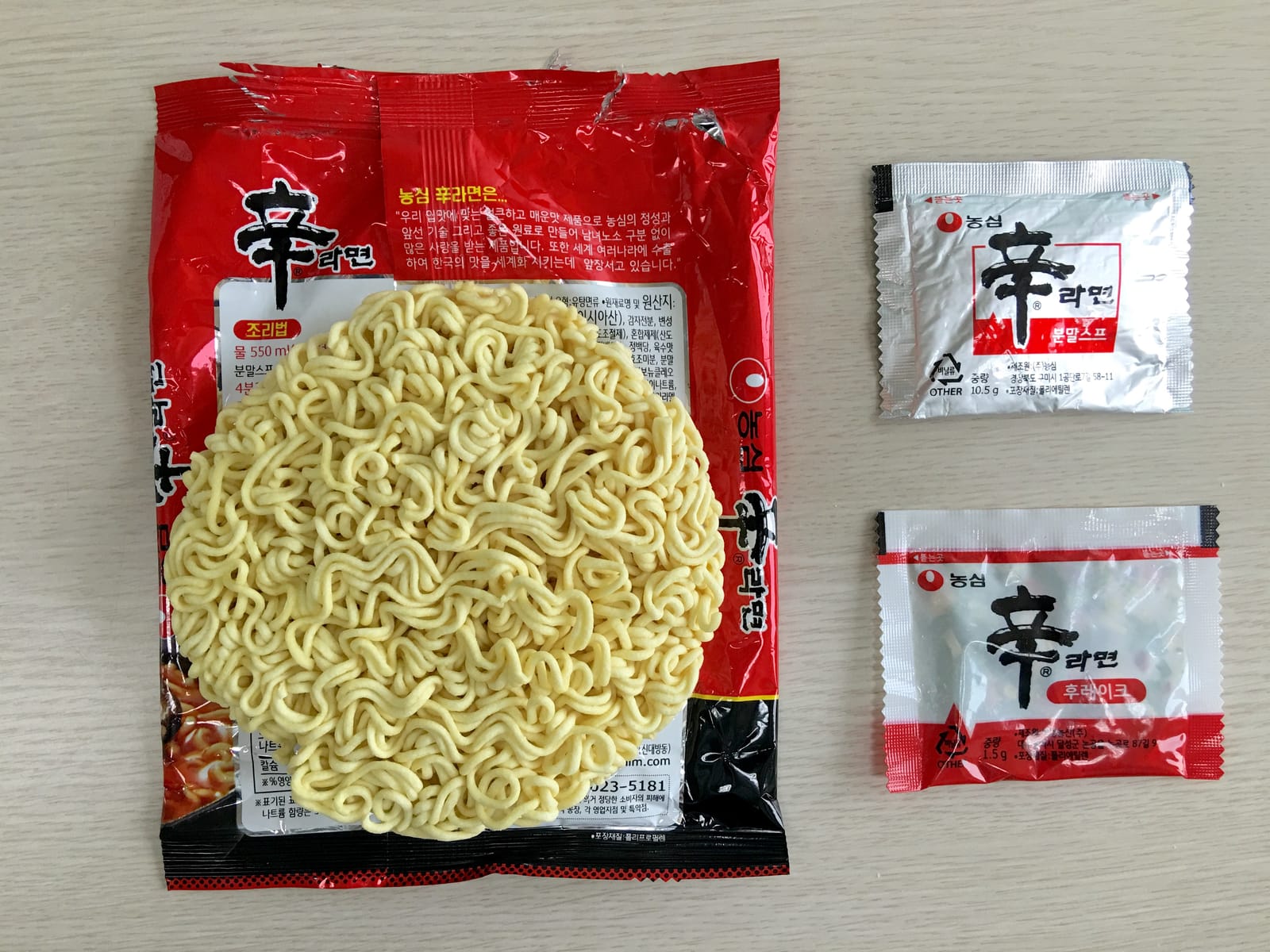
When you find things you can actually eat: the useful move is to note the exact product name before you leave Korea, because the same brand often sells a differently formulated export version. Nongshim Shin Ramyun is the clearest example — read the US ingredient list against the Korean one rather than assuming they match, because for this product they genuinely do not.
See Nongshim Shin Ramyun is the clearest example on AmazonFAQ About Korean Ingredient Labels
Q: How many allergens must Korean food labels declare?
Nineteen: eggs (poultry), milk, buckwheat, peanut, soybean, wheat, pine nut, walnut, crab, shrimp, squid, mackerel, shellfish (oyster, abalone, mussel), peach, tomato, chicken, pork, beef, and sulfites. Sulfites are declared at 10mg/kg or more; the rest are declared at any quantity.
Q: Where are allergens shown on a Korean package?
In a dedicated box near the 원재료명 ingredient section, printed on a background colour distinct from the rest of the label, so it stands out without reading the ingredient list.
Q: What does 혼입 가능 mean?
"Contamination possible." It is the cross-contact warning used when a product is made in a facility or on a line that handles an allergen. It is not used when the allergen is an actual ingredient, so it signals trace risk rather than presence.
Q: Is gelatin always pork in Korea?
No, and 젤라틴 is not one of the 19 mandatory allergens, so it will appear in the ingredient list rather than the allergen box. The word alone does not identify the animal source — check the manufacturer.
Q: What is the difference between 소비기한 and 유통기한?
유통기한 was a sell-by date; 소비기한 is a use-by date, meaning the last day the food is safe to eat if stored properly. Korea switched on 1 January 2023, so 소비기한 dates run later than the old ones. Refrigerated milk has until 1 January 2031 to change, so milk cartons still carry 유통기한.
Q: Are Korean ramen products vegetarian?
Do not assume. Many include beef, pork, seafood or dairy-derived seasoning, and a vegetable image on the front means nothing. The allergen box will flag pork, beef, chicken, shrimp and milk — but not anchovy or fish stock generally.
Q: Can I trust machine translation for allergies?
As a tool, not a guarantee. Translate the whole label rather than the product name, and for severe allergies carry a translated card and choose lower-risk food.
Final Take
Korean labels are dense but they are not hostile. The law puts your most important information in a box designed to catch your eye, names 19 substances that cannot be hidden inside a percentage, and uses a specific word — 혼입 — when the risk is contamination rather than content.
Learn your own trigger nouns, find the shaded box, and treat restaurant broth as a separate question with a different answer. That covers most of it, and when it does not, skipping one snack is cheaper than turning a trip into an emergency translation exercise.
Sources
- Allergen list, box requirement and cross-contact wording: 식품등의 표시·광고에 관한 법률 시행규칙 별표 2 (consumer safety labelling), and the Ministry of Food and Drug Safety's 식품안전나라 allergen guidance — 19 designated substances, separate allergen box distinguished from the background near the ingredient section, declared regardless of quantity, sulfites at 10mg/kg or above.
- Date labelling: Korea's transition from 유통기한 to 소비기한 effective 1 January 2023, with refrigerated milk products deferred to 1 January 2031.
- Halal certification: Korea Muslim Federation certification requirements, and the distinction between certified and self-declared "halal friendly" venues.
- Ministry of Food and Drug Safety (English)
- National Institute of Korean Language: Korean-English Learners' Dictionary
You Might Also Like
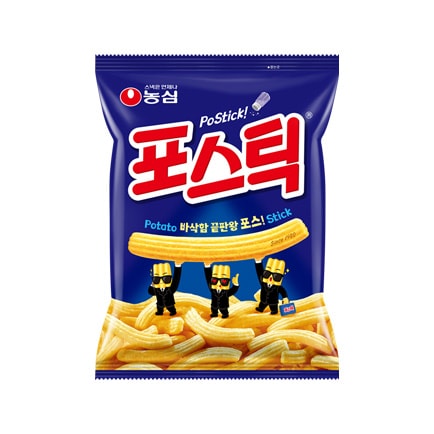
Postick: The Korean Snack That Used to Come With a Ketchup Packet
Postick (포스틱) has been on Korean shelves since 1980, it is only 23% potato, and it shipped with a ketchup sachet until the sachet got too expensive. What it costs now, and the ramyun-powder trick Koreans use on it.
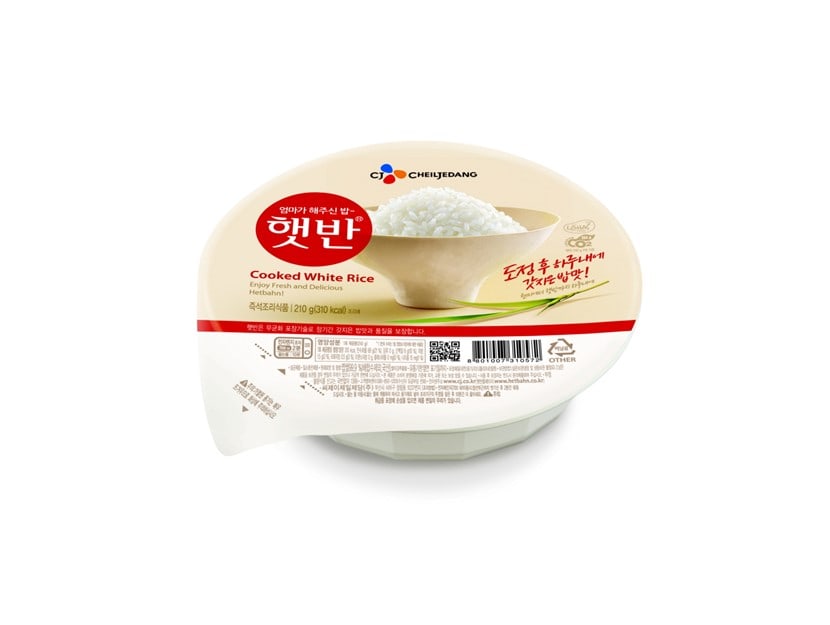
Hetbahn: What Korea's Instant Rice Is Made Of, and How to Heat It Without a Microwave
햇반 is 99.9% Korean rice and water plus 0.1% rice bran extract, sealed in a room cleaner than a hospital ward. The lid prints three cooking times and one of them needs no microwave at all. Prices, varieties, and the mistake almost everyone makes with the film.
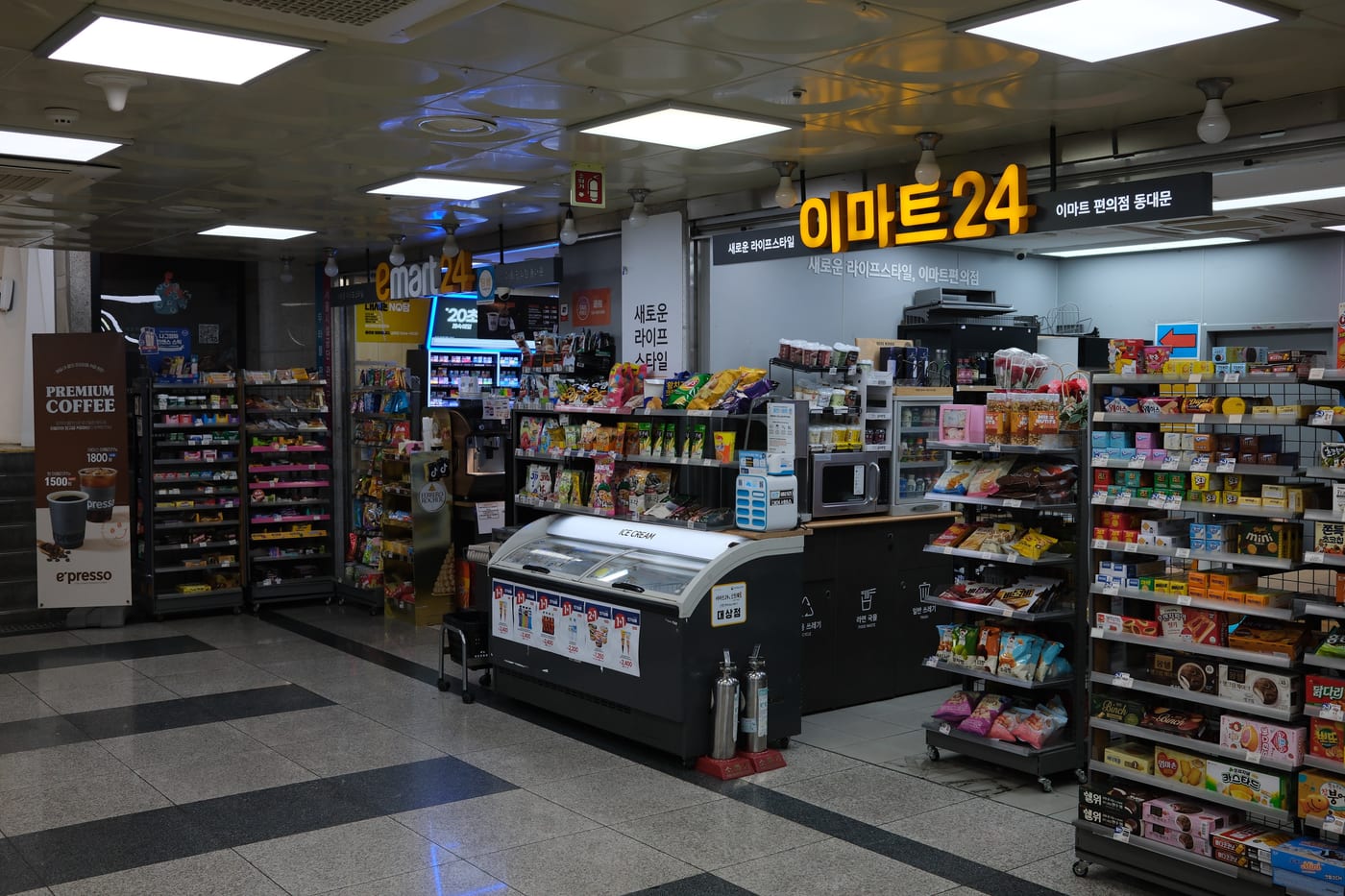
Korean Food Prices in August 2026: What Already Rose, and What Changes on the 25th
Four Korean food makers raised prices within three weeks, and Paris Baguette's 127-item increase lands on 25 August. The exact brands, dates and won amounts, why wheat and corn are behind it, and what it actually changes for a visitor.