Jin Ramen Mild vs Spicy: The Korean Ramyun Locals Buy Most Often
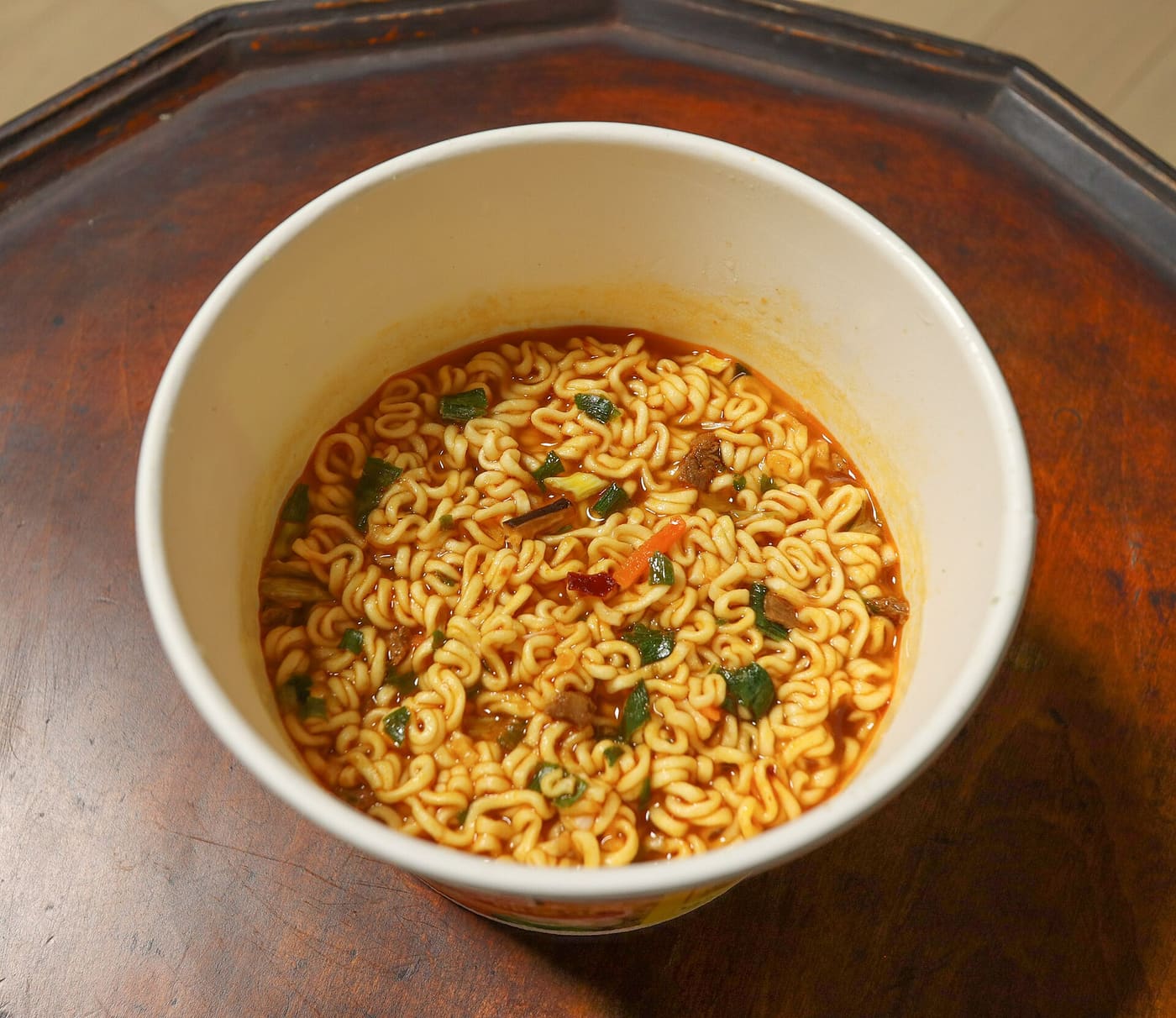
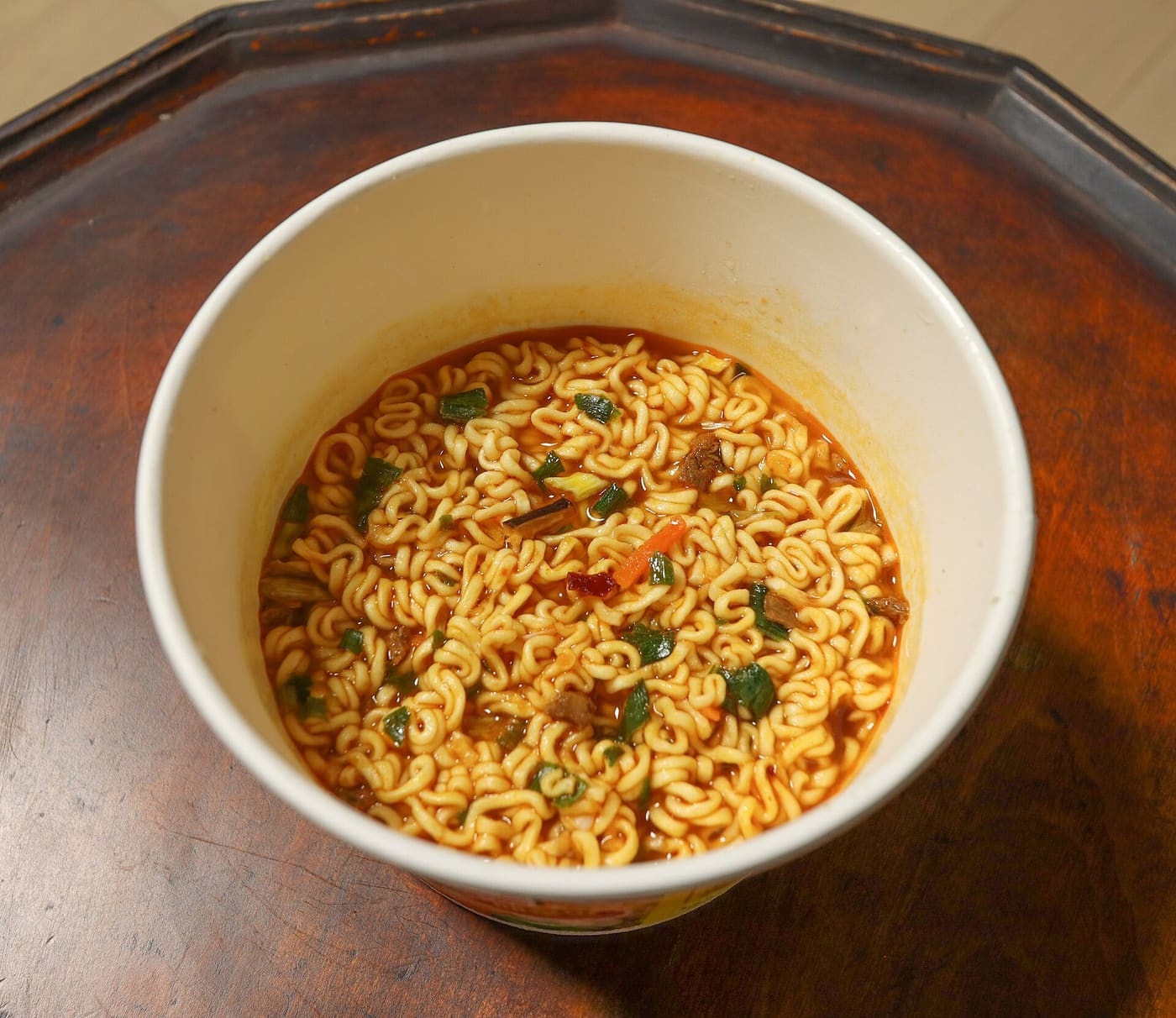
Jin Ramen spicy, made up. Photo by Mobius6, CC BY-SA 4.0, via Wikimedia Commons.
Ask which Korean instant noodle is the most famous and the answer is Shin Ramyun. Ask which one Koreans actually buy most often, and the answer changes.
In a national consumer survey published in 2020, the bagged ramyun Koreans reported buying most frequently was Jin Ramen (진라면) at 26.4%. On future purchase intent it also came first — 24% against Shin Ramyun's 20%.
Jin Ramen is the bag foreigners walk past. It is also the one behind two things visitors notice without explaining: why the mild version turns up in Korean households with small children, and why the free self-serve ramyun at Korean restaurants is always this brand and never the famous one.
The Short Answer
| Detail | |
|---|---|
| Korean name | 진라면 (Jin Ramyeon) |
| Maker | Ottogi (오뚜기) |
| Launched | March 1988 — 순한맛 and 매운맛 from day one |
| Heat grades | 순한맛 (mild) · 약간매운맛 (slightly spicy) · 매운맛 (spicy) |
| Bag colour | Yellow, always. The accent colour changes: blue for mild, red for spicy |
| Market position | No. 1 on purchase frequency (26.4%, 2020 KOBACO survey); Ottogi has been Korea's No. 2 ramyun maker since October 2012 |
| Cup price, Aug 2026 | ₩1,100 listed, often ₩825 effective on 3+1 or 2+1 |
| Why restaurants use it | It is the cheapest mainstream bag in Korea, and it is sold in catering bulk |
| The "purple" one | A BT21 collaboration edition, not a permanent flavour |
Compare Jin Ramen mild and spicy on AmazonAffiliate link. As an Amazon Associate, EpicKor earns from qualifying purchases at no extra cost to you.
If you only remember one line: the bag is yellow either way — check the accent colour, blue for mild and red for spicy.
Mild vs Spicy: The Soup Powder Settles It
Open both bags and empty them out. The noodle block is the same. The dried vegetable flake is nearly the same. The soup powder is not.
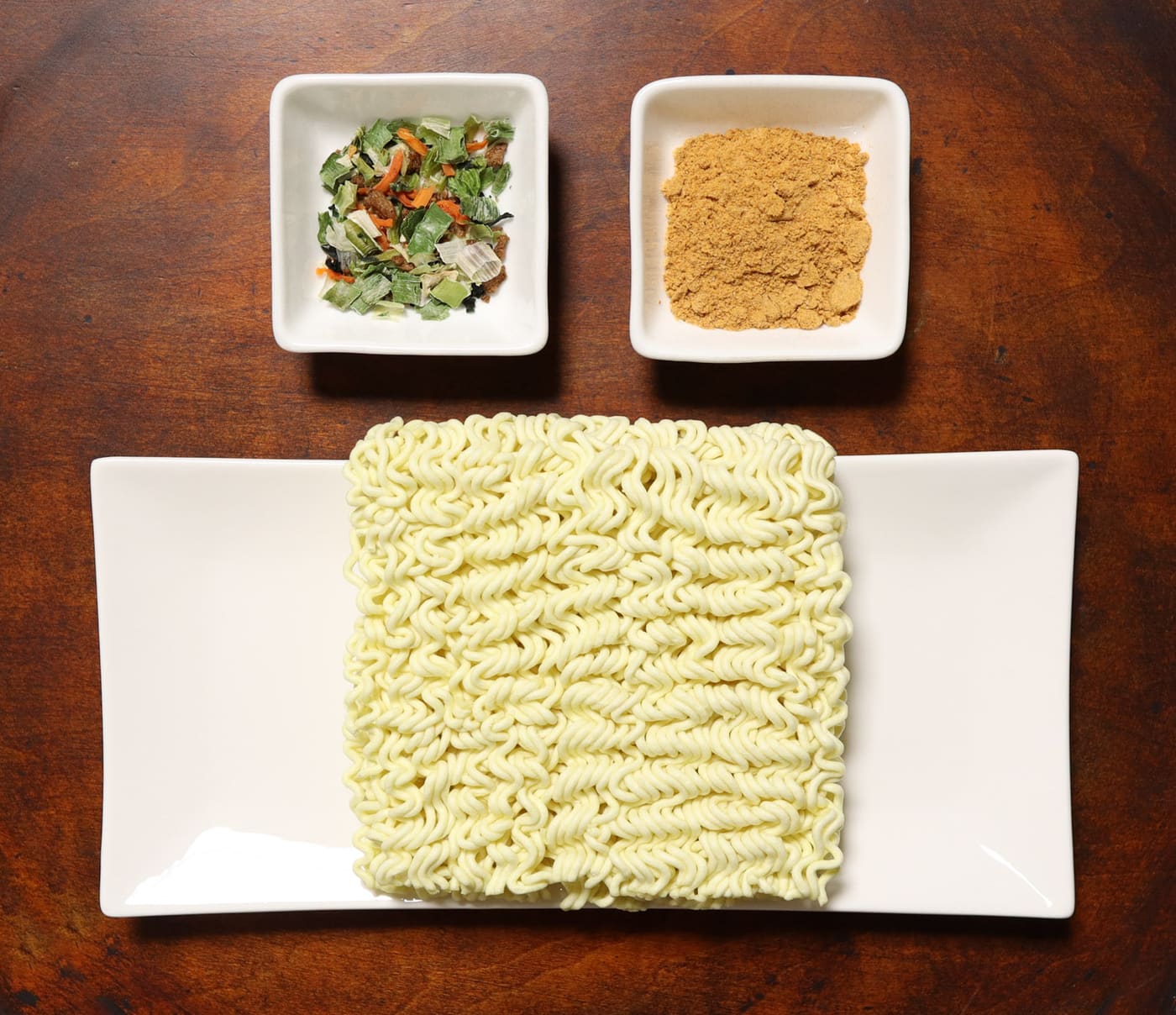
순한맛 (mild). The powder is a pale, sandy tan. Photo by Mobius6, CC BY-SA 4.0, via Wikimedia Commons.
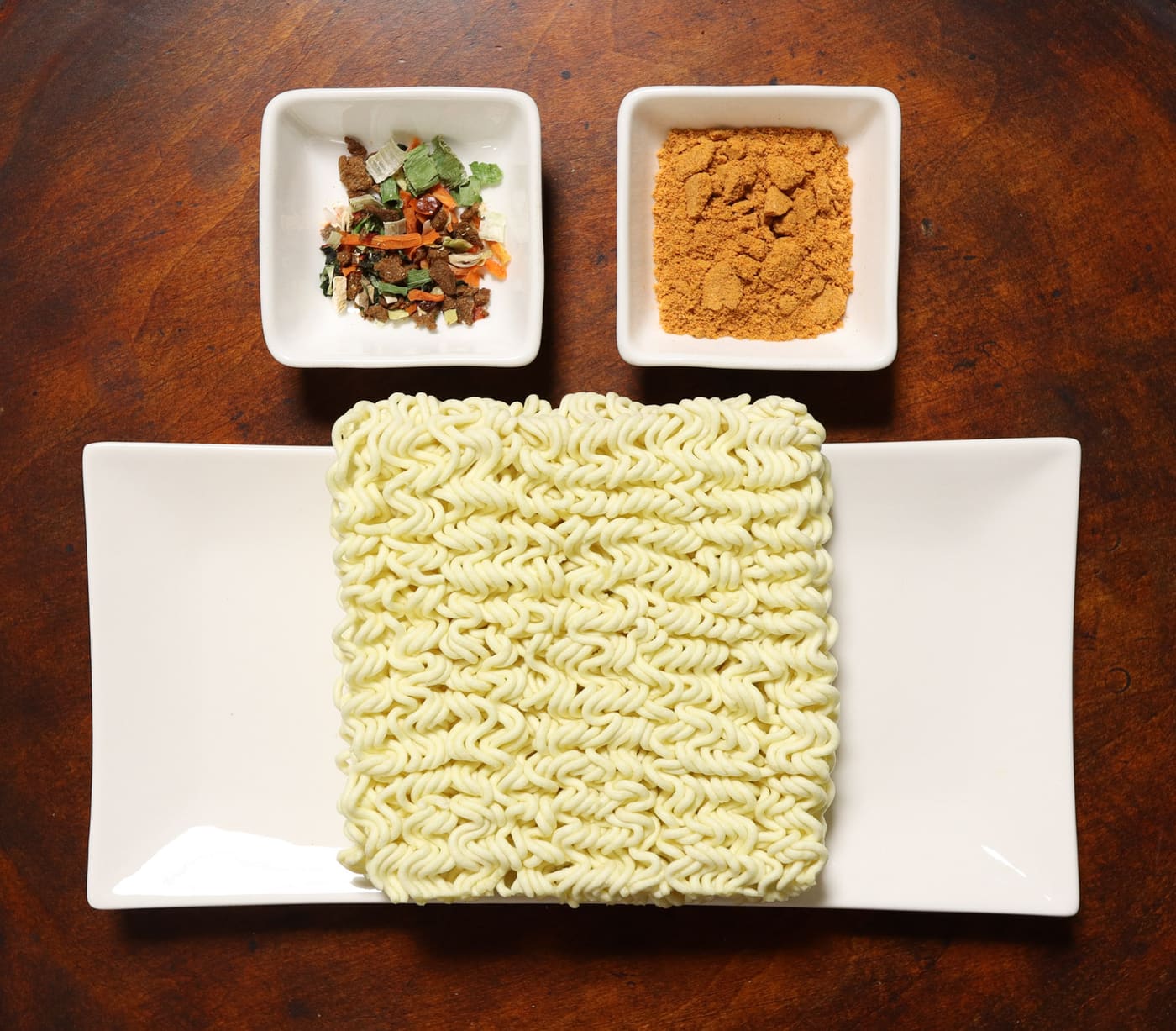
매운맛 (spicy). Same photographer, same setup — and the powder has visibly turned orange-red. Photo by Mobius6, CC BY-SA 4.0, via Wikimedia Commons.
That colour shift is the entire difference, and it tells you what kind of difference it is. These are not two recipes. They are one recipe with the chili dialled up. The savoury base underneath — a beefy, slightly sweet, everyday broth — is shared.
This matters when you choose. With Ansungtangmyun versus Shin Ramyun the two soups are built on genuinely different foundations, soybean paste against chili, so heat is the wrong axis to compare them on. Jin Ramen is the opposite case: heat really is the whole axis, so picking a grade is a straightforward decision rather than a flavour gamble.
How Mild Is Mild?
Mild enough that Korean families with small children buy it on purpose.
That is the honest calibration, and it is more useful than a number. Korean five-year-olds eat 진라면 순한맛 — not as a daily staple, but as an ordinary thing that happens in ordinary households. It is the standard answer in Korea when someone in the family cannot take heat.
For a visitor working out where their own tolerance sits, three reference points:
| Heat | |
|---|---|
| 진라면 순한맛 (mild) | Effectively not a spicy food. Savoury with warmth, no burn |
| 진라면 매운맛 (spicy) | Moderate. Present, not punishing |
| 신라면 (Shin Ramyun) | 3,400 SHU as measured in 2022 — the benchmark most people calibrate against |
If Shin Ramyun is at your limit, Jin Ramen spicy is a step down and Jin Ramen mild is not in the same conversation. If you have been avoiding Korean instant noodles because you assumed they are all hot, the mild bag is the counter-example, and it is on every shelf.
Buying both to compare: As an Amazon Associate, EpicKor may earn from qualifying purchases. The mild version is the one that rarely reaches overseas shelves, so if you want the actual comparison rather than half of it, Jin Ramen mild multi-packs are the half you will have to look for.
Compare on AmazonThere Is a Third Grade, and It Barely Leaves Korea
English coverage of Jin Ramen describes two options. Korea has three.
약간매운맛 — slightly spicy — sits between mild and spicy, and it is a normal stocked product, not a novelty. As of August 2026 the slightly-spicy cup is listed on Korean convenience-store promotion sheets at the same ₩1,100 as the mild and spicy cups, in the same 3+1 and 2+1 deals.
It is also, in Korean search behaviour, the most-searched Jin Ramen variant of the three.
Its absence from English write-ups explains a small mystery: people describe Jin Ramen spicy as milder than expected, or mild as blander than expected, because the grade that would have suited them was never presented as an option. If you are shopping in Korea and neither extreme sounds right, ask for 약간매운맛.
Why the Free Ramyun in Korean Restaurants Is Always Jin Ramen
Eat at enough Korean all-you-can-eat grills, budget buffets or self-serve noodle bars and you notice something. Many of them put out free ramyun — a rack of packets, a hot-water station, help yourself.
It is nearly always Jin Ramen. Not Shin Ramyun, which is the more famous brand and would arguably be a better draw. Not Neoguri. Jin Ramen.
The reason is a pricing decision Ottogi made and then held for over a decade.
Ottogi froze Jin Ramen's shipment price in April 2008 and did not raise it again until July 2021 — thirteen years and four months. Through that period Korean food inflation ran on regardless and competitors raised prices repeatedly. Ottogi's stated reason was easing the burden on ordinary households, and it earned the company a nickname that is still in use: 갓뚜기, a portmanteau of God and Ottogi.
When the freeze finally broke in July 2021, Jin Ramen went from ₩684 to ₩770 — a 12.6% rise, and Ottogi's first in thirteen years.
The commercial consequence is the thing nobody writes down. A price held flat for thirteen years made Jin Ramen the cheapest mainstream bag on the Korean shelf — not cheap in a budget-brand way, but the lowest-priced of the major manufacturers' flagship products. Ottogi also sells it in catering bulk, in 30-pack cases of 120 g bags aimed at food-service buyers.
So for a restaurant giving ramyun away, the arithmetic decides itself. An unlimited-refill business is a cost-control business. The free ramyun is Jin Ramen because Jin Ramen is the cheapest bag a Korean caterer can put out that customers will still be happy to see.
That is also why the brand's ubiquity is easy to underestimate. A lot of Koreans' Jin Ramen consumption never shows up in a retail number at all — it happens at a table where somebody else bought it.
Jin Ramen vs Shin Ramyun
| Jin Ramen (진라면) | Shin Ramyun (신라면) | |
|---|---|---|
| Maker | Ottogi (오뚜기) | Nongshim (농심) |
| Launched | March 1988 | 1986 |
| Heat grades | Three — mild, slightly spicy, spicy | One |
| Heat | Spicy version is moderate; mild is genuinely mild | 3,400 SHU (2022) |
| Bought most often (2020 survey) | 26.4% — first | second |
| Future purchase intent | 24% | 20% |
| Global fame | Low | Very high |
| Price position | The cheapest of the majors' flagships | Higher |
The two brands are not really competing on the same ground. Shin Ramyun won the world; Jin Ramen won the weekday. Nongshim's noodle is the one on export shelves, in films, and in the phrase "Korean instant noodle" as a foreigner hears it. Ottogi's is the one Korean households restock without thinking about it, largely because for thirteen years it did not get more expensive.
For where these sit against the rest of the shelf, our Ansungtangmyun vs Shin Ramyun comparison covers the soybean-paste side, Neoguri covers the seafood side, and the Korean ramyun guide maps the range.
Why "Jin," and What the Purple Bags Are
진 (jin) is from the Chinese character 眞, meaning true or genuine. It is a quality claim, not a flavour word — the same instinct as calling something "the real thing."
The brand's origin is less tidy. Jin Ramen descends from 진곱배기, made by Cheongbo Food from 1983. When Cheongbo went bankrupt in 1987, Ottogi acquired the business, and Jin Ramen launched in March 1988. It has carried both mild and spicy since that first day.
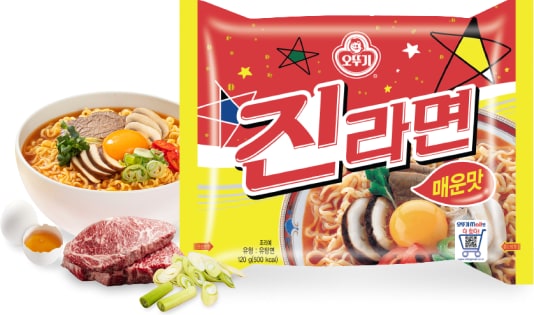
The spicy bag: yellow ground, red 진, and 매운맛 in the corner. Product image: Ottogi.
And the purple question. jin ramen purple and jin ramen violet are common English searches, and the answer is not a flavour.
In February 2023 Ottogi ran a BT21 collaboration edition with purple packaging across single bags and multipacks, carrying BT21 characters. BT21 is the character line created with the members of BTS — and BTS has a member named Jin, which is the same syllable as the noodle. The name collision is the whole reason the collaboration existed and the whole reason English speakers search for it.
The purple run also included the slightly-spicy grade, which pre-sold 1.5 times the prepared quantity on Coupang in May before a formal September launch.
So if you are hunting a purple bag: it is a limited collaboration edition, not a permanent heat level. The permanent line is yellow.
What It Costs
| Format | Price | Notes |
|---|---|---|
| Cup — mild, slightly spicy, or spicy | ₩1,100 listed | Frequently ₩825 effective on 3+1 or 2+1. Checked 3 August 2026 across emart24, CU and 7-Eleven promotion sheets |
| Bag, single | Lower than the cup | The cheapest mainstream bag on the Korean shelf |
| Bag, multipack | Lowest per unit | The normal household purchase |
| Catering bulk | Trade pricing | 120 g × 30 cases, which is what the free-refill racks are filled from |
All three heat grades cost the same, which is worth knowing — there is no premium on the middle grade, so trying 약간매운맛 costs nothing extra.
FAQ About Jin Ramen
Q: What is the difference between Jin Ramen mild and spicy?
A: The chili level, and essentially nothing else. Same noodle, same savoury base — the soup powder goes from pale tan to orange-red. Heat really is the whole axis here.
Q: Which is the blue bag and which is the red?
A: Both bags are yellow. The accent colour is the tell: blue means 순한맛 (mild), red means 매운맛 (spicy).
Q: What is the purple Jin Ramen?
A: A BT21 collaboration edition from February 2023, not a permanent flavour. BT21 is the character line made with BTS, whose member Jin shares the noodle's name. The regular product is yellow.
Q: Is Jin Ramen spicier than Shin Ramyun?
A: No. Jin Ramen spicy is moderate and sits below Shin Ramyun, which measured 3,400 SHU in 2022. Jin Ramen mild is not a spicy food at all.
Q: Can children eat Jin Ramen mild?
A: Korean households with small children buy it for exactly that reason, and Korean five-year-olds eat it. It is the standard choice when someone at the table cannot take heat.
Q: Why do Korean restaurants give away Jin Ramen specifically?
A: Cost. Ottogi held its price flat from April 2008 to July 2021, which left Jin Ramen the cheapest of the major makers' flagship bags, and it sells in catering bulk. For an unlimited-refill restaurant that decides it.
Q: Is Jin Ramen more popular than Shin Ramyun in Korea?
A: By purchase frequency, yes — a 2020 national survey put Jin Ramen first at 26.4%, and ahead on future purchase intent at 24% against 20%. Shin Ramyun remains far more famous internationally.
Q: What is 약간매운맛?
A: "Slightly spicy," the middle grade between mild and spicy. It is a normal stocked product in Korea at the same price as the other two, and it rarely appears on overseas shelves.
Related Reading
- Ansungtangmyun vs Shin Ramyun: Which Korean Ramyun to Buy First — the soybean-paste comparison
- Neoguri Ramen Hacks: How Koreans Cook Korea's Seafood Udon Noodle — the kelp one
- Korean Ramyun Guide: Shin, Buldak, Chapaghetti, and More — the wider shelf
- Korean Convenience Store Food Guide: Dosirak and Snacks — what to pair it with
You Might Also Like
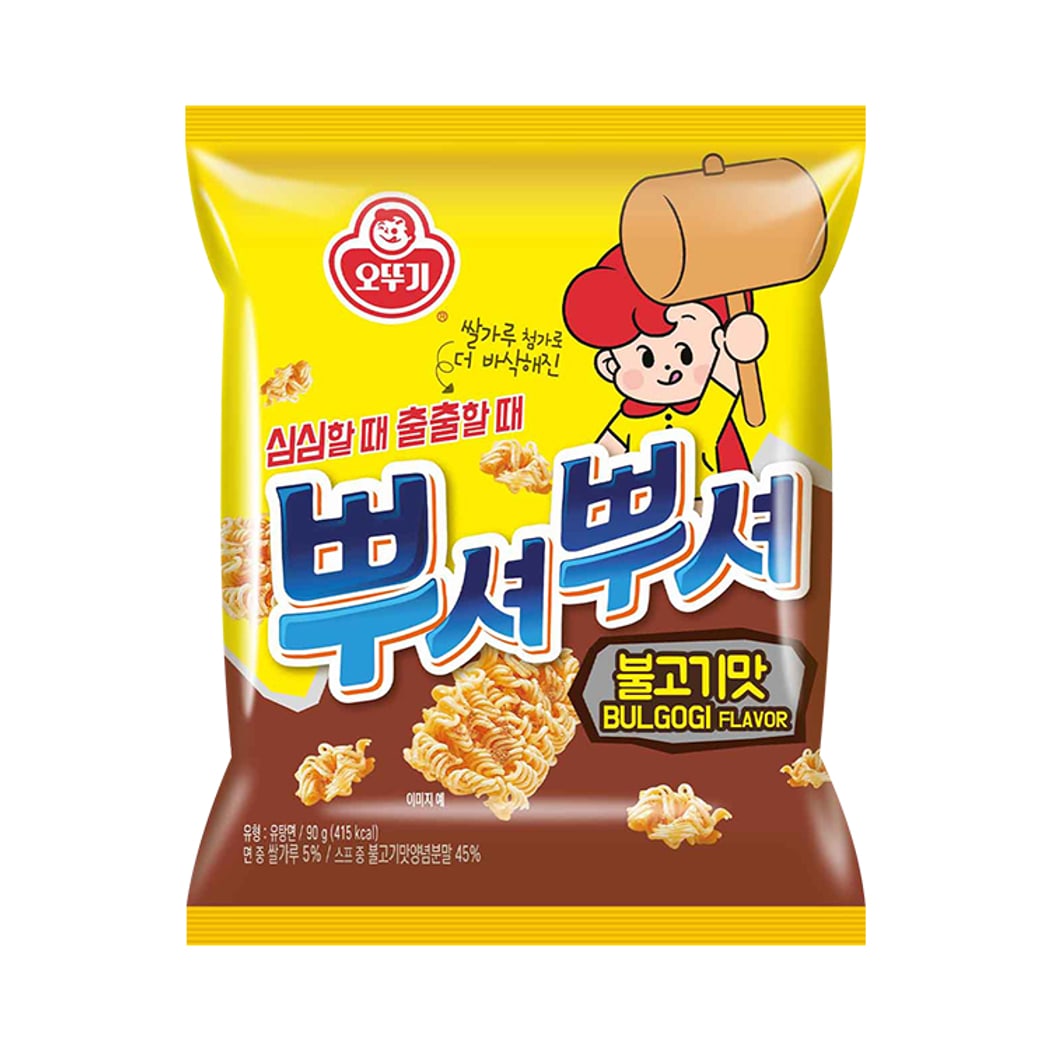
Ppushu Ppushu: Korea's Smash-It-Yourself Noodle Snack, and Which Flavour to Get
Ottogi launched it in July 1999 at ₩350 and sold 100 million bags in a year. The Korean shelf now runs to eight flavours the export version has never carried, the bag tells you not to boil it, and 1999's strawberry version was a disaster.
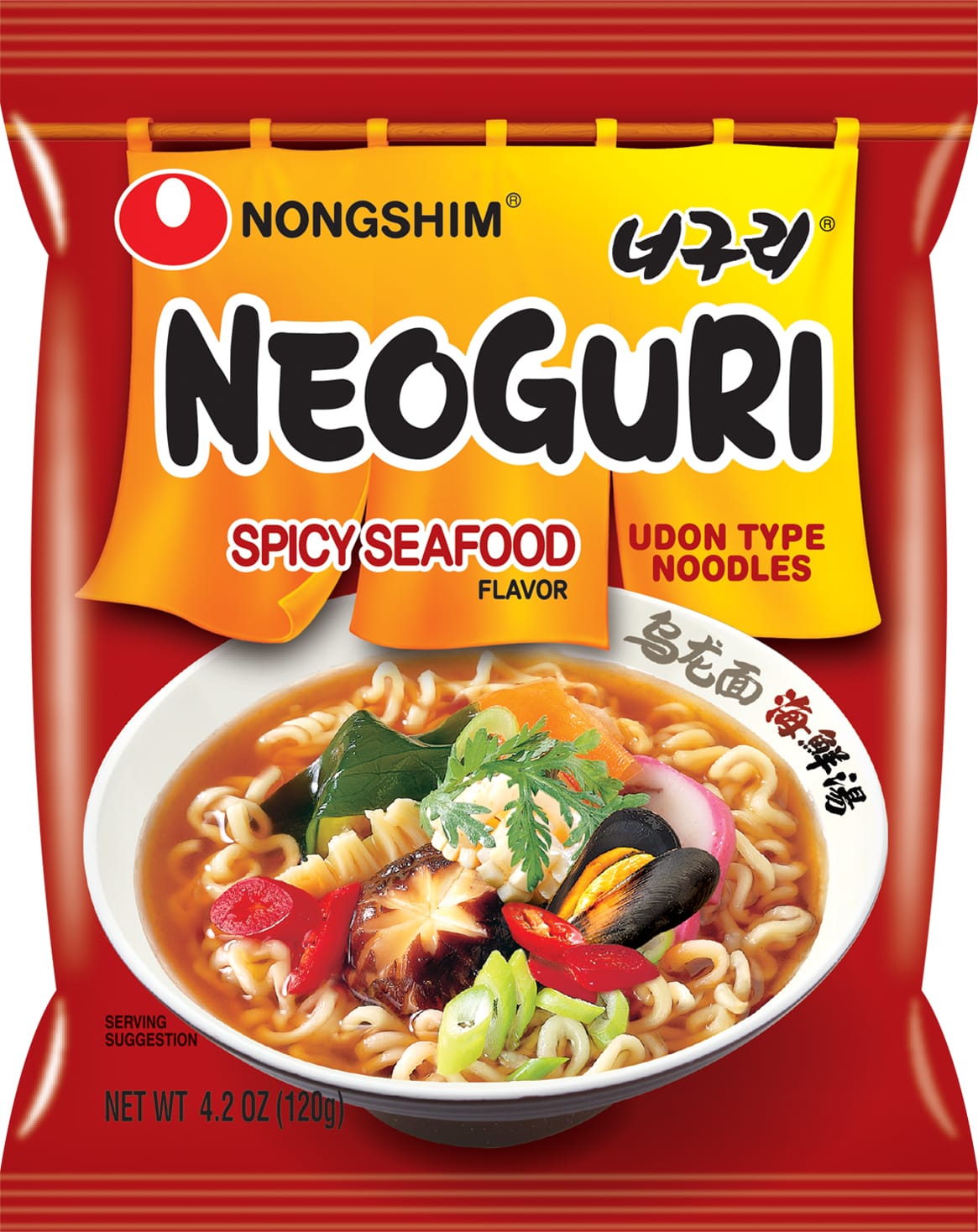
Neoguri Ramen Hacks: How Koreans Cook Korea's Seafood Udon Noodle
The green square in a Neoguri packet is a whole piece of Wando kelp, and Nongshim buys about 400 tonnes a year to put one in each bag. Most people outside Korea bin it. Here is what it does, how Koreans cook the noodle, and a straight answer on the recall.
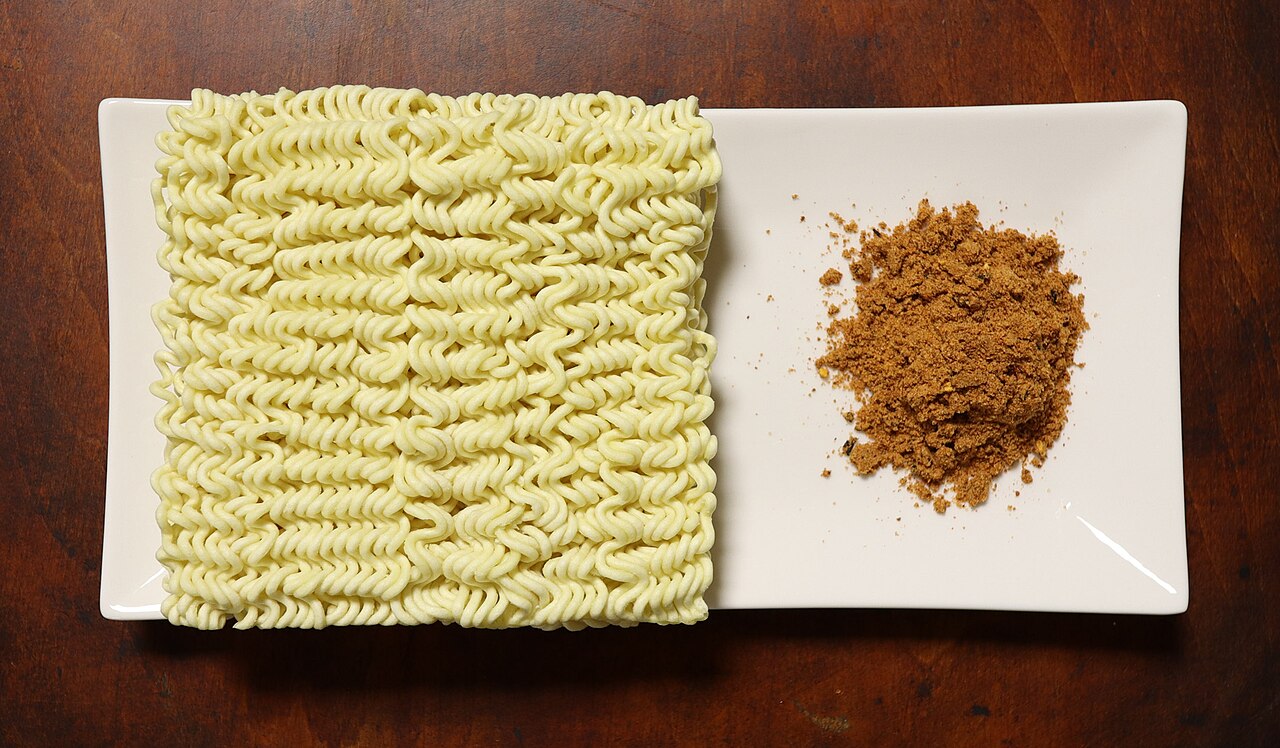
Ansungtangmyun vs Shin Ramyun: Which Korean Ramyun to Buy First
Ansungtangmyun is not just a milder Shin Ramyun. It is built on soybean paste while Shin Ramyun is built on chili, so the two taste different rather than differently hot. Here is the real difference, and which one to start with.