National Museum of Korea Crowds 2026: 17,000 Visitors a Day Against a 15,000 Limit — Free Entry, the One Chuseok Closure, and When Seoul's Busiest Museum Is Quiet
Last updated: September 2026. Visitor figures are the museum's own statistics as reported by Kyunghyang Shinmun, Newsis and Hankook Ilbo in June and July 2026, and its 2 January 2026 release for the full-year 2025 total; the world ranking is The Art Newspaper's 2026 survey; hours, closures and directions are from the museum's official site. Sources are listed at the end.
The National Museum of Korea (국립중앙박물관, Gungnip Jungang Bangmulgwan) has become one of the most crowded buildings in Seoul, and most English guides have not noticed. In the first half of 2026 it counted 3,795,400 visitors, up 39.7 percent on the same period of 2025. In June it averaged about 17,000 people a day against what the museum itself calls an appropriate daily capacity of 15,000; in May it was around 23,000. Over the whole of 2025 it drew 6.5 million, the most since it was founded in 1945, and The Art Newspaper's annual survey ranked it the third most visited museum in the world, behind only the Louvre and the Vatican Museums.
It is still free, at least until 2027, when the government plans to start charging. It still needs no ticket for the permanent galleries. And the visitors crowding it are overwhelmingly Korean: of the 3.8 million in the first half of 2026, 165,404 were foreign, about 4 percent, even after foreign visits rose 68.8 percent. That tells you when to go. The museum is packed on the days Korean families are free, and it has quiet hours that most tourists never use. This guide gives the numbers, the hours that changed this year, the one day it closes over Chuseok, and the booking system and paid entry planned for 2027.
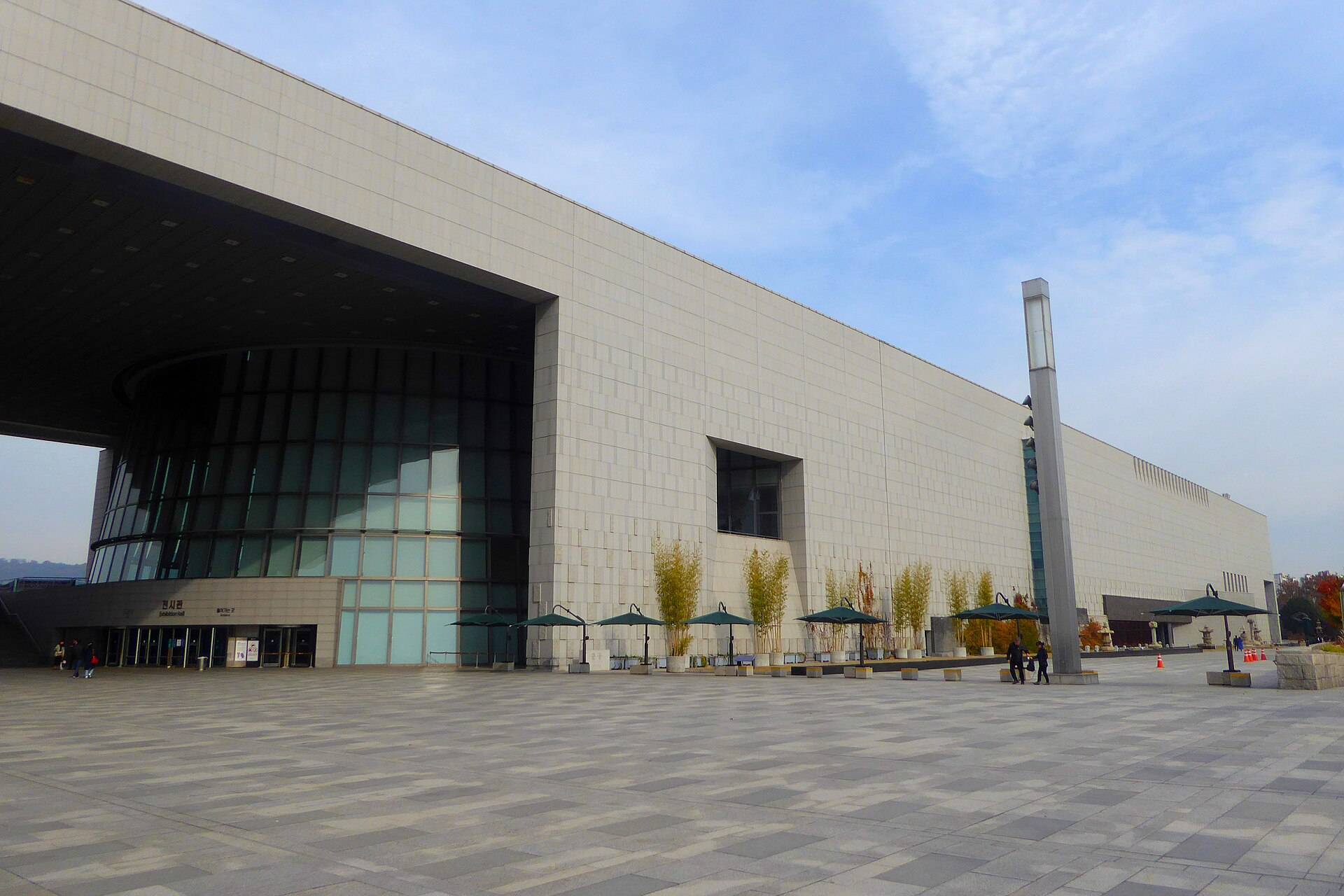
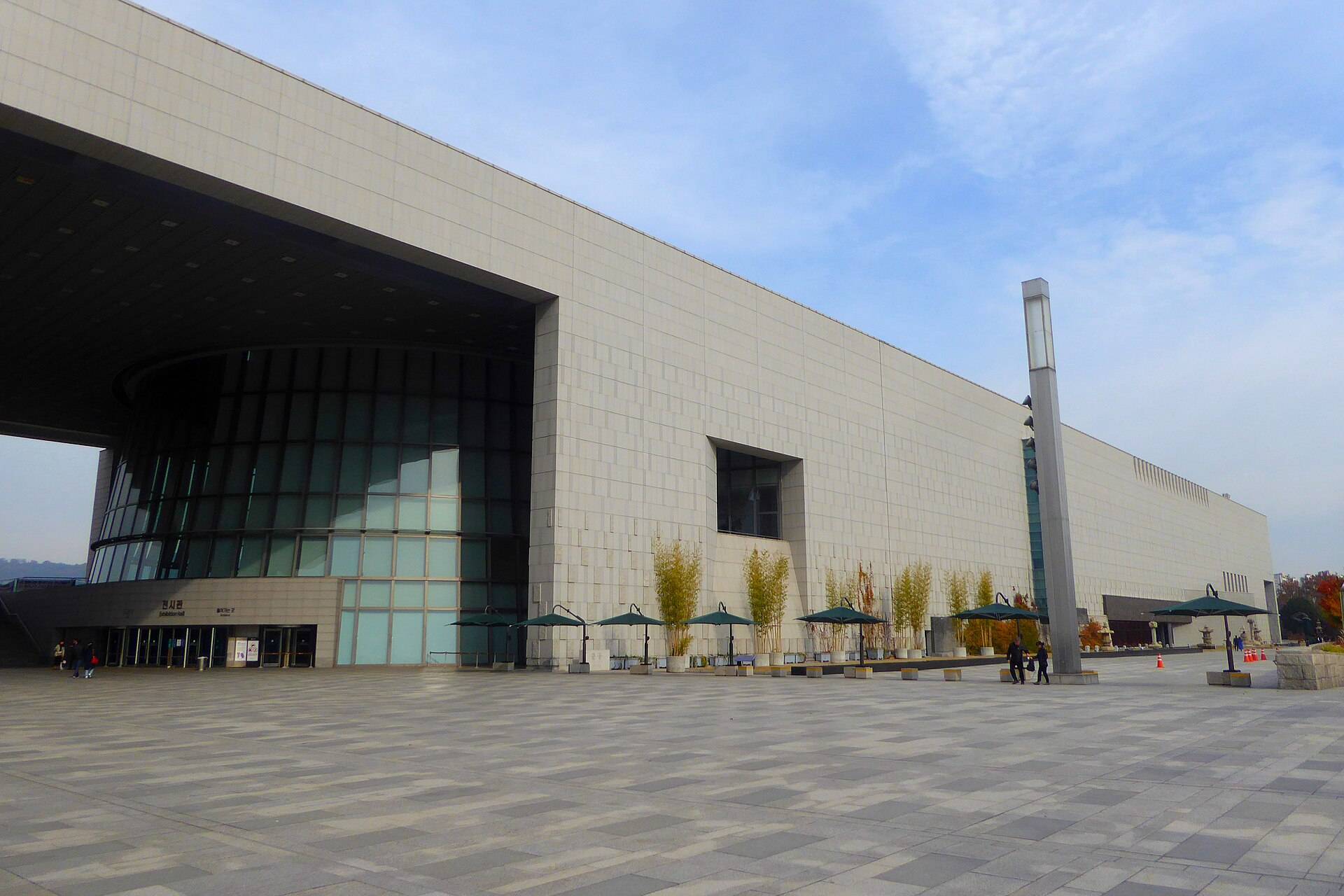
The National Museum of Korea in Yongsan, November 2019. The entrance hall sits under the open "gate" on the left. Photo: Ethan Doyle White, Wikimedia Commons, CC BY-SA 4.0.
Read the galleries before you queue for them: the museum's own English guide, National Museum of Korea: The Permanent Exhibition, walks through the permanent halls and the national treasures in them, so you can pick three rooms instead of wandering all of them. As an Amazon Associate, EpicKor earns from qualifying purchases.
Quick Guide: National Museum of Korea, autumn 2026
| What | Detail |
|---|---|
| Admission | Free for the permanent galleries, including the Room of Quiet Contemplation (사유의 방); no reservation needed. Special exhibitions are ticketed |
| Hours | Mon, Tue, Thu, Fri, Sun 09:30–17:30 (last entry 17:00) · Wed and Sat 09:30–21:00 (last entry 20:30) · outdoor garden 07:00–22:00 |
| Chuseok 2026 | Closed Friday 25 September only; open as normal on 24 and 26 September |
| Other 2026 closures | First Monday of December (7 Dec; 7 Sep has passed): indoor galleries closed, garden open |
| How crowded | H1 2026: 3,795,400 visitors (+39.7%); June about 17,000 a day vs a 15,000 comfort limit; about 4% foreign |
| Busiest months | January, February and May (over 700,000 each); March and April about 30% lower |
| Getting there | Ichon Station (Line 4 and Gyeongui–Jungang Line), Exit 2, then the underground walkway to the west gate |
| Coming in 2027 | Online reservations, e-ticketing and mobile tickets on trial in the first half of 2027; paid entry announced for 2027, fee not yet set |
Korean National Treasures: 2,000 Years of Art — the objects behind the crowds The catalogue of the Lee Kun-hee Collection exhibition that toured the Smithsonian, the Art Institute of Chicago and the British Museum: 150 paintings, sculptures, ceramics and books, more than twenty of them designated National Treasures. It is the better souvenir if the museum shop queue is the reason you leave. As an Amazon Associate, EpicKor earns from qualifying purchases.
See Korean National Treasures on AmazonThe numbers: from 3.8 million a year to 3.8 million a half-year
The museum's attendance has roughly doubled in two years. It recorded 3,788,785 visitors in 2024 and 6,507,483 in 2025, the most since its founding. In the first half of 2026 it reached 3,795,400, more than the whole of 2024 in six months.
| Month (2026) | Visitors | About per day |
|---|---|---|
| January | 730,473 | 23,600 |
| February | 760,792 | 27,200 |
| March | 535,451 | 17,300 |
| April | 515,268 | 17,200 |
| May | 713,176 | 23,000 |
| June | about 536,000–540,000 | 17,000–18,000 |
| First half | 3,795,400 (+39.7%) | about 21,000 |
The per-day figures divide by calendar days, so on open days the load is a little higher. Two sources give June slightly differently (about 536,000 in the museum's July statement; 540,240 if you subtract January–May from the half-year total), so we give a range.
The benchmark is the museum's own. It describes 15,000 a day (about 5.37 million a year) as its appropriate capacity, and in every month of the first half of 2026 it was above that on average. Its busiest single day on record, as reported in February 2026, reached about 44,000.
Why the surge? Korean coverage keeps returning to two things: the Room of Quiet Contemplation with its two Pensive Bodhisattva statues, which became a social-media pilgrimage, and the museum's own goods brand, MU:DS, which became a hit in its own right (our MU:DS souvenir guide has the sales figures). Neither costs a ticket.
Who is in the crowd: mostly Koreans, and that is the key to timing
Foreign visitors rose faster than anyone, from 97,985 to 165,404 in the first half-year, up 68.8 percent, but they are still about 4 percent of the total. The crowd is Korean families, school groups and couples, and it moves on the Korean calendar:
- School holidays: January and February, the winter break, were the two biggest months of 2026.
- May: Children's Day, Buddha's Birthday and Korea's "family month" put May above 700,000.
- Weekends and public holidays: a May 2026 report on the museum's crowding plans noted that popular galleries fill on weekends and holidays.
- Mornings: the museum moved its opening from 10:00 to 09:30 on 16 March 2026 because of the rush at opening time, and in the summer peak (27 July to 17 August) it opened at 09:00.
The quiet months are the ones in between. March and April 2026 ran about 30 percent below the peaks. By the same logic, late September to November outside the Chuseok days should look more like March and April than like February, though that is our reading of the pattern, not a museum forecast; the museum publishes monthly totals, not hourly or daily ones.
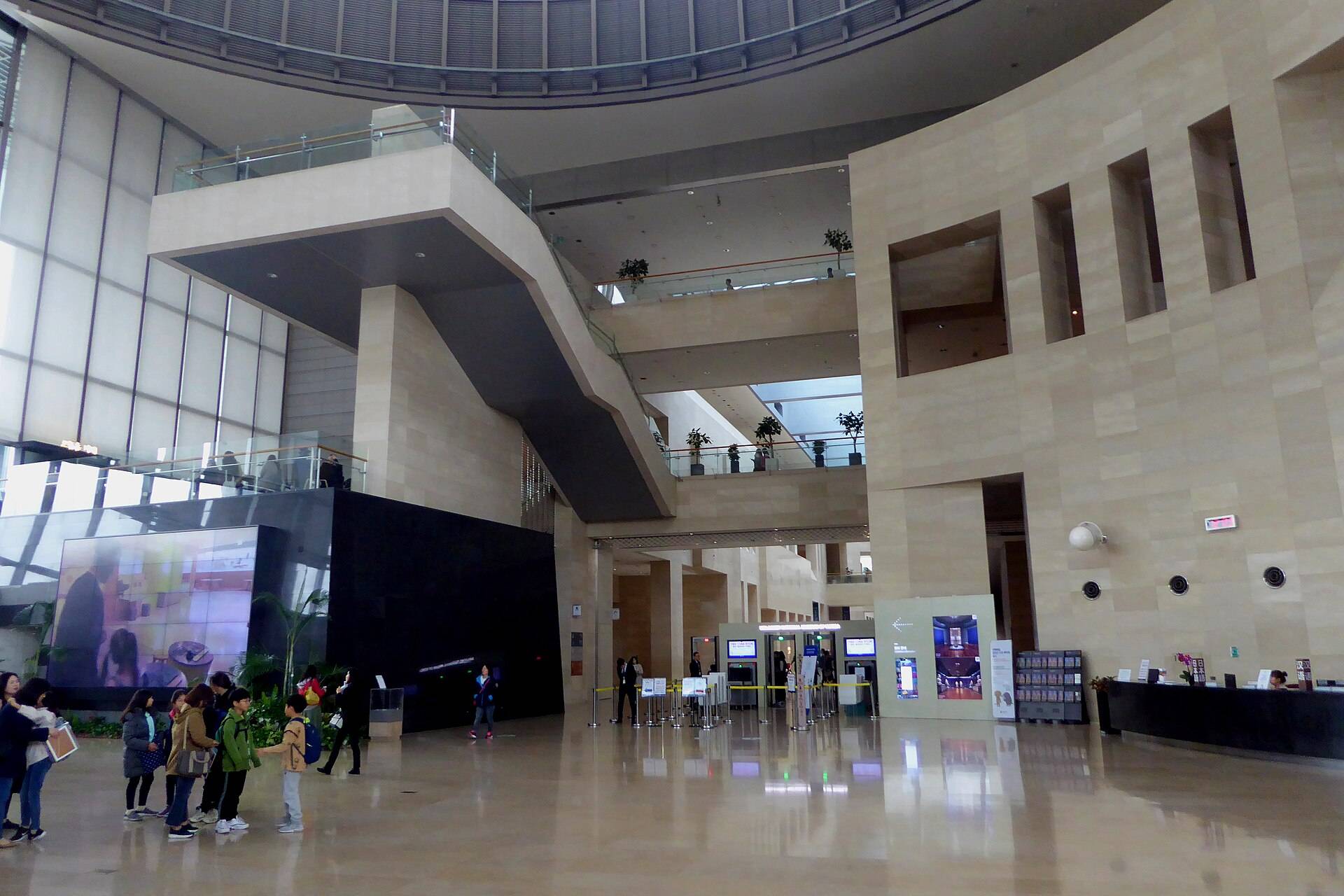
The entrance hall, with the bag-screening gates in the centre. The museum moved its opening to 09:30 because visitors were queuing well before the doors opened. Photo: Ethan Doyle White, 2019, Wikimedia Commons, CC BY-SA 4.0.
When to go: the quiet hours most visitors miss
Put the museum's own statements together with its hours and there are three windows worth aiming for:
- Wednesday and Saturday evenings. The museum stays open to 21:00 on those two days, with last entry at 20:30. Families with small children thin out after dinner, and visitors and bloggers consistently describe the evening galleries as the calmest. Wednesday evening is also the day to combine with a palace: Deoksugung is free every Wednesday, and Changdeokgung, Changgyeonggung and Jongmyo join it from 7 October (see our guide to the palace free-Wednesday rollout).
- Weekday afternoons outside school holidays. The opening rush is the museum's stated problem; by early afternoon on a Tuesday or Thursday in October, the school groups have usually moved on.
- Avoid the open Chuseok holidays. The museum is open on Thursday 24 and Saturday 26 September, when much of Seoul is on holiday and families are looking for somewhere to go. Expect those two days to be among the busiest of the autumn.
If you only have one slot and it is a weekend morning, go straight to one or two rooms rather than walking the whole building. The permanent galleries fill three floors; picking the Room of Quiet Contemplation and one period you care about is a better visit than fighting the flow through all of them.
Hours, closures and the Chuseok rule for 2026
The museum changed its hours this year, and older English guides still list the old ones.
- Since 16 March 2026: 09:30–17:30 on Monday, Tuesday, Thursday, Friday and Sunday (last entry 17:00), and 09:30–21:00 on Wednesday and Saturday (last entry 20:30). Before March it opened at 10:00 and closed at 18:00.
- Full closures in 2026: New Year's Day, Seollal (17 February) and Chuseok. For Chuseok 2026 that means Friday 25 September only; the museum is open on its normal schedule on 24 and 26 September.
- New quarterly closures: from 2026 the indoor galleries, including Special Exhibition Halls 1 and 2, close on the first Monday of March, June, September and December. In 2026 that was 1 June and 7 September, and will be 7 December. The outdoor garden stays open.
- Outdoor garden: 07:00 to 22:00, free, with a pond and stone pagodas.
For the rest of the Chuseok week in Seoul, including which palaces, shops and restaurants close, see our Chuseok 2026 guide.
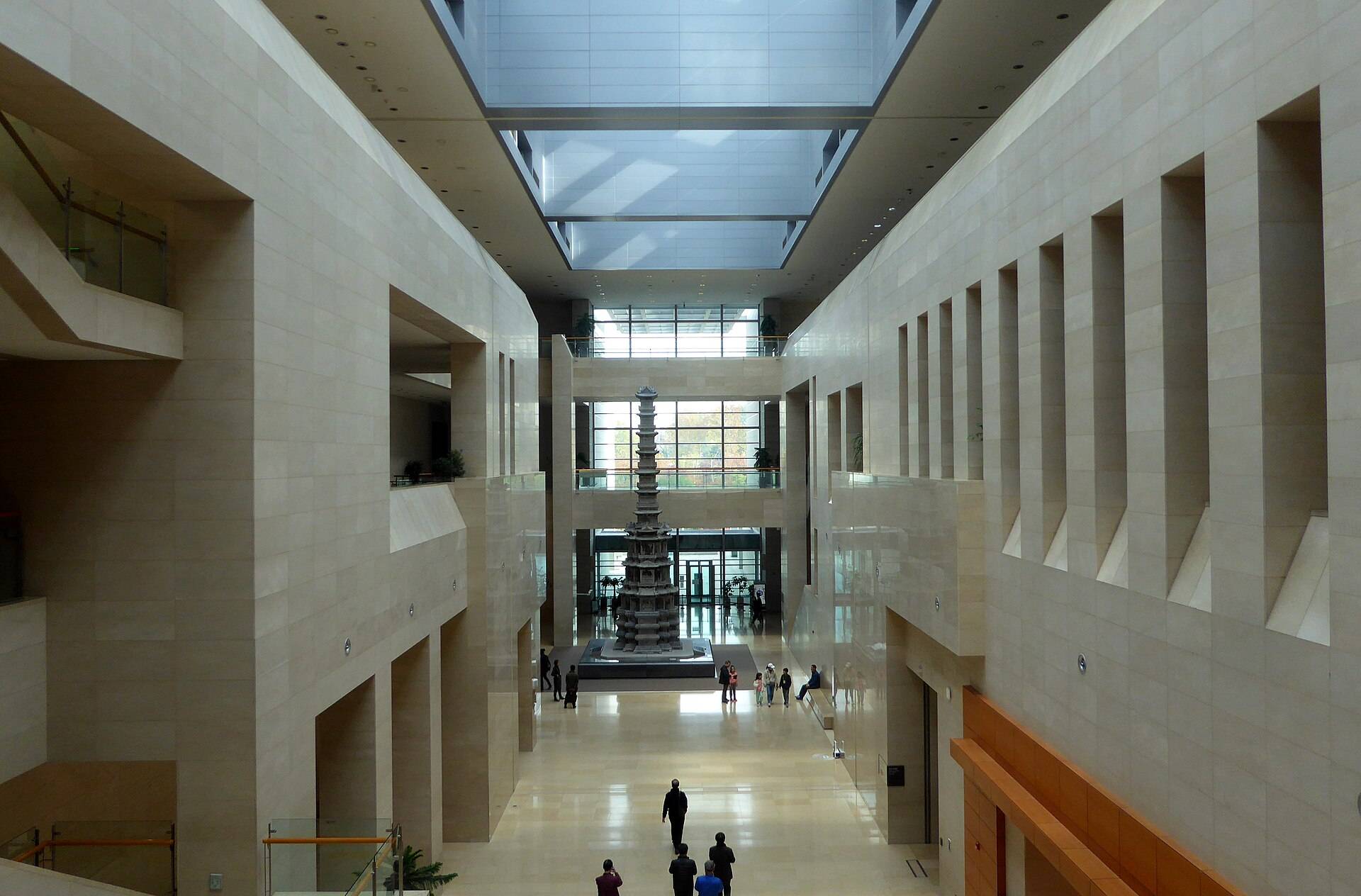
The central hall, known as the Road of History, with the ten-storey stone pagoda from Gyeongcheonsa Temple site (a National Treasure) at the far end. Photo: Ethan Doyle White, 2019, Wikimedia Commons, CC BY-SA 4.0.
Tickets and reservations: free now, booking and paid entry planned for 2027
The permanent galleries are free and need no reservation, including the Room of Quiet Contemplation. You walk in through bag screening. What does need a booking or a ticket:
- Special exhibitions: ticketed separately. The current one in Special Exhibition Hall 2, 우리들의 밥상 ("Our Dining Table"), a Korean food-culture exhibition, runs from 1 July to 25 October 2026 at ₩5,000 for adults and ₩3,000 for ages 7 to 24.
- The Children's Museum: free, but by timed online booking only, in five sessions a day.
What changes in 2027: the museum announced in February that it will develop a system for online reservations, contactless electronic ticket checks and mobile tickets, and trial it in the first half of 2027. The museum describes the system as groundwork for paid admission. On 30 March 2026 the government's 2027 budget guidelines, issued by the Ministry of Planning and Budget (기획예산처), said entry to the museum would become paid from 2027, ending the free admission that began in 2008. The fee has not been set; Korean reports put the range under discussion at about ₩5,000–10,000 for adults. The museum's director has said the aim is neither to cut crowds nor to raise revenue but to run reservations and a fast track, and that the details and timing will be settled after the booking trial. For the rest of 2026, the permanent galleries stay free.
Getting there and getting in
Take Line 4 or the Gyeongui–Jungang Line to Ichon Station (이촌역) and use Exit 2. An underground walkway, 박물관 나들길 (the "museum path"), runs from the exit to the museum's west gate; it is open from 07:00 to 23:00 and closes on museum closure days. From the west gate it is a short walk across the grounds to the entrance hall.
Bags go through screening at the entrance, so a small bag moves faster. The MU:DS shops are inside the main building, and at peak times their queues are part of the crowd problem too.
FAQ
Q: Is the National Museum of Korea free? Yes. The permanent galleries, including the Room of Quiet Contemplation, are free and need no reservation. Special exhibitions are ticketed; the one running until 25 October 2026 costs ₩5,000 for adults.
Q: Is the National Museum of Korea open during Chuseok 2026? It is closed on Friday 25 September 2026 only, and open on its normal schedule on 24 and 26 September. Expect those two days to be very busy.
Q: What are the National Museum of Korea's opening hours? Since 16 March 2026: 09:30–17:30 on Monday, Tuesday, Thursday, Friday and Sunday, and 09:30–21:00 on Wednesday and Saturday, with last entry 30 minutes before closing. The indoor galleries also close on the first Monday of March, June, September and December.
Q: How crowded is the National Museum of Korea? Very, by its own standard. It had 3,795,400 visitors in the first half of 2026 and averaged about 17,000 a day in June against a stated comfort level of 15,000. January, February and May were the busiest months; March and April were about 30 percent quieter.
Q: Do I need to book the National Museum of Korea? Not for the permanent galleries. Only the Children's Museum requires online booking. An online reservation and mobile-ticket system will be trialled in the first half of 2027, as groundwork for paid entry.
Q: Will the National Museum of Korea start charging admission? Probably, from 2027. The government's 2027 budget guidelines, announced on 30 March 2026, said entry would become paid, but the fee and start date have not been set. Entry is free for the rest of 2026.
Sources
- Kyunghyang Shinmun, 15 July 2026 (khan.co.kr/article/202607150841001): first-half 2026 visitors 3,795,400, up 39.7% from 2,716,323; foreign visitors 97,985 → 165,404 (+68.8%); June about 536,000, about 17,000 a day against an appropriate 15,000.
- Newsis and Hankook Ilbo, 7 June 2026: monthly visitors January–May 2026 (730,473; 760,792; 535,451; 515,268; 713,176); appropriate capacity 15,000 a day, 5.37 million a year. Dailian, 7 June 2026: May about 23,000 a day.
- National Museum of Korea, press release of 2 January 2026: 2025 visitors above 6.5 million, the highest since 1945; Asia Economy, 2 January 2026: 6,507,483 in 2025 against 3,788,785 in 2024.
- The Art Newspaper, visitor-figures survey, 31 March 2026, as reported by the Korea Times on 1 April 2026: Louvre 9 million, Vatican Museums 6.9 million, National Museum of Korea 6.5 million, British Museum 6.4 million.
- Yonhap News and Hankyung, 3 February 2026: opening moved to 09:30 from 16 March 2026; online reservation, e-ticketing and mobile ticket system to be trialled in the first half of 2027, as groundwork for paid admission; peak day of about 44,000.
- YTN, 30 March 2026: Ministry of Planning and Budget 2027 budget guidelines — National Museum of Korea admission to become paid from 2027, fee undecided (about ₩5,000–10,000 under discussion). Kyunghyang Shinmun, 23 February 2026: the director's Kwanhun Forum remarks on the purpose and timing of paid admission.
- National Museum of Korea, official visitor information (museum.go.kr), read September 2026: hours, 2026 closure days, quarterly first-Monday closures, Children's Museum booking, special exhibition prices, directions from Ichon Station Exit 2.
- National Museum of Korea, notice of temporary summer hours, 27 July–17 August 2026. ZDNet Korea, 29 May 2026: weekend and holiday crowding.
You Might Also Like
Is Korea Kid-Friendly? What Foreign Parents Report — and What Korean Data Shows: Strangers Who Hand Out Tangerines, 114 No-Kids Zones, and the 68% Who Accept Them
Foreign parents say older Koreans shower babies with snacks and department-store nursing rooms beat London's. Korean data adds 114 no-kids zones, 68% public acceptance, and 64% of Korean parents who feel watched. What that means for your trip.
Seoul Palaces Free on Wednesdays in 2026: Deoksugung Since 5 August, Changdeokgung, Changgyeonggung and Jongmyo From 7 October — Gyeongbokgung Still Only the Last Wednesday
Korea made every Wednesday Culture Day in April 2026, and the palace office is phasing in free entry: royal tombs since 27 May, Deoksugung since 5 August, three more from 7 October. Gyeongbokgung has no date. English guides get it wrong both ways.
Seoul Tech Shopping: What Yongsan Actually Is Now, and Where to Buy Instead
Half of Yongsan Electronics Market has been demolished since June 2025 and what remains is parts, repair and trade counters, not shopping. Where to actually buy tech in Seoul, the 2026 tax-refund limits, and why young Seoul now goes to Yongridan-gil instead.