Korean Pojangmacha Guide: What a Pojangmacha Is, Seoul's Tent Bar Rows at Jongno 3-ga, the Menu and Prices, and the Etiquette
A Korean pojangmacha announces itself before you understand what it is.
You hear metal chopsticks hit a bowl. Steam fogs the plastic wall. Someone lifts the tent flap and releases five seconds of grilled squid, fish-cake broth, soju, cold air, and a conversation that has already become louder than the office meeting it replaced. Inside, strangers sit close enough to know what everyone ordered, but polite enough to pretend they do not.
Then you arrive with the most tourist-shaped question possible: “Do we just walk in?”
Usually, yes. But a pojangmacha is not simply a restaurant wearing a tent. It is a tiny social machine with limited seats, a changing menu, uncertain payment options, and a host who may be cooking, serving, cleaning, and keeping the entire evening moving at once. The magic comes from the lack of distance. The awkwardness can, too.
This Korean pojangmacha guide explains how to choose one, what to order, how to pay, what etiquette matters, and how to enjoy Seoul’s tent-bar culture without treating somebody’s workplace like a K-drama set.
Pocha: Simple Korean Food from the Streets of Seoul — the cookbook named after the tent bar, for the dishes you eat under itAffiliate link. As an Amazon Associate, EpicKor earns from qualifying purchases at no extra cost to you.
Watch the 7-minute episode: Soju Was 35%. Now It’s 15.7%. Here’s Where It Went. — the green bottle on every tent table has been getting weaker for a century, from 35 percent in 1924 to 15.7 today, and pricier as it went.
Quick Answer: How Do You Visit a Korean Pojangmacha?
Walk the row once before sitting. Look for an open seat, a menu you can understand, food you genuinely want, and a stall that feels busy but not overwhelmed. Ask whether the seat is available, check the price of any seafood or set menu before ordering, and confirm the payment method if you do not carry cash. Order at least one proper dish per small group instead of occupying scarce seats with one drink.
For a first visit, cooked food is the easiest lane: eomuk-tang or another hot soup, gyeran-mari, pajeon, udon, grilled fish, or tteokbokki depending on the stall. Alcohol is optional. You can drink water, soda, or simply eat; the tent is not a test of how much soju you can survive.
The practical choice looks like this:
| Format | Best For | Main Tradeoff |
|---|---|---|
| Street tent or cart | Most direct atmosphere and close host interaction | Small, weather-exposed, variable payment and menu |
| Jongno 3-ga outdoor row | First-time energy, groups, easy visual choice | Crowds, waiting, tourist demand, uneven pricing |
| Indoor pocha | Comfort, larger groups, clearer ordering | Recreates the mood without the same street intimacy |
| Market food stall | Food-first visit and daytime flexibility | May feel more like a market meal than a late-night tent bar |
Lonely Planet Korean Phrasebook & Dictionary — pocket phrasebook with a pull-out fast-phrases card At a tent row, a few food, price and payment phrases matter more than perfect grammar, and a phrasebook still works when the translation app stalls on a hand-written menu. As an Amazon Associate, EpicKor earns from qualifying purchases at no extra cost to you.
See the Korean phrasebook on AmazonIf you are building a larger food night, connect this guide with EpicKor’s Korean drinking culture guide, Korean drinks besides soju guide, traditional market guide, Korean street food guide, and Seoul subway etiquette guide. The best pojangmacha evening is short enough that you can still get home without turning the last train into a thriller.
What Is a Pojangmacha? Korea's Tent Restaurant, and Where the Word Comes From
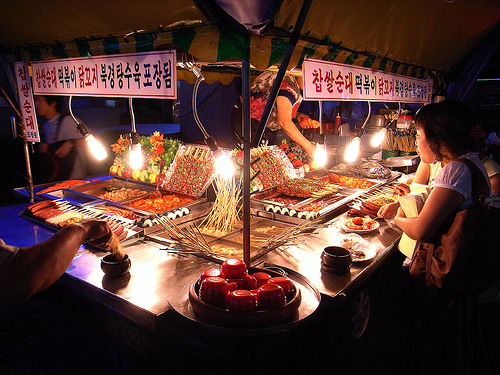
Pojangmacha literally evokes a covered wagon or covered cart. Pocha is the everyday abbreviation. The Academy of Korean Studies describes it as a street business selling simple food and alcohol from a cart, truck, or tented structure. Its modern urban form emerged after liberation, then expanded after the Korean War as displaced people and small vendors made a living through inexpensive, quickly prepared food.
That history explains the physical logic. Older stalls used wooden poles and heavy cloth; later versions shifted toward metal frames, vinyl, tarpaulin, fluorescent lights, and LEDs. The materials changed. The emotional architecture did not. A thin wall separates the table from the weather, and a narrow counter separates the customer from the person making the food.
The menu changed with the city. The encyclopedia records early grilled items, dumplings, noodles, sundae, bindaetteok, seafood, and other foods that could be served in a compact operation. By the 1980s, larger stalls with electricity and water appeared, while indoor bars began borrowing the same red-tent aesthetic. That is why the word “pocha” now describes everything from a literal street cart to a polished franchise bar.
The reverse case is worth knowing before you go looking. Some snacks that feel like street food never appear under a tent at all: delimanjoo, the corn-shaped custard cake, is a station-based franchise founded in 1998, which is why you meet it on a subway staircase rather than at a pojangmacha.
This distinction matters. If an Instagram Reel promises “the most authentic pocha” and sends you to a themed indoor restaurant, it is not necessarily fake. It is simply one branch of the culture. The street version is built around temporary space. The indoor version sells the memory of temporary space—with better heating and usually a bathroom.
Where to Try Pojangmacha in Seoul
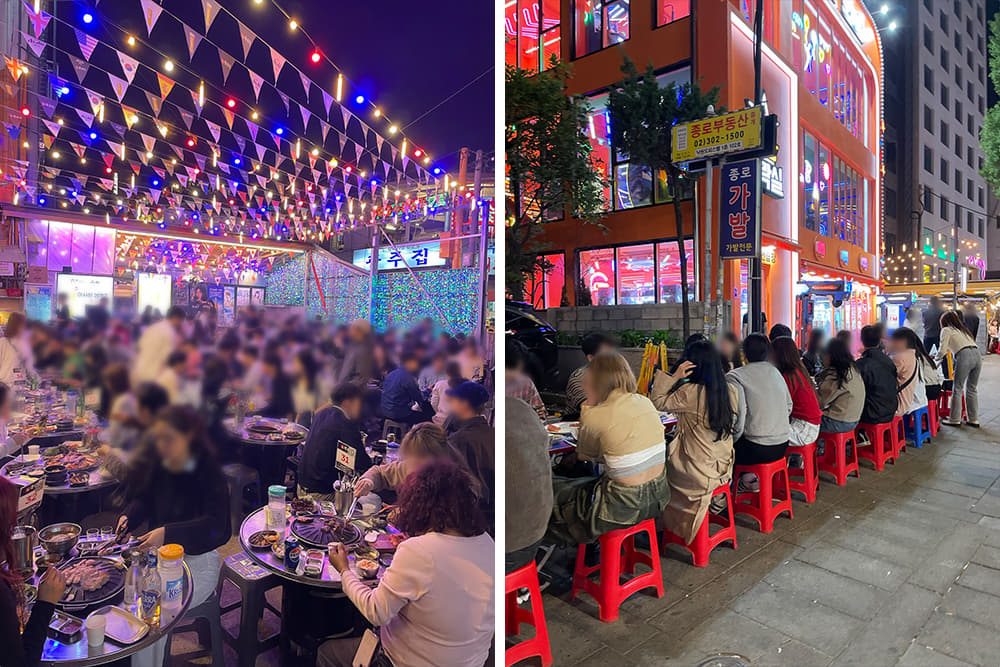
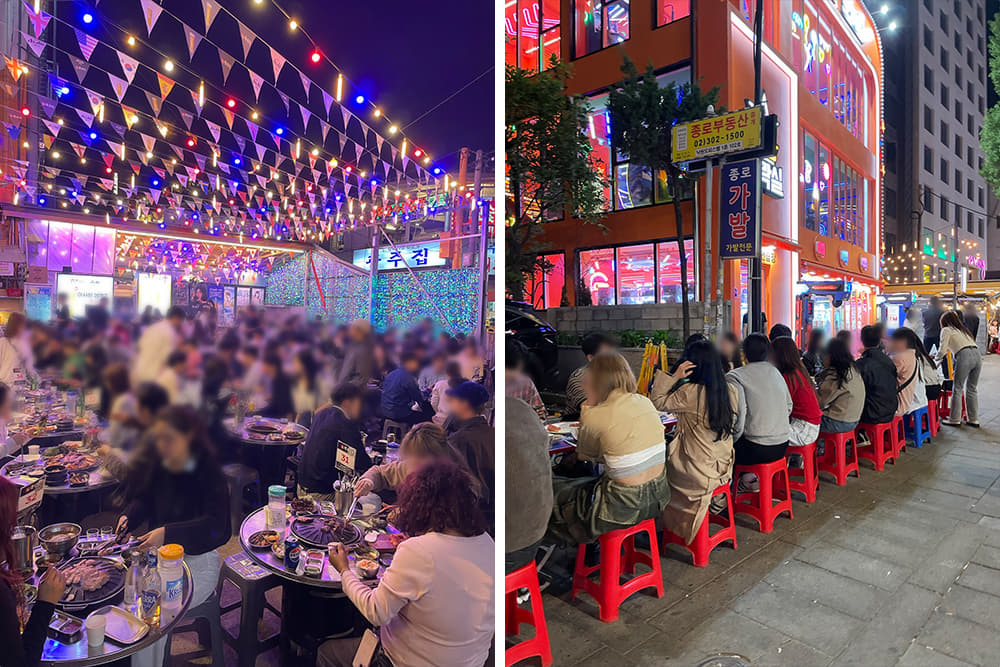
Jongno 3-ga is the clearest first-timer answer. Seoul’s official tourism guide still highlights the area in 2026, describing tents setting up around sunset near Ikseon-dong and serving dishes such as chicken feet, rolled omelet, udon, seafood pancakes, beer, and soju. The visual payoff is immediate: strings of lights, plastic stools, steam, Korean signs, and a crowd that makes the street feel temporarily redesigned around dinner.
Go out of Jongno 3-ga Station (종로3가역) Exit 3 and the red tents are lined up in front of you — that is the whole navigation problem solved.
Budget before you sit down, because the tents are no longer the cheap option they were a decade ago:
| What you order | Korean | Typical price, August 2026 |
|---|---|---|
| A shared dish (안주) | 안주 | around ₩15,000 |
| Soju or beer | 소주 · 맥주 | around ₩5,000 a bottle |
| Two people, one dish and two drinks | — | roughly ₩25,000 |
Jongno 3-ga tent-row averages, checked August 2026. Seafood and set menus run well above this — ask before ordering those.
That ₩15,000 anchor matters for one specific reason. Pojangmacha pricing is not posted the way a restaurant's is, and seafood in particular is where bills escalate. If a stall recommends something without naming a number, ask for the number before nodding.
But do not turn “Jongno 3-ga” into one exact pin. The row can shift with enforcement, weather, construction, operating decisions, and the day of the week. Search in Naver Map or Kakao Map on the day, then walk around the station area. Exact hours and stall availability are not guaranteed.
Other versions appear around markets, transport hubs, nightlife areas, and coastal cities. Haeundae became known for seafood-focused tent bars, although local layouts and operating conditions change. Gwangjang and other markets offer related stall culture, but the experience can be food-market-first rather than the classic late-night drinking tent. An indoor pocha is the sensible fallback on a freezing, stormy, or very humid night.
Choose by mood rather than mythology:
- Go to Jongno when you want a bright social street and an easy Ikseon-dong pairing.
- Choose a market when food matters more than drinking.
- Choose an indoor pocha when your group needs comfort, a larger table, or predictable facilities.
- Choose a seafood tent only when you are comfortable asking prices and understanding what is raw, cooked, seasonal, or sold as a set.
Do not assume a stall has a restroom. Ask before you settle in, especially if the group plans to stay. Do not assume every tent accepts foreign cards. And do not assume “street food” means cheap. A simple bowl can be modest; a seafood platter can become the most expensive decision of your evening.
Pojangmacha Menu and Prices: What to Order Without Panicking
The worst strategy is pointing at the most dramatic plate on someone else’s table before asking what it costs. The better strategy is one warm anchor dish, one shareable side, then more only if the group is still hungry.
| Dish | What It Is | First-Timer Note |
|---|---|---|
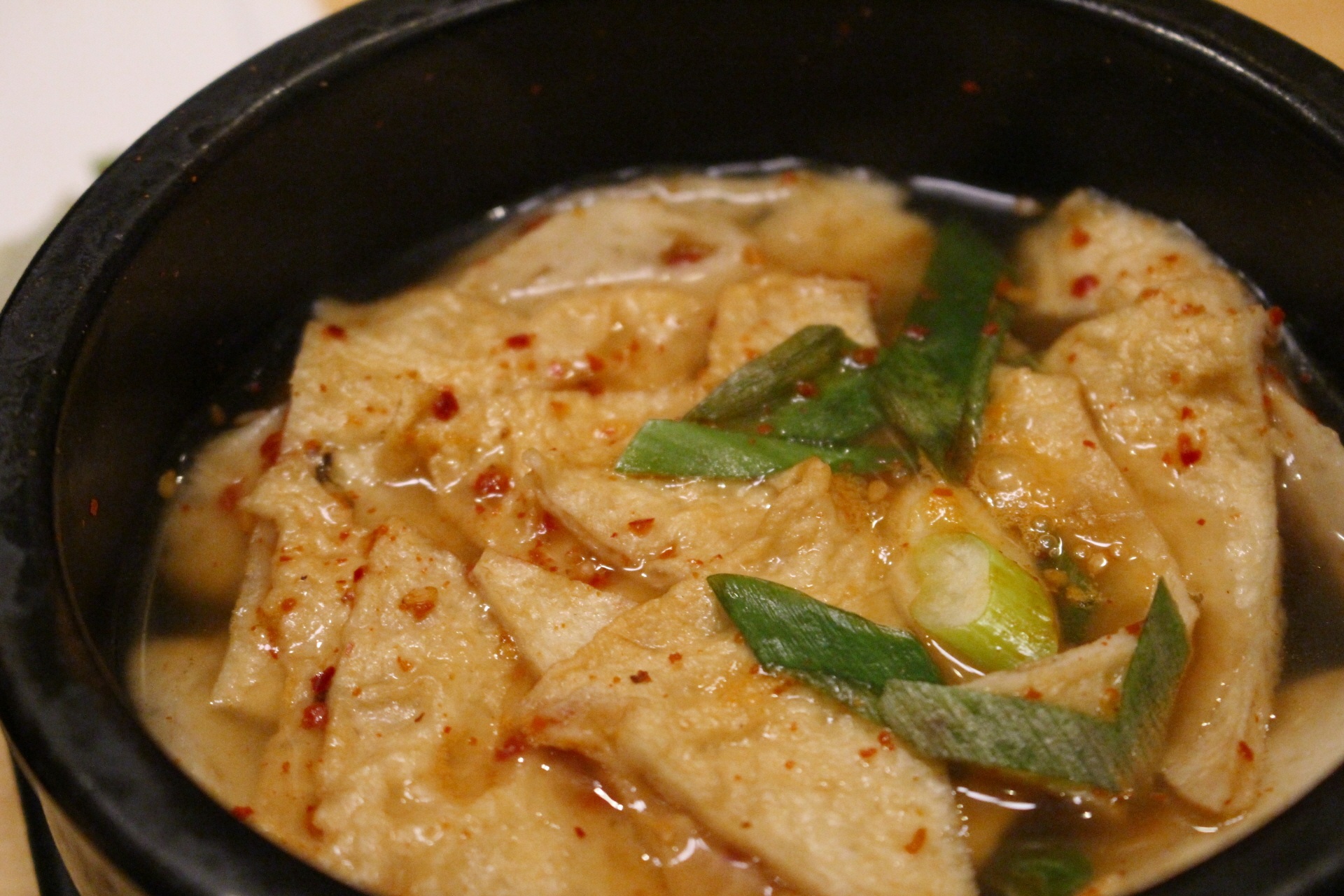
| Eomuk-tang | Fish cakes in hot broth | Warm, shareable, and usually an approachable start |
| Gyeran-mari | Rolled omelet | Mild option beside spicy or salty dishes |
| Pajeon | Savory scallion pancake, sometimes with seafood | Ask about shellfish if allergies matter |
| Udon or ramyeon | Hot noodles | Comforting, but not stocked at every stall |
| Dakbal | Usually spicy chicken feet | Great texture for fans, intimidating for cautious eaters |
| Grilled seafood | Squid, shellfish, fish, or seasonal items | Confirm portion, preparation, and price first |
| Raw seafood | Seasonal sashimi or shellfish offerings | Choose a reputable operation; skip if safety or allergies worry you |
Useful phrases are simple: Igeo eolmayeyo? means “How much is this?” Kadeu dwaeyo? asks whether card payment works. An maepge haejuseyo asks for it not spicy, although a stall may not be able to change a prepared sauce. Translation apps help, but showing the exact menu line is safer than translating an entire speech.
If the menu has no visible prices, ask before ordering. If a seafood set sounds vague, ask what is included. If the host seems too busy to explain and you are uncomfortable, smile, say thank you, and choose another stall. Leaving before ordering is less awkward than arguing after the plate arrives.
Maangchi's Big Book of Korean Cooking — the Korean home-cooking bible, street recipes included If the eomuk-tang, pajeon and tteokbokki are what you remember from the tent, this is the reliable way to make them again at home. As an Amazon Associate, EpicKor earns from qualifying purchases at no extra cost to you.
See Maangchi's Big Book on AmazonThe Etiquette That Makes the Tent Work
Pojangmacha etiquette is mostly space awareness.
Seats are valuable. Do not spread coats, shopping bags, camera gear, and three phones across a table designed for four elbows. Keep your bag between your feet or where the host directs. If a stall is full, do not block the entrance while conducting a group referendum.
Order enough to justify the seats. There is no universal minimum, so read the room and ask. A couple sharing one substantial dish and drinks is different from four people ordering one bottle of water during the busiest hour. When the host brings food, make room immediately; their path is also their kitchen.
Keep photography brief and human. Ask before filming the cook at close range. Avoid capturing other customers’ faces, private conversations, or drunken moments. A tent full of strangers is not public scenery just because the walls are plastic.
You do not need to follow every drinking ritual. If an older companion pours for you, receiving the glass with two hands is polite. If you do not drink, say so normally and move on. Never pressure a friend to finish a shot for “authenticity.” The most Korean thing in the room is not alcohol; it is the shared dish and the adjustment everyone makes to fit around it.
Do not arrive extremely intoxicated. Do not bring outside food without permission. Do not smoke unless it is clearly allowed—and assume it is not if uncertain. Keep late-night volume below the level that turns residents and workers into background characters in your vacation.
Payment, Weather, and Food Safety
Payment is the question to solve before the second round. Traditional unregistered street stalls historically relied heavily on cash, but contemporary operations vary. Some accept Korean cards, some accept transfers that are useless to most visitors, some take cash, and indoor pocha usually operate like regular restaurants. Ask Kadeu dwaeyo? before ordering if cash is a problem. Carrying a small backup amount is practical; carrying a giant stack is unnecessary.
Weather changes the experience. Plastic walls can make winter intimate and summer intense. Rain can be beautiful until water collects near your bag and the last subway requires a ten-minute walk. Check the forecast, dress in layers, and remember that a tent is protection—not climate control.
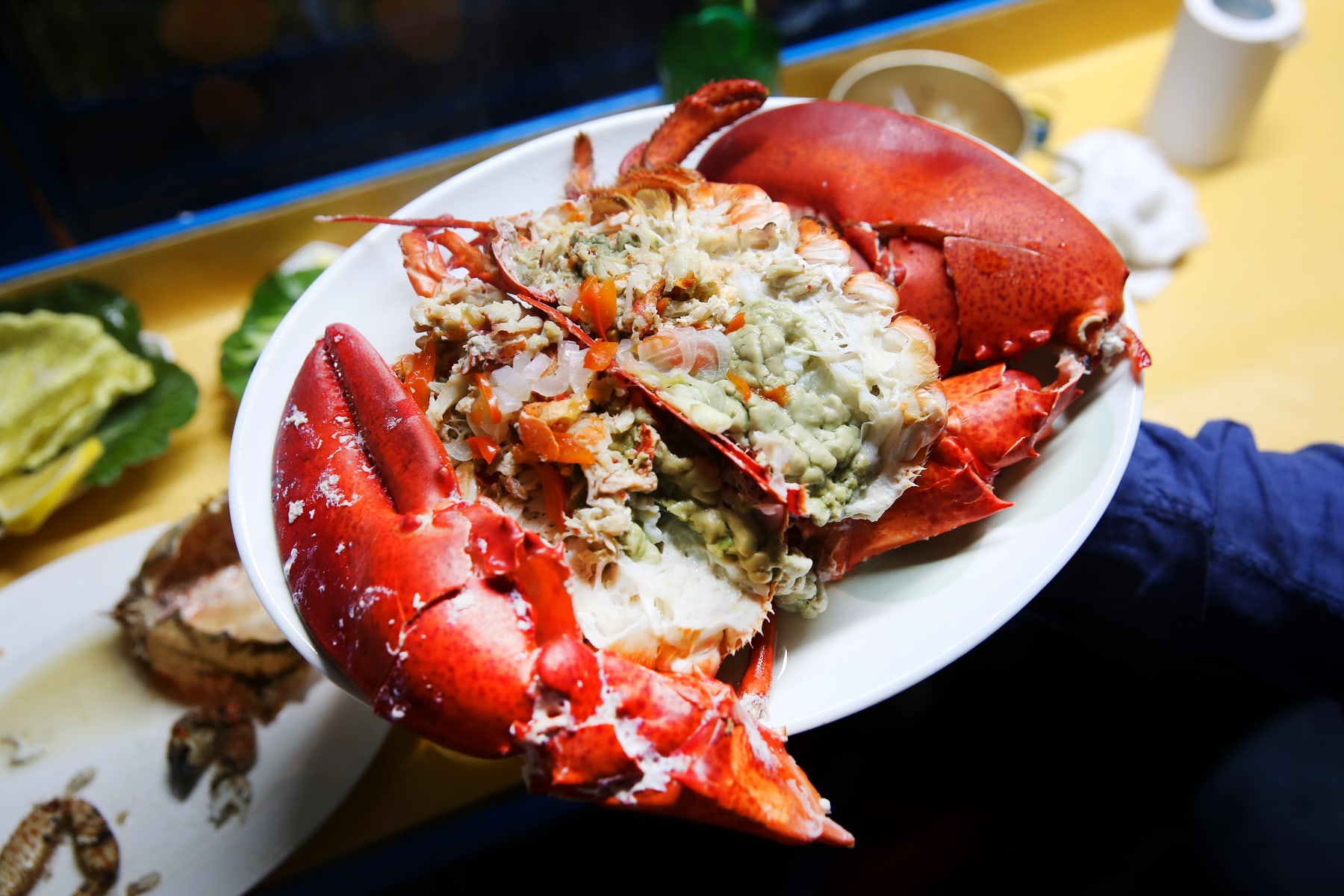
For food safety, use the same judgment you would at any small food operation. Look for active turnover, food kept appropriately hot or cold, a tidy cooking area, and clear handling. People with shellfish allergies should not rely on visual guessing; shared pans, broth, utensils, and grills can create cross-contact. Pregnant travelers, immunocompromised travelers, and anyone uncertain about raw seafood can choose fully cooked dishes without missing the cultural point.
Plan the trip home before drinking. Check subway closing time in the actual app, not an old blog. Use a licensed taxi platform if needed. Stay with friends, keep your phone charged, and never leave a drink unattended. Seoul is convenient, but convenience is not a substitute for judgment.
A Better First Pojangmacha Night
Start in Ikseon-dong or Jongno before sunset. Walk, eat lightly, and let the neighborhood shift from daytime alleys to evening signs. Reach the pojangmacha row before the deepest crowd. Walk once, choose a stall with visible prices or a host willing to explain, and order one soup plus one shareable dish.
Stay for an hour, not until the story collapses. Pay, thank the host, take a short Cheonggyecheon walk if the weather is good, and head home while the route is still easy. The goal is not to reproduce a television confession scene. It is to understand why a temporary room can feel so complete.
If the table includes coworkers or several rounds, use EpicKor's updated Korean hoesik, drinking-choice, and safe-return guide to separate real etiquette from forced shots and the myth that everyone must continue to a second venue.
The best moment may be smaller than expected: the host cuts something with kitchen scissors, pushes the plate toward you, and says one word you understand—meogeoyo, eat. Outside, Seoul is still performing speed and scale. Inside, everyone has agreed to fit into six square meters.
You might like: What Time Do Restaurants Close in Korea? Closing Times, Break Time, Last Order and Monday Closures
You might like: 18.9 Million Visitors Told Korea What They Couldn't Find: The Official Exit Survey, and the Answers to All Four Gaps
FAQ About Korean Pojangmacha
Q: What is a Korean pojangmacha?
A pojangmacha is a covered street cart, stall, truck, or tent serving simple food and often alcohol. “Pocha” is the common shortened term, and it can also describe indoor bars inspired by the street-tent atmosphere.
Q: Where is the best pojangmacha area in Seoul for tourists?
Jongno 3-ga is the clearest first-time option because it has a visible cluster, central transit, and nearby Ikseon-dong. Exact stall locations and operating conditions change, so verify the area on Naver Map or Kakao Map the same day.
Q: Are Seoul pojangmacha cash-only?
Not all of them, but payment varies. Ask whether cards are accepted before ordering and carry a modest amount of backup cash. Indoor pocha are generally more predictable than temporary street stalls.
Q: Do I have to drink alcohol at a pocha?
No. Order food and a nonalcoholic drink if available. A good host cares more about a clear order and respectful table than whether you finish soju.
Q: Is pojangmacha food cheap?
Simple snacks and soups can be affordable, but seafood and set menus can cost much more. Check the displayed price or ask before ordering, especially for seasonal seafood.
Q: Is pojangmacha safe for solo travelers?
It can be, particularly early in the evening, but use normal nightlife judgment. Choose a busy, well-lit operation, watch your drink and belongings, limit alcohol, and plan your route home in advance.
Sources
You Might Also Like
Pojangmacha Guide: Korean Street Tent Food and Etiquette
A practical guide to Korean pojangmacha street tents, including what to order, how to drink politely, prices, etiquette, safety, and Seoul areas.
Cham Bungeoppang: The Korean Fish Snack That Is Four Different Fish Abroad
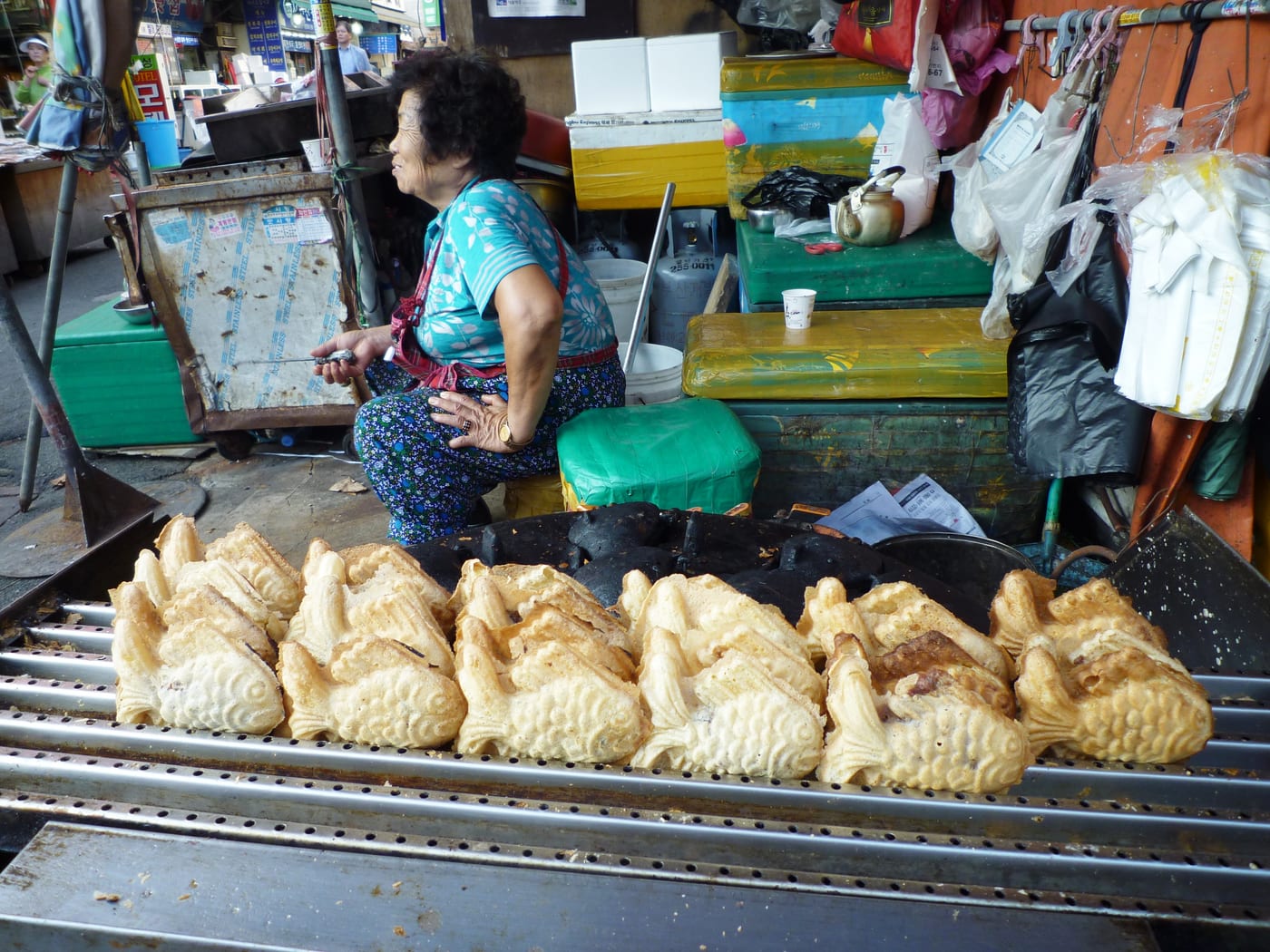
붕어빵 is a winter street food you have to find a cart for. Orion boxed it in 2011, released it in May on purpose, and sold 640 million packs — then renamed it after a different fish in China, Vietnam and Russia.
Tornado Potato: The Korean Invention Everybody Thinks Is Generic Fair Food
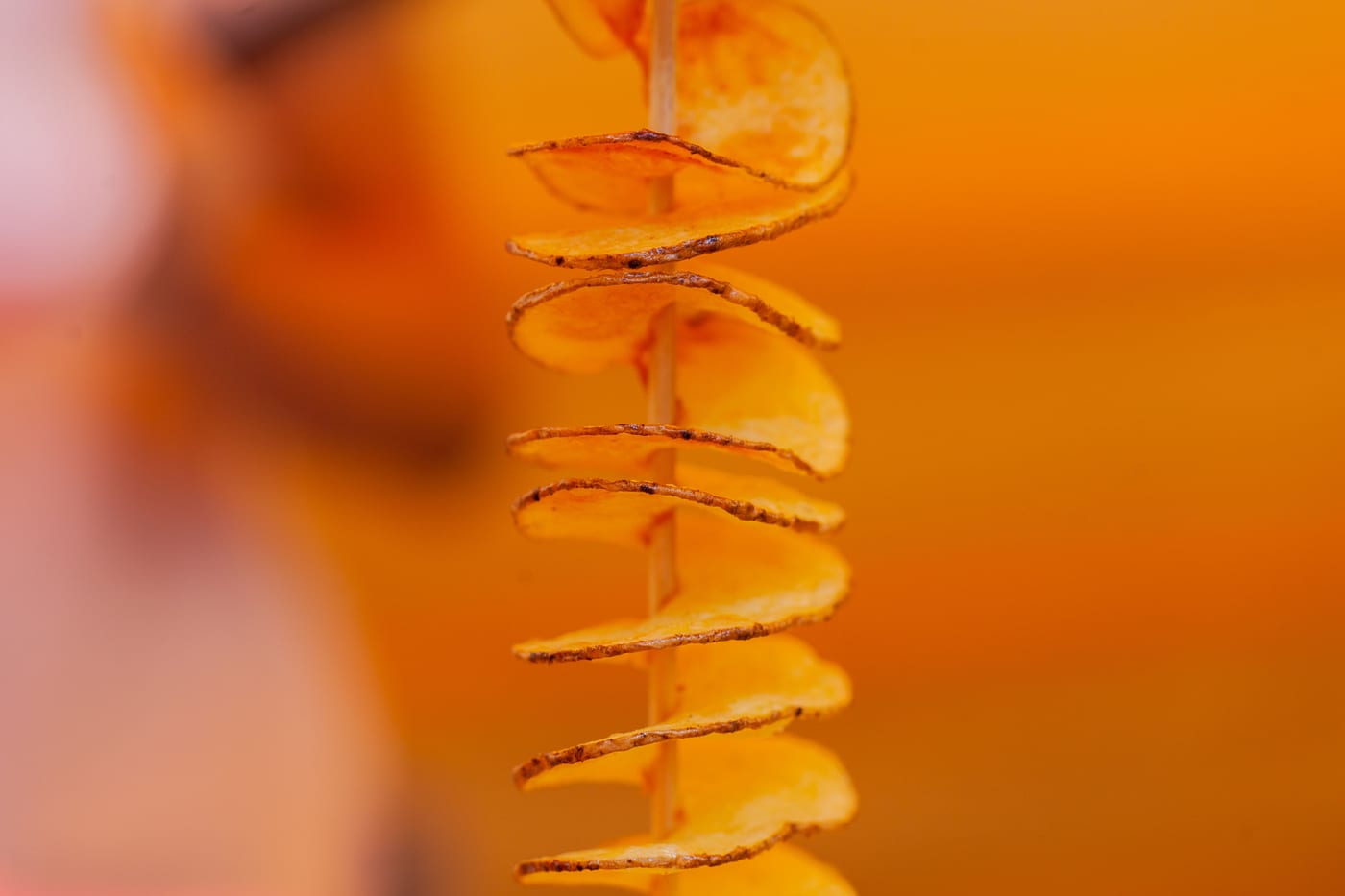
The spiral potato on a stick has a named inventor, a debut date in Myeongdong, and patents in six jurisdictions. 회오리감자 was designed in Korea in 2006, and the word itself is a trademark — which is why Korean vendors write 스프링감자 instead.